


Jeremiah 22:3
Bible text: King James Version (1769 Blayney text) · Public domain
Bible text: King James Version with Strong's numbers · Public domain
Bible text: Berean Standard Bible · Public domain
Bible text: American Standard Version (1901) · Public domain
Bible text: World English Bible, Messianic edition · Public domain
Bible text: Geneva Bible (1599) · Public domain
Bible text: Young's Literal Translation · Public domain
- כֹּהkohthusH3541AdvAdverb
- אָמַר'a·Marhe saysH559V-Qal-Perf-3msVerb Qal Perfect 3rd Singular Masculine
- יְהוָהYah·wehYahwehH3068N-properNoun Proper Title
- עֲשׂוּ'a·SudoH6213V-Qal-Imp-2mpVerb Qal Imperative 2nd Plural Masculine
- מִשְׁפָּטmish·PatjusticeH4941N-msNoun Singular Masculine Absolute
- וּצְדָקָהu·tze·da·Kahand righteousnessH6666Conj-w ¦ N-fsNoun Singular Feminine Absoluteוּandצְדָקָהrighteousness
- וְהַצִּילוּve·ha·Tzi·luand deliverH5337Conj-w ¦ V-Hiphil-Imp-2mpVerb Hiphil Imperative 2nd Plural Masculineוְandהַצִּילוּdeliver
- גָזוּלga·Zul[one who] has been robbedH1497V-Qal-PassPrtcpl-msVerb Qal Participle Passive Singular Masculine Absolute
- מִיַּדmi·Yadfrom [the] hand ofH3027Prep-m ¦ N-cscNoun Singular common gender Constructמִfromיַּד[the] hand of
- עָשׁוֹקa·Shokan oppressorH6216N-msNoun Singular Masculine Absolute
- וְגֵרve·Gerand sojournerH1616Conj-w ¦ N-msNoun Singular Masculine Absoluteוְandגֵרsojourner
- יָתוֹםya·TomfatherlessH3490N-msNoun Singular Masculine Absolute
- וְאַלְמָנָהve·'al·ma·Nahand widowH490Conj-w ¦ N-fsNoun Singular Feminine Absoluteוְandאַלְמָנָהwidow
- אַל'almay notH408NegParticle Negative
- תֹּנוּto·Nuyou maltreatH3238V-Hiphil-Imperf-2mpVerb Hiphil Imperfect 2nd Plural Masculine
- אַל'almay notH408NegParticle Negative
- תַּחְמֹסוּtach·Mo·suyou treat violentlyH2554V-Qal-Imperf-2mpVerb Qal Imperfect 2nd Plural Masculine
- וְדָםve·Damand bloodH1818Conj-w ¦ N-msNoun Singular Masculine Absoluteוְandדָםblood
- נָקִיna·KiinnocentH5355Adj-msAdjective Singular Masculine Absolute
- אַל'almay notH408NegParticle Negative
- תִּשְׁפְּכוּtish·pe·Khuyou shedH8210V-Qal-Imperf-2mpVerb Qal Imperfect 2nd Plural Masculine
- בַּמָּקוֹםba·ma·Komin the placeH4725Prep-b ¦ N-msNoun Singular Masculine Absoluteבַּin theמָּקוֹםplace
- הַזֶּהha·Zeh<the> thisH2088Art ¦ PrtParticle Demonstrativeהַ<the>זֶּהthis
English is a literal word-by-word gloss of the Hebrew, not the KJV's wording. Why?
This is the original text the KJV's translators worked from — each Hebrew word with its own literal English meaning in this verse, prepared by scholars at Tyndale House, Cambridge. The KJV translates whole sentences, not word by word, so its wording differs: one Hebrew word can become several English words, and the KJV may choose “the LORD” where the gloss reads “Yahweh”. Both are faithful — they answer different questions. For the KJV's own rendering, switch to the KJV text.
Details
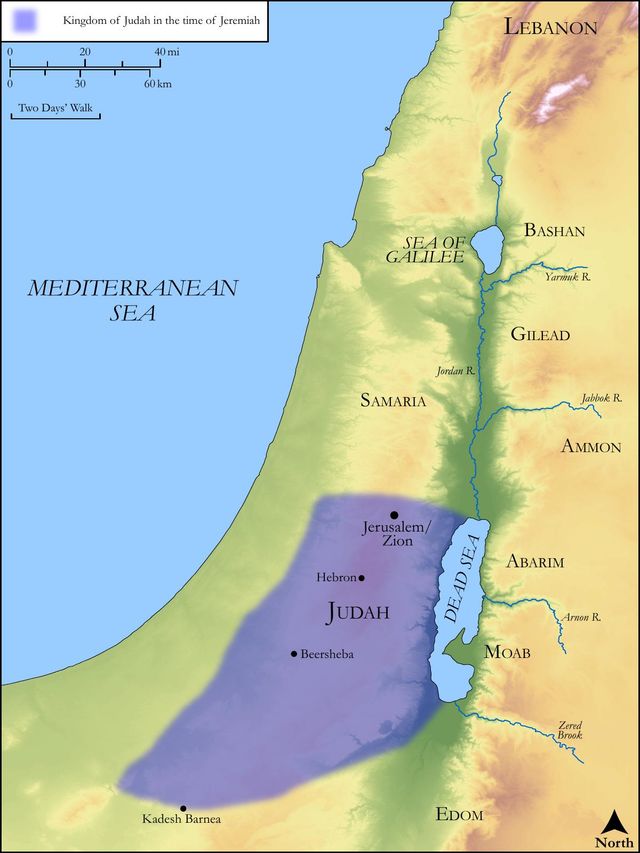
See on the biblical-era map
Study this verse
Public-domain commentary
Matthew Henry
From his Commentary on the Whole Bible. Henry comments on passages, not single verses — this entry covers Jeremiah 22:1–9. His four-level outline is real structure in the source text, so it is rendered as structure.
Here we have,
I.Orders given to Jeremiah to go and preach before the king.
In the foregoing chapter we are told that Zedekiah sent messengers to the prophet, but here the prophet is bidden to go, in his own proper person, to the house of the king, and demand his attention to the word of the King of kings (Jer 22:2): Hear the word of the Lord, O king of Judah! Subjects must own that where the word of the king is there is power over them, but kings must own that where the word of the Lord is there is power over them. The king of Judah is here spoken to as sitting upon the throne of David, who was a man after God's own heart, as holding his dignity and power by the covenant made with David; let him therefore conform to his example, that he may have the benefit of the promises made to him. With the king his servants are spoken to, because a good government depends upon a good ministry as well as a good king.
II.Instructions given him what to preach.
1.He must tell them what was their duty, what was the good which the Lord their God required of them, Jer 22:3. They must take care,
(1.)That they do all the good they can with the power they have. They must do justice in defence of those that were injured, and must deliver the spoiled out of the hand of their oppressors. This was the duty of their place, Psa 82:3. Herein they must be ministers of God for good.
(2.)That they do no hurt with it, no wrong, no violence. That is the greatest wrong and violence which is done under colour of law and justice, and by those whose business it is to punish and protect from wrong and violence. They must do no wrong to the stranger, fatherless, and widow; for these God does in a particular matter patronise and take under his tuition, Exo 22:21, Exo 22:22.
2.He must assure them that the faithful discharge of their duty would advance and secure their prosperity, Jer 22:4. There shall then be a succession of kings, an uninterrupted succession, upon the throne of David and of his line, these enjoying a perfect tranquillity, and living in great state and dignity, riding in chariots and on horses, as before, Jer 17:25. Note, the most effectual way to preserve the dignity of the government is to do the duty of it.
3.He must likewise assure them that the iniquity of their family, if they persisted in it, would be the ruin of their family, though it was a royal family (Jer 22:5): If you will not hear, will not obey, this house shall become a desolation, the palace of the kings of Judah shall fare no better than other habitations in Jerusalem. Sin has often been the ruin of royal palaces, though ever so stately, ever so strong. This sentence is ratified by an oath: I swear by myself (and God can swear by no greater, Heb 6:13) that this house shall be laid in ruins. Note, Sin will be the ruin of the houses of princes as well as of mean men.
4.He must show how fatal their wickedness would be to their kingdom as well as to themselves, to Jerusalem especially, the royal city, Jer 22:6-9.
(1.)It is confessed that Judah and Jerusalem had been valuable in God's eyes and considerable in their own: thou art Gilead unto me and the head of Lebanon. Their lot was cast in a place that was rich and pleasant as Gilead; Zion was a stronghold, as stately as Lebanon: this they trusted to as their security. But,
(2.)This shall not protect them; the country that is now fruitful as Gilead shall be made a wilderness. The cities that are now strong as Lebanon shall be cities not inhabited; and, when the country is laid waste, the cities must be dispeopled. See how easily God's judgments can ruin a nation, and how certainly sin will do it. When this desolating work is to be done,
[1.]There shall be those that shall do it effectually (Jer 22:7): "I will prepare destroyers against thee; I will sanctify them" (so the word is); "I will appoint them to this service and use them in it." Note, When destruction is designed destroyers are prepared, and perhaps are in the preparing, and things are working towards the designed destruction, and are getting ready for it, long before. And who can contend with destroyers of God's preparing? They shall destroy cities as easily as men fell trees in a forest: They shall cut down thy choice cedars; and yet, when they are down, shall value them no more than thorns and briers; they shall cast them into the fire, for their choicest cedars have become rotten ones and good for nothing else.
[2.]There shall be those who shall be ready to justify God in the doing of it (Jer 22:8, Jer 22:9); persons of many nations, when they pass by the ruins of this city in their travels, will ask, "Wherefore hath the Lord done thus unto this city? How came so strong a city to be overpowered? so rich a city to be impoverished? so populous a city to be depopulated? so holy a city to be profaned? and a city that had been so dear to God to be abandoned by him?" The reason is so obvious that it shall be ready in every man's mouth. Ask those that go by the way, Job 21:29. Ask the next man you meet, and he will tell you it was because they changed their gods, which other nations never used to do. They forsook the covenant of Jehovah their own God, revolted from their allegiance to him and from the duty which their covenant with him bound them to, and they worshipped other gods and served them, in contempt of him; and therefore he gave them up to this destruction. Note, God never casts any off until they first cast him off. "Go," says God to the prophet, "and preach this to the royal family."
Historical interpretation
Historical reception
1 surviving comment on this verse from the historical church.
(Chapter XXII - Verses 1 onwards) Thus says the Lord: Go down to the house of the king of Judah, and speak there this word, and say, Hear the word of the Lord, O king of Judah, who sits on the throne of David, you and your servants and your people who enter by these gates. Thus says the Lord, Do justice and righteousness, and deliver the one who has been robbed from the hand of his oppressor. And do not mistreat or do violence to the stranger, the orphan, or the widow, nor shed innocent blood in this place. For if you do this word, then the kings sitting upon the throne of David will enter in by the gates of this house, riding in chariots and on horses, they, and their servants, and their people. But if you will not hear these words, I swear by myself, saith the Lord, that this house shall become a desolation. This vision, or rather this word of the Lord, either happened before the messengers of Sedecias were sent to him, or certainly after they were sent, and before they returned again, Jeremiah is commanded, that he should not speak to the king by messengers, but that he himself should go into the house of the king, and there speak to him. At the same time, we notice the divine wisdom, that through messengers he commands sad news to be announced, mixed with good news, if the king will repent. However, because he is commanded himself to move forward, he does not announce sad news, and the impending captivity; but he warns what he should do to avoid the impending judgment of God. But it is the duty of kings to administer judgment and justice, and to deliver those oppressed by the violence of slanderers, and to provide assistance to foreigners, orphans, and widows (who are more easily oppressed by the powerful). And in order to impose a greater care of the commandments of God upon them, he said: Do not be distressed, so that you not only do not rescue, but also do not even allow others to be distressed through your connivance. And do not shed innocent blood in this place. For punishing murderers, sacrilegious, and poisoners is not the shedding of blood, but the ministry of the laws. If you do these things, O kings of Judah, you will maintain your former power, and you will enter the gates of Jerusalem with ambition. But if you refuse to do so, O royal household, the cruelty will not be so much of the Lord as it will be of your will, so that the whole city will be reduced to desolation. Let the bishops, along with their associates the presbyters and deacons, and all the ecclesiastical order, understand whatever has been said to the royal household, so that if they do what has been commanded and, among other things, do not shed innocent blood, causing offense to the least of these and striking the consciences of each individual, they may obtain the dignity entrusted to them by the Lord. But if they refuse and despise, let them themselves reduce the Church of God to solitude. And they enter by the gates of Jerusalem from the lineage of David, and they sit upon his throne, which is interpreted as strong by hand, and they ascend in chariots and horses, when they restrain both their own and the disturbances of the people, and in an orderly manner they enter the Church, with the chorus of many virtues, and singing in harmony from every side. And to believe that this is true, he swears by himself, because, according to the Apostle, he has no one greater by whom he may swear (Heb. VI).
Continue studying Jeremiah 22:3 across the web’s major study libraries — every link below opens this exact verse, chapter, or book on the destination site.
Read & Compare
 BibleGatewayThis verse in more than 200 translations and 70 languages.
 Bible.comThe YouVersion reader — hundreds of translations, reading plans, and highlights.
 ESV.orgCrossway's official English Standard Version reader.
 NET BibleThe NET translation with 60,000+ translators' notes on every rendering decision.
 STEP BibleTyndale House's free study tool — original text, vocabulary, and scholarly resources.
 BibliaLogos Bible Software's free web reader.
 USCCBThe New American Bible (Revised Edition) with the U.S. bishops' study notes.
Commentaries
 BibleHub CommentariesDozens of classic commentaries on this verse, gathered on one page.
 StudyLightMore than 100 commentary sets — the largest collection on the web.
 BibleRefPlain-English commentary on what this verse means, verse by verse.
 Enduring WordDavid Guzik's free commentary on this chapter, widely used by Bible teachers.
 Bible Study ToolsVerse commentary alongside Greek and Hebrew study aids.
Original Language & Research
- BibleHub InterlinearThe verse word by word — original language, transliteration, and English.
- BibleHub LexiconEvery word's original-language definition and Strong's entry.
 Blue Letter BibleDeep-study tools — Strong's numbers, concordance, and word studies.
 SefariaThe Hebrew text with Rashi and centuries of Jewish commentary.
Sermons, Hymns & Audio


TrulyRandomVerse is not affiliated with these sites and doesn’t control their content. They’re linked because they’re genuinely useful.
Summary
Jeremiah 22:3 presents a profound divine injunction from the LORD to the leaders and people of Judah, emphatically calling them to uphold the foundational principles of justice, righteousness, and compassion. This prophetic declaration demands active intervention to protect those who have been exploited, the stranger, the fatherless, and the widow, from oppression and harm. Furthermore, it strictly prohibits all forms of wrongdoing, violence, and the shedding of innocent blood, asserting that diligent adherence to these ethical and moral standards is absolutely paramount for the nation's well-being, stability, and continued existence in the land God has graciously given them.
Context
ShowHideLiterary Context
Jeremiah 22:3 is strategically positioned within a series of prophetic oracles known as the "Palace Sermon" (Jeremiah 21:11-23:8), primarily directed at the kings of Judah and their royal court. This specific verse functions as a concise, yet comprehensive, summary of the divine expectations for righteous governance. It immediately follows the LORD's conditional promise of blessing or judgment to the "house of David," contingent upon their commitment to "execute judgment in the morning, and deliver the spoiled out of the hand of the oppressor" Jeremiah 21:12. The verse then serves as a critical moral benchmark, preceding a lament over the unrighteous and exploitative reign of King Jehoiakim Jeremiah 22:13-19 and the pronouncement of judgment on King Jehoiachin Jeremiah 22:24-30. Thus, Jeremiah 22:3 highlights the stark contrast between God's ideal for leadership and the pervasive moral failures prevalent in the royal court, which ultimately contributed to Judah's impending Babylonian exile.
Historical & Cultural Context
The historical setting for Jeremiah 22:3 is the tumultuous late 7th and early 6th centuries BCE, a period marked by the decline of the Assyrian Empire and the ascendance of the Neo-Babylonian Empire. Judah, caught between these shifting imperial powers, faced immense external pressure alongside severe internal decay. The kings reigning during this time, particularly Jehoiakim (609-598 BCE), were notorious for their self-serving policies, disregard for the Mosaic Law, and oppressive practices towards their own people. They built lavish palaces through forced labor and withheld wages, directly contravening prophetic warnings. The "place" mentioned in the verse refers to Jerusalem and the land of Judah, underscoring that even in the very heart of their sacred and political life, injustice was rampant. Culturally, the emphasis on protecting the "stranger, the fatherless, and the widow" resonates deeply with Israel's unique covenantal obligations, for the law of Moses commanded, "Ye shall not afflict any widow, or fatherless child." These groups were consistently identified in the Torah as particularly vulnerable and dependent on the community's compassion and the ruler's justice (e.g., Deuteronomy 24:17-22).
Key Themes
ShowHideJeremiah 22:3 encapsulates several foundational themes central to the book of Jeremiah and the broader prophetic corpus. Firstly, it underscores the Divine Mandate for Justice and Righteousness, asserting that true leadership and national prosperity are contingent upon ethical governance and adherence to God's moral standards. This theme is pervasive throughout the prophets, emphasizing that genuine worship is inextricably linked to fairness and the pursuit of what is right, as articulated in passages like Amos 5:24. Secondly, the verse highlights God's profound Concern for the Vulnerable and Oppressed, explicitly naming the "spoiled," "stranger," "fatherless," and "widow." This reflects God's unchanging character as a defender of the weak and a champion of justice, a principle deeply embedded in the Mosaic Law and reinforced throughout Israel's history, as seen in Exodus 22:21-22. Finally, the stern prohibition against "wrong," "violence," and "shedding innocent blood" emphasizes the Sanctity of Human Life and Ethical Conduct. This denounces the rampant corruption, exploitation, and even child sacrifice that marked Judah's decline, reminding the people that such actions defile the land and invite severe divine judgment, echoing the foundational covenant principles established in Genesis 9:6.
Exposition and Analysis
ShowHideKey Word Analysis
ShowHideThis term (H4941) is more expansive than a mere legal verdict or a court ruling. It encompasses the entire concept of righteous living, justice, and proper governance in all aspects of society according to God's standards. It refers to the act of administering justice, the right or privilege of an individual (whether statutory or customary), and the broader societal order established by divine law. In this context, it demands the active and diligent implementation of fairness, equity, and moral rectitude.
Derived from the primitive root (H1497), meaning "to pluck off; specifically to flay, strip or rob," this word describes that which has been taken by violence, robbery, or forceful seizure. The command to "deliver the spoiled" underscores the imperative for rulers and people alike to actively intervene, restore what has been unjustly taken, and protect victims of exploitation and forceful seizure, rescuing them from the grasp of their oppressors.
This word (H5355) denotes blamelessness, guiltlessness, or being free from fault or legal culpability. When coupled with "blood" (H1818, dâm), it specifically refers to the shedding of life without just cause or legal justification. Such an act is considered a heinous sin in biblical law, profoundly defiling the land and provoking divine wrath and retribution, as life itself is sacred and belongs to God.
Verse Breakdown
ShowHide"Thus saith the LORD; Execute ye judgment and righteousness"
This opening phrase establishes the absolute divine authority behind the command, emphasizing that the call for justice and moral integrity is not a human suggestion but a direct, non-negotiable mandate from Yahweh (H3068), the sovereign God. The imperative "Execute" (H6213, ʻâsâh) demands active implementation, diligent practice, and consistent upholding of fairness (mishpâṭ, H4941) and moral rectitude (tsᵉdâqâh, H6666) in all spheres of life, particularly by those in positions of authority. It is a call to embody God's character in governance.
"and deliver the spoiled out of the hand of the oppressor"
This clause moves from general principles to specific, proactive action. It demands intervention on behalf of victims—those who have been robbed, defrauded, or exploited (H1497, gâzal). The "hand" (H3027, yâd) of the "oppressor" (H6216, ʻâshôwq) signifies the power, control, and coercive force wielded by those who unjustly afflict others. The command to "deliver" (H5337, nâtsal) is to rescue, liberate, and restore the victims from their oppressive grasp.
"and do no wrong, do no violence to the stranger, the fatherless, nor the widow"
This section provides explicit prohibitions, highlighting the most vulnerable and often exploited groups in ancient Israelite society. "Wrong" (from yânâh, H3238) implies vexing, harassing, defrauding, or oppressing. "Violence" (from châmaç, H2554) denotes active maltreatment, aggression, or oppressive force. The "stranger" (H1616, gêr, foreigner/sojourner), the "fatherless" (H3490, yâthôwm, orphan), and the "widow" (H490, ʼalmânâh) were socio-economically dependent and often lacked traditional familial or legal recourse, making their protection a crucial indicator of a truly righteous and God-fearing society.
"neither shed innocent blood in this place."
This final prohibition addresses the most egregious violation of human life and divine law. "Innocent blood" (H5355, nâqîy + H1818, dâm) refers to the taking of a blameless life, whether through murder, judicial corruption, or even abhorrent practices like child sacrifice. The phrase "in this place" (H4725, mâqôwm, referring to Jerusalem and the land of Judah) underscores the severity of such acts occurring within the very land consecrated to God, indicating a profound defilement that inevitably leads to divine judgment.
Literary Devices
ShowHideJeremiah 22:3 employs several powerful literary devices to convey its urgent and authoritative message, enhancing its impact and memorability. The most prominent is Direct Address, as the LORD speaks directly to the king and people, lending immediate divine authority and solemn gravity to the commands ("Thus saith the LORD; Execute ye... do no wrong..."). The verse's structure utilizes striking Parallelism, contrasting positive commands ("Execute ye judgment and righteousness," "deliver the spoiled") with equally emphatic negative prohibitions ("do no wrong, do no violence," "neither shed innocent blood"). This serves to reinforce the comprehensive and absolute nature of God's expectations for ethical conduct, covering both active good and the avoidance of evil. The repeated enumeration of vulnerable categories—"the stranger, the fatherless, nor the widow"—is a form of Merism or Synecdoche, where specific examples represent the entire class of overlooked and unprotected individuals. This highlights God's particular and unwavering concern for those without social power or traditional means of defense, making the divine mandate profoundly personal and practical. Finally, the phrase "shed innocent blood" is a stark Metonymy, where "blood" stands for the life itself, emphasizing the ultimate and irreversible violation of human dignity and God's sacred law.
Theological and Thematic Connections
ShowHideJeremiah 22:3 articulates a core theological principle: God's character is intrinsically linked to justice and righteousness, and He demands that His people, especially their leaders, reflect this character in their governance and societal interactions. This verse underscores the covenantal expectation that Israel's well-being in the land was conditional upon their obedience to God's moral law, particularly in their treatment of the vulnerable. The failure to uphold justice and protect the lowly was not merely a social failing but a profound theological rebellion against the very nature of Yahweh, leading to national judgment. It reveals that true worship and faithfulness are expressed not only through ritual and sacrifice but, fundamentally, through ethical conduct and compassionate action towards one's neighbor, echoing the prophetic emphasis on "doing justice and loving kindness." The divine mandate here is a powerful reminder that justice is not an optional add-on to faith but an essential expression of it.
Reflection and Application
ShowHideJeremiah 22:3 transcends its ancient context to offer timeless principles for personal and societal living, serving as a profound call to ethical action that resonates deeply today. For individuals, it compels us to examine our own lives: Do we actively seek justice in our spheres of influence, whether in our workplaces, neighborhoods, or families? Are we passive observers of injustice, or do we actively work to "deliver the spoiled" from the "hand of the oppressor" in our communities and beyond? This verse challenges us to cultivate a heart sensitive to the plight of the lowly—the modern "stranger" (the foreigner far from home), the "fatherless" (orphans, neglected children), and the "widow" (single parents, the elderly, the forgotten, those without traditional support systems). It demands that we not only refrain from direct harm but also actively resist attitudes that feed injustice, violence, and the devaluation of human life. For leaders, whether in government, business, or the church, it serves as a sobering reminder of their divine accountability to govern with integrity, prioritize the common good, and protect the rights and dignity of all, especially the most vulnerable. Our faithfulness to God is inextricably linked to our commitment to justice and compassion in the world, reflecting His own character.
Questions for Reflection
ShowHideFAQ
ShowHideWhy does God specifically mention the "stranger, the fatherless, nor the widow" so often in the Old Testament?
ShowHideGod's consistent emphasis on the "stranger, the fatherless, and the widow" (e.g., Deuteronomy 24:19-21) highlights His profound concern for the most vulnerable members of society. In ancient Israel, these groups were often without traditional familial or social structures for support and protection. The stranger (or sojourner) lacked tribal land rights and kinship networks, the fatherless (orphan) was deprived of a primary male protector and provider, and the widow had lost her husband, who was typically her economic and social security. By commanding His people to care for them, God was establishing a moral imperative that reflected His own character as a defender of the weak and a provider for the needy. It was a litmus test of true righteousness and faithfulness to the covenant, demonstrating that genuine worship extended beyond ritual to practical compassion and justice, ensuring the well-being of the entire community.
What does "shed innocent blood" imply beyond literal murder?
ShowHideWhile "shed innocent blood" (as seen in Genesis 9:6) certainly encompasses literal murder, its broader implication in prophetic literature often extends to pervasive injustices that lead to the destruction or oppression of blameless lives. This could include judicial corruption where the innocent are condemned, exploitation that leads to the slow death of the poor, or even the spiritual violence of idolatry that demands human sacrifice (e.g., Jeremiah 19:4-5). In Jeremiah's context, it likely referred to the unjust executions ordered by tyrannical kings like Jehoiakim (as hinted in Jeremiah 22:17), as well as the broader societal disregard for life that manifested in various forms of violence and exploitation. It speaks to any action or inaction that unjustly diminishes or takes human life, which is sacred because humanity is created in God's image.
Christ-Centered Fulfillment
ShowHideJeremiah 22:3, with its impassioned call for judgment, righteousness, and the protection of the vulnerable, finds its ultimate and perfect fulfillment in Jesus Christ. While the Old Testament kings consistently failed to "execute judgment and righteousness" and often became the very "oppressors" against whom God warned, Jesus perfectly embodied divine justice and compassion. He did not merely command justice; He is justice, the righteous King whose reign is characterized by perfect equity and peace (Isaiah 9:7). Moreover, Jesus actively "delivered the spoiled" and ministered to the lowly, identifying with the "stranger," "fatherless," and "widow" in a profound way. His earthly ministry was consistently directed towards the sick, the poor, the outcast, and the oppressed, declaring good news to them and setting the captives free (Luke 4:18-19). He condemned those religious leaders who "devour widows' houses" (Mark 12:40) and taught that true righteousness involves caring for "the least of these" among His brethren (Matthew 25:40). Most significantly, Jesus, the truly "innocent" one, allowed His "blood" to be "shed" on the cross, not as an act of injustice against Him, but as the ultimate act of redemptive justice for humanity's sin (1 Peter 1:18-19). Through His sacrifice, He delivers us from the hand of the ultimate oppressor, sin and death (Colossians 1:13-14), and establishes a new covenant where true righteousness is imputed to believers and cultivated by the Holy Spirit, empowering His followers to continue His work of justice and compassion in the world until His kingdom comes in its fullness (Matthew 6:10).