


Mark 12:40
- οἱhoithoseG3588T-NPMDefinite article Nominative Plural Masculine
- κατεσθίοντεςkatesthiontesdevouringG2719V-PAP-NPMVerb Present Active Participle Nominative Plural Masculine
- τὰςtastheG3588T-APFDefinite article Accusative Plural Feminine
- οἰκίαςoikiashousesG3614N-APFNoun Accusative Plural Feminine
- τῶνtōnof theG3588T-GPFDefinite article Genitive Plural Feminine
- χηρῶνchērōnwidowsG5503N-GPFNoun Genitive Plural Feminine
- καὶkaiandG2532CONJConjunction
- προφάσειprophaseias a pretextG4392N-DSFNoun Dative Singular Feminine
- μακρὰmakraat great lengthG3117A-APNAdjective Accusative Plural Neuter
- προσευχόμενοιproseuchomenoiprayingG4336V-PNP-NPMVerb Present Middle Or Passive Deponent Participle Nominative Plural Masculine
- οὗτοιhoutoiTheseG3778D-NPMDemonstrative pronoun Nominative Plural Masculine
- λήμψονταιlēmpsontaiwill receiveG2983V-FDI-3PVerb Future Middle Deponent Indicative 3rd Plural
- περισσότερονperissoteronmore excessiveG4055A-ASN-CAdjective Accusative Singular Neuter Comparative
- κρίμαkrimajudgmentG2917N-ASNNoun Accusative Singular Neuter
English is a literal word-by-word gloss of the Greek, not the KJV's wording. Why?
This is the original text the KJV's translators worked from — each Greek word with its own literal English meaning in this verse, prepared by scholars at Tyndale House, Cambridge. The KJV translates whole sentences, not word by word, so its wording differs: one Greek word can become several English words, and the KJV may choose “charity” where the gloss reads “love”. Both are faithful — they answer different questions. For the KJV's own rendering, switch to the KJV text.
Details
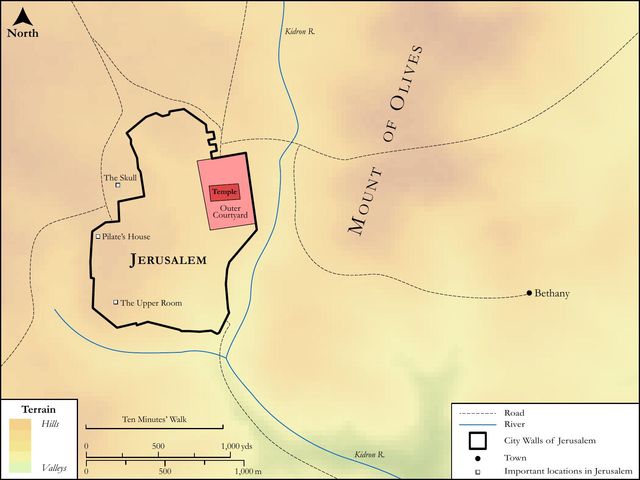
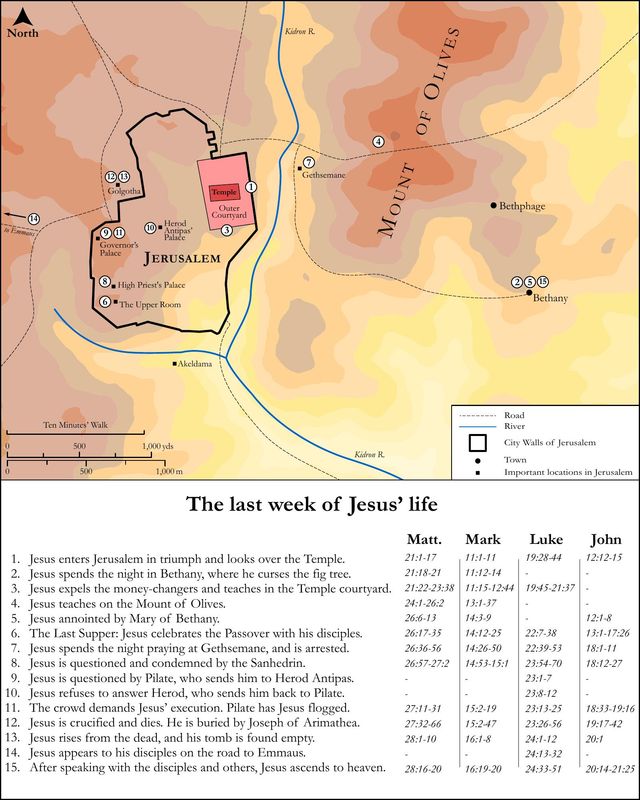
See on the biblical-era map

Study this verse
Public-domain commentary
Matthew Henry
From his Commentary on the Whole Bible. Henry comments on passages, not single verses — this entry covers Mark 12:35–40. His two-level outline is real structure in the source text, so it is rendered as structure.
Here, I. Christ shows the people how weak and defective the scribes were in their preaching, and how unable to solve the difficulties that occurred in the scriptures of the Old Testament, which they undertook to expound. Of this he gives an instance, which is not so fully related here as it was in Matthew. Christ was teaching in the temple: many things he said, which were not written; but notice is taken of this, because it will stir us up to enquire concerning Christ, and to enquire of him; for none can have the right knowledge of him but from himself; it is not to be had from the scribes, for they will soon be run aground.
1.They told the people that the Messiah was to be the Son of David (Mar 12:35), and they were in the right; he was not only to descend from his loins, but to fill his throne (Luk 1:32); The Lord shall give him the throne of his father David. The scripture said it often, but the people took it as what the scribes said; whereas the truths of God should rather be quoted from our Bibles than from our ministers, for there is the original of them. Dulcius ex ipso fonte bibuntur aquae - The waters are sweetest when drawn immediately from their source.
2.Yet they could not tell them how, notwithstanding that it was very proper for David, in spirit, the spirit of prophecy, to call him his Lord, as he doth, Psa 110:1. They had taught the people that concerning the Messiah, which would be for the honour of their nation - that he should be a branch of their royal family; but they had not taken care to teach them that which was for the honour of the Messiah himself - that he should be the Son of God, and, as such, and not otherwise, David's Lord. Thus they held the truth in unrighteousness, and were partial in the gospel, as well as in the law, of the Old Testament. They were able to say it, and prove it - that Christ was to be David's son; but if any should object, How then doth David himself call him Lord? they would not know how to avoid the force of the objection. Note, Those are unworthy to sit in Moses's seat, who, though they are able to preach the truth, are not in some measure able to defend it when they have preached it, and to convince gainsayers.
Now this galled the scribes, to have their ignorance thus exposed, and, no doubt, incensed them more against Christ; but the common people heard him gladly, Mar 12:37. What he preached was surprising and affecting; and though it reflected upon the scribes, it was instructive to them, and they had never heard such preaching. Probably there was something more than ordinarily commanding and charming in his voice and way of delivery, which recommended him to the affections of the common people; for we do not find that any were wrought upon to believe in him, and to follow him, but he was to them as a lovely song of one that could play well on an instrument; as Ezekiel was to his hearers, Eze 33:32. And perhaps some of these cried, Crucify him, as Herod heard John Baptist gladly, and yet cut off his head.
II.He cautions the people to take heed of suffering themselves to be imposed upon by the scribes, and of being infected with their pride and hypocrisy; He said unto them in his doctrine, "Beware of the scribes (Mar 12:38); stand upon your guard, that you neither imbibe their peculiar opinions, nor the opinions of the people concerning them." The charge is long as drawn up against them in the parallel place (Mt. 23); it is here contracted.
1.They affect to appear very great; for they go in long clothing, with vestures down to their feet, and in those they walk about the streets, as princes, or judges, or gentlemen of the long robe. Their going in such clothing was not sinful, but their loving to go in it, priding themselves in it, valuing themselves on it, commanding respect by it, saying to their long clothes, as Saul to Samuel, Honour me now before this people, this was a product of pride. Christ would have his disciples go with their loins girt.
2.They affect to appear very good; for they pray, they make long prayers, as if they were very intimate with heaven, and had a deal of business there. They took care it should be known that they prayed, that they prayed long, which, some think, intimates that they prayed not for themselves only, but for others, and therein were very particular and very large; this they did for a pretence, that they might seem to love prayer, not only for God's sake, whom hereby they pretended to glorify, but for their neighbour's sake, whom hereby they pretended to be serviceable to.
3.They here aimed to advance themselves: they coveted applause, and were fond of it; they loved salutations in the marketplaces, and the chief seats in the synagogues, and the uppermost rooms at feasts; these pleased a vain fancy; to have these given them, they thought, expressed the value they had for them, who did know them, and gained them respect for those who did not.
4.They herein aimed to enrich themselves. They devoured widows' houses, made themselves masters of their estates by some trick or other; it was to screen themselves from the suspicion of dishonesty, that they put on the mask of piety; and that they might not be thought as bad as the worst, they were studious to seem as good as the best. Let fraud and oppression be thought the worse of for their having profaned and disgraced long prayers; but let not prayers, no nor long prayers, be thought the worse of, if made in humility and sincerity, for their having been by some thus abused. But as iniquity, thus disguised with a show of piety, is double iniquity, so its doom will be doubly heavy; These shall receive great damnation; greater than those that live without prayer, greater than they would have received for the wrong done to the poor widows, if it had not been thus disguised. Note, The damnation of hypocrites will be of all others the greatest damnation.
Historical interpretation
Five Centuries of Reception
5 surviving comments on this verse. Each one is dated, so this reads as a timeline rather than a list.
Select a marker to jump to its quote. Markers stagger vertically where authors wrote within a few decades of each other.
That is, He openly speaks to them of Himself, that they may be inexcusable; for it goes on: How say the Scribes that Christ is the Son of David?
After confuting the Scribes and Pharisees, He burns up as a fire their dry and withered examples; wherefore it is said, And he said unto them in his doctrine, Beware of the Scribes, which love to go in long clothing.
(ubi sup.) But the putting own of His enemies by the Father, does not show the weakness of the Son, but the unity of nature, by which One works in the Other; for the Son also subjects the Father's enemies, because He glorifies His Father upon earth.
(ubi sup.) The question of Jesus is useful for us even now against the Jews; for they, acknowledging that Christ is to come, assert that He is a mere man, a holy Person descended from David. Let us then ask them, as our Lord has taught us, if He be a mere man, and only the son of David, how David in the Holy Spirit calls Him Lord. They are not however reproved for calling Him David's son, but for not believing Him to be the Son of God. It goes on, And the common people heard him gladly.
(ubi sup.) To walk in long clothing is to go forth into public clad in garments too much ornamented, in which amongst other things, that rich man, who fared sumptuously every day, is said to have sinned.
(ubi sup.) We must observe that He does not forbid that those, to whom it falls by the rule of their office, should be saluted in the marketplace, or have chief seats and places at feasts, but He teaches that those who love those things unduly, whether they have them or no, are to be avoided by the faithful as wicked men: that is, He blames the intention and not the office; although this too is culpable, that the very men who wish to be called masters of the synagogue in Moses' seat, should have to do with lawsuits in the marketplace. We are in two ways ordered to beware of those who are desirous of vain glory; first, we should not be seduced by their hypocrisy into thinking that what they do is good; nor secondly, should we be excited to imitate them, through a vain rejoicing in being praised for those virtues which they affect.
(ubi sup.) But they do not only seek for praise from men, but also for gain. Wherefore there follows, Which devour widows' houses, under the pretence of long prayers. For there are men who pretending to be just hesitate not to receive money from persons who are troubled in conscience, as though they would be their advocates in the judgment. A hand stretched out to the poor is always an accompaniment to prayer, but these men pass the night in prayer, that they may take away money from the poor.
Those who devour widows' houses under the pretense of long prayers will receive a harsher judgment. He did not merely say, "They will receive judgment," but added "harsher," to insinuate that those who stand praying in corners to be seen by people deserve condemnation. And those who engage in such practices more extensively, as though they were more religious, not only seeking praise from people but also money, are to be punished with a severer judgment. For there are those who, pretending to be righteous and of great merit before God, do not hesitate to take money from anyone of humble means and troubled by the awareness of their sins, as though they will act as their advocates in judgment. And while the outstretched hands of the poor typically bring aid through prayers, these individuals, mainly for the purpose of taking money from the poor, spend the night in prayer. To such individuals the curse of Judas fittingly applies: "When he is judged, let him come out condemned, and let his prayer become sin" (Psalm 108). When he is judged, he comes out condemned, and he takes his prayer into sin, as he, now held in high regard by humans, then finds himself not only incapable of interceding for others but also insufficient in his own merits before the divine judgment. In fact, he will bear the punishment for the very prayers by which he deceived human judgment.
Because Christ was coming to His Passion, He corrects a false opinion of the Jews, who said that Christ was the Son of David, not his Lord; wherefore it is said, And Jesus answered and said, while he taught in the temple.
But Christ shows Himself to be the Lord, by the words of David. For it goes on: For David himself said by the Holy Ghost, The Lord said to my Lord, Sit thou on my right hand; as if He had said, Ye cannot say that David said this without the grace of the Holy Spirit, but he called Him Lord in the Holy Spirit; and that He is Lord, he shows, by this that is added, Till I make thine enemies thy footstool; for they themselves were His enemies, whom God put under the footstool of Christ.
But they used to walk in honourable garments, because they wished to be highly esteemed for it, and in like manner they desired other things, which lead to glory. For it goes on: And love salutations in the marketplaces, and the chief seats in the synagogues, and the uppermost rooms at feasts.
He also especially teaches the Apostles, not to have any communication with the scribes, but to imitate Christ Himself; and in ordaining them to be masters in the duties of life, He places others under themv.
But the Scribes used to come to women, who were left without the protection of their husbands, as though they were their protectors; and by a pretence of prayer, a reverend exterior and hypocrisy, they used to deceive widows, and thus also devour the houses of the rich. It goes on, These shall receive a greater damnation, that is, than the other Jews, who sinned.
(non occ.) Thus then the Lord concludes from what has gone before the doubtful question. For from the foregoing words of David it is proved that Christ is the Lord of David, but according to the saying of the Scribes, it is proved that He is his son. And this is what is added, David himself then calls him Lord, how is he then his son?
(non occ.) Namely, because they saw that He answered and put questions wisely.
Continue studying Mark 12:40 across the web’s major study libraries — every link below opens this exact verse, chapter, or book on the destination site.
Read & Compare
 BibleGatewayThis verse in more than 200 translations and 70 languages.
 Bible.comThe YouVersion reader — hundreds of translations, reading plans, and highlights.
 ESV.orgCrossway's official English Standard Version reader.
 NET BibleThe NET translation with 60,000+ translators' notes on every rendering decision.
 STEP BibleTyndale House's free study tool — original text, vocabulary, and scholarly resources.
 BibliaLogos Bible Software's free web reader.
 USCCBThe New American Bible (Revised Edition) with the U.S. bishops' study notes.
Commentaries
 BibleHub CommentariesDozens of classic commentaries on this verse, gathered on one page.
 StudyLightMore than 100 commentary sets — the largest collection on the web.
 BibleRefPlain-English commentary on what this verse means, verse by verse.
 Enduring WordDavid Guzik's free commentary on this chapter, widely used by Bible teachers.
 Bible Study ToolsVerse commentary alongside Greek and Hebrew study aids.
Original Language & Research
- BibleHub InterlinearThe verse word by word — original language, transliteration, and English.
- BibleHub LexiconEvery word's original-language definition and Strong's entry.
 Blue Letter BibleDeep-study tools — Strong's numbers, concordance, and word studies.
 CNTR CollationThe earliest Greek manuscripts of this verse, collated letter by letter.
Sermons, Hymns & Audio


TrulyRandomVerse is not affiliated with these sites and doesn’t control their content. They’re linked because they’re genuinely useful.
Summary
In Mark 12:40, Jesus delivers a scathing indictment of certain religious leaders, specifically the scribes, exposing their profound hypocrisy and exploitation. He condemns them for preying on the most vulnerable in society—widows—by unjustly seizing their assets, all while maintaining a facade of piety through ostentatiously long prayers. This verse culminates in a severe warning that such egregious spiritual abuse and deceptive practices will incur a far greater divine judgment.
Context
ShowHideLiterary Context
Mark 12:40 concludes a series of interactions and teachings by Jesus in the Temple, leading up to His passion. Immediately preceding this verse, Jesus warns His disciples to "beware of the scribes" who crave public recognition, prominent seats, and deferential greetings (Mark 12:38). This verse then deepens the condemnation by revealing the insidious nature of their hypocrisy: their outward show of religiosity (long prayers) serves as a cloak for their inward corruption and exploitation of the vulnerable. It forms a stark contrast to the immediately following narrative, where Jesus observes a poor widow offering her last two small copper coins, commending her genuine sacrificial giving over the large, yet often insincere, donations of the wealthy (Mark 12:41-44). This juxtaposition powerfully highlights the scribes' spiritual bankruptcy against true devotion.
Historical & Cultural Context
In first-century Jewish society, widows were among the most vulnerable and overlooked groups. Lacking a male protector (husband or adult son), they often had no legal standing, economic security, or provision for the needy. The Mosaic Law and prophetic tradition consistently emphasized the community's responsibility to care for widows, orphans, and sojourners (Deuteronomy 10:18; Isaiah 1:17). Scribes, as legal and religious experts, were often consulted by widows regarding financial matters, wills, or disputes. Their position afforded them significant influence and trust. Jesus' condemnation implies that these scribes abused this trust, using their legal knowledge or religious authority to defraud widows of their property, perhaps through deceptive legal advice, exorbitant fees, or coercing "donations" that amounted to extortion. Their "long prayers" were typical of public displays of piety, intended to enhance their reputation and status, a practice Jesus frequently denounced (Matthew 6:5-6).
Key Themes
ShowHideThis verse powerfully encapsulates several key themes prevalent in Jesus' ministry and the Gospel of Mark. It underscores the theme of religious hypocrisy, where outward piety masks inward corruption and exploitative motives. Jesus consistently challenged those who prioritized external observance over genuine righteousness and love for God and neighbor, as seen in His critiques of the Pharisees and scribes throughout the Gospels (Matthew 23). The verse also highlights justice and the care for the vulnerable, a foundational principle of biblical ethics. Jesus' concern for the lowly is a recurring motif, contrasting sharply with the scribes' predatory behavior. Finally, it emphasizes the theme of divine judgment and accountability, particularly for those in positions of spiritual authority who abuse their power. The pronouncement of "greater damnation" foreshadows the severe consequences awaiting those who lead others astray or exploit them in the name of religion, a warning echoed in other passages concerning false teachers and shepherds (Ezekiel 34:1-10).
Exposition and Analysis
ShowHideKey Word Analysis
ShowHideThis verb, a compound of kata (down) and esthio (to eat), literally means "to eat down" or "consume entirely." Here, it is used metaphorically to describe the complete and ruthless appropriation of another's property. It conveys a sense of predatory, destructive action, implying not just taking, but utterly consuming or ruining the victim's livelihood, much like a ravenous beast. This word choice emphasizes the severity and completeness of the scribes' exploitation.
Derived from pro (before) and phaino (to show), prophasis refers to an "outward showing," a "pretext," or a "specious excuse." It denotes something put forward as a reason or justification that is not the true underlying motive. In this context, it reveals that the scribes' long prayers were not genuine acts of devotion but a deliberate charade, a calculated performance designed to create an illusion of piety and trustworthiness, thereby facilitating their exploitation of others. It highlights their duplicity and deceit.
From the verb krino (to judge), krima signifies a "decision," "judgment," or "condemnation." It is not merely a general punishment but a specific, weighty judicial pronouncement. The addition of "greater" (perissoteros) indicates a more severe, intense, or abundant judgment than might be expected for other sins. This heightened condemnation is due to the scribes' abuse of their religious authority, their betrayal of trust, and their exploitation of the most defenseless, making their sin particularly heinous in God's eyes.
Verse Breakdown
ShowHide"Which devour widows' houses"
This clause reveals the primary charge against the scribes: their predatory exploitation of vulnerable widows. "Devour" is a powerful metaphor, indicating not merely taking but utterly consuming or ruining the financial stability and security of these defenseless women. "Houses" here represents not just physical dwellings but their entire estate, their livelihood, and their means of survival, which the scribes unjustly seized or extorted.
"and for a pretence make long prayers"
This clause exposes the hypocrisy inherent in their actions. The conjunction "and" links their exploitation directly to their religious display. Their "long prayers" were not born of sincere devotion but were a "pretence"—a public show or deceptive facade. They used their outward piety to gain trust, enhance their reputation, and appear righteous, thereby masking their true, malevolent intentions and facilitating their financial abuse of widows.
"these shall receive greater damnation."
This concluding clause pronounces Jesus' severe judgment. "These" refers directly to the hypocritical, exploitative scribes. They will "receive" (lambano) a "greater damnation" (krima), signifying a more severe and weighty condemnation from God. Their sin is compounded by their position of religious authority and the vulnerability of their victims, making their accountability and consequent judgment far more severe than for ordinary transgressions.
Literary Devices
ShowHideMark 12:40 employs several potent Literary Devices to convey Jesus' condemnation. Hyperbole is evident in the phrase "devour widows' houses," which is not meant literally but vividly exaggerates the extent and ruthlessness of the scribes' exploitation, painting a picture of complete financial ruin. This strong imagery serves to shock the audience and underscore the gravity of the offense. Irony is central to the verse, as those who outwardly appear most pious ("make long prayers") are precisely the ones committing the most egregious injustices. Their religious performance is a perverse inversion of true righteousness, used as a "pretence" or cloak for their wickedness. This highlights the stark contrast between appearance and reality. Furthermore, the verse uses Metaphor in "devour," likening the scribes' actions to those of a ravenous animal, emphasizing their predatory nature and lack of human compassion. The culmination in "greater damnation" serves as a powerful Climax, delivering a final, severe pronouncement of divine judgment that underscores the ultimate consequences of such spiritual abuse.
Theological and Thematic Connections
ShowHideMark 12:40 stands as a profound theological statement on the nature of true righteousness versus religious hypocrisy, and God's unwavering commitment to justice for the oppressed. It reveals that outward religious observance, no matter how elaborate, is an abomination when it masks exploitation and a lack of genuine love for neighbor. Jesus' condemnation aligns with the Old Testament prophetic tradition that consistently denounced those who oppressed the poor and vulnerable while maintaining religious rituals (Amos 5:21-24; Micah 6:8). The "greater damnation" underscores the principle of heightened accountability for those in leadership, especially spiritual leadership, who betray trust and abuse their authority for personal gain. This verse serves as a timeless warning against spiritual abuse and a call to authentic, compassionate faith.
Reflection and Application
ShowHideMark 12:40 serves as a piercing mirror, inviting us to examine the authenticity of our own faith and the integrity of our actions. It challenges us to look beyond outward appearances, both in ourselves and in others, and to discern the true motives of the heart. Are our religious practices genuine expressions of love for God and neighbor, or are they, even subtly, a "pretence" to gain approval, status, or even material benefit? This verse compels us to consider how we treat the most vulnerable in our society and within our communities. Do we, like the scribes, inadvertently or intentionally exploit their weakness, or do we actively seek to protect, uplift, and advocate for them, reflecting God's heart for justice and compassion? It is a call to cultivate a faith that is deeply rooted in humility, integrity, and sacrificial love, recognizing that true worship is demonstrated not just in our prayers, but in our practical care for those in need.
Questions for Reflection
ShowHideFAQ
ShowHideWhy does Jesus condemn the scribes so harshly in Mark 12:40, and what does "devour widows' houses" truly mean?
ShowHideJesus condemns the scribes so harshly because their actions represented the epitome of religious hypocrisy and spiritual abuse. They were learned men, interpreters of the Law, and held positions of respect and trust. Instead of upholding justice and caring for the vulnerable as the Law commanded, they exploited them. The phrase "devour widows' houses" is a powerful metaphor, signifying that these scribes were systematically and ruthlessly stripping widows of their property and livelihood. Widows in that society were often without male protectors and thus extremely susceptible to financial manipulation. The scribes, perhaps through deceptive legal advice, exorbitant fees for services, or by coercing "donations" under religious guise, would take advantage of these vulnerable women, leaving them destitute. This act was particularly heinous because it violated the very spirit of the Law they professed to teach, which mandated special care for the fatherless and the widow (Deuteronomy 24:17). Their "long prayers" were merely a "pretence" (Mark 12:40) to project an image of piety, which ironically made them more effective in their exploitation. Jesus' condemnation highlights that God sees beyond external religious performance and judges the true motives and actions of the heart, especially when they involve the oppression of the weak.
Christ-Centered Fulfillment
ShowHideMark 12:40, with its searing condemnation of hypocritical religious leaders who exploit the vulnerable, finds its profound Christ-centered fulfillment in the person and work of Jesus Himself. While the scribes "devoured widows' houses" and made "long prayers" for show, Jesus consistently demonstrated a radical, self-sacrificial love that uplifted the lowly and challenged oppressive practices. He did not come to be served, but to serve, and to give His life as a ransom for many (Mark 10:45). Unlike the scribes who sought personal gain, Jesus emptied Himself, taking the form of a servant (Philippians 2:7). His life was a living embodiment of true righteousness, characterized by genuine compassion for the poor, the sick, and the outcast, including widows (Luke 7:11-17). The "greater damnation" pronounced upon the scribes highlights the severity of sin, particularly that of spiritual abuse, which Jesus bore upon the cross, taking upon Himself the judgment due to humanity's sin, including such profound hypocrisy and exploitation (2 Corinthians 5:21). Thus, Jesus is the antithesis of the condemned scribes: He is the righteous One who truly cares for the vulnerable, the High Priest who genuinely intercedes, and the Lamb of God who receives the ultimate judgment so that those who trust in Him might receive not damnation, but eternal life and true spiritual houses not made with hands (John 3:16; Hebrews 4:14-16).