


Mark 12:28
Bible text: King James Version (1769 Blayney text) · Public domain
Bible text: King James Version with Strong's numbers · Public domain
Bible text: Berean Standard Bible · Public domain
Bible text: American Standard Version (1901) · Public domain
Bible text: World English Bible, Messianic edition · Public domain
Bible text: Geneva Bible (1599) · Public domain
Bible text: Young's Literal Translation · Public domain
- ΚαὶKaiAndG2532CONJConjunction
- προσελθὼνproselthōnhaving come upG4334V-2AAP-NSMVerb 2nd Aorist Active Participle Nominative Singular Masculine
- εἷςheisoneG1520A-NSMAdjective Nominative Singular Masculine
- τῶνtōnof theG3588T-GPMDefinite article Genitive Plural Masculine
- γραμματέωνgrammateōnscribesG1122N-GPMNoun Genitive Plural Masculine
- ἀκούσαςakousashaving heardG191V-AAP-NSMVerb Aorist Active Participle Nominative Singular Masculine
- αὐτῶνautōnwhen theyG846P-GPMPersonal pronoun Genitive Plural Masculine
- συζητούντωνsuzētountōnare reasoning togetherG4802V-PAP-GPMVerb Present Active Participle Genitive Plural Masculine
- ἰδὼνidōnseeingG1492V-2AAP-NSMVerb 2nd Aorist Active Participle Nominative Singular Masculine
- ὅτιhotithatG3754CONJConjunction
- καλῶςkalōswellG2573ADVAdverb
- ἀπεκρίθηapekrithēHe answeredG611V-ADI-3SVerb Aorist Middle Deponent Indicative 3rd Singular
- αὐτοῖςautoisthemG846P-DPMPersonal pronoun Dative Plural Masculine
- ἐπηρώτησενepērōtēsenhe questionedG1905V-AAI-3SVerb Aorist Active Indicative 3rd Singular
- αὐτόν·autonHimG846P-ASMPersonal pronoun Accusative Singular Masculine
- ποίαpoiaWhichG4169I-NSFInterrogative pronoun Nominative Singular Feminine
- ἐστὶνestinisG1510V-PAI-3SVerb Present Active Indicative 3rd Singular
- ἐντολὴentolēcommandmentG1785N-NSFNoun Nominative Singular Feminine
- πρώτηprōtē[the] firstG4413A-NSFAdjective Nominative Singular Feminine
- πάντων;pantōnof allG3956A-GPNAdjective Genitive Plural Neuter
English is a literal word-by-word gloss of the Greek, not the KJV's wording. Why?
This is the original text the KJV's translators worked from — each Greek word with its own literal English meaning in this verse, prepared by scholars at Tyndale House, Cambridge. The KJV translates whole sentences, not word by word, so its wording differs: one Greek word can become several English words, and the KJV may choose “charity” where the gloss reads “love”. Both are faithful — they answer different questions. For the KJV's own rendering, switch to the KJV text.
Details
See on the biblical-era maps


Study this verse
Public-domain commentary
Matthew Henry
From his Commentary on the Whole Bible. Henry comments on passages, not single verses — this entry covers Mark 12:28–34. His three-level outline is real structure in the source text, so it is rendered as structure.
The scribes and Pharisees were (however bad otherwise) enemies to the Sadducees; now one would have expected that, when they heard Christ argue so well against the Sadducees, they would have countenanced him, as they did Paul when he appeared against the Sadducees (Act 23:9); but it had not the effect: because he did not fall in with them in the ceremonials of religion, he agreeing with them in the essentials, gained him no manner of respect with them. Only we have here an account of one of them, a scribe, who had so much civility in him as to take notice of Christ's answer to the Sadducees, and to own that he had answered well, and much to the purpose (Mar 12:28); and we have reason to hope that he did not join with the other scribes in persecuting Christ; for here we have his application to Christ for instruction, and it was such as became him; not tempting Christ, but desiring to improve his acquaintance with him.
I.He enquired, Which is the first commandment of all? Mar 12:28.
He doth not mean the first in order, but the first in weight and dignity; "Which is that command which we ought to have in a special manner an eye to, and our obedience to which will lay a foundation for our obedience to all the rest?" Not that any commandment of God is little (they are all the commands of a great God), but some are greater than others, moral precepts than rituals, and of some we may say, They are the greatest of all.
II.Christ gave him a direct answer to this enquiry, Mar 12:29-31.
Those that sincerely desire to be instructed concerning their duty, Christ will guide in judgment, and teach his way. He tells him,
1.That the great commandment of all, which is indeed inclusive of all, is, that of loving God with all our hearts.
(1.)Where there is a commanding principle in the soul, there is a disposition to every other duty. Love is the leading affection of the soul; the love of God is the leading grace in the renewed soul.
(2.)Where this is not, nothing else that is good is done, or done aright, or accepted, or done long. Loving God with all our heart, will effectually take us off fRom. and arm us against, all those things that are rivals with him for the throne in our souls, and will engage us to every thing by which he may be honoured, and with which he will be pleased; and no commandment will be grievous where this principle commands, and has the ascendant. Now here in, Mark, our Saviour prefixes to this command the great doctrinal truth upon which it is built (Mar 12:29); Hear, O Israel, The Lord our God is one Lord; if we firmly believe this, it will follow, that we shall love him with all our heart. He is Jehovah, who has all amiable perfections in himself; he is our God, to whom we stand related and obliged; and therefore we ought to love him, to set our affections on him, let out own desire toward him, and take a delight in him; and he is one Lord, therefore he must be loved with our whole heart; he has the sole right to us, and therefore ought to have the sole possession of us. If he be one, our hearts must be one with him, and since there is no God besides, no rival must be admitted with him upon the throne.
2.That the second great commandment is, to love our neighbour as ourselves (Mar 12:31), as truly and sincerely as we love ourselves, and in the same instances, and we must show it by doing as we would be done by. As we must therefore love God better than ourselves, because he is Jehovah, a being infinitely better than we are, and must love him with all our heart, because he is one Lord, and there is no other like him; so we must love our neighbour as ourselves, because he is of the same nature with ourselves; our hearts are fashioned alike, and my neighbour and myself are of one body, of one society, that of the world of mankind; and if a fellow-Christian, and of the same sacred society, the obligation is the stronger. Hath not one God created us? Mal 2:10. Has not one Christ redeemed us? Well might Christ say, There is no other commandment greater than these; for in these all the law is fulfilled, and if we make conscience of obedience to these, all other instances of obedience will follow of course.
III.The scribe consented to what Christ said, and descanted upon it, Mar 12:32, Mar 12:33.
1.He commends Christ's decision of this question; Well, Master, thou hast said the truth. Christ's assertions needed not the scribe's attestations; but this scribe, being a man in authority, thought it would put some reputation upon what Christ said, to have it commended by him; and it shall be brought in evidence against those who persecuted Christ, as a deceiver, that one of themselves, even a scribe of their own, confessed that he said the truth, and said it well. And thus must we subscribe to Christ's sayings, must set to our seal that they are true.
2.He comments upon it. Christ had quoted that great doctrine, that the Lord our God is one Lord; and this he not only assented to, but added, "There is none other but he; and therefore we must have no other God besides." This excludes all rivals with him, and secures the throne in the heart entire for him. Christ had laid down that great law, of loving God with all our hearts; and this also he explains - that it is loving him with the understanding, as those that know what abundant reason we have to love him. Our love to God, as it must be an entire, so it must be an intelligent, love; we must love him with all the understanding, ex holēs tēs suneseōs - out of the whole understanding; our rational powers and faculties must all be set on work to lead out the affections of our souls toward God. Christ has said, "To love God and our neighbour is the greatest commandment of all;" "Yea," saith the scribe, "it is better, it is more than all whole-burnt-offerings and sacrifices, more acceptable to God, and will turn to a better account to ourselves." There were those who held, that the law of sacrifices was the greatest commandment of all; but this scribe readily agreed with our Saviour in this - that the law of love to God and our neighbour is greater than that of sacrifice, even than that of whole-burnt-offerings, which were intended purely for the honour of God.
IV.Christ approved of what he said, and encouraged him to proceed in his enquiries of him, Mar 12:34.
1.He owned that he understood well, as far as he went; so far, so good. Jesus saw that he answered discreetly, and was the more pleased with it, because he had of late met with so many even of the scribes, men of letters, that answered indiscreetly, as those that had no understanding, nor desired to have any. He answered nounechōs - as one that had a mind; as a rational intelligent man, as one that had his wits about him; as one whose reason was not blinded, whose judgment was not biassed, and whose forethought was not fettered, by the prejudices which other scribes were so much under the power of. He answered as one that allowed himself liberty and leisure to consider, as one that had considered.
2.He owned that he stood fair for a further advance; "Thou art not far from the kingdom of God, the kingdom of grace and glory; thou art in a likely way to be a Christian, a disciple of Christ. For the doctrine of Christ insists most upon these things, and is designed, and has a tendency direct, to bring thee to this." Note, There is hope of those who make a good use of the light they have, and go as far as that will carry them, that by the grace of God they will be led further, by the clearer discoveries God has to make to them. What became of this scribe we are not told, but would willingly hope that he took the hint Christ hereby gave him, and that, having been told by him, so much to his satisfaction, what was the great commandment of the law, he proceeded to enquire of him, or his apostles, what was the great commandment of the gospel too. Yet, if he did not, but took, up here, and went no further, we are not to think it strange; for there are many who are not far from the kingdom of God, and yet never come thither. Now, one would think, this should have invited many to consult him: but it had a contrary effect; No man, after that, durst ask him any question; every thing he said, was spoken with such authority and majesty, that every one stood in awe of him; those that desired to learn, were ashamed to ask, and those that designed to cavil, were afraid to ask.
Historical interpretation
Eleven Centuries of Reception
7 surviving comments on this verse. Each one is dated, so this reads as a timeline rather than a list.
Select a marker to jump to its quote. Markers stagger vertically where authors wrote within a few decades of each other.
This question is only that which is a problem common to all skilled in the law, namely, that the commandments are differently set forth in Exodus, Leviticus, and Deuteronomy. Wherefore He brought forward not one but two commandments, by which, as by two paps rising on the breast of the bride, our infancy is nourished. And therefore there is added, And Jesus answered him, The first of all the commandments is, Hear, O Israel; the Lord thy God is one God. He mentions the first and greatest commandment of all; this is that to which each of us must give the first place in his heart, as the only foundation of piety, that is, the knowledge and confession of the Divine Unity, with the practice of good works, which is perfected in the love of God and our neighbour; wherefore there is added, Thou shalt love the Lord thy God with all thy heart, and with all thy mind, and with all thy soul, and with all thy strength: this is the first commandment.
Or else, he is not far who comes with knowledge; for ignorance is farther from the kingdom of God than knowledge; wherefore he says above to the Sadducees, Ye err, not knowing the Scriptures, or the power of God. It goes on: And no man after that durst ask him any questions.
For in this law given to Adam we recognise in embryo all the precepts which afterwards sprouted forth when given through Moses; that is, Thou shalt love the Lord thy God from thy whole heart and out of thy whole soul; Thou shalt love thy neighbour as thyself; Thou shalt not kill; Thou shall not commit adultery; Thou shalt not steal; False witness thou shall not utter; Honour thy father and mother; and, That which is another's, shall thou not covet.
(de Con. Evan. ii. 73) Nor let it trouble us that Matthew says, that he who addressed this question to the Lord tempted Him; for it may be that though he came as a tempter, yet he was corrected by the answer of the Lord. Or at all events, we must not look upon the temptation as evil, and done with the intention of deceiving an enemy, but rather as the caution of a man who wished to try a thing unknown to him.
(ubi sup.) He shows when he says, this is greater than all sacrifices, that a grave question was often debated between the scribes and Pharisees, which was the first commandment, or the greatest of the Divine law; that is, some praised offerings and sacrifices, others preferred acts of faith and love, because many of the fathers before the law pleased God by that faith only, which works by love. This scribe shows that he was of the latter opinion. But it continues, And when Jesus saw that he answered discreetly, he said unto him, Thou art not far from the kingdom of God.
(ubi sup) But the reason why he was not far from the kingdom of God was, that he proved himself to be a favourer of that opinion, which is proper to the New Testament and to Gospel perfection.
(ubi sup.) For since they were confuted in argument, they ask Him no farther questions, but take Him without any disguise, and give Him up to the Roman power. From which we understand that the venom of envy may be overcome, but can hardly lie quiet.
And one of the scribes came up who had heard them disputing. And seeing that he had answered them well, he asked him which commandment was the first of all. Jesus answered him that the first of all commandments is: Hear, O Israel, the Lord your God is one God. And you shall love the Lord your God with all your heart, and with all your soul, and with all your mind, and with all your strength. This is the first commandment. The second is like it: You shall love your neighbor as yourself. He says the first and greatest commandment is that before all things we each should place in our innermost heart, as the only foundation of piety. This he demonstrated more clearly in conclusion, when he said: There is no greater commandment than these. Therefore the first and greatest commandment is the acknowledgement and confession of divine unity along with the performance of good works. Good works are perfected in the love of God and neighbor. The Apostle commends this briefly in other words, saying: For in Christ Jesus neither circumcision nor uncircumcision counts for anything, but faith working through love (Galatians 5).
See how He has enumerated all the powers of the soul; for there is a 1living power in the soul, which He explains, when He says, With all thy soul, and to this belong anger and desire, all of which He will have us give to Divine love. There is also another power, which is called natural, to which belong nutriment and growth, and this also is all to be given to God, for which reason He says, With all thy heart. There is also another power, the rational, which He calls the mind, and that too is to be given whole to God.
He says that it is like, because these two commandments are harmonious one with the other, and mutually contain the other. For he who loves God, loves also His creature; but the chief of His creatures is man, wherefore he who loves God ought to love all men. But he who loves his neighbour, who so often offends him, ought much more to love Him, who is ever giving him benefits. And therefore on account of the connection between these commandments, He adds, There is none other commandment greater than these. It goes on: And the Scribe said unto him, Well, Master, thou hast said the truth: for there is one God, and there is none other but he: and to love him with all the heart, and with all the soul, and with all the understanding, and with all the strength, and to love his neighbour as himself, is more than all whole burnt offerings and sacrifices.
By which He shows that he was not perfect, for He did not say, Thou art within the kingdom of heaven, but, Thou art not far from the kingdom of God.
(non occ.) That is, because they contradicted the Scriptures, and derogated from the power of God.
(non occ.) After that the Lord confuted the Pharisees, and the Sadducees, who tempted Him, it is here shown how He satisfied the Scribe who questioned Him; wherefore it is said, And one of the scribes came, and having heard them reasoning together, and perceiving that he had answered them well, asked him, Which is the first commandment of all?
(non occ.) The words which are added, And with all thy strength, may be referred to the bodily powers. It goes on: And the second is like, namely this, Thou shalt love thy neighbour as thyself.
Continue studying Mark 12:28 across the web’s major study libraries — every link below opens this exact verse, chapter, or book on the destination site.
Read & Compare
 BibleGatewayThis verse in more than 200 translations and 70 languages.
 Bible.comThe YouVersion reader — hundreds of translations, reading plans, and highlights.
 ESV.orgCrossway's official English Standard Version reader.
 NET BibleThe NET translation with 60,000+ translators' notes on every rendering decision.
 STEP BibleTyndale House's free study tool — original text, vocabulary, and scholarly resources.
 BibliaLogos Bible Software's free web reader.
 USCCBThe New American Bible (Revised Edition) with the U.S. bishops' study notes.
Commentaries
 BibleHub CommentariesDozens of classic commentaries on this verse, gathered on one page.
 StudyLightMore than 100 commentary sets — the largest collection on the web.
 BibleRefPlain-English commentary on what this verse means, verse by verse.
 Enduring WordDavid Guzik's free commentary on this chapter, widely used by Bible teachers.
 Bible Study ToolsVerse commentary alongside Greek and Hebrew study aids.
Original Language & Research
- BibleHub InterlinearThe verse word by word — original language, transliteration, and English.
- BibleHub LexiconEvery word's original-language definition and Strong's entry.
 Blue Letter BibleDeep-study tools — Strong's numbers, concordance, and word studies.
 CNTR CollationThe earliest Greek manuscripts of this verse, collated letter by letter.
Sermons, Hymns & Audio


TrulyRandomVerse is not affiliated with these sites and doesn’t control their content. They’re linked because they’re genuinely useful.
Summary
Mark 12:28 introduces a pivotal moment in Jesus's public ministry, as a scribe approaches Him with a sincere theological inquiry, unlike the hostile challenges Jesus had previously faced. Having observed Jesus's profound wisdom in silencing His adversaries, this scribe genuinely seeks to understand the essence of God's Law by asking which is the foremost commandment of all. This sets the stage for one of Jesus's most profound declarations, revealing the heart of divine expectation.
Context
ShowHideLiterary Context
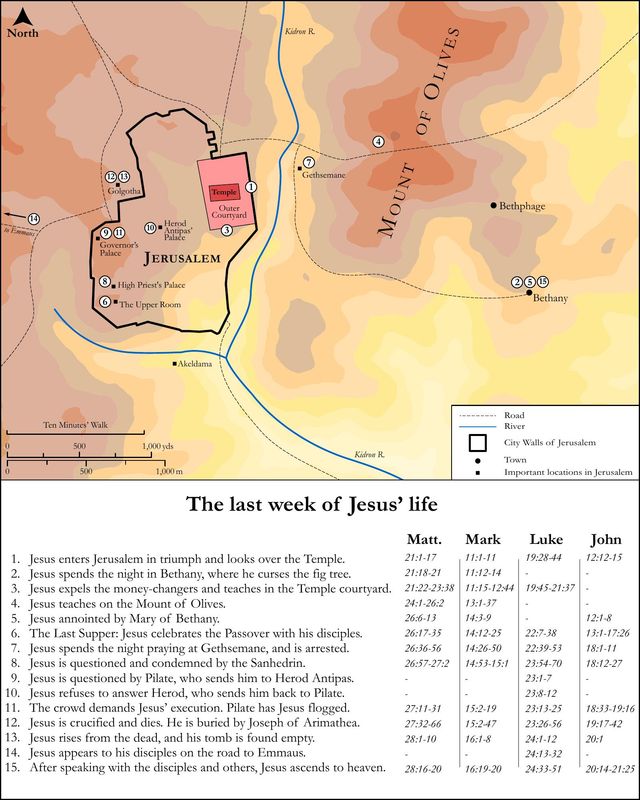
This verse is strategically placed within a series of intense confrontations between Jesus and various Jewish religious factions in the Temple courts during His final week in Jerusalem, often referred to as Passion Week. Immediately prior to this, Jesus had masterfully navigated two attempts to trap Him: first, by the Pharisees and Herodians regarding the legality of paying taxes to Caesar (Mark 12:13-17), and second, by the Sadducees, who challenged the concept of the resurrection with a convoluted hypothetical scenario (Mark 12:18-27). In both instances, Jesus's responses were so insightful and authoritative that they silenced His opponents, leaving them without a retort. The arrival of this scribe, who has "heard them reasoning together, and perceiving that he had answered them well," marks a distinct shift. Unlike the malicious intent of the previous questioners, the scribe's inquiry is born out of genuine curiosity and respect for Jesus's wisdom, creating an opening for a deeper theological discussion rather than a mere intellectual skirmish.
Historical & Cultural Context
The individual in this verse is identified as a "scribe" (Greek: grammateus), a highly respected and influential figure in first-century Jewish society. Scribes were learned men, often associated with the Pharisees, who dedicated their lives to the study, interpretation, and teaching of the Mosaic Law (Torah). They were responsible for copying scriptures, developing oral traditions, and serving as legal experts and advisors. Their role was crucial in preserving and applying the intricate details of the 613 commandments found in the Torah. Within this context, the question "Which is the first commandment of all?" was a common and significant rabbinic debate. Jewish scholars frequently discussed and sought to identify a foundational principle or a summary statement that could encapsulate the vast body of God's Law, providing a guiding principle for all other commandments. This inquiry was not trivial but represented a profound theological exercise aimed at discerning the very heart of God's will for His people.
Key Themes
ShowHideMark 12:28 introduces several profound themes that resonate throughout the Gospels and beyond. Firstly, it highlights the theme of Genuine Inquiry contrasted with hostile questioning. Unlike the malicious traps set by the Pharisees, Herodians, and Sadducees, the scribe's approach signals a sincere desire for truth and understanding, demonstrating that an open heart is essential for receiving divine wisdom. This sets the stage for a teaching moment rather than a confrontation, underscoring the value of seeking God with pure motives. Secondly, the question itself, "Which is the first commandment of all?", underscores the theme of The Essence of the Law. In a religious system with hundreds of commandments, the pursuit of a unifying principle was a central theological endeavor. The scribe's question reflects a deep yearning to grasp the core of God's demands, moving beyond mere legalistic adherence to the spirit of the Law. Finally, the scribe's acknowledgment that Jesus "had answered them well" powerfully reinforces the theme of Jesus's Authority and Wisdom. His ability to silence seasoned religious leaders with profound scriptural insight not only validated His teaching but also pointed to His unique understanding of God's will, positioning Him as the ultimate interpreter of the Law, a role further illuminated in passages like Matthew 7:28-29 where the crowds were astonished at His teaching.
Exposition and Analysis
ShowHideKey Word Analysis
ShowHideFrom gramma, meaning a writing or letter. A scribe was primarily a writer, but professionally, this term designated a learned man, an expert in Jewish law and tradition. They were responsible for copying, interpreting, and teaching the Torah, holding significant authority and influence in society. The presence of a scribe here indicates a representative of the learned religious elite.
A primary verb meaning "to see" (literally or figuratively), and by implication, "to know" or "to understand." In this context, it signifies that the scribe had not merely heard Jesus's answers but had intellectually grasped and appreciated their depth and correctness. This "perceiving" implies a genuine recognition of Jesus's wisdom and authority, distinguishing this scribe from many other antagonists.
From entellomai, meaning "to enjoin" or "to command." This term refers to an authoritative prescription, an injunction, or a precept. The scribe's question is about which of God's authoritative commands is primary or most foundational, seeking the essential core of the divine law.
Verse Breakdown
ShowHide"And one of the scribes came"
This introduces a new character into the narrative, distinct from the previous groups who had challenged Jesus. The phrase "one of the scribes" suggests a specific individual, not a collective group acting in concert, further emphasizing a personal, rather than institutional, inquiry. His act of "coming" implies a deliberate approach, indicating his intention to engage Jesus directly.
"and having heard them reasoning together"
The scribe had been an observer of the preceding debates between Jesus and the Pharisees, Herodians, and Sadducees. The "reasoning together" (Greek: syzēteō) refers to the intense theological discussions and disputes that had just transpired, where Jesus's opponents attempted to trap Him with difficult questions. The scribe's presence during these exchanges provides the immediate backdrop for his own question.
"and perceiving that he had answered them well"
This is a crucial phrase, highlighting the scribe's genuine assessment of Jesus's performance. "Perceiving" (Greek: eídō) indicates a clear understanding and appreciation of Jesus's wisdom and the effectiveness of His responses. The adverb "well" (Greek: kalōs) signifies that Jesus's answers were not merely correct but were delivered with profound insight, skill, and perhaps even moral uprightness, impressing the learned scribe. This positive evaluation sets his inquiry apart from the malicious intent of others.
"asked him, Which is the first commandment of all?"
This is the core of the scribe's interaction. His "asking" (Greek: eperōtaō) denotes an inquiry or a question, not a demand or a challenge. The question itself, "Which is the first commandment of all?", reflects a common rabbinic debate among Jewish scholars. With hundreds of commandments in the Torah, identifying the singular, most foundational, or most important principle was a significant theological exercise, seeking the very heart of God's will and the essence of righteous living.
Literary Devices
ShowHideThe passage employs several literary devices that enhance its meaning and impact. Contrast is a prominent device, as the sincere inquiry of this scribe is sharply contrasted with the malicious, trap-setting questions posed by the Pharisees, Herodians, and Sadducees in the preceding verses. This contrast highlights the purity of the scribe's motives and sets a different tone for the interaction. There is also an element of Foreshadowing, as the scribe's question directly sets the stage for Jesus's profound and foundational teaching on the greatest commandments (love for God and neighbor), which encapsulates the entire Law and Prophets. This question is not just answered but becomes the springboard for a central theological declaration. Finally, the scribe's question itself functions as a Rhetorical Inquiry within the broader rabbinic discourse of the time. While genuinely posed by the scribe, it represents a common intellectual and spiritual challenge within Judaism, inviting a definitive and authoritative response that Jesus uniquely provides.
Theological and Thematic Connections
ShowHideMark 12:28 serves as a crucial theological pivot, moving from Jesus's defensive responses to His proactive teaching on the essence of God's Law. The scribe's question, "Which is the first commandment of all?", represents a universal human desire to understand the core principles of faith and life. Theologically, it prompts Jesus to distil the vastness of the Torah into its fundamental, non-negotiable components. Jesus's subsequent answer, rooted in the Shema and Leviticus, transcends mere legalistic adherence, revealing that God's primary demand is not ritualistic observance but radical, holistic love—love for God with one's entire being, and love for one's neighbor as oneself. This highlights that all divine commands ultimately flow from and are fulfilled by love, demonstrating that the heart of God's character and His covenantal relationship with humanity is rooted in this profound affection.
Reflection and Application
ShowHideMark 12:28 invites us to reflect on the nature of our own spiritual inquiry and the priorities we set in our faith. The scribe's genuine desire to understand the "first commandment" challenges us to move beyond superficial engagement with scripture or mere adherence to religious rules. Are we, like the scribe, truly seeking the heart of God's will, or are we content with surface-level understanding? This verse sets the stage for Jesus's profound teaching that all of God's law and the prophets hang on love for God and love for neighbor. For believers today, this means examining whether our lives genuinely reflect these two foundational principles. Do our actions, thoughts, and relationships demonstrate a holistic love for God with all our being, and a selfless, sacrificial love for those around us? This passage calls us to a deeper, more integrated faith where love is not just a feeling but the driving force behind all our obedience and interactions.
Questions for Reflection
ShowHideFAQ
ShowHideWhat was the significance of the scribe's question about the "first commandment"?
ShowHideThe scribe's question, "Which is the first commandment of all?", was highly significant within the context of first-century Judaism. The Torah contained 613 commandments (mitzvot), and Jewish rabbis frequently debated which among them was the most important or foundational. This was not a trivial exercise but a profound theological pursuit to identify the essence of God's will and the guiding principle for righteous living. The question sought to distil the vastness of divine law into a single, overarching principle that could encapsulate or prioritize all other commands. By asking this, the scribe was inviting Jesus to participate in a central rabbinic discussion, and Jesus's answer, detailed in Mark 12:29-31, provided a definitive and revolutionary summary that continues to shape Christian ethics.
Christ-Centered Fulfillment
ShowHideMark 12:28, with the scribe's earnest inquiry, sets the stage for Jesus to reveal the very heart of God's Law, a revelation that finds its ultimate fulfillment in Christ Himself. Jesus doesn't merely state the greatest commandment; He embodies it. His entire life, from His incarnation to His crucifixion, is the perfect manifestation of loving God with all His being and loving His neighbor as Himself. He perfectly obeyed the Father, demonstrating complete devotion and submission, even to the point of death on a cross (Philippians 2:8). Furthermore, His ministry was characterized by selfless love for humanity, healing the sick, teaching the lost, and ultimately laying down His life for His friends (John 15:13). In Christ, the Law's demand for perfect love is not just articulated but perfectly fulfilled, making Him the "end of the law for righteousness to everyone who believes" (Romans 10:4). Thus, the scribe's question, seeking the essence of the Law, inadvertently points to the One who is the living embodiment and ultimate fulfillment of all that the Law truly demands.