


Luke 10:25
“The Good Samaritan”Luke 10:25–37
Bible text: King James Version (1769 Blayney text) · Public domain
Bible text: Berean Standard Bible · Public domain
Bible text: American Standard Version (1901) · Public domain
Bible text: World English Bible, Messianic edition · Public domain
Bible text: Geneva Bible (1599) · Public domain
Bible text: Young's Literal Translation · Public domain
- ΚαὶKaiAndG2532CONJConjunction
- ἰδοὺidoubeholdG2400INJInterjection
- νομικόςnomikosa lawyerG3544A-NSMAdjective Nominative Singular Masculine
- τιςtiscertainG5100X-NSMIndefinite pronoun Nominative Singular Masculine
- ἀνέστηanestēstood upG450V-2AAI-3SVerb 2nd Aorist Active Indicative 3rd Singular
- ἐκπειράζωνekpeirazōntestingG1598V-PAP-NSMVerb Present Active Participle Nominative Singular Masculine
- αὐτὸνautonHimG846P-ASMPersonal pronoun Accusative Singular Masculine
- καὶkaiandG2532CONJConjunction
- λέγων·legōnsayingG3004V-PAP-NSMVerb Present Active Participle Nominative Singular Masculine
- διδάσκαλεdidaskaleTeacherG1320N-VSM-TNoun Vocative Singular Masculine Person Gentilic
- τίtiwhatG5101I-ASNInterrogative pronoun Accusative Singular Neuter
- ποιήσαςpoiēsashaving doneG4160V-AAP-NSMVerb Aorist Active Participle Nominative Singular Masculine
- ζωὴνzōēnlifeG2222N-ASFNoun Accusative Singular Feminine
- αἰώνιονaiōnioneternalG166A-ASFAdjective Accusative Singular Feminine
- κληρονομήσω;klēronomēsōwill I inherit?G2816V-FAI-1SVerb Future Active Indicative 1st Singular
English is a literal word-by-word gloss of the Greek, not the KJV's wording. Why?
This is the original text the KJV's translators worked from — each Greek word with its own literal English meaning in this verse, prepared by scholars at Tyndale House, Cambridge. The KJV translates whole sentences, not word by word, so its wording differs: one Greek word can become several English words, and the KJV may choose “charity” where the gloss reads “love”. Both are faithful — they answer different questions. For the KJV's own rendering, switch to the KJV text.
Words in [ ] are added by the English.
- lawyer (KJV) / expert in the law (BSB) νομικός
Details
See on the biblical-era maps
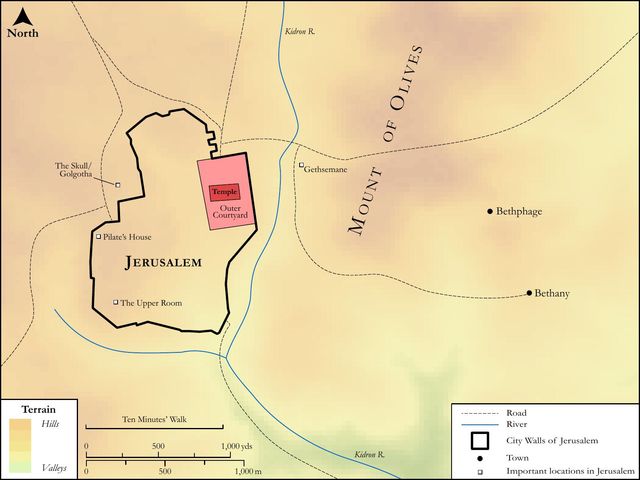
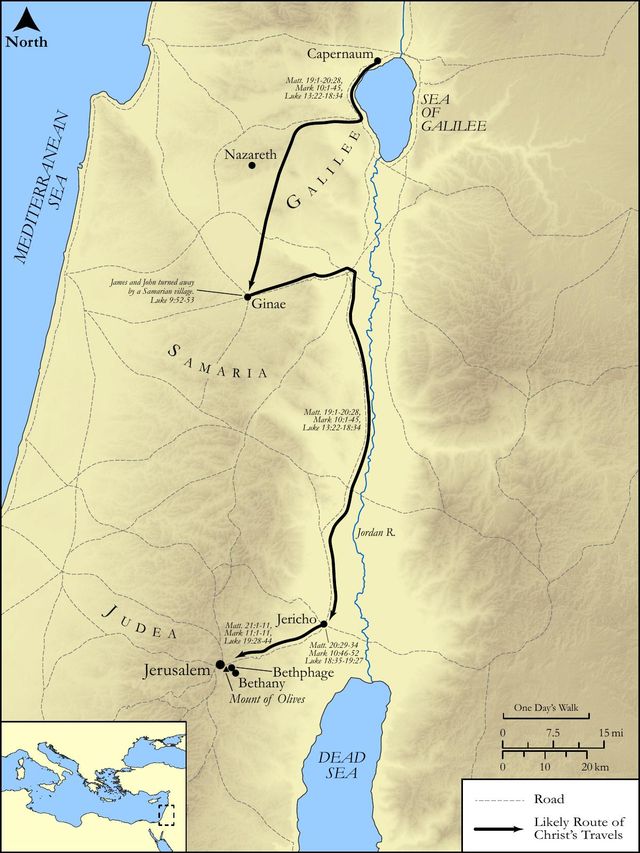
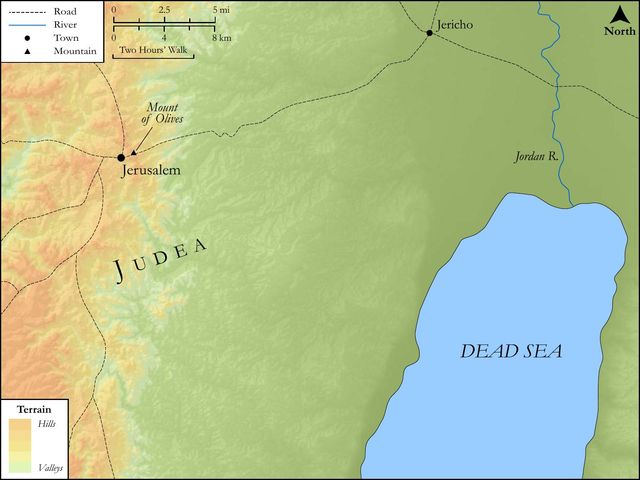
Study this verse
Public-domain commentary
Matthew Henry
From his Commentary on the Whole Bible. Henry wrote on whole passages, and this entry covers Luke 10:25–37. He set out his notes in a four-level outline, kept here as he numbered it.
We have here Christ's discourse with a lawyer about some points of conscience, which we are all concerned to be rightly informed in and are so here from Christ though the questions were proposed with no good intention.
I.We are concerned to know what that good is which we should do in this life, in order to our attaining eternal life.
A question to this purport was proposed to our Saviour by a certain lawyer, or scribe, only with a design to try him, not with a desire to be instructed by him, Luke 10:25. The lawyer stood up, and asked him, Master, what shall I do to inherit eternal life? If Christ had any thing peculiar to prescribe, by this question he would get it out of him, and perhaps expose him for it; if not, he would expose his doctrine as needless, since it would give no other direction for obtaining happiness than what they had already received; or, perhaps, he had no malicious design against Christ, as some of the scribes had, only he was willing to have a little talk with him, just as people go to church to hear what the minister will say. This was a good question: What shall I do to inherit eternal life? But it lost all its goodness when it was proposed with an ill design, or a very mean one. Note, It is not enough to speak of the things of God, and to enquire about them, but we must do it with a suitable concern. If we speak of eternal life, and the way to it, in a careless manner, merely as matter of discourse, especially as matter of dispute, we do but take the name of God in vain, as the lawyer here did. Now this question being started, observe,
1.How Christ turned him over to the divine law, and bade him follow the direction of that. Though he knew the thoughts and intents of his heart, he did not answer him according to the folly of that, but according to the wisdom and goodness of the question he asked. He answered him with a question: What is written in the law? How readest thou? Luke 10:26. He came to catechize Christ, and to know him; but Christ will catechize him, and make him know himself. He talks to him as a lawyer, as one conversant in the law: the studies of his profession would inform him; let him practise according to his knowledge, and he should not come short of eternal life. Note, It will be of great use to us, in our way to heaven, to consider what is written in the law, and what we read there. We must have recourse to our bibles, to the law, as it is now in the hand of Christ and walk in the way that is shown us there. It is a great mercy that we have the law written, that we have it thereby reduced to certainty, and that thereby it is capable of spreading the further, and lasting the longer. Having it written, it is our duty to read it, to read it with understanding, and to treasure up what we read, so that when there is occasion, we may be able to tell what is written in the law, and how we read. To this we must appeal; by this we must try doctrines and end disputes; this must be our oracle, our touchstone, our rule, our guide. What is written in the law? How do we read? if there be light in us, it will have regard to this light.
2.What a good account he gave of the law, of the principal commandments of the law, to the observance of which we must bind ourselves if we would inherit eternal life. He did not, like a Pharisee, refer himself to the tradition of the elders, but, like a good textuary, fastened upon the two first and great commandments of the law, as those which he thought must be most strictly observed in order to the obtaining of eternal life, and which included all the rest, Luke 10:27.
(1.)We must love God with all our hearts, must look upon him as the best of beings, in himself most amiable, and infinitely perfect and excellent; as one whom we lie under the greatest obligations to, both in gratitude and interest. We must prize him, and value ourselves by our elation to him; must please ourselves in him, and devote ourselves entirely to him. Our love to him must be sincere, hearty, and fervent; it must be a superlative love, a love that is as strong as death, but an intelligent love, and such as we can give a good account of the grounds and reasons of. It must be an entire love; he must have our whole souls, and must be served with all that is within us. We must love nothing besides him, but what we love for him and in subordination to him.
(2.)We must love our neighbours as ourselves, which we shall easily do, if we, as we ought to do, love God better than ourselves. We must wish well to all and ill to none; must do all the good we can in the world and no hurt, and must fix it as a rule to ourselves to do to others as we would they should do to us; and this is to love our neighbour as ourselves.
3.Christ's approbation of what he said, Luke 10:28. Though he came to tempt him, yet what he said that was good Christ commended: Thou hast answered right. Christ himself fastened upon these as the two great commandments of the law (Matthew 22:37): both sides agreed in this. Those who do well shall have praise of the same, and so should those have that speak well. So far is right; but he hardest part of this work yet remains: "This do, and thou shalt live; thou shalt inherit eternal life."
4.His care to avoid the conviction which was now ready to fasten upon him. When Christ said, This do, and thou shalt live, he began to be aware that Christ intended to draw from him an acknowledgment that he had not done this, and therefore an enquiry what he should do, which way he should look, to get his sins pardoned; an acknowledgment also that he could not do this perfectly for the future by any strength of his own, and therefore an enquiry which way he might fetch in strength to enable him to do it: but he was willing to justify himself, and therefore cared not for carrying on that discourse, but saith, in effect, as another did (Matthew 19:20), All these things have I kept from my youth up. Note, Many ask good questions with a design rather to justify themselves than to inform themselves, rather proudly to show what is good in them than humbly to see what is bad in them.
II.We are concerned to know who is our neighbour, whom by the second great commandment we are obliged to love.
This is another of this lawyer's queries, which he started only that he might drop the former, lest Christ should have forced him, in the prosecution of it, to condemn himself, when he was resolved to justify himself. As to loving God, he was willing to say no more of it; but, as to his neighbour, he was sure that there he had come up to the rule, for he had always been very kind and respectful to all about him. Now observe,
1.What was the corrupt notion of the Jewish teachers in this matter. Dr. Lightfoot quotes their own words to this purport: "Where he saith, Thou shalt love thy neighbour, he excepts all Gentiles, for they are not our neighbours, but those only that are of our own nation and religion." They would not put an Israelite to death for killing a Gentile, for he was not his neighbour: they indeed say that they ought not to kill a Gentile whom they were not at war with; but, if they saw a Gentile in danger of death, they thought themselves under no obligation to help to save his life. Such wicked inferences did they draw from that holy covenant of peculiarity by which God had distinguished them, and by abusing it thus they had forfeited it; God justly took the forfeiture, and transferred covenant-favours to the Gentile world, to whom they brutishly denied common favours.
2.How Christ corrected this inhuman notion, and showed, by a parable, that whomsoever we have need to receive kindness fRom. and find ready to show us the kindness we need, we cannot but look upon as our neighbour; and therefore ought to look upon all those as such who need our kindness, and to show them kindness accordingly, though they be not of our own nation and religion. Now observe,
(1.)The parable itself, which represents to us a poor Jew in distressed circumstances, succoured and relieved by a good Samaritan. Let us see here,
[1.]How he was abused by his enemies. The honest man was traveling peaceably upon his lawful business in the road, and it was a great road that led from Jerusalem to Jericho, Luke 10:30. The mentioning of those places intimates that it was matter of fact, and not a parable; probably it happened lately, just as it is here related. The occurrences of Providence would yield us many good instructions, if we would carefully observe and improve them, and would be equivalent to parables framed on purpose for instruction, and be more affecting. This poor man fell among thieves. Whether they were Arabians, plunderers, that lived by spoil, or some profligate wretches of his own nation, or some of the Roman soldiers, who, notwithstanding the strict discipline of their army, did this villany, does not appear; but they were very barbarous; they not only took his money, but stripped him of his clothes, and, that he might not be able to pursue them, or only to gratify a cruel disposition (for otherwise what profit was there in his blood?) they wounded him, and left him half dead, ready to die of his wounds. We may here conceive a just indignation at highwaymen, that have divested themselves of all humanity, and are as natural brute beasts, beasts of prey, made to be taken and destroyed; and at the same time we cannot but think with compassion on those that fall into the hands of such wicked and unreasonable men, and be ready, when it is in our power, to help them. What reason have we to thank God for our preservation from perils by robbers!
[2.]How he was slighted by those who should have been his friends, who were not only men of his own nation and religion, but one a priest and the other a Levite, men of a public character and station; nay, they were men of professed sanctity, whose offices obliged them to tenderness and compassion (Hebrews 5:2), who ought to have taught others their duty in such a case as this, which was to deliver them that were drawn unto death; yet they would not themselves do it. Dr. Lightfoot tells us that many of the courses of the priests had their residence in Jericho, and thence came up to Jerusalem, when it was their turn to officiate there, and so back again, which occasioned abundance of passing and repassing of priests that way, and Levites their attendants. They came this way, and saw the poor wounded man. It is probable that they heard his groans, and could not but perceive that if he were not helped he must quickly perish. The Levite not only saw him, but came and looked on him Luke 10:32. But they passed by on the other side; when they saw his case, they got as far off him as ever they could, as if they would have had a pretence to say, Behold, we knew it not. It is sad when those who should be examples of charity are prodigies of cruelty, and when those who should by displaying the mercies of God, open the bowels of compassion in others, shut up their own.
[3.]How he was succoured and relieved by a stranger, a certain Samaritan, of that nation which of all others the Jews most despised and detested and would have no dealings with. This man had some humanity in him, Luke 10:33. The priest had his heart hardened against one of his own people, but the Samaritan had his opened towards one of another people. When he saw him he had compassion on him, and never took into consideration what country he was of. Though he was a Jew, he was a man, and a man in misery, and the Samaritan has learned to honour all men; he knows not how soon this poor man's case may be his own, and therefore pities him, as he himself would desire and expect to be pitied in the like case. That such great love should be found in a Samaritan was perhaps thought as wonderful as that great faith which Christ admired in a Roman, and in a woman of Canaan; but really it was not so, for pity is the work of a man, but faith is the work of divine grace. The compassion of this Samaritan was not an idle compassion; he did not think it enough to say, "Be healed, be helped" (James 2:16); but, when he drew out his soul, he reached forth his hand also to this poor needy creature, Isaiah 58:7, Isaiah 58:10; Proverbs 31:20. See how friendly this good Samaritan was. First, He went to the poor man, whom the priest and Levite kept at a distance from; he enquired, no doubt, how he came into this deplorable condition, and condoled with him. Secondly, He did the surgeon's part, for want of a better. He bound up his wounds, making use of his own linen, it is likely, for that purpose; and poured in oil and wine, which perhaps he had with him; wine to wash the wound, and oil to mollify it, and close it up. He did all he could to ease the pain, and prevent the peril, of his wounds, as one whose heart bled with him. Thirdly, He set him on his own beast, and went on foot himself, and brought him to an inn. A great mercy it is to have inns upon the road, where we may be furnished for our money with all the conveniences for food and rest. Perhaps the Samaritan, if he had not met with this hindrance, would have got that night to his journey's end; but, in compassion to that poor man, he takes up short at an inn. Some think that the priest and Levite pretended they could not stay to help the poor man, because they were in haste to go and attend the temple-service at Jerusalem. We suppose the Samaritan went upon business; but he understood that both his own business and God's sacrifice too must give place to such an act of mercy as this. Fourthly, He took care of him in the inn, got him to bed, had food for him that was proper, and due attendance, and, it may be, prayed with him. Nay, Fifthly, As if he had been his own child, or one he was obliged to look after, when he left him next morning, he left money with the landlord, to be laid out for his use, and passed his word for what he should spend more. Twopence of their money was about fifteen pence of ours, which, according to the rate of things then, would go a great way; however, here it was an earnest of satisfaction to the full of all demands. All this was kind and generous, and as much as one could have expected from a friend or a brother; and yet here it is done by a stranger and foreigner.
Now this parable is applicable to another purpose than that for which it was intended; and does excellently set forth the kindness and love of God our Saviour towards sinful miserable man. We were like this poor distressed traveller. Satan, our enemy, had robbed us, stripped us, wounded us; such is the mischief that sin had done us. We were by nature more than half dead, twice dead, in trespasses and sins; utterly unable to help ourselves, for we were without strength. The law of Moses, like the priest and Levite, the ministers of the law, looks upon us, but has no compassion on us, gives us no relief, passes by on the other side, as having neither pity nor power to help us; but then comes the blessed Jesus, that good Samaritan (and they said of him, by way of reproach, he is a Samaritan), he has compassion on us, he binds up our bleeding wounds (Psalm 147:3; Isaiah 61:1), pours in, not oil and wine, but that which is infinitely more precious, his own blood. He takes care of us, and bids us put all the expenses of our cure upon his account; and all this though he was none of us, till he was pleased by his voluntary condescension to make himself so, but infinitely above us. This magnifies the riches of his love, and obliges us all to say, "How much are we indebted, and what shall we render?"
(2.)The application of the parable. [1.] The truth contained in it is extorted from the lawyer's own mouth. "Now tell me," saith Christ, "which of these three was neighbour to him that fell among thieves (Luke 10:36), the priest, the Levite, or the Samaritan? Which of these did the neighbour's part?" To this the lawyer would not answer, as he ought to have done, "Doubtless, the Samaritan was;" but, "He that showed mercy on him; doubtless, he was a good neighbour to him, and very neighbourly, and I cannot but say that it was a good work thus to save an honest Jew from perishing." [2.] The duty inferred from it is pressed home upon the lawyer's own conscience: Go, and do thou likewise. The duty of relations is mutual and reciprocal; the titles of friends, brethren, neighbours, are, as Grotius here speaks tōn pros ti - equally binding on both sides: if one side be bound, the other cannot be loose, as is agreed in all contracts. If a Samaritan does well that helps a distressed Jew, certainly a Jew does not well if he refuses in like manner to help a distressed Samaritan. Petimusque damusque vicissim - These kind offices are to be reciprocated. "And therefore go thou and do as the Samaritan did, whenever occasion offers: show mercy to those that need thy help, and do it freely, and with concern and compassion, though they be not of thy own nation and thy own profession, or of thy own opinion and communion in religion. Let thy charity be thus extensive, before thou boastest of having conformed thyself to that great commandment of loving thy neighbour." This lawyer valued himself much upon his learning and his knowledge of the laws, and in that he thought to have puzzled Christ himself; but Christ sends him to school to a Samaritan, to learn his duty: "Go, and do like him." Note, It is the duty of every one of us, in our places, and according to our ability, to succour, help, and relieve all that are in distress and necessity, and of lawyers particularly; and herein we must study to excel many that are proud of their being priests and Levites.
Historical interpretation
Nine Centuries of Reception
15 surviving comments on this verse. Each one is dated, so this reads as a timeline rather than a list.
Select a marker to jump to its quote. Markers stagger vertically where authors wrote within a few decades of each other.
For in this law given to Adam we recognise in embryo all the precepts which afterwards sprouted forth when given through Moses; that is, Thou shalt love the Lord thy God from thy whole heart and out of thy whole soul; Thou shalt love thy neighbour as thyself; Thou shalt not kill; Thou shall not commit adultery; Thou shalt not steal; False witness thou shall not utter; Honour thy father and mother; and, That which is another's, shall thou not covet.
First of all, nobody would have told Him that His mother and brethren were standing outside, if he were not certain both that He had a mother and brethren, and that they were the very persons whom he was then announcing,-who had either been known to him before, or were then and there discovered by him; although heretics have removed this passage from the gospel, because those who were admiring His doctrine said that His supposed father, Joseph the carpenter, and His mother Mary, and His brethren, and His sisters, were very well known to them. But it was with the view of tempting Him, that they had mentioned to Him a mother and brethren which He did not possess. The Scripture says nothing of this, although it is not in other instances silent when anything was done against Him by way of temptation. "Behold," it says, "a certain lawyer stood up, and tempted Him." And in another passage: "The Pharisees also came unto Him, tempting Him." Who was to prevent its being in this place also indicated that this was done with the view of tempting Him? I do not admit what you advance of your own apart from Scripture.
But suppose they sent Him the message for the purpose of tempting Him? Well, but the Scripture does not say so; and inasmuch as it is usual for it to indicate what is done in the way of temptation ("Behold, a certain lawyer stood up, and tempted Him; " again, when inquiring about tribute, the Pharisees came to Him, tempting Him ), so, when it makes no mention of temptation, it does not admit the interpretation of temptation.
(in Ps. 44.) By saying, with all thy mind, he does not admit of any division of love to other things, for whatever love you cast on lower things necessarily takes away from the whole. For as a vessel full of liquid, whatever flows therefrom must so much diminish its fulness; so also the soul, whatever love it has wasted upon things unlawful, has so much lessened its love to God.
(Reg. fus. ad int. 2.) But if any one ask how the love of God is to be obtained, we are sure that the love of God cannot be taught. For neither did we learn to rejoice in the presence of light, or to embrace life, or to love our parents and children; much less were we taught the love of God, but a certain seminal principle was implanted in us, which has within itself the cause, that man clings to God; which principle the teaching of the divine commands is wont to cultivate diligently, to foster watchfully, and to carry on to the perfection of divine grace. For naturally we love good; we love also what is our own, and akin to us; we likewise of our own accord pour forth all our affections on our benefactors. If then God is good, but all things desire that good, which is wrought voluntarily, He is by nature inherent in us, and although from His goodness we are far from knowing Him, yet from the very fact that we proceeded forth from Him, we are bound to love Him with exceeding love, as in truth akin to us; He is likewise also a greater benefactor than all whom by nature we love here. (ad int 3.). And again. The love of God then is the first and chief command, but the second, as filling up the first and filled up by it, bids us to love our neighbour. Hence it follows, And thy neighbour as thyself. But we have an instinct given us by God to perform this command, as who does not know that man is a kind and social animal? For nothing belongs so much to our nature as to communicate with one another, and mutually to need and love our relations. Of those things then of which in the first place He gave us the seed, He afterwards requires the fruits.
(de Hom. Opif. c. 8.) the soul is divided into three faculties; one merely of growth and vegetation, such as is found in plants; another which relates to the senses, which is preserved in the nature of irrational animals; but the perfect faculty of the soul is that of reason, which is seen in human nature. By saying then the heart, He signified the bodily substance, that is, the vegetative; by the soul the middle, or the sensitive; but by saying the mind, the higher nature, that is, the intellectual or reflective faculty.
For he was one of those who think themselves skilled in the law, and who keep the letter of the law, while they know nothing of its spirit. From a part of the law itself our Lord proves them to be ignorant of the law, showing that at the very first the law preached the Father and the Son, and announced the sacraments of the Lord's Incarnation; for it follows, And he answering said, Thou shall love the Lord thy God with all thy heart, and with all thy soul, and with all thy strength, and with all thy mind.
(Hom. 32. in 1 Cor.) Yet observe how, almost to the same extent of obedience he requires the performance of each command, For of God he says, with all thy heart. Of our neighbour, as thyself. Which if it were diligently kept, there would be neither slave nor free man, neither conqueror nor conquered, (or rather, neither prince nor subject,) rich nor poor, nor would the devil be even known, for the chaff would rather stand the touch of fire than the devil the fervour of love; so surpassing all things is the constancy of love.
Anyone who thoroughly understands the mystery of the incarnation may say to the lawyer, "If you were skillful in the law and in the meaning of its hidden teaching, you would not forget who he is you try to tempt. You thought that he was a mere man, only man, and not God who appeared in human likeness, knows what is secret, and can look into the hearts of those who approach him. In many ways Emmanuel is depicted to you by the shadowing of Moses. You saw him there sacrificed as a lamb, yet conquering the destroyer and abolishing death by his blood. You saw him in the arrangement of the ark, in which the divine law was deposited. In his holy flesh he was as in an ark, being the Word of the Father, the Son that was begotten of him by nature. You saw him as the mercy seat in the holy tabernacle, around which stood the seraphim." He is our mercy seat for pardon of our sins. Yes, and even as man he is glorified by the seraphim, who are the intelligent and holy powers above. They stand around his divine and exalted throne.
For there were in fact certain men who then went about the whole country of the Jews bringing charges against Christ, and saying that He spoke of the commands of Moses as useless, and Himself introduced certain strange doctrines. A lawyer then, wishing to entrap Christ into saying something against Moses, comes and tempts Him, calling Him Master, though not bearing to be His disciple. And because our Lord was wont to speak to those who came to Him concerning eternal life, the lawyer adopts this kind of language.
(19. Moral. c. 14.) But since it is said, Thou shalt love thy neighbour as thyself, how is he merciful in taking compassion upon another, who still, by unrighteous living, is unmerciful to himself?
To this end then the law commanded a threefold love to God, that it might pluck us away from the threefold fashion of the world, as touching possessions, glory, and pleasure, wherein also Christ was tempted.
Our Lord had told His disciples above that their names were written in Heaven; from this it seems to me the lawyer took occasion of tempting our Lord, as it is said, And, behold, a certain lawyer stood up, and tempted him.
And behold, a certain lawyer stood up, tempting him, and saying: Master, what shall I do to possess eternal life? The lawyer, who tests the Lord by asking about eternal life, as I think, took the occasion of testing from the very words of the Lord, where he said: But rejoice, because your names are written in heaven. But by his very temptation he declares how true is that confession of the Lord, with which he speaks to the Father: You have hidden these things from the wise and prudent, and have revealed them to little children.
This lawyer was not only arrogant and proud but also deceitful, as is shown by what follows. He comes to put the Lord to the test, and he imagined that he would trip the Lord by the answer which He gave. But the Lord leads him to the very law of which the lawyer boasted such great knowledge. See how precisely the law commands us to love God. Man is more perfect than all other created things, being in some respect like all created things, but in addition having something exceptional. For example, there is a part of man that is like stone, for he has hair and nails which are unfeeling, like a stone. And he is also in part like a plant, in that he grows and is nourished and engenders his own kind, just as plants do. He is in part like the irrational animals, in that he has emotions, and becomes angry, and desires. But unlike all other animals, he is also in part like God, in that he has a mind. Therefore the law teaches that man must give each and every part of himself entirely to God, and must expend all the forces of his life in loving God. When the law says, with all thy heart, it speaks of that force of human life that is purely physical and organic, a force likewise present in plant life. When the law says, with all thy soul, it speaks of that force of human life which feels, a force likewise present in animals. When the law says, with all thy mind, it speaks of that power which is unique to man, the intellect. With all thy strength means that we must use all these powers to pull [our stubborn selves to God]. We must harness even the organic, plant-like force of our soul to the love of Christ. How? With strength, and not faintheartedly. We must also subject, with strength, the power of all our senses to the love of Christ. As for the power of our rational soul, this too we must subject with all our strength to the love of Christ. So then, we must give all of ourselves to God, and we must subject our biological powers, our sensory powers, and our intellectual powers to the love of God. And thy neighbour as thyself .The law was not yet able to teach perfection on account of the spiritual immaturity of its listeners. Therefore the law urged a man only to love his neighbor as himself. But Christ taught man to love ones neighbor more than oneself. For He says, Greater love hath no man than this, thata man lay down his life for his friends. [Jn. 15:13] Therefore He says to the lawyer, Thou hast answered right. Since you are still subject to the law, you have answered correctly, for your thoughts are in accordance with the old law.
We must hereby understand that it becomes us to submit every power of the soul to the divine love, and that resolutely, not slackly. Hence it is added, And with all thy strength.
Continue studying Luke 10:25 across the web’s major study libraries — every link below opens this exact verse, chapter, or book on the destination site.
Read & Compare
 BibleGatewayThis verse in more than 200 translations and 70 languages.
 Bible.comThe YouVersion reader — hundreds of translations, reading plans, and highlights.
 ESV.orgCrossway's official English Standard Version reader.
 NET BibleThe NET translation with 60,000+ translators' notes on every rendering decision.
 STEP BibleTyndale House's free study tool — original text, vocabulary, and scholarly resources.
 BibliaLogos Bible Software's free web reader.
 USCCBThe New American Bible (Revised Edition) with the U.S. bishops' study notes.
Commentaries
 BibleHub CommentariesDozens of classic commentaries on this verse, gathered on one page.
 StudyLightMore than 100 commentary sets — the largest collection on the web.
 BibleRefPlain-English commentary on what this verse means, verse by verse.
 Enduring WordDavid Guzik's free commentary on this chapter, widely used by Bible teachers.
 Bible Study ToolsVerse commentary alongside Greek and Hebrew study aids.
Original Language & Research
- BibleHub InterlinearThe verse word by word — original language, transliteration, and English.
- BibleHub LexiconEvery word's original-language definition and Strong's entry.
 Blue Letter BibleDeep-study tools — Strong's numbers, concordance, and word studies.
 CNTR CollationThe earliest Greek manuscripts of this verse, collated letter by letter.
Sermons, Hymns & Audio


TrulyRandomVerse is not affiliated with these sites and doesn’t control their content. They’re linked because they’re genuinely useful.
Written with AI assistance. Always check it against Scripture.
This verse
An expert in the law of Moses stands up to test Jesus with the greatest question of all, what he must do to inherit eternal life.
“And, behold,”
In Greek kaí idoú, Luke’s way of calling attention to a new person and a new scene.
“a certain lawyer stood up,”
He rises to address the teacher, as a man would in a public discussion of the law.
“and tempted him,”
He sets out to test Jesus’ teaching, and Luke tells us so before the question is asked.
“saying, Master,”
A title of respect, spoken by a man who has come to put the teacher to the proof.
“what shall I do to inherit eternal life?”
He asks about life with God as an heir asks about an inheritance, and he looks to his own doing to secure it.
Passage studyLuke 10:25–37
The Good Samaritan: Who Is My Neighbour?
Summary
A lawyer stands up to test Jesus with the question “what shall I do to inherit eternal life?” Jesus sends him to the law, and the lawyer answers well: love God with all your heart, soul, strength and mind, and your neighbour as yourself. Jesus tells him to do this and live. Wanting to justify himself, the lawyer asks, “And who is my neighbour?” Jesus answers with a story. A man going down from Jerusalem to Jericho is robbed and left half dead. A priest and a Levite see him and pass by on the other side. A Samaritan, from a people the Jews of that day despised, is moved with compassion, binds up his wounds, takes him to an inn and pays for his care. Jesus asks which of the three was neighbour to the wounded man, and when the lawyer says “He that shewed mercy on him,” Jesus tells him, “Go, and do thou likewise.”
The passage teaches that love for God and love for neighbour belong together, that our neighbour is whoever God puts on our road in need, and that the mercy the law asks of us has been shown to us first in Christ, who came down to where we lay.
A lawyer asks how to inherit eternal life
Luke places this exchange just after the seventy come back rejoicing from the mission on which Jesus had sent them (Luke 10:17–20). It belongs to the long stretch of the Gospel in which Jesus is making his way toward Jerusalem, a time full of teaching and of challenges from the religious leaders.
The man who stands up is a lawyer, nomikós, a word built from nómos, “law”. He was a scribe, an expert in the law of Moses, who spent his life studying, interpreting and teaching it, together with the large body of tradition that had grown up around it. Men like him were highly respected. He rises to speak and calls Jesus “Master”, didáskalos, the ordinary respectful word for a teacher.
Luke says that he “tempted” Jesus. The verb ekpeirázō joins ek, “out”, to peirázō, “to test”, and means to test thoroughly or put to the proof. The same idea can describe Satan’s tempting of Jesus in the wilderness, but here the lawyer is probing Jesus’ teaching, perhaps to see whether it agreed with the accepted readings of the law, perhaps to find fault with it. Religious leaders tested Jesus in this way again and again (Matthew 22:15–46). Luke leaves the lawyer’s deeper motive unstated, and his test leads straight into one of the best-loved teachings Jesus ever gave.
The question itself was a serious one, often discussed among the teachers of the law, and it concerns a person’s standing before God and his share in the age to come. “Inherit”, klēronoméō, means to receive something as an heir. “Eternal life” joins zōḗ, the ordinary word for life, which Scripture also uses for the life of the kingdom of God, with aiṓnios, “eternal”, lasting without limit of time. Jesus says elsewhere that whoever hears his word and believes the Father “hath everlasting life” already (John 5:24), and in his prayer to the Father he says what that life is: “And this is life eternal, that they might know thee the only true God, and Jesus Christ, whom thou hast sent” (John 17:3).
“What shall I do” puts the weight on the lawyer’s own doing, and Jesus takes up that very word in verse 28. The Gospel’s full answer to the question is the gift of God: “For God so loved the world, that he gave his only begotten Son, that whosoever believeth in him should not perish, but have everlasting life” (John 3:16). Jesus is himself “the way, the truth, and the life” (John 14:6).
“What is written in the law? how readest thou?”
Jesus answers the expert with a question and sends him back to his own field. The law, nómos, is the Torah, the commandments God gave through Moses, which every devout Jew accepted as the rule for faith and life. “What is written” uses gráphō, the ordinary verb “to write”, and it points the lawyer to Scripture as the place where God has made his will known. “How readest thou?” uses anaginṓskō, the usual verb for reading, built from words meaning “to know again”. Jesus asks the lawyer what he finds there when he reads.
By asking in this way Jesus honours the Scriptures as the authority both men accept, and he lets the lawyer speak the truth with his own mouth. The psalm blesses the man whose “delight is in the law of the LORD; and in his law doth he meditate day and night” (Psalm 1:2). Joshua was told to meditate in the book of the law day and night, “that thou mayest observe to do according to all that is written therein” (Joshua 1:8). The lawyer has the first part of that charge well in hand, and the conversation is about to press him toward the second.
Love God with all you are, and your neighbour as yourself
The lawyer joins two commands from the law. The first is the heart of the Shema, which devout Jews recited daily as their confession of faith: “And thou shalt love the LORD thy God with all thine heart, and with all thy soul, and with all thy might” (Deuteronomy 6:5). The second comes from the law of holiness: “thou shalt love thy neighbour as thyself” (Leviticus 19:18). When Jesus is asked elsewhere which is the great commandment, he gives the same two and adds, “On these two commandments hang all the law and the prophets” (Matthew 22:37–40). Paul says the same in his own words: “love is the fulfilling of the law” (Romans 13:8–10).
The verb for love, agapáō, is a love of the will and of commitment, which shows itself in active goodwill. The four words that follow gather up the whole person. The heart (kardia) is the innermost self, the seat of feeling, will and character. The soul (psychē) is a person’s very life. Strength, ischýs, is might or ability, all the energy and resources a person has. Mind, diánoia, is the power of thought and understanding. To love God with all of these is to give him the whole of oneself, thinking as well as feeling and doing.
Why does Luke add “mind”?
Deuteronomy names heart, soul and might, and Luke, like Mark (Mark 12:30), adds mind. The Greek translation of the Old Testament, the Septuagint, sometimes has diánoia in its rendering of Deuteronomy 6:5, which shows that the understanding was already taken to be part of loving God with all one’s heart. Naming it plainly makes the point clear: we love God with our minds when we seek to know him and think on his truth, and faith is a thoughtful devotion.
The two commands belong together
The second command flows out of the first. Love for God shows itself in care for the people around us, and the rest of this passage shows what that care looks like on a real road. “As thyself” means giving others the same consideration, respect and kindness that each of us naturally wants for himself.
“This do, and thou shalt live”
Jesus tells the lawyer, “Thou hast answered right.” “Answered” is apokrínomai, the usual verb for answering. “Right” is orthōs, from orthos, “straight”, and means correctly. The lawyer’s summary of the law is exactly right, and Jesus says so. Then comes the command, “this do”. The lawyer knows the law well, and Jesus calls him to do it. The promise “thou shalt live” uses záō, to live, to be alive, and since it answers a question about eternal life, it promises that life.
Does Jesus teach that eternal life is earned?
Jesus answers the lawyer on the ground of his own question, and what he says is true: the law’s standard is right, and a person who loved God and neighbour perfectly would live. Moses said the same, and Paul quotes him: “the man which doeth those things shall live by them.” Paul goes on in that chapter to say that “Christ is the end of the law for righteousness to every one that believeth” (Romans 10:4–13). Scripture shows that every one of us falls short of that standard. “By the deeds of the law there shall no flesh be justified in his sight: for by the law is the knowledge of sin,” and we are “justified freely by his grace through the redemption that is in Christ Jesus” (Romans 3:20–24). James says that whoever keeps the whole law and offends in one point “is guilty of all” (James 2:10). Paul writes, “The just shall live by faith. And the law is not of faith: but, The man that doeth them shall live in them” (Galatians 3:11–12).
So the command shows the lawyer how high God’s standard is, and the story that follows shows him how far short of it his own love has reached. The law, read rightly, sends us to a Saviour. Jesus came to fulfil the law (Matthew 5:17). He kept it without sin (Hebrews 4:15), he redeemed us from its curse, “being made a curse for us” (Galatians 3:13), and he gives eternal life as a gift received by faith: “For by grace are ye saved through faith; and that not of yourselves: it is the gift of God” (Ephesians 2:8–9). Those who belong to him receive the Spirit, whose fruit is love (Galatians 5:22–23), “because the love of God is shed abroad in our hearts by the Holy Ghost which is given unto us” (Romans 5:5). In this way “the righteousness of the law might be fulfilled in us” (Romans 8:4). We love God and our neighbour as the grateful response of people to whom life has already been given.
“And who is my neighbour?”
Luke tells us why the lawyer asks: he was “willing to justify himself”. “Willing” is thélō, to wish, want or desire. “Justify” is dikaióō, to show or regard as just or innocent. He wants to show that he is in the right, and the way to do it is to fix the edge of the command, so that his duty ends somewhere he can reach and he can count himself blameless.
“Neighbour”, plēsíon, literally means one who is near, close by. In Leviticus the command stands beside “the children of thy people”, and in Jesus’ day the word was often taken to mean fellow Israelites, with some teachers drawing the line still more narrowly, between Jews and Gentiles or between one class of people and another. The lawyer’s question asks where the line falls, and a Samaritan would have stood well outside it. Jesus gives him a story in reply, and the story turns the question around.
The man on the road to Jericho
“A certain man”, ánthrōpos, is all Jesus tells us about him. He has no name, nation or rank. He is simply a man in need, and anyone who hears the story can stand in his place.
He “went down”, katabaínō, the ordinary verb for going down, and this road truly goes down. It runs about 17 miles from Jerusalem, some 2,500 feet above sea level, to Jericho, more than 800 feet below it, falling over 3,000 feet through steep, winding, desolate country. It was a natural place for an ambush, and travellers who went alone or in small groups were easy prey. The road was known as the “Way of Blood”. Jesus’ hearers knew it well, and the story would have felt real to them at once.
He “fell among thieves”. The verb peripíptō means to fall into something that is all around, to be surrounded by it. The thieves (lēistḗs) are robbers who use violence, brigands. They stripped him of his clothes, a serious loss that left him exposed, they wounded him, and they went off and left him “half dead”, hēmithanḗs. He lies helpless at the edge of death, and his life depends on someone stopping. Scripture lays that duty on the people of God: “If thou forbear to deliver them that are drawn unto death, and those that are ready to be slain; If thou sayest, Behold, we knew it not; doth not he that pondereth the heart consider it?” (Proverbs 24:11–12).
The priest and the Levite pass by
“By chance” translates synkyría, a coincidence, a meeting that simply happens. In the story it is also the moment that tests each traveller. A priest, hiereús, comes down the same road. Priests were descendants of Aaron who served in the temple, offered the sacrifices and taught the law, and the people held them in high honour. “When he saw him” he knew the man’s state, and “he passed by on the other side”. The verb antiparérchomai means to go along opposite, and it pictures him crossing to the far side of the road to keep his distance.
“And likewise a Levite.” The Levites, Leuḯtēs, were of the tribe of Levi, set apart for sacred service, next in rank to the priests. They assisted the priests in the temple, cared for it, and taught. This one comes to the very place, “looked on him”, eídō, to see, and he too passes by on the other side. Two men whose lives were given to the service of God’s house see the man and leave him lying there. Their passing by would have shocked Jesus’ hearers.
Why did the priest and the Levite pass by?
Jesus leaves their reasons unstated, and three are commonly suggested. Each one still ends with a wounded man left in the road.
Whatever the reason, the law they served asked for mercy. The LORD said through Hosea, “For I desired mercy, and not sacrifice; and the knowledge of God more than burnt offerings” (Hosea 6:6), and through Micah, “what doth the LORD require of thee, but to do justly, and to love mercy, and to walk humbly with thy God?” (Micah 6:8). Jesus sent the Pharisees to learn what Hosea’s words meant (Matthew 9:13), and among his woes against the scribes and Pharisees is this one, that they “have omitted the weightier matters of the law, judgment, mercy, and faith” (Matthew 23). James asks what profit there is in saying to a brother or sister who is naked and hungry, “Depart in peace, be ye warmed and filled,” and leaving them as they are, and he concludes, “Even so faith, if it hath not works, is dead, being alone” (James 2:14–17).
A Samaritan has compassion
“But a certain Samaritan.” The third traveller is a Samareítēs, a man of Samaria, and for Jesus’ hearers that word carried centuries of bitterness. The Samaritans were descended from Israelites who had intermarried with foreign settlers after the Assyrian conquest, so the Jews counted them impure in blood and false in religion. They had their own temple on Mount Gerizim, which the Jews held to be illegitimate, and their own version of the five books of Moses. Jews kept away from them, as the woman at the well says: “the Jews have no dealings with the Samaritans” (John 4:9). For Jesus to make a Samaritan the hero of the story, after a priest and a Levite had failed, struck hard at the prejudice his hearers had grown up with.
The Samaritan was journeying, a traveller with his own road and his own business, and he “came where he was”. The priest and the Levite kept their distance, and he came near. “When he saw him” uses the same verb, eídō, as the Levite’s look, and the same sight leads to the opposite response.
“He had compassion on him.” The verb splanchnízomai comes from the word for a person’s inward parts, and it means to be moved with pity from deep within. This compassion is what drives everything the Samaritan does next. The Gospels use the same word of Jesus himself. “But when he saw the multitudes, he was moved with compassion on them, because they fainted, and were scattered abroad, as sheep having no shepherd” (Matthew 9:36), and when he saw a great multitude he “was moved with compassion toward them, and he healed their sick” (Matthew 14:14).
Oil, wine, his own beast and an inn
The Samaritan’s compassion moves his hands. He “went to him, and bound up his wounds”. The verb katadéō means to tie down, to bandage a wound. He did it “pouring in oil and wine”, and epichéō means to pour upon. This was the medicine of the day, and a common treatment for wounds. Wine, with its alcohol and acid, cleaned the wounds and helped guard against infection. Olive oil soothed them, kept the bandages from sticking and helped them heal. The Samaritan used what he had and knew how to use it.
He “set him on his own beast”, most likely a donkey or a mule, giving up his own comfort and his own time. He “brought him to an inn”, a pandocheîon, a public lodging for travellers kept by a host, the pandocheus, and “took care of him”. Epimeléomai means to care for someone, and the Samaritan stayed and saw to the man’s needs himself.
“On the morrow when he departed” he had to go on his way, and he made arrangements first. He “took out two pence”, two dēnárion, Roman silver coins. One denarius was a day’s wage for a labourer, so this was about two days’ wages, enough for several days of lodging and care. He “gave” them (dídōmi) to the host and said, “Take care of him; and whatsoever thou spendest more, when I come again, I will repay thee.” Apodídōmi means to give back, to pay back. He takes on the whole cost of the man’s recovery, whatever it comes to, and trusts the innkeeper to give the care while he is away.
This is the love Scripture asks of us. “Withhold not good from them to whom it is due, when it is in the power of thine hand to do it” (Proverbs 3:27–28). “He that hath pity upon the poor lendeth unto the LORD; and that which he hath given will he pay him again” (Proverbs 19:17). John asks of the one who sees his brother in need “and shutteth up his bowels of compassion from him, how dwelleth the love of God in him?” (1 John 3:17). Paul writes, “As we have therefore opportunity, let us do good unto all men, especially unto them who are of the household of faith” (Galatians 6:10). And Jesus says that what is done for the hungry, the stranger, the naked and the sick is done for him: “Inasmuch as ye have done it unto one of the least of these my brethren, ye have done it unto me” (Matthew 25:34–40).
Which of the three became a neighbour?
Jesus asks, “Which now of these three, thinkest thou, was neighbour unto him that fell among the thieves?” “Thinkest” is dokéō, to think or suppose, and Jesus asks the lawyer for his own judgment on the story he has just heard. “Was” is gínomai, to become, so the question asks which of the three became a neighbour to the man.
The lawyer had asked who counted as his neighbour, which made the neighbour the one who receives love. Jesus asks who acted as a neighbour, which makes the neighbour the one who gives it. The question about the limits of a duty has become a question about the lawyer’s own heart. The neighbour, the plēsíon, the one near, turns out to be the man who came near. In Christ the old walls fall: “There is neither Jew nor Greek, there is neither bond nor free, there is neither male nor female: for ye are all one in Christ Jesus” (Galatians 3:28).
The lawyer answers, “He that shewed mercy on him.” Mercy is éleos, compassion shown in action, and the Greek says “he that did the mercy”, with poiéō, to make or do. His answer is right, and he gives it without once saying the word “Samaritan”. He names the true neighbour by what he did.
Why did Jesus answer with a story?
Jesus answered with a story because a story reaches the conscience and lets the hearer find the truth for himself, and a hearer remembers it long after. It let him set a despised Samaritan doing what the law asks so plainly that the lawyer had to say so with his own lips. And it turned the question from “Who is my neighbour?” into “Who became a neighbour?”, from a search for a definition into a call to act.
“Go, and do thou likewise”
Jesus’ last words are a command. “Go” sends the lawyer out from the discussion into his life. “Do” is poiéō again, and the conversation ends where it began, with doing. “Likewise”, homoíōs, means in the same way. The lawyer is to show the same kind of mercy the Samaritan showed, drawing near, binding wounds, spending his own goods and seeing the care through, for anyone he finds in need and whoever they are.
Jesus taught the same in the Sermon on the Plain (Luke 6:17–49), where he says, “But love ye your enemies, and do good,” and “Be ye therefore merciful, as your Father also is merciful.” John gives the root of it: “Beloved, let us love one another: for love is of God; and every one that loveth is born of God, and knoweth God. He that loveth not knoweth not God; for God is love” (1 John 4:7–8). Jesus’ whole ministry was care for the lowly, for he was anointed “to preach the gospel to the poor” and “to heal the brokenhearted” (Luke 4:18–19).
Christ, who came down to where we lay
The Samaritan also shows us Christ. We were the ones lying by the road, stripped and wounded by sin and unable to save ourselves, for “all have sinned, and come short of the glory of God.” Christ came down from heaven, “made himself of no reputation” and became “obedient unto death, even the death of the cross” (Philippians 2:6–8). He came “to seek and to save that which was lost” (Luke 19:10), and he is the physician who came “to call ... sinners to repentance” (Luke 5:31–32). “He was wounded for our transgressions,” and “with his stripes we are healed” (Isaiah 53:4–5). He “bare our sins in his own body on the tree” (1 Peter 2:24), and God “hath made him to be sin for us, who knew no sin; that we might be made the righteousness of God in him” (2 Corinthians 5:21). He is “the Lamb of God, which taketh away the sin of the world” (John 1:29).
The Samaritan came near to a man from a people who despised his own. Christ came near to us “while we were yet sinners”, and even “when we were enemies” (Romans 5:8–10). He “came not to be ministered unto, but to minister, and to give his life a ransom for many” (Matthew 20:28, Mark 10:45). “Greater love hath no man than this, that a man lay down his life for his friends” (John 15:13). His meat was to do the will of the Father who sent him (John 4:34), so he alone loved God with all his heart, soul, strength and mind, and his neighbour as himself. He came that we “might have life, and that they might have it more abundantly” (John 10:10). He is our peace, who “hath broken down the middle wall of partition between us” (Ephesians 2:14–16). He is himself “our life” (Colossians 3:4), the eternal life the lawyer asked how to inherit. And he gives us his own command: “That ye love one another; as I have loved you” (John 13:34–35).
Believers differ on how far to carry this picture into the details of the story. Some see a likeness in each part of it: the oil and wine as Christ’s grace and his atoning blood, the inn as the church where he leaves his people in care and gives rest to the weary (Matthew 11:28–30), the two pence as the gifts he has left with us, such as the Holy Spirit whom the Father sends in his name (John 14:26), and “when I come again” as his return, when “God shall wipe away all tears from their eyes” (Revelation 21:4). Others keep to the picture’s main lines and hold that the story’s lesson is the one Jesus draws from it himself, “Go, and do thou likewise.” On either reading, the mercy the Samaritan shows is the mercy Christ has shown us, and the mercy he now asks us to show.
Mercy on the road we travel
The lawyer wanted to know where his duty ended, and Jesus showed him a man who simply stopped. Our neighbour is whoever God puts on our road in need, including people from groups we are slow to love. The priest and the Levite had their reasons, and reasons come easily to us too: a busy day, fear, the mess and the cost, the hope that someone else will help. The Samaritan saw, was moved, came near and kept going, and his compassion became bandages, a walk beside his animal, two coins and a promise.
Love like this costs time, comfort and money, and it stays with a person until the care is done. We give it as people who were ourselves picked up from the road and carried. The mercy we show our neighbour grows out of the mercy Christ has shown us, and every time we stop for someone in need, we are doing what he did for us.
Luke 10:25 This verse
“And, behold,”
In Greek kaí idoú, Luke’s way of calling attention to a new person and a new scene.
“a certain lawyer stood up,”
He rises to address the teacher, as a man would in a public discussion of the law.
“and tempted him,”
He sets out to test Jesus’ teaching, and Luke tells us so before the question is asked.
“saying, Master,”
A title of respect, spoken by a man who has come to put the teacher to the proof.
“what shall I do to inherit eternal life?”
He asks about life with God as an heir asks about an inheritance, and he looks to his own doing to secure it.
Luke 10:26
“He said unto him,”
Jesus takes up the conversation and hands the question back to the one who asked it.
“What is written in the law?”
The answer to the lawyer’s question is already in the book he knows best.
“how readest thou?”
Jesus asks for the lawyer’s own reading, so that the answer comes from his mouth.
Luke 10:27
“And he answering said,”
He answers at once from Scripture.
“Thou shalt love the Lord thy God with all thy heart,”
From Deuteronomy 6:5. The innermost self is given to God.
“and with all thy soul,”
A person’s very life belongs to him.
“and with all thy strength,”
Every power and resource is put at his service.
“and with all thy mind;”
The understanding loves him too, the word Luke and Mark add to Deuteronomy’s three.
“and thy neighbour as thyself.”
From Leviticus 19:18, joined to the first command as its fruit.
Luke 10:28
“And he said unto him,”
Jesus replies directly to the lawyer’s summary.
“Thou hast answered right:”
Jesus agrees that this is what the law requires.
“this do,”
“This” is the love of God and neighbour the lawyer has just named. Knowing it is the start, and doing it is what Jesus asks.
“and thou shalt live.”
The promise answers the lawyer’s question about eternal life in his own terms.
Luke 10:29
“But he, willing to justify himself,”
“But” is dé, marking a turn after Jesus’ word of approval. Luke lets us see the motive behind the next question.
“said unto Jesus,”
He keeps the exchange going and puts the next question back to Jesus.
“And who is my neighbour?”
“And” (kaí) ties the question to the command he has just quoted, and “who” (tís) asks for a definite answer. He wants to know where his duty stops.
Luke 10:30
“And Jesus answering said,”
Jesus answers the question with a story.
“A certain man went down from Jerusalem to Jericho,”
An unnamed traveller on a steep and well-known road.
“and fell among thieves,”
Robbers surrounded him, and he was caught in the middle of them.
“which stripped him of his raiment, and wounded him,”
They took even his clothes, and their violence went beyond theft.
“and departed, leaving him half dead.”
They left him to die, helpless to save himself.
Luke 10:31
“And by chance there came down a certain priest that way:”
A man whose office was the service of God comes on the scene by what looks like accident.
“and when he saw him,”
He sees the man and knows his plight.
“he passed by on the other side.”
He crosses to the far side of the road and goes on.
Luke 10:32
“And likewise a Levite,”
“Likewise” ties him to the priest, and a pattern begins.
“when he was at the place,”
He reaches the very spot where the man lies.
“came and looked on him,”
He comes close enough to take a look, so he knows the man’s condition.
“and passed by on the other side.”
He keeps his distance just as the priest did.
Luke 10:33
“But a certain Samaritan,”
“But” (dé) marks the turn in the story, and the hero comes from the people the hearers least expected.
“as he journeyed,”
He had his own road and his own business, and stopping cost him.
“came where he was:”
He comes all the way to the man.
“and when he saw him,”
The same sight the others had.
“he had compassion on him,”
Pity from deep within, the spring of everything he does next.
Luke 10:34
“And went to him,”
He closes the distance the other two kept.
“and bound up his wounds,”
He bandages the man himself.
“pouring in oil and wine,”
The remedies of the day, wine to clean the wounds and oil to soothe them.
“and set him on his own beast,”
He gives up his own mount to carry the wounded man.
“and brought him to an inn,”
A public lodging where the man could be sheltered.
“and took care of him.”
He goes on caring for him there.
Luke 10:35
“And on the morrow when he departed,”
He has to go on, and he arranges the man’s care before he leaves.
“he took out two pence, and gave them to the host,”
About two days’ wages, paid in advance.
“and said unto him, Take care of him;”
He entrusts the man to the innkeeper’s care.
“and whatsoever thou spendest more,”
The cost is left open, and he accepts it.
“when I come again, I will repay thee.”
He promises to return and settle the account in full.
Luke 10:36
“Which now of these three,”
The priest, the Levite and the Samaritan.
“thinkest thou,”
Jesus asks for the lawyer’s own judgment.
“was neighbour unto him”
Literally “became neighbour”, the one who acted as a neighbour.
“that fell among the thieves?”
The question is put from the side of the wounded man.
Luke 10:37
“And he said, He that shewed mercy on him.”
The lawyer names the neighbour by his deed and leaves the word “Samaritan” unspoken.
“Then said Jesus unto him,”
Jesus has the last word.
“Go, and do thou likewise.”
A command to go out and show the same mercy, which answers both of the lawyer’s questions.
Last revised