


Luke 18:18
Bible text: King James Version (1769 Blayney text) · Public domain
Bible text: Berean Standard Bible · Public domain
Bible text: American Standard Version (1901) · Public domain
Bible text: World English Bible, Messianic edition · Public domain
Bible text: Geneva Bible (1599) · Public domain
Bible text: Young's Literal Translation · Public domain
- ΚαὶKaiAndG2532CONJConjunction
- ἐπηρώτησένepērōtēsenaskedG1905V-AAI-3SVerb Aorist Active Indicative 3rd Singular
- τιςtisa certainG5100X-NSMIndefinite pronoun Nominative Singular Masculine
- αὐτὸνautonHimG846P-ASMPersonal pronoun Accusative Singular Masculine
- ἄρχωνarchōnrulerG758N-NSMNoun Nominative Singular Masculine
- λέγων·legōnsayingG3004V-PAP-NSMVerb Present Active Participle Nominative Singular Masculine
- διδάσκαλεdidaskaleTeacherG1320N-VSM-TNoun Vocative Singular Masculine Person Gentilic
- ἀγαθέagathegoodG18A-VSMAdjective Vocative Singular Masculine
- τίtiwhatG5101I-ASNInterrogative pronoun Accusative Singular Neuter
- ποιήσαςpoiēsashaving doneG4160V-AAP-NSMVerb Aorist Active Participle Nominative Singular Masculine
- ζωὴνzōēnlifeG2222N-ASFNoun Accusative Singular Feminine
- αἰώνιονaiōnioneternalG166A-ASFAdjective Accusative Singular Feminine
- κληρονομήσω;klēronomēsōwill I inherit?G2816V-FAI-1SVerb Future Active Indicative 1st Singular
English is a literal word-by-word gloss of the Greek, not the KJV's wording. Why?
This is the original text the KJV's translators worked from — each Greek word with its own literal English meaning in this verse, prepared by scholars at Tyndale House, Cambridge. The KJV translates whole sentences, not word by word, so its wording differs: one Greek word can become several English words, and the KJV may choose “charity” where the gloss reads “love”. Both are faithful — they answer different questions. For the KJV's own rendering, switch to the KJV text.
Details
See on the biblical-era maps

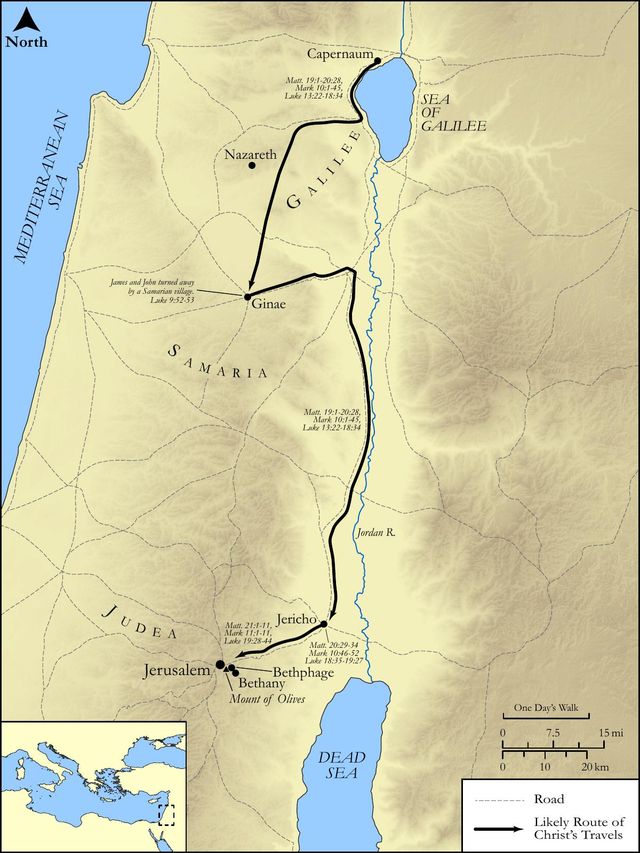
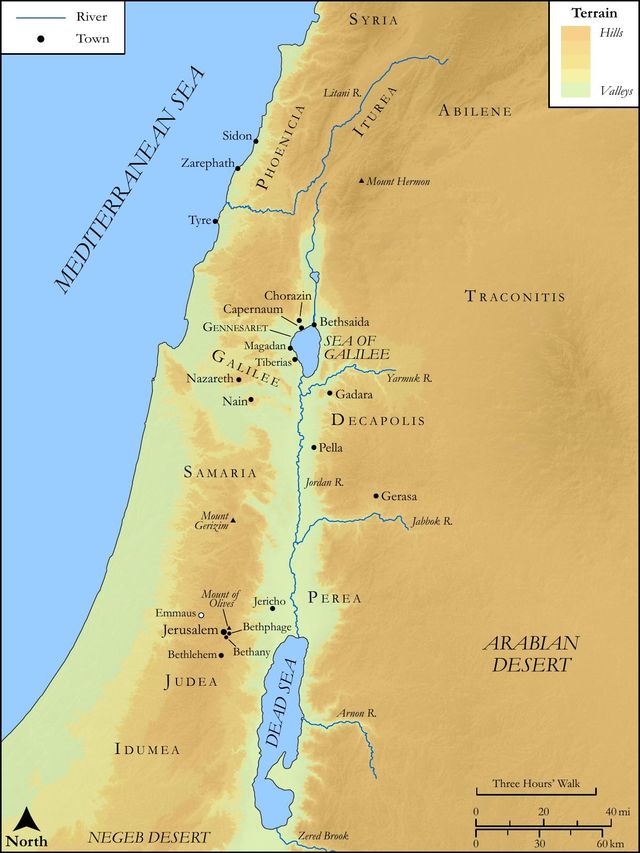
Study this verse
Public-domain commentary
Matthew Henry
From his Commentary on the Whole Bible. Henry comments on passages, not single verses — this entry covers Luke 18:18–30. His three-level outline is real structure in the source text, so it is rendered as structure.
In these verses we have,
I.Christ's discourse with a ruler, that had a good mind to be directed by him in the way to heaven. In which we may observe,
1.It is a blessed sight to see persons of distinction in the world distinguish themselves from others of their rank by their concern about their souls and another life. Luke takes notice of it that he was a ruler. Few of the rulers had any esteem for Christ, but here was one that had; whether a church or state ruler does not appear, but he was one in authority.
2.The great thing we are every one of us concerned to enquire after is what we shall do to get to heaven, what we shall do to inherit eternal life. This implies such a belief of an eternal life after this as atheists and infidels have not, such a concern to make it sure as a careless unthinking world have not, and such a willingness to comply with any terms that it may be made sure as those have not who are resolvedly devoted to the world and the flesh.
3.Those who would inherit eternal life must apply themselves to Jesus Christ as their Master, their teaching Master, so it signifies here (didaskale), and their ruling Master, and so they shall certainly find him. There is no learning the way to heaven but in the school of Christ, by those that enter themselves into it, and continue in it.
4.Those who come to Christ as their Master must believe him to have not only a divine mission, but a divine goodness. Christ would have this ruler know that if he understood himself aright in calling him good he did, in effect, call him God and indeed he was so (Luk 18:19): "Why callest thou me good? Thou knowest there is none good but one, that is, God; and dost thou then take me for God? If so, thou art in the right."
5.Our Master, Christ himself, has not altered the way to heaven from what it was before his coming, but has only made it more plain, and easy, and comfortable, and provided for our relief, in case we take any false step. Thou knowest the commandments. Christ came not to destroy the law and the prophets, but to establish them. Wouldest thou inherit eternal life? Govern thyself by the commandments.
6.The duties of the second table must be conscientiously observed, in order to our happiness, and we must not think that any acts of devotion, how plausible soever, will atone for the neglect of them. Nor is it enough to keep ourselves free from the gross violations of these commandments, but we must know these commandments, as Christ has explained them in his sermon upon the mount, in their extent and spiritual nature, and so observe them.
7.Men think themselves innocent because they are ignorant; so this ruler did. He said, All these have I kept from my youth up, Luk 18:21. He knows no more evil of himself than the Pharisee did, Luk 18:11. He boasts that he began early in a course of virtue, that he had continued in it to this day, and that he had not in any instance transgressed. Had he been acquainted with the extent and spiritual nature of the divine law, and with the workings of his own heart, - had he been but Christ's disciples awhile, and learned of him, he would have said quite the contrary: "All these have I broken from my youth up, in thought, word, and deed."
8.The great things by which we are to try our spiritual state are how we stand affected to Christ and to our brethren, to this world and to the other; by these this man was tried. For,
(1.)If we have a true affection to Christ, he will come and follow him, will attend to his doctrine, and submit to his discipline, whatever it cost him. None shall inherit eternal life who are not willing to take their lot with the Lord Jesus, to follow the Lamb whithersoever he goes.
(2.)If he have a true affection to his brethren, he will, as there is occasion, distribute to the poor, who are God's receivers of his dues out of our estates.
(3.)If he think meanly of this world, as he ought, he will not stick at selling what he has, if there be a necessity for it, for the relief of God's poor.
(4.)If he think highly of the other world, as he ought, he will desire no more than to have treasure in heaven, and will reckon that a sufficient abundant recompence for all that he has left, or lost, or laid out for God in this world.
9.There are many that have a great deal in them that is very commendable, and yet they perish for the lack of some one thing; so this ruler here; he broke with Christ upon this, he liked all his terms very well but this which would part between him and his estate: "In this, I pray thee, have me excused." If this be the bargain, it is no bargain.
10.Many that are loth to leave Christ, yet do leave him. After a long struggle between their convictions and their corruptions, their corruptions carry the day at last; they are very sorry that they cannot serve God and mammon both; but, if one must be quitted, it shall be their God, not their worldly gain.
II.Christ's discourse with his disciples upon this occasion, in which we may observe,
1.Riches are a great hindrance to many in the way to heaven. Christ took notice of the reluctancy and regret with which the rich man broke off from him. He saw that he was very sorrowful, and was sorry for him; but thence he infers, How hardly shall they that have riches enter into the kingdom of God! Luk 18:24. If this ruler had had but as little of the world as Peter, and James, and John had, in all probability he would have left it, to follow Christ, as they did; but, having a great estate, it had a great influence upon him, and he chose rather to take his leave of Christ than to lay himself under an obligation to dispose of his estate in charitable uses. Christ asserts the difficulty of the salvation of rich people very emphatically: It is easier for a camel to go through a needle's eye than for a rich man to enter into the kingdom of God, Luk 18:25. It is a proverbial expression, that denotes the thing to be extremely difficult.
2.There is in the hearts of all people such a general affection to this world, and the things of it, that, since Christ has required it as necessary to salvation that we should sit loose to this world, it is really very hard for any to get to heaven. If we must sell all, or break with Christ, who then can be saved? Luk 18:26. They do not find fault with what Christ required as hard and unreasonable. No, it is very fit that they who expect an eternal happiness in the other world should be willing to forego all that is dear to them in this world, in expectation of it. But they know how closely the hearts of most men cleave to this world, and are ready to despair of their being ever brought to this.
3.There are such difficulties in the way of our salvation: as could never be got over but by pure omnipotence, by that grace of God which is almighty, and to which that is possible which exceeds all created power and wisdom. The things which are impossible with men (and utterly impossible it is that men should work such a change upon their own spirits as to turn them from the world to God, it is like dividing the sea, and driving Jordan back), these things are possible with God. His grace can work upon the soul, so as to alter the bent and bias of it, and give it a contrary ply; and it is he that works in us both to will and to do.
4.There is an aptness in us to speak too much of what we have left and lost, of what we have done and suffered, for Christ. This appears in Peter: Lo, we have left all, and followed thee, Luk 18:28. When it came in his way, he could not forbear magnifying his own and his brethren's affection to Christ, in quitting all to follow him. But this we should be so far from boasting of, that we should rather acknowledge it not worth taking notice of, and be ashamed of ourselves that there should have been any regret and difficulty in the doing of it, and any hankerings towards those things afterwards.
5.Whatever we have left, or laid out, for Christ, it shall without fail be abundantly made up to us in this world and that to come, notwithstanding our weaknesses and infirmities (Luk 18:29, Luk 18:30): No man has left the comfort of his estate or relations for the kingdom of God's sake, rather than they should hinder either his services to that kingdom or his enjoyments of it, who shall not receive manifold more in this present time, in the graces and comforts of God's Spirit, in the pleasures of communion with God and of a good conscience, advantages which, to those that know how to value and improve them, will abundantly countervail all their loses. Yet that is not all; in the world to come they shall receive life everlasting, which is the thing that the ruler seemed to have his eye and heart upon.
Historical interpretation
Nine Centuries of Reception
19 surviving comments on this verse. Each one is dated, so this reads as a timeline rather than a list.
Select a marker to jump to its quote. Markers stagger vertically where authors wrote within a few decades of each other.
For when on earth He acted in the very same manner, and answered to one who addressed Him as 'Good Master': 'Why callest thou me good? One is good, my Father who is in heaven.'
He confessed that God who is truly good, saying, "Why callest thou Me good: there is One who is good, the Father in the heavens; "
Just as the world is composed of opposites, of heat and cold, dry and wet, so also is it made up of givers and receivers. Again when he says, "If you would be perfect, sell your possessions and give to the poor," he convicts the man who boasts that he has kept all the commandments from his youth up. For he had not fulfilled "Thou shalt love thy neighbour as thyself." Only then was he taught by the Lord who wished to make him perfect, to give for love's sake.
Now, undoubtedly, He is the good God who "sendeth rain on the just and on the unjust, and maketh His sun to rise on the evil and on the good; " sustaining and nourishing and assisting even Marcionites themselves! When afterwards "a certain man asked him, `Good Master, what shall I do to inherit eternal life? '" (Jesus) inquired whether he knew (that is, in other words, whether he kept) the commandments of the Creator, in order to testify that it was by the Creator's precepts that eternal life is acquired. Then, when he affirmed that from his youth up he had kept all the principal commandments, (Jesus) said to him: "One thing thou yet lackest: sell all that thou hast, and give to the poor, and thou shalt have treasure in heaven; and come, follow me.
That rich man did go his way who had not "received" the precept of dividing his substance to the needy, and was abandoned by the Lord to his own opinion. Nor will "harshness" be on this account imputed to Christ, the Found of the vicious action of each individual free-will.
(ex Apol. de sua fuga.) For when we despise the world, we must not imagine we have resigned any thing great, for the whole earth in comparison of the heaven is but a span long; therefore even should they who renounce it be lords of the whole earth, yet still it would be nothing worth in comparison of the kingdom of heaven.
When he says then, Good Master, what shall I do to inherit eternal life? it is the same as if he says, Thou art good; vouchsafe me then an answer to my question. I am learned in the Old Testament, but I see in Thee something far more excellent. For Thou makest no earthly promises, but preachest the kingdom of heaven. Tell me then, what shall I do to inherit eternal life? The Saviour then considering his meaning, because faith is the way to good works, passes over the question he asked, and leads him to the knowledge of faith; as if a man was to ask a physician, "What shall I eat?" and he was to show him what ought to go before his food. And then He sends him to His Father, saying, Why callest thou me good? not that He was not good, for He was the good branch from the good tree, or the good Son of the good Father.
After instructing him in the knowledge of the faith, He adds, Thou knowest the commandments. As though He said, Know God first, and then will it be time to seek what thou askest.
But you may observe that these commandments consist in not doing certain things; that if thou hast not committed adultery, thou art chaste; if thou stealest not, honestly disposed; if thou bearest not false witness, truth-telling. Virtue then we see is rendered easy through the goodness of the Lawgiver. For He speaks of avoiding of evil, not practising of good. And any cessation from action is easier than any actual work.
Our Lord next declares, that though a man has kept the old covenant, he is not perfect, since he lacks to follow Christ. Thou yet lackest one thing, Sell all that thou hast, &c. As if He says, Thou askest how to possess eternal life; scatter thy goods among the poor, and thou shalt obtain it. A little thing is that thou spendest, thou receivest great things.
(in Esai. cap. 1. 23.) Now we must not understand by thieves, only such as cut strips off hides, or commit robberies in the baths. But all such also as, when appointed leaders of legions, or installed governors of states or nations, are guilty of secret embezzlement, or violent and open exactions.
(in Reg. Brev. int. 92.) He does not tell us to sell our goods, because they are by nature evil, for then they would not be God's creatures; He therefore does not bid us cast them away as if they were bad, but distribute them; nor is any one condemned for possessing them, but for abusing them. And thus it is, that to lay out our goods according to God's command both blots out sins, and bestows the kingdom.
(in Reg. fus. disp. 3. ad int. 9.) When our Lord says, Give to the poor, it becomes a man no longer to be careless, but diligently to dispose of all things, first of all by himself if in any measure he is able, if not, by those who are known to be faithful, and prudent in their management; for cursed is he who doeth the work of the Lord negligently. (Jerem. 49, 10.)
(Hom. de eleemos.) The merchant when he goes to the market, is not loth to, part with all that he has, in order to obtain what he requires, but thou art grieved at giving mere dust and ashes that thou mayest gain everlasting bliss.
That ruler tempting Him said, Good Master, he ought to have said, Good God. For although goodness exists in divinity and divinity in goodness, yet by adding Good Master, he uses good only in part, not in the whole. For God is good altogether, man partially.
He does not deny that He is good, but points to God. None is good then except he be full of goodness. But should it strike any one that it is said, none is good, let this also strike him, save God, and if the Son is not excepted from God, surely neither is Christ excepted from good. For how is He not good who is born from good? A good tree brings forth good fruits. (Matt. 7:17.) How is He not good, seeing that the substance of His goodness which He took unto Him from the Father has not degenerated in the Son which did not degenerate in the Spirit. Thy good spirit, he says, shall lead me into a land of uprightness. (Ps. 148:10.) But if the Spirit is good who received from the Son, verily He also is good who gave It. Because then it was a lawyer who tempted Him, as is plainly shown in another book, He therefore well said, None is good, save God, that He might remind him that it was written, Thou shalt not tempt the Lord thy God, (Deut. 6:16.) but he the rather gives thanks to the Lord that He is good. (Ps. 118.)
Honour is concerned not only with paying respect, but also with giving bountifully. For it is honouring to reward deserts. Feed thy father, feed thy mother, and when thou hast fed them thou hast not requited all the pangs and agony thy mother underwent for thee. To the one thou owest all thou hast, to the other all thou art. What a condemnation, should the Church feed those whom thou art able to feed! But it may be said, What I was going to bestow upon my parents, I prefer to give to the Church. God seeks not a gift which will starve thy parents, but the Scripture says as well that parents are to be fed, as that they are to be left for God's sake, should they check the love of a devout mind.
It follows, And he said, All these things have I kept from my youth up.
And Peter said: "I shall explain to you how goodness itself is just. Our teacher Himself first said to the Pharisee who asked Him, 'What shall I do to inherit eternal life?' 'Do not call me good; for one is good, even the Father who is in the heavens;' and straightway He introduced these words, 'But if you shall wish to enter into life, keep the commandments.' And when he said, 'What commandments?' He pointed him to those of the law."
(Hom. 63. in Matt.) Or else; I shall not hesitate to call this ruler covetous, for with this Christ reproaches him, but I say not that he was a tempter.
(Hom. 22. in 1 ad Cor.) God might indeed feed the poor without our taking compassion upon them, but He wishes the givers to be bound by the ties of love to the receivers.
(Hom. 32. in 1. ad Cor.) But it is asked, how does Christ acknowledge the giving all things to the poor to be perfection, whereas St. Paul declares this very thing without charity to be imperfect. Their harmony is shown in the words which succeed, And come, follow me, which betokens it to be from love. For herein shall all men know that ye are my, disciples, if ye have love one toward another. (John 13:35.)
(in Matt. 19:19.) The young man speaks false, for if he had fulfilled that which was afterwards placed among the commandments, Thou shalt love thy neighbour as thyself, how was it that when he heard, Go and sell all that thou hast, and give to the poor, he went away sorrowful?
(Quæst. Ev. lib. ii. qu. 63.) It may seem that the account given in Matthew is different, where it is said, "Why askest thou me of good?" which might apply better to the question which he asked, What good shall I do? (Matt. 10.) In this place he both calls Him good, and asks the question about good. It will be best then to understand both to have been said, Why callest thou me good? and, Why askest thou me of good? though the latter may rather be implied in the former.
The Jewish crowds … with their princes and teachers … looked at Christ as being a mere man like one of us, and not as God who had become man. They approached him to test him and lay the nets of their cleverness for him.…He is called here a ruler. He fancied himself to have learned the law and supposed that he had been accurately taught it. He imagined that he could convict Christ of introducing laws of his own and of dishonoring the commandment spoken by most wise Moses. It was the Jews' goal to prove that Christ opposed and resisted the former commandments and established new laws by his own authority, in opposition to those previously existing. Their wicked conduct toward him had a false pretext. He comes near and makes a pretense of speaking kindly. He calls him "Teacher," designates him "good," and professes himself desirous of being a disciple. He says, "What shall I do to inherit eternal life?" Observe how he mixes flattery with fraud and deceit, like one who mingles vinegar with honey. He supposed that he could deceive him in this way.
Now he thought to detect Christ in blaming the law of Moses, while He introduced His own commands. He went then to the Master, and calling Him good, says that he wishes to be taught by Him, for he sought to tempt Him. But He who takes the wise in their craftiness answers him fitly as follows, Why callest thou me good? there is none good, save God alone.
But the ruler expected to hear Christ say, Forsake the commandments of Moses, and listen to Mine. Whereas He sends him to the former; as it follows, Thou shalt not kill, Thou shalt not commit adultery.
The ruler was not able to contain the new word, but being like an old bottle, burst with sorrow.
And a certain ruler asked him, saying: Good teacher, what shall I do to inherit eternal life? I believe this ruler had heard from the Lord that only those who want to be like children will enter the kingdom of God, and therefore, concerned with obtaining clear guidance, he asks to be told openly, not in parables, by what merits of works he may gain eternal life.
A certain ruler having heard our Lord say, that only those who would be like little children should enter the kingdom of heaven, entreats Him to explain to him not by parable but openly by what works he may merit to obtain eternal life.
Or we must not think him to have lied, but to have avowed that he had lived honestly, that is, at least in outward things, else Mark could never have said, And Jesus seeing him, loved him. (Mark. 10:21.)
Whoever then wishes to be perfect must sell all that he hath, not a part only, as Ananias and Sapphira did, but the whole.
Some think that this man was cunning and sought to trap the Lord with words. But this is not how he appears; rather, he was a lover of money, and Christ Himself rebuked him as such. Mark says that the man came running, and knelt before Jesus, and asked Him his question, and that Jesus, beholding him, loved him. [Mk. 10:17-22] The man is a lover of money, and he approaches Jesus eager to learn how he, along with his wealth, might inherit eternal life. For there is no one who loves prolonged life as much as a man who loves money. Therefore this man thought that Jesus could show him some way in which he could live forever enjoying his possession of wealth. But when the Lord told him that non-possession is what bestows eternal life, he went away as if he regretted both his question and Jesus answer. In his mind he needed eternal life for the very reason that he had great wealth. If he were to give up his possessions, why would he want eternal life, he thought, since that life was to be the life of a pauper? He approached the Lord as if the Lord were merely a man and a teacher. Therefore the Lord shows him that he ought not to approach Him in this manner, saying, None is good, save One, that is, God. By this He means, "You call Me good; why then do you also call Me a teacher? It appears that you think that I am one among many men. But if this were so, I would not be good, for no man is good in and of himself. Only God is. If you want to call Me good, you must call Me good because I am God; do not approach Me then as if I were merely a man. But if you think I am only a man, do not call Me good. For in truth God is good, and the source of goodness, and the first cause of goodness itself. If any man is good, he is not good in and of himself, but only because he receives a share of God’s goodness. Moreover, what goodness a man has is changeable."
Thou knowest the commandments: Do not commit adultery, Do not murder, Do not steal, Do not bear false witness, and so forth. The law remedies first those sins into which we fall easily, and then those less frequent sins to which fewer men fall. And so adultery and murder are mentioned first, because lust and anger are difficult to control: lust is a raging fire, inflaming both the outer and inner man, and anger is a great wild beast. But stealing comes from a less fierce passion and bearing false witness occurs rarely. Therefore, the law remedies first those sins into which we fall most easily, and which are the most grave. But the other sins, such as stealing and bearing false witness, He places second because they lead astray less often and are less grave than murder and adultery. To sin against ones parents He mentions last of all; for although it is a grave sin, it does not occur often. Rarely is there found a man so cruel that he abuses his parents. Because the young man said that he had kept all these commandments from his youth, the Lord enjoins him to keep that commandment which stands at the head of all: non-possession. Behold the laws of the true Christian life. Sell all that thou hast, the Lord says. If anything remains, you are its slave. And distribute, not to your rich relatives, but unto the poor. I think that the word distribute implies that the meting out of wealth is to be done with discernment and not haphazardly. And because a man must have all the other virtues as well as non-possession, the Lord then said, And come, follow Me, meaning, "Be My disciple in all things, and always keep following Me. Do not follow Me today only, and leave Me tomorrow." Because the ruler was a lover of money, the Lord promised him treasure in heaven, but the ruler did not give heed, because he was a slave of his money. Therefore when he heard what the Lord had asked of him, he was sorrowful. For the Lord had counselled him to deprive himself of his wealth; yet that was the very reason he wanted eternal life in the first place, so that he could live forever enjoying his many possessions. That he was sorrowful shows that he was sincere and not devious. Not one of the Pharisees was ever sorrowful; instead, they raged even more against the Lord when they heard His answers to their questions. I am not unaware that the great light of the world, John Chrysostom, believed that this young man truly desired eternal life, but that he was held fast by the love of money, a passion that was stronger than his love for eternal life. What we have said here is not inconsistent, namely, that the young man desired to have eternal life along with his wealth.
The wise men of the Gentiles therefore who seek for wisdom in a mystery, which is the kingdom of God, and will not receive this without the evidence of logical proof, are rightly shut out from this kingdom.
The law first forbids those things to which we are most prone, as adultery for instance, the incitement to which is within us, and of our nature; and murder, because rage is a great and savage monster. But theft and bearing false witness are sins which men seldom fall into. And besides, the former also are the more grievous sins, therefore He places theft and bearing false witness in the second place, as both less common, and of less weight than the other.
Because sin against parents, although a great crime, very rarely happens, He places it last of all, Honour thy father and mother.
Hence when he says, All that thou hast, He inculcates the most complete poverty. For if there is any thing left over or remaining to thee, thou art its slave.
Together with poverty must exist all the other virtues, therefore He says, Come, follow me, that is, In all other things be My disciples, be always following Me.
Continue studying Luke 18:18 across the web’s major study libraries — every link below opens this exact verse, chapter, or book on the destination site.
Read & Compare
 BibleGatewayThis verse in more than 200 translations and 70 languages.
 Bible.comThe YouVersion reader — hundreds of translations, reading plans, and highlights.
 ESV.orgCrossway's official English Standard Version reader.
 NET BibleThe NET translation with 60,000+ translators' notes on every rendering decision.
 STEP BibleTyndale House's free study tool — original text, vocabulary, and scholarly resources.
 BibliaLogos Bible Software's free web reader.
 USCCBThe New American Bible (Revised Edition) with the U.S. bishops' study notes.
Commentaries
 BibleHub CommentariesDozens of classic commentaries on this verse, gathered on one page.
 StudyLightMore than 100 commentary sets — the largest collection on the web.
 BibleRefPlain-English commentary on what this verse means, verse by verse.
 Enduring WordDavid Guzik's free commentary on this chapter, widely used by Bible teachers.
 Bible Study ToolsVerse commentary alongside Greek and Hebrew study aids.
Original Language & Research
- BibleHub InterlinearThe verse word by word — original language, transliteration, and English.
- BibleHub LexiconEvery word's original-language definition and Strong's entry.
 Blue Letter BibleDeep-study tools — Strong's numbers, concordance, and word studies.
 CNTR CollationThe earliest Greek manuscripts of this verse, collated letter by letter.
Sermons, Hymns & Audio


TrulyRandomVerse is not affiliated with these sites and doesn’t control their content. They’re linked because they’re genuinely useful.
Summary
Luke 18:18 introduces a pivotal encounter between Jesus and a prominent, wealthy individual, commonly known as the rich young ruler. This verse captures the ruler's earnest, yet fundamentally misdirected, question regarding the pathway to eternal life, setting the stage for Jesus' profound teaching on the nature of salvation, the demands of discipleship, and the inherent human struggle with material possessions and self-righteousness in the pursuit of God's Kingdom.
Context
ShowHideLiterary Context
This encounter immediately follows Jesus' teaching on the necessity of receiving the Kingdom of God with the humble, dependent faith of a child, as articulated in Luke 18:17. The ruler's question, "what shall I do to inherit eternal life?", directly contrasts with Jesus' preceding emphasis on passive reception rather than active earning. This juxtaposition highlights a central tension in the Gospel: human attempts at self-justification versus divine grace. The narrative continues to explore the ruler's inability to fully embrace Jesus' radical call, leading to his sorrowful departure and Jesus' subsequent teaching on the difficulty for the wealthy to enter the Kingdom of God, as seen in Luke 18:23-27. Parallel accounts of this significant interaction are also found in Matthew 19:16-22 and Mark 10:17-22, underscoring its thematic importance across the Synoptic Gospels.
Historical & Cultural Context
The individual is identified as an "archon" (ruler), indicating a position of authority and influence, likely a member of the Sanhedrin or a local synagogue leader, suggesting he was a respected and observant Jew. In the Jewish tradition of the time, "inheriting eternal life" was often understood as the reward for strict adherence to the Mosaic Law and the commandments. The question "what shall I do?" reflects a common rabbinic framework where righteousness was achieved through diligent obedience and good works. Wealth was often viewed as a sign of God's blessing, making the ruler's subsequent struggle with Jesus' command to sell his possessions particularly challenging within his cultural paradigm. His address to Jesus as "Good Master" (Good Teacher) also reveals a cultural respect for religious instructors, yet Jesus' response to this title in Luke 18:19 subtly challenges the ruler's understanding of goodness itself, pointing to God as the ultimate standard.
Key Themes
ShowHideThis verse introduces several profound themes central to the Gospel of Luke and Christian theology. The most prominent is The Quest for Eternal Life, reflecting humanity's innate longing for ultimate meaning and salvation, though often approached through a works-based mentality. The ruler's question immediately sets up the theme of Human Effort vs. Divine Grace, contrasting the desire to "do" something to earn salvation with Jesus' revelation that true entry into the Kingdom is a gift received through humble faith and radical discipleship. Furthermore, the interaction highlights Jesus' Authority and Identity, as He not only answers the ruler's question but also probes the implications of the title "Good Master," subtly hinting at His own divine nature and the unique source of true goodness. Finally, the subsequent narrative will delve into the theme of The Danger of Riches, demonstrating how material wealth can become an obstacle to wholehearted devotion to God.
Exposition and Analysis
ShowHideKey Word Analysis
ShowHideThis primary word signifies "good" in any sense, often used as a noun to mean benefit or good things. When the ruler addresses Jesus as "Good Master," he is using a term of high respect, acknowledging Jesus' moral excellence and teaching. However, Jesus' immediate response in Luke 18:19 challenges the ruler to consider the absolute nature of goodness, implying that only God is inherently good in the ultimate sense. This forces the ruler to ponder whether he truly understands the implications of his address.
Derived from the verb "to teach," this term denotes an instructor, doctor, or teacher. The ruler recognizes Jesus as a respected religious authority, a teacher who could impart wisdom on the path to eternal life. This title reflects the ruler's perception of Jesus as a human sage or rabbi, capable of providing instruction, rather than necessarily acknowledging His divine authority or messianic identity.
This verb means "to be an heir to" or "to obtain by inheritance," literally or figuratively. It suggests receiving a legacy, a birthright, or a portion that is given rather than earned through labor. The ruler's use of this term, coupled with his question "what shall I do?", reveals a tension: he speaks of receiving an inheritance, yet he seeks to earn it through his own actions, highlighting a fundamental misunderstanding of the nature of eternal life as a divine gift.
Verse Breakdown
ShowHide"And a certain ruler asked him, saying,"
This opening clause immediately establishes the setting and the primary character. The "ruler" (ἄρχων, archōn) signifies a person of significant social standing and authority, likely a respected leader in the Jewish community. His initiative in approaching Jesus indicates a genuine spiritual earnestness and a recognition of Jesus' growing reputation as a teacher. The phrase "asked him, saying" sets up a direct dialogue, a common pedagogical method employed by Jesus.
"Good Master,"
This address is a respectful and honorific title. "Good" (ἀγαθέ, agathe) acknowledges Jesus' moral character and perceived wisdom, while "Master" (διδάσκαλε, didaskale) identifies Jesus as a teacher or rabbi. This respectful salutation, however, becomes a point of theological inquiry for Jesus, who uses it to prompt the ruler to consider the ultimate source of goodness.
"what shall I do"
This phrase reveals the ruler's underlying assumption about obtaining eternal life. His focus is on "doing" (ποιέω, poiéō), indicating a works-based understanding of righteousness, common in the legalistic religious climate of the time. He believes that eternal life is something that can be achieved through specific actions, commandments, or religious observances. This question frames the entire subsequent dialogue, as Jesus will challenge this premise.
"to inherit eternal life?"
This is the core of the ruler's inquiry, expressing a deep human longing for ultimate salvation and a lasting future beyond earthly existence. "Eternal life" (ζωὴν αἰώνιον, zōēn aiōnion) refers not merely to unending existence but to a quality of life—a life in fellowship with God, characterized by His divine nature and blessing. The use of "inherit" (κληρονομήσω, klēronomēsō) suggests a legacy or birthright, which ironically contrasts with the ruler's "what shall I do?" approach, hinting at the tension between earning and receiving.
Literary Devices
ShowHideLuke 18:18 effectively employs several literary devices to set the stage for Jesus' profound teaching. The most prominent is Dialogue, which serves as the primary vehicle for theological instruction in this pericope. The ruler's direct question initiates a back-and-forth exchange that allows Jesus to expose the ruler's spiritual blind spots and reveal deeper truths about the Kingdom of God. There is also a subtle Irony present: the ruler, a man of authority and presumed wisdom, approaches Jesus with a question that reveals his fundamental misunderstanding of salvation, believing it to be earned by human effort rather than received as a gift. Furthermore, the verse sets up a powerful Contrast between the ruler's works-based mindset and the childlike humility Jesus had just advocated in Luke 18:17, highlighting the different approaches to entering God's Kingdom.
Theological and Thematic Connections
ShowHideLuke 18:18 serves as a crucial theological pivot, highlighting the perennial human inclination to earn divine favor through personal merit and religious observance. The ruler's question, "what shall I do to inherit eternal life?", encapsulates the works-righteousness paradigm prevalent in many religious systems, contrasting sharply with the New Testament's revelation of salvation as a gift received by grace through faith. This encounter underscores that true goodness resides in God alone, challenging any human presumption of self-sufficiency in the pursuit of eternal life. It also sets the stage for Jesus to expose the idols of the heart, particularly the deceptive power of wealth, which can hinder one's complete surrender to God. Ultimately, the verse initiates a discourse that reveals the radical demands of discipleship and the transformative power of God to accomplish what is impossible for humans.
Reflection and Application
ShowHideThe rich young ruler's question in Luke 18:18 resonates deeply with the human condition, reflecting our innate desire for purpose, meaning, and a lasting legacy. Yet, it also exposes our tendency to approach God from a position of self-reliance, asking "What must I do?" rather than "What has God done?" or "How can I receive?" This verse challenges us to honestly examine our own hearts: Do we subtly believe that our good deeds, moral uprightness, or religious observances are sufficient to earn God's favor or secure our eternal destiny? Are we, like the ruler, prepared to receive an "inheritance" but unwilling to relinquish the things we hold most dear when God calls us to radical obedience? True spiritual fulfillment is not found in accumulating merits but in humbly acknowledging our need for God's grace and surrendering our lives, including our possessions and perceived achievements, to His sovereign will. This passage calls us to a profound re-evaluation of our priorities and a radical trust in God's provision and pathway to life.
Questions for Reflection
ShowHideFAQ
ShowHideWho was the "certain ruler" mentioned in Luke 18:18?
ShowHideThe "certain ruler" is commonly referred to as the rich young ruler. While Luke identifies him simply as an "archon" (a ruler or magistrate), the parallel accounts in Matthew 19:20 add that he was "young," and all three Synoptic Gospels (Matthew, Mark, and Luke) emphasize his great wealth. His position as a "ruler" suggests he was a person of significant social standing and authority, likely a member of the Jewish Sanhedrin or a leader in a local synagogue, indicating he was a respected and observant Jew.
Why did Jesus challenge the ruler's use of "Good Master" in Luke 18:19?
ShowHideWhen the ruler addressed Jesus as "Good Master" (or "Good Teacher"), Jesus responded by saying, "Why do you call me good? No one is good—except God alone" (Luke 18:19). Jesus was not denying His own goodness or divinity. Instead, He was probing the ruler's understanding of "goodness." Was the ruler merely using a polite honorific, or did he truly grasp the profound implications of calling someone "good" in an absolute sense? Jesus' response forces the ruler to consider that ultimate, inherent goodness belongs uniquely to God. It was a challenge to the ruler to either acknowledge Jesus' divine nature (if he truly believed Jesus was absolutely good) or to reconsider his own limited understanding of goodness and the source of eternal life.
Christ-Centered Fulfillment
ShowHideLuke 18:18, with the rich young ruler's earnest inquiry about inheriting eternal life, powerfully sets the stage for the Christ-centered fulfillment of humanity's deepest longings. The ruler's question, "what shall I do?", highlights the inherent human tendency to seek salvation through works and self-effort, a path that ultimately proves insufficient. Jesus, as the Good Master, subtly redirects the ruler's gaze from his own doing to the ultimate source of all goodness—God Himself. This encounter foreshadows the New Covenant reality where eternal life is not earned by adherence to the Law, but is a gracious gift freely offered through Jesus Christ. He is the one who perfectly fulfilled the Law (Matthew 5:17), and through His sacrificial death and resurrection, He became the sole means by which humanity can truly "inherit" eternal life (John 3:16). The "goodness" the ruler attributed to Jesus finds its ultimate expression in Christ's sinless life and His atoning work, which alone makes us righteous before God (2 Corinthians 5:21). Thus, the answer to "what shall I do?" is ultimately "believe in the Lord Jesus, and you will be saved" (Acts 16:31), receiving as an inheritance what no human effort could ever achieve.