


Luke 18:29
Bible text: King James Version (1769 Blayney text) · Public domain
Bible text: King James Version with Strong's numbers · Public domain
Bible text: Berean Standard Bible · Public domain
Bible text: American Standard Version (1901) · Public domain
Bible text: World English Bible, Messianic edition · Public domain
Bible text: Geneva Bible (1599) · Public domain
Bible text: Young's Literal Translation · Public domain
- ὉHo<the>G3588T-NSMDefinite article Nominative Singular Masculine
- δὲdeAndG1161CONJConjunction
- εἶπενeipenHe saidG2036V-2AAI-3SVerb 2nd Aorist Active Indicative 3rd Singular
- αὐτοῖς·autoisto themG846P-DPMPersonal pronoun Dative Plural Masculine
- ἀμὴνamēnAmenG281INJ-HEBInterjection
- λέγωlegōI sayG3004V-PAI-1SVerb Present Active Indicative 1st Singular
- ὑμῖνhuminto youG4771P-2DPPersonal pronoun Dative 2nd Plural
- ὅτιhotithatG3754CONJConjunction
- οὐδείςoudeisno [one]G3762A-NSMAdjective Nominative Singular Masculine
- ἐστινestinthere isG1510V-PAI-3SVerb Present Active Indicative 3rd Singular
- ὃςhoswhoG3739R-NSMRelative pronoun Nominative Singular Masculine
- ἀφῆκενaphēkenhas leftG863V-AAI-3SVerb Aorist Active Indicative 3rd Singular
- οἰκίανoikianhouseG3614N-ASFNoun Accusative Singular Feminine
- ἢēorG2228CONJConjunction
- γυναῖκαgunaikawifeG1135N-ASFNoun Accusative Singular Feminine
- ἢēorG2228CONJConjunction
- ἀδελφοὺςadelphousbrothersG80N-APMNoun Accusative Plural Masculine
- ἢēorG2228CONJConjunction
- γονεῖςgoneisparentsG1118N-APMNoun Accusative Plural Masculine
- ἢēorG2228CONJConjunction
- τέκναteknachildrenG5043N-APNNoun Accusative Plural Neuter
- ἕνεκενhenekenfor the sake ofG1752PREPPreposition
- τῆςtēstheG3588T-GSFDefinite article Genitive Singular Feminine
- βασιλείαςbasileiaskingdomG932N-GSFNoun Genitive Singular Feminine
- τοῦtou<the>G3588T-GSMDefinite article Genitive Singular Masculine
- θεοῦtheouof GodG2316N-GSM-TNoun Genitive Singular Masculine Title
English is a literal word-by-word gloss of the Greek, not the KJV's wording. Why?
This is the original text the KJV's translators worked from — each Greek word with its own literal English meaning in this verse, prepared by scholars at Tyndale House, Cambridge. The KJV translates whole sentences, not word by word, so its wording differs: one Greek word can become several English words, and the KJV may choose “charity” where the gloss reads “love”. Both are faithful — they answer different questions. For the KJV's own rendering, switch to the KJV text.
Details
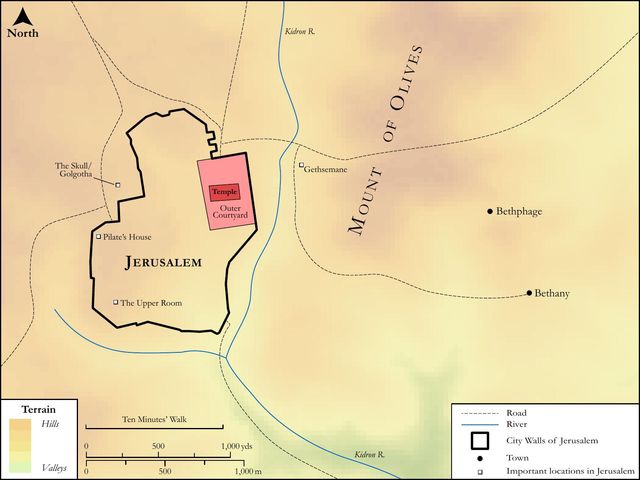
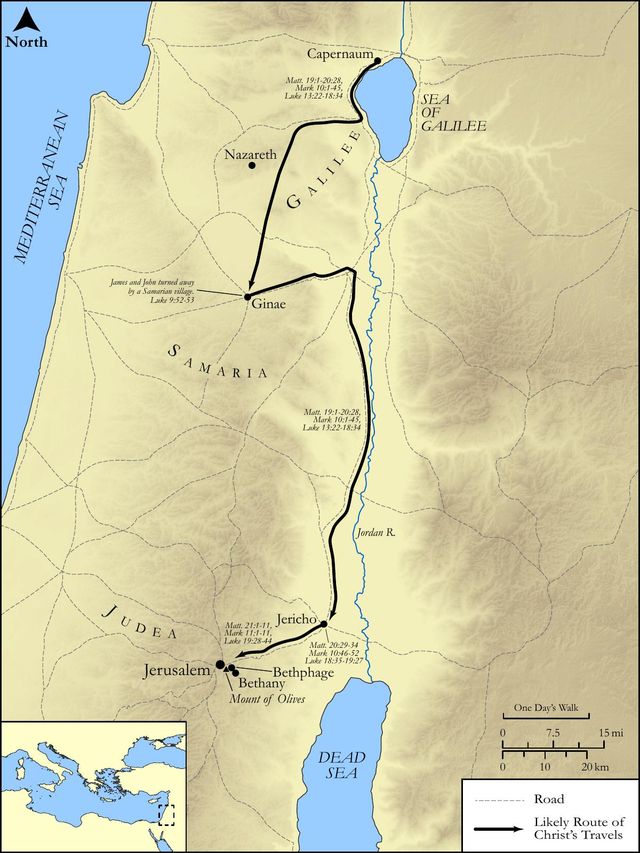
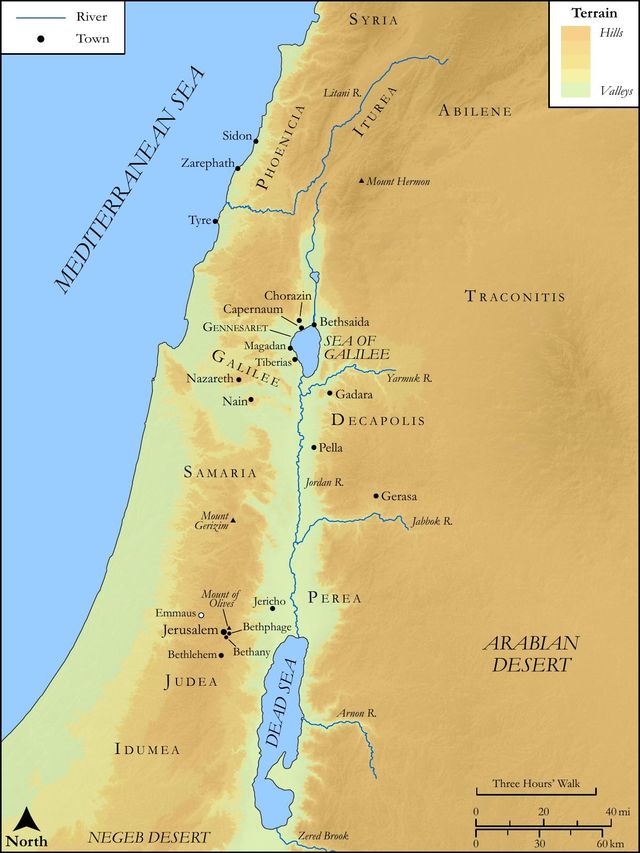
See on the biblical-era maps
Study this verse
Public-domain commentary
Matthew Henry
From his Commentary on the Whole Bible. Henry comments on passages, not single verses — this entry covers Luke 18:18–30. His three-level outline is real structure in the source text, so it is rendered as structure.
In these verses we have,
I.Christ's discourse with a ruler, that had a good mind to be directed by him in the way to heaven. In which we may observe,
1.It is a blessed sight to see persons of distinction in the world distinguish themselves from others of their rank by their concern about their souls and another life. Luke takes notice of it that he was a ruler. Few of the rulers had any esteem for Christ, but here was one that had; whether a church or state ruler does not appear, but he was one in authority.
2.The great thing we are every one of us concerned to enquire after is what we shall do to get to heaven, what we shall do to inherit eternal life. This implies such a belief of an eternal life after this as atheists and infidels have not, such a concern to make it sure as a careless unthinking world have not, and such a willingness to comply with any terms that it may be made sure as those have not who are resolvedly devoted to the world and the flesh.
3.Those who would inherit eternal life must apply themselves to Jesus Christ as their Master, their teaching Master, so it signifies here (didaskale), and their ruling Master, and so they shall certainly find him. There is no learning the way to heaven but in the school of Christ, by those that enter themselves into it, and continue in it.
4.Those who come to Christ as their Master must believe him to have not only a divine mission, but a divine goodness. Christ would have this ruler know that if he understood himself aright in calling him good he did, in effect, call him God and indeed he was so (Luk 18:19): "Why callest thou me good? Thou knowest there is none good but one, that is, God; and dost thou then take me for God? If so, thou art in the right."
5.Our Master, Christ himself, has not altered the way to heaven from what it was before his coming, but has only made it more plain, and easy, and comfortable, and provided for our relief, in case we take any false step. Thou knowest the commandments. Christ came not to destroy the law and the prophets, but to establish them. Wouldest thou inherit eternal life? Govern thyself by the commandments.
6.The duties of the second table must be conscientiously observed, in order to our happiness, and we must not think that any acts of devotion, how plausible soever, will atone for the neglect of them. Nor is it enough to keep ourselves free from the gross violations of these commandments, but we must know these commandments, as Christ has explained them in his sermon upon the mount, in their extent and spiritual nature, and so observe them.
7.Men think themselves innocent because they are ignorant; so this ruler did. He said, All these have I kept from my youth up, Luk 18:21. He knows no more evil of himself than the Pharisee did, Luk 18:11. He boasts that he began early in a course of virtue, that he had continued in it to this day, and that he had not in any instance transgressed. Had he been acquainted with the extent and spiritual nature of the divine law, and with the workings of his own heart, - had he been but Christ's disciples awhile, and learned of him, he would have said quite the contrary: "All these have I broken from my youth up, in thought, word, and deed."
8.The great things by which we are to try our spiritual state are how we stand affected to Christ and to our brethren, to this world and to the other; by these this man was tried. For,
(1.)If we have a true affection to Christ, he will come and follow him, will attend to his doctrine, and submit to his discipline, whatever it cost him. None shall inherit eternal life who are not willing to take their lot with the Lord Jesus, to follow the Lamb whithersoever he goes.
(2.)If he have a true affection to his brethren, he will, as there is occasion, distribute to the poor, who are God's receivers of his dues out of our estates.
(3.)If he think meanly of this world, as he ought, he will not stick at selling what he has, if there be a necessity for it, for the relief of God's poor.
(4.)If he think highly of the other world, as he ought, he will desire no more than to have treasure in heaven, and will reckon that a sufficient abundant recompence for all that he has left, or lost, or laid out for God in this world.
9.There are many that have a great deal in them that is very commendable, and yet they perish for the lack of some one thing; so this ruler here; he broke with Christ upon this, he liked all his terms very well but this which would part between him and his estate: "In this, I pray thee, have me excused." If this be the bargain, it is no bargain.
10.Many that are loth to leave Christ, yet do leave him. After a long struggle between their convictions and their corruptions, their corruptions carry the day at last; they are very sorry that they cannot serve God and mammon both; but, if one must be quitted, it shall be their God, not their worldly gain.
II.Christ's discourse with his disciples upon this occasion, in which we may observe,
1.Riches are a great hindrance to many in the way to heaven. Christ took notice of the reluctancy and regret with which the rich man broke off from him. He saw that he was very sorrowful, and was sorry for him; but thence he infers, How hardly shall they that have riches enter into the kingdom of God! Luk 18:24. If this ruler had had but as little of the world as Peter, and James, and John had, in all probability he would have left it, to follow Christ, as they did; but, having a great estate, it had a great influence upon him, and he chose rather to take his leave of Christ than to lay himself under an obligation to dispose of his estate in charitable uses. Christ asserts the difficulty of the salvation of rich people very emphatically: It is easier for a camel to go through a needle's eye than for a rich man to enter into the kingdom of God, Luk 18:25. It is a proverbial expression, that denotes the thing to be extremely difficult.
2.There is in the hearts of all people such a general affection to this world, and the things of it, that, since Christ has required it as necessary to salvation that we should sit loose to this world, it is really very hard for any to get to heaven. If we must sell all, or break with Christ, who then can be saved? Luk 18:26. They do not find fault with what Christ required as hard and unreasonable. No, it is very fit that they who expect an eternal happiness in the other world should be willing to forego all that is dear to them in this world, in expectation of it. But they know how closely the hearts of most men cleave to this world, and are ready to despair of their being ever brought to this.
3.There are such difficulties in the way of our salvation: as could never be got over but by pure omnipotence, by that grace of God which is almighty, and to which that is possible which exceeds all created power and wisdom. The things which are impossible with men (and utterly impossible it is that men should work such a change upon their own spirits as to turn them from the world to God, it is like dividing the sea, and driving Jordan back), these things are possible with God. His grace can work upon the soul, so as to alter the bent and bias of it, and give it a contrary ply; and it is he that works in us both to will and to do.
4.There is an aptness in us to speak too much of what we have left and lost, of what we have done and suffered, for Christ. This appears in Peter: Lo, we have left all, and followed thee, Luk 18:28. When it came in his way, he could not forbear magnifying his own and his brethren's affection to Christ, in quitting all to follow him. But this we should be so far from boasting of, that we should rather acknowledge it not worth taking notice of, and be ashamed of ourselves that there should have been any regret and difficulty in the doing of it, and any hankerings towards those things afterwards.
5.Whatever we have left, or laid out, for Christ, it shall without fail be abundantly made up to us in this world and that to come, notwithstanding our weaknesses and infirmities (Luk 18:29, Luk 18:30): No man has left the comfort of his estate or relations for the kingdom of God's sake, rather than they should hinder either his services to that kingdom or his enjoyments of it, who shall not receive manifold more in this present time, in the graces and comforts of God's Spirit, in the pleasures of communion with God and of a good conscience, advantages which, to those that know how to value and improve them, will abundantly countervail all their loses. Yet that is not all; in the world to come they shall receive life everlasting, which is the thing that the ruler seemed to have his eye and heart upon.
Historical interpretation
Nine Centuries of Reception
13 surviving comments on this verse. Each one is dated, so this reads as a timeline rather than a list.
Select a marker to jump to its quote. Markers stagger vertically where authors wrote within a few decades of each other.
And again He says, "Whosoever shall have left lands, or houses, or parents, or brethren, or children because of Me, he shall receive in this world an hundred-fold, and in that to come he shall inherit eternal life."
What hope and reward remains for the righteous and for martyrs after the conflicts and sufferings of this present time, The Holy Spirit shows and predicts by Solomon, saying: "And although in the sight of men they suffered torments, yet their hope is full of immortality. And having been troubled in a few things, they shall be in many happily ordered, because God has tried them, and has found them worthy of Himself. As gold in the furnace, He hath tried them; and as whole burnt-offerings of sacrifice, He hath received them, and in its season there will be respect of them. They will shine and run about as sparks in a place set with reeds. They shall judge the nations, and have dominion over the peoples; and their Lord shall reign for ever." In the same also our vengeance is described, and the repentance of those who persecute and molest us is announced. "Then," saith he," shall the righteous stand in great constancy before such as have afflicted them, and who have taken away their labours; when they see it, they shall be troubled with a horrible fear: and they shall marvel at the suddenness of their unexpected salvation, saying among themselves, repenting and groaning for anguish of spirit, These are they whom we had sometime in derision and as a proverb of reproach. We fools counted their life madness, and their end to be without honour. How are they numbered among the children of God, and their lot is among the saints! Therefore have we erred from the way of truth, and the light of righteousness hath not shined unto us, and the sun hath not risen upon us. We have been wearied in the way of unrighteousness and perdition, and have walked through hard deserts, but have not known the way of the Lord. What hath pride profited us, or what hath the boasting of riches brought to us? All these things have passed away like a shadow." Likewise in the cxvth Psalm is shown the price and the reward of suffering: "Precious," it says, "in the sight of the Lord is the death of His saints. In the cxxvth Psalm also is expressed the sadness of the struggle, and the joy of the retribution: "They who sow," it says. "in tears, shall reap in joy. As they walked, they walked and wept, casting their seeds; but as they come again, they shall come in exultation, bearing their sheaves." And again, in the cxviiith Psalm: "Blessed are those that are undefiled in the way, who walk in the law of the Lord. Blessed are they who search His testimonies, and seek Him out with their whole heart." Moreover, the Lord in the Gospel, Himself the avenger of our persecution and the rewarder of our suffering, says: "Blessed are they who suffer persecution for righteousness' sake, for theirs is the kingdom of heaven." And again: "Blessed shall ye be when men shall hate you, and shall separate you, and shall expel you, and shall revile your name as evil, for the Son of man's sake. Rejoice ye in that day, and leap for joy; for, behold, your reward is great in heaven." And once more: "Whosoever shall lose his life for my sake, the same shall save it." Nor do the rewards of the divine promise attend those alone who are reproached and slain; but if the passion itself, be wanting to the faithful, while their faith has remained sound and unconquered, and having forsaken and contemned all his possessions, the Christian has shown that he is following Christ, even be also is honoured by Christ among the martyrs, as He Himself promises and says: "There is no man that leaveth house, or land, or parents, or brethren, or wife, or children, for the kingdom of God's sake, but shall receive seven times as much in this present time, and in the world to come eternal life." In the Apocalypse also He says the same thing: "And I saw," saith he, "the souls of them that were slain for the name of Jesus and the word of God." And when he had placed those who were slain in the first place, he added, saying: "And whosoever had not worshipped the image of the beast, neither had received his mark upon their forehead or in their hand; "all these he joins together, as seen by him at one time in the same place, and says, "And they lived and reigned with Christ." He says that all live and reign with Christ, not only who have been slain; but even whosoever, standing in firmness of the faith and in the fear of God, have not worshipped the image of the beast, and have not consented to his deadly and sacrilegious edicts.
Of the benefits of martyrdom.
In the Proverbs of Solomon: "The faithful martyr delivers his soul from evils." Also in the same place: "Then shall the righteous stand in great boldness against them who have afflicted them, and who took away their labours. When they see them, they shall be disturbed with a horrible fear; and they shall wonder at the suddenness of their unhoped-for salvation, saying among themselves, repenting and groaning with distress of spirit, These are they whom some time we had in derision, and in the likeness of a proverb; we fools counted their life madness, and their end without honour. How are they reckoned among the children of God, and their lot among the saints! Therefore we have wandered from the way of truth, and the light of righteousness has not shined upon us, and the sun has not risen upon us. We have been wearied in the way of iniquity and of perdition, and we have walked through difficult solitudes; but we have not known the way of the Lord. What hath pride profited us? or what hath the boasting of riches brought to us? All these things have passed away as a shadow." Of this same thing in the cxvth Psalm: "Precious in the sight of the Lord is the death of His saints." Also in the cxxvth Psalm: "They who sow in tears shall reap in joy. Walking they walked, and wept as they cast their seeds; but coming they shall come in joy, raising up their laps." Of this same thing in the Gospel according to John: "He who loveth his life shall lose it; and he that hateth his life in this world shall find it to life eternal." Also in the same place: "But when they shall deliver you up, take no thought what ye shall speak; for it is not ye who speak, but the Spirit of your Father which speaketh in you." Also in the same place: "The hour shall come, that every one that killeth you shall think he doeth service to God l but they shall do this also because they have not known the Father nor me." Of this same matter, according to Matthew: "Blessed are they which shall suffer persecution for righteousness' sake; for theirs is the kingdom of heaven." Also in the same place: "Fear not them which kill the body, but are not able to kill the soul; but rather fear Him which is able to kill the soul and body in Gehenna." Also in the same place: "Whosoever shall confess me before men, him also will I confess before my Father which is in heaven; but he who shall deny me before men, him also will I deny before my Father which is in heaven. And he that shall endure to the end, the same shall be saved." Of this same thing, according to Luke: "Blessed shall ye be when men shall hate you, and shall separate you (from their company), and shall drive you out, and shall speak evil of your name, as wicked, for the Son of man's sake. Rejoice in that day, and exult; for, lo, your reward is great in heaven." Also in the same place: "Verily I say unto you, There is no man that leaveth house, or parents, or brethren, or wife, or children, for the sake of the kingdom of God, and does not receive seven times as much in this present time, but in the world to come life everlasting." Of this same thing in the Apocalypse: "And when he had opened the fifth seal, I saw under the altar of God the souls of them that were slain on account of the word of God and His testimony. And they cried with a loud voice, saying, How long, O Lord, holy and true, dost Thou not judge and avenge our blood on them that dwell on the earth? And unto every one of them were given white robes; and it was said to them, that they should rest still for a short time, until the number of their fellow-servants, and of their brethren, should be fulfilled, and they who shall afterwards be slain, after their example." Also in the same place: "After these things I saw a great crowd, which no one among them could number, from every nation, and from every tribe, and from every people and tongue, standing before the throne and before the Lamb; and they were clothed with white robes, and palms were in their hands. And they said with a loud voice, Salvation to our God, that sitteth upon the throne, and to the Lamb. And one of the elders answered and said to me, What are these which are clothed with white robes? who are they, and whence have they come? And I said unto him, My lord, thou knowest. And he said unto me, These are they who have come out of great tribulation, and have washed their robes, and made them white in the blood of the Lamb. Therefore they are before the throne of God, and serve Him day and night in His temple; and He who sitteth upon the throne shall dwell among them. They shall neither hunger nor thirst ever; and neither shall the sun fall upon them, nor shall they suffer any heat: for the Lamb who is in the midst of the throne shall protect them, and shall lead them to the fountains of the waters of life; and God shall wipe away every tear from their eyes." Also in the same place: "He who shall overcome I will give him to eat of the tree of life, which as in the paradise of my God." Also in the same place: "Be thou faithful even unto death, and I will give thee a crown of life." Also in the same place: "Blessed shall they be who shall watch, and shall keep their garments, lest they walk naked, and they see their shame." Of this same thing, Paul in the second Epistle to Timothy: "I am now offered up, and the time of my assumption is at hand. I have fought a good fight, I have finished my course, I have kept the faith. There now remains for me a crown of righteousness, which the Lord, the righteous Judge, will give me in that day; and not only to me, but to all also who love His appearing." Of this same thing to the Romans: "We are the sons of God: but if sons and heirs of God, we are also joint-heirs with Christ; if we suffer together, that we may also be magnified together." Of this same thing in the cxviiith Psalm: "Blessed are they who are undefiled in the way, and walk in the law of the Lord. Blessed are they who search into His testimonies."
Which things must all now be considered by us, that no one may desire anything from the world that is now dying, but may follow Christ, who both lives for ever, and quickens His servants, who are established in the faith of His name. For there comes the time, beloved brethren, which our Lord long ago foretold and taught us was approaching, saying, "The time cometh, that whosoever killeth you will think that he doeth God service. And these things they will do unto you, because they have not known the Father nor me. But these things have I told you, that when the time shall come, ye may remember that I told you of them." Nor let any one wonder that we are harassed with constant persecutions, and continually tried with increasing afflictions, when the Lord before predicted that these things would happen in the last times, and has instructed us for the warfare by the teaching and exhortation of His words. Peter also, His apostle, has taught that persecutions occur for the sake of our being proved, and that we also should, by the example of righteous men who have gone before us, be joined to the love of God by death and sufferings. For he wrote in his epistle, and said, "Beloved, think it not strange concerning the fiery trial which is thing happened unto you; but as often as ye partake in Christ's sufferings, rejoice in all things, that when His glory shall be revealed, ye may be glad also with exceeding joy. If ye be reproached in the name of Christ, happy are ye; for the name of the majesty and power of the Lord resteth on you, which indeed on their part is blasphemed, but on our part is glorified." Now the apostles taught us those things which they themselves also learnt from the Lord's precepts and the heavenly commands, the Lord Himself thus strengthening us, and saying, "There is no man that hath left house, or land, or parents, or brethren, or sisters, or wife, or children, for the kingdom of God's sake, who shall not receive sevenfold more in this present time, and in the world to come life everlasting." And again He says, "Blessed are ye when men shall hate you, and shall separate you from their company, and shall cast you out, and shall reproach your name as evil for the Son of man's sake. Rejoice ye in that day, and leap for joy; for, behold your reward is great in heaven."
(Hom. de eleemos.) The merchant when he goes to the market, is not loth to, part with all that he has, in order to obtain what he requires, but thou art grieved at giving mere dust and ashes that thou mayest gain everlasting bliss.
“It is easier for a camel to pass through the eye of a needle than for a rich man to enter into the kingdom of God.” This is great power. It has great weight in words. With what other words would he more vehemently express that a rich person must not boast in his riches than these by which a compassionate person is defined as against nature?… You can also understand it morally, about every sinner and haughty rich person. When he did not dare to raise his eyes to God, the tax collector, burdened with the awareness of his own sins, was like a camel. Through the help of his confession, he will pass more easily through the eye of a needle than the Pharisee will enter the kingdom of heaven. The Pharisee was arrogant in prayer, boasting of innocence, and overconfident of glory. He rebuked mercy, proclaimed himself, and accused another. He would rather confront the Lord than beg him. If anyone trembles at the camel, let him shudder at him whose deeds are uglier than a camel.
(Hom. 24. in 1 ad Cor.) Abraham indeed possessed wealth for the poor. And all they who righteously possess it, spend it as receiving it from God, according to the divine command, while those who have acquired wealth in an ungodly way, are ungodly in their use of it; whether in squandering it on harlots or parasites, or hiding it in the ground, but sparing nothing for the poor. (Hom. 18. in Joan.). He does not then forbid men to be rich, but to be the slaves of their riches. He would have us use them as necessary, not keep guard over them. It is of a servant to guard, of a master to dispense. Had he wished to preserve them, He would never have given them to men, but left them to remain in the earth.
(Hom. 80. in Matt.) There is no profit in riches while the soul suffers poverty, no hurt in poverty, while the soul abounds in wealth. But if the sign of a man waxing rich is to be in need of nothing, and of becoming poor to be in want, it is plain that the poorer a man is, the richer he grows. For it is far easier for one in poverty to despise wealth, than for the rich. Nor again is avarice wont to be satisfied by having more, for thereby are men only the more inflamed, just as a fire spreads, the more it has to feed upon. Those which seem to be the evils of poverty, it has in common with riches, but the evils of riches are peculiar to them.
(Hom. 63. in Matt.) These weighty words so far exceeded the capacity of the disciples, that when they heard them, they asked, Who then can be saved? not that they feared for themselves, but for the whole world.
The rich man who has despised many things will naturally expect a reward, but he who possessing little resigns what he has, may fairly ask what there is in store for him; as it follows, Then Peter said, Lo, we have left all. Matthew adds, What shall we have therefore? (Matt. 19:27.)
It was necessary to say this, because those who forsake a few things, as far as regards their motives and obedience, are weighed in the same balance with the rich, who have forsaken all, inasmuch as they act from the like affections, in voluntarily making a surrender of all that they possess. And therefore it follows, Verily I say unto you, there is no man that hath left house, &c. who shall not receive manifold more, &c. He inspires all who hear Him with the most joyful hopes, confirming His promises to them with an oath, beginning His declaration with Verily. For when the divine teaching invites the world to the faith of Christ, some perhaps regarding their unbelieving parents are unwilling to distress them by coming to the faith, and have the like respect of others of their relations; while some again forsake their father and mother, and hold lightly the love of their whole kindred in comparison of the love of Christ.
This then we say, that he who gives up all worldly and carnal things will gain for himself far greater, inasmuch as the Apostles, after leaving a few things, obtained the manifold gifts of grace, and were accounted great every where. We then shall be like to them. If a man has left his home, he shall receive an abiding place above. If his father, he shall have a Father in heaven. If he has forsaken his kindred, Christ shall take him for a brother. If he has given up a wife, he shall find divine wisdom, from which he shall beget spiritual offspring. If a mother, he shall find the heavenly Jerusalem, who is our mother. From brethren and sisters also united together with him by the spiritual bond of his will, he shall receive in this life far more kindly affections.
It says, "Peter said to him, 'Look, we have left all and followed you.' " …I imagine, to this some may reply, "What had the disciples given up? They were men who gained the necessities of life by their sweat and labor, being by trade fishermen, who perhaps owned a boat and nets somewhere. They did not have well-built houses or any other possessions. What did they leave, or for what did they ask a reward from Christ?" What is our answer to this? For this very reason, they made this most necessary inquiry. Since they possessed nothing except what was trifling and of slight value, they would learn how God will reward and gladden with his gifts those who likewise have left but little for the sake of the kingdom of God. They desired to be counted worthy of the kingdom of heaven because of their love for him. The rich man, one who has disregarded much, will confidently expect a reward. He who possessed little and abandoned it, how was it not right to ask what hopes he might entertain? For this reason, as representing those in the same condition of their having left little, they say, "Behold, we have left all and followed you."
It is further necessary to observe also this. Correctly considered, the pain of abandoning is the same whether one abandons much or little. Come and let us see the real meaning of the matter by a trivial example. Suppose two men had to stand naked. The one took off expensive clothes while the other put off only what was cheap and easy to get. Would not the pain of the nakedness be equal in both cases? What possible doubt can there be on this point? As far as regards obedience and good will, those who had different circumstances and yet practiced equal readiness and willingly sold what they had must be placed on an equal footing with the rich. The very wise Paul also takes up their cause. He wrote, "If there be a ready mind, it is accepted according to what a man has and not according to what he has not." Thus inquiry of the holy apostles was not unreasonable.
He said to them: "Truly I tell you, there is no one who has left house, or parents, or brothers, or wife, or children for the sake of the kingdom of God, who will not receive much more in this time, and in the age to come, eternal life." Some, on account of this saying, build up the Jewish fable of a thousand years after the resurrection of the just, when all things which we have abandoned for God will be rendered to us with manifold interest, and eternal life will be granted in addition. Nor do the foolish see that even if in other respects the promise is worthy, in wives it appears as a scandal a hundredfold, according to other evangelists; especially as the Lord testifies that in the resurrection there will be no marriage, and according to the evangelist Mark, that what has been left will be received in this time with persecutions: which persecutions, indeed, those chiliasts dogmatize as absent from their thousand years of troubles. The sense, therefore, is this: Whoever has despised all affections for the sake of acquiring the kingdom of God, has trampled on all the delights and luxuries of the world, will receive much more in the present because, from brothers and companions of his purpose, who are bound to him with spiritual glue, he will receive much greater charity even in this life. This charity, which is joined among parents, children, and brothers, spouses or relatives, either by the society of marriage or the necessity of consanguinity, is known to be quite brief and fragile. In fact, sometimes it is even broken for a just cause. Only those who retain the unity of perpetual conjunction, and indiscriminately possess all things, who believe that all that is theirs is the brothers', all the brothers' things are theirs. Read the Acts of the Apostles, that the heart and soul of the multitude of believers were one, and all things were common to them, and there was not a needy person among them who left their own for the Lord. Of whom Paul also says: "As having nothing, yet possessing everything" (II Cor. 6). A much greater sweetness indeed will be received from conjugal continence than that which was previously offered to them by the mingling of sexes. Before, I possessed a wife in the lascivious passion of desire; now I possess the same in the honor of sanctification and true love of Christ. There is one woman, but the merit of chastity has grown a hundredfold. For what is said according to Mark: "He will receive a hundred times as much now in this time, houses, and brothers, and sisters, and mothers, and children, and fields, with persecutions" (Mark 10), can be understood more deeply. Certainly, the number a hundred, transferred from left to right, although it appears to hold the same shape in the curve of the fingers, grows exceedingly in magnitude, because all who scorn temporal things for the kingdom of God’s sake, even in this life, taste the fullest joys of that same kingdom with firm faith, and in the expectation of the heavenly homeland, they enjoy most sincerely the love of all the elect together.
As if he says, We have done what Thou commandedst us, what reward then wilt Thou give us? And because it is not enough to have left all things, he adds that which made it perfect, saying, And have followed thee.
The sense then is this; He who in seeking the kingdom of God has despised all earthly affections, has trampled under foot all riches, pleasures, and smiles of the world, shall receive far greater in the present time. Upon the ground of this declaration, some of the Jews build up the fable of a millennium after the resurrection of the just, when all things which we have given up for God's sake shall be restored with manifold interest, and eternal life be granted. Nor do they from their ignorance seem to be aware, that even if in other things there might be a fit promise of restoration, yet in the matter of wives, who might be according to some Evangelists an hundred fold, it would be manifestly shocking, especially since our Lord declares that in the resurrection there will be no marrying. And according to Mark, those things which have been given up, He declares shall be received at this time with persecutions, which these Jews assert will be absent for a thousand years.
“How hard it is for those who have riches to enter into the kingdom of God! It is easier for a camel to go through the eye of a needle than for a rich man to enter into the kingdom of God!” When all the saints heard this command, they thought they should withdraw from this hardness of riches. They parted with all their goods. By this distribution of their riches to the poor, they laid up for themselves eternal riches. They took up the cross and followed Christ. Some followed, being made perfect by martyrdom, even as I have already told you, while others by the practice of self-denial did not fall short of them in the life of the true philosophy. Know that this is a command of Christ our King and God that leads us from corruptible things and makes us partakers of everlasting things.
Our Lord, seeing that the rich man was sorrowful when it was told him to surrender his riches, marvelled, saying, How hardly shall they that have riches enter into the kingdom of God! He says not, It is impossible for them to enter, but it is difficult. For they might through their riches reap an heavenly reward, but it is a hard thing, seeing that riches are more tenacious than birdlime, and hardly is the soul ever plucked away, that is once seized by them. But he next speaks of it as impossible. It is easier for a camel to go through a needle's eye. The word in the Greek answers equally to the animal called the camel, and to a cable, or ship rope. However we may understand it, impossibility is implied. What must we say then? First of all that the thing is positively true, for we must remember that the rich man differs from the steward, or dispenser of riches. The rich man is he who reserves his riches to himself, the steward or dispenser one who holds them entrusted to his care for the benefit of others.
Again, observe that He says, a rich man can not possibly be saved, but one who possesses riches hardly; as if he said, The rich man who has been taken captive by his riches, and is a slave to them, shall not be saved; but he who possesses or is the master of them shall with difficulty be saved, because of human infirmity. For the devil is ever trying to make our foot slip as long as we possess riches, and it is a hard matter to escape his wiles. Poverty therefore is a blessing, and as it were free from temptation.
With men therefore whose thoughts creep earthward, salvation is impossible, but with God it is possible. For when man shall have God for his counsellor, and shall have received the righteousness of God and His teaching concerning poverty, as well as have invoked His aid, this shall be possible to him.
Continue studying Luke 18:29 across the web’s major study libraries — every link below opens this exact verse, chapter, or book on the destination site.
Read & Compare
 BibleGatewayThis verse in more than 200 translations and 70 languages.
 Bible.comThe YouVersion reader — hundreds of translations, reading plans, and highlights.
 ESV.orgCrossway's official English Standard Version reader.
 NET BibleThe NET translation with 60,000+ translators' notes on every rendering decision.
 STEP BibleTyndale House's free study tool — original text, vocabulary, and scholarly resources.
 BibliaLogos Bible Software's free web reader.
 USCCBThe New American Bible (Revised Edition) with the U.S. bishops' study notes.
Commentaries
 BibleHub CommentariesDozens of classic commentaries on this verse, gathered on one page.
 StudyLightMore than 100 commentary sets — the largest collection on the web.
 BibleRefPlain-English commentary on what this verse means, verse by verse.
 Enduring WordDavid Guzik's free commentary on this chapter, widely used by Bible teachers.
 Bible Study ToolsVerse commentary alongside Greek and Hebrew study aids.
Original Language & Research
- BibleHub InterlinearThe verse word by word — original language, transliteration, and English.
- BibleHub LexiconEvery word's original-language definition and Strong's entry.
 Blue Letter BibleDeep-study tools — Strong's numbers, concordance, and word studies.
 CNTR CollationThe earliest Greek manuscripts of this verse, collated letter by letter.
Sermons, Hymns & Audio


TrulyRandomVerse is not affiliated with these sites and doesn’t control their content. They’re linked because they’re genuinely useful.
Summary
Luke 18:29 encapsulates a profound declaration by Jesus concerning the radical commitment required of His disciples. Following Peter's assertion that the disciples had "left all" to follow Him, Jesus affirms that anyone who sacrifices the most fundamental earthly ties—family, home, and personal security—for the sake of God's Kingdom will receive an incomparable reward, emphasizing the supreme value of prioritizing divine allegiance over all human attachments.
Context
ShowHideLiterary Context
This verse is Jesus' direct response to Peter's statement in Luke 18:28, "Lo, we have left all, and followed thee." This exchange immediately follows the challenging encounter with the rich young ruler, who, despite his apparent piety and desire for eternal life, was unwilling to surrender his vast possessions to follow Jesus. The ruler's sorrowful departure prompted Jesus to speak about the extreme difficulty for the wealthy to enter the Kingdom of God, famously stating that it is "easier for a camel to go through the eye of a needle, than for a rich man to enter into the kingdom of God" (Luke 18:25). Jesus' words in Luke 18:29-30 serve as both an affirmation of Peter's sacrifice and a universal promise of divine recompense for all who make similar commitments for the Kingdom.
Historical & Cultural Context
In ancient Jewish society, family and household (οἰκία, oikía) were the foundational units of identity, security, and social structure. To "leave" parents, brethren, wife, or children was an act of profound social and economic disruption, often implying a rejection of one's primary obligations and support network. Marriage and procreation were highly valued, and children were seen as a blessing and a means of perpetuating the family line. To forsake these ties for a religious or spiritual calling was highly unconventional and often met with disapproval. Furthermore, hospitality and familial loyalty were paramount. Jesus' teaching here, therefore, directly challenged deeply ingrained cultural norms, demanding a reorientation of ultimate loyalty from the earthly family to the divine family of God's Kingdom. This radical call was understood within a context where itinerant teachers and prophets often required their followers to leave behind conventional lives to join their movement.
Key Themes
ShowHideLuke 18:29 contributes significantly to several major themes present in Luke's Gospel and the broader New Testament. Firstly, it underscores the theme of Radical Discipleship and Cost. Following Jesus is not a casual endeavor but demands supreme allegiance that may necessitate significant personal sacrifice, even of the most cherished relationships. This echoes Jesus' earlier teachings on the cost of discipleship, such as in Luke 14:26, where He states one must "hate" father and mother (a Semitic idiom for loving less by comparison) to be His disciple. Secondly, it highlights the Priority of the Kingdom of God. The motivation for such sacrifice is explicitly "for the kingdom of God's sake," emphasizing that God's sovereign rule and redemptive purposes must take precedence over all earthly concerns and loyalties. This aligns with Jesus' consistent call to "seek ye first the kingdom of God, and his righteousness" (Matthew 6:33). Finally, it introduces the theme of Divine Recompense and Eternal Reward, which is fully articulated in the subsequent verse (Luke 18:30), assuring those who make such sacrifices that their losses will be abundantly compensated, both in this life and in the age to come.
Exposition and Analysis
ShowHideKey Word Analysis
ShowHideFrom ἀπό (apo) and ἵημι (hiēmi, to send). This verb means "to send forth," but in various applications, including to "forgive," "forsake," "lay aside," or "leave." In this context, it signifies a deliberate act of abandoning or separating oneself from something or someone. It implies a conscious decision to relinquish a prior attachment or commitment, not necessarily through neglect, but for a higher purpose.
From βασιλεύς (basileus, king). Properly, "royalty," referring to the abstract concept of rule or sovereignty, or concretely, a "realm." Here, "the kingdom of God" refers to God's sovereign rule, both present (in the person and ministry of Jesus) and future (in its full eschatological manifestation). It is the sphere of God's redemptive activity and the ultimate allegiance of His people.
Of uncertain affinity. This preposition means "on account of," "because of," or "for the sake of." It denotes the cause, reason, or purpose behind an action. In this verse, it clearly defines the motivation for leaving earthly ties: the sacrifice is undertaken specifically for the advancement, honor, and purposes of God's Kingdom, not for personal gain or asceticism.
Verse Breakdown
ShowHide"And he said unto them, Verily I say unto you,"
This opening phrase, "Verily I say unto you" (ἀμὴν λέγω ὑμῖν, amēn legō hymin), is a characteristic and emphatic declaration used by Jesus throughout the Gospels. "Verily" (ἀμήν, amēn) is a transliteration of the Hebrew word for "truly" or "so be it," functioning as a solemn affirmation of truth. It signals that what follows is an exceptionally weighty, authoritative, and trustworthy statement, demanding the disciples' full attention and belief.
"There is no man that hath left house, or parents, or brethren, or wife, or children,"
This clause specifies the nature of the sacrifice. The list of "house, or parents, or brethren, or wife, or children" represents the most fundamental and cherished human relationships and sources of security in Israel. "House" (οἰκία, oikía) encompasses one's dwelling, livelihood, and even the extended household or family unit. The inclusion of "wife" and "children" highlights the extreme nature of the sacrifice, as these were central to one's identity and future. The phrase "no man that hath left" (οὐδεὶς ὅς ἀφῆκεν, oudeis hos aphēken) emphasizes that this is a universal principle applying to anyone who makes such a commitment.
"for the kingdom of God's sake,"
This concluding phrase provides the crucial motivation and purpose for the radical detachment described. The sacrifices are not arbitrary acts of asceticism or abandonment but are undertaken specifically "on account of" (ἕνεκεν, héneka) or "for the sake of" (literally, "because of") "the kingdom of God" (τῆς βασιλείας τοῦ Θεοῦ, tēs basileías tou Theoú). This means the ultimate allegiance is to God's sovereign rule and His redemptive purposes, indicating that the individual's life and priorities are reordered to serve God's divine agenda above all else.
Literary Devices
ShowHideLuke 18:29 employs several potent literary devices to convey its profound message. Hyperbole is evident in the comprehensive list of relationships that one might "leave": "house, or parents, or brethren, or wife, or children." While not always a literal command to abandon family, this exaggerated list emphasizes the absolute priority and radical nature of discipleship, suggesting that nothing should stand in the way of one's commitment to God's Kingdom. This is further reinforced by the use of Parallelism in the repetitive "or" (ἤ, ē) structure, which creates a rhythmic enumeration, underscoring the breadth of potential sacrifices. Finally, Jesus' characteristic opening, "Verily I say unto you," serves as a powerful device of Emphasis (specifically, a solemn affirmation or amen formula). This phrase signals the supreme importance and truthfulness of the statement that follows, drawing the listener's full attention to the weighty implications of His teaching on the cost and reward of discipleship.
Theological and Thematic Connections
ShowHideLuke 18:29 articulates a core theological principle of the Christian faith: the supreme sovereignty of God and the call for His followers to prioritize His Kingdom above all earthly allegiances, even the most sacred familial bonds. This teaching does not advocate for the abandonment of family responsibilities but rather for a reordering of loves and loyalties, where God holds the preeminent position. It challenges the natural human tendency to find ultimate security and identity in relationships or possessions, redirecting the disciple's gaze towards an eternal, divine reality. The sacrifice described is not an end in itself, but a means of demonstrating radical trust in God's provision and a willingness to participate fully in His redemptive plan, knowing that any earthly loss for His sake will be met with immeasurable spiritual and eternal gain.
Reflection and Application
ShowHideLuke 18:29 challenges contemporary believers to examine the true object of their ultimate loyalty. While few are called to physically abandon their families, the principle of prioritizing God's Kingdom remains profoundly relevant. This verse calls us to a spiritual detachment from anything that might hinder our full devotion to Christ and His purposes. This could manifest in various ways: making career decisions based on God's call rather than financial gain, choosing to live simply to free up resources for ministry, or standing for biblical truth even when it creates tension with family or cultural norms. It requires an honest assessment of what truly holds first place in our hearts and lives. Are we willing to reorder our priorities, release our grip on earthly comforts, and surrender our most cherished relationships to the lordship of Christ, trusting that He is worthy of our supreme allegiance and that His Kingdom is our ultimate home? This verse encourages a radical faith that believes God's promises of eternal reward outweigh any temporal sacrifice.
Questions for Reflection
ShowHideFAQ
ShowHideDoes Jesus literally mean I should abandon my family?
ShowHideNot necessarily. While some unique callings in Scripture have involved literal separation (e.g., missionaries leaving home), Jesus' primary intent here is to emphasize the priority of the Kingdom of God. The language used is a form of hyperbole, like Jesus' words on the right eye and the right hand, to stress that one's allegiance to God must be supreme, even over the most cherished human relationships. It means that if there is a conflict between loyalty to family and loyalty to God's call, God's call must always take precedence. This is similar to Luke 14:26, where "hate" means to "love less by comparison." The goal is not to destroy family bonds, but to ensure that God is unequivocally first, which often strengthens family relationships as they are lived out under God's will.
What does "for the kingdom of God's sake" truly mean in practical terms?
ShowHide"For the kingdom of God's sake" means that any sacrifice or reordering of priorities is done specifically for the advancement, honor, and purposes of God's sovereign rule on earth. Practically, this could involve:
Ultimately, it means aligning one's life with the values and mission of God's Kingdom, ensuring that God's will is done "on earth as it is in heaven" (Matthew 6:10).
Christ-Centered Fulfillment
ShowHideLuke 18:29 finds its ultimate fulfillment and deepest meaning in the person and work of Jesus Christ Himself. Jesus is the supreme example of one who "left" everything for the Kingdom of God's sake. He left the glory of heaven, humbling Himself to take on human flesh (Philippians 2:6-8). He left His earthly home and family to embark on an itinerant ministry, declaring that "the Son of Man has nowhere to lay his head" (Luke 9:58). His entire life was a singular, unwavering devotion to establishing and proclaiming the Kingdom of God (Mark 1:14-15). The ultimate sacrifice He made on the cross—laying down His life—was the supreme act "for the kingdom of God's sake," securing redemption and opening the way for all to enter His eternal reign (Colossians 1:13-14). Therefore, when Jesus calls His disciples to leave all for the Kingdom, He is not demanding something He Himself has not already perfectly exemplified. Our sacrifices are not merely for a concept, but for the King of that Kingdom, who first sacrificed Himself for us, enabling us to become citizens of His heavenly realm and co-heirs with Him (Romans 8:17).