


Luke 14:28
Bible text: King James Version (1769 Blayney text) · Public domain
Bible text: King James Version with Strong's numbers · Public domain
Bible text: Berean Standard Bible · Public domain
Bible text: American Standard Version (1901) · Public domain
Bible text: World English Bible, Messianic edition · Public domain
Bible text: Geneva Bible (1599) · Public domain
Bible text: Young's Literal Translation · Public domain
- ΤίςTisWhichG5101I-NSMInterrogative pronoun Nominative Singular Masculine
- γὰρgarforG1063CONJConjunction
- ἐξexofG1537PREPPreposition
- ὑμῶνhumōnyouG4771P-2GPPersonal pronoun Genitive 2nd Plural
- θέλωνthelōnis desiringG2309V-PAP-NSMVerb Present Active Participle Nominative Singular Masculine
- πύργονpurgona towerG4444N-ASMNoun Accusative Singular Masculine
- οἰκοδομῆσαιoikodomēsaito buildG3618V-AANVerb Aorist Active Infinitive
- οὐχὶouchinotG3780PRT-NNegative Particle Negative
- πρῶτονprōtonfirstG4413A-ASNAdjective Accusative Singular Neuter
- καθίσαςkathisashe having sat downG2523V-AAP-NSMVerb Aorist Active Participle Nominative Singular Masculine
- ψηφίζειpsēphizeihe countsG5585V-PAI-3SVerb Present Active Indicative 3rd Singular
- τὴνtēntheG3588T-ASFDefinite article Accusative Singular Feminine
- δαπάνηνdapanēncostG1160N-ASFNoun Accusative Singular Feminine
- εἰeiwhetherG1487CONDConjunction
- ἔχειecheihe hasG2192V-PAI-3SVerb Present Active Indicative 3rd Singular
- τὰta<the>G3588T-APNDefinite article Accusative Plural Neuter
- εἰςeisforG1519PREPPreposition
- ἀπαρτισμόν;apartismon[its] completion?G535N-ASMNoun Accusative Singular Masculine
English is a literal word-by-word gloss of the Greek, not the KJV's wording. Why?
This is the original text the KJV's translators worked from — each Greek word with its own literal English meaning in this verse, prepared by scholars at Tyndale House, Cambridge. The KJV translates whole sentences, not word by word, so its wording differs: one Greek word can become several English words, and the KJV may choose “charity” where the gloss reads “love”. Both are faithful — they answer different questions. For the KJV's own rendering, switch to the KJV text.
Details
See on the biblical-era maps

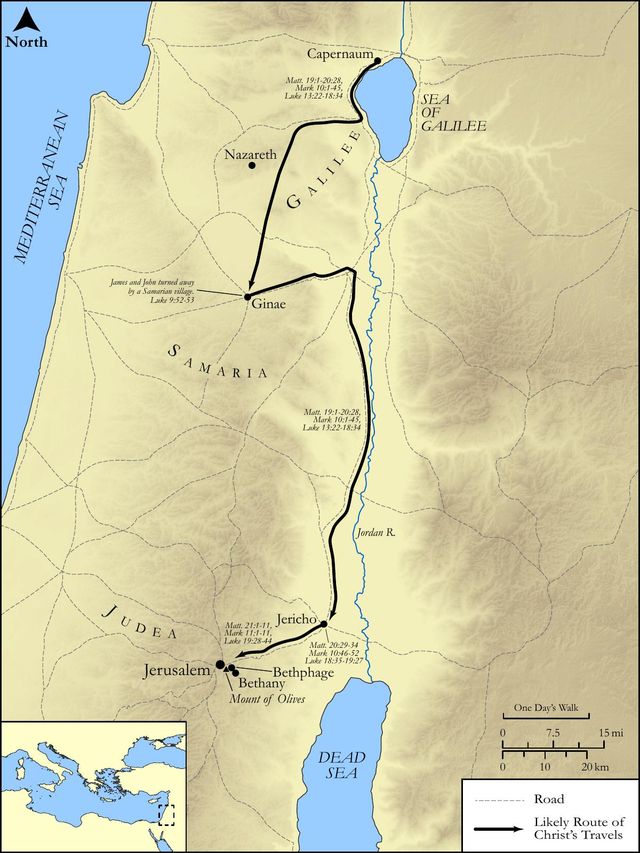
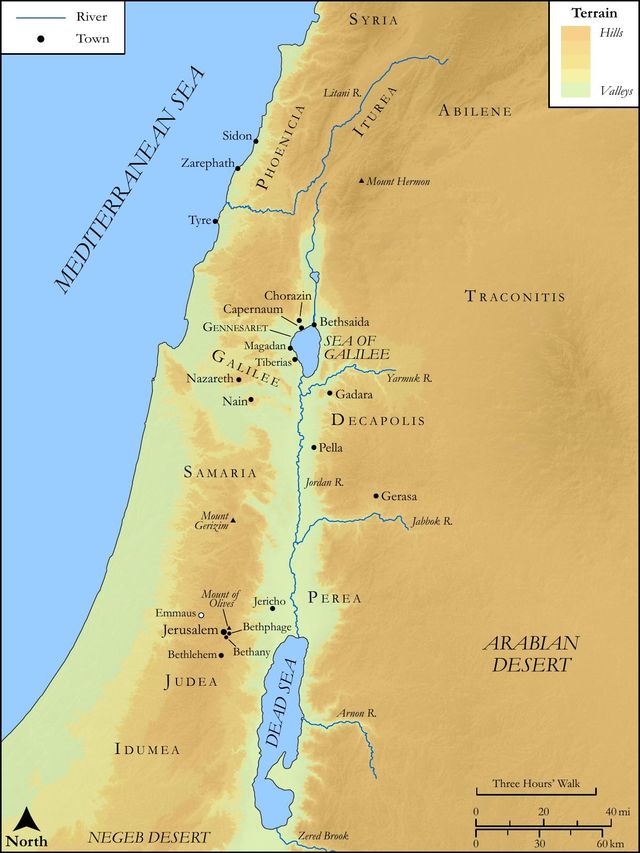
Study this verse
Public-domain commentary
Matthew Henry
From his Commentary on the Whole Bible. Henry comments on passages, not single verses — this entry covers Luke 14:25–35. His four-level outline is real structure in the source text, so it is rendered as structure.
See how Christ in his doctrine suited himself to those to whom he spoke, and gave every one his portion of meat. To Pharisees he preached humility and charity. He is in these verses directing his discourse to the multitudes that crowded after him, and seemed zealous in following him; and his exhortation to them is to understand the terms of discipleship, before they undertook the profession of it, and to consider what they did. See here,
I.How zealous people were in their attendance on Christ (Luk 14:25):
There went great multitudes with him, many for love and more for company, for where there are many there will be more. Here was a mixed multitude, like that which went with Israel out of Egypt; such we must expect there will always be in the church, and it will therefore be necessary that ministers should carefully separate between the precious and the vile.
II.How considerate he would have them to be in their zeal.
Those that undertake to follow Christ must count upon the worst, and prepare accordingly.
1.He tells them what the worst is that they must count upon, much the same with what he had gone through before them and for them. He takes it for granted that they had a mind to be his disciples, that they might be qualified for preferment in his kingdom. They expected that he should say, "If any man come to me, and be my disciple, he shall have wealth and honour in abundance; let me alone to make him a great man." But he tells them quite the contrary.
(1.)They must be willing to quit that which was very dear, and therefore must come to him thoroughly weaned from all their creature-comforts, and dead to them, so as cheerfully to part with them rather than quit their interest in Christ, Luk 14:26. A man cannot be Christ's disciple but he must hate father, and mother, and his own life. He is not sincere, he will be constant and persevering, unless he love Christ better than any thing in this world, and be willing to part with that which he may and must leave, either as a sacrifice, when Christ may be glorified by our parting with it (so the martyrs, who loved not their lives to death), or as a temptation, when by our parting with it we are put into a better capacity of serving Christ. Thus Abraham parted with his own country, and Moses with Pharaoh's court. Mention is not made here of houses and lands; philosophy will teach a man to look upon these with contempt; but Christianity carries it higher.
[1.]Every good man loves his relations; and yet, if he be a disciple of Christ, he must comparatively hate them, must love them less than Christ, as Leah is said to be hated when Rachel was better loved. Not that their persons must be in any degree hated, but our comfort and satisfaction in them must be lost and swallowed up in our love to Christ, as Levi's was, when he said to his father, I have not seen him, Deu 33:9. When our duty to our parents comes in competition with our evident duty to Christ, we must give Christ the preference. If we must either deny Christ or be banished from our families and relations (as many of the primitive Christians were), we must rather lose their society than his favour.
[2.]Every man loves his own life, no man ever yet hated it; and we cannot be Christ's disciples if we do not love him better than our own lives, so as rather to have our lives embittered by cruel bondage, nay, and taken away by cruel deaths, than to dishonour Christ, or depart from any of his truths and ways. The experience of the pleasures of the spiritual life, and the believing hopes and prospects of eternal life, will make this hard saying easy. When tribulation and persecution arise because of the word, then chiefly the trial is, whether we love better, Christ or our relations and lives; yet even in the days of peace this matter is sometimes brought to the trial. Those that decline the service of Christ, and opportunities of converse with him, and are ashamed to confess him, for fear of disobliging a relation or friend, or losing a customer, give cause to suspect that they love him better than Christ.
(2.)That they must be willing to bear that which was very heavy (Luk 14:27): Whosoever doth not bear his cross, as those did that were condemned to be crucified, in submission to the sentence and in expectation of the execution of it, and so come after me whithersoever I shall lead him, he cannot be my disciple; that is (says Dr. Hammond), he is not for my turn; and my service, being so sure to bring persecution along with it, will not be for his. Though the disciples of Christ are not all crucified, yet they all bear their cross, as if they counted upon being crucified. They must be content to be put into an ill name, and to be loaded with infamy and disgrace; for no name is more ignominious than Furcifer - the bearer of the gibbet. He must bear his cross, and come after Christ; that is, he must bear it in the way of his duty, whenever it lies in that way. He must bear it when Christ calls him to it, and in bearing it he must have an eye to Christ, and fetch encouragements from him, and live in hope of a recompence with him.
2.He bids them count upon it, and then consider of it. Since he has been so just to us as to tell us plainly what difficulties we shall meet with in following him, let us be so just to ourselves as to weigh the matter seriously before we take upon us a profession of religion. Joshua obliged the people to consider what they did when they promised to serve the Lord, Jos 24:19. It is better never to begin than not to proceed; and therefore before we begin we must consider what it is to proceed. This is to act rationally, and as becomes men, and as we do in other cases. The cause of Christ will bear a scrutiny. Satan shows the best, but hides the worst, because his best will not counter-vail his worst; but Christ's will abundantly. This considering of the case is necessary to perseverance, especially in suffering times. Our Saviour here illustrates the necessity of it by two similitudes, the former showing that we must consider the expenses of our religion, the latter that we must consider the perils of it.
(1.)When we take upon us a profession of religion we are like a man that undertakes to build a tower, and therefore must consider the expense of it (Luk 14:28-30): Which of you, intending to build a tower or stately house for himself, sitteth not down first, and counteth the cost? and he must be sure to count upon a great deal more than his workmen will tell him it will cost. Let him compare the charge with his purse, lest he make himself to be laughed at, by beginning to build what he is not able to finish. Note,
[1.]All that take upon them a profession of religion undertake to build a tower, not as the tower of Babel, in opposition to Heaven, which therefore was left unfinished, but in obedience to Heaven, which therefore shall have its top-stone brought forth. Begin low, and lay the foundation deep, lay it on the rock, and make sure work, and then aim as high as heaven.
[2.]Those that intend to build this tower must sit down and count the cost. Let them consider that it will cost them the mortifying of their sins, even the most beloved lusts; it will cost them a life of self-denial and watchfulness, and a constant course of holy duties; it may, perhaps, cost them their reputation among men, their estates and liberties, and all that is dear to them in this world, even life itself. And if it should cost us all this, what is it in comparison with what it cost Christ to purchase the advantages of religion for us, which come to us without money and without price?
[3.]Many that begin to build this tower do not go on with it, nor persevere in it, and it is their folly; they have not courage and resolution, have not a rooted fixed principle, and so bring nothing to pass. It is true, we have none of us in ourselves sufficient to finish this tower, but Christ hath said, My grace is sufficient for thee, and that grace shall not be wanting to any of us, if we seek for it and make use of it.
[4.]Nothing is more shameful than for those that have begun well in religion to break off; every one will justly mock him, as having lost all his labour hitherto for want of perseverance. We lose the things we have wrought (Jo2 1:8), and all we have done and suffered is in vain, Gal 3:4.
(2.)When we undertake to be Christ's disciples we are like a man that goes to war, and therefore must consider the hazard of it, and the difficulties that are to be encountered, Luk 14:31, Luk 14:32. A king that declares war against a neighbouring prince considers whether he has strength wherewith to make his part good, and, if not, he will lay aside his thoughts of war. Note,
[1.]The state of a Christian in this world is a military state. Is not the Christian life a warfare? We have many passes in our way, that must be disputed with dint of sword; nay, we must fight every step we go, so restless are our spiritual enemies in their opposition.
[2.]We ought to consider whether we can endure the hardness which a good soldier of Jesus Christ must expect and count upon, before we enlist ourselves under Christ's banner; whether we are able to encounter the forces of hell and earth, which come against us twenty thousand strong.
[3.]Of the two it is better to make the best terms we can with the world than pretend to renounce it and afterwards, when tribulation and persecution arise because of the word, to return to it. That young man that could not find in his heart to part with his possessions for Christ did better to go away from Christ sorrowing than to have staid with him dissembling.
This parable is another way applicable, and may be taken as designed to teach us to begin speedily to be religious, rather than to begin cautiously; and may mean the same with Mat 5:25, Agree with thine adversary quickly. Note, First, Those that persist in sin make war against God, the most unnatural, unjustifiable war; they rebel against their lawful sovereign, whose government is perfectly just and good. Secondly, The proudest and most daring sinner is no equal match for God; the disproportion of strength is much greater than that here supposed between ten thousand and twenty thousand. Do we provoke the Lord to jealousy? Are we stronger than he? No, surely; who knows the power of his anger? In consideration of this, it is our interest to make peace with him. We need not send to desire conditions of peace; they are offered to us, and are unexceptionable, and highly to our advantage. Let us acquaint ourselves with them, and be at peace; do this in time, while the other is yet a great way off; for delays in such a case are highly dangerous, and make after-applications difficult.
But the application of this parable here (Luk 14:33) is to the consideration that ought to be exercised when we take upon us a profession of religion. Solomon saith, With good advice make war (Pro 20:18); for he that draws the sword throws away the scabbard; so with good advice enter upon a profession of religion, as those that know that except you forsake all you have you cannot be Christ's disciples; that is, except you count upon forsaking all and consent to it, for all that will live godly in Christ Jesus must suffer persecution, and yet continue to live godly.
3.He warns them against apostasy and a degeneracy of mind from the truly Christian spirit and temper, for that would make them utterly useless, Luk 14:34, Luk 14:35.
(1.)Good Christians are the salt of the earth, and good ministers especially (Mat 5:13); and this salt is good and of great use; by their instructions and examples they season all they converse with, to keep them from putrefying, and to quicken them, and make them savoury.
(2.)Degenerate Christians, who, rather than part with what they have in the world, will throw up their profession, and then of course become carnal, and worldly, and wholly destitute of a Christian spirit, are like salt that has lost its savour, like that which the chemists call the caput mortuum, that has all its salts drawn from it, that is the most useless worthless thing in the world; it has no manner of virtue or good property in it.
[1.]It can never be recovered: Wherewith shall it be seasoned? You cannot salt it. This intimates that it is extremely difficult, and next to impossible, to recover an apostate, Heb 6:4-6. If Christianity will not prevail to cure men of their worldliness and sensuality, if that remedy has been tried in vain, their ease must even be concluded desperate.
[2.]It is of no use. It is not fit, as dung is, for the land, to manure that, nor will it be the better if it be laid in the dunghill to rot; there is nothing to be got out of it. A professor of religion whose mind and manners are depraved is the most insipid animal that can be. If he speaks of the things of God, of which he has had some knowledge, it is so awkwardly that none are the better for it: it is a parable in the mouth of a fool.
[3.]It is abandoned: Men cast it out, as that which they will have no more to do with. Such scandalous professors ought to be cast out of the church, not only because they have forfeited all the honours and privileges of their church-membership, but because there is danger that others will be infected by them. Our Saviour concludes this with a call to all to take notice of it, and to take warning: He that hath ears to hear, let him hear. Now can the faculty of hearing be better employed than in attending to the word of Christ, and particularly to the alarms he has given us of the danger we are in of apostasy, and the danger we run ourselves into by apostasy?
Historical interpretation
Nine Centuries of Reception
11 surviving comments on this verse. Each one is dated, so this reads as a timeline rather than a list.
Select a marker to jump to its quote. Markers stagger vertically where authors wrote within a few decades of each other.
It is advanced too late. For after the similitude of that most prudent builder, who first computes the costs of the work, together with his own means, lest, when he has begun, he afterwards blush to find himself spent, deliberation should have been made before.
(in Esai. 2.) Or the tower is a lofty watch-tower fitted for the guardianship of the city and the discovery of the enemy's approach. In like manner was our understanding given us to preserve the good, to guard against the evil. For the building up whereof the Lord bids us sit down and count our means if we have sufficient to finish.
But our Lord's intention in the above-mentioned example is not indeed to afford occasion or give liberty to any one to become His disciple or not, as indeed it is lawful not to begin a foundation, or not to treat of peace, but to show the impossibility of pleasing God, amidst those things which distract the soul, and in which it is in danger of becoming an easy prey to the snares and wiles of the devil.
(lib. de Virg. 17.) For we must be ever pressing onward that we may reach the end of each difficult undertaking by successive increases of the commandments of God, and so to the completion of the divine work. For neither is one stone the whole fabric of the tower, nor does a single command lead to the perfection of the soul. But we must lay the foundation, and according to the Apostle, thereupon must be placed store of gold, silver, and precious stones. (1 Cor. 3:12.) Whence it is added, Lest haply after he hath laid the foundation, &c.
The Gospel somewhere says that a person who begins to build a tower but stops with the foundations and never completes it is ridiculous. What do we learn from this parable? We learn that we should work to bring every aspiration to a conclusion, completing the work of God by an elaborate building up of his commandments. One stone does not make a complete tower, nor does one commandment bring the perfection of the soul to its desired measure. It is necessary to both erect the foundation and, as the apostle says, “to lay upon it a foundation of gold and precious stones.” That is what the products of the commandments are called by the prophet when he says, “I have loved your commandment more than gold and much precious stone.”
(ut sup.) But as with respect to the unfinished tower, he alarms us by the reproaches of those who say, The man began to build, and was not able to finish, so with regard to the king with whom the battle was to be, he reproved even peace, adding, Or else, while the other is yet a great way off, he sendeth an ambassage, and desireth conditions of peace; signifying that those also who forsake all they possess cannot endure from the devil the threats of even coming temptations, and make peace with him by consenting unto him to commit sin.
Next he uses two examples to encourage his friends to an unconquerable strength and to establish those who want to attain to honors by patience and endurance in an unwavering zeal. If anyone wants to build a tower, he first counts if he has sufficient means to finish it. Otherwise when he has laid the foundation and is not able to finish it, people will laugh at him. Those who choose to lead a glorious and blameless life should store up beforehand in their mind a sufficient zeal. They should remember him who says, "My son, if you come close to serve the Lord, prepare yourself for every temptation. Make your heart straight and endure." How will those who do not have this zeal be able to reach the goal that is set before them?
Because lofty precepts have been given, a comparison of building something lofty is immediately added, when it is said: "For which of you, wishing to build a tower, does not first sit down and count the costs that are necessary, whether he has enough to complete it?" Everything we do, we ought to anticipate through careful consideration. For behold, according to the voice of Truth, he who builds a tower first prepares the costs of the building. If therefore we desire to construct a tower of humility, we must first prepare ourselves against the adversities of this world. For this is the difference between an earthly and a heavenly building: an earthly building is constructed by gathering expenses, but a heavenly building is constructed by dispersing expenses. For the former we make expenditures if we gather things not possessed; for the latter we make expenditures if we relinquish even what we possess. That rich man could not have these expenditures, who, possessing many properties, sought out the Master, saying: "Good Master, what shall I do to possess eternal life?" When he had heard the command to leave all things, he went away sad, and was made anxious in his mind from the very source by which he was outwardly richer in possessions. For because he loved in this life the expenditures of exaltation, in striving toward the eternal homeland he refused to have the expenditures of humility.
(in Hom. 37. in Ev.) Or because the cross is so called from torturing. In two ways we bear our Lord's cross, either when by abstinence we afflict our bodies, or when through compassion of our neighbour we think all his necessities our own. But because some exercise abstinence of the flesh not for God's sake but for vain-glory, and show compassion, not spiritually but carnally, it is rightly added, And, cometh after me. For to bear His cross and come after the Lord, is to use abstinence of the flesh, or compassion to our neighbour, from the desire of an eternal gain.
(37. in Ev.) Because He had been giving high and lofty precepts, immediately follows the comparison of building a tower, when it is said, For which of you intending to build a tower does not first count &c. For every thing that we do should be preceded by anxious consideration. If then we desire to build a tower of humility, we ought first to brace ourselves against the ills of this world.
(ubi sup.) For when occupied in good works, unless we watch carefully against the evil spirits, we find those our mockers who are persuading us to evil. But another comparison is added proceeding from the less to the greater, in order that from the least things the greatest may be estimated. For it follows, Or what king, going to make war against another king, sitteth not down first, and consultelh whether he be able with ten thousand to meet him that cometh against him with twenty thousand?
(in Hom. ut sup.) Or else, in that awful trial we come not to the judgment a match for our king, for ten thousand are against twenty thousand, two against one. He comes with a double army against a single. For while we are scarcely prepared in deeds only, he sifts us at once both in thought and deed. While then he is yet afar off, who though still present in judgment, is not seen, let us send him an embassy, our tears, our works of mercy, the propitiatory victim. This is our message which appeases the coming king.
For which of you, wishing to build a tower, does not first sit down and calculate the cost necessary to complete it? For in all things, the end must be considered. Everything we do should be preceded by the effort of consideration. Behold, according to the voice of Truth, he who builds a tower prepares the cost of the building. Therefore, if we wish to construct the tower of humility, we must first prepare ourselves for the adversities of this world. For the distinction between earthly and heavenly building is this: that the earthly building is constructed by collecting expenses, while the heavenly building is constructed by dispersing expenses. We make expenses for the former by collecting what we do not have; we make expenses for the latter by even relinquishing what we have. It must indeed be considered what is said:
But there is a difference between renouncing all things and leaving all things. For it is the way of few perfect men to leave all things, that is, to cast behind them the cares of the world, but it is the part of all the faithful to renounce all things, that is, so to hold the things of the world as by them not to be held in the world.
For we ought not to lay a foundation, i. e. begin to follow Christ, and not bring the work to an end, as those of whom St. John writes, That many of his disciples went backward. (John 6:66.) Or by the foundation understand the word of teaching, as for instance concerning abstinence. There is need therefore of the above-mentioned foundation, that the building up of our works be established, a tower of strength from the face of the enemy. (Ps. 61:3.) Otherwise, man is laughed at by those who see him, men as well as devils.
The king is sin reigning in our mortal body; (Rom. 6:12.) but our understanding also was created king. If then he wishes to fight against sin, let him consider with his whole mind. For the devils are the satellites of sin, which being twenty thousand, seem to surpass in number our ten thousand, because that being spiritual compared to us who are corporeal, they are come to have much greater strength.
Continue studying Luke 14:28 across the web’s major study libraries — every link below opens this exact verse, chapter, or book on the destination site.
Read & Compare
 BibleGatewayThis verse in more than 200 translations and 70 languages.
 Bible.comThe YouVersion reader — hundreds of translations, reading plans, and highlights.
 ESV.orgCrossway's official English Standard Version reader.
 NET BibleThe NET translation with 60,000+ translators' notes on every rendering decision.
 STEP BibleTyndale House's free study tool — original text, vocabulary, and scholarly resources.
 BibliaLogos Bible Software's free web reader.
 USCCBThe New American Bible (Revised Edition) with the U.S. bishops' study notes.
Commentaries
 BibleHub CommentariesDozens of classic commentaries on this verse, gathered on one page.
 StudyLightMore than 100 commentary sets — the largest collection on the web.
 BibleRefPlain-English commentary on what this verse means, verse by verse.
 Enduring WordDavid Guzik's free commentary on this chapter, widely used by Bible teachers.
 Bible Study ToolsVerse commentary alongside Greek and Hebrew study aids.
Original Language & Research
- BibleHub InterlinearThe verse word by word — original language, transliteration, and English.
- BibleHub LexiconEvery word's original-language definition and Strong's entry.
 Blue Letter BibleDeep-study tools — Strong's numbers, concordance, and word studies.
 CNTR CollationThe earliest Greek manuscripts of this verse, collated letter by letter.
Sermons, Hymns & Audio


TrulyRandomVerse is not affiliated with these sites and doesn’t control their content. They’re linked because they’re genuinely useful.
Summary
Luke 14:28 presents a pivotal parable from Jesus, challenging His potential followers to consider the profound commitment required for genuine discipleship. Through the relatable example of a builder planning a tower, Jesus underscores the necessity of careful forethought and realistic assessment of one's resources and resolve before embarking on the spiritual journey of following Him. This teaching serves as a sober call to introspection, ensuring that individuals approach discipleship not with casual enthusiasm, but with a clear understanding of its all-encompassing demands and a steadfast determination to endure to the end.
Context
ShowHideLiterary Context
This verse is strategically placed within a larger discourse by Jesus concerning the radical demands of discipleship, immediately following His declaration that one must "hate" (i.e., love less by comparison) family and even one's own life, and "bear his cross" to be His disciple (Luke 14:26-27). The parable of the tower builder in Luke 14:28-30 and the subsequent parable of the king going to war in Luke 14:31-32 serve as practical illustrations of the abstract principles Jesus has just laid out. They are designed to underscore the gravity of the commitment required, culminating in the unequivocal statement that "whosoever he be of you that forsaketh not all that he hath, he cannot be my disciple" (Luke 14:33). The parables clarify why such radical self-denial is necessary and what happens if one fails to count the cost.
Historical & Cultural Context
Building a tower in ancient Israel could refer to various structures: a watchtower in a vineyard to guard crops (Isaiah 5:2), a defensive fortification for a city (Nehemiah 3:1), or even a significant part of a private dwelling. Regardless of its specific function, constructing such a tower was a substantial undertaking, requiring considerable resources, skilled labor, and sustained effort. It was a visible and public project, meaning an unfinished tower would not only represent wasted resources but also bring public shame and ridicule to the builder (Luke 14:29-30). This cultural understanding of public perception and the practicalities of large-scale construction would have resonated deeply with Jesus' audience, making the parable's message immediately comprehensible and impactful.
Key Themes
ShowHideThe primary themes illuminated by this parable include prudence and forethought, emphasizing the wisdom of careful planning and assessment before undertaking any significant endeavor, especially one with high stakes. Central to its spiritual message is the cost of discipleship, highlighting that following Jesus is not a superficial or casual decision but an all-encompassing commitment that demands sacrifice, self-denial, and a reordering of one's entire life. Jesus is not discouraging followers but rather ensuring that potential disciples fully grasp the profound nature of their decision, urging them to embrace genuine commitment rather than a half-hearted or uninformed allegiance that is prone to failure and public disgrace, much like an unfinished building. This theme of commitment is echoed throughout Jesus' teachings, such as in the Parable of the Sower, where some seeds fail to produce fruit due to lack of depth or perseverance (Luke 8:6-15).
Exposition and Analysis
ShowHideKey Word Analysis
ShowHideThis word signifies a strong, active desire, a deliberate choice, or a fixed purpose. It is not merely a fleeting thought but a settled inclination or will. In the context of the verse, it highlights that the decision to build is not accidental but a conscious, intentional act, mirroring the deliberate choice one makes to follow Christ.
This verb literally means "to seat oneself" or "to sit down." Figuratively, it conveys the idea of settling down, pausing, or taking time for a deliberate and unhurried action. It implies a calm, thoughtful, and methodical approach, rather than a hasty or impulsive one. The builder pauses to consider, emphasizing the importance of careful deliberation before action.
Derived from a root meaning "to devour" or "to consume," this noun refers to expense or outlay. It denotes the financial or material resources that will be consumed or expended in the process of building. In the spiritual analogy, it represents the sacrifices, renunciations, and personal investments required for genuine discipleship, underscoring that following Christ is not without significant personal expenditure.
Verse Breakdown
ShowHide"For which of you, intending to build a tower,"
Jesus begins with a rhetorical question, immediately engaging His audience by appealing to their common sense and practical experience. The phrase "intending to build a tower" sets the stage for a significant, costly, and public undertaking. The "tower" serves as a metaphor for the new life, commitment, and spiritual journey of discipleship.
"sitteth not down first, and counteth the cost,"
This is the core action Jesus highlights. The builder's prudence is demonstrated by pausing ("sitteth not down first") and meticulously calculating ("counteth the cost") what is required. "Counteth the cost" (Greek: psēphízō the dapánē) implies a careful, deliberate, and thorough computation, perhaps using pebbles for calculation, to assess all necessary resources—financial, material, and labor—before commencing. This emphasizes that a rational and responsible approach is expected in earthly matters, and thus, even more so in spiritual ones.
"whether he have [sufficient] to finish [it]?"
The ultimate purpose of counting the cost is to determine if one possesses the adequate resources ("sufficient") to bring the project to completion ("to finish it"). The implication is that starting a project without the means to finish it leads to failure and shame. Spiritually, this questions whether a potential disciple has truly grasped the lifelong commitment required and is prepared to persevere through challenges, ensuring their faith does not falter midway.
Literary Devices
ShowHideJesus employs several potent literary devices in Luke 14:28. Foremost is the Parable, a short, illustrative story that uses a familiar, earthly scenario (building a tower) to convey a profound spiritual truth (the cost of discipleship). This makes abstract theological concepts accessible and memorable. The verse is also framed as a Rhetorical Question, "For which of you... sitteth not down first...?" This technique directly engages the audience, inviting them to agree with the self-evident wisdom of the builder's actions, thereby making the spiritual application undeniable. Furthermore, an Analogy is central, drawing a direct parallel between the practical wisdom of a builder assessing resources for a physical structure and the spiritual prudence required for a disciple to assess the demands of following Christ. The shame associated with an unfinished tower (Luke 14:29-30) serves as a powerful Consequence to underscore the importance of this forethought.
Theological and Thematic Connections
ShowHideThis parable profoundly shapes our understanding of discipleship, moving it beyond mere intellectual assent or emotional enthusiasm to a realm of sober, deliberate commitment. It challenges the notion of "cheap grace," asserting that while salvation is freely given, discipleship demands everything. The "cost" is not a price paid to earn salvation, but the necessary surrender of self, worldly allegiances, and personal ambitions that hinder total devotion to Christ. This counting of the cost is not meant to discourage, but to ensure a genuine, enduring faith that is prepared for the inevitable challenges and sacrifices inherent in following Jesus. It highlights the importance of spiritual integrity and perseverance, ensuring that one's commitment is rooted in a realistic understanding of the journey rather than a naive assumption.
Reflection and Application
ShowHideLuke 14:28 serves as a timeless call to radical self-examination for anyone considering themselves a follower of Christ. It urges us to move beyond superficial declarations of faith to a deep, honest assessment of our willingness to embrace the full implications of discipleship. Are we prepared for the sacrifices, the challenges, the reordering of priorities, and the lifelong dedication that truly following Jesus entails? This parable is not meant to deter us, but to solidify our resolve, ensuring that our commitment is robust enough to withstand the trials and temptations that will inevitably arise. Just as an unfinished building invites scorn, a half-hearted or uninformed spiritual commitment risks spiritual failure and a diminished witness. By truly counting the cost, we gain a profound appreciation for the immeasurable value of Christ and the eternal life He offers, enabling us to prioritize Him above all earthly possessions, relationships, or ambitions, thereby building a faith that is stable, resilient, and enduring to the very end.
Questions for Reflection
ShowHideFAQ
ShowHideDoes "counting the cost" mean we earn our salvation?
ShowHideNo, "counting the cost" in Luke 14:28 does not imply that salvation is earned through human effort or sacrifice. Salvation is a free gift of God's grace, received through faith in Jesus Christ (Ephesians 2:8-9). Rather, "counting the cost" refers to the demands of discipleship, which is distinct from, though a consequence of, salvation. It highlights the radical transformation and surrender required for one to truly follow Jesus as Lord. It's about understanding the commitment involved in walking with Christ daily, which often entails self-denial, prioritizing God's kingdom, and potentially facing hardship or persecution (Matthew 16:24-26). Jesus is ensuring that potential followers are aware of the profound implications of their decision, so they do not start with enthusiasm only to falter when challenges arise.
Christ-Centered Fulfillment
ShowHideWhile Luke 14:28 appears to be a practical lesson on human prudence, its deepest fulfillment is found in Christ Himself. The "tower" we are called to build, representing a life of discipleship, is not constructed by our own strength or resources alone, but by the power and provision of God. The ultimate "cost" was not ours to pay for salvation, but was fully borne by Jesus Christ on the cross, who "gave his life a ransom for many" (Matthew 20:28). He is the one who "counted the cost" of our redemption, knowing full well the suffering and separation from the Father He would endure to accomplish our salvation (Hebrews 12:2). Furthermore, the ability to "finish" the tower of discipleship, to persevere to the end, does not come from our inherent sufficiency but from Christ, who is "able to keep you from stumbling and to present you blameless before the presence of his glory with great joy" (Jude 1:24). Thus, this parable, while calling for our deliberate commitment, ultimately points to Jesus as the foundation, the architect, the provision, and the finisher of our faith, ensuring that the "tower" of our spiritual life can indeed be completed for His glory.