


Matthew 19:20
Bible text: King James Version (1769 Blayney text) · Public domain
Bible text: Berean Standard Bible · Public domain
Bible text: American Standard Version (1901) · Public domain
Bible text: World English Bible, Messianic edition · Public domain
Bible text: Geneva Bible (1599) · Public domain
Bible text: Young's Literal Translation · Public domain
- ΛέγειLegeiSaysG3004V-PAI-3SVerb Present Active Indicative 3rd Singular
- αὐτῷautōto himG846P-DSMPersonal pronoun Dative Singular Masculine
- ὁhotheG3588T-NSMDefinite article Nominative Singular Masculine
- νεανίσκος·neaniskosyoung manG3495N-NSMNoun Nominative Singular Masculine
- πάνταpantaAllG3956A-APNAdjective Accusative Plural Neuter
- ταῦταtautatheseG3778D-APNDemonstrative pronoun Accusative Plural Neuter
- ἐφύλαξαephulaxaI have keptG5442V-AAI-1SVerb Aorist Active Indicative 1st Singular
- ἐκekfromG1537PREPPreposition
- νεότητόςneotētosyouthG3503N-GSFNoun Genitive Singular Feminine
- μουmouof meG3165P-1GSPersonal pronoun Genitive 1st Singular
- τίtiWhatG5101I-ASNInterrogative pronoun Accusative Singular Neuter
- ἔτιetiyetG2089ADVAdverb
- ὑστερῶ;husterōdo I lack?G5302V-PAI-1SVerb Present Active Indicative 1st Singular
English is a literal word-by-word gloss of the Greek, not the KJV's wording. Why?
This is the original text the KJV's translators worked from — each Greek word with its own literal English meaning in this verse, prepared by scholars at Tyndale House, Cambridge. The KJV translates whole sentences, not word by word, so its wording differs: one Greek word can become several English words, and the KJV may choose “charity” where the gloss reads “love”. Both are faithful — they answer different questions. For the KJV's own rendering, switch to the KJV text.
Details
See on the biblical-era maps
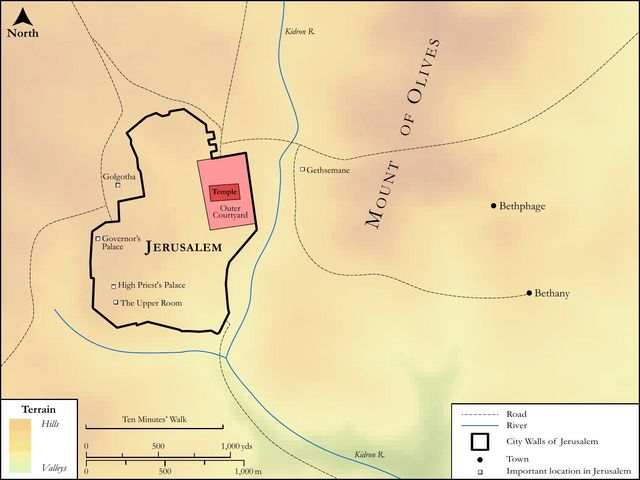
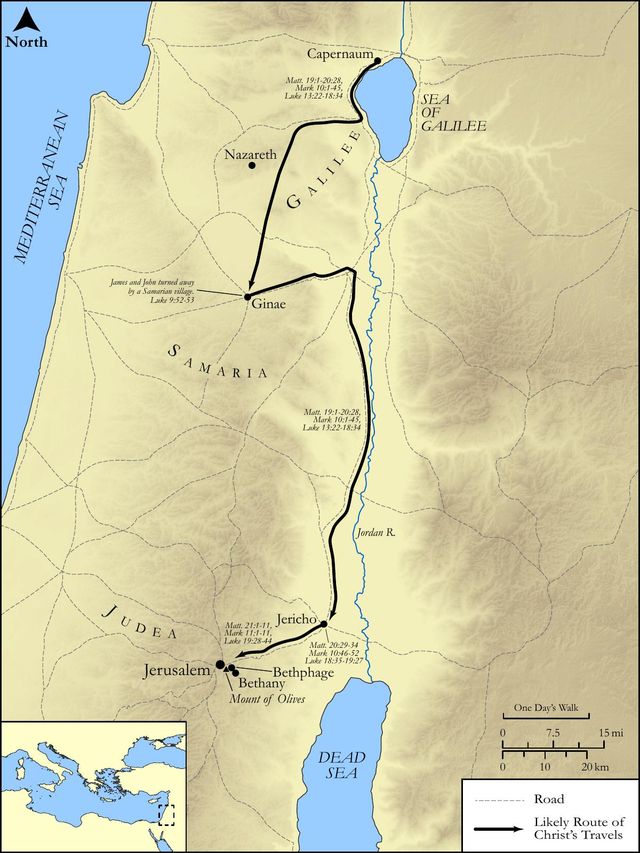
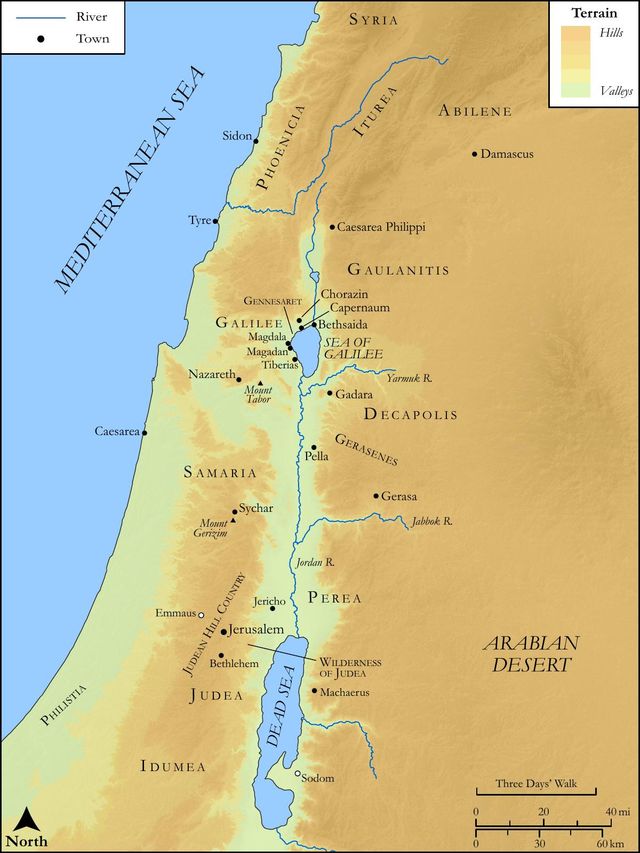
Study this verse
Historical interpretation
Seven Centuries of Reception
9 surviving comments on this verse. Each one is dated, so this reads as a timeline rather than a list.
Select a marker to jump to its quote. Markers stagger vertically where authors wrote within a few decades of each other.
The infants are a type of the Gentiles, to whom salvation is rendered by faith and hearing. But the disciples, in their first zeal for the salvation of Israel, forbid them to approach, but the Lord declares that they are not to be forbidden. For the gift of the Holy Ghost was to be conferred upon the Gentiles by laying on of hands, as soon as the Law had ceased.
(Hom. lxiii.) But I for my part, though I deny not that he was a lover of money, because Christ convicts him as such, cannot consider him to have been a hypocrite, because it is unsafe to decide in uncertain cases, and especially in making charges against any. Moreover Mark removes all suspicion of this kind, for he says that he came to Him, and knelt before Him; (Mark 10:17.) and that Jesus when He looked on him, loved him. And if he had come to tempt Him, the Evangelist would have signified as much, as he has done in other places. Or if he had said nothing thereof, Christ would not have suffered him to be hid, but would either have convicted him openly, or have covertly suggested it. But He does not this; for it follows, He saith unto him, Why askest thou me concerning good?
Wherein then was the profit that He answered thus? He leads him by degrees, and teaches him to lay aside false flattery, and rising above the things which are upon earth to cleave to God, to seek things to come, and to know Him that is truly good, the root and source of every good.
This he said not to tempt Him, but because he supposed that they were other than the commandments of the Law, which should be the means of life to him.
But because all the commandments that the Lord had recounted were contained in the Law, The young man saith unto him. All these have I kept from my youth up. And did not even rest there, but asked further, What lack I yet? which alone is a mark of his intense desire.
And because He spake of riches warning us to strip ourselves of them, He promises to repay things greater, by how much heaven is greater than earth, and therefore He says, And thou shalt have treasure in heaven. By the word treasure He denotes the abundance and endurance of the reward.
For they that have little, and they that abound, are not in like measure encumbered. For the acquisition of riches raises a greater flame, and desire is more violently kindled.
Therefore when Christ said, "If thou wilt enter into life, keep the commandments," he saith, "Which?" Not tempting, far from it, but supposing there were some others besides those of the law that should procure him life, which was like one who was very desirous. Then since Jesus mentioned those out of the law, he saith, "All these things have I kept from my youth up." And neither at this did he stop, but again asks, "What lack I yet?" which itself again was a sign of his very earnest desire.
He that asks this question is both young, rich, and proud, and he asks not as one that desires to learn, but as tempting Him. This we can prove by this, that when the Lord had said unto him, If thou wilt enter into life, keep the commandments, he further insidiously asks, which are the commandments? as if he could not read them for himself, or as if the Lord could command any thing contrary to them.
But because he had styled Him Good Master, and had not confessed Him as God, or as the Son of God, He tells him, that in comparison of God there is no saint to be called good, of whom it is said, Confess unto the Lord, for he is good; (Ps. 118:1.) and therefore He says, There is one good, that is, God. But that none should suppose that by this the Son of God is excluded from being good, we read in another place, The good Shepherd layeth down his life for his sheep. (John 10:11.)
For Our Saviour does not reject this witness to His goodness, but corrected the error of calling Him Good Master apart from God.
(cont. Vigilant. 15.) That Vigilantius asserts that they who retain the use of their property, and from time to time divide their incomes among the poor, do better than they who sell their possessions and lavish them in one act of charity, to him, not I, but God shall make answer, If thou wilt be perfect, Go and sell. That which you so extol, is but the second or third grade; which we indeed admit, only remembering that what is first is to be set before what is third or second.
For many who leave their riches do not therefore follow the Lord; and it is not sufficient for perfection that they despise money, unless they also follow the Saviour, that unless having forsaken evil, they also do what is good. For it is easier to contemn the hoard than quit the propensityb; therefore it follows, And come and follow me; for he follows the Lord who is his imitator, and who walks in his steps. It follows, And when the young man had heard these words, he went away sorrowful. This is the sorrow that leads to death. And the cause of his sorrow is added, for he had great possessions, thorns, that is, and briars, which choked the holy leaven.
(Verse 20.) The young man said to Him: All these things I have kept from my youth, what do I still lack? Jesus said to him: The young man lies. For if he had fulfilled the commandments: You shall love your neighbor as yourself, how then, upon hearing: Go, sell what you have and give to the poor, did he go away sad, for he had many possessions?
(Gennadius, de Eccles. Dogm. 36.) It is good to distribute with discrimination to the poor; it is better, with resolve of following the Lord, to strip one's self of all at once, and freed from anxiety to suffer want with Christ.
These words prove that the Law gave to such as kept it not only temporal promises, but also life eternal. And because the hearing these things made him thoughtful, He saith unto him, Which?
And Jesus, condescending as to a weak one, most graciously set out to him the precepts of the Law; Jesus said, Thou shalt do no murder; and of all these precepts follows the exposition, And thou shalt love thy neighbour as thyself. For the Apostle says, Whoso loveth his neighbour has fulfilled the Law? (Prov. 13:10.) But it should be enquired, why the Lord has enumerated only the precepts of the Second Table? Perhaps because this young man was zealous in the love of God, or because love of our neighbour is the step by which we ascend to the love of God.
But to those who would be perfect in grace, He shows how they may come to perfection, Jesus saith unto him, If thou wilt be perfect, go, and sell all that thou hast, and give to the poor. Mark the words; He said not, Go, and consume all thou hast; but Go, and sell; and not some, as did Ananias and Sapphira, but All. And well He added, that thou hast, for what we have are our lawful possessions. Those therefore that he justly possessed were to be sold; what had been gained unjustly were to be restored to those from whom they had been taken. And He said not, Give to thy neighbours, nor to the rich, but to the poor.
(e Bed. in Luc. Mat. 18:3.) This man had, it may be, heard of the Lord, that only they who were like to little children were worthy to enter into the heavenly kingdom; but desiring to know more certainly, he asks to have it declared to him not in parables, but expressly, by what merits he might attain eternal life. Therefore it is said And, behold, one came and said unto him, Good Master, what good thing shall I do that I may have eternal life?
See two kinds of life which we have heard set before men; the Active, to which pertains, Thou shalt not kill, and the rest of the Law; and the Contemplative, to which pertains this, If thou wilt be perfect. The active pertains to the Law, the contemplative to the Gospel; for as the Old Testament went before the New, so good action goes before contemplation.
Some accuse him of boasting and arrogance. For how could he have achieved love for neighbor if he were rich? For no one who loves his neighbor as himself is wealthier than his neighbor. Others understand it thus: suppose, he says, that I have kept all these things — what do I still lack?
Continue studying Matthew 19:20 across the web’s major study libraries — every link below opens this exact verse, chapter, or book on the destination site.
Read & Compare
 BibleGatewayThis verse in more than 200 translations and 70 languages.
 Bible.comThe YouVersion reader — hundreds of translations, reading plans, and highlights.
 ESV.orgCrossway's official English Standard Version reader.
 NET BibleThe NET translation with 60,000+ translators' notes on every rendering decision.
 STEP BibleTyndale House's free study tool — original text, vocabulary, and scholarly resources.
 BibliaLogos Bible Software's free web reader.
 USCCBThe New American Bible (Revised Edition) with the U.S. bishops' study notes.
Commentaries
 BibleHub CommentariesDozens of classic commentaries on this verse, gathered on one page.
 StudyLightMore than 100 commentary sets — the largest collection on the web.
 BibleRefPlain-English commentary on what this verse means, verse by verse.
 Enduring WordDavid Guzik's free commentary on this chapter, widely used by Bible teachers.
 Bible Study ToolsVerse commentary alongside Greek and Hebrew study aids.
Original Language & Research
- BibleHub InterlinearThe verse word by word — original language, transliteration, and English.
- BibleHub LexiconEvery word's original-language definition and Strong's entry.
 Blue Letter BibleDeep-study tools — Strong's numbers, concordance, and word studies.
 CNTR CollationThe earliest Greek manuscripts of this verse, collated letter by letter.
Sermons, Hymns & Audio


TrulyRandomVerse is not affiliated with these sites and doesn’t control their content. They’re linked because they’re genuinely useful.
Summary
Matthew 19:20 captures the confident assertion of a wealthy young man who believes he has meticulously observed all the Mosaic commandments from his earliest years. Despite his outward adherence to the Law, his follow-up question, "what lack I yet?", reveals a profound underlying spiritual dissatisfaction and an unconscious awareness that his diligent obedience has not brought him the complete assurance or fulfillment he seeks in his pursuit of eternal life.
Context
ShowHideLiterary Context
This verse is a pivotal moment in the well-known encounter between Jesus and the Rich Young Ruler, recorded in Matthew 19:16-30. The narrative begins with the young man's earnest question to Jesus: "Good Master, what good thing shall I do, that I may have eternal life?" (Matthew 19:16). Jesus first challenges his understanding of "goodness" and then directs him to keep the commandments. The young man's response in verse 20 is a declaration of his perceived righteousness, setting the stage for Jesus' subsequent, more radical command to sell his possessions and follow Him (Matthew 19:21), which ultimately exposes the young man's true spiritual impediment. This entire exchange is immediately followed by Jesus' teaching on the difficulty of the rich entering the kingdom of heaven and His disciples' question about who then can be saved, leading to the profound statement that "with God all things are possible" (Matthew 19:26).
Historical & Cultural Context
In first-century Judaism, strict adherence to the Mosaic Law was widely considered the path to righteousness and divine favor. Many devout Jews, particularly Pharisees and those influenced by their teachings, strove for meticulous obedience, believing it would secure their standing with God and their inheritance of eternal life. Wealth was often viewed as a sign of God's blessing, making the young man's status even more indicative of his perceived favor. The question "what lack I yet?" reflects a common human tendency to seek a quantifiable measure of spiritual success, often rooted in a works-based understanding of salvation. This mindset, prevalent in the religious culture of the day, stands in stark contrast to Jesus' radical call for complete surrender and heart-level devotion, which transcended mere external compliance.
Key Themes
ShowHideMatthew 19:20 contributes significantly to several overarching themes within the Gospel of Matthew and broader biblical theology. It highlights the theme of self-righteousness versus true righteousness, demonstrating how human effort, even sincere and diligent, falls short of God's perfect standard. The young man's confidence in his law-keeping, contrasted with his underlying sense of incompleteness, underscores the limitations and purpose of the Law. While the Law is holy and good, it serves primarily to reveal sin and humanity's inability to achieve salvation through works, thereby pointing to a deeper spiritual need for divine intervention, as articulated in Romans 3:20. Furthermore, this verse sets the stage for the theme of the cost of discipleship, showing that genuine commitment to Christ demands more than external obedience; it requires a radical reordering of priorities and a willingness to surrender everything, including cherished possessions and self-reliance, to follow Jesus.
Exposition and Analysis
ShowHideKey Word Analysis
ShowHideThis term (G3495) refers to a youth, typically under forty years of age. Its use here emphasizes the individual's relative inexperience in life, yet his confident assertion of lifelong obedience. It highlights that even from a young age, he had dedicated himself to religious observance, making his perceived spiritual standing all the more significant in his own eyes.
Derived from G5442, this verb means "to watch, to be on guard," and by implication, "to preserve, obey, or avoid." When the young man says he has "kept" the commandments, he implies a diligent, careful, and consistent observance, as if guarding them meticulously. This word underscores his earnest effort and the high standard of his external performance.
This word signifies "to be later," "to be inferior," or more commonly, "to fall short," "to be deficient," or "to be in want." This is the most crucial word in the young man's statement. Despite his confident declaration of obedience, his use of hysteréō reveals an inherent sense of incompleteness or deficiency. He is not merely asking for more tasks, but rather expressing an internal awareness that something fundamental is still missing from his spiritual life, preventing him from achieving full satisfaction or eternal life.
Verse Breakdown
ShowHide"The young man saith unto him,"
This phrase establishes the direct and confident response of the rich young ruler to Jesus' earlier instruction to keep the commandments. It immediately signals his readiness to declare his perceived spiritual achievements.
"All these things have I kept from my youth up:"
Here, the young man confidently asserts his lifelong, meticulous adherence to the commandments Jesus had just listed (and implicitly, the broader Mosaic Law). The phrase "from my youth up" (Greek: ek moû neótēs, G1537 G3450 G3503) emphasizes the duration and consistency of his obedience, suggesting a deep-seated commitment to external righteousness from an early age. He believes he has fulfilled all the requirements.
"what lack I yet?"
This pivotal question, using the Greek word hysteréō (G5302), reveals the young man's underlying spiritual void. Despite his outward confidence and diligent observance, he senses an incompleteness. He is not asking for more commandments to keep, but rather expressing a deep, perhaps unconscious, awareness that his efforts have not yielded the full assurance or eternal life he seeks. It betrays a spiritual hunger that external performance cannot satisfy.
Literary Devices
ShowHideThe verse employs several literary devices to convey its profound meaning. Irony is prominent, as the young man confidently declares his perfect obedience ("All these things have I kept") yet immediately asks, "what lack I yet?" This juxtaposition highlights the ironic truth that his perceived completeness is, in fact, incomplete. There is a contrast between his outward performance and his inward spiritual state; he appears righteous but feels a void. The question "what lack I yet?" functions as a rhetorical question that subtly undermines his preceding boast. While framed as an inquiry, it serves to express his genuine, though perhaps unarticulated, spiritual hunger and the inadequacy of a works-based righteousness, setting the stage for Jesus to reveal the true "lack" in his heart.
Theological and Thematic Connections
ShowHideThe young man's confident assertion and subsequent question in Matthew 19:20 underscore a fundamental theological truth: human effort, no matter how diligent or sincere, is insufficient to earn eternal life or achieve true righteousness before God. His "lack" is not a missing commandment but a missing heart—a heart fully surrendered to God and His kingdom above all else. This interaction profoundly illustrates that the Law, while holy and good, was never intended as a means of salvation but rather as a mirror to reveal humanity's sinfulness and utter inability to meet God's perfect standard. It exposes the futility of self-righteousness and points to the necessity of a righteousness that comes from God alone.
Reflection and Application
ShowHideThe rich young ruler's encounter with Jesus serves as a powerful mirror for contemporary believers, challenging us to examine the true foundation of our faith and assurance. Are we, like him, subtly relying on our good deeds, moral uprightness, or religious observances as a means to earn God's favor or secure our eternal destiny? His confident declaration, followed by his revealing question, prompts us to ask: Do we outwardly conform to Christian standards while an inner voice still whispers, "what lack I yet?" This internal spiritual hunger often points not to a need for more rules or greater effort, but to a deeper need for complete surrender to Christ and a recognition that our righteousness is found in Him alone. The verse calls us to consider what "things" we might be holding onto—be it wealth, status, comfort, self-reliance, or even our own perceived goodness—that prevent us from fully embracing Christ's radical call to discipleship and experiencing the abundant life He offers. Our greatest "lack" is not in our doing, but in the complete devotion of our hearts and lives to the One who perfectly fulfilled the Law on our behalf.
Questions for Reflection
ShowHideFAQ
ShowHideHad the young man truly kept all the commandments as he claimed?
ShowHideFrom his own perspective, and likely from the perspective of his peers, the young man had indeed meticulously kept the commandments externally. He was a devout and morally upright individual according to the letter of the Law. However, Jesus' subsequent challenge in Matthew 19:21—to sell all his possessions and give to the poor—revealed that he had not truly kept the spirit of the Law, particularly the commandment to "love your neighbor as yourself" (Matthew 19:19) and, more fundamentally, to "love the Lord your God with all your heart, soul, and mind" (Matthew 22:37). His unwillingness to part with his wealth exposed an idol in his heart, demonstrating that his obedience was ultimately incomplete and his righteousness self-derived, not truly God-centered. The Law's purpose is not to enable perfect keeping, but to expose sin and the need for a Savior, which it effectively did in this encounter.
Christ-Centered Fulfillment
ShowHideThe rich young man's poignant question, "what lack I yet?", finds its ultimate answer and fulfillment in Jesus Christ. The young man sought to earn eternal life through his own diligent adherence to the Law, believing that one more good deed or one less deficiency would secure his salvation. However, his "lack" was not a missing commandment to obey, but the very righteousness of God that only Christ could provide. Jesus, the perfect Law-keeper (Matthew 5:17), lived a life of flawless obedience, perfectly fulfilling every demand of the Law that humanity could not. His atoning death on the cross provides the complete and sufficient righteousness that the Law demands but that no human effort can achieve (2 Corinthians 5:21). Eternal life is not earned by human merit but is a free gift received through faith in Him (John 3:16). The young man walked away sorrowful because he could not surrender his idol of wealth and self-righteousness, failing to grasp that the true "treasure in heaven" (Matthew 19:21) was found not in his possessions, but in the person of Christ Himself. His inability to part with his earthly treasures prevented him from embracing the one who offers genuine spiritual completeness and the abundant life (John 10:10) that transcends all human striving.