


Luke 18:22
Bible text: King James Version (1769 Blayney text) · Public domain
Bible text: King James Version with Strong's numbers · Public domain
Bible text: Berean Standard Bible · Public domain
Bible text: American Standard Version (1901) · Public domain
Bible text: World English Bible, Messianic edition · Public domain
Bible text: Geneva Bible (1599) · Public domain
Bible text: Young's Literal Translation · Public domain
- ἈκούσαςAkousasHaving heardG191V-AAP-NSMVerb Aorist Active Participle Nominative Singular Masculine
- δὲdethenG1161CONJConjunction
- ταῦταtautathese thingsG3778D-APNDemonstrative pronoun Accusative Plural Neuter
- ὁho<the>G3588T-NSMDefinite article Nominative Singular Masculine
- ἸησοῦςIēsousJesusG2424N-NSM-PNoun Nominative Singular Masculine Individual
- εἶπενeipensaidG2036V-2AAI-3SVerb 2nd Aorist Active Indicative 3rd Singular
- αὐτῷ·autōto himG846P-DSMPersonal pronoun Dative Singular Masculine
- ἔτιetiYetG2089ADVAdverb
- ἕνhenone thingG1520A-NSNAdjective Nominative Singular Neuter
- σοιsoito youG4771P-2DSPersonal pronoun Dative 2nd Singular
- λείπει·leipeiis lackingG3007V-PAI-3SVerb Present Active Indicative 3rd Singular
- πάνταpantaAllG3956A-APNAdjective Accusative Plural Neuter
- ὅσαhosaas much asG3745K-APNCorrelative pronoun Accusative Plural Neuter
- ἔχειςecheisyou haveG2192V-PAI-2SVerb Present Active Indicative 2nd Singular
- πώλησονpōlēsondo sellG4453V-AAM-2SVerb Aorist Active Imperative 2nd Singular
- καὶkaiandG2532CONJConjunction
- διάδοςdiadosdo distributeG1239V-2AAM-2SVerb 2nd Aorist Active Imperative 2nd Singular
- πτωχοῖςptōchoisto [the] poorG4434N-DPMNoun Dative Plural Masculine
- καὶkaiandG2532CONJConjunction
- ἕξειςhexeisyou will haveG2192V-FAI-2SVerb Future Active Indicative 2nd Singular
- θησαυρὸνthēsaurontreasureG2344N-ASMNoun Accusative Singular Masculine
- ἐνeninG1722PREPPreposition
- οὐρανοῖς·ouranoisheavensG3772N-DPMNoun Dative Plural Masculine
- καὶkaiandG2532CONJConjunction
- δεῦροdeurocomeG1204INJInterjection
- ἀκολούθειakoloutheido followG190V-PAM-2SVerb Present Active Imperative 2nd Singular
- μοιmoiMeG3165P-1DSPersonal pronoun Dative 1st Singular
English is a literal word-by-word gloss of the Greek, not the KJV's wording. Why?
This is the original text the KJV's translators worked from — each Greek word with its own literal English meaning in this verse, prepared by scholars at Tyndale House, Cambridge. The KJV translates whole sentences, not word by word, so its wording differs: one Greek word can become several English words, and the KJV may choose “charity” where the gloss reads “love”. Both are faithful — they answer different questions. For the KJV's own rendering, switch to the KJV text.
Details
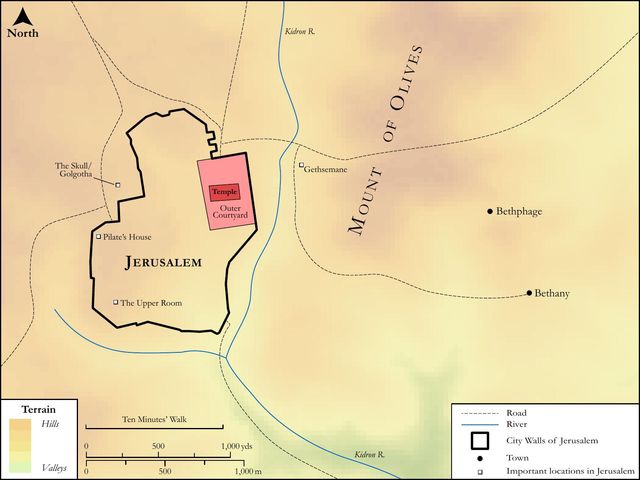
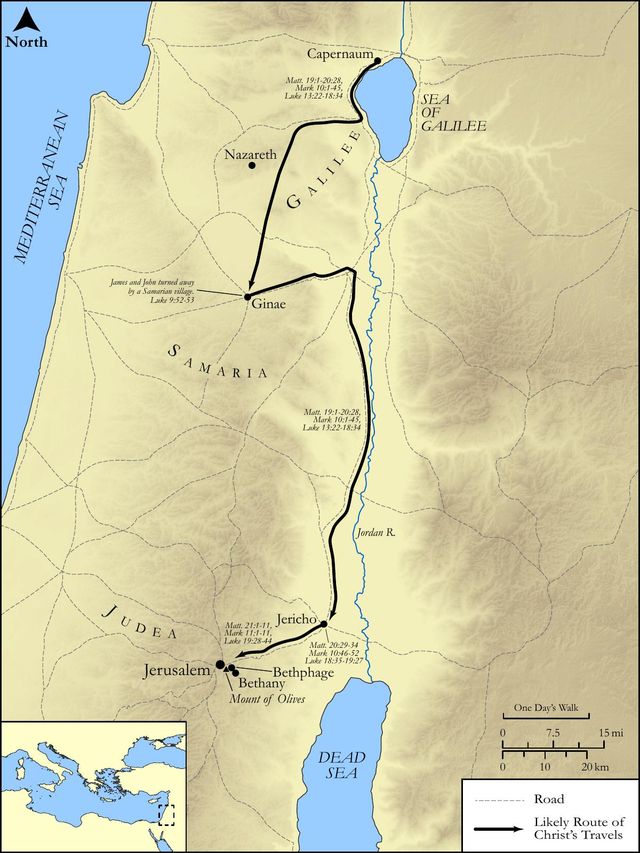
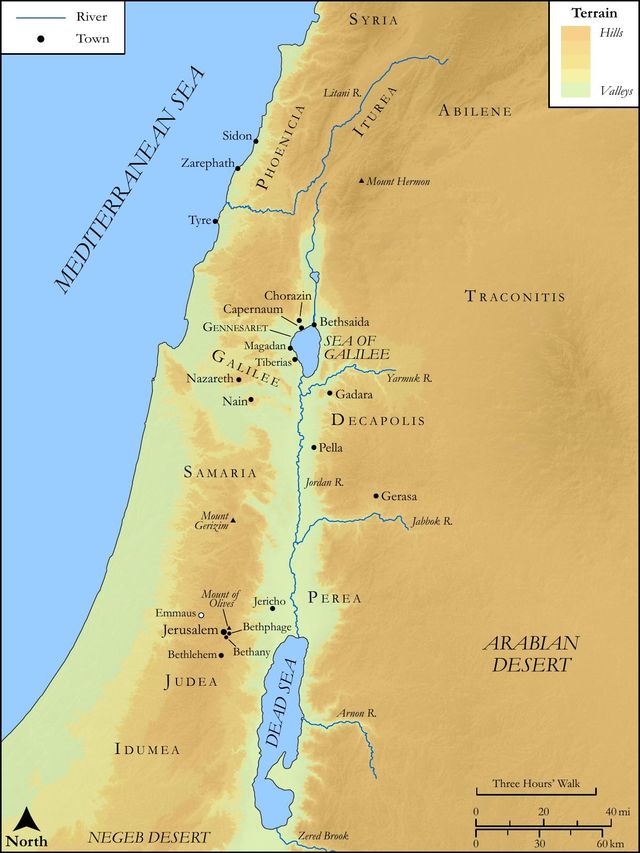
See on the biblical-era maps
Study this verse
Public-domain commentary
Matthew Henry
From his Commentary on the Whole Bible. Henry comments on passages, not single verses — this entry covers Luke 18:18–30. His three-level outline is real structure in the source text, so it is rendered as structure.
In these verses we have,
I.Christ's discourse with a ruler, that had a good mind to be directed by him in the way to heaven. In which we may observe,
1.It is a blessed sight to see persons of distinction in the world distinguish themselves from others of their rank by their concern about their souls and another life. Luke takes notice of it that he was a ruler. Few of the rulers had any esteem for Christ, but here was one that had; whether a church or state ruler does not appear, but he was one in authority.
2.The great thing we are every one of us concerned to enquire after is what we shall do to get to heaven, what we shall do to inherit eternal life. This implies such a belief of an eternal life after this as atheists and infidels have not, such a concern to make it sure as a careless unthinking world have not, and such a willingness to comply with any terms that it may be made sure as those have not who are resolvedly devoted to the world and the flesh.
3.Those who would inherit eternal life must apply themselves to Jesus Christ as their Master, their teaching Master, so it signifies here (didaskale), and their ruling Master, and so they shall certainly find him. There is no learning the way to heaven but in the school of Christ, by those that enter themselves into it, and continue in it.
4.Those who come to Christ as their Master must believe him to have not only a divine mission, but a divine goodness. Christ would have this ruler know that if he understood himself aright in calling him good he did, in effect, call him God and indeed he was so (Luk 18:19): "Why callest thou me good? Thou knowest there is none good but one, that is, God; and dost thou then take me for God? If so, thou art in the right."
5.Our Master, Christ himself, has not altered the way to heaven from what it was before his coming, but has only made it more plain, and easy, and comfortable, and provided for our relief, in case we take any false step. Thou knowest the commandments. Christ came not to destroy the law and the prophets, but to establish them. Wouldest thou inherit eternal life? Govern thyself by the commandments.
6.The duties of the second table must be conscientiously observed, in order to our happiness, and we must not think that any acts of devotion, how plausible soever, will atone for the neglect of them. Nor is it enough to keep ourselves free from the gross violations of these commandments, but we must know these commandments, as Christ has explained them in his sermon upon the mount, in their extent and spiritual nature, and so observe them.
7.Men think themselves innocent because they are ignorant; so this ruler did. He said, All these have I kept from my youth up, Luk 18:21. He knows no more evil of himself than the Pharisee did, Luk 18:11. He boasts that he began early in a course of virtue, that he had continued in it to this day, and that he had not in any instance transgressed. Had he been acquainted with the extent and spiritual nature of the divine law, and with the workings of his own heart, - had he been but Christ's disciples awhile, and learned of him, he would have said quite the contrary: "All these have I broken from my youth up, in thought, word, and deed."
8.The great things by which we are to try our spiritual state are how we stand affected to Christ and to our brethren, to this world and to the other; by these this man was tried. For,
(1.)If we have a true affection to Christ, he will come and follow him, will attend to his doctrine, and submit to his discipline, whatever it cost him. None shall inherit eternal life who are not willing to take their lot with the Lord Jesus, to follow the Lamb whithersoever he goes.
(2.)If he have a true affection to his brethren, he will, as there is occasion, distribute to the poor, who are God's receivers of his dues out of our estates.
(3.)If he think meanly of this world, as he ought, he will not stick at selling what he has, if there be a necessity for it, for the relief of God's poor.
(4.)If he think highly of the other world, as he ought, he will desire no more than to have treasure in heaven, and will reckon that a sufficient abundant recompence for all that he has left, or lost, or laid out for God in this world.
9.There are many that have a great deal in them that is very commendable, and yet they perish for the lack of some one thing; so this ruler here; he broke with Christ upon this, he liked all his terms very well but this which would part between him and his estate: "In this, I pray thee, have me excused." If this be the bargain, it is no bargain.
10.Many that are loth to leave Christ, yet do leave him. After a long struggle between their convictions and their corruptions, their corruptions carry the day at last; they are very sorry that they cannot serve God and mammon both; but, if one must be quitted, it shall be their God, not their worldly gain.
II.Christ's discourse with his disciples upon this occasion, in which we may observe,
1.Riches are a great hindrance to many in the way to heaven. Christ took notice of the reluctancy and regret with which the rich man broke off from him. He saw that he was very sorrowful, and was sorry for him; but thence he infers, How hardly shall they that have riches enter into the kingdom of God! Luk 18:24. If this ruler had had but as little of the world as Peter, and James, and John had, in all probability he would have left it, to follow Christ, as they did; but, having a great estate, it had a great influence upon him, and he chose rather to take his leave of Christ than to lay himself under an obligation to dispose of his estate in charitable uses. Christ asserts the difficulty of the salvation of rich people very emphatically: It is easier for a camel to go through a needle's eye than for a rich man to enter into the kingdom of God, Luk 18:25. It is a proverbial expression, that denotes the thing to be extremely difficult.
2.There is in the hearts of all people such a general affection to this world, and the things of it, that, since Christ has required it as necessary to salvation that we should sit loose to this world, it is really very hard for any to get to heaven. If we must sell all, or break with Christ, who then can be saved? Luk 18:26. They do not find fault with what Christ required as hard and unreasonable. No, it is very fit that they who expect an eternal happiness in the other world should be willing to forego all that is dear to them in this world, in expectation of it. But they know how closely the hearts of most men cleave to this world, and are ready to despair of their being ever brought to this.
3.There are such difficulties in the way of our salvation: as could never be got over but by pure omnipotence, by that grace of God which is almighty, and to which that is possible which exceeds all created power and wisdom. The things which are impossible with men (and utterly impossible it is that men should work such a change upon their own spirits as to turn them from the world to God, it is like dividing the sea, and driving Jordan back), these things are possible with God. His grace can work upon the soul, so as to alter the bent and bias of it, and give it a contrary ply; and it is he that works in us both to will and to do.
4.There is an aptness in us to speak too much of what we have left and lost, of what we have done and suffered, for Christ. This appears in Peter: Lo, we have left all, and followed thee, Luk 18:28. When it came in his way, he could not forbear magnifying his own and his brethren's affection to Christ, in quitting all to follow him. But this we should be so far from boasting of, that we should rather acknowledge it not worth taking notice of, and be ashamed of ourselves that there should have been any regret and difficulty in the doing of it, and any hankerings towards those things afterwards.
5.Whatever we have left, or laid out, for Christ, it shall without fail be abundantly made up to us in this world and that to come, notwithstanding our weaknesses and infirmities (Luk 18:29, Luk 18:30): No man has left the comfort of his estate or relations for the kingdom of God's sake, rather than they should hinder either his services to that kingdom or his enjoyments of it, who shall not receive manifold more in this present time, in the graces and comforts of God's Spirit, in the pleasures of communion with God and of a good conscience, advantages which, to those that know how to value and improve them, will abundantly countervail all their loses. Yet that is not all; in the world to come they shall receive life everlasting, which is the thing that the ruler seemed to have his eye and heart upon.
Historical interpretation
Nine Centuries of Reception
11 surviving comments on this verse. Each one is dated, so this reads as a timeline rather than a list.
Select a marker to jump to its quote. Markers stagger vertically where authors wrote within a few decades of each other.
"My work was my subsistence." Nay, but "all things are to be sold, and divided to the needy." "But provision must be made for children and posterity.
(ex Apol. de sua fuga.) For when we despise the world, we must not imagine we have resigned any thing great, for the whole earth in comparison of the heaven is but a span long; therefore even should they who renounce it be lords of the whole earth, yet still it would be nothing worth in comparison of the kingdom of heaven.
When he says then, Good Master, what shall I do to inherit eternal life? it is the same as if he says, Thou art good; vouchsafe me then an answer to my question. I am learned in the Old Testament, but I see in Thee something far more excellent. For Thou makest no earthly promises, but preachest the kingdom of heaven. Tell me then, what shall I do to inherit eternal life? The Saviour then considering his meaning, because faith is the way to good works, passes over the question he asked, and leads him to the knowledge of faith; as if a man was to ask a physician, "What shall I eat?" and he was to show him what ought to go before his food. And then He sends him to His Father, saying, Why callest thou me good? not that He was not good, for He was the good branch from the good tree, or the good Son of the good Father.
After instructing him in the knowledge of the faith, He adds, Thou knowest the commandments. As though He said, Know God first, and then will it be time to seek what thou askest.
But you may observe that these commandments consist in not doing certain things; that if thou hast not committed adultery, thou art chaste; if thou stealest not, honestly disposed; if thou bearest not false witness, truth-telling. Virtue then we see is rendered easy through the goodness of the Lawgiver. For He speaks of avoiding of evil, not practising of good. And any cessation from action is easier than any actual work.
Our Lord next declares, that though a man has kept the old covenant, he is not perfect, since he lacks to follow Christ. Thou yet lackest one thing, Sell all that thou hast, &c. As if He says, Thou askest how to possess eternal life; scatter thy goods among the poor, and thou shalt obtain it. A little thing is that thou spendest, thou receivest great things.
(in Esai. cap. 1. 23.) Now we must not understand by thieves, only such as cut strips off hides, or commit robberies in the baths. But all such also as, when appointed leaders of legions, or installed governors of states or nations, are guilty of secret embezzlement, or violent and open exactions.
(in Reg. Brev. int. 92.) He does not tell us to sell our goods, because they are by nature evil, for then they would not be God's creatures; He therefore does not bid us cast them away as if they were bad, but distribute them; nor is any one condemned for possessing them, but for abusing them. And thus it is, that to lay out our goods according to God's command both blots out sins, and bestows the kingdom.
(in Reg. fus. disp. 3. ad int. 9.) When our Lord says, Give to the poor, it becomes a man no longer to be careless, but diligently to dispose of all things, first of all by himself if in any measure he is able, if not, by those who are known to be faithful, and prudent in their management; for cursed is he who doeth the work of the Lord negligently. (Jerem. 49, 10.)
(Hom. de eleemos.) The merchant when he goes to the market, is not loth to, part with all that he has, in order to obtain what he requires, but thou art grieved at giving mere dust and ashes that thou mayest gain everlasting bliss.
That ruler tempting Him said, Good Master, he ought to have said, Good God. For although goodness exists in divinity and divinity in goodness, yet by adding Good Master, he uses good only in part, not in the whole. For God is good altogether, man partially.
He does not deny that He is good, but points to God. None is good then except he be full of goodness. But should it strike any one that it is said, none is good, let this also strike him, save God, and if the Son is not excepted from God, surely neither is Christ excepted from good. For how is He not good who is born from good? A good tree brings forth good fruits. (Matt. 7:17.) How is He not good, seeing that the substance of His goodness which He took unto Him from the Father has not degenerated in the Son which did not degenerate in the Spirit. Thy good spirit, he says, shall lead me into a land of uprightness. (Ps. 148:10.) But if the Spirit is good who received from the Son, verily He also is good who gave It. Because then it was a lawyer who tempted Him, as is plainly shown in another book, He therefore well said, None is good, save God, that He might remind him that it was written, Thou shalt not tempt the Lord thy God, (Deut. 6:16.) but he the rather gives thanks to the Lord that He is good. (Ps. 118.)
Honour is concerned not only with paying respect, but also with giving bountifully. For it is honouring to reward deserts. Feed thy father, feed thy mother, and when thou hast fed them thou hast not requited all the pangs and agony thy mother underwent for thee. To the one thou owest all thou hast, to the other all thou art. What a condemnation, should the Church feed those whom thou art able to feed! But it may be said, What I was going to bestow upon my parents, I prefer to give to the Church. God seeks not a gift which will starve thy parents, but the Scripture says as well that parents are to be fed, as that they are to be left for God's sake, should they check the love of a devout mind.
It follows, And he said, All these things have I kept from my youth up.
(Hom. 63. in Matt.) Or else; I shall not hesitate to call this ruler covetous, for with this Christ reproaches him, but I say not that he was a tempter.
(Hom. 22. in 1 ad Cor.) God might indeed feed the poor without our taking compassion upon them, but He wishes the givers to be bound by the ties of love to the receivers.
(Hom. 32. in 1. ad Cor.) But it is asked, how does Christ acknowledge the giving all things to the poor to be perfection, whereas St. Paul declares this very thing without charity to be imperfect. Their harmony is shown in the words which succeed, And come, follow me, which betokens it to be from love. For herein shall all men know that ye are my, disciples, if ye have love one toward another. (John 13:35.)
(in Matt. 19:19.) The young man speaks false, for if he had fulfilled that which was afterwards placed among the commandments, Thou shalt love thy neighbour as thyself, how was it that when he heard, Go and sell all that thou hast, and give to the poor, he went away sorrowful?
The young man asked the Lord how to attain to eternal life and heard that he must sell all his goods and distribute them to the poor and have his treasure in heaven. Why else did he go away sad, except that he had, as the Gospel says, great riches? It is one thing not to wish to hoard up what one does not have. It is another thing to scatter what has been accumulated. The former is like refusing food; the latter, like cutting off a limb.
Sell all that you have, and give to the poor, and you will have treasure in heaven, and come, follow me. Whoever wishes to be perfect must sell, like Ananias and Sapphira, but sell everything; and when he has sold it, give everything to the poor, and so prepare a treasure for himself in the kingdom of heaven. And this does not suffice for perfection, unless after despising riches, he follows the Savior, that is, leaving behind evil, he does good. For it is easier to despise the purse than the will. Many, though they leave riches, do not follow the Lord. However, he follows the Lord who is his imitator, and walks in his footsteps. For whoever says he believes in Christ, ought to walk as He did.
A certain ruler having heard our Lord say, that only those who would be like little children should enter the kingdom of heaven, entreats Him to explain to him not by parable but openly by what works he may merit to obtain eternal life.
Or we must not think him to have lied, but to have avowed that he had lived honestly, that is, at least in outward things, else Mark could never have said, And Jesus seeing him, loved him. (Mark. 10:21.)
Whoever then wishes to be perfect must sell all that he hath, not a part only, as Ananias and Sapphira did, but the whole.
The wise men of the Gentiles therefore who seek for wisdom in a mystery, which is the kingdom of God, and will not receive this without the evidence of logical proof, are rightly shut out from this kingdom.
The law first forbids those things to which we are most prone, as adultery for instance, the incitement to which is within us, and of our nature; and murder, because rage is a great and savage monster. But theft and bearing false witness are sins which men seldom fall into. And besides, the former also are the more grievous sins, therefore He places theft and bearing false witness in the second place, as both less common, and of less weight than the other.
Because sin against parents, although a great crime, very rarely happens, He places it last of all, Honour thy father and mother.
Hence when he says, All that thou hast, He inculcates the most complete poverty. For if there is any thing left over or remaining to thee, thou art its slave.
Together with poverty must exist all the other virtues, therefore He says, Come, follow me, that is, In all other things be My disciples, be always following Me.
Continue studying Luke 18:22 across the web’s major study libraries — every link below opens this exact verse, chapter, or book on the destination site.
Read & Compare
 BibleGatewayThis verse in more than 200 translations and 70 languages.
 Bible.comThe YouVersion reader — hundreds of translations, reading plans, and highlights.
 ESV.orgCrossway's official English Standard Version reader.
 NET BibleThe NET translation with 60,000+ translators' notes on every rendering decision.
 STEP BibleTyndale House's free study tool — original text, vocabulary, and scholarly resources.
 BibliaLogos Bible Software's free web reader.
 USCCBThe New American Bible (Revised Edition) with the U.S. bishops' study notes.
Commentaries
 BibleHub CommentariesDozens of classic commentaries on this verse, gathered on one page.
 StudyLightMore than 100 commentary sets — the largest collection on the web.
 BibleRefPlain-English commentary on what this verse means, verse by verse.
 Enduring WordDavid Guzik's free commentary on this chapter, widely used by Bible teachers.
 Bible Study ToolsVerse commentary alongside Greek and Hebrew study aids.
Original Language & Research
- BibleHub InterlinearThe verse word by word — original language, transliteration, and English.
- BibleHub LexiconEvery word's original-language definition and Strong's entry.
 Blue Letter BibleDeep-study tools — Strong's numbers, concordance, and word studies.
 CNTR CollationThe earliest Greek manuscripts of this verse, collated letter by letter.
Sermons, Hymns & Audio


TrulyRandomVerse is not affiliated with these sites and doesn’t control their content. They’re linked because they’re genuinely useful.
Summary
Luke 18:22 captures Jesus' direct and challenging response to a wealthy and outwardly righteous young ruler, revealing the single, critical impediment to his full commitment to God's kingdom. Jesus calls the man to radical detachment from his earthly possessions, a compassionate distribution to the poor, and an invitation to personal discipleship, promising an eternal reward in heaven in exchange for temporal sacrifice. This encounter serves as a profound illustration of the cost of true discipleship and the heart's ultimate allegiance.
Context
ShowHideLiterary Context
This verse is the climax of Jesus' interaction with the rich young ruler, immediately following the man's confident assertion that he has kept all the commandments from his youth (Luke 18:21). The preceding verses set up the ruler's initial question about inheriting eternal life (Luke 18:18) and Jesus' initial response by listing several commandments. The narrative then shifts dramatically from the ruler's self-assurance to Jesus' pinpointing of his deepest spiritual obstacle. Following this exchange, the disciples' astonishment at Jesus' words about the difficulty for the rich to enter the kingdom (Luke 18:24-27) further underscores the radical nature of Jesus' demand.
Historical & Cultural Context
In first-century Jewish society, wealth was often perceived as a sign of God's blessing and favor, a common belief among the Pharisees and many religious leaders. This cultural assumption made Jesus' challenge to the rich young ruler particularly counter-cultural and shocking. The concept of "treasure in heaven" would have contrasted sharply with the prevailing emphasis on earthly prosperity. Furthermore, the practice of distributing to the poor was a recognized act of righteousness, but Jesus' command went beyond mere almsgiving, demanding a complete divestment of wealth, which would have been an unprecedented and deeply unsettling instruction for someone of the ruler's status.
Key Themes
ShowHideThis pivotal verse contributes significantly to several overarching themes in Luke's Gospel. It highlights the theme of radical discipleship, emphasizing that following Jesus requires a willingness to surrender everything, particularly those things that compete for ultimate allegiance. It also powerfully addresses the peril of wealth, demonstrating how material possessions can become an idol that hinders entry into the Kingdom of God, a theme Jesus frequently touched upon (e.g., Luke 12:15). The promise of "treasure in heaven" introduces the theme of eternal perspective, contrasting transient earthly riches with enduring heavenly rewards, a concept also found in Luke 12:33-34. Finally, the instruction to "distribute unto the poor" reinforces Luke's consistent emphasis on compassion for the lowly and the ethical implications of wealth, a recurring motif throughout the book, as seen in the parable of the rich man and Lazarus in Luke 16:19-31.
Exposition and Analysis
ShowHideKey Word Analysis
ShowHideThis verb, meaning "to fail or be absent," indicates that despite the ruler's outward adherence to the law and his commendable life, there was a single, crucial element missing or deficient in his spiritual state. It implies an incompleteness, a void that prevented him from fully entering into the life Jesus offered.
Derived from "to give throughout a crowd," this word signifies a complete and widespread dispersal of possessions, not merely a partial donation. It emphasizes a radical act of divestment and generosity, ensuring that the wealth is spread among many in need, rather than being kept or transferred to a single recipient or institution.
Meaning "to be in the same way with" or "to accompany as a disciple," this term is a common call to discipleship in the Gospels. It implies not just intellectual assent or belief, but an active, ongoing, and personal commitment to Jesus' way of life, often involving sacrifice and a reordering of priorities.
Verse Breakdown
ShowHide"Now when Jesus heard these things, he said unto him,"
This clause sets the scene, indicating Jesus' attentive listening to the rich young ruler's prior declaration of his righteousness. Jesus' subsequent words are not a general sermon but a direct, personalized response tailored to the man's specific spiritual condition.
"Yet lackest thou one thing:"
This is the core diagnosis. Despite the ruler's apparent moral uprightness and adherence to the commandments, Jesus identifies a singular, critical deficiency. This "one thing" is the spiritual obstacle that prevents him from truly inheriting eternal life and fully embracing God's kingdom.
"sell all that thou hast, and distribute unto the poor,"
This is Jesus' radical command, directly addressing the "one thing" lacking. It demands a complete detachment from earthly possessions, specifically targeting the ruler's wealth, which had become an idol. The instruction to "distribute unto the poor" highlights the ethical and compassionate dimension of this divestment, redirecting the man's resources toward those in genuine need.
"and thou shalt have treasure in heaven:"
This phrase presents the divine incentive and promised reward for radical obedience. It contrasts the fleeting nature of earthly wealth with the enduring and infinitely more valuable "treasure" that awaits those who prioritize God's kingdom. This treasure is not merely a future reward but an eternal reality.
"and come, follow me."
This is the ultimate invitation to discipleship. It is a personal call to join Jesus, to align one's life with His mission, and to live in active obedience to His teachings. This command encapsulates the essence of true faith, moving beyond mere adherence to rules to a dynamic, personal relationship with the Savior.
Literary Devices
ShowHideLuke 18:22 employs several powerful literary devices. Irony is evident in Jesus' response to the rich young ruler. The man believes he has kept all the commandments and asks what more he must do, only for Jesus to identify a single, profound lack that undermines his entire self-assessment. This highlights the spiritual blindness that can accompany outward religiosity. Hyperbole is present in the command to "sell all that thou hast." While not a universal command for every believer to divest themselves of all possessions, it serves as a powerful, exaggerated statement designed to expose the ruler's ultimate allegiance and the radical nature of true discipleship. The verse also utilizes Contrast, setting up a stark opposition between "treasure" on earth (the ruler's current wealth) and "treasure in heaven" (the eternal reward offered by Jesus), thereby emphasizing the superior value of spiritual over material riches. Finally, the direct imperative "come, follow me" functions as a Call to Discipleship, a recurring motif in the Gospels that invites a personal, transformative relationship with Jesus.
Theological and Thematic Connections
ShowHideLuke 18:22 is a profound theological statement on the nature of discipleship, the deceptive power of wealth, and the true source of eternal security. It challenges the common human tendency to find security and identity in material possessions, asserting that such attachments can become idols that prevent a full and undivided devotion to God. Jesus' command reveals that true righteousness extends beyond mere outward obedience to the law; it requires a transformed heart willing to surrender everything for the sake of the Kingdom. The promise of "treasure in heaven" reorients the disciple's focus from temporal gain to eternal reward, emphasizing that God's economy operates on principles fundamentally different from the world's. This passage underscores that following Christ is not an additive to one's existing life but a radical reordering of priorities, where He becomes the supreme treasure and ultimate pursuit.
Reflection and Application
ShowHideLuke 18:22 stands as a timeless challenge, prompting every believer to honestly examine the "one thing" that might be hindering their complete surrender and full pursuit of Christ. It invites us to consider what earthly possessions, ambitions, or securities might have subtly taken the place of God in our hearts, becoming an obstacle to radical obedience. While Jesus' specific command to sell everything was a diagnostic word for this particular individual, the underlying principle of detachment from worldly things and an undivided loyalty to Christ remains universally applicable. This verse calls us to cultivate a generous spirit, to prioritize eternal treasure over temporal gain, and to trust God implicitly for our provision, knowing that true wealth is found not in what we accumulate, but in our relationship with Him and our willingness to follow Him wholeheartedly, regardless of the cost.
Questions for Reflection
ShowHideFAQ
ShowHideWas Jesus commanding everyone to sell all their possessions to follow Him?
ShowHideNo, Jesus' command to the rich young ruler in Luke 18:22 was a specific, diagnostic instruction tailored to this individual's spiritual condition. For this man, his great wealth was clearly an idol, preventing him from fully trusting and following Jesus. While the principle of detachment from worldly possessions and prioritizing God's kingdom is universal for all believers, the literal command to "sell all that thou hast" is not a blanket requirement for every Christian. Instead, it reveals that anything that takes precedence over God in our hearts can become an obstacle to genuine discipleship. Other disciples, like Zacchaeus (Luke 19:8), were called to different expressions of generosity and repentance, not necessarily total divestment. The core message is about the heart's allegiance and willingness to surrender whatever God asks.
Christ-Centered Fulfillment
ShowHideLuke 18:22, while a direct challenge to the rich young ruler, powerfully points to Christ as the ultimate fulfillment of its demands and promises. Jesus Himself perfectly embodied the radical detachment and complete surrender He called for. Though "He was rich, yet for your sakes He became poor" (2 Corinthians 8:9), divesting Himself of heavenly glory to take on human form. He did not cling to earthly possessions or status but lived a life of humble dependence, having "nowhere to lay His head" (Luke 9:58). Jesus is the one who truly "distributed to the poor" by offering the boundless riches of salvation to all who believe, freely giving His life as a ransom (Mark 10:45). Moreover, He is the "treasure in heaven" that far surpasses any earthly gain, for in Him "are hidden all the treasures of wisdom and knowledge" (Colossians 2:3). To "come, follow me" is not merely to imitate a moral teacher but to enter into a saving relationship with the one who perfectly fulfilled God's righteous demands and who Himself is the ultimate reward, offering eternal life and true riches to all who surrender their lives to Him (John 10:10).