


Luke 19:8
- ΣταθεὶςStatheisHaving stoodG2476V-APP-NSMVerb Aorist Passive Participle Nominative Singular Masculine
- δὲdethenG1161CONJConjunction
- ΖακχαῖοςZakchaiosZacchaeusG2195N-NSM-PNoun Nominative Singular Masculine Individual
- εἶπενeipensaidG2036V-2AAI-3SVerb 2nd Aorist Active Indicative 3rd Singular
- πρὸςprostoG4314PREPPreposition
- τὸνtontheG3588T-ASMDefinite article Accusative Singular Masculine
- κύριον·kurionLordG2962N-ASM-TNoun Accusative Singular Masculine Title
- ἰδοὺidouBeholdG2400INJInterjection
- τὰtatheG3588T-APNDefinite article Accusative Plural Neuter
- ἡμίσιάhēmisiahalfG2255A-APNAdjective Accusative Plural Neuter
- μουmoumyG3165P-1GSPersonal pronoun Genitive 1st Singular
- τῶνtōn<the>G3588T-GPNDefinite article Genitive Plural Neuter
- ὑπαρχόντωνhuparchontōnpossessionsG5225V-PAP-GPNVerb Present Active Participle Genitive Plural Neuter
- κύριεkurieLordG2962N-VSM-TNoun Vocative Singular Masculine Person Gentilic
- τοῖςtoisto theG3588T-DPMDefinite article Dative Plural Masculine
- πτωχοῖςptōchoispoorG4434N-DPMNoun Dative Plural Masculine
- δίδωμι·didōmiI giveG1325V-PAI-1SVerb Present Active Indicative 1st Singular
- καὶkaiandG2532CONJConjunction
- εἴeiifG1487CONDConjunction
- τινόςtinosof anyoneG5100X-GSMIndefinite pronoun Genitive Singular Masculine
- τιtianythingG5100X-ASNIndefinite pronoun Accusative Singular Neuter
- ἐσυκοφάντησαesukophantēsaI have defraudedG4811V-AAI-1SVerb Aorist Active Indicative 1st Singular
- ἀποδίδωμιapodidōmiI restore [it]G591V-PAI-1SVerb Present Active Indicative 1st Singular
- τετραπλοῦνtetraplounfourfoldG5073A-ASNAdjective Accusative Singular Neuter
English is a literal word-by-word gloss of the Greek, not the KJV's wording. Why?
This is the original text the KJV's translators worked from — each Greek word with its own literal English meaning in this verse, prepared by scholars at Tyndale House, Cambridge. The KJV translates whole sentences, not word by word, so its wording differs: one Greek word can become several English words, and the KJV may choose “charity” where the gloss reads “love”. Both are faithful — they answer different questions. For the KJV's own rendering, switch to the KJV text.
Details
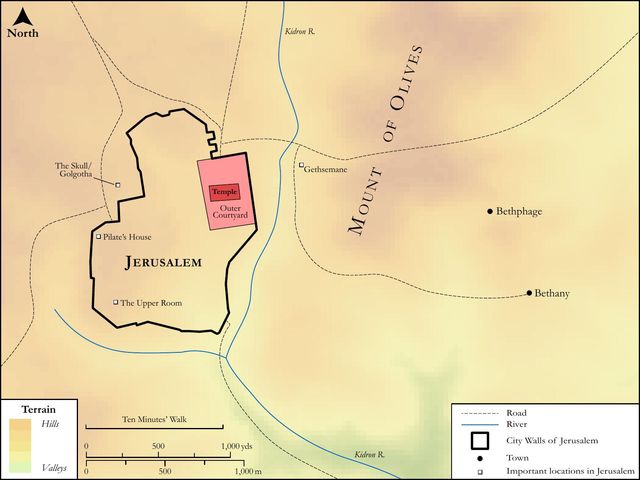
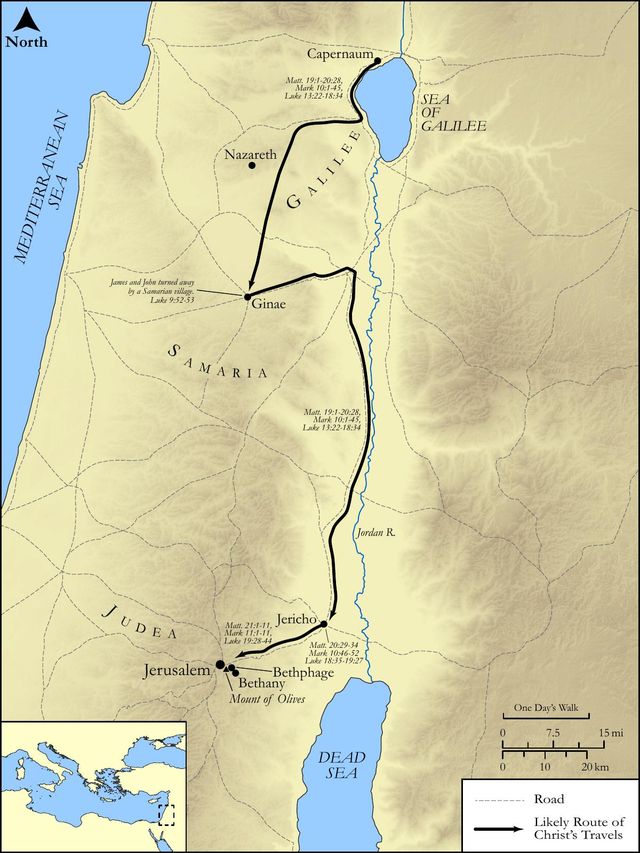
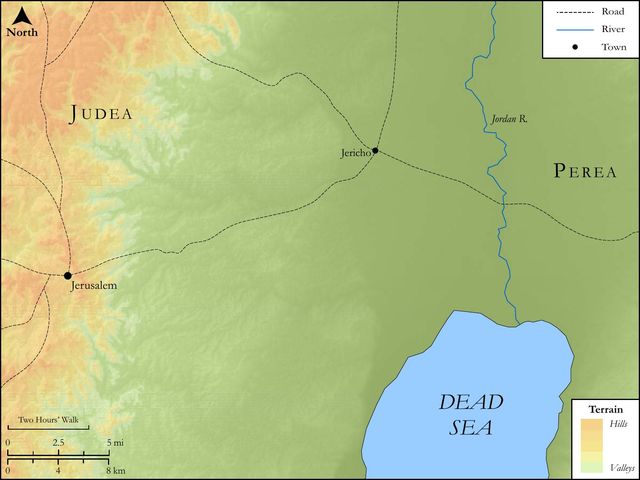
See on the biblical-era map
Study this verse
Public-domain commentary
Matthew Henry
From his Commentary on the Whole Bible. Henry comments on passages, not single verses — this entry covers Luke 19:1–10. His three-level outline is real structure in the source text, so it is rendered as structure.
Many, no doubt, were converted to the faith of Christ of whom no account is kept in the gospels; but the conversion of some, whose case had something in it extraordinary, is recorded, as this of Zaccheus. Christ passed through Jericho, Luk 19:1. This city was build under a curse, yet Christ honoured it with his presence, for the gospel takes away the curse. Though it ought not to have been built, yet it was not therefore a sin to live in it when it was built. Christ was now going from the other side Jordan to Bethany near Jerusalem, to raise Lazarus to life; when he was going to do one good work he contrived to do many by the way. He did good both to the souls and to the bodies of people; we have here an instance of the former. Observe,
I.Who, and what, this Zaccheus was.
His name bespeaks him a Jew. Zaccai was a common name among the Jews; they had a famous rabbi, much about this time, of that name. Observe,
1.His calling, and the post he was in: He was the chief among the publicans, receiver-general; other publicans were officers under him; he was, as some think, farmer of the customs. We often read of publicans coming to Christ; but here was one that was chief of the publicans, was in authority, that enquired after him. God has his remnant among all sorts. Christ came to save even the chief of publicans.
2.His circumstances in the world were very considerable: He was rich. The inferior publicans were commonly men of broken fortunes, and low in the world; but he that was chief of the publicans had raised a good estate. Christ had lately shown how hard it is for rich people to enter into the kingdom of God, yet presently produces an instance on one rich man that had been lost, and was found, and that not as the prodigal by being reduced to want.
II.How he came in Christ's way, and what was the occasion of his acquaintance with him.
1.He had a great curiosity to see Jesus, what kind of a man he was, having heard great talk of him, Luk 19:3. It is natural to us to come in sight, if we can, of those whose fame has filled our ears, as being apt to imagine there is something extraordinary in their countenances; at least, we shall be able to say hereafter that we have seen such and such great men. But the eye is not satisfied with seeing. We should now seek to see Jesus with an eye of faith, to see who he is; we should address ourselves in holy ordinances with this in our eye, We would see Jesus.
2.He could not get his curiosity gratified in this matter because he was little, and the crowd was great. Christ did not study to show himself, was not carried on men's shoulders (as the pope is in procession), that all men might see him; neither he nor his kingdom came with observation. He did not ride in an open chariot, as princes do, but, as one of us, he was lost in a crowd; for that was the day of his humiliation. Zaccheus was low of stature, and over-topped by all about him, so that he could not get a sight of Jesus. Many that are little of stature have large souls, and are lively in spirit. Who would not rather be a Zaccheus than a Saul, though he was higher by head and shoulders than all about him? Let not those that are little of stature take thought of adding cubits to it.
3.Because he would not disappoint his curiosity he forgot his gravity, as chief of the publicans, and ran before, like a boy, and climbed up into a sycamore-tree, to see him. Note, Those that sincerely desire a sight of Christ will use the proper means for gaining a sight of him, and will break through a deal of difficulty and opposition, and be willing to take pains to see him. Those that find themselves little must take all the advantages they can get to raise themselves to a sight of Christ, and not be ashamed to own that they need them, and all little enough. Let not dwarfs despair, with good help, by aiming high to reach high.
III.The notice Christ took of him, the call he gave him to a further acquaintance (Luk 19:5), and the efficacy of that call, Luk 19:6.
1.Christ invited himself to Zaccheus's house, not doubting of his hearty welcome there; nay, wherever Christ comes, as he brings his own entertainment along with him, so he brings his own welcome; he opens the heart, and inclines it to receive him. Christ looked up into the tree, and saw Zaccheus. He came to look upon Christ, and resolved to take particular notice of him, but little thought of being taken notice of by Christ. That was an honour too great, and too far above his merit, for him to have any thought of. See how Christ prevented him with the blessings of his goodness, and outdid his expectations; and see how he encouraged very weak beginnings, and helped them forward. He that had a mind to know Christ shall be known of him; he that only courted to see him shall be admitted to converse with him. Note, Those that are faithful in a little shall be entrusted with more. And sometimes those that come to hear the word of Christ, as Zaccheus did, only for curiosity, beyond what they thought of, have their consciences awakened, and their hearts changed. Christ called him by name, Zaccheus, for he knows his chosen by name; are they not in his book? He might ask, as Nathanael did (Joh 1:48), Whence knowest thou me? But before he climbed the sycamore-tree Christ saw him, and knew him. He bade him make haste, and come down. Those that Christ calls must come down, must humble themselves, and not think to climb to heaven by any righteousness of their own; and they must make haste and come down, for delays are dangerous. Zaccheus must not hesitate, but hasten; he knows it is not a matter that needs consideration whether he should welcome such a guest to his house. He must come down, for Christ intends this day to bait at his house, and stay an hour or two with him. Behold, he stands at the door and knocks.
2.Zaccheus was overjoyed to have such an honour put upon his house (Luk 19:6): He made haste, and came down, and received him joyfully; and his receiving him into his house was an indication and token of his receiving him into his heart. Note, When Christ calls to us we must make haste to answer his calls; and when he comes to us we must receive him joyfully. Lift up your heads, O ye gates. We may well receive him joyfully who brings all good along with him, and, when he takes possession of the soul, opens springs of joy there which shall flow to eternity. How often has Christ said to us, Open to me, when we have, with the spouse, made excuses! Sol 5:2, Sol 5:3. Zaccheus's forwardness to receive Christ will shame us. We have not now Christ to entertain in our houses, but we have his disciples, and what is done to them he takes as done to himself.
IV.The offence which the people took at this kind greeting between Christ and Zaccheus.
Those narrow-souled censorious Jews murmured, saying that he was gone to be a guest with a man that is a sinner, para hamartōlō andri - with a sinful man; and were not they themselves sinful men? Was it not Christ's errand into the world to seek and save men that are sinners? But Zaccheus they think to be a sinner above all men that dwelt in Jericho, such a sinner as was not fit to be conversed with. Now this was very unjust to blame Christ for going to his house; for,
1.Though he was a publican, and many of the publicans were bad men, it did not therefore follow that they were all so. We must take heed of condemning men in the lump, or by common fame, for at God's bar every man will be judged as he is.
2.Though he had been a sinner, it did not therefore follow that he was now as bad as he had been; though they knew his past life to be bad, Christ might know his present frame to be good. God allows room for repentance, and so must we.
3.Though he was now a sinner, they ought not to blame Christ for going to him, because he was in no danger of getting hurt by a sinner, but in great hopes of doing good to a sinner; whither should the physician go but to the sick? Yet see how that which is well done may be ill construed.
V.The proofs which Zaccheus gave publicly that, though he had been a sinner, he was now a penitent, and a true convert, Luk 19:8.
He does not expect to be justified by his works as the Pharisee who boasted of what he had done, but by his good works he will, through the grace of God, evidence the sincerity of his faith and repentance; and here he declares what his determination was. He made this declaration standing, that he might be seen and heard by those who murmured at Christ for coming to his house; with the mouth confession is made of repentance as well as faith. He stood, which denotes his saying it deliberately and with solemnity, in the nature of a vow to God. He addressed himself to Christ in it, not to the people (they were not to be his judges), but to the Lord, and he stood as it were at his bar. What we do that is good we must do as unto him; we must appeal to him, and approve ourselves to him, in our integrity, in all our good purposes and resolutions. He makes it appear that there is a change in his heart (and that is repentance), for there is a change in his way. His resolutions are of second-table duties; for Christ, upon all occasions, laid great stress on them: and they are such as are suited to his condition and character; for in them will best appear the truth of our repentance.
1.Zaccheus had a good estate, and, whereas he had been in it hitherto laying up treasure for himself, and doing hurt to himself, now he resolves that for the future he will be all towards God, and do good to others with it: Behold, Lord, the half of my goods I give to the poor. Not, "I will give it by my will when I die," but, "I do give it now." Probably he had heard of the command of trial which Christ gave to another rich man to sell what he had, and give to the poor (Mat 19:21), and how he broke with Christ upon it. "But so will not I," saith Zaccheus; "I agree to it at the first word; though hitherto I have been uncharitable to the poor, now I will relieve them, and give so much the more for having neglected the duty so long, even the half of my goods." This is a very large proportion to be set apart for works of piety and charity. The Jews used to say that a fifth part of a man's income yearly was very fair to be given to pious uses, and about that share the law directed; but Zaccheus would go much further, and give one moiety to the poor, which would oblige him to retrench all his extravagant expenses, as his retrenching these would enable him to relieve many with his superfluities. If we were but more temperate and self-denying, we should be more charitable; and, were we content with less ourselves, we should have the more to give to them that need. This he mentions here as a fruit of his repentance. Note, It well becomes converts to God to be charitable to the poor.
2.Zaccheus was conscious to himself that he had not gotten all he had honestly and fairly, but some by indirect and unlawful means, and of what he had gotten by such means he promises to make restitution: "If I have taken any thing from any man by false accusation, or if I have wronged any man in the way of my business as a publican, exacting more than was appointed, I promise to restore him four-fold." This was the restitution that a thief was to make, Exo 22:1.
(1.)He seems plainly to own that he had done wrong; his office, as a publican, gave him opportunity to do wrong, imposing upon the merchants to curry favour with the government. True penitents will own themselves not only in general guilty before God, but will particularly reflect upon that which has been their own iniquity, and which, by reason of their business and employment in the world, has most easily beset them.
(2.)That he had done wrong by false accusation; this was the temptation of the publicans, which John Baptist had warned them of particularly, Luk 3:14. They had the ear of the government, and every thing would be stretched in favour of the revenue, which gave them an opportunity of gratifying their revenge if they bore a man an ill will.
(3.)He promises to restore four-fold, as far as he could recollect or find by his books that he had wronged any man. He does not say, "If I be sued, and compelled to it, I will make restitution" (some are honest when they cannot help it); but he will do it voluntarily: It shall be my own act and deed. Note, Those who are convinced of having done wrong cannot evidence the sincerity of their repentance but by making restitution. Observe, He does not think that his giving half his estate to the poor will atone for the wrong he has done. God hates robbery for burnt-offerings, and we must first do justly and then love mercy. It is no charity, but hypocrisy, to give that which is none of our own; and we are not to reckon that our own which we have not come honestly by, nor that our own which is not so when all our debts are paid, and restitution made for wrong done.
VI.Christ's approbation and acceptance of Zaccheus's conversion, by which also he cleared himself from any imputation in going to be a guest with him, Luk 19:9, Luk 19:10.
1.Zaccheus is declared to be now a happy man. Now he is turned from sin to God; now he has bidden Christ welcome to his house, and is become an honest, charitable, good man: This day is salvation come to this house. Now that he is converted he is in effect saved, saved from his sins, from the guilt of them, from the power of them; all the benefits of salvation are his. Christ is come to his house, and, where Christ comes, he brings salvation along with him. He is, and will be, the Author of eternal salvation to all that own him as Zaccheus did. Yet this is not all. Salvation this day comes to his house.
(1.)When Zaccheus becomes a convert, he will be, more than he had been, a blessing to his house. He will bring the means of grace and salvation to his house, for he is a son of Abraham indeed now, and therefore, like Abraham, will teach his household to keep the way of the Lord. He that is greedy of gain troubles his own house, and brings a curse upon it (Hab 2:9), but he that is charitable to the poor does a kindness to his own house, and brings a blessing upon it and salvation to it, temporal at least, Psa 112:3.
(2.)When Zaccheus is brought to Christ himself his family also become related to Christ, and his children are admitted members of his church, and so salvation comes to his house, for that he is a son of Abraham, and therefore interested in God's covenant with Abraham, that blessing of Abraham which comes upon the publicans, upon the Gentiles, through faith, that God will be a God to them and to their children; and therefore, when he believes, salvation comes to his house, as the gaoler's to whom it was said, Believe in the Lord Jesus Christ, and thou shalt be saved, and thy house, Act 16:31. Zaccheus is by birth a son of Abraham, but, being a publican, he was deemed a heathen; they are put upon a level, Mat 18:17. And as such the Jews were shy of conversing with him, and expected Christ should be so; but he shows that, being a true penitent, he is become rectus in curia - upright in court, as good a son of Abraham as if he had never been an publican, which therefore ought not to be mentioned against him.
2.What Christ had done to make him, in particular, a happy man, was consonant to the great design and intention of his coming into the world, Luk 19:10. With the same argument he had before justified his conversing with publicans, Mat 9:13. There he pleaded that he came to call sinners to repentance; now that he came to seek and save that which was lost, to apolōlos - the lost thing. Observe,
(1.)The deplorable case of the sons of men: they were lost; and here the whole race of mankind is spoken of as one body. Note, The whole world of mankind, by the fall, is become a lost world: lost as a city is lost when it has revolted to the rebels, as a traveller is lost when he has missed his way in a wilderness, as a sick man is lost when his disease is incurable, or as a prisoner is lost when sentence is passed upon him.
(2.)The gracious design of the Son of God: he came to seek and save, to seek in order to saving. He came from heaven to earth (a long journey), to seek that which was lost (which had wandered and gone astray), and to bring it back (Mat 18:11, Mat 18:12), and to save that which was lost, which was perishing, and in a manner destroyed and cut off. Christ undertook the cause when it was given up for lost: undertook to bring those to themselves that were lost to God and all goodness. Observe, Christ came into this lost world to seek and save it. His design was to save, when there was not salvation in any other. In prosecution of that design, he sought, took all probable means to effect that salvation. He seeks those that were not worth seeking to; he seeks those that sought him not, and asked not for him, as Zaccheus here.
Historical interpretation
Nine Centuries of Reception
19 surviving comments on this verse. Each one is dated, so this reads as a timeline rather than a list.
Select a marker to jump to its quote. Markers stagger vertically where authors wrote within a few decades of each other.
But that possessions distributed to the poor do annul former covetousness, Zaccheus made evident, when he said, "Behold, the half of my goods I give to the poor; and if I have defrauded any one, I restore fourfold."
It is said, therefore, that Zaccheus, or, according to some, Matthew, the chief of the publicans, on hearing that the Lord had deigned to come to him, said, "Lord, and if I have taken anything by false accusation, I restore him fourfold; "on which the Saviour said, "The Son of man, on coming to-day, has found that which was lost."
This he did in the best possible way, by receiving the Lord, and entertaining Him in his house. "When thou seest the naked cover him." This he promised to do, in an equally satisfactory way, when he offered the half of his goods for all works of mercy. So also "he loosened the bands of wickedness. undid the heavy burdens, let the oppressed go free, and broke every yoke," when he said, "If I have taken anything from any man by false accusation, I restore him fourfold." Therefore the Lord said, "This day is salvation come to this house." Thus did He give His testimony, that the precepts of the Creator spoken by the prophet tended to salvation.
Of the benefit of good works and mercy. In Isaiah: "Cry aloud," saith He, "and spare not; lift up thy voice like a trumpet; tell my people their sins, and the house of Jacob their wickednesses. They seek me from day to day, and desire to know my ways, as a people which did righteousness, and did not forsake the judgment of God. They ask of me now a righteous judgment, and desire to approach to God, saying, What! because we have fasted, and Thou hast not seen: we have humiliated our souls, and Thou hast not known. For in the days of fasting are found your own wills; for either ye torment those who are subjected to you, or ye fast for strifes and judgments, or ye strike your neighbours with fists. For what do you fast unto me, that to-day your voice should be heard in clamour? This fast I have not chosen, save that a man should humble his soul. And if thou shalt bend thy neck like a ring, and spread under thee sackcloth and ashes, neither thus shall it be called an acceptable fast. Not such a fast have I chosen, saith the Lord; but loose every knot of unrighteousness, let go the chokings of impotent engagements. Send away the harassed into rest, and scatter every unrighteous contract. Break thy bread to the hungry, and bring the houseless poor into thy dwelling. If thou seest the naked, clothe him; and despise not them of thy own seed in thy house. Then shall thy seasonable light break forth, and thy garments shall quickly arise; and righteousness shall go before thee: and the glory of God shall surround thee. Then thou shalt cry out, and God shall hear thee; while thou art yet speaking, He shall say, Here I am." Concerning this same thing in Job: "I have preserved the needy from the hand of the mighty; and I have helped the orphan, to whom there was no helper. The mouth of the widow blessed me, since I was the eye of the blind; I was also the foot of the lame, and the father of the weak." Of this same matter in Tobit: "And I said to Tobias, My son, go and bring whatever poor man thou shalt find out of our brethren, who still has God in mind with his whole heart. Bring him hither, and he shall eat my dinner together with me. Behold, I attend thee, my son, until thou come." Also in the same place: "All the days of thy life, my son, keep God in mind, and transgress not His precepts. Do justice all the days of thy life, and do not walk in the way of unrighteousness; because if thou act truly, there will be respect of thy works. Give alms of thy substance, and turn not thy face from any poor man. So shall it come to pass that the face of God shall not be turned away from thee. Even as thou hast, my son, so do: if thou hast abundant substance, give the more alms therefrom; if thou hast little, communicate even of that little. And do not fear when thou givest alms: thou layest up for thyself a good reward against the day of need; because alms delivereth from death, and does not suffer to go into darkness. Alms is a good office for all who do it in the sight of the most high God." On this same subject in Solomon in Proverbs: "He that hath pity on the poor lendeth unto the Lord." Also in the same place: "He that giveth to the poor shall never want; but he who turns away his eye shall be in much penury." Also in the same place: "Sins are purged away by alms-giving and faith." Again, in the same place: "If thine enemy hunger, feed him; and if he thirst, give him to drink: for by doing this thou shalt scatter live coals upon his head." Again, in the same place: "As water extinguishes fire, so alms-giving extinguishes sin." In the same in Proverbs: "Say not, Go away, and return, to-morrow I will give; when you can do good immediately. For thou knowest not what may happen on the coming day." Also in the same place: "He who stoppeth his ears that he may not hear the weak, shall himself call upon God, and there shall be none to hear him." Also in the same place: "He who has his conversation without reproach in righteousness, leaves blessed children." In the same in Ecclesiasticus: "My son, if thou hast, do good by thyself, and present worthy offerings to God; remember that death delayeth not." Also in the same place: "Shut up alms in the heart of the poor, and this will entreat for thee from all evil." Concerning this thing in the thirty-sixth Psalm, that mercy is beneficial also to one's posterity: "I have been young, and I have also grown old; and I have not seen the righteous forsaken, nor his seed begging their bread. The whole day he is merciful, and lendeth; and his seed is in blessing." Of this same thing in the fortieth Psalm: "Blessed is he who considereth over the poor and needy: in the evil day God will deliver him." Also in the cxith Psalm: "He hath distributed, he hath given to the poor; his righteousness shall remain from generation to generation." Of this same thing in Hosea: "I desire mercy rather than sacrifice, and the knowledge of God more than whole burnt-offerings." Of this same thing also in the Gospel according to Matthew: "Blessed are they who hunger and thirst after righteousness: for they shall be satisfied." Also in the same place: "Blessed are the merciful: for they shall obtain mercy." Also in the same place: "Lay up for yourselves treasures in heaven, where neither moth nor rust doth corrupt, and where thieves do not dig through and steal: for where your treasure is, there will your heart be also." Also in the same place: "The kingdom of heaven is like unto a merchantman seeking goodly pearls: and when he hath found a precious pearl, he went away and sold all that he had, and bought it." That even a small work is of advantage, also in the same place: "And whoever shall give to drink to one of the least of these a cup of cold water in the name of a disciple, verily I say unto you, His reward shall not perish." That alms are to be denied to none, also in the same place: "Give to every one that asketh thee; and from him who would wish to borrow, be not turned away." Also in the same place: "If thou wilt enter into life, keep the commandments. He saith, Which? Jesus saith unto him, Thou shalt not kill, Thou shalt not commit adultery, Thou shalt not bear false witness, Honour thy father and mother: and, Thou shalt love thy neighbour as thyself. The young man saith unto Him, All these things have I observed: what lack I yet? Jesus saith unto him, If thou wilt be perfect, go and sell all that thou hast, and give to the poor, and thou shalt have treasure in heaven; and come, follow me." Also in the same place: "When the Son of man shall come in His majesty, and all the angels with Him, then He shall sit on the throne of His glory: and all nations shall be gathered together before Him; and He shall separate them one from another, even as a shepherd separates the sheep from the goats: and He shall place the sheep on the right hand, but the goats on the left hand. Then shall the King say unto them that are on His right hand, Come, ye blessed of my Father, receive the kingdom prepared for you from the beginning of the world. For I was hungry, and ye gave me to eat: I was thirsty, and ye gave me to drink: I was a stranger, and ye took me in: naked, and ye clothed me: I was sick, and ye visited me: I was in prison, and ye came unto me. Then shall the righteous answer Him, and say, Lord, when saw we Thee a stranger, and took Thee in: naked, and clothed Thee? And when saw we Thee sick, and in prison, and came to Thee? And the King, answering, shall say unto them, Verily I say unto you, Inasmuch as ye did it to one of the least of these my brethren, ye did it unto me. Then shall He say unto them who are on His left hand, Depart from me, ye cursed, into everlasting fire, which my Father hath prepared for the devil and his angels: for I was hungry, and ye gave me not to eat: I was thirsty, and ye gave me not to drink: I was a stranger, and ye took me not in: I was naked, and ye clothed me not: sick, and in prison, and ye visited me not. Then shall they also answer, and say, Lord, when saw we Thee hungry, or thirsty, or a stranger, or naked, or sick, or in prison, and did not minister unto Thee? And He shall answer them, Verily I say unto you, Inasmuch as ye did it not to one of the least of these, ye did it not unto me. And these shall go away into everlasting burning: but the righteous into life eternal." Concerning this same matter in the Gospel according to Luke: "Sell your possessions, and give alms." Also in the same place: "He who made that which is within, made that which is without also. But give alms, and, behold, all things are pure unto you." Also in the same place: "Behold, the half of my substance I give to the poor; and if I have defrauded any one of anything, I restore him fourfold. And Jesus said unto him, that salvation has this day been wrought for this house, since he also is a son of Abraham." Of this same thing also in the second Epistle to the Corinthians: "Let your abundance supply their want, that their abundance also may be the supplement of your want, that there may be equality: as it is written, He who had much had not excess; and he who had little had no lack." Also in the same place: "He who soweth sparingly shall reap also sparingly; and he who soweth in blessing shall reap also of blessing. But let every one do as he has proposed in his heart: not as if sorrowfully, or of necessity: for God loveth a cheerful giver." Also in the same place: "As it is written, He hath dispersed abroad; he hath given to the poor: his righteousness remaineth for ever." Likewise in the same place: "Now he who ministereth seed to the sower, shall both supply bread to be eaten, and shall multiply your seed, and shall increase the growth of the fruits of your righteousness: that in all things ye may be made rich." Also in the same place: "The administration of this service has not only supplied that which is lacking to the saints, but has abounded by much giving of thanks unto God." Of this same matter in the Epistle of John: "Whoso hath this world's substance, and seeth his brother desiring, and shutteth up his bowels from him, how dwelleth the love of God in him? " Of this same thing in the Gospel according to Luke: "When thou makest a dinner or a supper, call not thy friends, nor brethren, nor neighbours, nor the rich; lest haply they also invite thee again, and a recompense be made thee. But when thou makest a banquet, call the poor, the weak, the blind, and lame: and thou shalt be blessed; because they have not the means of rewarding thee: but thou I shalt be recompensed in the resurrection of the I just."
In fine, He calls those the children of Abraham whom He sees to be laborious in aiding and nourishing the poor. For when Zacchaeus said, "Behold, the half of my goods I give to the poor; and if I have done any wrong to any man, I restore fourfold," Jesus answered and said, "That salvation has this day come to this house, for that he also is a son of Abraham." For if Abraham believed in God, and it was counted unto him for righteousness, certainly he who gives alms according to God's precept believes in God, and he who has the truth of faith maintains the fear of God; moreover, he who maintains the fear of God considers God in showing mercy to the poor. For he labours thus because he believes-because he knows that what is foretold by God's word is true, and that the Holy Scripture cannot lie-that unfruitful trees, that is, unproductive men, are cut off and cast into the fire, but that the merciful are called into the kingdom. He also, in another place, calls laborious and fruitful men faithful; but He denies faith to unfruitful and barren ones, saying, "If ye have not been faithful in the unrighteous mammon, who will commit to you that which is true? And if ye have not been faithful in that which is another man's, who shall give you that which is your own? "
Zacchaeus was praying in his heart as follows, “Happy the one who is worthy that this just man should enter into his dwelling.” The Lord said to him, “Hurry, come down, Zacchaeus.” Seeing he knew his thoughts, he said, “Just as he knows this, he knows also all that I have done.” He therefore said, “All that I have unjustly received, I give back fourfold.” Hurry and come down from the fig tree, because it is with you that I will be staying. The first fig tree of Adam will be forgotten, because of the last fig tree of the chief tax collector, and the name of the guilty Adam will be forgotten because of the innocent Zacchaeus.
The seed of salvation had begun to spring up in him, for he desired to see Jesus, having never seen Him. For if he had seen Him, he would long since have given up the Publican's wicked life. No one that sees Jesus can remain any longer in wickedness. But there were two obstacles to his seeing Him. The multitude not so much of men as of his sins prevented him, for he was little of stature.
But he discovered a good device; running before he climbed up into a sycamore, and saw Him whom he had long wished for, i. e. Jesus, passing by. Now Zacchæus desired no more than to see, but He who is able to do more than we ask for, granted to Him far above what he expected; as it follows, And when Jesus came to the place, he looked up, and saw him. He saw the soul of the man striving earnestly to live a holy life, and converts him to godliness.
Zacchæus in the sycamore, the blind man by the way side: upon the one our Lord waits to show mercy, upon the other He confers the great glory of abiding in his house. The chief among the Publicans is here fitly introduced. For who will hereafter despair of himself, now that he attains to grace who gained his living by fraud. And he too moreover a rich man, that we may know that not all rich men are covetous.
What means the Evangelist by describing his stature, and that of none other? It is perhaps because he was young in wickedness, or as yet weak in the faith. For he was not yet prostrate in sin who could climb up. He had not yet seen Christ.
Uninvited he invites Himself to his house; as it follows, Zacchæus, make haste, and come down, & c. for He knew how richly He would reward his hospitality. And though He had not yet heard the word of invitation, He had already seen the will.
Let the rich learn that guilt attaches not to the goods themselves, but to those who know not how to use them. For riches, as they are hindrances to virtue in the unworthy, so are they means of advancing it in the good.
He has well added, that our Lord was to pass that way, either where the sycamore-tree was, or where he was who was about to believe, that so He might preserve the mystery, and sow the seeds of grace. For He had so come as that through the Jews He came to the Gentiles. He sees then Zacchæus above, for already the excellence of his faith shone forth amidst the fruits of good works, and the loftiness of the fruitful tree; but Zacchæus stands out above the tree, as one who is above the law.
And that thou mayest learn that this is, above all, a house's adorning, enter into the house of Zacchaeus, and learn, when Christ was on the point of entering therein, how Zacchaeus adorned it. For he did not run to his neighbors begging curtains, and seats, and chairs made of ivory, neither did he bring forth from his closets Laconian hangings; but he adorned it with an adorning suitable to Christ. What was this? "The half of my goods I will give," he saith, "to the poor; and whomsoever I have robbed, I will restore fourfold." On this wise let us too adorn our houses, that Christ may enter in unto us also. These are the fair curtains, these are wrought in Heaven, they are woven there. Where these are, there is also the King of Heaven. But if thou adorn it in another way, thou art inviting the devil and his company.
The Lord, who had already welcomed Zacchaeus in his heart, was now ready to be welcomed by him in his house. He said, "Zacchaeus, hurry up and come down, since I have to stay in your house." He thought it was a marvelous piece of good luck to see Christ. While imagining it was a marvelous piece of luck quite beyond words to see him passing by, he was suddenly found worthy to have him in his house. Grace is poured out, and faith starts working through love. Christ, who was already dwelling in his heart, is welcomed into his house. Zacchaeus says to Christ, "Lord, half my goods I give to the poor, and if I have cheated anyone of anything, I am paying back four times over." It is as if he were saying, "The reason I am keeping back half for myself is not in order to have it, but to have something from which to pay people back."There you are. That is really what welcoming Jesus means, welcoming him into your heart. Christ was already there. He was in Zacchaeus and spoke through him. The apostle says that this is what it means, "For Christ to dwell by faith in your hearts."
But Zacchæus made no delay in what he did, and so was accounted worthy of the favour of God, which gives sight to the blind, and calls them who are afar off.
The crowd is the tumultuous state of an ignorant multitude, which cannot see the lofty top of wisdom. Zacchæus therefore, while he was in the crowd, saw not Christ, but having advanced beyond the vulgar ignorance, was thought worthy to entertain Him, whom he desired to look upon.
Zacchaeus must be praised. His riches were unable to keep him from the royal threshold. He should be greatly praised because his riches brought him to the threshold of the kingdom. From this, we understand that wealth is not a hindrance but a help to attaining the glory of Christ. While we possess it, we should not squander it on wild living but give it away for the sake of salvation. There is no crime in possessions, but there is crime in those who do not know how to use possessions. For the foolish, wealth is a temptation to vice, but for the wise, it is a help to virtue. Some receive an opportunity for salvation, but others acquire an obstacle of condemnation.
(Hom. de cæc. et Zacc.) Observe the gracious kindness of the Saviour. The innocent associates with the guilty, the fountain of justice with covetousness, which is the source of injustice. Having entered the publican's house, He suffers no stain from the mists of avarice, but disperses them by the bright beam of His righteousness. But those who deal with biting words and reproaches, try to cast a slur upon the things which were done by Him; for it follows, And when they saw it, they all murmured, saying, That he was gone to be guest with a man that is a sinner. But He, though accused of being a wine-bibber and a friend of publicans, regarded it not, so long as He could accomplish His end. As a physician sometimes can not save his patients from their diseases without the defilement of blood. And so it happened here, for the publican was converted, and lived a better life. Zacchæus stood, and said unto the Lord, Behold, Lord, the half of my goods I give to the poor; and if I have defrauded any man, I restore him fourfold. Behold here is a marvel: without learning he obeys. And as the sun pouring its rays into a house enlightens it not by word, but by work, so the Saviour by the rays of righteousness put to flight the darkness of sin; for the light shineth in darkness. Now every thing united is strong, but divided, weak; therefore Zacchæus divides into two parts his substance. But we must be careful to observe, that his wealth was not made up from unjust gains, but from his patrimony, else how could he restore fourfold what he had unjustly extorted. He knew that the law ordered what was wrongly taken away to be restored fourfold, that if the law deterred not, a man's losses might soften him. Zacchæus waits not for the judgment of the law, but makes himself his own judge.
(ubi sup.) Why do ye accuse me if I bring sinners to righteousness? So far am I from hating them, that for their sakes I came. For I came to heal, not to judge, therefore am I the constant guest of those that are sick, and I suffer their noisomeness that I may supply remedies. But some one may ask, how does Paul bid us, If we have a brother that is a fornicator or covetous man, with such not even to take food; (1 Cor. 5:11.) whereas Christ was the guest of publicans? They were not as yet so far advanced as to be brethren, and besides, St. Paul bids us avoid our brethren only when they persist in evil, but these were converted.
For our external possessions, however small, are sufficient for the Lord. For he weighs the heart, not the substance; nor does he consider how much is offered in his sacrifice, but from how much it is brought forth. For if we weigh external substance, behold, our holy merchants purchased the perpetual life of angels by giving up their nets and boat. Indeed it has no estimation of price, yet the kingdom of God is worth as much as you have. For it was worth half his substance to Zacchaeus, because he reserved the other half to restore fourfold what he had unjustly taken. It was worth the abandoned nets and boat to Peter and Andrew; it was worth two small coins to the widow; it was worth a cup of cold water to another. The kingdom of God, therefore, as we said, is worth as much as you have.
For I consider Peter, I reflect upon the thief, I look at Zacchaeus, I gaze upon Mary, and I see nothing else in these except examples of hope and repentance placed before our eyes. Another, panting with the fevers of avarice, has seized the property of others; let him look to Zacchaeus, who if he had taken anything from anyone, restored it fourfold.
(Mor. 27. c. 46.) Or because the sycamore is from its name called the foolish fig, the little Zacchæus gets up into the sycamore and sees the Lord, for they who humbly choose the foolish things of this world are those who contemplate most closely the wisdom of God. For what is more foolish in this world than not to seek for what is lost, to give our possessions to robbers, to return not injury for injury? However, by this wise foolishness, the wisdom of God is seen, not yet really as it is, but by the light of contemplation.
See here, the camel disencumbered of his hunch passes through the eye of a needle, that is, the rich man and the publican abandoning his love of riches, and loathing his dishonest gains, receives the blessing of his Lord's company. It follows, And he made haste, and came down, and received him joyfully.
Zacchæus is called the son of Abraham, not because he was born of Abraham's seed, but because he imitates his faith, that as Abraham left his country and his father's house, so he abandoned all his goods in giving them to the poor. And He well says, "He also," to declare that not only those who had lived justly, but those who are raised up from a life of injustice, belong to the sons of promise.
Mystically, Zacchæus, which is by interpretation "justified," signifies the Gentile believers, who were depressed and brought very low by their worldly occupations, but sanctified by God. And he was desirous to see our Saviour entering Jericho, inasmuch as he sought to share in that faith which Christ brought into the world.
Or the crowd, that is, the general habit of vice, which rebuked the blind man crying out, lest he should seek the light, also impedes Zacchæus looking up, that he might not see Jesus; that as by crying out the more the blind man overcame the crowd, so the man weak in the faith by forsaking earthly things, and climbing the tree of the Cross, surmounts the opposing multitude. The sycamore, which is a tree resembling the mulberry in foliage, but exceeding it in height, whence by the Latins it is called "lofty," is called the "foolish fig-tree;" and so the Cross of our Lord sustains believers, as the fig-tree figs, and is mocked by unbelievers as foolishness. This tree Zacchæus, who was little in stature, climbed up, that he might be raised together with Christ; for every one who is humble, and conscious of his own weakness, cries out, God forbid that I should glory, save in the cross of our Lord Jesus Christ. (Gal. 6:14.)
The Lord as He journeyed came to the place where Zacchæus had climbed the sycamore, for having sent His preachers throughout the world in whom He Himself spoke and went, He comes to the Gentile people, who were already raised up on high through faith in His Passion, and whom when He looked up He saw, for He chose them through grace. Now our Lord once abode in the house of the chief of the Pharisees, but when He did works such as none but God could do, they railed at Him. Wherefore hating their deeds He departed, saying, Your house shall be left unto you desolate; (Matt. 23:38.) but now He must needs stay at the house of the weak Zacchæus, that is, by the grace of the new law brightly shining, He must take rest in the hearts of the lowly nations. But that Zacchæus is bid to come down from the sycamore tree, and prepare an abode for Christ, this is what the Apostle says, Yea, though we have known Christ after the flesh, yet now henceforth know we Him no more. (2 Cor. 5:16.) And again elsewhere, For though he was crucified through weakness, yet he liveth by the power of God. (2 Cor. 13:4.) It is plain that the Jews always hated the salvation of the Gentiles; but salvation, which formerly filled the houses of the Jews, has this day shone upon the Gentiles, forasmuch as this people also by believing on God is a son of Abraham.
But Zacchaeus, standing, said to the Lord: “Behold, Lord, I give half of my goods to the poor, and if I have defrauded anyone of anything, I restore fourfold.” While others were slandering the man as a sinner, Zacchaeus himself, standing, that is, persisting in the truth of the faith he had begun, proves not only to have been converted from a sinner, but also to have lived among the perfect. For as the Lord says: “If you want to be perfect, go, sell all that you have and give to the poor” (Matthew XIX), anyone who lived innocently before conversion can give everything to the poor after being converted. But whoever has taken anything by fraud must first return these things according to the law, then give what remains to the poor. And thus he himself, because he keeps nothing for himself, disperses all his possessions, gives them to the poor, and his justice remains forever (Psalm CXI). And this is that wise foolishness, which the publican had gathered from the sycamore tree, as it were the fruit of life, namely to restore what was taken, to leave behind one’s own property, to despise visible things, to desire even to die for unseen things, to deny oneself, and to long to follow in the footsteps of the Lord, who is not yet seen.
If we examine more closely, we shall see that nothing was left of his own property. For having given half of his goods to the poor, out of the remainder he restored fourfold to those whom he had injured. He not only promised this, but did it. For he says not, "I will give the half, and I will restore fourfold, but, I give, and I restore. To such Christ announces salvation; Jesus saith unto him, This day is salvation come to this house, signifying that Zacchæus had attained to salvation, meaning by the house the inhabitant thereof. And it follows, forasmuch as he also is a son of Abraham. For He would not have given the name of a son of Abraham to a lifeless building.
He said not that he "was" a son of Abraham, but that he now is. For before when he was the chief among the publicans, and bore no likeness to the righteous Abraham, he was not his son. But because some murmured that he tarried with a man who was a sinner, he adds in order to restrain them, For the Son of man came to seek and to save that which was lost.
It is easy to turn this to a moral use. For whoever surpasses many in wickedness is small in spiritual growth, and cannot see Jesus for the crowd. For disturbed by passion and worldly things, he beholds not Jesus walking, that is, working in us, not recognising His operation. But he climbs up to the top of a sycamore-tree, in that he rises above the sweetness of pleasure, which is signified by a fig, and subduing it, and so becoming more exalted, he sees and is seen by Christ.
The Lord said to him, Make haste and come down, that is, "Thou hast ascended by penitence to a place too high for thee, come down by humility, lest thy exaltation cause thee to slip. I must abide in the house of a humble man. We have two kinds of goods in us, bodily, and spiritual; the just man gives up all his bodily goods to the poor, but he forsakes not his spiritual goods, but if he has extorted any thing from any one, he restores to him fourfold; signifying thereby that if a man by repentance walks in the opposite path to his former perverseness, he by the manifold practice of virtue heals all his old offences, and so merits salvation, and is called the son of Abraham, because he went out from his own kindred, that is, from his ancient wickedness.
Continue studying Luke 19:8 across the web’s major study libraries — every link below opens this exact verse, chapter, or book on the destination site.
Read & Compare
 BibleGatewayThis verse in more than 200 translations and 70 languages.
 Bible.comThe YouVersion reader — hundreds of translations, reading plans, and highlights.
 ESV.orgCrossway's official English Standard Version reader.
 NET BibleThe NET translation with 60,000+ translators' notes on every rendering decision.
 STEP BibleTyndale House's free study tool — original text, vocabulary, and scholarly resources.
 BibliaLogos Bible Software's free web reader.
 USCCBThe New American Bible (Revised Edition) with the U.S. bishops' study notes.
Commentaries
 BibleHub CommentariesDozens of classic commentaries on this verse, gathered on one page.
 StudyLightMore than 100 commentary sets — the largest collection on the web.
 BibleRefPlain-English commentary on what this verse means, verse by verse.
 Enduring WordDavid Guzik's free commentary on this chapter, widely used by Bible teachers.
 Bible Study ToolsVerse commentary alongside Greek and Hebrew study aids.
Original Language & Research
- BibleHub InterlinearThe verse word by word — original language, transliteration, and English.
- BibleHub LexiconEvery word's original-language definition and Strong's entry.
 Blue Letter BibleDeep-study tools — Strong's numbers, concordance, and word studies.
 CNTR CollationThe earliest Greek manuscripts of this verse, collated letter by letter.
Sermons, Hymns & Audio


TrulyRandomVerse is not affiliated with these sites and doesn’t control their content. They’re linked because they’re genuinely useful.
Summary
Luke 19:8 records the astonishing and immediate declaration of Zacchaeus, the chief tax collector of Jericho, to Jesus Christ. This verse serves as the tangible evidence of a profound spiritual transformation, where Zacchaeus publicly commits to radical generosity by giving half of his possessions to the poor and to extraordinary restitution, pledging to restore fourfold anything he had unjustly acquired. It powerfully illustrates that genuine repentance, ignited by an encounter with divine grace, manifests in concrete actions of justice and compassion.
Context
ShowHideLiterary Context
This verse is the climactic response of Zacchaeus following his encounter with Jesus. The preceding verses detail Zacchaeus's desperate desire to see Jesus, his diminutive stature leading him to climb a sycamore tree, and Jesus's surprising initiative to invite Himself to Zacchaeus's home (Luke 19:1-5). This act by Jesus was scandalous to the onlookers, who grumbled that Jesus had gone "to be the guest of a man who is a sinner" (Luke 19:7). Zacchaeus's declaration in verse 8 is not a negotiation for salvation but a spontaneous, Spirit-prompted outpouring of a heart transformed by the unexpected grace and acceptance he received from the Lord. It sets the stage for Jesus's pronouncement in Luke 19:9-10 that "salvation has come to this house."
Historical & Cultural Context
In first-century Judea, tax collectors (publicans) were among the most despised members of society. They were Jewish individuals who had bought the right to collect taxes for the Roman Empire, often extorting more than required for their personal gain. They were viewed as traitors to their people, collaborators with the oppressive Roman regime, and ritually unclean due to their constant interaction with Gentiles. Their profession was synonymous with corruption, greed, and injustice. Zacchaeus, as a "chief tax collector," held a position of significant wealth and power, implying an even greater degree of exploitation. His home would have been considered defiled, and his association with Jesus would have been deeply offensive to devout Jews. His pledge to restore fourfold goes beyond the Mosaic Law's typical requirement for theft, which was usually double restitution (Exodus 22:1-4), or an added fifth for confessed wrongdoing (Numbers 5:7).
Key Themes
ShowHideZacchaeus's declaration powerfully illustrates several core themes within Luke's Gospel and the broader biblical narrative. Firstly, it highlights Genuine Repentance and Transformation, demonstrating that a true encounter with Christ leads to a radical reorientation of life, moving from self-serving greed to outward-focused generosity and justice. This aligns with John the Baptist's call for "fruits worthy of repentance" (Luke 3:8). Secondly, it emphasizes Radical Restitution and Justice, as Zacchaeus's commitment to restore fourfold far exceeds legal requirements, showcasing a deep desire to make amends for past wrongs and pursue righteousness. This extraordinary act underscores the transformative power of God's grace to inspire a profound commitment to ethical living. Finally, the narrative underscores God's Pursuit of the Lost, as Jesus actively seeks out and embraces those considered outcasts and sinners by society, demonstrating His mission to bring salvation to all, especially those in desperate need of redemption, as declared in Luke 19:10.
Exposition and Analysis
ShowHideKey Word Analysis
ShowHideThis verb (G2476) implies a deliberate and firm posture. Zacchaeus doesn't just speak casually; he takes a stand, indicating a decisive and public declaration. It suggests a moment of conviction and resolve, a turning point where he publicly aligns himself with a new way of life and a new Lord.
The term (G4811) literally means "to be a fig-informer" (one who reported illegal fig exportation in ancient Athens), but evolved to mean "to defraud," "to extort," or "to accuse falsely." This word precisely describes the corrupt and exploitative practices common among tax collectors, who used their authority to exact more than was due. Zacchaeus's use of this term acknowledges his specific sin, demonstrating a clear awareness of his past injustices.
This adjective (G5073) means "quadruple." Zacchaeus's pledge to restore four times what he had taken by false accusation is remarkable. While Mosaic Law required double restitution for theft (Exodus 22:4) and a fifth added to the principal for confessed wrongdoing (Numbers 5:7), a fourfold restitution was typically reserved for severe cases of theft of livestock (Exodus 22:1) or was a Roman legal penalty. Zacchaeus's willingness to go beyond the legal and customary Jewish requirements underscores the depth of his repentance and his earnest desire to make amends fully.
Verse Breakdown
ShowHide"And Zacchaeus stood, and said unto the Lord;"
This phrase highlights Zacchaeus's immediate and public response. His standing signifies a bold, decisive, and perhaps even defiant declaration in the face of the murmuring crowd. Addressing Jesus as "Lord" indicates a recognition of His authority and a submission to His person.
"Behold, Lord, the half of my goods I give to the poor;"
Zacchaeus's first pledge demonstrates a radical reorientation of his values. From a life of accumulating wealth through extortion, he immediately commits to immense generosity, giving away half of his substantial possessions to those in need. The "Behold, Lord" emphasizes the sincerity and immediacy of his commitment, presenting it as a direct offering to Christ.
"and if I have taken any thing from any man by false accusation, I restore [him] fourfold."
This second pledge addresses his specific sin as a tax collector. He acknowledges the possibility of past injustice ("if I have taken any thing from any man by false accusation") and commits to a restitution that far exceeds legal requirements. This goes beyond mere legal compliance, revealing a heart genuinely broken over his past wrongs and committed to making things right, even at great personal cost.
Literary Devices
ShowHideLuke's narrative in Luke 19:1-10, culminating in Zacchaeus's declaration in verse 8, masterfully employs several literary devices. Contrast is paramount, juxtaposing Zacchaeus's past life of greed and exploitation with his immediate and radical acts of generosity and restitution. This dramatic shift underscores the transformative power of Jesus's presence. There is also an element of Dramatic Irony, as the crowd condemns Jesus for associating with a "sinner" (Luke 19:7), unaware that this very association is the catalyst for the sinner's profound repentance. Zacchaeus's pledge of fourfold restitution can be seen as Hyperbole or Exaggeration in the context of legal requirements, serving to emphasize the extraordinary depth of his contrition and his zeal for justice. Finally, Zacchaeus's actions serve as Symbolism for the fruit of genuine salvation, demonstrating that true faith is not merely intellectual assent but a life-altering encounter that compels tangible acts of righteousness and love.
Theological and Thematic Connections
ShowHideZacchaeus's dramatic transformation in Luke 19:8 is a powerful testament to the immediate and profound impact of God's grace. It illustrates that salvation is not merely a declaration but a dynamic process that reorients one's entire life, values, and priorities. His spontaneous and radical acts of generosity and restitution serve as irrefutable evidence of a heart truly changed by Christ. This narrative affirms that genuine repentance involves not only sorrow for sin but also a fervent desire to make amends, rectify wrongs, and live justly. It challenges the common misconception that salvation is a passive experience, instead portraying it as an active, fruit-bearing encounter that profoundly impacts one's relationship with wealth, others, and God.
Reflection and Application
ShowHideZacchaeus's story is a timeless reminder that an authentic encounter with Jesus Christ inevitably leads to tangible transformation. It challenges us to move beyond mere intellectual assent to faith and to examine our lives for concrete evidence of repentance and new life. His radical generosity and commitment to restitution compel us to consider how our own resources and actions reflect our values. Are we holding onto possessions or past wrongs that hinder our spiritual growth or our witness? True faith is active and sacrificial, prompting us to seek justice, practice generosity, and make amends where we have caused harm. This narrative encourages believers to live out their salvation in practical, impactful ways, demonstrating the reality of Christ's transforming power to a watching world.
Questions for Reflection
ShowHideFAQ
ShowHideWhat does Zacchaeus's pledge of fourfold restitution signify beyond legal requirements?
ShowHideZacchaeus's commitment to restore fourfold signifies an extraordinary depth of repentance and a profound desire for reconciliation and justice that far exceeds the typical legal requirements of the Mosaic Law. While the Law usually mandated double restitution for theft (Exodus 22:4) or an added fifth for confessed wrongdoing (Numbers 5:7), a fourfold restitution was a penalty for specific severe thefts (Exodus 22:1). By voluntarily pledging this, Zacchaeus demonstrated not just compliance, but a heart broken over his past injustices and a zealous commitment to make things right, even at great personal cost. It was a clear, tangible fruit of his newfound faith and a powerful repudiation of his former life of extortion.
Christ-Centered Fulfillment
ShowHideZacchaeus's transformation in Luke 19:8 is a vivid illustration of Christ's redemptive mission and the power of the Gospel to bring about radical change. Jesus's deliberate act of seeking out Zacchaeus, a despised outcast, and inviting Himself to his home, demonstrates that the Messiah came not for the righteous but for sinners (Luke 5:32). Zacchaeus's immediate and extravagant response—giving half his wealth to the poor and restoring fourfold—is the undeniable fruit of a heart renewed by Christ's unmerited grace. This transformation foreshadows the new creation that occurs in Christ, where "if anyone is in Christ, he is a new creation; the old has gone, the new has come!" (2 Corinthians 5:17). Zacchaeus's story is a beautiful picture of what it means to be truly saved: not just a change in status, but a profound reorientation of desires, values, and actions, all enabled by the atoning work of Jesus, who "gave himself for us to redeem us from all wickedness and to purify for himself a people that are his very own, eager to do what is good" (Titus 2:14). His encounter with the Savior led him to embrace the very principles of justice and generosity that define God's kingdom, demonstrating that true faith in Christ always bears the fruit of righteousness.