


Philippians 3:6
Bible text: King James Version (1769 Blayney text) · Public domain
Bible text: King James Version with Strong's numbers · Public domain
Bible text: Berean Standard Bible · Public domain
Bible text: American Standard Version (1901) · Public domain
Bible text: World English Bible, Messianic edition · Public domain
Bible text: Geneva Bible (1599) · Public domain
Bible text: Young's Literal Translation · Public domain
- κατὰkataaccording toG2596PREPPreposition
- ζῆλοςzēloszealG2205N-ASNNoun Accusative Singular Neuter
- διώκωνdiōkōnpersecutingG1377V-PAP-NSMVerb Present Active Participle Nominative Singular Masculine
- τὴνtēntheG3588T-ASFDefinite article Accusative Singular Feminine
- ἐκκλησίανekklēsianchurchG1577N-ASFNoun Accusative Singular Feminine
- κατὰkataaccording toG2596PREPPreposition
- δικαιοσύνηνdikaiosunēnrighteousnessG1343N-ASFNoun Accusative Singular Feminine
- τὴνtēnwhich [is]G3588T-ASFDefinite article Accusative Singular Feminine
- ἐνeninG1722PREPPreposition
- νόμῳnomō[the] LawG3551N-DSMNoun Dative Singular Masculine
- γενόμενοςgenomenoshaving becomeG1096V-2ADP-NSMVerb 2nd Aorist Middle Deponent Participle Nominative Singular Masculine
- ἄμεμπτοςamemptosfaultlessG273A-NSMAdjective Nominative Singular Masculine
English is a literal word-by-word gloss of the Greek, not the KJV's wording. Why?
This is the original text the KJV's translators worked from — each Greek word with its own literal English meaning in this verse, prepared by scholars at Tyndale House, Cambridge. The KJV translates whole sentences, not word by word, so its wording differs: one Greek word can become several English words, and the KJV may choose “charity” where the gloss reads “love”. Both are faithful — they answer different questions. For the KJV's own rendering, switch to the KJV text.
Details
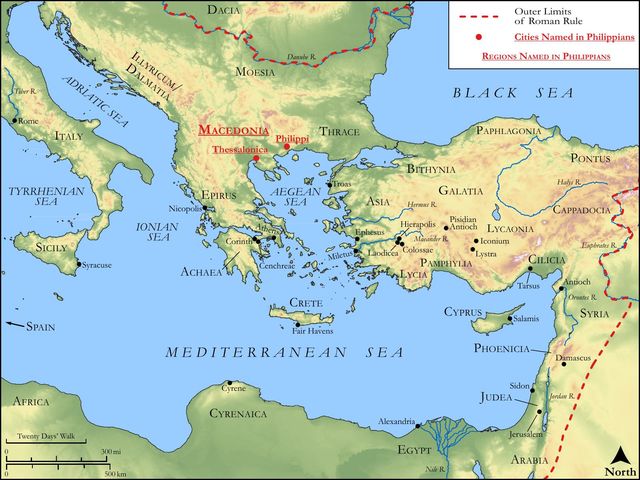
See on the biblical-era maps

Study this verse
Public-domain commentary
Matthew Henry
From his Commentary on the Whole Bible. Henry comments on passages, not single verses — this entry covers Philippians 3:4–8. His two-level outline is real structure in the source text, so it is rendered as structure.
The apostle here proposes himself for an example of trusting in Christ only, and not in his privileges as an Israelite.
I.He shows what he had to boast of as a Jew and a Pharisee.
Let none think that the apostle despised these things (as men commonly do) because he had them not himself to glory in. No, if he would have gloried and trusted in the flesh, he had as much cause to do so as any man: If any other man thinketh that he hath whereof to trust in the flesh, I more, Phi 3:4. He had as much to boast of as any Jew of them all.
1.His birth-right privileges. He was not a proselyte, but a native Israelite: of the stock of Israel. And he was of the tribe of Benjamin, in which tribe the temple stood, and which adhered to Judah when all the other tribes revolted. Benjamin was the father's darling, and this was a favourite tribe. A Hebrew of the Hebrews, an Israelite on both sides, by father and mother, and from one generation to another; none of his ancestors had matched with Gentiles.
2.He could boast of his relations to the church and the covenant, for he was circumcised the eighth day; he had the token of God's covenant in his flesh, and was circumcised the very day which God had appointed.
3.For learning, he was a Pharisee, brought up at the feet of Gamaliel, an eminent doctor of the law: and was a scholar learned in all the learning of the Jews, taught according to the perfect manner of the laws of the fathers, Act 22:3. He was a Pharisee, the son of a Pharisee (Act 23:6), and after the most strict sect of his religion lived a Pharisee, Act 26:5.
4.He had a blameless conversation: Toughing the righteousness which is of the law, blameless: as far as the Pharisees' exposition of the law went, and as to the mere letter of the law and outward observance of it, he could acquit himself from the breach of it and could not be accused by any.
5.He had been an active man for his religion. As he made a strict profession of it, under the title and character of a Pharisee, so he persecuted those whom he looked upon as enemies to it. Concerning zeal, persecuting the church.
6.He showed that he was in good earnest, though he had a zeal without knowledge to direct and govern the exercise of it: I was zealous towards God, as you all are this day, and I persecuted this way unto the death, Act 22:3, Act 22:4. All this was enough to have made a proud Jew confident, and was stock sufficient to set up with for his justification. But,
II.The apostle tells us here how little account he made of these, in comparison of his interest in Christ and his expectations from him:
But what things were gain to me those have I counted loss for Christ (Phi 3:7); that is, those things which he had counted gain while he was a Pharisee, and which he had before reckoned up, these he counted loss for Christ. "I should have reckoned myself an unspeakable loser of, to adhere to them, I had lost my interest in Jesus Christ." He counted them loss; not only insufficient to enrich him, but what would certainly impoverish and ruin him, if he trusted to them, in opposition to Christ. Observe, The apostle did not persuade them to do any thing but what he had himself did, to quit any thing but what he had himself quitted, nor venture on any bottom but what he himself had ventured his immortal soul upon. - Yea doubtless, and I count all things but loss for the excellency of the knowledge of Christ Jesus my Lord, Phi 3:8. Here the apostle explains himself.
1.He tells us what it was that he was ambitious of and reached after: it was the knowledge of Christ Jesus his Lord, a believing experimental acquaintance with Christ as Lord; not a merely notional and speculative, but a practical and efficacious knowledge of him. So knowledge is sometimes put for faith: By his knowledge, or the knowledge of him, shall my righteous servant justify many, Isa 53:11. And it is the excellency of knowledge. There is an abundant and transcendent excellency in the doctrine of Christ, or the Christian religion above all the knowledge of nature, and improvements of human wisdom; for it is suited to the case of fallen sinners, and furnishes them with all they need and all they can desire and hope for, with all saving wisdom and saving grace.
2.He shows how he had quitted his privileges as a Jew and a Pharisee: Yea doubtless; his expression rises with a holy triumph and elevation, alla men oun ge kai. There are five particles in the original: But indeed even also do I count all things but loss. He had spoken before of those things, his Jewish privileges: here he speaks of all things, all worldly enjoyments and mere outward privileges whatsoever, things of a like kind or any other kind which could stand in competition with Christ for the throne in his heart, or pretend to merit and desert. There he had said that he did count them but loss; but it might be asked, "Did he continue still in the same mind, did he not repent his renouncing them?" No, now he speaks in the present tense: Yea doubtless, I do count them but loss. But it may be said, "It is easy to say so; but what would he do when he came to the trial?" Why he tells us that he had himself practised according to this estimate of the case: For whom I have suffered the loss of all things. He had quitted all his honours and advantages, as a Jew and a Pharisee, and submitted to all the disgrace and suffering which attended the profession and preaching of the gospel. When he embarked in the bottom of the Christian religion, he ventured all in it, and suffered the loss of all for the privileges of a Christian. Nay, he not only counted them loss, but dung, skubala - offals thrown to dogs; they are not only less valuable than Christ, but in the highest degree contemptible, when they come in competition with him. Note, The New Testament never speaks of saving grace in any terms of diminution, but on the contrary represents it as the fruits of the divine Spirit and the image of God in the soul of man; as a divine nature, and the seed of God: and faith is called precious faith; and meekness is in the sight of God of great price, Pe1 3:4; Pe2 1:1, etc.
Historical interpretation
Historical reception
3 surviving comments on this verse. Each one is dated, so this reads as a timeline rather than a list.
Select a marker to jump to its quote. Markers stagger vertically where authors wrote within a few decades of each other.
But he comes to the things which are matters of choice, wherein we have the "rather." "As touching the law, a Pharisee; as touching zeal, persecuting the Church." But this is not sufficient; for it is possible to be a Pharisee even, and yet not very zealous. But this also he adds; behold the "rather." "According to righteousness." It is possible, however, to be adventurous, or to act thus from ambition, and not out of zeal for the law, as the chief priests did. Yet neither was this the case, but, "according to the righteousness which is in the law, found blameless." If then both for purity of descent, and earnestness, and habits, and mode of life, I surpassed all, why have I renounced all those dignities, he asks, but because I found that the things of Christ are better, and better far?
Before his conversion Paul fulfilled the law conspicuously, either through fear of the people or of God himself, even if he may have offended the law in his internal affections. But he was fulfilling the law through fear of punishment, not through love of righteousness.
“When I was harrying the church,” he says, “I was not driven by love of honor or vainglory or jealousy, like the rulers of the Jews. I was burning with zeal for the law.”
Continue studying Philippians 3:6 across the web’s major study libraries — every link below opens this exact verse, chapter, or book on the destination site.
Read & Compare
 BibleGatewayThis verse in more than 200 translations and 70 languages.
 Bible.comThe YouVersion reader — hundreds of translations, reading plans, and highlights.
 ESV.orgCrossway's official English Standard Version reader.
 NET BibleThe NET translation with 60,000+ translators' notes on every rendering decision.
 STEP BibleTyndale House's free study tool — original text, vocabulary, and scholarly resources.
 BibliaLogos Bible Software's free web reader.
 USCCBThe New American Bible (Revised Edition) with the U.S. bishops' study notes.
Commentaries
 BibleHub CommentariesDozens of classic commentaries on this verse, gathered on one page.
 StudyLightMore than 100 commentary sets — the largest collection on the web.
 BibleRefPlain-English commentary on what this verse means, verse by verse.
 Enduring WordDavid Guzik's free commentary on this chapter, widely used by Bible teachers.
 Bible Study ToolsVerse commentary alongside Greek and Hebrew study aids.
Original Language & Research
- BibleHub InterlinearThe verse word by word — original language, transliteration, and English.
- BibleHub LexiconEvery word's original-language definition and Strong's entry.
 Blue Letter BibleDeep-study tools — Strong's numbers, concordance, and word studies.
 CNTR CollationThe earliest Greek manuscripts of this verse, collated letter by letter.
Sermons, Hymns & Audio


TrulyRandomVerse is not affiliated with these sites and doesn’t control their content. They’re linked because they’re genuinely useful.
Summary
In Philippians 3:6, the Apostle Paul continues his autobiographical account, detailing his former life as a zealous Pharisee. He highlights two primary aspects of his pre-conversion identity: his intense, albeit misguided, fervor that led him to actively persecute the nascent Christian church, and his impeccable adherence to the Mosaic Law, by which he was considered "blameless" in the eyes of his peers. This verse serves as a crucial backdrop for Paul's radical re-evaluation of all his former achievements as "loss" for the surpassing worth of knowing Christ.
Context
ShowHideLiterary Context
Philippians 3:6 is situated within a highly personal and polemical section of Paul's letter to the Philippians, beginning in Philippians 3:1. Paul is warning the Philippian believers against "dogs" and "evil workers," likely referring to Judaizers who insisted on circumcision and adherence to the Mosaic Law for salvation. To counter their claims of righteousness based on human effort, Paul presents his own formidable Jewish credentials (circumcised on the eighth day, of the tribe of Benjamin, a Hebrew of Hebrews, a Pharisee) in Philippians 3:4-6. The purpose is not to boast, but to demonstrate that if anyone had reason to trust in their own flesh, it was he. He then dramatically shifts, declaring all these accomplishments as "rubbish" or "loss" for the sake of Christ in Philippians 3:7-8, setting the stage for his profound explanation of true righteousness found in Christ alone.
Historical & Cultural Context
Paul, originally Saul of Tarsus, was a highly educated and devout Jew, trained under the esteemed Rabbi Gamaliel (Acts 22:3). As a Pharisee, he belonged to one of the most rigorous and influential Jewish sects, known for their meticulous observance of the Mosaic Law and oral traditions. This sect believed that strict adherence to the law was the path to righteousness and national redemption. Paul's "zeal" was characteristic of many Pharisees who saw the emerging Christian movement, with its claims of a crucified Messiah and salvation apart from the law, as a dangerous heresy that threatened the very foundations of Judaism. His persecution of the church was not an act of personal malice but a religiously motivated endeavor, believing he was serving God by stamping out what he perceived as blasphemy (Acts 26:9-11). His "blameless" status under the law reflects his outward conformity to all its precepts, a testament to the high standards of legalistic piety within the Pharisaic tradition.
Key Themes
ShowHideThis verse contributes significantly to several key themes within Philippians and Paul's broader theology. Firstly, it underscores the theme of righteousness by faith versus righteousness by works. Paul's pre-conversion "blamelessness" in the law is contrasted with the "righteousness that comes from God on the basis of faith" (Philippians 3:9). Secondly, it highlights the danger of misguided zeal. Paul's fervent passion, though sincere, was tragically misdirected, leading him to oppose God's true work in Christ. This illustrates that zeal must be coupled with knowledge and truth (Romans 10:2-3). Finally, it subtly introduces the theme of transformation and grace, as the persecutor of the church becomes its most ardent apostle, a testament to the power of Christ's saving grace (1 Timothy 1:12-16).
Exposition and Analysis
ShowHideKey Word Analysis
ShowHideThis term, derived from a word meaning "to boil," denotes intense fervor, passion, or enthusiasm. In Paul's case, as described by the Ground Truth Strong's data, it refers to a "fervent mind" or "ardor" for his Jewish heritage and traditions. While zeal can be positive, here it describes a burning passion that was tragically misdirected, leading him to oppose God's true work.
According to the Ground Truth Strong's data, this word means "to pursue (literally or figuratively)" and "by implication, to persecute." It describes Paul's active, aggressive pursuit of Christians, seeking to suppress and destroy the nascent church. This was not passive disapproval but a forceful, systematic campaign against believers.
As per the Ground Truth Strong's data, this adjective means "irreproachable," "without fault," or "unblamable." It signifies that Paul, from a human and legalistic perspective, meticulously fulfilled all the outward requirements of the Mosaic Law and its traditions. He was outwardly perfect according to the standards of his Pharisaic peers, meaning no one could find a legitimate legal charge against his adherence to the law.
Verse Breakdown
ShowHide"Concerning zeal, persecuting the church"
This clause reveals the driving force behind Paul's pre-conversion actions. His "zeal" was an intense, fervent devotion to Judaism and what he believed was God's honor. This passion, however, manifested in a violent opposition to the followers of Christ, whom he considered a heretical sect. His zeal was not merely intellectual but actively expressed in "persecuting the church," meaning he actively pursued, harassed, and sought to destroy Christian communities.
"touching the righteousness which is in the law, blameless"
This clause describes Paul's standing before God and man based on his adherence to the Mosaic Law. "Righteousness which is in the law" refers to the legalistic righteousness achieved through strict obedience to the commandments and traditions. Paul asserts that in this regard, he was "blameless," meaning he was irreproachable, faultless, and without accusation according to the standards of the law and the judgment of his peers. This highlights his exemplary performance in fulfilling the external requirements of the law, presenting himself as a model of legalistic piety.
Literary Devices
ShowHidePaul employs Autobiographical Confession in this verse, providing a concise summary of his pre-conversion life to establish his credentials and then dramatically devalue them. There is a strong element of Contrast inherent in the entire passage, where Paul sets up his former "blameless" legal righteousness against the true righteousness that comes through faith in Christ, which he elaborates on in subsequent verses. The term "blameless" itself, while literally true from a human perspective, carries an underlying Irony when contrasted with God's perfect standard and Paul's later understanding that no one is truly blameless before God through the law. His "zeal" for persecuting the church also presents a powerful Paradox, as his fervent devotion to God led him to oppose God's own Son and His people, a tragic misdirection of passion.
Theological and Thematic Connections
ShowHidePhilippians 3:6 powerfully illustrates the stark contrast between human effort and divine grace in the pursuit of righteousness. Paul's impeccable legal standing, achieved through fervent zeal and meticulous adherence to the law, represents the pinnacle of human religious achievement. Yet, he would come to understand that such self-righteousness, however outwardly impressive, is utterly insufficient to secure a right standing with God. This verse underscores the fundamental theological truth that true righteousness is not earned by works of the law but is a gift received through faith in Jesus Christ. It serves as a profound reminder that even the most sincere religious devotion can be tragically misguided if it is not rooted in the truth of God's revelation and the person of Christ.
Reflection and Application
ShowHidePaul's testimony in Philippians 3:6 challenges us to critically examine the foundations of our own confidence and righteousness. Do we, like Paul in his former life, place our trust in our own efforts, our moral conduct, our religious observances, or our perceived "blamelessness" before others? This verse serves as a powerful corrective, reminding us that true spiritual standing before God is never a matter of human achievement, but always a gift of divine grace. It also prompts us to consider the nature of our zeal: is our passion for God's work truly aligned with His will and truth, or is it a misguided fervor that might, however unintentionally, oppose His purposes? We are called to surrender our self-righteousness, however subtle, and to direct our energies toward knowing Christ and living by faith in Him, rather than relying on our own performance or reputation.
Questions for Reflection
ShowHideFAQ
ShowHideWhat does Paul mean by being "blameless" in the law?
ShowHideWhen Paul states he was "blameless" concerning the righteousness found in the law, he is referring to his outward, meticulous adherence to the Mosaic Law and the traditions of the Pharisees. From a human perspective, and according to the legal standards of his day, he had fulfilled all the requirements and could not be accused of any transgression. He was outwardly irreproachable. However, Paul later clarifies that this external blamelessness did not equate to true righteousness before a holy God, nor could it atone for sin or transform the heart. It was a righteousness based on human effort, which he ultimately counted as "loss" (Philippians 3:7).
How could Paul, a man of such "zeal," persecute the church?
ShowHidePaul's "zeal" was a fervent, intense passion for what he believed was God's honor and the purity of Judaism. Before his conversion, he genuinely believed that Christianity was a dangerous heresy that blasphemed God and undermined the Mosaic Law. Therefore, his persecution of the church was not an act of personal hatred but a religiously motivated campaign to defend God and the traditions of his fathers. He recounts this period in his life in Acts 22:3-5 and Galatians 1:13-14, demonstrating his sincerity, even in his error. This highlights the critical truth that zeal, however strong, must be grounded in divine truth and knowledge, not merely human conviction.
Christ-Centered Fulfillment
ShowHidePhilippians 3:6, while describing Paul's pre-conversion life under the law, powerfully sets the stage for the glorious Christ-centered fulfillment that follows. Paul's "blameless" legal righteousness, a pinnacle of human achievement, is ultimately revealed as insufficient, a "loss" and "rubbish" compared to the surpassing worth of knowing Christ (Philippians 3:7-8). Christ fulfills the law's demands not by enabling us to perfectly keep it, but by perfectly keeping it Himself and then becoming the end of the law for righteousness to everyone who believes (Romans 10:4). The righteousness Paul once sought through his own efforts is now freely given through faith in Christ, who became sin for us so that in Him we might become the righteousness of God (2 Corinthians 5:21). Furthermore, Paul's transformation from a zealous persecutor of the church to its most fervent apostle is a testament to Christ's redemptive power and boundless grace. The very object of his persecution, the church, is now the body of Christ, through which he proclaims the very gospel he once sought to destroy (Acts 9:1-19). Thus, Philippians 3:6 serves as a dark backdrop against which the radiant light of Christ's perfect righteousness, transforming grace, and ultimate supremacy shine all the more brightly.