


Mark 12:29
Bible text: King James Version (1769 Blayney text) · Public domain
Bible text: Berean Standard Bible · Public domain
Bible text: American Standard Version (1901) · Public domain
Bible text: World English Bible, Messianic edition · Public domain
Bible text: Geneva Bible (1599) · Public domain
Bible text: Young's Literal Translation · Public domain
- δὲdenowG1161CONJConjunction
- ἀπεκρίθηapekrithēAnsweredG611V-ADI-3SVerb Aorist Middle Deponent Indicative 3rd Singular
- ὁho<the>G3588T-NSMDefinite article Nominative Singular Masculine
- ἸησοῦςIēsousJesusG2424N-NSM-PNoun Nominative Singular Masculine Individual
- αὐτῷautōto himG846P-DSMPersonal pronoun Dative Singular Masculine
- ὅτιhotiTheG3754CONJConjunction
- πρώτηprōtēfirstG4413A-NSFAdjective Nominative Singular Feminine
- πασῶνpasōnof allG3956A-GPFAdjective Genitive Plural Feminine
- τῶνtōn<the>G3588T-GPFDefinite article Genitive Plural Feminine
- ἐντολῶν·entolōncommandmentsG1785N-GPFNoun Genitive Plural Feminine
- ἄκουεakouedo listenG191V-PAM-2SVerb Present Active Imperative 2nd Singular
- ἸσραήλIsraēlO IsraelG2474N-VSM-LNoun Vocative Singular Masculine Person Gentilic
- κύριοςkurios[The] LordG2962N-NSM-TNoun Nominative Singular Masculine Title
- ὁhotheG3588T-NSMDefinite article Nominative Singular Masculine
- θεὸςtheosGodG2316N-NSM-TNoun Nominative Singular Masculine Title
- ἡμῶνhēmōnof usG3165P-1GPPersonal pronoun Genitive 1st Plural
- κύριοςkurios[the] LordG2962N-NSM-TNoun Nominative Singular Masculine Title
- εἷςheisOneG1520A-NSMAdjective Nominative Singular Masculine
- ἐστιν·estinisG1510V-PAI-3SVerb Present Active Indicative 3rd Singular
English is a literal word-by-word gloss of the Greek, not the KJV's wording. Why?
This is the original text the KJV's translators worked from — each Greek word with its own literal English meaning in this verse, prepared by scholars at Tyndale House, Cambridge. The KJV translates whole sentences, not word by word, so its wording differs: one Greek word can become several English words, and the KJV may choose “charity” where the gloss reads “love”. Both are faithful — they answer different questions. For the KJV's own rendering, switch to the KJV text.
Details
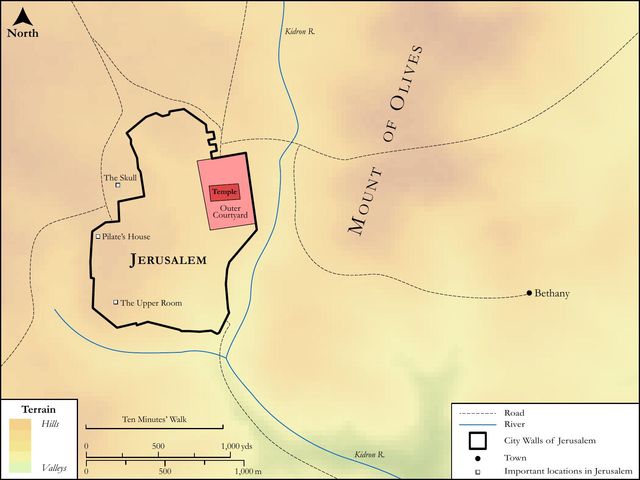
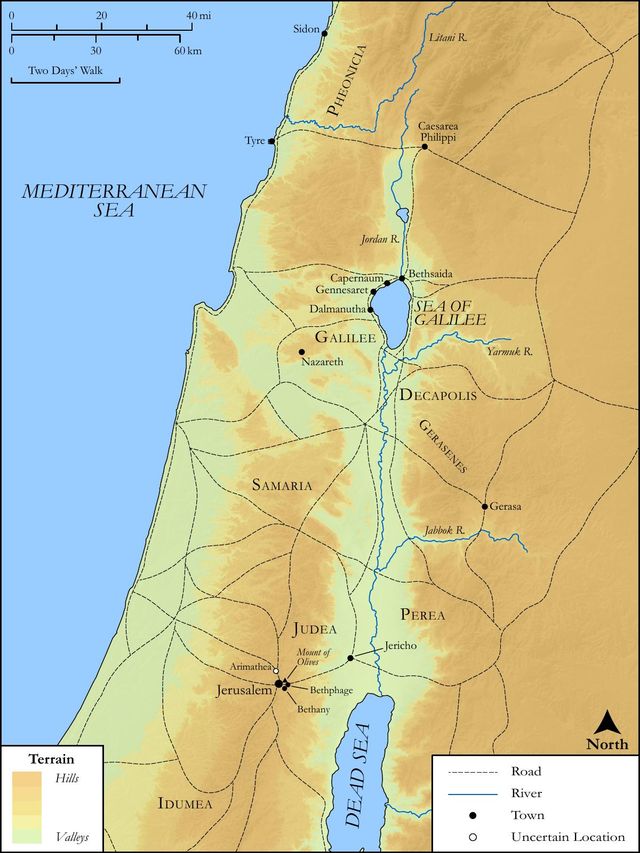
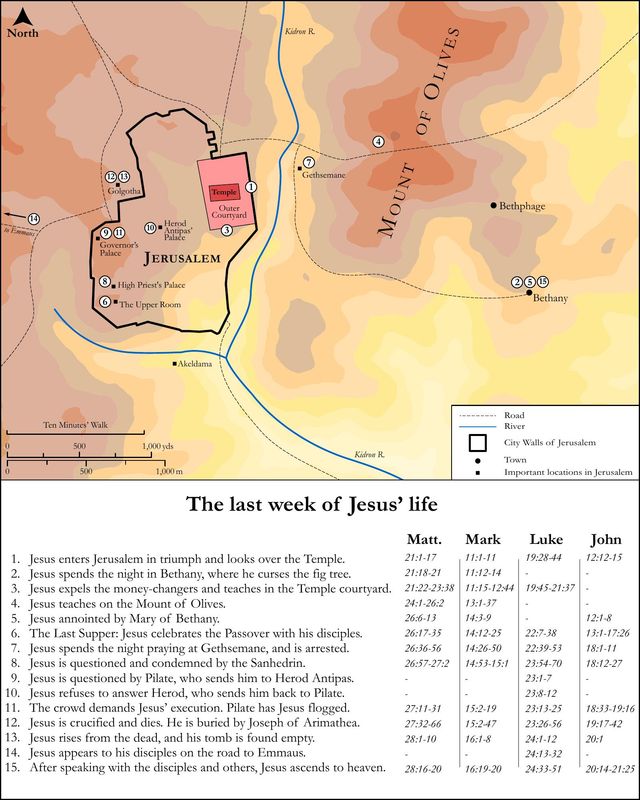
See on the biblical-era maps
Study this verse
Public-domain commentary
Matthew Henry
From his Commentary on the Whole Bible. Henry comments on passages, not single verses — this entry covers Mark 12:28–34. His three-level outline is real structure in the source text, so it is rendered as structure.
The scribes and Pharisees were (however bad otherwise) enemies to the Sadducees; now one would have expected that, when they heard Christ argue so well against the Sadducees, they would have countenanced him, as they did Paul when he appeared against the Sadducees (Act 23:9); but it had not the effect: because he did not fall in with them in the ceremonials of religion, he agreeing with them in the essentials, gained him no manner of respect with them. Only we have here an account of one of them, a scribe, who had so much civility in him as to take notice of Christ's answer to the Sadducees, and to own that he had answered well, and much to the purpose (Mar 12:28); and we have reason to hope that he did not join with the other scribes in persecuting Christ; for here we have his application to Christ for instruction, and it was such as became him; not tempting Christ, but desiring to improve his acquaintance with him.
I.He enquired, Which is the first commandment of all? Mar 12:28.
He doth not mean the first in order, but the first in weight and dignity; "Which is that command which we ought to have in a special manner an eye to, and our obedience to which will lay a foundation for our obedience to all the rest?" Not that any commandment of God is little (they are all the commands of a great God), but some are greater than others, moral precepts than rituals, and of some we may say, They are the greatest of all.
II.Christ gave him a direct answer to this enquiry, Mar 12:29-31.
Those that sincerely desire to be instructed concerning their duty, Christ will guide in judgment, and teach his way. He tells him,
1.That the great commandment of all, which is indeed inclusive of all, is, that of loving God with all our hearts.
(1.)Where there is a commanding principle in the soul, there is a disposition to every other duty. Love is the leading affection of the soul; the love of God is the leading grace in the renewed soul.
(2.)Where this is not, nothing else that is good is done, or done aright, or accepted, or done long. Loving God with all our heart, will effectually take us off fRom. and arm us against, all those things that are rivals with him for the throne in our souls, and will engage us to every thing by which he may be honoured, and with which he will be pleased; and no commandment will be grievous where this principle commands, and has the ascendant. Now here in, Mark, our Saviour prefixes to this command the great doctrinal truth upon which it is built (Mar 12:29); Hear, O Israel, The Lord our God is one Lord; if we firmly believe this, it will follow, that we shall love him with all our heart. He is Jehovah, who has all amiable perfections in himself; he is our God, to whom we stand related and obliged; and therefore we ought to love him, to set our affections on him, let out own desire toward him, and take a delight in him; and he is one Lord, therefore he must be loved with our whole heart; he has the sole right to us, and therefore ought to have the sole possession of us. If he be one, our hearts must be one with him, and since there is no God besides, no rival must be admitted with him upon the throne.
2.That the second great commandment is, to love our neighbour as ourselves (Mar 12:31), as truly and sincerely as we love ourselves, and in the same instances, and we must show it by doing as we would be done by. As we must therefore love God better than ourselves, because he is Jehovah, a being infinitely better than we are, and must love him with all our heart, because he is one Lord, and there is no other like him; so we must love our neighbour as ourselves, because he is of the same nature with ourselves; our hearts are fashioned alike, and my neighbour and myself are of one body, of one society, that of the world of mankind; and if a fellow-Christian, and of the same sacred society, the obligation is the stronger. Hath not one God created us? Mal 2:10. Has not one Christ redeemed us? Well might Christ say, There is no other commandment greater than these; for in these all the law is fulfilled, and if we make conscience of obedience to these, all other instances of obedience will follow of course.
III.The scribe consented to what Christ said, and descanted upon it, Mar 12:32, Mar 12:33.
1.He commends Christ's decision of this question; Well, Master, thou hast said the truth. Christ's assertions needed not the scribe's attestations; but this scribe, being a man in authority, thought it would put some reputation upon what Christ said, to have it commended by him; and it shall be brought in evidence against those who persecuted Christ, as a deceiver, that one of themselves, even a scribe of their own, confessed that he said the truth, and said it well. And thus must we subscribe to Christ's sayings, must set to our seal that they are true.
2.He comments upon it. Christ had quoted that great doctrine, that the Lord our God is one Lord; and this he not only assented to, but added, "There is none other but he; and therefore we must have no other God besides." This excludes all rivals with him, and secures the throne in the heart entire for him. Christ had laid down that great law, of loving God with all our hearts; and this also he explains - that it is loving him with the understanding, as those that know what abundant reason we have to love him. Our love to God, as it must be an entire, so it must be an intelligent, love; we must love him with all the understanding, ex holēs tēs suneseōs - out of the whole understanding; our rational powers and faculties must all be set on work to lead out the affections of our souls toward God. Christ has said, "To love God and our neighbour is the greatest commandment of all;" "Yea," saith the scribe, "it is better, it is more than all whole-burnt-offerings and sacrifices, more acceptable to God, and will turn to a better account to ourselves." There were those who held, that the law of sacrifices was the greatest commandment of all; but this scribe readily agreed with our Saviour in this - that the law of love to God and our neighbour is greater than that of sacrifice, even than that of whole-burnt-offerings, which were intended purely for the honour of God.
IV.Christ approved of what he said, and encouraged him to proceed in his enquiries of him, Mar 12:34.
1.He owned that he understood well, as far as he went; so far, so good. Jesus saw that he answered discreetly, and was the more pleased with it, because he had of late met with so many even of the scribes, men of letters, that answered indiscreetly, as those that had no understanding, nor desired to have any. He answered nounechōs - as one that had a mind; as a rational intelligent man, as one that had his wits about him; as one whose reason was not blinded, whose judgment was not biassed, and whose forethought was not fettered, by the prejudices which other scribes were so much under the power of. He answered as one that allowed himself liberty and leisure to consider, as one that had considered.
2.He owned that he stood fair for a further advance; "Thou art not far from the kingdom of God, the kingdom of grace and glory; thou art in a likely way to be a Christian, a disciple of Christ. For the doctrine of Christ insists most upon these things, and is designed, and has a tendency direct, to bring thee to this." Note, There is hope of those who make a good use of the light they have, and go as far as that will carry them, that by the grace of God they will be led further, by the clearer discoveries God has to make to them. What became of this scribe we are not told, but would willingly hope that he took the hint Christ hereby gave him, and that, having been told by him, so much to his satisfaction, what was the great commandment of the law, he proceeded to enquire of him, or his apostles, what was the great commandment of the gospel too. Yet, if he did not, but took, up here, and went no further, we are not to think it strange; for there are many who are not far from the kingdom of God, and yet never come thither. Now, one would think, this should have invited many to consult him: but it had a contrary effect; No man, after that, durst ask him any question; every thing he said, was spoken with such authority and majesty, that every one stood in awe of him; those that desired to learn, were ashamed to ask, and those that designed to cavil, were afraid to ask.
Historical interpretation
Nineteen Centuries of Reception
13 surviving comments on this verse. Each one is dated, so this reads as a timeline rather than a list.
Select a marker to jump to its quote. Markers stagger vertically where authors wrote within a few decades of each other.
This question is only that which is a problem common to all skilled in the law, namely, that the commandments are differently set forth in Exodus, Leviticus, and Deuteronomy. Wherefore He brought forward not one but two commandments, by which, as by two paps rising on the breast of the bride, our infancy is nourished. And therefore there is added, And Jesus answered him, The first of all the commandments is, Hear, O Israel; the Lord thy God is one God. He mentions the first and greatest commandment of all; this is that to which each of us must give the first place in his heart, as the only foundation of piety, that is, the knowledge and confession of the Divine Unity, with the practice of good works, which is perfected in the love of God and our neighbour; wherefore there is added, Thou shalt love the Lord thy God with all thy heart, and with all thy mind, and with all thy soul, and with all thy strength: this is the first commandment.
Or else, he is not far who comes with knowledge; for ignorance is farther from the kingdom of God than knowledge; wherefore he says above to the Sadducees, Ye err, not knowing the Scriptures, or the power of God. It goes on: And no man after that durst ask him any questions.
For Moses, the faithful servant of God, when he said, "The Lord thy God is one Lord," and thus proclaimed that there was only one God, did yet forthwith confess also our Lord when he said, "The Lord rained upon Sodom and Gomorrah fire and brimstone from the Lord." And again, "And God said, Let Us make man after our image: and so God made man, after the image of God made He him." And further "In the image of God made He man." And that [the Son of God] was to be made man [Moses shows when] he says, "A prophet shall the Lord raise up unto you of your brethren, like unto me."
There is then one God and Father, and not two or three; One who is; and there is no other besides Him, the only true [God]. For "the Lord thy God," saith [the Scripture], "is one Lord." And again, "Hath not one God created us? Have we not all one Father? And there is also one Son, God the Word. For "the only-begotten Son," saith [the Scripture], "who is in the bosom of the Father." And again, "One Lord Jesus Christ." And in another place, "What is His name, or what His Son's name, that we may know? " And there is also one Paraclete. For "there is also," saith [the Scripture], "one Spirit," since "we have been called in one hope of our calling." And again, "We have drunk of one Spirit," with what follows. And it is manifest that all these gifts [possessed by believers] "worketh one and the self-same Spirit." There are not then either three Fathers, or three Sons, or three Paracletes, but one Father, and one Son, and one Paraclete. Wherefore also the Lord, when He sent forth the apostles to make disciples of all nations, commanded them to "baptize in the name of the Father, and of the Son, and of the Holy Ghost," not unto one [person] having three names, nor into three [persons] who became incarnate, but into three possessed of equal honour.
That God alone must be worshipped. "As it is written, Thou shall worship the Lord thy God, and Him only shalt thou serve." Also in Exodus: "Thou shalt have none other gods beside me." Also in Deuteronomy: "See ye, see ye that I am He, and that there is no God beside me. I will kill, and will make alive; I will smite, and I will heal; and there is none who can deliver out of mine hands." In the Apocalypse, moreover: "And I saw another angel fly in the midst of heaven, having the everlasting Gospel to preach over the earth, and over all nations, and tribes, and tongues, and peoples, saying with a loud voice, Fear God rather, and give glory to Him: for the hour of His judgment is come; and worship Him that made heaven and earth, and the sea, and all that therein is." So also the Lord, in His Gospel, makes mention of the first and second commandment, saying, "Hear, O Israel, The Lord thy God is one God; " and, "Thou shalt love thy Lord with all thy heart, and with all thy soul, and with all thy strength. This is the first; and the second is like unto it, Thou shall love thy neighbour as thyself. On these two commandments hang all the law and the prophets." And once more: "And this is life eternal, that they may know Thee, the only and true God, and Jesus Christ, whom Thou hast sent."
For both to prophesy and to cast out devils, and to do great acts upon the earth is certainly a sublime and an admirable thing; but one does not attain the kingdom of heaven although he is found in all these things, unless he walks in the observance of the right and just way. The Lord denounces, and says, "Many shall say to me in that day, Lord, Lord, have we not prophesied in Thy name, and in Thy name have cast out devils, and in Thy name done many wonderful works? And then will I profess unto them, I never knew you: depart from me, ye that work iniquity." There is need of righteousness, that one may deserve well of God the Judge; we must obey His precepts and warnings, that our merits may receive their reward. The Lord in His Gospel, when He would direct the way of our hope and faith in a brief summary, said, "The Lord thy God is one God: and thou shalt love the Lord thy God with all thy heart, and with all thy soul, and with all thy strength. This is the first commandment; land the second is like unto it: Thou shall love thy neighbour as thyself. On these two commandments hang all the law and the prophets." He taught, at the same time, love and unity by His instruction. He has included all the prophets and the law in two precepts. But what unity does he keep, what love does he maintain or consider, who, savage with the madness of discord, divides the Church, destroys the faith, I disturbs the peace, dissipates charity, profanes the sacrament?
If sacred truth, when challenged by blasphemy, is met by silence, even that silence may be falsely construed as consent. This is what has happened in the case of the Arian assertion that because God is one, therefore his Son is not God.… The same one who authorizes us to confess the Son of God as God justifies us in proclaiming the one God.
Since God is one, it is ridiculous to suppose that there could be still another “Lord” of heaven and earth in addition to the Lord who is one. There is simply no room for a second Lord of all, if the one true God fills all things in the compass of heaven and earth.
"Hear, O Israel; the Lord our God is one Lord."
"But to those who are persuaded that He is evil, as the Scriptures say, He said, 'Call not me good, for One only is good.' And again, 'Be ye good and merciful, as your Father in the heavens, who makes the sun rise on good and evil men, and brings rain upon just and unjust.' But to those who were misled to imagine many gods, as the Scriptures say, He said, 'Hear, O Israel; the Lord your God is one Lord.'"
(ubi sup.) He shows when he says, this is greater than all sacrifices, that a grave question was often debated between the scribes and Pharisees, which was the first commandment, or the greatest of the Divine law; that is, some praised offerings and sacrifices, others preferred acts of faith and love, because many of the fathers before the law pleased God by that faith only, which works by love. This scribe shows that he was of the latter opinion. But it continues, And when Jesus saw that he answered discreetly, he said unto him, Thou art not far from the kingdom of God.
(ubi sup) But the reason why he was not far from the kingdom of God was, that he proved himself to be a favourer of that opinion, which is proper to the New Testament and to Gospel perfection.
(ubi sup.) For since they were confuted in argument, they ask Him no farther questions, but take Him without any disguise, and give Him up to the Roman power. From which we understand that the venom of envy may be overcome, but can hardly lie quiet.
See how He has enumerated all the powers of the soul; for there is a 1living power in the soul, which He explains, when He says, With all thy soul, and to this belong anger and desire, all of which He will have us give to Divine love. There is also another power, which is called natural, to which belong nutriment and growth, and this also is all to be given to God, for which reason He says, With all thy heart. There is also another power, the rational, which He calls the mind, and that too is to be given whole to God.
He says that it is like, because these two commandments are harmonious one with the other, and mutually contain the other. For he who loves God, loves also His creature; but the chief of His creatures is man, wherefore he who loves God ought to love all men. But he who loves his neighbour, who so often offends him, ought much more to love Him, who is ever giving him benefits. And therefore on account of the connection between these commandments, He adds, There is none other commandment greater than these. It goes on: And the Scribe said unto him, Well, Master, thou hast said the truth: for there is one God, and there is none other but he: and to love him with all the heart, and with all the soul, and with all the understanding, and with all the strength, and to love his neighbour as himself, is more than all whole burnt offerings and sacrifices.
By which He shows that he was not perfect, for He did not say, Thou art within the kingdom of heaven, but, Thou art not far from the kingdom of God.
(non occ.) That is, because they contradicted the Scriptures, and derogated from the power of God.
(non occ.) After that the Lord confuted the Pharisees, and the Sadducees, who tempted Him, it is here shown how He satisfied the Scribe who questioned Him; wherefore it is said, And one of the scribes came, and having heard them reasoning together, and perceiving that he had answered them well, asked him, Which is the first commandment of all?
(non occ.) The words which are added, And with all thy strength, may be referred to the bodily powers. It goes on: And the second is like, namely this, Thou shalt love thy neighbour as thyself.
Here is the paradox of Christianity. As practical imperatives for here and now the two great commandments have to be translated "Behave as if you loved God and man." For no man can love because he is told to. Yet obedience on this practical level is not really obedience at all. And if a man really loved God and man, once again this would hardly be obedience; for if he did, he would be unable to help it. Thus the command really says to us, "Ye must be born again." Till then, we have duty, morality, the Law. A schoolmaster, as St. Paul says, to bring us to Christ. We must expect no more of it than of a schoolmaster; we must allow it no less. I must say my prayers today whether I feel devout or not; but that is only as I must learn my grammar if I am ever to read the poets.
Continue studying Mark 12:29 across the web’s major study libraries — every link below opens this exact verse, chapter, or book on the destination site.
Read & Compare
 BibleGatewayThis verse in more than 200 translations and 70 languages.
 Bible.comThe YouVersion reader — hundreds of translations, reading plans, and highlights.
 ESV.orgCrossway's official English Standard Version reader.
 NET BibleThe NET translation with 60,000+ translators' notes on every rendering decision.
 STEP BibleTyndale House's free study tool — original text, vocabulary, and scholarly resources.
 BibliaLogos Bible Software's free web reader.
 USCCBThe New American Bible (Revised Edition) with the U.S. bishops' study notes.
Commentaries
 BibleHub CommentariesDozens of classic commentaries on this verse, gathered on one page.
 StudyLightMore than 100 commentary sets — the largest collection on the web.
 BibleRefPlain-English commentary on what this verse means, verse by verse.
 Enduring WordDavid Guzik's free commentary on this chapter, widely used by Bible teachers.
 Bible Study ToolsVerse commentary alongside Greek and Hebrew study aids.
Original Language & Research
- BibleHub InterlinearThe verse word by word — original language, transliteration, and English.
- BibleHub LexiconEvery word's original-language definition and Strong's entry.
 Blue Letter BibleDeep-study tools — Strong's numbers, concordance, and word studies.
 CNTR CollationThe earliest Greek manuscripts of this verse, collated letter by letter.
Sermons, Hymns & Audio


TrulyRandomVerse is not affiliated with these sites and doesn’t control their content. They’re linked because they’re genuinely useful.
Summary
Mark 12:29 captures Jesus' profound response to a scribe's inquiry regarding the foremost commandment. In this pivotal declaration, Jesus affirms the foundational truth of Israel's faith, the Shema, by proclaiming the singular, unified nature of God as the supreme Lord. This statement not only establishes monotheism as the bedrock of all divine instruction but also sets the stage for the subsequent command to love this one God with undivided devotion.
Context
ShowHideLiterary Context
This verse is situated within a series of intense encounters Jesus has with various religious factions in Jerusalem during the final week leading up to His crucifixion. Having skillfully navigated challenging questions from the Pharisees and Herodians regarding taxes to Caesar (Mark 12:13-17), and from the Sadducees concerning the resurrection (Mark 12:18-27), a scribe approaches Him. Unlike the previous groups who sought to trap Him, this scribe's question in Mark 12:28 appears to be a genuine theological inquiry, seeking to understand the most important commandment amidst the numerous laws of the Torah. Jesus' answer, beginning with the Shema in Mark 12:29, and continuing with the command to love God and neighbor in Mark 12:30-31, is a culminating moment that synthesizes the essence of the Law.
Historical & Cultural Context
The declaration "Hear, O Israel; The Lord our God is one Lord" is a direct quotation from Deuteronomy 6:4, the central pillar of Jewish monotheism known as the Shema. This verse was not merely a theological statement but a daily confession of faith for every devout Jew, recited morning and evening. It served as a constant reminder of God's unique identity and sovereignty, distinguishing Israel's faith from the polytheistic religions of surrounding nations. The scribe, as an expert in the Law, would have been intimately familiar with the debates among rabbis regarding which commandment held preeminence. Jesus' response, therefore, was not a novel teaching but a profound affirmation and distillation of the core truth of Israel's covenant with the one true God, presented in a way that highlighted its practical implications for love and devotion.
Key Themes
ShowHideThis verse contributes significantly to several key themes within Mark's Gospel and broader biblical theology. Foremost is the theme of God's absolute oneness (monotheism), which is the bedrock of all biblical revelation. Jesus' affirmation of the Shema underscores that there is only one true God, rejecting any form of polytheism or idolatry. This singular identity of God is the foundation for exclusive devotion, demanding that all worship, allegiance, and love be directed solely to Him. Furthermore, by linking this declaration to the "first of all the commandments," Jesus establishes the primacy of theological truth – understanding who God is precedes and enables proper obedience and love. This truth then flows directly into the command to love God with all one's being, as elaborated in Mark 12:30, demonstrating that right theology leads to right relationship and action.
Exposition and Analysis
ShowHideKey Word Analysis
ShowHideThis word signifies not merely chronological order but preeminence, chief importance, or superiority. When Jesus declares this commandment to be "the first," He is asserting its foundational and supreme status among all divine injunctions. It is the most important, the one from which all others derive their meaning and power.
This imperative verb, "Hear," translates the Hebrew Shema, which is more than just a physical act of hearing. It implies listening with attention, understanding, and, crucially, obeying. It is a call to active engagement with God's word, to internalize it and allow it to shape one's life. It demands a receptive heart and a responsive will.
This numeral emphasizes the singular, unique, and indivisible nature of God. In the context of the Shema, it stands in stark contrast to the polytheistic beliefs of the surrounding nations. While the Hebrew echad (translated "one") can sometimes imply a composite unity (as in "one flesh" in marriage), here in the Greek, and certainly in its primary context, it primarily asserts God's absolute singularity and uniqueness, affirming that there is no other god beside Him.
Verse Breakdown
ShowHide"And Jesus answered him,"
This phrase highlights Jesus' direct and authoritative engagement with the scribe's sincere question. Unlike previous exchanges where Jesus was tested, here He provides a clear, concise, and profound theological answer, affirming the core of Jewish faith.
"The first of all the commandments is,"
Jesus immediately establishes the hierarchy of God's commands. By designating this as "the first" (prōtos), He indicates its supreme importance and foundational nature. It is not merely one among many, but the preeminent truth upon which all other commandments are built and from which they derive their significance.
"Hear, O Israel;"
This is the opening imperative of the Shema (from Deuteronomy 6:4), a direct address to the covenant people of God. The command "Hear" (Shema) is a call to attentive listening, understanding, and obedient action. It signifies a profound summons to acknowledge and respond to divine truth.
"The Lord our God is one Lord:"
This is the core declaration of the Shema, affirming absolute monotheism. "The Lord our God" (Yahweh Eloheinu) identifies the specific God of Israel, the covenant-keeping God. The climactic "is one Lord" (Yahweh Echad) declares His unique, singular, and indivisible nature. It means He is utterly unique, incomparable, and the sole object of worship and allegiance. There is no other god, nor any division within His singular being.
Literary Devices
ShowHideJesus' response in Mark 12:29 is rich with literary and rhetorical force. The most prominent device is Quotation/Allusion, as Jesus directly quotes Deuteronomy 6:4, the Shema. This not only demonstrates His profound knowledge of the Torah but also grounds His teaching in the established, sacred texts of Israel. By quoting this foundational declaration, Jesus affirms its timeless truth and its centrality to the Law. There is also a strong element of Emphasis through the very selection of this verse as the "first" commandment, highlighting its preeminence. The structure of the Shema itself, with the repetition of "Lord" (Kyrios), creates a sense of Solemnity and Authority, underscoring the gravity of the declaration. Furthermore, Jesus' response carries a Didactic Tone, serving as an authoritative teaching that distills the essence of the Law for both the scribe and the broader audience.
Theological and Thematic Connections
ShowHideThe declaration "The Lord our God is one Lord" is the theological bedrock of the entire Judeo-Christian faith. It asserts God's absolute singularity, uniqueness, and indivisibility, fundamentally distinguishing biblical monotheism from all forms of polytheism and idolatry. This oneness implies His supreme sovereignty, His incomparable nature, and His exclusive claim to human worship and devotion. The theological implication is that all aspects of life—worship, ethics, and relationships—must be oriented around this singular truth. To acknowledge God as "one Lord" means to reject any rival allegiances, whether to material possessions, human ideologies, or self-worship. It calls for an undivided heart and a life wholly submitted to His Lordship, forming the essential prerequisite for truly loving Him with all one's being, as outlined in the subsequent command.
Reflection and Application
ShowHideMark 12:29 challenges believers today to deeply internalize and live out the truth that "The Lord our God is one Lord." In a world filled with competing allegiances, distractions, and subtle forms of idolatry, this foundational declaration calls us to an exclusive and undivided devotion to the one true God. It compels us to examine our hearts and lives: What truly holds the preeminent place in our affections, our time, and our resources? Is our worship truly directed solely to Him, or are there other "lords" subtly vying for our allegiance? Recognizing God's singular identity should lead to a profound sense of awe, humility, and complete surrender. This truth is not merely an intellectual assent but a call to a unified faith that impacts every facet of our existence—our spiritual disciplines, our ethical choices, our relationships, and our ultimate purpose. It reminds us that all true love for God flows from a clear understanding and unwavering affirmation of who He is: the one, supreme, and incomparable Lord.
Questions for Reflection
ShowHideFAQ
ShowHideWhat is the "Shema" and why is it so important?
ShowHideThe "Shema" refers to the foundational declaration of Jewish faith found in Deuteronomy 6:4: "Hear, O Israel: The Lord our God is one Lord." It is named after the first Hebrew word, Shema, meaning "Hear" or "Listen." This declaration is supremely important because it establishes the absolute monotheism of Israel's God, distinguishing Him from the polytheistic deities of surrounding nations. It asserts God's unique singularity, His indivisible nature, and His exclusive claim to worship and allegiance. For Jews, it was (and remains) a daily confession, recited morning and evening, serving as a constant reminder of God's covenant identity and the bedrock upon which all other commandments and their relationship with God are built. Jesus' quoting of the Shema in Mark 12:29 underscores its timeless and universal significance as the first and greatest truth.
Christ-Centered Fulfillment
ShowHideMark 12:29, with its declaration of "The Lord our God is one Lord," finds its ultimate Christ-centered fulfillment in the person and work of Jesus Christ. While affirming the singular identity of God, the New Testament simultaneously reveals Jesus as fully God, the One through whom this singular God is perfectly revealed and made accessible. Jesus, by quoting the Shema, not only upholds the foundational truth of monotheism but also implicitly presents Himself as the very Lord to whom this exclusive devotion is due. He is the pre-existent Word, who "was with God, and the Word was God" (John 1:1), through whom "all things were created" (Colossians 1:16). The unified God, previously revealed in part, is now fully and finally revealed in the Son, who is "the radiance of God's glory and the exact representation of his being" (Hebrews 1:3). Therefore, the command to love the "one Lord" with all heart, soul, mind, and strength, as articulated in Mark 12:30, is ultimately fulfilled in loving and obeying Jesus, for He is the embodiment of that one Lord, the very object of our supreme devotion, to whom "every knee should bow... and every tongue acknowledge that Jesus Christ is Lord" (Philippians 2:10-11).