


Matthew 22:40
- ἐνenOnG1722PREPPreposition
- ταύταιςtautaistheseG3778D-DPFDemonstrative pronoun Dative Plural Feminine
- ταῖςtais<the>G3588T-DPFDefinite article Dative Plural Feminine
- δυσὶνdusintwoG1417A-DPFAdjective Dative Plural Feminine
- ἐντολαῖςentolaiscommandmentsG1785N-DPFNoun Dative Plural Feminine
- ὅλοςholosallG3650A-NSMAdjective Nominative Singular Masculine
- ὁhotheG3588T-NSMDefinite article Nominative Singular Masculine
- νόμοςnomoslawG3551N-NSMNoun Nominative Singular Masculine
- κρέματαιkremataihangsG2910V-PPI-3SVerb Present Passive Indicative 3rd Singular
- καὶkaiandG2532CONJConjunction
- οἱhoitheG3588T-NPMDefinite article Nominative Plural Masculine
- προφῆταιprophētaiProphetsG4396N-NPMNoun Nominative Plural Masculine
English is a literal word-by-word gloss of the Greek, not the KJV's wording. Why?
This is the original text the KJV's translators worked from — each Greek word with its own literal English meaning in this verse, prepared by scholars at Tyndale House, Cambridge. The KJV translates whole sentences, not word by word, so its wording differs: one Greek word can become several English words, and the KJV may choose “charity” where the gloss reads “love”. Both are faithful — they answer different questions. For the KJV's own rendering, switch to the KJV text.
Details
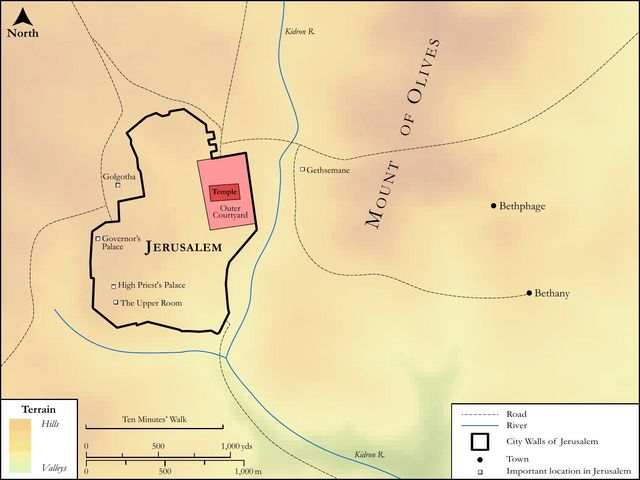
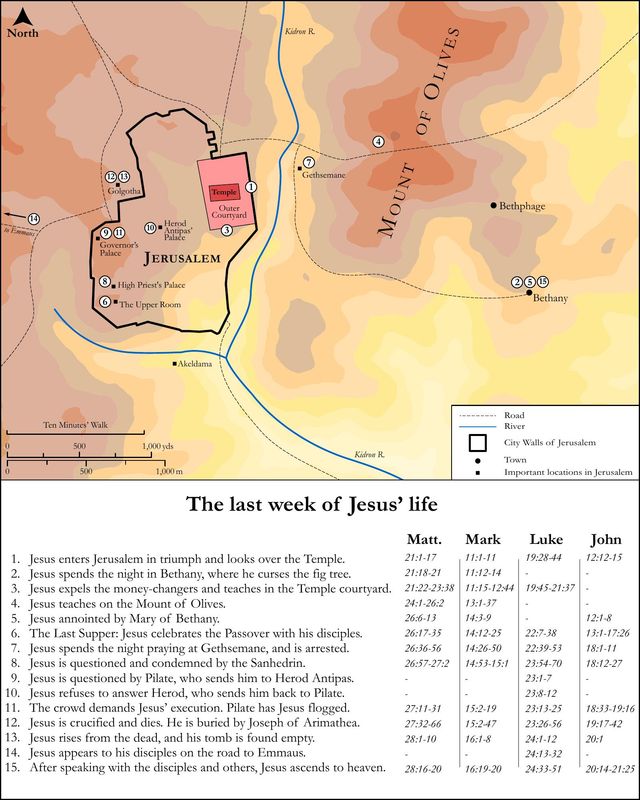
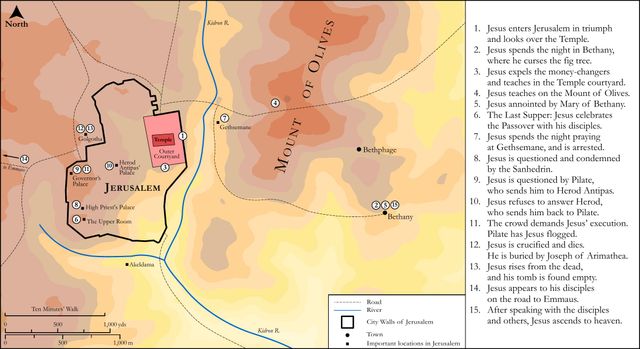
See on the biblical-era map
Study this verse
Historical interpretation
Ten Centuries of Reception
15 surviving comments on this verse. Each one is dated, so this reads as a timeline rather than a list.
Select a marker to jump to its quote. Markers stagger vertically where authors wrote within a few decades of each other.
After this you ask how it is that “all the law and the prophets depend upon these two commands.” For it seems that the texts show us that whatever was written in Exodus or Leviticus or Numbers or Deuteronomy depend “upon these two commands.” But how is the law which regards lepers or the continual flow of blood or the menstruation of women dependent “upon these two commands”? And still further, how does the prophecy about captured Jerusalem, or the vision of Egypt in Isaiah and the other prophets, or the vision of Tyre or whatever may be prophesied about Tyre or the king of Tyre, or Isaiah’s vision of the four-footed beasts in the wasteland “depend upon these two commands”?It seems to me that the answer is something like this. He who fulfills all that is written concerning the love of God and neighbor is worthy to receive the greatest thanks from God.
Concerning this it has been argued that “the utterance of wisdom [comes] through the Holy Spirit,” after which follows “the utterance of knowledge” which is “according to the Spirit.”
Or otherwise; With all thy heart, that is, in all recollection, act, thought; with all thy soul, to be ready, that is, to lay it down for God's religion; with all thy mind, bringing forth nothing but what is of God. And consider whether you cannot thus take the heart of the understanding, by which we contemplate things intellectual, and the mind of that by which we utter thoughts, walking as it were with the mind through each expression, and uttering it. If the Lord had given no answer to the Pharisee who thus tempted Him, we should have judged that there was no commandment greater than the rest. But when the Lord adds, This is the first and great commandment, we learn how we ought to think of the commandments, that there is a great one, and that there are less down to the least. And the Lord says not only that it is a great, but that it is the first commandment, not in order of Scripture, but in supremacy of value. They only take upon them the greatness and supremacy of this precept, who not only love the Lord their God, but add these three conditions. Nor did He only teach the first and great commandment, but added that there was a second like unto the first, Thou shall love thy neighbour as thyself. But if Whoso loveth iniquity hath hated his own soul, (Ps. 11:5.) it is manifest that he does not love his neighbour as himself, when he does not love himself.
Or, because he that has fulfilled the things that are written concerning the love of God and our neighbour, is worthy to receive from God the great reward, that he should be enabled to understand the Law and the Prophets.
Or otherwise; That the second command is like the first signifies that the obligation and merit of both are alike; for no love of God without Christ, or of Christ without God, can profit to salvation.
It follows, On these two commandments hang all the Law and the Prophets.
If therefore to love God is to love one's neighbor, "For if thou lovest me," He saith, "O Peter, feed my sheep," but to love one's neighbor worketh a keeping of the commandments, with reason doth He say, "On these hang all the law and the prophets."
So therefore what He did before, this He doth here also. I mean, that both there, when asked about the manner of the resurrection, He also taught a resurrection, instructing "For charity envieth not." By this He shows Himself to be submissive both to the law and to the prophets.
(Verse 34 and following) But when the Pharisees heard that he had silenced the Sadducees, they gathered together. And one of them, a lawyer, asked him a question to test him: "Teacher, which is the great commandment in the Law?" And he said to him, "You shall love the Lord your God with all your heart and with all your soul and with all your mind. This is the great and first commandment. And a second is like it: You shall love your neighbor as yourself. In his two commands, the whole law and the prophets hang. What we read about Herod and Pontius Pilate, that they conspired in the death of the Lord, we also see now concerning the Pharisees and the Sadducees, who are opposed to each other, but agree with the same mind in testing Jesus. Therefore, those who had already been confuted in the display of the coin and had seen the faction of the opposing party undermined, should have been warned by example not to plot further snares: but malice and envy nourish audacity. One of the legal experts, not desiring to not know but attempting, asks whether the one being questioned knew what was being asked, what the greater commandment is: not asking about the commandments, but what the first and great commandment is; so that when all that God has commanded is great: whatever he may answer, he may have an opportunity to slander, asserting that something else is great among many. Therefore, whoever knows and asks not by desire to learn, but by the desire to know, whether the one who is going to respond knows, approaches in the likeness of the Pharisees, not as a disciple, but as a tempter.
The Pharisees having been themselves already confuted (in the matter of the denarius), and now seeing their adversaries also overthrown, should have taken warning to attempt no further deceit against Him; but hate and jealousy are the parents of impudence.
The Pharisees and Sadducees, thus foes to one another, unite in one common purpose to tempt Jesus.
Or he enquires not for the sake of the commands, but which is the first and great commandment, that seeing all that God commands is great, he may have occasion to cavil whatever the answer be.
(De Doctr. Christ. i. 30. et 26.) But since the Divine substance is more excellent and higher than our nature, the command to love God is distinct from that to love our neighbour. But if by yourself, you understand your whole self, that is both your soul and your body, and in like manner of your neighbour, there is no sort of things to be loved omitted in these commands. The love of God goes first, and the rule thereof is so set out to us as to make all other loves center in that, so that nothing seems said of loving yourself. But then follows, Thou shall love thy neighbour as thyself, so that love of yourself is not omitted.
(de Trin. viii. 7.) Since there are two commandments, the love of God and the love of our neighbour, on which hang the Law and the Prophets, not without reason does Scripture put one for both; sometimes the love of God; as in that, We know that all tilings work together for good to them that love God; (Rom. 8:28.) and sometimes the love of our neighbour; as in that, All the law is fulfilled in one word, even in this, Thou shall love thy neighbour as thyself. (Gal. 5:14.) And that because if a man love his neighbour, it follows therefrom that he loves God also; for it is the selfsame affection by which we love God, and by which we love our neighbour, save that we love God for Himself, but ourselves and our neighbour for God's sake.
(Quaest. Ev. i. 33.) Hang, that is, refer thither as their end.
Or the Pharisees meet together, that their numbers may silence Him whom their reasonings could not confute; thus, while they array numbers against Him, showing that truth failed them; they said among themselves, Let one speak for all, and all speak, through one, so if He prevail, the victory may seem to belong to all; if He be overthrown, the defeat may rest with Him alone; so it follows, Then one of them, a teacher of the Law, asked him a question, tempting him.
He who now enquires for the greatest commandment had not observed the least. He only ought to seek for a higher righteousness who has fulfilled the lower.
But the Lord so answers him, as at once to lay bare the dissimulation of his enquiry, Jesus saith unto him, Thou shalt love the Lord thy God with all thy heart, with all thy soul, and with all thy mind. Thou shalt love, not 'fear,' for to love is more than to fear; to fear belongs to slaves, to love to sons; fear is in compulsion, love in freedom. Whoso serves God in fear escapes punishment, but has not the reward of righteousness because he did well unwillingly through fear. God does not desire to be served servilely by men as a master, but to be loved as a father, for that He has given the spirit of adoption to men. But to love God with the whole heart, is to have the heart inclined to the love of no one thing more than of God. To love God again with the whole soul is to have the mind stayed upon the truth, and to be firm in the faith. For the love of the heart and the love of the soul are different. The first is in a sort carnal, that we should love God even with our flesh, which we cannot do unless we first depart from the love of the things of this world. The love of the heart is felt in the heart, but the love of the soul is not felt, but is perceived because it consists in a judgment of the soul. For he who believes that all good is in God, and that without Him is no good, he loves God with his whole soul. But to love God with the whole mind, is to have all the faculties open and unoccupied for Him. He only loves God with his whole mind, whose intellect ministers to God, whose wisdom is employed about God, whose thoughts travail in the things of God, and whose memory holds the things which are good.
But who loves man is as who loves God; for man is God's image, wherein God is loved, as a King is honoured in his statue. For this cause this commandment is said to be like the first.
Not the Sadducees but the multitudes were astonished. This is daily done in the Church; when by Divine inspiration the adversaries of the Church are overcome, the multitude of the faithful rejoice.
For to these two commandments belongs the whole decalogue; the commandments of the first table to the love of God, those of the second to the love of our neighbour.
Out of immeasurable spite this man comes forward to put the Lord to the test. For when they saw the Sadducees put to shame and the Lord praised for His wisdom, they came forward to test Him to see if He would add something to the first commandment, and thus give them the chance to accuse Him of being an innovator who corrects the law. But the Lord discloses their malice, and because they came not to learn, but rather, devoid of love, to show their envy and their spite, He reveals to them the exceedingly great love expressed by the commandments. And He teaches that we ought not to love God partially, but to give all of ourselves to God. For we perceive these three distinctions of the human soul: the vegetative, the animal, and the rational. When the soul grows and is nourished and begets what is like unto it, it resembles the plants; when it experiences anger or desire, it is like the animals; when it understands, it is called rational. See, then, how these three facets are indicated here. "Thou shalt love thy God with all thy heart" — this is the animal part of a man; "and with all thy soul [or life]" — this is the vegetative part of a man, for plants are alive and animate; "and with all thy mind" — this is the rational (Deut. 6:5). So one must love God with all one’s soul, that is, one must attend to Him with all the parts and powers of one’s soul. "This is the first and great commandment," training us in piety. "The second is like unto it," which exhorts us to do to other men what is just and right. For there are two things which lead to perdition, evil doctrines and a corrupt life. Lest we fall into unholy doctrines, we must love God; so that we do not lead a corrupt life, we must love our neighbor (Levit. 19:18). For he who loves his neighbor fulfills all the commandments, and he who fulfills all the commandments, loves God. So by means of each other these two commandments are welded together and united, containing within themselves all the other commandments. For who is it that loves God and his neighbor, but also steals, or bears grudges, or commits adultery, or murders, or fornicates? This lawyer, then, at the onset came to test Him but then, hearing Christ’s answer, he amended his ways, and the Lord praised him, as Mark also says that Jesus looked at him with love, and said, "Thou art not far from the kingdom of heaven" (Mk. 12:34).
Interlin.: Or, “with all thy heart,” i.e. understanding; “with all thy soul,”i.e. thy will; “with all thy mind,” i.e. memory; so you shall think, will, remember nothing contrary to Him. If the Lord had given no answer to the Pharisee who thus tempted Him, we should have judged that there was no commandment greater than the rest. But when the Lord adds, “This is the firstand great commandment,” we learn how we ought to think of the commandments, that there is a great one, and that there are less down to the least. And the Lord says not only that it is a great, but that it is the first commandment, not in order of Scripture, but in supremacy of value. They only take upon them the greatness and supremacy of this precept, who not only love the Lord their God, but add these three conditions. Nor did He only teach the first and great commandment, but added that there was a second like unto the first, “Thou shalt love thyneighbour as thyself:” But if “Whoso loveth iniquity hath hated his own soul,” it is manifest that he does not love his neighbour as himself, when he does not love himself.
Or, with all thy heart, i. e. understanding; with all thy soul, i.e. thy will; with all thy mind, i.e. memory; so you shall think, will, remember nothing contrary to Him.
Continue studying Matthew 22:40 across the web’s major study libraries — every link below opens this exact verse, chapter, or book on the destination site.
Read & Compare
 BibleGatewayThis verse in more than 200 translations and 70 languages.
 Bible.comThe YouVersion reader — hundreds of translations, reading plans, and highlights.
 ESV.orgCrossway's official English Standard Version reader.
 NET BibleThe NET translation with 60,000+ translators' notes on every rendering decision.
 STEP BibleTyndale House's free study tool — original text, vocabulary, and scholarly resources.
 BibliaLogos Bible Software's free web reader.
 USCCBThe New American Bible (Revised Edition) with the U.S. bishops' study notes.
Commentaries
 BibleHub CommentariesDozens of classic commentaries on this verse, gathered on one page.
 StudyLightMore than 100 commentary sets — the largest collection on the web.
 BibleRefPlain-English commentary on what this verse means, verse by verse.
 Enduring WordDavid Guzik's free commentary on this chapter, widely used by Bible teachers.
 Bible Study ToolsVerse commentary alongside Greek and Hebrew study aids.
Original Language & Research
- BibleHub InterlinearThe verse word by word — original language, transliteration, and English.
- BibleHub LexiconEvery word's original-language definition and Strong's entry.
 Blue Letter BibleDeep-study tools — Strong's numbers, concordance, and word studies.
 CNTR CollationThe earliest Greek manuscripts of this verse, collated letter by letter.
Sermons, Hymns & Audio


TrulyRandomVerse is not affiliated with these sites and doesn’t control their content. They’re linked because they’re genuinely useful.
Summary
Matthew 22:40 encapsulates Jesus' profound summation of God's entire moral and ethical revelation to humanity. Following His declaration of the two greatest commandments—love for God and love for neighbor—He states that "On these two commandments hang all the law and the prophets." This declaration underscores the foundational nature of love as the essence, interpretive key, and ultimate fulfillment of all divine instruction, revealing the unified and relational heart of God's will.
Context
ShowHideLiterary Context
This verse serves as the climactic conclusion to a series of challenging encounters Jesus had with various Jewish religious factions in Jerusalem, as recorded in Matthew 21-22. After Jesus silenced the Sadducees regarding the resurrection (Matthew 22:23-33), a lawyer, described as a Pharisee, stepped forward to test Him with the question, "Which is the great commandment in the law?" (Matthew 22:36). This was a common rabbinic debate, with scholars often attempting to prioritize the 613 Mosaic commandments. Instead of choosing one, Jesus skillfully synthesized two distinct commands from the Torah—Deuteronomy 6:5 (love for God) and Leviticus 19:18 (love for neighbor)—and then declared that the entirety of God's revealed will "hangs" upon them, thereby elevating love as the supreme principle governing all divine instruction.
Historical & Cultural Context
First-century Judaism was characterized by a deep reverence for the Torah, the Law of Moses, which comprised 613 commandments (248 positive and 365 negative). Rabbinic schools often engaged in intricate debates about the relative importance of these commandments, seeking to identify a "heavy" (more significant) or "light" (less significant) command, or even a single principle that could summarize them all. This context explains the lawyer's question, which was not necessarily malicious but rather a common intellectual exercise. The phrase "the Law and the Prophets" was a standard Jewish idiom referring to the entire Hebrew Scriptures, the Old Testament. By stating that "all the law and the prophets" depend on these two love commands, Jesus was not abolishing the Law but rather revealing its true intent and purpose, moving beyond a mere external adherence to rules towards an internal, relational transformation.
Key Themes
ShowHideThis verse powerfully articulates several core themes central to Jesus' teaching and the broader biblical narrative. Foremost is the Supremacy of Love, establishing both vertical love (for God with one's entire being, as in Deuteronomy 6:5) and horizontal love (for one's neighbor as oneself, as in Leviticus 19:18) as the ultimate principles governing all divine commands. This highlights the Unity and Simplicity of God's Will, demonstrating that despite the vastness and complexity of the Old Testament Law, its essence can be distilled into these two interconnected principles. Furthermore, the concept of the Law and Prophets "hanging" implies the Fulfillment of Scripture, suggesting that these two commandments are the foundation, the support, and the interpretive key for understanding all of God's revelation. Without love, the detailed regulations and prophetic messages lose their true spirit and purpose, a concept echoed in Paul's teaching that "love is the fulfilling of the law" (Romans 13:10).
Exposition and Analysis
ShowHideKey Word Analysis
ShowHideMeaning an injunction or authoritative prescription. Here, it refers specifically to the divine directives given by God. Jesus' choice to combine two distinct commandments into a singular, overarching principle demonstrates that while the individual commands are important, their true essence and purpose are found in the broader context of love. These are not mere human suggestions but authoritative divine mandates.
Meaning "to hang" or "to be suspended." This vivid verb creates a powerful image. It implies that the entire structure, weight, and meaning of "the law and the prophets" are supported by, dependent upon, and derive their stability from these two foundational commands of love. Just as a heavy object depends on a strong support, or a door hangs on its hinges, so the entirety of God's revelation finds its support and proper operation in these two principles.
Referring to law, especially the Mosaic Law, or a principle. In the context of "the law and the prophets," it specifically denotes the Pentateuch (the first five books of the Old Testament) and by extension, the entire body of God's revealed will contained therein. Jesus' statement implies that the detailed regulations and statutes of the Law are not arbitrary but are expressions of, and ultimately serve, the overarching principles of love for God and neighbor.
Verse Breakdown
ShowHide"On these two commandments"
Jesus refers to the two great commandments He has just articulated: love for God with all one's heart, soul, and mind (Deuteronomy 6:5) and love for one's neighbor as oneself (Leviticus 19:18). The preposition "On" (Greek, en' from G1722) signifies the foundational basis or point of support. These two commands are not merely important among others, but are the very bedrock upon which everything else rests.
"hang all the law and the prophets"
This clause reveals the profound relationship between the two love commands and the entire Old Testament. "The law and the prophets" is a common merism, a figure of speech where two contrasting parts represent the whole, signifying the entire body of Hebrew Scripture. The verb "hang" (Greek, kremánnymi' from G2910) vividly portrays the dependence. It means that the entire Old Testament—its narratives, prophecies, laws, wisdom, and poetry—is suspended from, supported by, and finds its ultimate meaning and coherence in these two principles of love. Without love, the Law becomes legalism, and the Prophets' messages lose their ethical and spiritual heart.
Literary Devices
ShowHideThe most prominent literary device in Matthew 22:40 is Metaphor. When Jesus states that "On these two commandments hang all the law and the prophets," He is not speaking literally of physical suspension. Instead, He employs a vivid metaphorical image of the entire Old Testament (represented by "the law and the prophets") being suspended from or dependent upon these two fundamental principles of love. This metaphor powerfully conveys the idea that love for God and neighbor is the foundational support, the interpretive key, and the ultimate purpose for all of God's revealed will. Additionally, the phrase "the law and the prophets" itself is an example of Merism, a rhetorical device where two contrasting parts are used to represent a whole. In this case, "the law" (Torah) and "the prophets" (Nevi'im, often including the Ketuvim or Writings) together signify the entire Hebrew Bible, emphasizing the comprehensive scope of Jesus' statement.
Theological and Thematic Connections
ShowHideMatthew 22:40 profoundly encapsulates the essence of biblical ethics and theology, revealing that the myriad commands and prophetic utterances of the Old Testament are not disparate rules but emanate from, and point back to, the singular, unifying principle of love. This declaration elevates love from a mere emotion or one virtue among many to the very core of divine character and human responsibility. It teaches that true obedience is not a mechanical adherence to external regulations but a heartfelt response of love towards God and, consequently, towards His image-bearers. This concept transcends legalism, inviting believers into a relationship-centered faith where all actions are evaluated through the lens of love, fostering a holistic spirituality that impacts both one's vertical relationship with the Creator and horizontal relationships within community.
Reflection and Application
ShowHideMatthew 22:40 offers a timeless and profoundly practical framework for Christian living. In a world often characterized by complexity and moral ambiguity, Jesus provides a clear, unifying principle: love. This verse challenges believers to move beyond a superficial understanding of rules and regulations to embrace the spirit of the Law—a spirit of genuine, self-sacrificial love. When faced with ethical dilemmas, interpersonal conflicts, or decisions about how to best honor God, the two great commandments serve as an infallible moral compass. Asking "Does this action demonstrate love for God?" and "Does it demonstrate genuine love for my neighbor?" can powerfully filter our choices, guiding us toward alignment with God's heart. This perspective liberates us from burdensome legalism and invites us into a vibrant, relationship-centered faith where obedience flows naturally from a heart transformed by divine love, making our faith tangible and impactful in the world.
Questions for Reflection
ShowHideFAQ
ShowHideWhat does "the law and the prophets" mean in this context?
ShowHide"The law and the prophets" is a common Jewish idiom that refers to the entire body of the Old Testament Scriptures. "The Law" (Torah) primarily encompasses the first five books of Moses (Genesis, Exodus, Leviticus, Numbers, Deuteronomy), which contain the foundational laws and narratives of Israel. "The Prophets" (Nevi'im) refers to the prophetic books, both former (e.g., Joshua, Judges, Samuel, Kings) and latter (e.g., Isaiah, Jeremiah, Ezekiel, the Twelve Minor Prophets). Together, these terms represent the complete written revelation of God to Israel before the time of Jesus, indicating that His summary of love applies to the entirety of God's revealed will. Jesus' statement means that the entire Old Testament finds its ultimate meaning and purpose in these two commands of love.
Why are these two commandments considered the "greatest" and the foundation for all others?
ShowHideThese two commandments are "greatest" because they encapsulate the very character of God and the essence of His relationship with humanity. Love for God (Deuteronomy 6:5) addresses the vertical dimension of our faith, acknowledging God's supreme worthiness and our complete dependence on Him. Love for neighbor (Leviticus 19:18) addresses the horizontal dimension, recognizing that all people are created in God's image and deserve our respect, compassion, and care. All other commandments, whether moral, ceremonial, or civil, are ultimately expressions or applications of these two fundamental principles. For example, commandments like "You shall not murder" or "You shall not steal" are direct outgrowths of loving your neighbor. Similarly, commands regarding worship and reverence spring from loving God. As Paul explains in Romans 13:9-10, "Love worketh no ill to his neighbour: therefore love is the fulfilling of the law."
Christ-Centered Fulfillment
ShowHideMatthew 22:40 finds its ultimate and perfect fulfillment in Jesus Christ Himself. He is not merely the one who articulates these two great commandments; He is the living embodiment of them. Jesus perfectly loved God, demonstrated by His unwavering obedience to the Father's will, even to the point of death on the cross (Philippians 2:8). His entire life was a seamless expression of love for His neighbor, as He healed the sick, fed the hungry, taught the lost, and ultimately laid down His life for humanity's salvation (John 15:13). Through His atoning sacrifice, Christ not only fulfilled the Law's demands but also provided the means for humanity to truly live out these commands. The Holy Spirit, given through Christ, empowers believers to love God and neighbor, transforming hearts of stone into hearts of flesh that can genuinely obey these foundational principles (Ezekiel 36:26-27). Thus, in Christ, the "law and the prophets" do not merely hang; they are perfectly accomplished, and their essence—love—is made accessible and actionable for all who believe.