


Matthew 22:35
Bible text: King James Version (1769 Blayney text) · Public domain
Bible text: Berean Standard Bible · Public domain
Bible text: American Standard Version (1901) · Public domain
Bible text: World English Bible, Messianic edition · Public domain
Bible text: Geneva Bible (1599) · Public domain
Bible text: Young's Literal Translation · Public domain
- καὶkaiAndG2532CONJConjunction
- ἐπηρώτησενepērōtēsenquestioned [Him]G1905V-AAI-3SVerb Aorist Active Indicative 3rd Singular
- εἷςheisoneG1520A-NSMAdjective Nominative Singular Masculine
- ἐξexofG1537PREPPreposition
- αὐτῶνautōnthemG846P-GPMPersonal pronoun Genitive Plural Masculine
- νομικὸςnomikosa lawyerG3544A-NSMAdjective Nominative Singular Masculine
- πειράζωνpeirazōntestingG3985V-PAP-NSMVerb Present Active Participle Nominative Singular Masculine
- αὐτόνautonHimG846P-ASMPersonal pronoun Accusative Singular Masculine
- καὶkaiandG2532CONJConjunction
- λέγων·legōnsayingG3004V-PAP-NSMVerb Present Active Participle Nominative Singular Masculine
English is a literal word-by-word gloss of the Greek, not the KJV's wording. Why?
This is the original text the KJV's translators worked from — each Greek word with its own literal English meaning in this verse, prepared by scholars at Tyndale House, Cambridge. The KJV translates whole sentences, not word by word, so its wording differs: one Greek word can become several English words, and the KJV may choose “charity” where the gloss reads “love”. Both are faithful — they answer different questions. For the KJV's own rendering, switch to the KJV text.
Details
See on the biblical-era maps

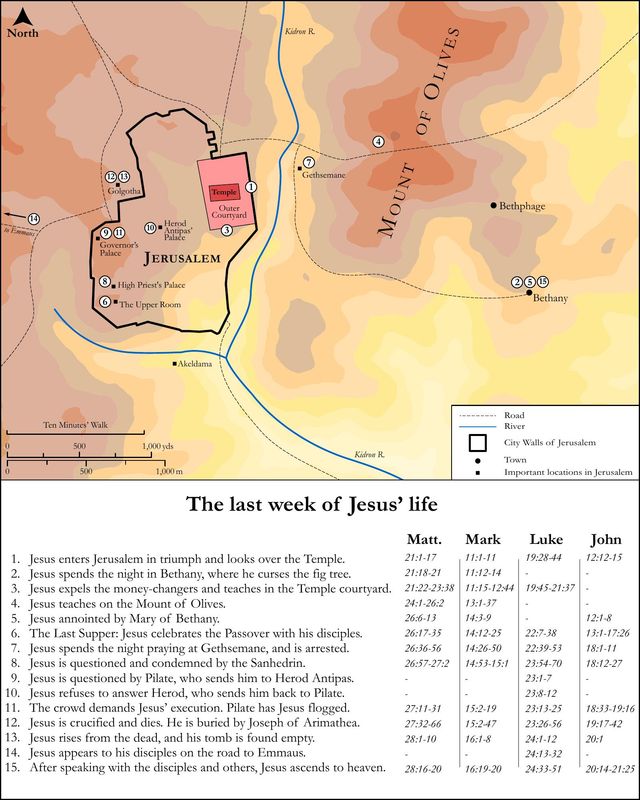
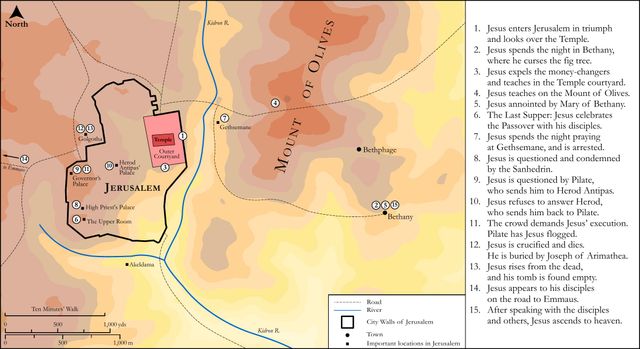
Study this verse
Historical interpretation
Ten Centuries of Reception
12 surviving comments on this verse. Each one is dated, so this reads as a timeline rather than a list.
Select a marker to jump to its quote. Markers stagger vertically where authors wrote within a few decades of each other.
All who thus ask questions of any teacher to try him, and not to learn of him, we must regard as brethren of this Pharisee, according to what is said below, Inasmuch as ye have done it unto one of the least of mine, ye have done it unto me. (Matt. 25:40.)
Now let us consider one argument of entrapment: “Teacher,” he says, “what is the greater commandment in the law?” He says “teacher” trying to entrap him, since he offers his thoughts not as a disciple of Christ. This however, will be clearer from an example we now offer. Consider: The father of a son is indeed the father, and no one else is able to call him father except the son; and the mother of a daughter is indeed her mother, and no one else can call her mother except her own daughter. And so the teacher of a disciple is indeed his teacher, and the disciple of a teacher is truly his disciple. As a result, no one is able to say “teacher” properly except a disciple. And see how, on account of this, that not all who call him teacher do so appropriately but only those who have a desire to learn from him. He said to his disciples, “You call me teacher and lord, and rightly so, for so I am.” Therefore disciples of Christ properly indeed address him as teacher, and by this word from the Lord himself his servants rightly call him Lord. Thus the apostle spoke well when he said, “Yet for us there is one Lord Jesus Christ, through whom are all things and for whom we exist.” And consider what he says, “It is enough for the disciple to be” not simply like a teacher but “like his teacher.” Therefore if anyone does not learn something from this word or surrender himself with his whole heart, in order to become his delightful dwelling place but still calls him “teacher,” he is brother to the Pharisees attempting to entrap Christ while calling him “teacher.” And so all who say “Our Father who art in heaven” ought not to have “the spirit of slavery in fear but a spirit of the adoption of sons.” However, whoever does not have “the spirit of adoption of sons” and yet says “Our Father who art in heaven” is lying, since he is not a son of God, while calling God his father.
Or otherwise; That the second command is like the first signifies that the obligation and merit of both are alike; for no love of God without Christ, or of Christ without God, can profit to salvation.
It follows, On these two commandments hang all the Law and the Prophets.
Again doth the evangelist express the cause, for which they ought to have held their peace, and marks their boldness by this also. How and in what way? Because when those others were put to silence, these again assail Him. For when they ought even for this to hold their peace, they strive to urge further their former endeavors, and put forward the lawyer, not desiring to learn, but making a trial of Him, and ask, "What is the first commandment?"
For since the first commandment was this, "Thou shalt love the Lord thy God," thinking that He would afford them some handle, as though He would amend it, for the sake of showing that Himself too was God, they propose the question.
(Verse 34 and following) But when the Pharisees heard that he had silenced the Sadducees, they gathered together. And one of them, a lawyer, asked him a question to test him: "Teacher, which is the great commandment in the Law?" And he said to him, "You shall love the Lord your God with all your heart and with all your soul and with all your mind. This is the great and first commandment. And a second is like it: You shall love your neighbor as yourself. In his two commands, the whole law and the prophets hang. What we read about Herod and Pontius Pilate, that they conspired in the death of the Lord, we also see now concerning the Pharisees and the Sadducees, who are opposed to each other, but agree with the same mind in testing Jesus. Therefore, those who had already been confuted in the display of the coin and had seen the faction of the opposing party undermined, should have been warned by example not to plot further snares: but malice and envy nourish audacity. One of the legal experts, not desiring to not know but attempting, asks whether the one being questioned knew what was being asked, what the greater commandment is: not asking about the commandments, but what the first and great commandment is; so that when all that God has commanded is great: whatever he may answer, he may have an opportunity to slander, asserting that something else is great among many. Therefore, whoever knows and asks not by desire to learn, but by the desire to know, whether the one who is going to respond knows, approaches in the likeness of the Pharisees, not as a disciple, but as a tempter.
The Pharisees having been themselves already confuted (in the matter of the denarius), and now seeing their adversaries also overthrown, should have taken warning to attempt no further deceit against Him; but hate and jealousy are the parents of impudence.
The Pharisees and Sadducees, thus foes to one another, unite in one common purpose to tempt Jesus.
Or he enquires not for the sake of the commands, but which is the first and great commandment, that seeing all that God commands is great, he may have occasion to cavil whatever the answer be.
(de Cons. Ev. ii. 73.) Let no one find a difficulty in this, that Matthew speaks of this man as putting his question to tempt the Lord, whereas Mark does not mention this, but concludes with what the Lord said to him upon his answering wisely, Thou art not far from the kingdom of God. (Mark 12:34.) For it is possible that, though he came to tempt, yet the Lord's answer may have wrought correction within him. Or, the tempting here meant need not be that of one designing to deceive an enemy, but rather the cautious approach of one making proof of a stranger. And that is not written in vain, Whoso believeth lightly, he is of a vain heart. (Ecclus. 19:4.)
Or the Pharisees meet together, that their numbers may silence Him whom their reasonings could not confute; thus, while they array numbers against Him, showing that truth failed them; they said among themselves, Let one speak for all, and all speak, through one, so if He prevail, the victory may seem to belong to all; if He be overthrown, the defeat may rest with Him alone; so it follows, Then one of them, a teacher of the Law, asked him a question, tempting him.
He who now enquires for the greatest commandment had not observed the least. He only ought to seek for a higher righteousness who has fulfilled the lower.
But the Lord so answers him, as at once to lay bare the dissimulation of his enquiry, Jesus saith unto him, Thou shalt love the Lord thy God with all thy heart, with all thy soul, and with all thy mind. Thou shalt love, not 'fear,' for to love is more than to fear; to fear belongs to slaves, to love to sons; fear is in compulsion, love in freedom. Whoso serves God in fear escapes punishment, but has not the reward of righteousness because he did well unwillingly through fear. God does not desire to be served servilely by men as a master, but to be loved as a father, for that He has given the spirit of adoption to men. But to love God with the whole heart, is to have the heart inclined to the love of no one thing more than of God. To love God again with the whole soul is to have the mind stayed upon the truth, and to be firm in the faith. For the love of the heart and the love of the soul are different. The first is in a sort carnal, that we should love God even with our flesh, which we cannot do unless we first depart from the love of the things of this world. The love of the heart is felt in the heart, but the love of the soul is not felt, but is perceived because it consists in a judgment of the soul. For he who believes that all good is in God, and that without Him is no good, he loves God with his whole soul. But to love God with the whole mind, is to have all the faculties open and unoccupied for Him. He only loves God with his whole mind, whose intellect ministers to God, whose wisdom is employed about God, whose thoughts travail in the things of God, and whose memory holds the things which are good.
But who loves man is as who loves God; for man is God's image, wherein God is loved, as a King is honoured in his statue. For this cause this commandment is said to be like the first.
Not the Sadducees but the multitudes were astonished. This is daily done in the Church; when by Divine inspiration the adversaries of the Church are overcome, the multitude of the faithful rejoice.
For to these two commandments belongs the whole decalogue; the commandments of the first table to the love of God, those of the second to the love of our neighbour.
Out of immeasurable spite this man comes forward to put the Lord to the test. For when they saw the Sadducees put to shame and the Lord praised for His wisdom, they came forward to test Him to see if He would add something to the first commandment, and thus give them the chance to accuse Him of being an innovator who corrects the law. But the Lord discloses their malice, and because they came not to learn, but rather, devoid of love, to show their envy and their spite, He reveals to them the exceedingly great love expressed by the commandments. And He teaches that we ought not to love God partially, but to give all of ourselves to God. For we perceive these three distinctions of the human soul: the vegetative, the animal, and the rational. When the soul grows and is nourished and begets what is like unto it, it resembles the plants; when it experiences anger or desire, it is like the animals; when it understands, it is called rational. See, then, how these three facets are indicated here. Thou shalt love thy God with all thy heart—this is the animal part of a man; and with all thy soul (or life)—this is the vegetative part of a man, for plants are alive and animate; and with all thy mind—this is the rational. So one must love God with all one's soul, that is, attend to Him with all the parts and powers of one's soul. This is the first and great commandment, training us in piety. The second is like unto it, exhorting us to do to other men what is just and right. For there are two things which lead to perdition, evil doctrines and a corrupt life. Lest we fall into unholy doctrines, we must love God; so that we do not lead a corrupt life, we must love our neighbor (see Levit. 19:18). For he who loves his neighbor fulfills all the commandments, and he who fulfills all the commandments, loves God. So by means of each other these two commandments are welded together and united, containing within themselves all the other commandments. Who is it that loves God and his neighbor, but also steals, or bears grudges, or commits adultery, or murders, or fornicates? This lawyer, then, at the onset came to test Him but then, hearing Christ's answer, he amended his ways, and the Lord praised him, as Mark also says that Jesus looked at him with love, and said, Thou art not far from the kingdom of heaven (Mk. 12:34).
Or, with all thy heart, i. e. understanding; with all thy soul, i.e. thy will; with all thy mind, i.e. memory; so you shall think, will, remember nothing contrary to Him.
Continue studying Matthew 22:35 across the web’s major study libraries — every link below opens this exact verse, chapter, or book on the destination site.
Read & Compare
 BibleGatewayThis verse in more than 200 translations and 70 languages.
 Bible.comThe YouVersion reader — hundreds of translations, reading plans, and highlights.
 ESV.orgCrossway's official English Standard Version reader.
 NET BibleThe NET translation with 60,000+ translators' notes on every rendering decision.
 STEP BibleTyndale House's free study tool — original text, vocabulary, and scholarly resources.
 BibliaLogos Bible Software's free web reader.
 USCCBThe New American Bible (Revised Edition) with the U.S. bishops' study notes.
Commentaries
 BibleHub CommentariesDozens of classic commentaries on this verse, gathered on one page.
 StudyLightMore than 100 commentary sets — the largest collection on the web.
 BibleRefPlain-English commentary on what this verse means, verse by verse.
 Enduring WordDavid Guzik's free commentary on this chapter, widely used by Bible teachers.
 Bible Study ToolsVerse commentary alongside Greek and Hebrew study aids.
Original Language & Research
- BibleHub InterlinearThe verse word by word — original language, transliteration, and English.
- BibleHub LexiconEvery word's original-language definition and Strong's entry.
 Blue Letter BibleDeep-study tools — Strong's numbers, concordance, and word studies.
 CNTR CollationThe earliest Greek manuscripts of this verse, collated letter by letter.
Sermons, Hymns & Audio


TrulyRandomVerse is not affiliated with these sites and doesn’t control their content. They’re linked because they’re genuinely useful.
Summary
Matthew 22:35 introduces a pivotal moment in Jesus's final week in Jerusalem, immediately following His encounters with the Herodians and Sadducees. Here, a lawyer, acting on behalf of the Pharisees, steps forward with a question designed not for genuine inquiry but to "tempt" or entrap Jesus, setting the stage for one of His most profound teachings on the greatest commandment.
Context
ShowHideLiterary Context
Matthew 22:35 is situated within a series of escalating confrontations between Jesus and the religious authorities in Jerusalem during the Passion Week. Prior to this verse, Jesus has already skillfully parried the politically charged question about paying taxes to Caesar from the Herodians and Pharisees in Matthew 22:15-22. He then silenced the Sadducees, who denied the resurrection, with His theological acumen in Matthew 22:23-33. The Pharisees, seeing their rivals defeated and their own influence challenged, gather to make a final, concerted effort to discredit Jesus, with one of their legal experts leading the charge. This verse serves as the immediate prelude to Jesus's declaration of the greatest commandment in Matthew 22:36-40.
Historical & Cultural Context
The term "lawyer" (Greek: nomikos) in this context refers to an expert in the Mosaic Law, often a scribe who specialized in the interpretation and teaching of the Torah. These individuals were highly respected within Jewish society for their profound knowledge of Scripture and tradition. The setting is Jerusalem during the Passover festival, a time of heightened religious and political tension, with large crowds and a strong Roman presence. The religious leaders, particularly the Pharisees, viewed Jesus as a threat to their authority and established order. Their repeated attempts to "tempt" or test Jesus reflect a deep-seated animosity and a desperate desire to find a charge against Him, either theological or political, that would justify His arrest and condemnation. This was not a friendly debate but a calculated ambush.
Key Themes
ShowHideThis verse contributes to several overarching themes in Matthew's Gospel. Firstly, it underscores the persistent opposition and hostility Jesus faced from the religious establishment, highlighting their spiritual blindness and unwillingness to accept His divine authority, despite His miraculous works and profound teachings. Secondly, it emphasizes the wisdom and authority of Christ as He consistently outmaneuvers His adversaries, turning their malicious questions into opportunities for divine revelation. His response to the lawyer's question, found in Matthew 22:37-40, becomes a foundational summary of the entire Law and Prophets. Lastly, the episode illustrates the nature of true spiritual inquiry versus deceptive testing, contrasting genuine seeking with malicious intent, a theme seen throughout Jesus's ministry as recorded in Matthew's Gospel.
Exposition and Analysis
ShowHideKey Word Analysis
ShowHideThis term denotes someone "according (or pertaining) to law," specifically an expert in the Mosaic Law. Unlike a modern legal professional, a nomikós was a theologian and interpreter of divine statutes. Their challenge to Jesus was therefore not merely legal but deeply theological, aiming to expose a perceived flaw in His understanding or application of God's commandments.
While simply meaning "to ask for" or "inquire," the context of "tempting him" (G3985) imbues this verb with a specific nuance. It suggests an inquiry made with an ulterior motive, not for genuine understanding but to probe for weakness or to set a trap.
This word signifies "to test (objectively)," "endeavor," "scrutinize," or "entice." In this context, it carries the strong connotation of putting someone to the test with malicious intent, seeking to find fault, entrap, or prove them wrong. It is the same word used to describe Satan's temptation of Jesus in the wilderness (Matthew 4:1).
Verse Breakdown
ShowHide"Then one of them"
This phrase immediately connects the lawyer to the group of Pharisees mentioned in the preceding verse (Matthew 22:34). It highlights that this was not an isolated individual but a representative of the religious establishment, part of their collective effort to challenge Jesus. The use of "one" (G1520, heîs) emphasizes a specific individual stepping forward from the group.
"[which was] a lawyer"
This identifies the specific expertise of the challenger. By sending a "lawyer," the Pharisees intended to pose a question that would be highly complex or divisive, hoping to force Jesus into a theological misstep or an answer that would alienate a segment of the populace. It underscores the intellectual and spiritual weight of the impending question.
"asked [him a question], tempting him, and saying"
This clause reveals the true, hostile motive behind the inquiry. The "question" was not born of sincere curiosity or a desire for truth, but was a deliberate attempt to "tempt" (G3985, peirázō) Jesus, to test His loyalty to the Law, His wisdom, or His adherence to rabbinic tradition. The phrase "and saying" then introduces the specific content of the trap, which is revealed in the subsequent verse.
Literary Devices
ShowHideThe passage employs several literary devices. Antagonism is a dominant feature, as the verse clearly establishes a confrontational dynamic between Jesus and the religious authorities, represented by the lawyer. This is part of a larger pattern of escalating conflict throughout Matthew's narrative leading to the crucifixion. Foreshadowing is also present; the lawyer's malicious intent to "tempt" Jesus subtly echoes the earlier temptations by Satan in the wilderness (Matthew 4:1-11), hinting at the spiritual battle underlying these earthly confrontations. Furthermore, there is an element of dramatic irony, as the lawyer, intending to trap Jesus, unwittingly provides Him with an opportunity to deliver one of His most profound and enduring teachings, ultimately exposing the spiritual blindness of His interrogators rather than His own.
Theological and Thematic Connections
ShowHideMatthew 22:35, though brief, is theologically significant as it sets the stage for Jesus's definitive teaching on the essence of God's Law. The persistent "tempting" of Jesus by the religious leaders underscores the profound spiritual blindness and hardened hearts of those who, despite their intimate knowledge of the Scriptures, failed to recognize the Messiah standing before them. Their questions were not a search for truth but an attempt to maintain control and discredit divine authority. Jesus's response, however, transcends their malicious intent, revealing the divine wisdom that perfectly encapsulates the entirety of God's will. This encounter highlights the contrast between human cunning and divine wisdom, and between superficial adherence to law and the deep, relational love that is its true fulfillment. It emphasizes that true understanding of God's commands flows from a heart transformed by love for God and neighbor.
Reflection and Application
ShowHideMatthew 22:35 offers a powerful lesson in discernment and spiritual integrity. In a world where genuine inquiry can be mixed with skepticism, criticism, or even malicious intent, this verse reminds us that not all questions posed about faith are sincere. We may encounter individuals who, like the lawyer, seek to "tempt" or trap us, not to understand but to undermine. In such moments, we are called to emulate Christ's wisdom and grace. Jesus did not shy away from the challenge; instead, He used the opportunity to articulate profound truth, transforming an adversarial encounter into a teaching moment. This encourages us to respond to challenges not with defensiveness, but with clarity, courage, and a focus on the core tenets of our faith, allowing the truth of the Gospel to speak for itself. It also prompts us to examine our own motives when we approach spiritual questions, ensuring our hearts are open to genuine understanding rather than seeking to prove a point or find fault.
Questions for Reflection
ShowHideFAQ
ShowHideWhat is the significance of the term "lawyer" in this context?
ShowHideIn the New Testament, a "lawyer" (Greek: nomikós) was not a legal professional in the modern sense, but rather an expert in the Mosaic Law. These individuals were often scribes who dedicated their lives to studying, interpreting, and teaching the Torah and its vast body of oral traditions. Their challenge to Jesus in Matthew 22:35 was therefore deeply theological, aiming to test Jesus's understanding and adherence to the very divine law they specialized in. By sending a nomikós, the Pharisees intended to pose a question that was complex and potentially divisive, hoping to expose Jesus as either ignorant or unorthodox in His interpretation of God's commands.
Why did the religious leaders keep "tempting" Jesus?
ShowHideThe religious leaders, including the Pharisees, Sadducees, and Herodians, repeatedly "tempted" or tested Jesus throughout His ministry for several reasons. Primarily, they saw Him as a threat to their authority, influence, and the established religious and social order. They were deeply entrenched in their traditions and could not accept Jesus's radical teachings or His claims of divine authority. Their questions, as seen in Matthew 22:15-35, were designed to trap Him into saying something politically seditious against Rome, religiously heretical against the Law, or socially divisive among the people. Their ultimate goal was to find grounds to discredit Him, undermine His growing popularity, and ultimately silence Him, leading to His crucifixion.
Christ-Centered Fulfillment
ShowHideMatthew 22:35, though a seemingly simple narrative introduction, profoundly highlights the Christ-centered nature of the Gospel. Jesus, as the incarnate Son of God, stands as the ultimate authority and embodiment of divine wisdom, perfectly navigating the cunning schemes of His adversaries. This lawyer's attempt to "tempt" Him underscores the relentless opposition faced by the One who is the very fulfillment of the Law and the Prophets (Matthew 5:17). Unlike humanity's consistent failure under temptation, Jesus, the second Adam, perfectly resists every test, demonstrating His sinless perfection and qualifications as the spotless Lamb of God (John 1:29). His subsequent answer to the lawyer's question, revealing the greatest commandment, is not merely a rabbinic interpretation but a divine revelation, showing that all of God's Law is perfectly encapsulated in love for God and neighbor—a love perfectly demonstrated by Christ Himself through His life, death, and resurrection (Romans 5:8). This encounter ultimately points to Jesus as the One who perfectly fulfills all righteousness (Matthew 3:15), silencing not only the accusations of human adversaries but also the ultimate accuser, Satan, through His redemptive work on the cross (Colossians 2:14-15).