


John 14:15
- ἘὰνEanIfG1437CONDConjunction
- ἀγαπᾶτέagapateyou shall loveG25V-PAS-2PVerb Present Active Subjunctive 2nd Plural
- μεmeMeG3165P-1ASPersonal pronoun Accusative 1st Singular
- τὰςtas<the>G3588T-APFDefinite article Accusative Plural Feminine
- ἐντολὰςentolascommandmentsG1785N-APFNoun Accusative Plural Feminine
- τὰςtas<the>G3588T-APFDefinite article Accusative Plural Feminine
- ἐμὰςemasof MineG1473S-1SAPFPossessive pronoun Accusative 1st Person Plural Feminine
- τηρήσετεtērēseteyou will keepG5083V-FAI-2PVerb Future Active Indicative 2nd Plural
English is a literal word-by-word gloss of the Greek, not the KJV's wording. Why?
This is the original text the KJV's translators worked from — each Greek word with its own literal English meaning in this verse, prepared by scholars at Tyndale House, Cambridge. The KJV translates whole sentences, not word by word, so its wording differs: one Greek word can become several English words, and the KJV may choose “charity” where the gloss reads “love”. Both are faithful — they answer different questions. For the KJV's own rendering, switch to the KJV text.
Details
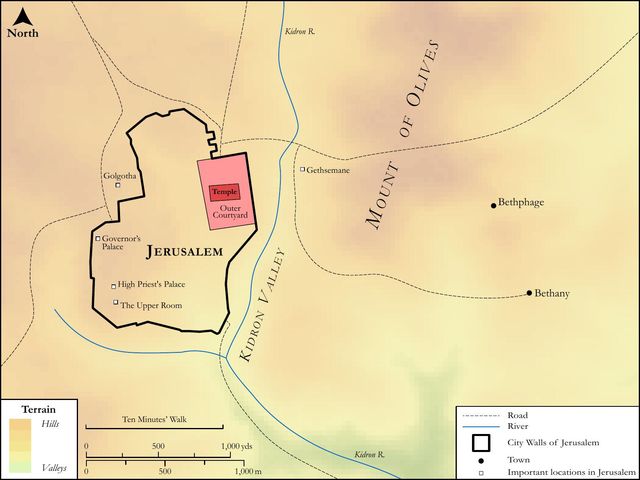
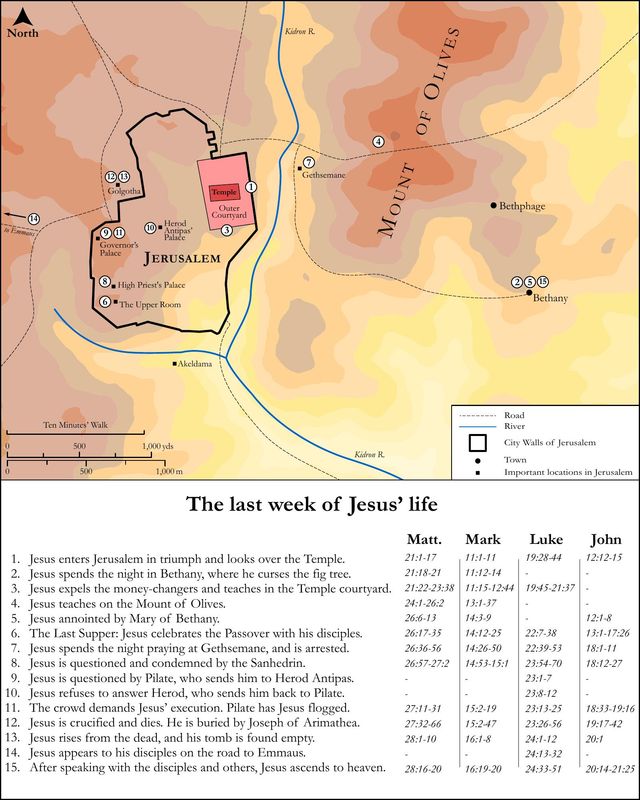
See on the biblical-era map

Study this verse
Public-domain commentary
Matthew Henry
From his Commentary on the Whole Bible. Henry comments on passages, not single verses — this entry covers John 14:15–17. His four-level outline is real structure in the source text, so it is rendered as structure.
Christ not only proposes such things to them as were the matter of their comfort, but here promises to send the Spirit, whose office it should be to be their Comforter, to impress these things upon them.
I.He premises to this a memento of duty (Joh 14:15):
If you love me, keep my commandments. Keeping the commandments of Christ is here put for the practice of godliness in general, and for the faithful and diligent discharge of their office as apostles in particular. Now observe,
1.When Christ is comforting them, he bids them keep his commandments; for we must not expect comfort but in the way of duty. The same word (parakaleō) signifies both to exhort and to comfort.
2.When they were in care what they should do, now that their Master was leaving them, and what would become of them now, he bids them keep his commandments, and then nothing could come amiss to them. In difficult times our care concerning the events of the day should be swallowed up in a care concerning the duty of the day.
3.When they were showing their love to Christ by their grieving to think of his departure, and the sorrow which filled their hearts upon the foresight of that, he bids them, if they would show their love to him, do it, not by these weak and feminine passions, but by their conscientious care to perform their trust, and by a universal obedience to his commands; this is better than sacrifice, better than tears. Lovest thou me? Feed my lambs.
4.When Christ has given them precious promises, of the answer of their prayers and the coming of the Comforter, he lays down this as a limitation of the promises, "Provided you keep my commandments, from a principle of love to me." Christ will not be an advocate for any but those that will be ruled and advised by him as their counsel. Follow the conduct of the Spirit, and you shall have the comfort of the Spirit.
II.He promises this great and unspeakable blessing to them, Joh 14:16, Joh 14:17.
1.It is promised that they shall have another comforter. This is the great New Testament promise (Act 1:4), as that of the Messiah was of the Old Testament; a promise adapted to the present distress of the disciples, who were in sorrow, and needed a comforter. Observe here,
(1.)The blessing promised: allon paraklēton. The word is used only here in these discourses of Christ's, and Jo1 2:1, where we translate it an advocate. The Rhemists, and Dr. Hammond, are for retaining the Greek word Paraclete; we read, Act 9:31, of the paraklēsis tou hagiou pneumatos, the comfort of the Holy Ghost, including his whole office as a paraclete.
[1.]You shall have another advocate. The office of the Spirit was to be Christ's advocate with them and others, to plead his cause, and take care of his concerns, on earth; to be vicarius Christi - Christ's Vicar, as one of the ancients call him; and to be their advocate with their opposers. When Christ was with them he spoke for them as there was occasion; but now that he is leaving them they shall not be run down, the Spirit of the Father shall speak in them, Mat 10:19, Mat 10:20. And the cause cannot miscarry that is pleaded by such an advocate.
[2.]You shall have another master or teacher, another exhorter. While they had Christ with them he excited and exhorted them to their duty; but now that he is going he leaves one with them that shall do this as effectually, though silently. Jansenius thinks the most proper word to render it by is a patron, one that shall both instruct and protect you.
[3.]Another comforter. Christ was expected as the consolation of Israel. One of the names of the Messiah among the Jews was Menahem - the Comforter. The Targum calls the days of the Messiah the years of consolation. Christ comforted his disciples when he was with them, and now that he was leaving them in their greatest need he promises them another.
(2.)The giver of this blessing: The Father shall give him, my Father and your Father; it includes both. The same that gave the Son to be our Saviour will give his Spirit to be our comforter, pursuant to the same design. The Son is said to send the Comforter (Joh 15:26), but the Father is the prime agent.
(3.)How this blessing is procured - by the intercession of the Lord Jesus: I will pray the Father. He said (Joh 14:14) I will do it; here he saith, I will pray for it, to show not only that he is both God and man, but that he is both king and priest. As priest he is ordained for men to make intercession, as king he is authorized by the Father to execute judgment. When Christ saith, I will pray the Father, it does not suppose that the Father is unwilling, or must be importuned to it, but only that the gift of the Spirit is a fruit of Christ's mediation, purchased by his merit, and taken out by his intercession.
(4.)The continuance of this blessing: That he may abide with you for ever. That is, [1.] "With you, as long as you live. You shall never know the want of a comforter, nor lament his departure, as you are now lamenting mine." Note, It should support us under the loss of those comforts which were designed us for a time that there are everlasting consolations provided for us. It was not expedient that Christ should be with them for ever, for they who were designed for public service, must not always live a college-life; they must disperse, and therefore a comforter that would be with them all, in all places alike, wheresoever dispersed and howsoever distressed, was alone fit to be with them for ever. [2.] "With your successors, when you are gone, to the end of time; your successors in Christianity, in the ministry." [3.] If we take for ever in its utmost extent, the promise will be accomplished in those consolations of God which will be the eternal joy of all the saints, pleasures for ever.
2.This comforter is the Spirit of truth, whom you know, Joh 14:16, Joh 14:17. They might think it impossible to have a comforter equivalent to him who is the Son of God: "Yea," saith Christ, "you shall have the Spirit of God, who is equal in power and glory with the Son."
(1.)The comforter promised is the Spirit, one who should do his work in a spiritual way and manner, inwardly and invisibly, by working on men's spirits.
(2.)"He is the Spirit of truth." He will be true to you, and to his undertaking for you, which he will perform to the utmost. He will teach you the truth, will enlighten your minds with the knowledge of it, will strengthen and confirm your belief of it, and will increase your love to it. The Gentiles by their idolatries, and the Jews by their traditions, were led into gross errors and mistakes; but the Spirit of truth shall not only lead you into all truth, but others by your ministry. Christ is the truth, and he is the Spirit of Christ, the Spirit that he was anointed with.
(3.)He is one whom the world cannot receive; but you know him. Therefore he abideth with you.
[1.]The disciples of Christ are here distinguished from the world, for they are chosen and called out of the world that lies in wickedness; they are the children and heirs of another world, not of this.
[2.]It is the misery of those that are invincibly devoted to the world that they cannot receive the Spirit of truth. The spirit of the world and of God are spoken of as directly contrary the one to the other (Co1 2:12); for where the spirit of the world has the ascendant, the Spirit of God is excluded. Even the princes of this world, though, as princes, they had advantages of knowledge, yet, as princes of this world, they laboured under invincible prejudices, so that they knew not the things of the Spirit of God, Co1 2:8.
[3.]Therefore men cannot receive the Spirit of truth because they see him not, neither know him. The comforts of the Spirit are foolishness to them, as much as ever the cross of Christ was, and the great things of the gospel, like those of the law, are counted as a strange thing. These are judgments far above out of their sight. Speak to the children of this world of the operations of the Spirit, and you are as a barbarian to them.
[4.]The best knowledge of the Spirit of truth is that which is got by experience: You know him, for he dwelleth with you. Christ had dwelt with them, and by their acquaintance with him they could not but know the Spirit of truth. They had themselves been endued with the Spirit in some measure. What enabled them to leave all to follow Christ, and to continue with him in his temptations? What enabled them to preach the gospel, and work miracles, but the Spirit dwelling in them? The experiences of the saints are the explications of the promises; paradoxes to others are axioms to them.
[5.]Those that have an experimental acquaintance with the Spirit have a comfortable assurance of his continuance: He dwelleth with you, and shall be in you, for the blessed Spirit doth not use to shift his lodging. Those that know him know how to value him, invite him and bid him welcome; and therefore he shall be in them, as the light in the air, as the sap in the tree, as the soul in the body. Their communion with him shall be intimate, and their union with him inseparable.
[6.]The gift of the Holy Ghost is a peculiar gift, bestowed upon the disciples of Christ in a distinguishing way - them, and not the world; it is to them hidden manna, and the white stone. No comforts comparable to those which make no show, make no noise. This is the favour God bears to his chosen; it is the heritage of those that fear his name.
Historical interpretation
Two Centuries of Reception
12 surviving comments on this verse. Each one is dated, so this reads as a timeline rather than a list.
Select a marker to jump to its quote. Markers stagger vertically where authors wrote within a few decades of each other.
From which an example is given us to avoid the way of the old man, to stand in the footsteps of a conquering Christ, that we may not again be incautiously turned back into the nets of death, but, foreseeing our danger, may possess the immortality that we have received. But how can we possess immortality, unless we keep those commands of Christ whereby death is driven out and overcome, when He Himself warns us, and says, "If thou wilt enter into life, keep the commandments? " And again: "If ye do the things that I command you, henceforth I call you not servants, but friends." Finally, these persons He calls strong and stedfast; these He declares to be founded in robust security upon the rock, established with immoveable and unshaken firmness, in opposition to all the tempests and hurricanes of the world. "Whosoever," says He, "heareth my words, and doeth them, I will liken him unto a wise man, that built his house upon a rock: the rain descended, the floods came, the winds blew, and beat upon that house; and it fell not: for it was founded upon a rock." We ought therefore to stand fast on His words, to learn and do whatever He both taught and did. But how can a man say that he believes in Christ, who does not do what Christ commanded him to do? Or whence shall he attain to the reward of faith, who will not keep the faith of the commandment? He must of necessity waver and wander, and, caught away by a spirit of error, like dust which is shaken by the wind, be blown about; and he will make no advance in his walk towards salvation, because he does not keep the truth of the way of salvation.
We need everywhere works and actions, not a mere show of words. For to say and to promise is easy for any one, but to act is not equally easy. Why have I made these remarks? Because there are many at this time who say that they fear and love God, but in their works show the contrary; but God requireth that love which is shown by works. Wherefore He said to the disciples, "If ye love Me, keep My commandments." For after He had told them, "Whatsoever ye shall ask, I will do it," that they might not deem the mere "asking" to be availing, He added, "If ye love Me," "then," He saith, "I will do it." And since it was likely that they would be troubled when they heard that, "I go to the Father," He telleth them "to be troubled now is not to love, to love is to obey My words. I have given you a commandment that ye love one another, that ye do so to each other as I have done to you; this is love, to obey these My words, and to yield to Him who is the object of your love."
Our Lord having said, Whatsoever ye shall ask in My name, that I will do; that they might not think simply asking would be enough, He adds, If ye love Me, keep My commandments. And then I will do what ye ask, seems to be His meaning. Or the disciples having heard Him say, I go to the Father, and being troubled at the thought of it, He says, To love Me, is not to be troubled, but to keep My commandments: this is love, to obey and believe in Him who is loved. And as they had been expressing a strong desire for His bodily presence, He assures them that His absence will be supplied to them in another way: And I will pray the Father, and He will give you another Comforter.
(Hom. lxxiv. 2) He says, I will ask the Father, to make them believe Him: which they could not have done, had He simply said, I will send.
(Hom. lxxiv) But what had He more than the Apostles, if He could only ask the Father to give others the Spirit? The Apostles did this often even without praying.
(Hom. lxxv. 1) That He may abide with you for ever. The Spirit does not depart even at death. He intimates too that the Holy Ghost will not suffer death, or go away, as He has done. But that the mention of the Comforter might not lead them to expect another incarnation, a Comforter to be seen with the eye, He adds, Even the Spirit of truth, Whom the world cannot receive, because it seeth Him not, neither knoweth Him.
(Hom. lxxv. 1) The Spirit of truth He calls Him, because He unfolds the figures of the Old Testament. The world are the wicked, seeing is certain knowledge; sight being the most certain of the senses.
(Hom. lxxv. 1) As if He said, He will not dwell with you as I have done, but will dwell in your souls.
(Hom. lxxv. 1) This speech levels at a stroke, as it were, the opposite heresies. The word another, shows the distinct personality of the Spirit: the word Paraclete, His consubstantiality.
(Hom. lxxv. 1) When He had cleansed His disciples by the sacrifice of His passion, and their sins were remitted, and they were sent forth to dangers and trials, it was necessary that they should receive the Holy Spirit abundantly. But they were made to wait some time for this gift, in order that they might feel the want of it, and so be the more grateful for it when it came.
"He remaineth with you." This showeth that even after death It departeth not. But lest when they heard of the "Paraclete," they should imagine a second Incarnation, and expect to see It with their eyes, He setteth them right by saying, "Whom the world cannot receive, because it seeth Him not." "He will not be with you as I have been, but will dwell in your very souls"; for this is the, "shall be in you." He calleth it the "Spirit of truth"; thus explaining the types in the Old Testament.
"Whom the world cannot receive, because it seeth Him not." "Why, what is there belonging to the other Persons that is visible?" Nothing; but He speaketh here of knowledge; at least He addeth, "neither knoweth Him." For He is wont, in the case of exact knowledge, to call it "sight"; because sight is clearer than the other senses, by this He always representeth exact knowledge. By "world," He here speaketh of "the wicked," thus too comforting the disciples by giving to them a special gift. See in how many particulars He raised His discourse concerning It. He said, "He is Another like unto Me"; He said, "He will not leave you"; He said, "Unto you alone He cometh, as also did I"; He said, that "He remaineth in you"; but not even so did He drive out their despondency. For they still sought Him and His society. To cure then this feeling, He saith, "I will not leave you orphans, I will come unto you."
"And I will ask the Father, and He shall give you another Comforter." Again His speech is one of condescension. For since it was probable, that they not yet knowing Him would eagerly seek His society, His discourse, His presence in the flesh, and would admit of no consolation when He was absent, what saith He? "I will ask the Father, and He shall give you another Comforter," that is, "Another like unto Me." Let those be ashamed who have the disease of Sabellius, who hold not the fitting opinion concerning the Spirit. For the marvel of this discourse is this, that it hath stricken down contradictory heresies with the same blow. For by saying "another," He showeth the difference of Person, and by "Paraclete," the connection of Substance. But why said He, "I will ask the Father"? Because had He said, "I will send Him," they would not have so much believed and now the object is that He should be believed. For afterwards He declares that He Himself sendeth Him, saying, "Receive ye the Holy Ghost"; but in this place He telleth them that He asketh the Father, so as to render His discourse credible to them.
But when John the Baptist said, "For God giveth not the Spirit by measure," he was speaking exclusively of the Son of God, who received not the Spirit by measure; for in Him dwelleth all the fullness of the Godhead. And no more is it independently of the grace of the Holy Spirit that the Mediator between God and men is the man Christ Jesus: for with His own lips He tells us that the prophetical utterance had been fulfilled in Himself: "The Spirit of the Lord is upon me; because He hath anointed me, and hath sent me to preach the gospel to the poor." For His being the Only-begotten, the equal of the Father, is not of grace, but of nature; but the assumption of human nature into the personal unity of the Only-begotten is not of nature, but of grace, as the Gospel acknowledges itself when it says, "And the child grew, and waxed strong, being filled with wisdom, and the grace of God was in Him." But to others He is given by measure,-a measure ever enlarging until each has received his full complement up to the limits of his own perfection. As we are also reminded by the apostle, "Not to think of ourselves more highly than we ought to think, but to think soberly; according as God hath dealt to every man the measure of faith." Nor is it the Spirit Himself that is divided, but the gifts bestowed by the Spirit: for there are diversities of gifts, but the same Spirit.
(Tract. lxxiv. 4) Wherein He shows too that He Himself is the Comforter. Paraclete means advocate, and is applied to Christ: We have an Advocate with the Father, Jesus Christ the righteous. (1 John 2:1)
(contra Serm. Arrian. c. xix.) Yet to show that His works are inseparable from His Father's, He says below, When I shall go, I will send Him unto you.
(Tract. lxxiv. 1) This is the Holy Ghost in the Trinity, Whom the Catholic faith professes to be consubstantial and coeternal with the Father and the Son.
(Tract. lxxiv. 4) Thus the world, i. e. the lovers of the world, cannot, He says, receive the Holy Spirit: that is to say, unrighteousness cannot be righteous. The world, i. e. the lovers of the world, cannot receive Him, because it seeth Him not. The love of the world hath not invisible eyes wherewith to see that, which can only be seen invisibly. It follows: But ye know Him, for He dwelleth (manebit) with you. And that they might not think this meant a visible dwelling, in the sense in which we use the phrase with respect to a guest, He adds, And shall be in you.
(Tract. lxxiv. 5) To be in a place is prior to dwelling. Be in you, is the explanation of dwell with you: i. e. shows that the latter means not that He is seen, but that He is known, He must be in us, that the knowledge of Him may be in us. We see the Holy Ghost then in us, in our consciences.
(contr. Serm. Arrian. c. xix.) Comforter, the title of the Holy Spirit, the third Person in the Trinity, the Apostle applies to God: God that comforteth those that are cast down, comforted us. (2 Cor. 7:6) The Holy Spirit therefore Who comforts those that are cast down, is God. Or if they will have this said by the Apostle of the Father or the Son, let them not any longer separate the Holy Spirit from the Father and the Son, in His peculiar office of comforting.
(Tract. lxxiv. c. 1) But when the love of God is shed abroad in our hearts by the Holy Ghost which is given unto us, (Rom. 5:6) how shall we love and keep the commandments of Christ, so as to receive the Spirit, when we are not able to love or to keep them, unless we have received the Spirit? Does love in us go first, i. e. do we so love Christ and keep His commandments as to deserve to receive the Holy Spirit, and to have the love of God the Father shed abroad in our hearts? This is a perverse opinion. For he who does not love the Father, does not love the Son, however he may think he does. (c. 2). It remains for us to understand, that he who loves has the Holy Spirit, and by having Him, attains to having more of Him, and by having more of Him, to loving more. The disciples had already the Spirit which our Lord promised; but they were to be given more of Him: they had Him secretly, they were to receive Him openly. The promise is made both to him who has the Spirit, and to him who has Him not; to the former, that he shall have Him; to the latter, that He shall have more of Him.
We have heard, brethren, while the Gospel was read, the Lord saying: "If ye love me, keep my commandments: and I will ask the Father, and He shall give you another Comforter [Paraclete], that He may abide with you for ever; [even] the Spirit of truth; whom the world cannot receive, because it seeth Him not, neither knoweth Him: but ye shall know Him; for He shall dwell with you, and shall be in you." There are many points which might form the subject of inquiry in these few words of the Lord; but it were too much for us either to search into all that is here for the searching, or to find out all that we here search for. Nevertheless, as far as the Lord is pleased to grant us the power, and in proportion to our capacity and yours, attend to what we ought to say and you to hear, and receive, beloved, what we on our part are able to give, and apply to Him for that wherein we fail. It is the Spirit, the Comforter, that Christ has promised to His apostles; but let us notice the way in which He gave the promise. "If ye love me," He says, "keep my commandments: and I will ask the Father, and He shall give you another Comforter, that He may abide with you for ever: [even] the Spirit of truth." We have here, at all events, the Holy Spirit in the Trinity, whom the catholic faith acknowledges to be consubstantial and co-eternal with Father and Son: He it is of whom the apostle says, "The love of God is shed abroad in our hearts by the Holy Spirit, who is given unto us." How, then, doth the Lord say, "If ye love me, keep my commandments: and I will ask the Father, and He shall give you another Comforter;" when He saith so of the Holy Spirit, without [having] whom we can neither love God nor keep His commandments? How can we love so as to receive Him, without whom we cannot love at all? or how shall we keep the commandments so as to receive Him, without whom we have no power to keep them? Or can it be that the love wherewith we love Christ has a prior place within us, so that, by thus loving Christ and keeping His commandments, we become worthy of receiving the Holy Spirit, in order that the love, not of Christ, which had already preceded, but of God the Father, may be shed abroad in our hearts by the Holy Spirit, who is given unto us? Such a thought is altogether wrong. For he who believes that he loveth the Son, and loveth not the Father, certainly loveth not the Son, but some figment of his own imagination. And besides, this is the apostolic declaration, "No one saith, Lord Jesus, but in the Holy Spirit: and who is it that calleth Him Lord Jesus but he that loveth Him, if he so call Him in the way the apostle intended to be understood? For many call Him so with their lips, but deny Him in their hearts and works; just as He saith of such, "For they profess that they know God, but in works they deny Him." If it is by works He is denied, it is doubtless also by works that His name is truly invoked. "No one," therefore, "saith, Lord Jesus," in mind, in word, in deed, with the heart, the lips, the labor of the hands,-no one saith, Lord Jesus, but in the Holy Spirit; and no one calls Him so but he that loveth. And accordingly the apostles were already calling Him Lord Jesus: and if they called Him so, in no way that implied a feigned utterance, with the mouth confessing, in heart and works denying Him; if they called Him so in all truthfulness of soul, there can be no doubt they loved. And how, then, did they love, but in the Holy Spirit? And yet they are commanded to love Him and keep His commandments, previous and in order to their receiving the Holy Spirit: and yet, without having that Spirit, they certainly could not love Him and keep His commandments.
We are therefore to understand that he who loves has already the Holy Spirit, and by what he has becomes worthy of a fuller possession, that by having the more he may love the more. Already, therefore, had the disciples that Holy Spirit whom the Lord promised, for without Him they could not call Him Lord; but they had Him not as yet in the way promised by the Lord. Accordingly they both had, and had Him not, inasmuch as they had Him not as yet to the same extent as He was afterwards to be possessed. They had Him, therefore, in a more limited sense: He was yet to be given them in an ampler measure. They had Him in a hidden way, they were yet to receive Him in a way that was manifest; for this present possession had also a bearing on that fuller gift of the Holy Spirit, that they might come to a conscious knowledge of what they had. It is in speaking of this gift that the apostle says: "Now we have received, not the spirit of this world, but the spirit which is of God, that we may know the things that are freely given to us of God." For that same manifest bestowal of the Holy Spirit the Lord made, not once, but on two separate occasions. For close on the back of His resurrection from the dead He breathed on them and said, "Receive ye the Holy Spirit." And because He then gave [the Spirit], did He on that account fail in afterwards sending Him according to His promise? Or was it not the very same Spirit who was both then breathed upon them by Himself, and afterwards sent by Him from heaven? And so, why that same giving on His part which took place publicly, also took place twice, is another question: for it may be that this twofold bestowal of His in a public way took place because of the two Commandments of love, that is, to our neighbor and to God, in order that love might be impressively intimated as pertaining to the Holy Spirit. And if any other reason is to be sought for, we cannot at present allow our discourse to be improperly prolonged by such an inquiry: provided, however, it be admitted that, without the Holy Spirit, we can neither love Christ nor keep His commandments; while the less experience we have of His presence, the less also can we do so; and the fuller our experience, so much the greater our ability. Accordingly, the promise is no vain one, either to him who has not [the Holy Spirit], or to him who has. For it is made to him who has not, in order that he may have; and to him who has, that he may have more abundantly. For were it not that He was possessed by some in smaller measure than by others, St. Elisha would not have said to St. Elijah, "Let the spirit that is in thee be in a twofold measure in me."
Having determined and expressly declared that the enjoyment of the heavenly blessings (supplied, that is, through him by the Father) is both due to those who love him and in very truth shall be theirs, he immediately goes on to describe the power of love. He provides excellent and irreproachable instruction to us for our profit with the intent that we should devote ourselves to its pursuit. For even if a person says that he loves God, he will not immediately merit credit for having true love of God, since the power of virtue does not stand on bare speech alone, nor piety on naked words. Rather, it is distinguished by performance of good deeds and an obedient disposition. Keeping the divine commandments is the best way to give living expression to our love toward God. It presents the picture of a life lived in all its fullness and truth. It is not a life sketched out in mere sounds that flow from the tongue. It gleams instead with the altogether radiant and brilliant colors that paint a portrait of good works.
Having ordained that when men pray they must ask in His Name and promising that He will Himself supply to them that ask whatsoever they desire to receive, He takes great thought not to seem to speak falsehood, having in view the unholy slanders of such as are wont to be captious. For a man can see, and best out of the Sacred Writings themselves, that some approach and ask earnestly in His Name, and notwithstanding in no wise receive; because God is not ignorant of what is fitting for each and profitable for the askers. Therefore to the end that our Lord Jesus the Christ might clearly exhibit who they are in reference to whom the word has been spoken and stands good, and to whom is due the grace of the promise; He straightway introduced the mention of the persons who love Him, in whose case the promise will assuredly be fulfilled, and conjoins with His saying the exactly-defined keeper of the law, showing that unto such and not unto others shall the promise of kindness and the bestowal of the spiritual blessings hold good and come to pass. For that oftentimes the bounteous hand of God is shortened in hesitation, cutting off from them that will not ask aright the consummation of their hopes, thou wilt easily understand, from what the disciple of Christ is at pains to write on this wise: Ye ask, and receive not, because ye ask amiss, when ye will spend it in your pleasures. Wherefore also again he says, about them that are wont to be double-minded: For let not that man think that he shall receive anything of the Lord; for [he is] a double-minded man, unstable in all his ways. For to them that ask for the grace that is from above, not for establishing of virtue, but for enjoyment of carnal pleasure and worldly lusts, God well-nigh shuts fast His ear, and in no wise grants them anything; for what things soever He forbids and wholly casts out by reason of the abomination that is in them, how could He grant them to any? And the spring of all sweetness, how could it give forth a bitter stream? But that unto the lovers of spiritual gifts with rich and readiest hand He distributes blessings, thou shalt easily perceive, when thou hearest Him saying unto them by the mouth of Isaiah the prophet: While thou art yet speaking, 1 will say, What is it? and by the voice of the Psalmist: The eyes of the Lord are upon the righteous, and His ears are open unto their prayer.
So having determined and expressly declared that the enjoyment of the heavenly blessings, supplied, that is, through Him by the Father, is both due to them that love Him, and in very truth shall be theirs; He straightway goes on to describe the power of love, and instructs us excellently and irreproachably, for our profit, with intent that we should devote ourselves to the pursuit thereof. For albeit a man say that he loves God, he will not therefore straightway win the credit of truly loving, forasmuch as the power of virtue stands not in bare speech, nor is the beauty of piety towards God fashioned in naked words; but rather it is really distinguished by means of good deeds effected and an obedient temper; and the keeping of the Divine precepts best gives living expression to love towards the Divinity, and presents the picture of a virtue wholly living and true; not sketched out in mere sounds that flow from the tongue, as we have said, but gleaming as it were and altogether radiant with brilliant colours, to wit, the portraits of good works. And indeed our Lord Jesus the Christ shows us this plainly, when He says: Not every one that saith unto Me, Lord, Lord, shall enter into the kingdom of heaven; but he that doeth the will of My Father, Which is in heaven. For the proof of faith lies not in barren words or professions, but in the qualities of acts, and indeed the Holy Scripture says that it is dead when the works do not follow therewith. For the knowledge that God is One, it says, we shall find, not only in human minds, but in the unclean devils themselves; who also shudder, even involuntarily, at the power of Him that made them. Howbeit to keep the radiance of their acts concurrent with their faith is manifestly the beauty and ornament of those only who truly love God. So then the proof of love and the most perfect definition of faith is the observance of the Evangelic decrees and the keeping of the Divine precepts. And perhaps it would be in no wise difficult to add other things hereunto, akin in their drift; only that I suppose they do not suit the present occasion. Wherefore we must once more betake ourselves to such points as are more suitable to what lies before us. If ye love Me, He says, ye will keep My commandments. For indeed thou must understand once again and call well to mind that oftentimes, when conversing with His own disciples or even with the Jews themselves, He would say: The words that I speak are not Mine, but His Who sent Me; and again: I speak not from Myself, but the Father Which sent Me, He hath given Me a commandment, what I should say, and what I should speak; and again: The things therefore which I speak, are not Mine, but His Who sent Me. And yet now again, notwithstanding He has confessed at large, up and down His discourses, that the words He addressed to us are God the Father's, He here says they are His own commandments, which He has spoken to us. And no one that has sense will suppose that He speaks falsely, for let not this thought come into the mind of a Christian; and moreover He will of course speak truly, forasmuch as He is Himself the Truth. For it was not in the manner of one of the prophets, as if with the rank of a minister and a servant, that He conveyed the message from the Father to us; but as bearing such likeness to Him that not even in word was He haply observed to differ, but rather naturally to speak on such wise as the Father Himself might peradventure talk with us. For the exact similarity of essence leads us to believe that the Son also corresponds in His utterances to Him that begat Him; and inasmuch as He is Himself the Word and Wisdom and Purpose of God the Father, He says that He has received commandment what to say and what He shall speak. For we also ourselves individually see that our own minds well-nigh even lay a commandment on our speech uttered through words, as it proceeds to the world without, that it shall interpret what is in the mind itself. Small indeed is the force of the illustration as applied to God; but notwithstanding this, by taking the analogy of human things to assure us of the things that transcend them, we apprehend the Divine Mysteries as it were in a mirror and darkly.
Continue studying John 14:15 across the web’s major study libraries — every link below opens this exact verse, chapter, or book on the destination site.
Read & Compare
 BibleGatewayThis verse in more than 200 translations and 70 languages.
 Bible.comThe YouVersion reader — hundreds of translations, reading plans, and highlights.
 ESV.orgCrossway's official English Standard Version reader.
 NET BibleThe NET translation with 60,000+ translators' notes on every rendering decision.
 STEP BibleTyndale House's free study tool — original text, vocabulary, and scholarly resources.
 BibliaLogos Bible Software's free web reader.
 USCCBThe New American Bible (Revised Edition) with the U.S. bishops' study notes.
Commentaries
 BibleHub CommentariesDozens of classic commentaries on this verse, gathered on one page.
 StudyLightMore than 100 commentary sets — the largest collection on the web.
 BibleRefPlain-English commentary on what this verse means, verse by verse.
 Enduring WordDavid Guzik's free commentary on this chapter, widely used by Bible teachers.
 Bible Study ToolsVerse commentary alongside Greek and Hebrew study aids.
Original Language & Research
- BibleHub InterlinearThe verse word by word — original language, transliteration, and English.
- BibleHub LexiconEvery word's original-language definition and Strong's entry.
 Blue Letter BibleDeep-study tools — Strong's numbers, concordance, and word studies.
 CNTR CollationThe earliest Greek manuscripts of this verse, collated letter by letter.
Sermons, Hymns & Audio


TrulyRandomVerse is not affiliated with these sites and doesn’t control their content. They’re linked because they’re genuinely useful.
Summary
John 14:15 serves as a foundational declaration by Jesus, establishing a direct and inseparable link between genuine love for Him and active obedience to His divine directives. Spoken within the intimate setting of the Upper Room Discourse, this verse clarifies that authentic affection for Christ is not merely an emotional sentiment but a tangible commitment expressed through faithful adherence to His teachings, thereby defining the very essence of discipleship.
Context
ShowHideLiterary Context
This verse is nestled within Jesus' extensive farewell discourse (John 13-17), delivered to His disciples in the Upper Room just hours before His crucifixion. Following the washing of the disciples' feet and the identification of Judas as the betrayer, Jesus begins to prepare His disciples for His imminent departure. Chapter 14 specifically focuses on comforting them, promising the Holy Spirit as their Helper, and explaining the nature of their ongoing relationship with Him and the Father. Immediately preceding John 14:15, Jesus has just promised that whatever the disciples ask in His name, He will do, so that the Father may be glorified in the Son (John 14:13-14). Verse 15 then introduces the condition for this intimate relationship and the reception of divine power: love expressed through obedience. It sets the stage for further promises regarding the Spirit's indwelling and teaching role, which will enable this very obedience.
Historical & Cultural Context
In the Jewish tradition, the concept of "commandments" (Hebrew: mitzvot) was central to one's relationship with God. Obedience to the Torah was understood as the primary expression of love and faithfulness to Yahweh. Jesus, as a Jewish Rabbi, spoke to His disciples within this framework, yet He redefined the source and nature of these commandments—they were His commandments, flowing from His divine authority and embodying the will of God. The master-disciple (Rabbi-talmid) relationship also played a crucial role; disciples were expected to emulate their teacher and internalize his teachings. Jesus' words here elevate this expectation to a new level, linking it directly to personal love for Him, not just intellectual assent or ritualistic adherence. This context underscores that Jesus was not introducing a new legalism but rather a deeper, heart-level commitment that manifests in lived righteousness, echoing the prophetic call for internal transformation found in the Old Testament, such as Jeremiah 31:33.
Key Themes
ShowHideJohn 14:15 encapsulates several profound themes central to the Gospel of John and Christian theology. Firstly, it highlights the nature of true love – not merely an emotion, but an active, volitional commitment demonstrated through obedience. This concept is foundational to understanding discipleship. Secondly, it emphasizes divine authority; Jesus' commandments are not suggestions but authoritative directives that reflect His divine nature and the Father's will. Thirdly, it underscores the reciprocal relationship between God and humanity: our love for Christ is met with His abiding presence and the Father's love, as further explained in John 14:21. Finally, it foreshadows the role of the Holy Spirit in empowering believers to fulfill these commands, a theme extensively developed in the subsequent verses of John 14 and John 16.
Exposition and Analysis
ShowHideKey Word Analysis
ShowHideThis verb signifies a profound, self-sacrificial, and volitional love, distinct from mere affection or friendship (phileo). In this context, it refers to the deep, spiritual affection and commitment that disciples are to have for Jesus, a love that is active and demonstrated rather than merely felt. It implies a conscious choice to prioritize Jesus and His will.
This word means to guard, watch over, observe, or preserve. It suggests more than just passive adherence or occasional compliance. It implies a diligent, careful, and continuous observance of the commandments, holding them dear, protecting them from neglect or violation, and actively putting them into practice. It denotes a watchful, intentional, and enduring obedience.
This noun refers to an injunction or an authoritative prescription. In Jesus' teaching, these are not merely human rules but divine directives that embody His character and the Father's will. They encompass His teachings, ethical demands, and the new command to love one another (John 13:34). Keeping His commandments means living in accordance with His entire revelation of truth and life.
Verse Breakdown
ShowHide"If ye love me,"
This clause presents a conditional premise. It is not an assertion that the disciples do love Him, but rather sets up a test or a demonstration of that love. The "if" (Greek: eán) implies a real possibility or a hypothetical situation that requires a response. Jesus is inviting His disciples to examine the authenticity of their affection for Him, suggesting that true love will inevitably lead to a specific outcome. This love is not a superficial sentiment but a deep, abiding commitment.
"keep my commandments."
This is the imperative consequence or demonstration of the preceding condition. If genuine love for Jesus exists, it will manifest itself in active, diligent obedience to His directives. The "commandments" here refer to all of Jesus' teachings and ethical demands, embodying the Father's will. This phrase establishes obedience as the tangible, undeniable proof of love, making it clear that discipleship involves not just belief, but faithful action.
Literary Devices
ShowHideJohn 14:15 employs several literary devices to convey its profound message. The most prominent is the Conditional Statement, structured with "If...then" (though "then" is implied in the KJV translation). This creates a direct cause-and-effect relationship: genuine love for Jesus (the condition) will result in keeping His commandments (the consequence). This rhetorical structure emphasizes the inseparable link between inward affection and outward action. The verse also uses Imperative Mood in "keep my commandments," which is a direct command, underscoring the authority of Jesus and the non-negotiable nature of His expectation. Furthermore, there is an element of Synecdoche, where "my commandments" stands for the entire body of Jesus' teaching and example, representing the whole of His divine will for His followers.
Theological and Thematic Connections
ShowHideJohn 14:15 is a cornerstone verse that profoundly shapes Christian understanding of discipleship, love, and obedience. It dismantles any notion that love for Christ is a mere emotional or intellectual assent, instead asserting that it is fundamentally volitional and expressed through action. This verse does not suggest that obedience earns love or salvation, but rather that it evidences a love that has already been given and received by grace. It highlights the dynamic interplay between faith and works, where works are the natural fruit of a living faith and a genuine relationship with Christ. True spiritual intimacy with Jesus is cultivated not just through feeling, but through the active alignment of one's life with His revealed will, demonstrating a heart transformed by His grace.
Reflection and Application
ShowHideJohn 14:15 serves as a profound mirror for every believer, prompting a deep self-examination of the authenticity of our professed love for Jesus. It challenges us to move beyond mere sentimentality or intellectual agreement to a tangible, active demonstration of our devotion. If we claim to love Christ, then our lives should reflect a diligent, joyful, and consistent effort to understand and obey His teachings, not out of legalistic compulsion, but out of a heart transformed by His grace and filled with gratitude. This verse reminds us that true discipleship is a holistic commitment, encompassing both our inner affections and our outward actions. It calls us to align our priorities, choices, and daily habits with the will of our Savior, recognizing that His commandments are not burdensome restrictions but pathways to abundant life, true freedom, and deeper intimacy with Him. Our obedience, empowered by the Holy Spirit, becomes a living testimony to the transforming power of His love in our lives.
Questions for Reflection
ShowHideFAQ
ShowHideWhat are "my commandments" that Jesus refers to?
ShowHideJesus' "commandments" refer to the entirety of His teachings, ethical demands, and the new way of life He inaugurated, which are rooted in His divine authority and perfectly embody the will of God the Father. While they certainly include the moral principles of the Old Testament law (which He fulfilled, not abolished, as seen in Matthew 5:17), they extend beyond mere legalistic adherence. They encompass His teachings on love for God and neighbor (Matthew 22:37-40), the command to love one another as He has loved us (John 13:34-35), His call to discipleship, self-denial, and following Him (Luke 9:23), and His instructions regarding prayer, forgiveness, and service. Ultimately, they are the principles that define life in the Kingdom of God and reflect the very character of Christ Himself.
Christ-Centered Fulfillment
ShowHideJohn 14:15 finds its ultimate Christ-centered fulfillment not only in Jesus' perfect embodiment of this principle but also in the new covenant reality He established, enabling His followers to obey. Jesus Himself is the supreme example of one who loved the Father and perfectly kept His commandments, declaring, "I have kept my Father's commandments, and abide in his love" (John 15:10). His entire life, from His incarnation to His crucifixion, was an act of perfect obedience to the Father's will (Philippians 2:8). Furthermore, Christ's work on the cross did not abolish the need for obedience but transformed its nature and provided the means. Through His atoning sacrifice, He dealt with the sin that hinders obedience, and through His resurrection and ascension, He sent the Holy Spirit. The Spirit, the "Helper" promised in John 14:26, indwells believers, empowering them to love God and keep His commandments, writing God's laws on their hearts (Hebrews 8:10). Thus, Christ's command to "keep my commandments" is fulfilled in believers not by their own strength, but by the power of the Spirit, enabling them to live out the love of God, reflecting the very life of Christ in a world that desperately needs to see it.