


Mark 12:39
- καὶkaiandG2532CONJConjunction
- πρωτοκαθεδρίαςprōtokathedriasfirst seatsG4410N-APFNoun Accusative Plural Feminine
- ἐνeninG1722PREPPreposition
- ταῖςtaistheG3588T-DPFDefinite article Dative Plural Feminine
- συναγωγαῖςsunagōgaissynagoguesG4864N-DPFNoun Dative Plural Feminine
- καὶkaiandG2532CONJConjunction
- πρωτοκλισίαςprōtoklisiasfirst placesG4411N-APFNoun Accusative Plural Feminine
- ἐνenatG1722PREPPreposition
- τοῖςtoistheG3588T-DPNDefinite article Dative Plural Neuter
- δείπνοιςdeipnoisfeastsG1173N-DPNNoun Dative Plural Neuter
English is a literal word-by-word gloss of the Greek, not the KJV's wording. Why?
This is the original text the KJV's translators worked from — each Greek word with its own literal English meaning in this verse, prepared by scholars at Tyndale House, Cambridge. The KJV translates whole sentences, not word by word, so its wording differs: one Greek word can become several English words, and the KJV may choose “charity” where the gloss reads “love”. Both are faithful — they answer different questions. For the KJV's own rendering, switch to the KJV text.
Details
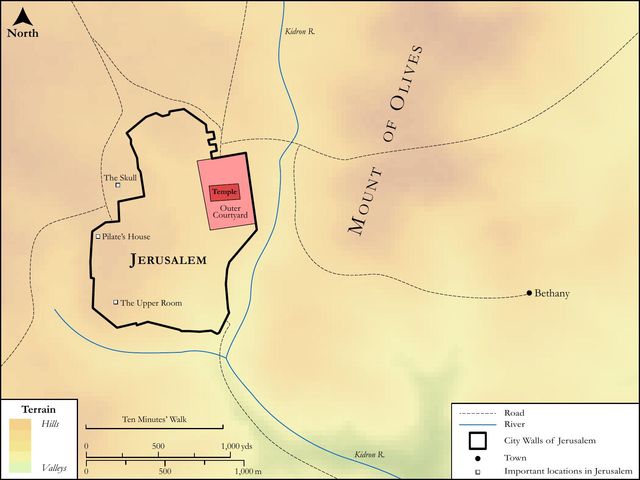
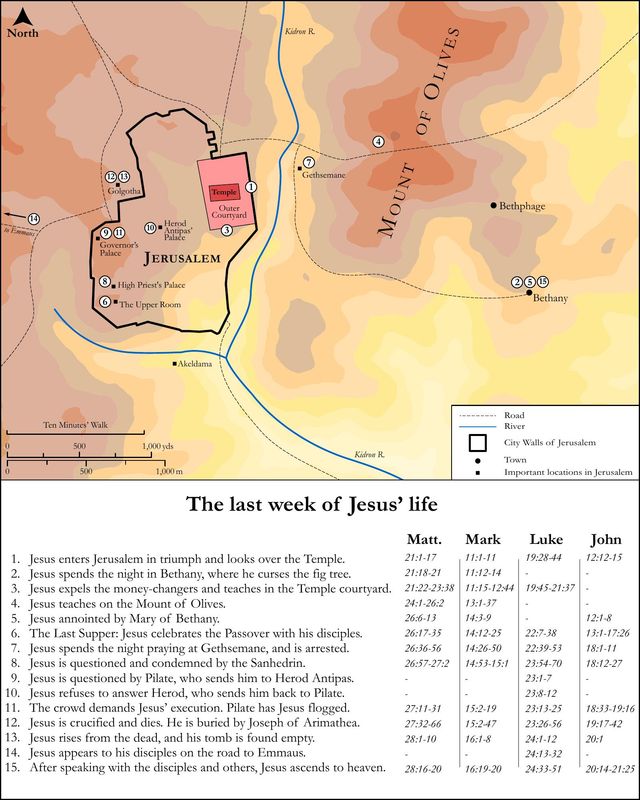
See on the biblical-era map

Study this verse
Public-domain commentary
Matthew Henry
From his Commentary on the Whole Bible. Henry comments on passages, not single verses — this entry covers Mark 12:35–40. His two-level outline is real structure in the source text, so it is rendered as structure.
Here, I. Christ shows the people how weak and defective the scribes were in their preaching, and how unable to solve the difficulties that occurred in the scriptures of the Old Testament, which they undertook to expound. Of this he gives an instance, which is not so fully related here as it was in Matthew. Christ was teaching in the temple: many things he said, which were not written; but notice is taken of this, because it will stir us up to enquire concerning Christ, and to enquire of him; for none can have the right knowledge of him but from himself; it is not to be had from the scribes, for they will soon be run aground.
1.They told the people that the Messiah was to be the Son of David (Mar 12:35), and they were in the right; he was not only to descend from his loins, but to fill his throne (Luk 1:32); The Lord shall give him the throne of his father David. The scripture said it often, but the people took it as what the scribes said; whereas the truths of God should rather be quoted from our Bibles than from our ministers, for there is the original of them. Dulcius ex ipso fonte bibuntur aquae - The waters are sweetest when drawn immediately from their source.
2.Yet they could not tell them how, notwithstanding that it was very proper for David, in spirit, the spirit of prophecy, to call him his Lord, as he doth, Psa 110:1. They had taught the people that concerning the Messiah, which would be for the honour of their nation - that he should be a branch of their royal family; but they had not taken care to teach them that which was for the honour of the Messiah himself - that he should be the Son of God, and, as such, and not otherwise, David's Lord. Thus they held the truth in unrighteousness, and were partial in the gospel, as well as in the law, of the Old Testament. They were able to say it, and prove it - that Christ was to be David's son; but if any should object, How then doth David himself call him Lord? they would not know how to avoid the force of the objection. Note, Those are unworthy to sit in Moses's seat, who, though they are able to preach the truth, are not in some measure able to defend it when they have preached it, and to convince gainsayers.
Now this galled the scribes, to have their ignorance thus exposed, and, no doubt, incensed them more against Christ; but the common people heard him gladly, Mar 12:37. What he preached was surprising and affecting; and though it reflected upon the scribes, it was instructive to them, and they had never heard such preaching. Probably there was something more than ordinarily commanding and charming in his voice and way of delivery, which recommended him to the affections of the common people; for we do not find that any were wrought upon to believe in him, and to follow him, but he was to them as a lovely song of one that could play well on an instrument; as Ezekiel was to his hearers, Eze 33:32. And perhaps some of these cried, Crucify him, as Herod heard John Baptist gladly, and yet cut off his head.
II.He cautions the people to take heed of suffering themselves to be imposed upon by the scribes, and of being infected with their pride and hypocrisy; He said unto them in his doctrine, "Beware of the scribes (Mar 12:38); stand upon your guard, that you neither imbibe their peculiar opinions, nor the opinions of the people concerning them." The charge is long as drawn up against them in the parallel place (Mt. 23); it is here contracted.
1.They affect to appear very great; for they go in long clothing, with vestures down to their feet, and in those they walk about the streets, as princes, or judges, or gentlemen of the long robe. Their going in such clothing was not sinful, but their loving to go in it, priding themselves in it, valuing themselves on it, commanding respect by it, saying to their long clothes, as Saul to Samuel, Honour me now before this people, this was a product of pride. Christ would have his disciples go with their loins girt.
2.They affect to appear very good; for they pray, they make long prayers, as if they were very intimate with heaven, and had a deal of business there. They took care it should be known that they prayed, that they prayed long, which, some think, intimates that they prayed not for themselves only, but for others, and therein were very particular and very large; this they did for a pretence, that they might seem to love prayer, not only for God's sake, whom hereby they pretended to glorify, but for their neighbour's sake, whom hereby they pretended to be serviceable to.
3.They here aimed to advance themselves: they coveted applause, and were fond of it; they loved salutations in the marketplaces, and the chief seats in the synagogues, and the uppermost rooms at feasts; these pleased a vain fancy; to have these given them, they thought, expressed the value they had for them, who did know them, and gained them respect for those who did not.
4.They herein aimed to enrich themselves. They devoured widows' houses, made themselves masters of their estates by some trick or other; it was to screen themselves from the suspicion of dishonesty, that they put on the mask of piety; and that they might not be thought as bad as the worst, they were studious to seem as good as the best. Let fraud and oppression be thought the worse of for their having profaned and disgraced long prayers; but let not prayers, no nor long prayers, be thought the worse of, if made in humility and sincerity, for their having been by some thus abused. But as iniquity, thus disguised with a show of piety, is double iniquity, so its doom will be doubly heavy; These shall receive great damnation; greater than those that live without prayer, greater than they would have received for the wrong done to the poor widows, if it had not been thus disguised. Note, The damnation of hypocrites will be of all others the greatest damnation.
Historical interpretation
Eleven Centuries of Reception
6 surviving comments on this verse. Each one is dated, so this reads as a timeline rather than a list.
Select a marker to jump to its quote. Markers stagger vertically where authors wrote within a few decades of each other.
That is, He openly speaks to them of Himself, that they may be inexcusable; for it goes on: How say the Scribes that Christ is the Son of David?
After confuting the Scribes and Pharisees, He burns up as a fire their dry and withered examples; wherefore it is said, And he said unto them in his doctrine, Beware of the Scribes, which love to go in long clothing.
Give heed, therefore, ye who glory in your wealth, lest those who are needy should groan, and their groans should ascend to the Lord, and ye be shut out with all your goods beyond the gate of the tower. Wherefore I now say to you who preside over the Church and love the first seats, "Be not like to drug-mixers. For the drug-mixers carry their drugs in boxes, but ye carry your drug and poison in your heart."
Such an one is in reality a presbyter of the Church, and a true minister (deacon) of the will of God, if he do and teach what is the Lord's; not as being ordained by men, nor regarded righteous because a presbyter, but enrolled in the presbyterate because righteous. And although here upon earth he be not honoured with the chief seat, he will sit down on the four-and-twenty thrones, judging the people, as John says in the Apocalypse.
(ubi sup.) But the putting own of His enemies by the Father, does not show the weakness of the Son, but the unity of nature, by which One works in the Other; for the Son also subjects the Father's enemies, because He glorifies His Father upon earth.
(ubi sup.) The question of Jesus is useful for us even now against the Jews; for they, acknowledging that Christ is to come, assert that He is a mere man, a holy Person descended from David. Let us then ask them, as our Lord has taught us, if He be a mere man, and only the son of David, how David in the Holy Spirit calls Him Lord. They are not however reproved for calling Him David's son, but for not believing Him to be the Son of God. It goes on, And the common people heard him gladly.
(ubi sup.) To walk in long clothing is to go forth into public clad in garments too much ornamented, in which amongst other things, that rich man, who fared sumptuously every day, is said to have sinned.
(ubi sup.) We must observe that He does not forbid that those, to whom it falls by the rule of their office, should be saluted in the marketplace, or have chief seats and places at feasts, but He teaches that those who love those things unduly, whether they have them or no, are to be avoided by the faithful as wicked men: that is, He blames the intention and not the office; although this too is culpable, that the very men who wish to be called masters of the synagogue in Moses' seat, should have to do with lawsuits in the marketplace. We are in two ways ordered to beware of those who are desirous of vain glory; first, we should not be seduced by their hypocrisy into thinking that what they do is good; nor secondly, should we be excited to imitate them, through a vain rejoicing in being praised for those virtues which they affect.
(ubi sup.) But they do not only seek for praise from men, but also for gain. Wherefore there follows, Which devour widows' houses, under the pretence of long prayers. For there are men who pretending to be just hesitate not to receive money from persons who are troubled in conscience, as though they would be their advocates in the judgment. A hand stretched out to the poor is always an accompaniment to prayer, but these men pass the night in prayer, that they may take away money from the poor.
Because Christ was coming to His Passion, He corrects a false opinion of the Jews, who said that Christ was the Son of David, not his Lord; wherefore it is said, And Jesus answered and said, while he taught in the temple.
But Christ shows Himself to be the Lord, by the words of David. For it goes on: For David himself said by the Holy Ghost, The Lord said to my Lord, Sit thou on my right hand; as if He had said, Ye cannot say that David said this without the grace of the Holy Spirit, but he called Him Lord in the Holy Spirit; and that He is Lord, he shows, by this that is added, Till I make thine enemies thy footstool; for they themselves were His enemies, whom God put under the footstool of Christ.
But they used to walk in honourable garments, because they wished to be highly esteemed for it, and in like manner they desired other things, which lead to glory. For it goes on: And love salutations in the marketplaces, and the chief seats in the synagogues, and the uppermost rooms at feasts.
He also especially teaches the Apostles, not to have any communication with the scribes, but to imitate Christ Himself; and in ordaining them to be masters in the duties of life, He places others under themv.
But the Scribes used to come to women, who were left without the protection of their husbands, as though they were their protectors; and by a pretence of prayer, a reverend exterior and hypocrisy, they used to deceive widows, and thus also devour the houses of the rich. It goes on, These shall receive a greater damnation, that is, than the other Jews, who sinned.
(non occ.) Thus then the Lord concludes from what has gone before the doubtful question. For from the foregoing words of David it is proved that Christ is the Lord of David, but according to the saying of the Scribes, it is proved that He is his son. And this is what is added, David himself then calls him Lord, how is he then his son?
(non occ.) Namely, because they saw that He answered and put questions wisely.
Continue studying Mark 12:39 across the web’s major study libraries — every link below opens this exact verse, chapter, or book on the destination site.
Read & Compare
 BibleGatewayThis verse in more than 200 translations and 70 languages.
 Bible.comThe YouVersion reader — hundreds of translations, reading plans, and highlights.
 ESV.orgCrossway's official English Standard Version reader.
 NET BibleThe NET translation with 60,000+ translators' notes on every rendering decision.
 STEP BibleTyndale House's free study tool — original text, vocabulary, and scholarly resources.
 BibliaLogos Bible Software's free web reader.
 USCCBThe New American Bible (Revised Edition) with the U.S. bishops' study notes.
Commentaries
 BibleHub CommentariesDozens of classic commentaries on this verse, gathered on one page.
 StudyLightMore than 100 commentary sets — the largest collection on the web.
 BibleRefPlain-English commentary on what this verse means, verse by verse.
 Enduring WordDavid Guzik's free commentary on this chapter, widely used by Bible teachers.
 Bible Study ToolsVerse commentary alongside Greek and Hebrew study aids.
Original Language & Research
- BibleHub InterlinearThe verse word by word — original language, transliteration, and English.
- BibleHub LexiconEvery word's original-language definition and Strong's entry.
 Blue Letter BibleDeep-study tools — Strong's numbers, concordance, and word studies.
 CNTR CollationThe earliest Greek manuscripts of this verse, collated letter by letter.
Sermons, Hymns & Audio


TrulyRandomVerse is not affiliated with these sites and doesn’t control their content. They’re linked because they’re genuinely useful.
Summary
Mark 12:39 is a sharp indictment by Jesus against the scribes, the religious scholars and legal experts of His day, revealing their profound spiritual hypocrisy. This verse specifically targets their ostentatious desire for public recognition and elevated status, manifested in their pursuit of the most prominent seating in both religious assemblies and social gatherings. It exposes a heart motivated by self-glory rather than genuine devotion or humble service, standing in stark contrast to the values of the Kingdom of God.
Context
ShowHideLiterary Context
This verse is part of Jesus' scathing public denunciation of the scribes, which begins in Mark 12:38 and culminates in the severe condemnation found in Mark 12:40. This entire discourse follows a series of intense theological and ethical confrontations where various groups (Pharisees, Herodians, Sadducees, and a scribe) attempt to trap Jesus with challenging questions, such as paying taxes to Caesar (Mark 12:13-17), the resurrection (Mark 12:18-27), and the greatest commandment (Mark 12:28-34). Jesus' critique of the scribes serves as a powerful conclusion to these interactions, exposing the spiritual bankruptcy of those who held religious authority but lacked true righteousness. It also sets the stage for the dramatic account of the widow's offering in Mark 12:41-44, which beautifully contrasts the scribes' self-serving piety with genuine, sacrificial devotion.
Historical & Cultural Context
In first-century Jewish society, scribes (or "teachers of the Law") held immense prestige and authority. They were the interpreters and custodians of the Mosaic Law, revered for their knowledge and seen as spiritual guides. Synagogues were not merely places of worship but also community centers, courts, and schools, where seating arrangements often reflected social status. The "chief seats" (or "first seats") were typically at the front, facing the congregation and the Torah scroll, signifying honor and prominence. Similarly, feasts and banquets were significant social events, and the "uppermost rooms" or "chief places at feasts" referred to the most honorable positions at the dining table, usually nearest the host. For a scribe, occupying these seats was a public display of their perceived importance and status within the community. This cultural emphasis on honor and shame meant that such public displays were highly valued, and Jesus' criticism directly challenged the prevailing social norms and the scribes' motivations.
Key Themes
ShowHideMark 12:39 contributes significantly to several key themes within the Gospel of Mark and the broader New Testament. Foremost among these is the theme of hypocrisy, as Jesus exposes the profound disconnect between the scribes' outward religious observance and their inward, self-serving motives. Their desire for public acclaim reveals a heart that seeks honor from men rather than from God, a stark contrast to the genuine humility and service that Jesus consistently taught. This also highlights the theme of pride and status seeking, which Jesus condemned throughout His ministry, advocating instead for a radical reorientation of values where true greatness is found in humble service (Mark 10:43-45). The verse further underscores Jesus' consistent warning against externalism in religion, challenging those who prioritize outward show, public recognition, and adherence to traditions over genuine spiritual devotion, inner righteousness, and compassionate service to others. This theme is echoed powerfully in the Sermon on the Mount, where Jesus warns against performing righteous acts "to be seen by others" (Matthew 6:1).
Exposition and Analysis
ShowHideKey Word Analysis
ShowHideThis compound word, derived from prōtos (first) and kathédra (seat), literally means "first sitting" or "preeminence in council." It refers to the most prominent and honorable seats in the synagogue, typically facing the congregation, reserved for those of highest authority and esteem. The scribes' desire for these seats underscored their craving for public recognition and social hierarchy within the religious sphere, valuing outward display over inner piety.
Similar to prōtokathedría, this term combines prōtos (first) and klisía (a reclining place at a meal). It refers to the most honored position at a banquet or feast, where guests would recline on couches. In ancient Near Eastern dining customs, the guest of honor would recline at the head of the table or in a central, prominent position. The scribes' pursuit of these "first reclining places" at feasts highlights their ambition for social preeminence and their desire to be seen as superior, even in common social settings.
This word denotes the main meal of the day, typically eaten in the evening, often a dinner or supper. In the context of the verse, it refers to social gatherings or banquets where people would recline to eat. The mention of "feasts" alongside "synagogues" emphasizes that the scribes' desire for prominence was not limited to religious settings but permeated their entire social existence, revealing a pervasive pride and self-aggrandizement.
Verse Breakdown
ShowHide"And the chief seats in the synagogues"
This phrase directly points to the scribes' ambition for religious prominence. In the synagogue, the "chief seats" were reserved for the most honored and influential members, typically facing the ark where the Torah scrolls were kept. By seeking these positions, the scribes were not merely desiring comfort but actively pursuing public recognition, authority, and the deference that came with such status within the religious community. This behavior betrayed a heart focused on human applause rather than divine approval.
"and the uppermost rooms at feasts"
This second clause extends the scribes' desire for status beyond the religious sphere into their social lives. At banquets and social gatherings, the "uppermost rooms" or "chief places" were the most prestigious positions at the dining table, signifying the guest of honor. Their craving for these positions demonstrated that their pride and self-exaltation were not confined to their professional or religious roles but were deeply ingrained aspects of their character, influencing their behavior in all social interactions.
Literary Devices
ShowHideMark 12:39 employs several literary devices to emphasize Jesus' critique. Irony is prominent, as those who are supposed to be spiritual leaders, guiding people towards God, are instead consumed by worldly desires for status and recognition. Their pursuit of "chief seats" and "uppermost rooms" is diametrically opposed to the humility and self-sacrifice that true spiritual leadership demands, as exemplified by Christ Himself. Symbolism is also at play, with the "chief seats" and "uppermost rooms" serving as powerful symbols of worldly status, pride, and the desire for human applause. These physical positions represent the scribes' spiritual condition—a heart elevated by self-importance rather than humbled by God's truth. Furthermore, the verse uses parallelism by presenting two similar phrases ("chief seats in the synagogues" and "uppermost rooms at feasts"), which intensifies the condemnation by showing that this desire for preeminence pervaded both their religious and social lives, underscoring the consistency of their self-serving ambition.
Theological and Thematic Connections
ShowHideThis verse powerfully highlights the pervasive danger of religious hypocrisy and the human tendency to seek glory from others rather than from God. Jesus consistently challenged outward displays of piety that lacked genuine inner transformation, asserting that true righteousness is not about public acclaim but about sincere devotion and humble service. The scribes' desire for prominent positions exposed a heart that valued human honor over divine approval, illustrating a profound misunderstanding of God's Kingdom, where the last shall be first and the greatest is the servant of all. This pursuit of status ultimately blinds one to true spiritual priorities and can lead to spiritual emptiness and condemnation.
Reflection and Application
ShowHideMark 12:39 serves as a timeless mirror for all who claim to follow God, especially those in positions of leadership or influence within the church. It compels us to rigorously examine our own motives: are we serving God and others out of genuine love, humility, and a desire for His glory, or are we subtly, perhaps even unconsciously, seeking recognition, status, or influence for ourselves? The temptation to prioritize outward appearance or public acclaim over sincere devotion and sacrificial service remains a potent danger in every age. True spiritual impact is not measured by the size of one's platform or the prestige of one's position, but by the depth of one's humility and the authenticity of one's love for God and neighbor. This verse calls us to cultivate a heart that seeks to honor God in secret, trusting that His approval is the only one that truly matters, and to embrace the path of humble service, following the example of Christ who came not to be served, but to serve.
Questions for Reflection
ShowHideFAQ
ShowHideWhat was the significance of "chief seats" and "uppermost rooms" in Jesus' time?
ShowHideIn Jesus' time, "chief seats" (Greek: prōtokathedría) in the synagogues referred to the prominent benches at the front, often facing the congregation and the ark containing the Torah scrolls. These seats were reserved for esteemed leaders, scholars, and respected members of the community, signifying their authority and honor. Similarly, "uppermost rooms" (Greek: prōtoklisía) at feasts or banquets denoted the most honorable positions at the dining table, typically nearest the host or in a central, elevated spot. Both terms symbolized social and religious preeminence, public recognition, and the deference accorded to those in positions of power or influence. Jesus' critique in Mark 12:39 highlights that the scribes' pursuit of these positions was driven by pride and a desire for human glory, rather than genuine humility or a focus on God's will. This behavior stood in stark contrast to the values of the Kingdom of God, where true greatness is found in humble service, as taught in Luke 14:7-11.
Christ-Centered Fulfillment
ShowHideMark 12:39, while a condemnation of the scribes' pride, finds its ultimate Christ-centered fulfillment in the radical humility and self-emptying of Jesus Himself. The scribes sought the "chief seats" and "uppermost rooms," desiring to be served and honored, but Christ, though "in the form of God, did not count equality with God a thing to be grasped, but emptied himself, by taking the form of a servant" (Philippians 2:6-7). He did not seek the places of honor but instead ministered to the lowly, ate with sinners, and ultimately took the lowest place, enduring the cross for the salvation of humanity (Philippians 2:8). Jesus' life and teachings consistently inverted the world's values, declaring that "whoever would be great among you must be your servant, and whoever would be first among you must be slave of all" (Mark 10:43-44). His example, from washing the disciples' feet (John 13:1-17) to His sacrificial death, stands as the perfect antithesis to the scribes' self-aggrandizement, revealing the true path to glory through humble service and self-denial. He is the one who, though rejected by men, was exalted by God, demonstrating that true honor comes from above, not from human accolades or earthly positions (Acts 2:33).