


Micah 6:6
Bible text: King James Version (1769 Blayney text) · Public domain
Bible text: Berean Standard Bible · Public domain
Bible text: American Standard Version (1901) · Public domain
Bible text: World English Bible, Messianic edition · Public domain
Bible text: Geneva Bible (1599) · Public domain
Bible text: Young's Literal Translation · Public domain
- בַּמָּהba·Mahwith what?H4100Prep-b ¦ InterrogPronoun Interrogativeבַּwithמָּהwhat?
- אֲקַדֵּם'a·ka·Demwill I come to meetH6923V-Piel-Imperf-1csVerb Piel Imperfect 1st Singular common gender
- יְהוָהYah·wehYahwehH3068N-properNoun Proper Title
- אִכַּף'i·Kafwill I bend myself down?H3721V-Niphal-Imperf-1csVerb Niphal Imperfect 1st Singular common gender
- לֵאלֹהֵיle·lo·Heito [the] God ofH430Prep-l ¦ N-mpcNoun Plural Masculine Constructלֵtoאלֹהֵי[the] God of
- מָרוֹםma·RomheightH4791N-msNoun Singular Masculine Absolute
- הַאֲקַדְּמֶנּוּha·'a·kad·de·Me·nu¿ will I come to meet himH6923Interrog ¦ V-Piel-Imperf-1cs ¦ 3msVerb Piel Imperfect 1st Singular common genderהַ¿אֲקַדְּמֶwill I come to meetנּוּhim
- בְעוֹלוֹתve·'o·Lotwith burnt offeringsH5930Prep-b ¦ N-fpNoun Plural Feminine Absoluteבְwithעוֹלוֹתburnt offerings
- בַּעֲגָלִיםba·'a·ga·Limwith calvesH5695Prep-b ¦ N-mpNoun Plural Masculine Absoluteבַּwithעֲגָלִיםcalves
- בְּנֵיbe·Neisons ofH1121N-mpcNoun Plural Masculine Construct
- שָׁנָהsha·Naha yearH8141N-fsNoun Singular Feminine Absolute
English is a literal word-by-word gloss of the Hebrew, not the KJV's wording. Why?
This is the original text the KJV's translators worked from — each Hebrew word with its own literal English meaning in this verse, prepared by scholars at Tyndale House, Cambridge. The KJV translates whole sentences, not word by word, so its wording differs: one Hebrew word can become several English words, and the KJV may choose “the LORD” where the gloss reads “Yahweh”. Both are faithful — they answer different questions. For the KJV's own rendering, switch to the KJV text.
Details
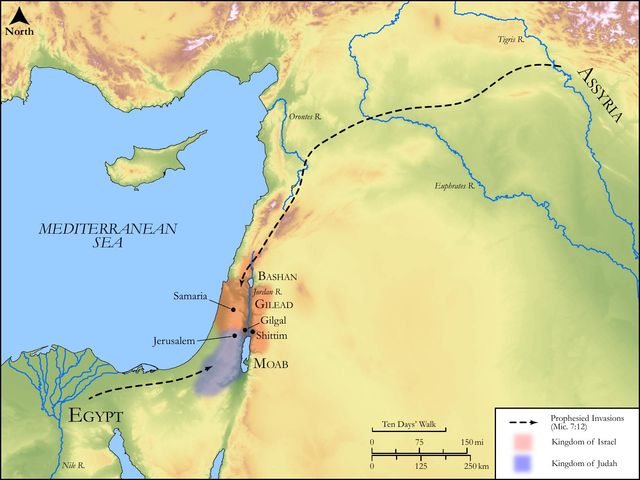
See on the biblical-era map
Study this verse
Public-domain commentary
Matthew Henry
From his Commentary on the Whole Bible. Henry comments on passages, not single verses — this entry covers Micah 6:6–8. His three-level outline is real structure in the source text, so it is rendered as structure.
Here is the proposal for accommodation between God and Israel, the parties that were at variance in the beginning of the chapter. Upon the trial, judgment is given against Israel; they are convicted of injustice and ingratitude towards God, the crimes with which they stood charged. Their guilt is too plain to be denied, too great to be excused, and therefore,
I.They express their desires to be at peace with God upon any terms (Mic 6:6, Mic 6:7):
Wherewith shall I come before the Lord? Being made sensible of the justice of God's controversy with them, and dreading the consequences of it, they were inquisitive what they might do to be reconciled to God and to make him their friend. They apply to a proper person, with this enquiry, to the prophet, the Lord's messenger, by whose ministry they had been convinced. Who so fit to show them their way as he that had made them sensible of their having missed it? And it is observable that each one speaks for himself: Wherewith shall I come? Knowing every one the plague of his own heart, they ask, not, What shall this man do? But, What shall I do? Note, Deep convictions of guilt and wrath will put men upon careful enquiries after peace and pardon, and then, and not till then, there begins to be some hope of them. They enquire wherewith they may come before the Lord, and bow themselves before the high God. They believe there is a God, that he is Jehovah, and that he is the high God, the Most High. Those whose consciences are convinced learn to speak very honourably of God, whom before they spoke slightly of. Now,
1.We know we must come before God; he is the God with whom we have to do; we must come as subjects, to pay our homage to him, as beggars, to ask alms from him, nay, we must come before him, as criminals, to receive our doom from him, must come before him as our Judge.
2.When we come before him we must bow before him; it is our duty to be very humble and reverent in our approaches to him; and, when we come before him, there is no remedy but we must submit; it is to no purpose to contend with him.
3.When we come and bow before him it is our great concern to find favour with him, and to be accepted of him; their enquiry is, What will the Lord be pleased with? Note, All that rightly understand their own interest cannot but be solicitous what they must do to please God, to avoid his displeasure and to obtain his good-will.
4.In order to God's being pleased with us, our care must be that the sin by which we have displeased him may be taken away, and an atonement made for it. The enquiry here is, What shall I give for my transgression, for the sin of my soul? Note, The transgression we are guilty of is the sin of our soul, for the soul acts it (without the soul's act it is not sin) and the soul suffers by it; it is the disorder, disease, and defilement of the soul, and threatens to be the death of it: What shall I give for my transgressions? What will be accepted as a satisfaction to his justice, a reparation of his honour? And what will avail to shelter me from his wrath?
5.We must therefore ask, Wherewith may we come before him? We must not appear before the Lord empty. What shall we bring with us? In what manner must we come? In whose name must we come? We have not that in ourselves which will recommend us to him, but must have it from another. What righteousness then shall we appear before him in?
II.They make proposals, such as they are, in order to it.
Their enquiry was very good and right, and what we are all concerned to make, but their proposals betray their ignorance, though they show their zeal; let us examine them: -
1.They bid high. They offer,
(1.)That which is very rich and costly - thousands of rams. God required one ram for a sin-offering; they proffer flocks of them, their whole stock, will be content to make themselves beggars, so that they may but be at peace with God. They will bring the best they have, the rams, and the most of them, till it comes to thousands.
(2.)That which is very dear to them, and which they would be most loth to part with. They could be content to part with their first-born for their transgressions, if that would be accepted as an atonement, and the fruit of their body for the sin of their soul. To those that had become vain in their imaginations this seemed a probable expedient of making satisfaction for sin, because our children are pieces of ourselves; and therefore the heathen sacrificed their children, to appease their offended deities. Note, Those that are thoroughly convinced of sin, of the malignity of it, and of their misery and danger by reason of it, would give all the world, if they had it, for peace and pardon.
2.Yet they do not bid right. It is true some of these things were instituted by the ceremonial law, as the bringing of burnt-offerings to God's altar, and calves of a year old, rams for sin-offerings, and oil for the meat-offerings; but these alone would not recommend them to God. God had often declared that to obey is better than sacrifice, and to hearken than the fat of rams, that sacrifice and offering he would not; the legal sacrifices had their virtue and value from the institution, and the reference they had to Christ the great propitiation; but otherwise, of themselves, it was impossible that the blood of bulls and goats should take away sin. And as to the other things here mentioned,
(1.)Some of them are impracticable things, as rivers of oil, which nature has not provided to feed men's luxury, but rivers of water to supply men's necessity. All the proposals of peace but those that are according to the gospel are absurd. One stream of the blood of Christ is worth ten thousand rivers of oil.
(2.)Some of them are wicked things, as to give our first-born and the fruit of our body to death, which would but add to the transgression and the sin of the soul. He that hates robbery for burnt-offerings much more hates murder, such murder. What right have we to our first born and the fruit of our body? Do they not belong to God? Are they not his already, and born to him? Are they not sinners by nature, and their lives forfeited upon their own account? How then can they be a ransom for ours?
(3.)They are all external things, parts of that bodily exercise which profiteth little, and which could not make the comers thereunto perfect.
(4.)They are all insignificant, and insufficient to attain the end proposed; they could not answer the demands of divine justice, nor satisfy the wrong done to God in his honour by sin, nor would they serve in lieu of the sanctification of the heart and the reformation of the life. Men will part with any thing rather than their sins, but they part with nothing to God's acceptance unless they part with them.
III.God tells them plainly what he demands, and insists upon, from those that would be accepted of him, Mic 6:8.
Let their money perish with them that think the pardon of sin and the favour of God may be so purchased; no, God has shown thee, O man! what is good. Here we are told,
1.That God has made a discovery of his mind and will to us, for the rectifying of our mistakes and the direction of our practice.
(1.)It is God himself that has shown us what we must do. We need not trouble ourselves to make proposals, the terms are already settled and laid down. He whom we have offended, and to whom we are accountable, has told us upon what conditions he will be reconciled to us.
(2.)It is to man that he has shown it, not only to thee, O Israel! but to thee, O man! Gentiles as well as Jews - to men, who are rational creatures, and capable of receiving the discovery, and not to brutes, - to men, for whom a remedy is provided, not to devils, whose case is desperate. What is spoken to all men every where in general, must by faith be applied to ourselves in particular, as if it were spoken to thee, O man! by name, and to no other.
(3.)It is a discovery of that which is good, and which the Lord requires of us. He has shown us our end, which we should aim at, in showing us what is good, wherein our true happiness does consist; he has shown us our way in which we must walk towards that end in showing us what he requires of us. There is something which God requires we should do for him and devote to him; and it is good. It is good in itself; there is an innate goodness in moral duties, antecedent to the command; they are not, as ceremonial observances, good because they are commanded, but commanded because they are good, consonant to the eternal rule and reason of good and evil, which are unalterable. It has likewise a direct tendency to our good; our conformity to it is not only the condition of our future happiness, but is a great expedient of our present happiness; in keeping God's commandments there is great reward, as well as after keeping them.
(4.)It is shown us. God has not only made it known, but made it plain; he has discovered it to us with such convincing evidence as amounts to a demonstration. Lo this, we have searched it, so it is.
2.What that discovery is. The good which God requires of us is not the paying of a price for the pardon of sin and acceptance with God, but doing the duty which is the condition of our interest in the pardon purchased.
(1.)We must do justly, must render to all their due, according as our relation and obligation to them are; we must do wrong to none, but do right to all, in their bodies, goods, and good name.
(2.)We must love mercy; we must delight in it, as our God does, must be glad of an opportunity to do good, and do it cheerfully. Justice is put before mercy, for we must not give that in alms which is wrongfully got, or with which our debts should be paid. God hates robbery for a burnt-offering.
(3.)We must walk humbly with our God. This includes all the duties of the first table, as the two former include all the duties of the second table. We must take the Lord for our God in covenant, must attend on him and adhere to him as ours, and must make it our constant care and business to please him. Enoch's walking with God is interpreted (Heb 11:5) his pleasing God. We must, in the whole course of our conversation, conform ourselves to the will of God, keep up our communion with God, and study to approve ourselves to him in our integrity; and this we must do humbly (submitting our understandings to the truths of God and our will to his precepts and providences); we must humble ourselves to walk with God (so the margin reads it); every thought within us must be brought down, to be brought into obedience to God, if we would walk comfortably with him. This is that which God requires, and without which the most costly services are vain oblations; this is more than all burnt-offerings and sacrifices.
Historical interpretation
Sixteen Centuries of Reception
4 surviving comments on this verse. Each one is dated, so this reads as a timeline rather than a list.
Select a marker to jump to its quote. Markers stagger vertically where authors wrote within a few decades of each other.
Is everyone who is turning from sin to faith, turning from sinful practices (as if they were his mother) to life? I shall call in evidence one of the twelve prophets, who says, “Am I to make an offering of my firstborn son for my impiety? Should I offer the fruit of my womb for the sin of my soul?” Can the mother buy her way to God by giving up her firstborn? This must not be taken as an attack on the words “increase in numbers.” Micah is naming, by using the word impiety, the first impulses after birth, which do not help us to knowledge of God. If anyone misuses this as a basis for saying that that birth is evil, he should also use it as a basis for saying that it is good, in that in it we come to know the truth. “Come back to a sober and upright life and stop sinning.” But the sinner knows nothing of God. “We are not wrestling against flesh and blood but against spiritual beings, potent in temptation, the rulers of this dark world,” so there is forbearance. This is why Paul says, “I bruise my own body and treat it as a slave, because every athlete goes into total training.” By “total training” we understand not that he abstains from absolutely everything but that he shows self-control in those things he has taken a deliberate decision to use. “They do it to win a crown which dies, we for one which never dies,” if we win the contest. No effort, no crown!
For what is asked of you, O man? Only that you fear God: seek for him, walk after him, follow in his ways. “With what shall I win over the Lord? Shall I win him over with burnt offerings?” The Lord is not reconciled, nor are sins redeemed, with tens of thousands of young goats or thousands of rams or with the fruits of unholiness, but the grace of the Lord is won with a good life.
(Vers. 6, 7.) What shall I offer to the Lord? Shall I bow down before the Most High God? Shall I offer burnt offerings to Him, and yearling calves? Can the Lord be pleased with thousands of rams, or with many thousands of fattened goats? Shall I give my firstborn for my transgression, the fruit of my body for the sin of my soul? LXX: Where shall I find the Lord? Shall I seek my God on high? Shall I seek Him in burnt offerings, in yearling calves? May the Lord receive in the thousands of rams, or in the ten thousands of fat goats? If I offer my firstborn for my impiety: the fruit of my womb for the sin of my soul. God has called the people to judgment: he, knowing his own sin, does not want to contend, but to plead, and yet he has no confidence in his own prayers. For nothing is worthy to be offered to God for sin, and no humility can cleanse the stains of transgressions, because it is impossible for the blood of bulls and calves, and the marrow-burning holocaust, and the blood of rams and fat goats, to wash away the filth of the soul. Will I, he says, give my firstborn for my crime, as it is described that the king of Moab did (2 Kings 3)? Or the fruit of my womb for the sin of my soul, as Jephthah did, offering his daughter for the rashness of his vow (Judith 11)? Therefore we who are of the people of God, knowing that not every living creature will be justified in his sight (Psalm 142), and saying: I have become like an animal before you (Psalm 73:22-23), repenting for our sins, we doubt and say: Where shall I find the Lord, shall I receive my exalted Lord? How can I capture him as he flees? How much cleanliness will I be able to prepare for the Trinity's lodging? Should I seize him in burnt offerings, so that I offer myself as a whole burnt offering to him, or in one-year-old calves, so that I, deserting milk and coming to solid food, may become worthy of the acceptable food in the year of the Lord? If I offer a thousand rams, if I offer ten thousand goats, and if I spiritually understand and present all the Levitical sacrifices in myself, and if a thousand and ten thousand fall from my side, yet I will not be able to give anything worthy in which I can apprehend or receive God. If I give my firstborn for impiety, and the fruit of my womb for the sin of my soul: indeed I will give whatever is first in me, but for my sin and impiety I will offer nothing worthy to God. Therefore, even David prays and says: Wash me more and more from my iniquity, and cleanse me from my sin. For I know my iniquities, and my sin is always against me (Psalm 50, 3). Only the blood is offered worthily for the sin of the soul: and the blood, not of calves, nor of rams, nor of goats, but one's own blood is offered worthily, as the prophet says and asks: What shall I repay to the Lord for all that he has repaid to me? And afterwards, responding, I will receive the chalice of salvation and invoke the name of the Lord. Precious in the sight of the Lord is the death of his saints. (Ps. CXV). But we do not give the blood itself, but we give it back. And what is similar? When the righteous person died for sinners, the Son of God died for men, shall we sinners and men die for the confession of his name?
What shall I offer: This is spoken in the person of the people, desiring to be informed what they are to do to please God.
Continue studying Micah 6:6 across the web’s major study libraries — every link below opens this exact verse, chapter, or book on the destination site.
Read & Compare
 BibleGatewayThis verse in more than 200 translations and 70 languages.
 Bible.comThe YouVersion reader — hundreds of translations, reading plans, and highlights.
 ESV.orgCrossway's official English Standard Version reader.
 NET BibleThe NET translation with 60,000+ translators' notes on every rendering decision.
 STEP BibleTyndale House's free study tool — original text, vocabulary, and scholarly resources.
 BibliaLogos Bible Software's free web reader.
 USCCBThe New American Bible (Revised Edition) with the U.S. bishops' study notes.
Commentaries
 BibleHub CommentariesDozens of classic commentaries on this verse, gathered on one page.
 StudyLightMore than 100 commentary sets — the largest collection on the web.
 BibleRefPlain-English commentary on what this verse means, verse by verse.
 Enduring WordDavid Guzik's free commentary on this chapter, widely used by Bible teachers.
 Bible Study ToolsVerse commentary alongside Greek and Hebrew study aids.
Original Language & Research
- BibleHub InterlinearThe verse word by word — original language, transliteration, and English.
- BibleHub LexiconEvery word's original-language definition and Strong's entry.
 Blue Letter BibleDeep-study tools — Strong's numbers, concordance, and word studies.
 SefariaThe Hebrew text with Rashi and centuries of Jewish commentary.
Sermons, Hymns & Audio


TrulyRandomVerse is not affiliated with these sites and doesn’t control their content. They’re linked because they’re genuinely useful.
Summary
Micah 6:6 initiates a profound theological inquiry, capturing humanity's desperate attempt to discern how to properly approach the transcendent God. Posed as a rhetorical question, it explores the efficacy of traditional, costly sacrifices—specifically burnt offerings and year-old calves—as a means of appeasing the Almighty and establishing a right relationship with Him. This verse sets the stage for the prophet's subsequent declaration of God's true requirements, highlighting the inadequacy of mere ritual without genuine heart and righteous living.
Context
ShowHideLiterary Context
Micah 6:6 opens the second major section of the book of Micah, often referred to as a "rib" or divine lawsuit, where God brings charges against His people. The preceding verses (Micah 6:1-5) establish God's faithfulness to Israel, recounting His mighty acts of deliverance and His unwavering covenant love. Against this backdrop of divine grace, verse 6 shifts to the people's response, expressing their bewilderment and perhaps their misplaced confidence in external religious performance. This question is not merely an intellectual exercise but a plea from a people who, despite their ritualistic adherence, sense a profound disconnect from God. It serves as a crucial setup for the climactic declaration in Micah 6:8, which unveils God's true desires for justice, mercy, and humility.
Historical & Cultural Context
The prophet Micah ministered in Judah during the reigns of Jotham, Ahaz, and Hezekiah (circa 735-700 BC), a period characterized by significant social decay, political instability, and spiritual apostasy. While the Northern Kingdom of Israel was on the brink of Assyrian conquest due to its idolatry and injustice, Judah itself was plagued by similar sins. Leaders, priests, and prophets were corrupt, exploiting the poor and perverting justice. Religious practices, including the elaborate sacrificial system prescribed by the Mosaic Law, continued, but they often became empty rituals, divorced from ethical living and genuine devotion. The people believed that performing these sacrifices, especially the most expensive ones like year-old calves, would guarantee God's favor, even while their daily lives contradicted the spirit of the Law. This verse reflects the prevailing mindset that external acts could substitute for internal transformation and righteous conduct.
Key Themes
ShowHideMicah 6:6 contributes significantly to several key themes within the book and broader prophetic literature. Firstly, it underscores The Inadequacy of Mere Ritual, challenging the notion that elaborate or costly religious acts can appease God when divorced from a transformed heart. The question about "burnt offerings" and "calves of a year old" represents the pinnacle of prescribed sacrifices, yet the prophet implies their insufficiency. Secondly, the verse highlights the Transcendence and Holiness of God, as the worshiper seeks to "bow myself before the high God." This phrase acknowledges God's supreme authority, majesty, and unapproachable holiness, emphasizing the vast chasm between the divine and the human, which demands a proper approach. Finally, it sets the stage for the theme of True Worship and Righteous Living, asserting that God desires more than external performance. This prepares the reader for the revolutionary statement in Micah 6:8, which redefines true piety as a commitment to justice, steadfast love, and humble walking with God, echoing similar prophetic critiques found in Isaiah 1:11-17 and Amos 5:21-24.
Exposition and Analysis
ShowHideKey Word Analysis
ShowHideThis term refers to "the self-Existent or Eternal; Jehovah, Jewish national name of God." In this context, it emphasizes God's covenant name, signifying His unchanging character, faithfulness, and sovereign authority over His people. The question of how to approach "the LORD" is therefore a question of how to rightly relate to the covenant-keeping God who has revealed Himself.
This primitive root means "to curve; bow down (self)." It denotes a physical posture of prostration or deep reverence, signifying humility, submission, and worship before a superior being. The act of bowing before "the high God" underscores the recognition of His exalted status and the worshiper's acknowledgment of their own lowliness and dependence.
This term refers to a "holocaust (as going up in smoke); ascent, burnt offering (sacrifice)." The ʻôlâh was a sacrifice entirely consumed by fire on the altar, symbolizing complete dedication, atonement for sin, and the worshiper's total surrender to God. The question of whether these costly, all-consuming sacrifices are sufficient highlights the people's reliance on prescribed ritual as their primary means of seeking divine favor.
Verse Breakdown
ShowHide"Wherewith shall I come before the LORD,"
This opening clause establishes the core dilemma: how can a sinful human being properly approach the holy, covenant-keeping God? The interrogative "Wherewith" (or "With what?") signals a search for the appropriate means or offering, reflecting a deep-seated human desire to bridge the gap between themselves and the divine.
"and bow myself before the high God?"
This second clause expands on the nature of the encounter, emphasizing the posture of reverence and the character of the divine. "Bow myself" indicates a posture of humility and worship, acknowledging God's supreme authority. The designation "the high God" (Hebrew: ʼĕlôhîym mârôwm) highlights His transcendence, majesty, and elevated status above all creation, reinforcing the immense challenge of approaching such a being.
"shall I come before him with burnt offerings, with calves of a year old?"
This final clause proposes specific, costly means of approach, representing the pinnacle of Old Testament sacrificial worship. "Burnt offerings" (ʻôlâh) were wholly consumed on the altar, symbolizing complete dedication and atonement. "Calves of a year old" refers to young, unblemished, and therefore highly valuable animals, signifying a significant and costly sacrifice. The rhetorical nature of the question implies that even these most perfect and expensive external rites may not be enough to truly satisfy God's requirements.
Literary Devices
ShowHideMicah 6:6 effectively employs several literary devices to convey its profound message. The most prominent is the Rhetorical Question, which is posed not to elicit a direct answer from the audience, but to provoke thought and highlight the inadequacy of the proposed solutions. By asking "Wherewith shall I come...?" and "shall I come...?", the prophet compels the listener to consider the limitations of external rituals. The verse also uses Parallelism, specifically Synonymous Parallelism, in the phrases "come before the LORD" and "bow myself before the high God." These phrases convey a similar idea of approaching and revering God, reinforcing the solemnity and importance of the act. Furthermore, Synecdoche or Metonymy is present in "burnt offerings, with calves of a year old," where these specific, valuable sacrifices stand in for the entire system of ritualistic worship. This allows the prophet to critique the broader human tendency to rely on external religious acts as a substitute for genuine obedience and internal transformation.
Theological and Thematic Connections
ShowHideMicah 6:6 serves as a powerful theological statement on the nature of true worship, challenging the deeply ingrained human tendency to equate piety with external ritual and costly offerings. It underscores the profound truth that God desires a transformed heart and righteous living far more than mere ceremonial observance. The question posed by the people reflects a common misunderstanding of God's character and requirements, assuming that He can be appeased through material goods or prescribed acts alone. However, the prophet, speaking for God, will soon clarify that genuine devotion is holistic, encompassing ethical conduct, compassionate engagement with others, and a humble, ongoing relationship with the Divine. This verse thus lays the groundwork for a radical redefinition of what it means to truly "come before the LORD," shifting the focus from the outward to the inward, from the sacrificial altar to the altar of the heart and daily life.
Reflection and Application
ShowHideMicah 6:6 remains profoundly relevant for contemporary believers, challenging us to critically examine our own approach to God and the nature of our worship. In an age where religious activity can often become a performance or a means of self-justification, this verse calls us back to the heart of what God truly desires. Are we relying on outward displays of religiosity—church attendance, financial giving, participation in ministries, or adherence to specific spiritual disciplines—while neglecting the deeper call to justice, mercy, and humility in our daily lives? The prophet's rhetorical question forces us to confront the possibility that even our most earnest and costly "offerings" might fall short if they are not accompanied by a transformed character and a genuine desire to walk in God's ways. True worship is not merely about what we do for God, but about who we are becoming in Christ. It's a holistic commitment that permeates every aspect of our existence, shaping our interactions with others, our pursuit of righteousness, and our intimate walk with the Holy One. This verse serves as a timeless reminder that God is not impressed by mere ritual without a transformed heart, urging us to pursue authenticity and integrity in our faith.
Questions for Reflection
ShowHideFAQ
ShowHideDoes Micah 6:6 mean that sacrifices were pointless in the Old Testament?
ShowHideNo, Micah 6:6 does not mean that sacrifices were pointless or invalid under the Old Covenant. The Mosaic Law clearly prescribed various sacrifices, including burnt offerings, as a means of atonement, worship, and fellowship with God (e.g., Leviticus 1). The issue addressed in Micah 6:6 (and reiterated throughout the prophets) is not the inherent validity of the sacrificial system itself, but the attitude and lifestyle of those offering the sacrifices. God was displeased when people performed rituals mechanically, without genuine repentance, faith, or a commitment to live righteously. The prophets consistently emphasized that God desired obedience, justice, and mercy more than mere external acts of worship (e.g., 1 Samuel 15:22; Isaiah 1:11-17). Thus, Micah 6:6 highlights the inadequacy of ritual alone to satisfy God's requirements, pointing to the deeper spiritual and ethical demands of the covenant.
Christ-Centered Fulfillment
ShowHideMicah 6:6, with its poignant question about how to approach the "high God" through sacrifices, finds its ultimate and profound fulfillment in Jesus Christ. The Old Testament sacrificial system, including the burnt offerings and year-old calves mentioned here, served as a temporary and imperfect means of atonement, constantly pointing forward to a greater, once-for-all sacrifice. The prophet's rhetorical question underscores the inherent limitation of these animal offerings; they could never truly take away sin or perfectly bridge the chasm between a holy God and sinful humanity. Jesus, however, is revealed as the Lamb of God who takes away the sin of the world, the perfect and final sacrifice. His death on the cross was the ultimate "burnt offering," a complete and voluntary surrender that fully satisfied God's righteous demands (see Hebrews 9:11-14). Through His shed blood, we now have bold access to the Father and can "come before the LORD" not with the blood of animals, but with confidence in Christ's finished work. Furthermore, the emphasis in Micah 6:6-8 on God desiring justice, mercy, and humility over mere ritual is perfectly embodied in Christ's teachings and life. He taught that true worship is in spirit and truth, requiring an internal transformation and ethical living that flows from a relationship with Him. As believers, our "sacrifice" is now a living sacrifice, our lives offered in humble obedience and service, empowered by the Spirit, in response to the perfect sacrifice of Christ.