


Micah 6:10
- עוֹדodstillH5750Adj-msAdjective Numerical Singular Masculine Absolute
- הַאִשׁha·'Ish¿ [are] thereH786Interrog ¦ N-csNoun Singular common gender Absoluteהַ¿אִשׁ[are] there
- בֵּיתbeithouse ofH1004N-mscNoun Singular Masculine Construct
- רָשָׁעra·Sha'[the] wickedH7563N-msNoun Singular Masculine Absolute
- אֹצְרוֹת'o·tze·Rottreasures ofH214N-fpcNoun Plural Feminine Construct
- רֶשַׁעRe·sha'wickednessH7562N-msNoun Singular Masculine Absolute
- וְאֵיפַתve·'ei·Fatand an ephah ofH374Conj-w ¦ N-fscNoun Singular Feminine Constructוְandאֵיפַתan ephah of
- רָזוֹןra·ZonscantnessH7332N-msNoun Singular Masculine Absolute
- זְעוּמָהze·'u·MahaccursedH2194V-Qal-PassPrtcpl-fsVerb Qal Participle Passive Singular Feminine Absolute
English is a literal word-by-word gloss of the Hebrew, not the KJV's wording. Why?
This is the original text the KJV's translators worked from — each Hebrew word with its own literal English meaning in this verse, prepared by scholars at Tyndale House, Cambridge. The KJV translates whole sentences, not word by word, so its wording differs: one Hebrew word can become several English words, and the KJV may choose “the LORD” where the gloss reads “Yahweh”. Both are faithful — they answer different questions. For the KJV's own rendering, switch to the KJV text.
Details
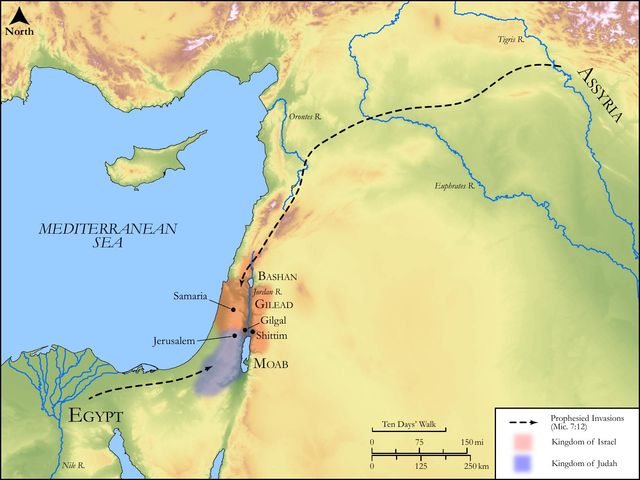
See on the biblical-era map
Study this verse
Public-domain commentary
Matthew Henry
From his Commentary on the Whole Bible. Henry comments on passages, not single verses — this entry covers Micah 6:9–16. His three-level outline is real structure in the source text, so it is rendered as structure.
God, having shown them how necessary it was that they should do justly, here shows them how plain it was that they had done unjustly; and since they submitted not to his controversy, nor went the right way to have it taken up, here he proceeds in it. Observe,
I.How the action is entered against them, Mic 6:9.
God speaks to the city, to Jerusalem, to Samaria. His voice cries to it by his servants the prophets who were to cry aloud and not spare. Note, The voice of the prophets is the Lord's voice, and that cries to the city, cries to the country. Doth not wisdom cry? Pro 8:1. When the sin of a city cries to God his voice cries against the city; and, when the judgments of God are coming upon a city, his voice first cries unto it. He warns before he wounds, because he is not willing that any should perish. Now observe,
1.How the voice of God is discerned by some: The man of wisdom will see thy name. When the voice of God cries to us we may by it see his name, may discern and perceive that by which he makes himself known. Yet many see it not, are not aware of it, because they do not regard it. God speaks once, yea, twice, and they perceive it not (Job 33:14); but those that are men of wisdom will see it, and perceive it, and make a good use of it. Note, It is a point of true wisdom to discover the name of God in the voice of God, and to learn what he is from what he says. Wisdom shall see thy name, for the knowledge of the holy is understanding.
2.What this voice of God says to all: "Hear you the rod, and who hath appointed it. Hear the rod when it is coming; hear it at a distance, before you see it and feel it; and be awakened to go forth to meet the Lord in the way of his judgments. Hear the rod when it has come, and is actually upon you, and you are sensible of the smart of it; hear what it says to you, what convictions, what counsels, what cautions, it speaks to you." Note, Every rod has a voice, and it is the voice of God that is to be heard in the rod of God, and it is well for those that understand the language of it, which if we would do we must have an eye to him that appointed it. Note, Every rod is appointed, of what kind it shall be, where it shall light, and how long it shall lie. God in every affliction performs the thing that is appointed for us (Job 23:14), and to him therefore we must have an eye, to him we must have an ear; we must hear what he says to us by the affliction. Hear it, and know it for thy good, Job 5:27. The work of ministers is to explain the providences of God and to quicken and direct men to learn the lessons that are taught by them.
II.What is the ground of the action, and what are the things that are laid to their charge.
1.They are charged with injustice, a sin against the second table. Are there yet to be found among them the marks and means of fraudulent dealing? What! after all the methods that God has taken to teach them to do justly, will they yet deal unjustly? It seems, they will, Mic 6:10. And shall I count them pure? Mic 6:11. No; this is a sin which will by no means consist with a profession of purity. Those that are dishonest in their dealings have not the spots of God's children, and shall never be reckoned pure, whatever shows of devotion they may make. Be not deceived, God is not mocked. When a man is suspected of theft, or fraud, the justice of peace will send a warrant to search his house. God here does, as it were, search the houses of those citizens, and there he finds,
(1.)Treasures of wickedness, abundance of wealth, but it is ill-got, and not likely to prosper; for treasures of wickedness profit nothing.
(2.)A scant measure, by which they sold to the poor, and so exacted upon them and cheated them.
(3.)They had wicked balances and a bag of false weights, by which, under a pretence of weighing what they sold, and giving the buyer what was right, they did him the greatest wrong, Mic 6:11.
(4.)Those that had wealth and power in their hands abused it to oppression and extortion; The rich men thereof are full of violence; for those that have much would have more, and are in a capacity of making it more by the power which their abundance of wealth gives them. They are full of violence, that is, they have their houses full of that which is got by violence.
(5.)Those that had not the advantage of doing wrong by their wealth yet found means of defrauding those they dealt with: The inhabitants thereof have spoken lies; if they are not able to use force and violence, they use fraud and deceit; the inhabitants have spoken lies, and their tongue is deceitful in their mouth; they do not stick at a deliberate lie, to make a good bargain. Some understand it of their speaking falsely concerning God, saying, The Lord seeth not; he hath forsaken the earth, Eze 8:12.
2.They are charged with idolatry (Mic 6:6): The statutes of Omri are kept, and all the work of the house of Ahab. Both these kings were wicked, and did evil in the sight of the Lord; but the wickedness which they established by a law, concerning which they made statutes, and which was the peculiar work of that house, was idolatry. Omri walked in the way of Jeroboam, and in his sin of provoking God to anger with their vanities, Kg1 16:26, Kg1 16:31. Ahab introduced the worship of Baal. These reigns were some ages before the time when this prophet lived, and yet the wickedness which they established by their laws and examples remained to this day; those statutes were still kept, and that work was still done; and the princes and people still walked in their counsels, took the same measures, and governed themselves and the people by the same politics. Observe,
(1.)The same wickedness continued from one generation to another. Sin is a root of bitterness, soon planted, but not so soon plucked up again. The iniquity of former ages is often transmitted to, and entailed upon, the succeeding ones. Those that make corrupt laws, and bring in corrupt usages, are doing that which perhaps may prove the ruin of the child unborn.
(2.)It was not the less evil in itself, provoking to God, and dangerous to the sinners, for its having been established and confirmed by the laws of princes, the examples of great men, and a long prescription. Though the worship of idols is enacted by the statutes of Omri, recommended by the practice of the house of Ahab, and pleads that it has been the usage of many generations, yet it is still displeasing to God and destructive to Israel; for no laws nor customs are of force against the divine command.
III.What is the judgment given upon this.
Being found guilty of these crimes, the sentence is that that which God had given them warning of (Mic 6:9) shall be brought upon them (Mic 6:13): Therefore also will I make thee sick, in smiting thee. As they had smitten the poor with the rod of their oppressions, so would God in like manner smite them, so as to make them sick, sick of the gains they had unjustly gotten, so that though they had swallowed down riches they should vomit them up again, Job 20:15. Their doom is,
1.That what they have they shall not have any comfortable enjoyment of; it shall do them no good. They grasped at more than enough, but, when they have it, it shall not be enough to make them easy and happy. What is got by fraud and oppression cannot be kept or enjoyed with any satisfaction.
(1.)Their food shall not nourish them: Thou shalt eat, but not be satisfied, either because the food shall not digest, for want of God's blessing going along with it, or because the appetite shall by disease be made insatiable and still craving, the just punishment of those that were greedy of gain and enlarged their desires as hell. Men may be surfeited with the good things of this world and yet not satisfied, Ecc 5:10; Isa 55:2.
(2.)Their country shall not harbour and protect them: "Thy casting down shall be in the midst of thee, that is, thou shalt be broken and ruined by the intestine troubles, mischiefs at home enough to cast thee down, though thou shouldst not be invaded by a foreign force." God can cast a nation down by that which is in the midst of them, can consume them by a fire in their own bowels.
(3.)They shall not be able to preserve what they have from a foreign force, nor to recover what they have lost: "Thou shalt take hold of what is about to be taken from thee, but thou shalt not hold it fast, shalt catch at it, but shalt not deliver it, shalt not retrieve it." It is meant of their wives and children, that were very dear to them, which they took hold of, as resolved not to part with them, but there is no remedy, they must go into captivity. Note, What we hold closest we commonly lose soonest, and that proves least safe which is most dear.
(4.)What they save for a time shall be reserved for a future and sorer stroke: That which thou deliverest out of the hand of one enemy will I give up to the sword of another enemy; for God has many arrows in his quiver; if one miss the sinner, the next shall not.
(5.)What they have laboured for they shall not enjoy (Mic 6:15): "Thou shalt sow, but thou shalt not reap; it shall be blasted and withered, and there shall be nothing to reap, or an enemy shall come and reap it for himself, or thou shalt be carried into captivity, and leave it to be reaped by thou knowest not whom. Thou shalt tread the olives, but thou shalt not anoint thyself with oil, having no heart to make use of ornaments and refreshments when all is going to ruin. Thou shalt tread out the sweet wine, but shalt not drink wine, for many things may fall between the cup and the lip." Note, It is very grievous to be disappointed of our expectations, and not to have the pleasure of that which we have taken pains for; and this will be the just punishment of those that frustrate God's expectations from them, and answer not the cost he has been at upon them. See this threatened in the law, Lev 26:16; Deu 28:30, Deu 28:38, etc.; and compare Isa 62:8, Isa 62:9.
2.That all they have shall at length be taken from them (Mic 6:13): Thou shalt be made desolate because of thy sins; and Mic 6:16, a desolation and a hissing. Sin makes a nation desolate; and when a people that have been famous and flourishing are made desolate it is the astonishment of some and the triumph of others; some lament it, and others hiss at it. Thus you shall bear the reproach of my people. Their being the people of God, in name and profession while they kept close to their duty and kept themselves in his love, was an honour to them, and all their neighbours thought it so; but now that they have corrupted and ruined themselves, now that their sins and God's judgments have made their land desolate, their having been once the people of God does but turn so much the more to their reproach; their enemies will say, These are the people of the Lord, Eze 36:20. Note, If professors of religion ruin themselves, their ruin will be the most reproachful of any; and they in a special manner will rise at the last day to everlasting shame and contempt.
Historical interpretation
Fourteen Centuries of Reception
2 surviving comments on this verse. Each one is dated, so this reads as a timeline rather than a list.
Select a marker to jump to its quote. Markers stagger vertically where authors wrote within a few decades of each other.
(Verse 10 and following). Listen, you who are wise, and who will approve of it? The fire is still burning in the house of the wicked, the treasure of impiety, and the measure of anger is not yet full. Shall I justify the wicked scales and the deceitful weights of the bag? In them, her rich ones are filled with iniquity, and those who dwell in her speak lies, and their tongue is deceitful in their mouth. And so I have begun to strike you with destruction because of your sins. You will eat, but not be satisfied, and your humiliation will be in your midst; you will try to save, but you will not succeed; and those whom you do save, I will give over to the sword. You shall sow, and not reap: you shall tread the olive, and not anoint yourself with oil; and the must, and you shall not drink wine. And you have kept the precepts of Omri, and all the works of the house of Achab; and you have walked in their wills, that I should give you up to destruction, and the inhabitants thereof to hissing, and you shall bear the reproach of my people. If the unrighteous is justified on the scales, and fraudulent weights on the balance, by which they have filled the riches of their impiety (or yours), and those who dwell (or dwelt) in it speak wickedly, and their tongue is exalted in their mouth. And I have afflicted you with destruction because of your sins: you will eat, but not be satisfied; I will cast you into yourself, and you will grasp, but not save; and all those who are saved will be handed over to the sword: you will sow, but not reap; you will tread the olive, but not be anointed with oil; and you will crush the grapes, but not drink wine; and the laws of my people will be scattered, and all the works of the house of Ahab; and you have walked in their councils, to deliver you to destruction, and its inhabitants to hissing, and you will receive reproach from the peoples. In this chapter, there are many discrepancies from the Hebrew truth, especially in the beginning: 'Hear, three, and who will adorn the city? And the legitimate people of mine will be scattered.' For this reason we have substituted 'And you have kept the commandments of Amri' for the sake of consistency in the narrative, even though in Hebrew it is written: 'And the commandments of Amri were kept, and all the works of the house of Ahab.' For if it had been written in Hebrew 'Ammi' (), then the LXX would have translated correctly as 'my people.' But now, since it is written 'Amri' (), and the letter 'Res' added, it signifies not the name of a people, but the father Ahab, about whom the history of King wrote (3 Kings 16), there is no doubt that there is an error. Finally, after the father's name, the son is named, and it is said, and all the deeds of the house of Ahab. Let us return, therefore, to the beginning of the chapter. And first, speaking literally, we strive to grasp the spiritual meaning while you pray. Listen, O ten tribes of Samaria, whom the Lord testifies to: there is still fire, that is, wickedness, in the house of the impious Amri, and the treasures of impiety persist in the royal house. Do you want to hear in detail with what evils your city is filled? Learn: By provoking the lesser measure of God's wrath, using deceptive scales and different weights, and selling in one weight and buying in another, they buy and sell merchandise (Prov. XI; Deut. XXV). And if the poor were to do this, poverty could justify the crime. But now the rich, full not so much with wealth as with iniquity, because all their wealth is gained through the plundering of others. A congregation of wealth is followed by deceit, and a hand accustomed to hide treasures possesses a deceitful tongue. Truth brings poverty, falsehood brings wealth. When your leaders did this, I did not immediately overthrow you; but I began to strike gradually and admonish with various blows. I sent hunger upon you, I sent thirst, I sent sickness, and hostile devastation all around: the harvest did not yield crops, the pressed olive did not produce oil, the barren vines denied wine. Against injustices, deceitful measures, and fraudulent weights, I inflicted these punishments. However, since you have kept all the ceremonies of idolatry that the wicked king Amri established (3 Kings 16ff), and all the works of the house of Ahab and Jezebel, you have preserved for my law, I have been moved by your wickedness to give you and your inhabitants over to a hissing and a reproach, so that while you are captured by the Assyrians, you are conquered like the people of God, and because of you my name is blasphemed among the nations (Rom. 2:24). It should be noted in the present place that where it is read, 'and you shall bear the shame of my people': or, as the Septuagint translated it, 'you shall receive the reproaches of the peoples,' in Hebrew it is written 'Ammi,' which means 'my people.' Therefore, if it sounds bad that I, the son of my people, was transferred for Amri, my people. We have expressed what seemed to us according to the Hebrew until now: now returning to the translation of the LXX interpreters, let us discuss each one as best we can. The Samaritan is called upon to listen, who has separated herself from the people of God. And it is said to her, 'You futilely make idols, you skillfully fashion golden calves with your own hand, and you desire to build another metropolis like Jerusalem: for who can adorn a city?' Is the fire, which is kindled by the burning darts of the devil; and the house of the wicked, which according to its stubbornness and unrepentant heart treasures up wrath for itself on the day of wrath and revelation of the righteous judgment of God (Rom. II, 5)? And does injustice increase wickedness, so that it not only snatches away from the house of God, which is the Church, but also arrogantly and disdainfully devastates what belongs to others? Can one who deceitfully gathers riches from the testimonies of the Scriptures without balance and measure be justified, riches which are the treasures of wickedness? For when the Lord commands, 'You shall not have in your bag unequal weights, a great and a small' (Deut. XXV): these people, for the sake of shameful gain, always show favoritism in judgment, and in the same case they judge the rich and the poor, not according to the merit of the case, but according to the disparity of their wealth. And the inhabitants of their city, who think they are adorned by wicked teachings and perverse doctrine, speak falsehood and set their mouth on high, and despise the simplicity of the Ecclesiastical people. Whereas the most merciful God does not strike them equally, but strives to admonish them gradually through blows, saying: And I will begin to strike you with destruction because of your sins; and the sense is: O city that the heretics want to build, I will strike you, so that you may perish, not for annihilation, but according to what you are, a sinner. It follows: You will eat, and you will not be satisfied. For they read, and do not understand; and feasting on the words of Scriptures, they suffer from a lack of truth. And I will cast you out," he says, "and you will seize, and you will not save; and whoever is saved, will be handed over to the sword. By your own judgment, I will abandon you; and after seeking many things, finding nothing, understanding your error, you will see that you cannot be saved by all your teachings. But whoever thinks they are satisfied, and is not cast out by themselves, nor grasps the truth, will be handed over to the sword and will be educated by punishments. Therefore, you will sow, O three, and O most wicked city, which heretics build with fire, injustice, insults, deceitful scales, and fraudulent bags; you will sow, but not reap; you will press olives, but not anoint yourself with oil; you will gather grapes, but not drink wine. It is indeed profitable for you, once your error is known, not to have disciples, not to anoint your head with the oil of sinners, not to be intoxicated by drinking the wine of Sodom. And the rightful people of mine, or rather the people of Amri, and all the works of the house of Ahab, those who have arisen as leaders in heresy, will be scattered. We can refer either to opposing powers or to heretics, as was the case with Marcion and Basilides, and recently Arius and Eunomius. And you have followed their desires, namely those of Omri and Ahab. And it is rightly said, in their desires. For the doctrine of wicked teachers is not the doctrine of God, but the inventions of their own hearts. And I will deliver you to destruction, so that you may perish according to what you are, heretical. And your inhabitants into a hissing, or that you may follow the hissing of a good shepherd according to Zechariah, saying: I will whistle for them and gather them, for I have redeemed them (Zechariah 10:8). And certainly into the hissing of the dragon, that is, into the destruction of the flesh, so that the spirit may be saved (I Cor. V), and let the ones being rebuked learn not to blaspheme (I Tim. I). And let them endure all of this so that they may understand their error, that they have borne the reproaches and sins of many peoples and nations. I know that some have referred to the Church, which we have interpreted as surpassing heresies. But how the names of Amri and Ahab, the leaders of Samaria, can be related to Jerusalem and Judah, under whose names the Church is interpreted, I do not quite understand.
Full of wrath: That is, highly provoking in the sight of God.
Continue studying Micah 6:10 across the web’s major study libraries — every link below opens this exact verse, chapter, or book on the destination site.
Read & Compare
 BibleGatewayThis verse in more than 200 translations and 70 languages.
 Bible.comThe YouVersion reader — hundreds of translations, reading plans, and highlights.
 ESV.orgCrossway's official English Standard Version reader.
 NET BibleThe NET translation with 60,000+ translators' notes on every rendering decision.
 STEP BibleTyndale House's free study tool — original text, vocabulary, and scholarly resources.
 BibliaLogos Bible Software's free web reader.
 USCCBThe New American Bible (Revised Edition) with the U.S. bishops' study notes.
Commentaries
 BibleHub CommentariesDozens of classic commentaries on this verse, gathered on one page.
 StudyLightMore than 100 commentary sets — the largest collection on the web.
 BibleRefPlain-English commentary on what this verse means, verse by verse.
 Enduring WordDavid Guzik's free commentary on this chapter, widely used by Bible teachers.
 Bible Study ToolsVerse commentary alongside Greek and Hebrew study aids.
Original Language & Research
- BibleHub InterlinearThe verse word by word — original language, transliteration, and English.
- BibleHub LexiconEvery word's original-language definition and Strong's entry.
 Blue Letter BibleDeep-study tools — Strong's numbers, concordance, and word studies.
 SefariaThe Hebrew text with Rashi and centuries of Jewish commentary.
Sermons, Hymns & Audio


TrulyRandomVerse is not affiliated with these sites and doesn’t control their content. They’re linked because they’re genuinely useful.
Summary
Micah 6:10 presents a piercing rhetorical question from God, confronting the people of Judah with their pervasive social and economic injustices. It exposes the divine awareness and profound abhorrence for ill-gotten gains and fraudulent practices, particularly the use of dishonest weights and measures, which were rampant even among those who claimed to follow Him. This verse underscores that pervasive economic exploitation is not merely a social wrong but a spiritual abomination that deeply offends God's righteous character.
Context
ShowHideLiterary Context
Micah 6:10 is situated within a powerful divine lawsuit, or "rib" (Hebrew for a legal dispute), that God brings against His covenant people. Following the profound summary of what God truly requires from humanity in Micah 6:8, where He calls for justice, mercy, and humble walking with Him, the prophet Micah shifts to detailing the specific sins that have provoked God's righteous anger. Verses Micah 6:9-16 describe a society riddled with corruption, violence, and deceit, highlighting their pervasive moral decay rather than just individual transgressions. Micah 6:10 specifically targets economic fraud, a widespread issue that undermined the very fabric of communal trust, fairness, and the covenant relationship with God.
Historical & Cultural Context
Micah prophesied during the reigns of Jotham, Ahaz, and Hezekiah in Judah (late 8th century BCE), a period marked by significant social and economic upheaval. While some enjoyed prosperity, it often came at the expense of the poor and vulnerable. There was a stark divide between the wealthy elite, who often used their power to oppress, and the struggling masses. The use of "scant measure" and "treasures of wickedness" points to common fraudulent practices in ancient Near Eastern markets, where merchants would manipulate scales and measuring devices to shortchange customers. This was not only a violation of common decency but a direct transgression of Mosaic Law, which explicitly commanded honest weights and measures as a reflection of God's justice (e.g., Deuteronomy 25:13-16). Such practices were particularly egregious in a covenant community where justice and care for the vulnerable were foundational principles.
Key Themes
ShowHideThe verse significantly contributes to several major themes found throughout Micah and the broader prophetic literature. Firstly, it underscores Divine Indignation Against Injustice, revealing God's full awareness and profound disapproval of ill-gotten gains and dishonest practices. It emphasizes that God, as the righteous judge, detests all forms of exploitation, as echoed in Proverbs 11:1. Secondly, it highlights Economic Dishonesty as a grave spiritual offense. The "scant measure" was a direct violation of God's law concerning fair dealings, as outlined in passages like Leviticus 19:35-36 and Deuteronomy 25:13-16. Such practices were not just societal wrongs but spiritual abominations. Lastly, the mention of "treasures of wickedness in the house of the wicked" points to Pervasive Corruption, indicating that dishonesty was ingrained in the economic life of many, leading to prosperity for the wicked at the expense of the poor and vulnerable, thus corrupting the entire societal fabric.
Exposition and Analysis
ShowHideKey Word Analysis
ShowHideDerived from a root meaning "to store up," this term refers to a depository, a storehouse, or accumulated wealth. In Micah 6:10, it signifies wealth or possessions that have been amassed, but the context of "wickedness" immediately qualifies these as ill-gotten gains, accumulated through unjust means.
This word denotes a wrong, specifically a moral wrong or iniquity. It speaks to the inherent perversion of justice and righteousness. When combined with "treasures," it powerfully describes wealth obtained through immoral, unjust, or ungodly actions, highlighting the corrupt source of the accumulation.
A primitive root meaning "to foam at the mouth" or "to be enraged," this term expresses intense divine anger, abhorrence, or indignation. Its use here signifies God's profound disgust and detestation for the "scant measure," elevating economic fraud from a mere social misdeed to something utterly offensive and detestable in God's sight, akin to idolatry or other grievous sins.
Verse Breakdown
ShowHide"Are there yet the treasures of wickedness"
This opening rhetorical question serves as a direct, accusatory challenge from God. It implies His full awareness of the illicit wealth accumulated through unjust means within the community. The use of "yet" suggests a continued, persistent problem despite previous warnings or expectations of righteousness. It's a divine indictment of ill-gotten gains.
"in the house of the wicked"
This phrase specifies the location and ownership of these "treasures." "House" (Hebrew, bayith') here refers not just to a physical dwelling but can encompass the household, family, or even the established practices within a wicked person's domain. It suggests that the ill-gotten wealth is not merely an isolated incident but is entrenched within the very fabric of the wicked individual's life and perhaps even their lineage or business operations, indicating pervasive corruption.
"and the scant measure [that is] abominable?"
This second part of the rhetorical question identifies a specific, egregious economic injustice: the "scant measure." This refers to the fraudulent practice of using an undersized or manipulated measuring device (like an ephah, a common grain measure) to shortchange customers. The addition of "abominable" (Hebrew, zâʻam') intensifies the divine condemnation, declaring this practice to be utterly detestable and enraging to God, placing it on par with the most serious offenses against His holiness and justice.
Literary Devices
ShowHideMicah 6:10 masterfully employs several literary devices to convey its powerful message. The most prominent is the Rhetorical Question, "Are there yet the treasures of wickedness... and the scant measure [that is] abominable?" This is not a request for information but a forceful accusation, designed to highlight the undeniable presence of these sins and to elicit a sense of conviction and shame in the audience. It underscores God's omniscience and His deep displeasure. Furthermore, there is a strong element of Metonymy or Synecdoche in "treasures of wickedness," where "wickedness" stands for the wicked means by which the treasures were acquired. The phrase "scant measure" is a specific Epithet for fraudulent trade practices, vividly illustrating the concrete nature of the injustice. Finally, the use of the word "abominable" (Hebrew, zâʻam') functions as a powerful Intensifier, elevating economic dishonesty from a mere social infraction to an act that provokes God's profound anger and disgust, emphasizing its severe spiritual gravity.
Theological and Thematic Connections
ShowHideMicah 6:10 profoundly connects to the core theological truth of God's unwavering character as just and righteous. It reveals that true worship and covenant faithfulness are inextricably linked to ethical conduct, particularly in economic dealings. God's abhorrence for "treasures of wickedness" and "scant measures" demonstrates that He is not merely concerned with ritualistic obedience but with the practical outworking of justice and love in daily life, especially towards the vulnerable. This verse highlights that economic exploitation is a direct affront to God's holiness and His covenant demands for a society built on equity and integrity, disrupting the very shalom (peace, wholeness) He desires for His people.
Reflection and Application
ShowHideMicah 6:10 serves as a timeless and convicting reminder of God's unchanging character concerning justice and fairness, challenging us to examine our own lives and the systems we participate in. For believers today, this verse calls for radical integrity in all our dealings, whether in business, personal finance, or everyday transactions. It compels us to ensure that our pursuit of prosperity never comes at the expense of others, especially the vulnerable. We are called to be vigilant against any form of exploitation, deceit, or unfair advantage, recognizing that such practices are not merely ethical lapses but spiritual abominations in God's eyes. This prophetic word also challenges us to look beyond individual actions to pervasive injustices, prompting us to advocate for policies and practices that promote equity, transparency, and fairness in our communities and the broader world, reflecting God's heart for justice.
Questions for Reflection
ShowHideFAQ
ShowHideWhat does "scant measure" specifically refer to in ancient Israelite context?
ShowHideIn the ancient Israelite context, a "scant measure" (often referring to an "ephah," a common dry measure for grain) was a fraudulent practice where merchants would use a measuring container that was intentionally smaller than the standard, or they would manipulate the measurement process to give less product than what was paid for. This was a direct violation of God's law, which commanded honest weights and measures to ensure fair dealings and protect the vulnerable, as seen in Leviticus 19:35-36 and Deuteronomy 25:13-16. It was a form of economic exploitation that undermined trust and caused hardship, particularly for the poor who depended on fair prices for their basic necessities.
Why is economic injustice considered "abominable" by God?
ShowHideEconomic injustice, such as using a "scant measure," is considered "abominable" (Hebrew, zâʻam', signifying God's intense rage and disgust) by God for several profound reasons. Firstly, it directly violates His character of justice and righteousness. God is inherently just, and He commands His people to reflect His character in their dealings (Micah 6:8). Secondly, it exploits and oppresses the vulnerable, a group God consistently champions and protects throughout Scripture (Psalm 82:3-4). Thirdly, such practices demonstrate a lack of love for one's neighbor and a disregard for the covenant community's well-being, prioritizing selfish gain over communal shalom. Finally, it implies a rejection of God's authority and His laws, placing human greed above divine commands, making it a spiritual offense akin to idolatry in its severity.
Christ-Centered Fulfillment
ShowHideMicah's indictment of "treasures of wickedness" and "scant measures" finds its ultimate fulfillment and radical redefinition in Jesus Christ. While the Old Testament law exposed the sinfulness of economic exploitation, Jesus not only condemned such practices but embodied perfect justice and righteousness. He directly confronted those who profited from religious exploitation, cleansing the temple and declaring it a "den of robbers" (Luke 19:45-46). More profoundly, Jesus' teachings, particularly in the Sermon on the Mount, elevated the standard of righteousness beyond mere external compliance to the law, demanding a transformation of the heart that naturally produces integrity, generosity, and a disregard for ill-gotten gain. He identified with the poor and overlooked, declaring that what is done to "the least of these" is done to Him (Matthew 25:40). Ultimately, Christ's death on the cross and His resurrection provide the means for humanity to be reconciled to a just God, offering forgiveness for our own "wicked treasures" and empowering us through the Holy Spirit to live lives of true integrity and justice. His kingdom, which He inaugurated and will fully establish, is one where "righteousness dwells" (2 Peter 3:13), and there will be no place for "scant measures" or any form of exploitation in the new heavens and new earth (Revelation 21:1-4).