


1 Kings 16:26
- וַיֵּלֶךְvai·Ye·lekhand he walkedH1980Conj-w ¦ V-Qal-ConsecImperf-3msVerb Qal Consecutive Imperfect 3rd Singular Masculineוַandיֵּלֶךְhe walked
- בְּכָלbe·kholin allH3605Prep-b ¦ N-mscNoun Singular Masculine Constructבְּinכָלall
- דֶּרֶךְde·rekh[the] way ofH1870N-cscNoun Singular common gender Construct
- יָרָבְעָםya·ra·ve·'AmJeroboamH3379N-proper-mNoun Proper Masculine
- בֶּןben[the] son ofH1121N-mscNoun Singular Masculine Construct
- נְבָטne·VatNebatH5028N-proper-mNoun Proper Masculine
- וּבְחַטָּאתוֹu·ve·cha·to·tavand in his sinH2403Conj-w ¦ Prep-b ¦ N-fsc ¦ 3msNoun Singular Feminine Constructוּandבְinחַטָּאתsinוֹhis
- אֲשֶׁר'a·SherwhichH834RelParticle Relative
- הֶחֱטִיאhe·che·Ti'he caused to sinH2398V-Hiphil-Perf-3msVerb Hiphil Perfect 3rd Singular Masculine
- אֶת'et<obj.>H853DirObjMParticle Object Indicator
- יִשְׂרָאֵלYis·ra·'ElIsraelH3478N-properNoun Proper Location
- לְהַכְעִיסle·hakh·'Isto provoke to angerH3707Prep-l ¦ V-Hiphil-InfVerb Hiphil Infinitive Constructלְtoהַכְעִיסprovoke to anger
- אֶת'et<obj.>H853DirObjMParticle Object Indicator
- יְהוָהYah·wehYahwehH3068N-properNoun Proper Title
- אֱלֹהֵי'e·lo·Hei[the] God ofH430N-mpcNoun Plural Masculine Construct
- יִשְׂרָאֵלYis·ra·'ElIsraelH3478N-properNoun Proper Location
- בְּהַבְלֵיהֶםbe·hav·lei·Hemwith their vanitiesH1892Prep-b ¦ N-mpc ¦ 3mpNoun Plural Masculine Constructבְּwithהַבְלֵיvanitiesהֶםtheir
English is a literal word-by-word gloss of the Hebrew, not the KJV's wording. Why?
This is the original text the KJV's translators worked from — each Hebrew word with its own literal English meaning in this verse, prepared by scholars at Tyndale House, Cambridge. The KJV translates whole sentences, not word by word, so its wording differs: one Hebrew word can become several English words, and the KJV may choose “the LORD” where the gloss reads “Yahweh”. Both are faithful — they answer different questions. For the KJV's own rendering, switch to the KJV text.
Details
See on the biblical-era map
Study this verse
Public-domain commentary
Matthew Henry
From his Commentary on the Whole Bible. Henry comments on passages, not single verses — this entry covers 1 Kings 16:15–28. His two-level outline is real structure in the source text, so it is rendered as structure.
Solomon observes (Pro 28:2) that for the transgression of a land many were the princes thereof (so it was here in Israel), but by a man of understanding the state thereof shall be prolonged - so it was with Judah at the same time under Asa. When men forsake God they are out of the way of rest and establishment. Zimri, and Tibni, and Omri, are here striving for the crown. Proud aspiring men ruin one another, and involve others in the ruin. These confusions end in the settlement of Omri; we must therefore take him along with us through this part of the story.
I.How he was chosen, as the Roman emperors often were, by the army in the field, now encamped before Gibbethon.
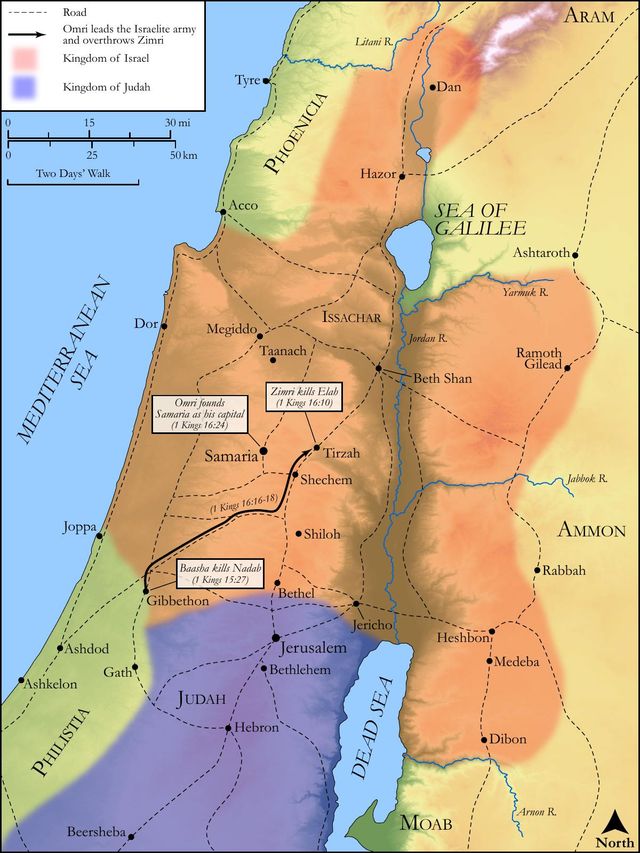
Notice was soon brought thither that Zimri had slain their king (Kg1 16:16) and set up himself in Tirzah, the royal city, whereupon they chose Omri king in the camp, that they might without delay avenge the death of Elah upon Zimri. Though he was idle and intemperate, yet he was their king, and they would not tamely submit to his murderer, nor let the treason go unpunished. They did not attempt to avenge the death of Nadab upon Baasha, perhaps because the house of Baasha had ruled with more gentleness than the house of Jeroboam; but Zimri shall feel the resentments of the provoked army. The siege of Gibbethon is quitted (Philistines are sure to gain when Israelites quarrel) and Zimri is prosecuted.
II.How he conquered Zimri, who is said to have reigned seven days (Kg1 16:15), so long before Omri was proclaimed king and himself proclaimed traitor; but we may suppose it was a longer time before he died, for he continued long enough to show his inclination to the way of Jeroboam, and to make himself obnoxious to the justice of God by supporting his idolatry, Kg1 16:19. Tirzah was a beautiful city, but not fortified, so that Omri soon made himself master of it (Kg1 16:17), forced Zimri into the palace, which being unable to defend, and yet unwilling to surrender, he burnt, and himself in it, Kg1 16:18. Unwilling that his rival should ever enjoy that sumptuous palace, he burnt it; and fearing that if he fell into the hands of the army, either alive or dead, he should be ignominiously treated, he burnt himself in it. See what desperate practices men's wickedness sometimes brings them to, and how it hurries them into their own ruin; see the disposition of incendiaries, who set palaces and kingdoms on fire, though they are themselves in danger of perishing in the flame.
III.How he struggled with Tibni, and at length got clear of him:
Half of the people followed this Tibni (Kg1 16:21), probably those who were in Zimri's interest, with whom others joined, who would not have a king chosen in the camp (lest he should rule by the sword and a standing army), but in a convention of the states. The contest between these two lasted some years, and, it is likely, cost a great deal of blood on both sides, for it was in the twenty-seventh year of Asa that Omri was first elected (Kg1 16:15) and thence the twelve years of his reign are to be dated; but it was not till the thirty-first year of Asa that he began to reign without a rival; then Tibni died, it is likely in battle, and Omri reigned, Kg1 16:22. Sir Walter Raleigh, in his History of the World (2.19.6), enquires here why it was that in all these confusions and revolutions of the kingdom of Israel they never thought of returning to the house of David, and uniting themselves again to Judah, for then it was better with them than now; and he thinks the reason was because the kings of Judah assumed a more absolute, arbitrary, and despotic power than the kings of Israel. It was the heaviness of the yoke that they complained of when they first revolted from the house of David, and the dread of that made them ever after averse to it, and attached to kings of their own, who ruled more by law and the rules of a limited monarchy.
IV.How he reigned when he was at length settled on the throne.
1.He made himself famous by building Samaria, which, ever after, was the royal city of the kings of Israel (the palace at Tirzah being burnt), and in process of time grew so considerable that it gave name to the middle part of Canaan (which lay between Galilee on the north and Judea on the south) and to the inhabitants of that country, who were called Samaritans. He bought the ground for two talents of silver, somewhat more than 700l. of our money, for a talent was 353l. 11s. 10 1/2d. Perhaps Shemer, who sold him the ground, let him have it considerably the cheaper upon condition that the city should be called after his name, for otherwise it would have borne the name of the purchaser; it was called Samaria, or Shemeren (as it is in the Hebrew), from Shemer, the former owner, Kg1 16:24. The kings of Israel changed their royal seats, Shechem first, then Tirzah, now Samaria; but the kings of Judah were constant to Jerusalem, the city of God. Those that cleave to the Lord fix, but those that leave him ever wander.
2.He made himself infamous by his wickedness; for he did worse than all that were before him, Kg1 16:25. Though he was brought to the throne with much difficulty, and Providence had remarkably favoured him in his advancement, yet he was more profane, or more superstitious, and a greater persecutor, than either of the houses of Jeroboam or Baasha. He went further than they had done in establishing iniquity by a law, and forcing his subjects to comply with him in it; for we read of the statutes of Omri, the keeping of which made Israel a desolation, Mic 6:16. Jeroboam caused Israel to sin by temptation, example, and allurement; but Omri did it by compulsion.
V.How he ended his reign, Kg1 16:27, Kg1 16:28.
He was in some repute for the might which he showed. Many a bad man has been a stout man. He died in his bed, as did Jeroboam and Baasha themselves; but, like them, left it to his posterity to fill up the measure, and then pay off the scores, of his iniquity.
Historical interpretation
Historical reception
1 surviving comment on this verse from the historical church.
With their vanities: That is, their idols their golden calves, vain, false, deceitful things.
Continue studying 1 Kings 16:26 across the web’s major study libraries — every link below opens this exact verse, chapter, or book on the destination site.
Read & Compare
 BibleGatewayThis verse in more than 200 translations and 70 languages.
 Bible.comThe YouVersion reader — hundreds of translations, reading plans, and highlights.
 ESV.orgCrossway's official English Standard Version reader.
 NET BibleThe NET translation with 60,000+ translators' notes on every rendering decision.
 STEP BibleTyndale House's free study tool — original text, vocabulary, and scholarly resources.
 BibliaLogos Bible Software's free web reader.
 USCCBThe New American Bible (Revised Edition) with the U.S. bishops' study notes.
Commentaries
 BibleHub CommentariesDozens of classic commentaries on this verse, gathered on one page.
 StudyLightMore than 100 commentary sets — the largest collection on the web.
 BibleRefPlain-English commentary on what this verse means, verse by verse.
 Enduring WordDavid Guzik's free commentary on this chapter, widely used by Bible teachers.
 Bible Study ToolsVerse commentary alongside Greek and Hebrew study aids.
Original Language & Research
- BibleHub InterlinearThe verse word by word — original language, transliteration, and English.
- BibleHub LexiconEvery word's original-language definition and Strong's entry.
 Blue Letter BibleDeep-study tools — Strong's numbers, concordance, and word studies.
 SefariaThe Hebrew text with Rashi and centuries of Jewish commentary.
Sermons, Hymns & Audio


TrulyRandomVerse is not affiliated with these sites and doesn’t control their content. They’re linked because they’re genuinely useful.
Summary
This verse delivers a searing indictment of King Omri's reign over the northern kingdom of Israel, succinctly capturing his profound spiritual apostasy and its devastating national consequences. It reveals that despite his political and military successes, Omri's legacy was defined by his adherence to the idolatrous path established by Jeroboam, thereby leading the entire nation into sin and provoking the righteous anger of the LORD God through their futile worship of "vanities."
Context
ShowHideLiterary Context
Omri's ascent to the throne, detailed in the preceding verses of 1 Kings 16, follows a period of intense political instability and rapid succession of kings in the northern kingdom, including the brief, tumultuous reign of Zimri. Verse 26 immediately follows the declaration of Omri's kingship and the mention of his initial actions, setting the stage for the divine assessment of his rule. The narrative of 1 Kings consistently evaluates Israelite kings not primarily by their political or military prowess, but by their spiritual alignment with the covenant God. Thus, this verse serves as the theological lens through which Omri's entire reign, including his significant achievement of establishing Samaria as the capital, is to be understood and judged.
Historical & Cultural Context
King Omri reigned over Israel from approximately 885-874 BC, a period marked by significant geopolitical shifts in the ancient Near East. While his reign is sparsely detailed in the biblical text, extra-biblical sources, such as the Moabite Stone (Mesha Inscription), attest to his military strength and the establishment of a powerful dynasty that would include his son Ahab. Culturally, the northern kingdom had, since its secession, embraced a syncretistic form of worship, initiated by Jeroboam I. Jeroboam's strategic placement of golden calves at Dan and Bethel was intended to prevent his subjects from returning to Jerusalem for worship, thereby securing his political control. This act, a direct violation of the Mosaic covenant's prohibition against idolatry, became the defining "sin of Jeroboam," establishing a pervasive pattern of apostasy that subsequent northern kings, including Omri, perpetuated, leading to the spiritual decay of the nation.
Key Themes
ShowHideThe primary themes embedded in 1 Kings 16:26 revolve around the perpetuation of dynastic sin and its profound impact on national identity and divine relationship. Omri's "walking in all the way of Jeroboam" underscores the tragic reality of inherited spiritual corruption, where the idolatrous practices initiated by the first king of Israel became a deeply entrenched standard for his successors, as seen in 1 Kings 12:28-30. This perpetuation of sin highlights the theme of accountability in leadership, as the king's personal choices directly led "Israel to sin," demonstrating the immense spiritual responsibility of those in authority. Furthermore, the verse emphasizes the holiness and righteous anger of God, who is "provoked to anger" by the worship of "vanities"—a term that powerfully conveys the utter futility and emptiness of idols in contrast to the living God, a concept reiterated in passages like Psalm 115:4-8.
Exposition and Analysis
ShowHideKey Word Analysis
ShowHideThis primitive root (H3212) signifies not merely physical movement but, more profoundly, one's conduct, course of life, or mode of action in a moral or spiritual sense. When applied to Omri, "walked in all the way of Jeroboam" indicates a comprehensive and deliberate adoption of Jeroboam's spiritual and religious practices, particularly his idolatry. It points to a chosen lifestyle and a set of principles that defined Omri's reign.
This noun (H2403) refers to an offense, often habitual sinfulness, and its associated penalty or expiation. In this context, it specifically denotes the grave transgression of idolatry and the abandonment of the covenant with Yahweh. The phrase "his sin wherewith he made Israel to sin" emphasizes the king's active role in establishing and enforcing a system that led the entire nation astray, highlighting the corporate dimension of sin under his leadership.
This term (H1892), often translated as "emptiness" or "vanity," is a derogatory designation for idols. It figuratively describes something transitory and unsatisfactory, emphasizing the utter futility, powerlessness, and worthlessness of the false gods worshipped by Israel. The use of "vanities" underscores the profound insult and spiritual blindness inherent in worshipping such impotent objects, contrasting them sharply with the self-existent and mighty God of Israel.
Verse Breakdown
ShowHide"For he walked in all the way of Jeroboam the son of Nebat"
This clause immediately establishes Omri's spiritual failure by linking him directly to the foundational apostasy of the northern kingdom. "The way of Jeroboam" refers to the establishment of alternative worship centers at Dan and Bethel with golden calves, designed to prevent the people from worshipping in Jerusalem. This was not merely a political move but a profound theological transgression, setting a pattern of idolatry that became the standard by which all subsequent northern kings were judged. Omri's "walking" in this way signifies his full and intentional adoption of this idolatrous system.
"and in his sin wherewith he made Israel to sin"
This phrase highlights the devastating ripple effect of the king's actions. Omri's personal sin was not isolated; it became a national crisis. By perpetuating Jeroboam's idolatry, he actively led the entire nation of Israel away from the exclusive worship of the LORD, making them complicit in his transgression. This underscores the immense responsibility of leadership, where the spiritual choices of the king directly influence the spiritual destiny of the populace.
"to provoke the LORD God of Israel to anger with their vanities"
This final clause reveals the divine consequence of Omri's and Israel's actions. The worship of idols, referred to here as "vanities" (worthless, empty things), is a direct affront to the holy character of the LORD God of Israel. God's "anger" is not a capricious emotion but a righteous and just response to covenant unfaithfulness and the betrayal of His exclusive claim on His people's worship. It signifies His zealous defense of His glory and His covenant relationship, which was being systematically undermined by Israel's idolatry.
Literary Devices
ShowHideThe verse employs several potent literary devices to convey its damning indictment. The phrase "the way of Jeroboam" serves as a powerful Epithet and a form of Symbolism, encapsulating an entire system of apostasy and idolatry established by the first king of the northern kingdom. It functions as a shorthand for the specific sin of establishing golden calves and alternative worship sites, representing the quintessential spiritual deviation of Israel. The use of "all the way" can be seen as a form of Hyperbole or Emphasis, stressing the comprehensive and unreserved nature of Omri's adherence to this wicked path, leaving no room for partial fidelity. Furthermore, the explicit statement that Omri "made Israel to sin" highlights the Causality and direct impact of leadership on national spiritual health, while the term "vanities" is a stark example of Dysphemism or Derogatory Language, stripping idols of any perceived power or divinity and reducing them to mere emptiness in the eyes of the true God. This rhetorical choice underscores the absurdity and offense of worshipping such impotent objects.
Theological and Thematic Connections
ShowHideThis verse profoundly illustrates the theological principle of corporate responsibility and the enduring consequences of spiritual rebellion. Omri's sin is not merely personal but national, demonstrating how leadership's spiritual choices directly shape a nation's destiny and its relationship with God. The persistent "way of Jeroboam" underscores the cyclical nature of sin and the challenge of breaking from entrenched patterns of apostasy. Furthermore, the concept of "provoking the LORD God to anger" highlights God's active holiness and His righteous intolerance for idolatry, which is a direct affront to His unique sovereignty and covenant faithfulness. The "vanities" serve as a stark reminder of the futility of worshipping anything other than the living God, emphasizing the exclusive claim of Yahweh on His people's devotion.
Reflection and Application
ShowHideThe stark condemnation of Omri in 1 Kings 16:26 resonates deeply with contemporary life, offering timeless warnings and profound spiritual insights. It compels us to examine our own lives and the institutions we inhabit, asking whether we, like Omri, prioritize worldly success or convenience over uncompromising spiritual fidelity. The "way of Jeroboam" can manifest today as any system or ideology that subtly or overtly displaces God from the center of our lives, whether it be the pursuit of wealth, power, comfort, or even self-righteousness. This verse reminds us that true prosperity is not measured by earthly achievements but by our unwavering devotion to the LORD. Moreover, it highlights the profound ripple effect of personal choices, particularly for those in positions of influence, underscoring the responsibility we bear to lead ourselves and others towards genuine worship and obedience, rather than towards "vanities" that promise much but deliver only emptiness and divine displeasure.
Questions for Reflection
ShowHideFAQ
ShowHideWhat exactly was "the way of Jeroboam the son of Nebat" that Omri followed?
ShowHide"The way of Jeroboam" refers to the specific religious innovations introduced by Jeroboam I, the first king of the northern kingdom of Israel, after the kingdom divided. To prevent his subjects from returning to Jerusalem for worship and potentially shifting their allegiance back to the Davidic dynasty, Jeroboam established two new cultic centers at Dan and Bethel. At these sites, he set up golden calves and appointed non-Levitical priests, declaring, "It is too much for you to go up to Jerusalem. Behold your gods, O Israel, which brought you up from the land of Egypt!" (1 Kings 12:28). This act constituted a profound breach of the Mosaic covenant, particularly the first two commandments, by introducing idolatry and unauthorized worship. It became the benchmark of spiritual apostasy by which almost every subsequent king of Israel was judged, signifying a deep-seated national sin.
Why is Omri's reign, which was politically successful, condemned so harshly in the biblical narrative?
ShowHideThe biblical narrative, particularly in the Deuteronomistic History (which includes 1 Kings), applies a consistent theological framework for evaluating kings: their fidelity to the LORD God of Israel and the Mosaic covenant. While Omri was indeed a politically and militarily successful king, even establishing Samaria as the new capital (1 Kings 16:24), his reign is condemned because he failed the ultimate spiritual test. He not only continued the idolatrous practices of Jeroboam but actively perpetuated them, leading the nation further into sin. For the biblical authors, political success was secondary to spiritual obedience. A king's primary duty was to lead the people in worship of the one true God, and Omri's failure in this regard rendered his reign spiritually bankrupt, regardless of his earthly achievements.
What does the term "vanities" signify in this verse?
ShowHideThe term "vanities" (Hebrew: hebel, H1892) is a highly derogatory and dismissive term used in the Old Testament to refer to idols or false gods. It literally means "emptiness," "worthless things," "non-gods," or "things of naught." This word choice powerfully conveys the utter emptiness, futility, and impotence of the objects of worship that Israel had embraced. Unlike the living God of Israel, who is omnipotent, active in history, and faithful to His covenant, these "vanities" are lifeless, powerless, and unable to deliver on any promises. Their worship is therefore not only an insult to the true God but also a profound act of self-deception and spiritual folly, as highlighted in passages like Psalm 115:4-8 and Isaiah 44:9-20.
Christ-Centered Fulfillment
ShowHideThe condemnation of Omri in 1 Kings 16:26 for perpetuating the "way of Jeroboam" and leading Israel into sin, thereby provoking God's anger with their "vanities," finds its ultimate resolution and fulfillment in Jesus Christ. Omri's failure as king highlights humanity's persistent inability to perfectly obey God and lead others in righteousness. The "way of Jeroboam" represents the universal human tendency to create idols—whether physical or ideological—that displace the one true God, leading to spiritual death and divine judgment. Jesus, however, is the perfect King who did not "walk in the way" of sin, but perfectly fulfilled the law and walked in complete obedience to the Father (Hebrews 4:15). He is the true "Lamb of God" who takes away the sin of the world, offering Himself as the ultimate sacrifice to atone for the very idolatry and rebellion that provoked God's anger in Israel's history (John 1:29). Through His death and resurrection, Christ not only redeems us from the "vanities" of this world but also empowers us by His Spirit to turn from all forms of idolatry and to worship the living God in spirit and truth (1 Thessalonians 1:9-10). He is the King who leads His people not into sin, but into eternal life and true fellowship with God, demonstrating God's ultimate solution to the problem of human sin and idolatry.