


1 Kings 16:27
Bible text: King James Version (1769 Blayney text) · Public domain
Bible text: King James Version with Strong's numbers · Public domain
Bible text: Berean Standard Bible · Public domain
Bible text: American Standard Version (1901) · Public domain
Bible text: World English Bible, Messianic edition · Public domain
Bible text: Geneva Bible (1599) · Public domain
Bible text: Young's Literal Translation · Public domain
- וְיֶתֶרve·Ye·terand [the] rest ofH3499Conj-w ¦ N-mscNoun Singular Masculine Constructוְandיֶתֶר[the] rest of
- דִּבְרֵיdiv·Rei[the] matters ofH1697N-mpcNoun Plural Masculine Construct
- עָמְרִי'a·me·RiOmriH6018N-proper-mNoun Proper Masculine
- אֲשֶׁר'a·SherwhichH834RelParticle Relative
- עָשָׂה'a·Sahhe didH6213V-Qal-Perf-3msVerb Qal Perfect 3rd Singular Masculine
- וּגְבוּרָתוֹu·ge·vu·ra·Toand his mightH1369Conj-w ¦ N-fsc ¦ 3msNoun Singular Feminine Constructוּandגְבוּרָתmightוֹhis
- אֲשֶׁר'a·SherwhichH834RelParticle Relative
- עָשָׂה'a·Sahhe didH6213V-Qal-Perf-3msVerb Qal Perfect 3rd Singular Masculine
- הֲלֹאha·lo'¿ notH3808Interrog ¦ NegParticle Negativeהֲ¿לֹאnot
- הֵםhem[are] theyH1992Pro-3mpPronoun Personal 3rd Plural Masculine
- כְּתוּבִיםke·tu·VimwrittenH3789V-Qal-PassPrtcpl-mpVerb Qal Participle Passive Plural Masculine Absolute
- עַל'alonH5921PrepPreposition
- סֵפֶרSe·fer[the] scroll ofH5612N-mscNoun Singular Masculine Construct
- דִּבְרֵיdiv·Rei[the] matters ofH1697N-mpcNoun Title Plural Masculine Construct
- הַיָּמִיםhai·ya·Mimthe daysH3117Art ¦ N-mpNoun Plural Masculine Absoluteהַtheיָּמִיםdays
- לְמַלְכֵיle·mal·Kheiof [the] kings ofH4428Prep-l ¦ N-mpcNoun Plural Masculine Constructלְofמַלְכֵי[the] kings of
- יִשְׂרָאֵלYis·ra·'ElIsraelH3478N-properNoun Proper Location
English is a literal word-by-word gloss of the Hebrew, not the KJV's wording. Why?
This is the original text the KJV's translators worked from — each Hebrew word with its own literal English meaning in this verse, prepared by scholars at Tyndale House, Cambridge. The KJV translates whole sentences, not word by word, so its wording differs: one Hebrew word can become several English words, and the KJV may choose “the LORD” where the gloss reads “Yahweh”. Both are faithful — they answer different questions. For the KJV's own rendering, switch to the KJV text.
Details
See on the biblical-era maps

Study this verse
Public-domain commentary
Matthew Henry
From his Commentary on the Whole Bible. Henry comments on passages, not single verses — this entry covers 1 Kings 16:15–28. His two-level outline is real structure in the source text, so it is rendered as structure.
Solomon observes (Pro 28:2) that for the transgression of a land many were the princes thereof (so it was here in Israel), but by a man of understanding the state thereof shall be prolonged - so it was with Judah at the same time under Asa. When men forsake God they are out of the way of rest and establishment. Zimri, and Tibni, and Omri, are here striving for the crown. Proud aspiring men ruin one another, and involve others in the ruin. These confusions end in the settlement of Omri; we must therefore take him along with us through this part of the story.
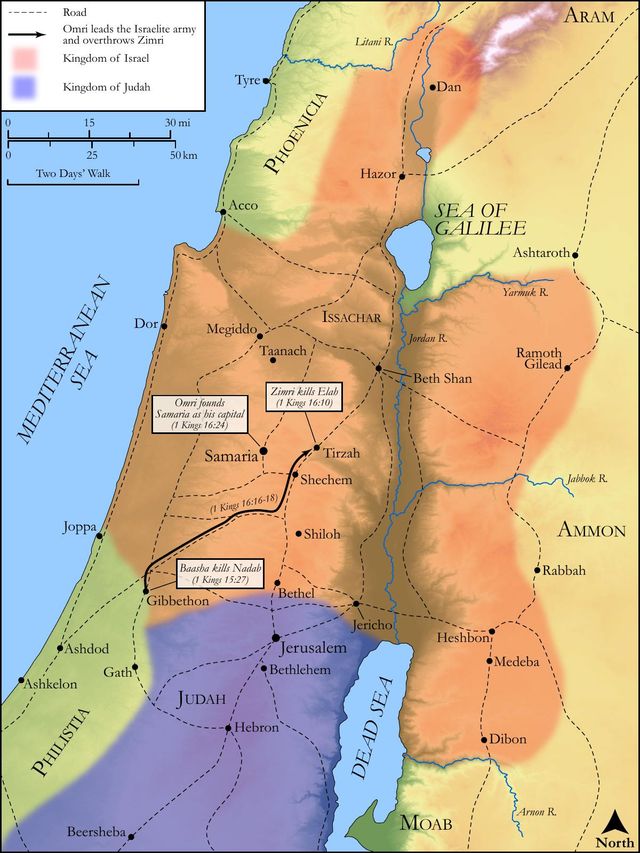
I.How he was chosen, as the Roman emperors often were, by the army in the field, now encamped before Gibbethon.
Notice was soon brought thither that Zimri had slain their king (Kg1 16:16) and set up himself in Tirzah, the royal city, whereupon they chose Omri king in the camp, that they might without delay avenge the death of Elah upon Zimri. Though he was idle and intemperate, yet he was their king, and they would not tamely submit to his murderer, nor let the treason go unpunished. They did not attempt to avenge the death of Nadab upon Baasha, perhaps because the house of Baasha had ruled with more gentleness than the house of Jeroboam; but Zimri shall feel the resentments of the provoked army. The siege of Gibbethon is quitted (Philistines are sure to gain when Israelites quarrel) and Zimri is prosecuted.
II.How he conquered Zimri, who is said to have reigned seven days (Kg1 16:15), so long before Omri was proclaimed king and himself proclaimed traitor; but we may suppose it was a longer time before he died, for he continued long enough to show his inclination to the way of Jeroboam, and to make himself obnoxious to the justice of God by supporting his idolatry, Kg1 16:19. Tirzah was a beautiful city, but not fortified, so that Omri soon made himself master of it (Kg1 16:17), forced Zimri into the palace, which being unable to defend, and yet unwilling to surrender, he burnt, and himself in it, Kg1 16:18. Unwilling that his rival should ever enjoy that sumptuous palace, he burnt it; and fearing that if he fell into the hands of the army, either alive or dead, he should be ignominiously treated, he burnt himself in it. See what desperate practices men's wickedness sometimes brings them to, and how it hurries them into their own ruin; see the disposition of incendiaries, who set palaces and kingdoms on fire, though they are themselves in danger of perishing in the flame.
III.How he struggled with Tibni, and at length got clear of him:
Half of the people followed this Tibni (Kg1 16:21), probably those who were in Zimri's interest, with whom others joined, who would not have a king chosen in the camp (lest he should rule by the sword and a standing army), but in a convention of the states. The contest between these two lasted some years, and, it is likely, cost a great deal of blood on both sides, for it was in the twenty-seventh year of Asa that Omri was first elected (Kg1 16:15) and thence the twelve years of his reign are to be dated; but it was not till the thirty-first year of Asa that he began to reign without a rival; then Tibni died, it is likely in battle, and Omri reigned, Kg1 16:22. Sir Walter Raleigh, in his History of the World (2.19.6), enquires here why it was that in all these confusions and revolutions of the kingdom of Israel they never thought of returning to the house of David, and uniting themselves again to Judah, for then it was better with them than now; and he thinks the reason was because the kings of Judah assumed a more absolute, arbitrary, and despotic power than the kings of Israel. It was the heaviness of the yoke that they complained of when they first revolted from the house of David, and the dread of that made them ever after averse to it, and attached to kings of their own, who ruled more by law and the rules of a limited monarchy.
IV.How he reigned when he was at length settled on the throne.
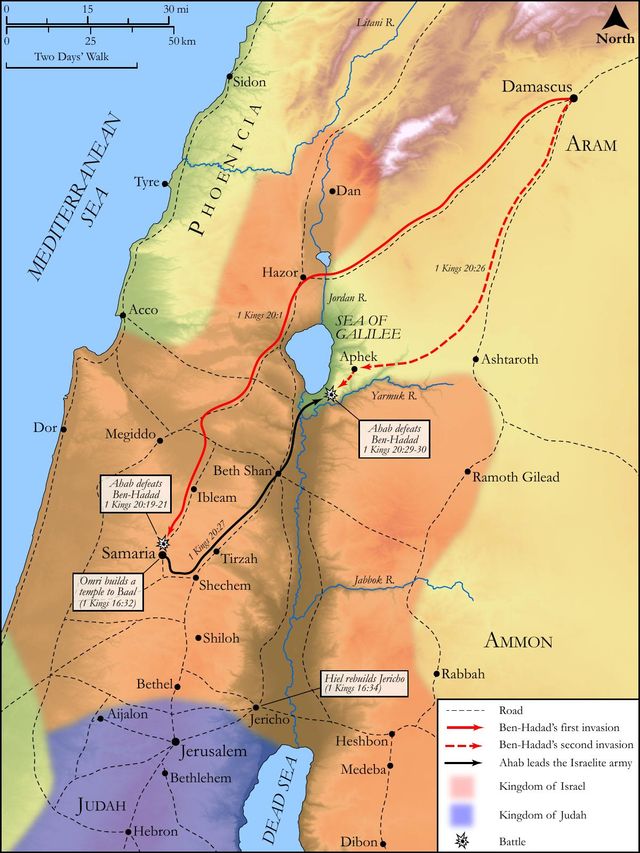
1.He made himself famous by building Samaria, which, ever after, was the royal city of the kings of Israel (the palace at Tirzah being burnt), and in process of time grew so considerable that it gave name to the middle part of Canaan (which lay between Galilee on the north and Judea on the south) and to the inhabitants of that country, who were called Samaritans. He bought the ground for two talents of silver, somewhat more than 700l. of our money, for a talent was 353l. 11s. 10 1/2d. Perhaps Shemer, who sold him the ground, let him have it considerably the cheaper upon condition that the city should be called after his name, for otherwise it would have borne the name of the purchaser; it was called Samaria, or Shemeren (as it is in the Hebrew), from Shemer, the former owner, Kg1 16:24. The kings of Israel changed their royal seats, Shechem first, then Tirzah, now Samaria; but the kings of Judah were constant to Jerusalem, the city of God. Those that cleave to the Lord fix, but those that leave him ever wander.
2.He made himself infamous by his wickedness; for he did worse than all that were before him, Kg1 16:25. Though he was brought to the throne with much difficulty, and Providence had remarkably favoured him in his advancement, yet he was more profane, or more superstitious, and a greater persecutor, than either of the houses of Jeroboam or Baasha. He went further than they had done in establishing iniquity by a law, and forcing his subjects to comply with him in it; for we read of the statutes of Omri, the keeping of which made Israel a desolation, Mic 6:16. Jeroboam caused Israel to sin by temptation, example, and allurement; but Omri did it by compulsion.
V.How he ended his reign, Kg1 16:27, Kg1 16:28.
He was in some repute for the might which he showed. Many a bad man has been a stout man. He died in his bed, as did Jeroboam and Baasha themselves; but, like them, left it to his posterity to fill up the measure, and then pay off the scores, of his iniquity.
Continue studying 1 Kings 16:27 across the web’s major study libraries — every link below opens this exact verse, chapter, or book on the destination site.
Read & Compare
 BibleGatewayThis verse in more than 200 translations and 70 languages.
 Bible.comThe YouVersion reader — hundreds of translations, reading plans, and highlights.
 ESV.orgCrossway's official English Standard Version reader.
 NET BibleThe NET translation with 60,000+ translators' notes on every rendering decision.
 STEP BibleTyndale House's free study tool — original text, vocabulary, and scholarly resources.
 BibliaLogos Bible Software's free web reader.
 USCCBThe New American Bible (Revised Edition) with the U.S. bishops' study notes.
Commentaries
 BibleHub CommentariesDozens of classic commentaries on this verse, gathered on one page.
 StudyLightMore than 100 commentary sets — the largest collection on the web.
 BibleRefPlain-English commentary on what this verse means, verse by verse.
 Enduring WordDavid Guzik's free commentary on this chapter, widely used by Bible teachers.
 Bible Study ToolsVerse commentary alongside Greek and Hebrew study aids.
Original Language & Research
- BibleHub InterlinearThe verse word by word — original language, transliteration, and English.
- BibleHub LexiconEvery word's original-language definition and Strong's entry.
 Blue Letter BibleDeep-study tools — Strong's numbers, concordance, and word studies.
 SefariaThe Hebrew text with Rashi and centuries of Jewish commentary.
Sermons, Hymns & Audio


TrulyRandomVerse is not affiliated with these sites and doesn’t control their content. They’re linked because they’re genuinely useful.
Summary
1 Kings 16:27 concludes the biblical summary of Omri's reign with a formulaic statement, directing the reader to external, non-biblical state annals for a more comprehensive record of his actions and military prowess. This verse serves as a literary device to mark the end of Omri's account in the biblical narrative, simultaneously affirming the existence of broader historical documentation while underscoring the selective, theological nature of the Books of Kings, which prioritize covenantal faithfulness over exhaustive secular detail.
Context
ShowHideLiterary Context
This verse appears as the concluding element of the "regnal formula" for King Omri, a recurring literary device employed by the Deuteronomistic historian throughout the Books of Kings. Omri's reign is introduced in 1 Kings 16:23 and described as particularly wicked, with Omri doing "evil more than all who were before him" (1 Kings 16:25). The formula, typically comprising the king's age at ascension, length of reign, capital city, and a moral evaluation, culminates in this reference to external records and the king's death and burial. This consistent referencing to "the book of the chronicles of the kings of Israel" (distinct from the biblical books of Chronicles) signifies that the biblical narrative is not an exhaustive historical account but a theologically driven one, focusing on the king's adherence or deviation from the Mosaic covenant. It transitions the narrative seamlessly to the next monarch, Ahab, Omri's son, whose reign would prove even more disastrous for Israel's spiritual state, as detailed in 1 Kings 16:29.
Historical & Cultural Context
King Omri (c. 884-873 BC) was a pivotal figure in the Northern Kingdom of Israel, a military commander who seized power and founded the Omride dynasty. His reign marked a period of significant political and economic stability for Israel, largely due to his strategic acumen. Omri is renowned for establishing Samaria as the new capital city, a highly defensible and centrally located site that would remain the heart of the Northern Kingdom until its fall. His influence extended beyond Israel's borders, as evidenced by extra-biblical inscriptions like the Mesha Stele (Moabite Stone), which refers to Israel as "the House of Omri" centuries after his death, indicating his lasting regional impact. The practice of maintaining "chronicles" or royal annals was widespread among the kings of that day. These official state records, meticulously kept by scribes, documented royal decrees, military campaigns, building projects, and diplomatic relations, serving both as historical archives and as instruments of royal legitimation and propaganda. The biblical authors' reference to these external sources grounds their theological narrative within a broader historical reality.
Key Themes
ShowHideDespite its brevity, 1 Kings 16:27 contributes significantly to several overarching themes within the Deuteronomistic History. Firstly, it highlights Historical Record and Accountability, implying that all human actions, even those of powerful rulers like Omri, are subject to documentation and a form of historical scrutiny, whether in human annals or divine memory. This underscores the principle that no deed goes unrecorded. Secondly, the verse subtly emphasizes The Transience of Earthly Power. Despite Omri's considerable worldly "might" and accomplishments—which left a significant mark on the region and are acknowledged even in extra-biblical sources—his reign, like all human reigns, ultimately concludes, giving way to the next. This serves as a poignant reminder of the temporary nature of human authority when contrasted with God's eternal sovereignty, a theme echoed in passages such as Psalm 103:15-16. Finally, and most crucially, it reinforces the Selective Divine Narrative of the Bible. By pointing to more extensive secular records, the biblical text deliberately asserts its own unique purpose: to present a theological interpretation of history, focusing on God's interaction with His people and their response to His covenant, rather than providing an exhaustive secular account of every royal "act" or display of "might." This selective focus is evident throughout Kings, where the spiritual and moral standing of kings before the Lord is paramount, as seen in the evaluations of both righteous kings like David and wicked kings like Jeroboam.
Exposition and Analysis
ShowHideKey Word Analysis
ShowHideFrom the Strong's definition, dâbâr means "a word; by implication, a matter (as spoken of) or thing." In this context, it refers to the deeds, events, or affairs of a king's reign, encompassing the totality of his administration, policies, and accomplishments. The phrase "the rest of the acts" implies that the biblical account has already presented the most pertinent (theologically significant) details, and a more exhaustive record of all "matters" exists elsewhere, particularly those of a secular or administrative nature.
This term denotes "force (literally or figuratively); by implication, valor, victory; power, strength." When applied to a king, it specifically refers to his military prowess, successful campaigns, and the display of his authority and dominance. For Omri, this would have included his successful coup, the establishment of Samaria, and his regional influence, which was recognized by neighboring nations. The biblical text acknowledges his worldly "might" even as it condemns his spiritual wickedness.
This primitive root means "to grave, by implication, to write (describe, inscribe, prescribe, subscribe)." Its use here confirms that Omri's actions and might were formally recorded in official documents. The rhetorical question "are they not written?" serves to validate the existence and accessibility of these external records, assuring the reader that the biblical narrative, while selective, is grounded in verifiable historical documentation.
Verse Breakdown
ShowHide"Now the rest of the acts of Omri which he did"
This opening clause immediately signals that the biblical account of Omri's reign is not exhaustive. The "rest" implies that only a selection of his deeds has been presented, primarily those relevant to the Deuteronomistic historian's theological agenda concerning covenant fidelity and the consequences of idolatry. It acknowledges the existence of a larger body of information about his rule, particularly those aspects not directly related to his spiritual standing.
"and his might that he shewed"
This phrase specifically highlights Omri's worldly achievements, particularly his military and political strength. It indicates that his power and influence were significant and demonstrable, leaving a tangible mark on the history of Israel and the surrounding region. The biblical author, while condemning Omri's spiritual failures, does not deny his secular accomplishments or the impact of his reign.
"[are] they not written in the book of the chronicles of the kings of Israel?"
This is a rhetorical question, expecting an affirmative answer. It functions as a literary device to confirm that more detailed information about Omri's reign, particularly his non-theological "acts" and "might," can be found in the official state records. It validates the biblical narrative by pointing to an external, verifiable source, while simultaneously underscoring the biblical text's own selective focus on spiritual matters and its role as a theological interpretation of history.
Literary Devices
ShowHideThe primary literary devices at play in 1 Kings 16:27 are Formulaic Language and a Rhetorical Question. The entire verse is a quintessential example of the recurring "regnal formula" that consistently marks the conclusion of almost every king's account in the Books of Kings. This consistent repetition provides structural unity to the narrative, signaling to the reader the end of one reign and the transition to the next, while also reinforcing the Deuteronomistic historian's consistent theological evaluation. The use of a Rhetorical Question ("are they not written?") is a common Hebrew idiom that strongly implies an affirmative answer. It functions not as a genuine inquiry, but as an emphatic statement, asserting that the referenced "book of the chronicles" does indeed contain further details. This rhetorical device serves to validate the biblical narrative's selectivity, assuring the reader that while the Bible focuses on theological and covenantal aspects, a more comprehensive historical record exists for those interested in the minutiae of royal administration and military campaigns.
Theological and Thematic Connections
ShowHide1 Kings 16:27, though a seemingly simple concluding formula, carries profound theological implications. It reminds us that God's sovereign hand is at work even in the reigns of wicked kings like Omri, whose worldly "might" and political achievements are acknowledged but ultimately framed within a divine narrative that prioritizes spiritual obedience. The biblical author's decision to refer to external chronicles underscores that the Bible is not merely a historical record but a theological interpretation of history, focused on humanity's relationship with God and the unfolding of His covenant purposes. While human records may detail every "act" and every display of "might," God's ultimate record is concerned with the heart and faithfulness, demonstrating that true legacy is measured not by earthly power but by one's standing before the Almighty. The fleeting nature of human power and the enduring nature of God's purposes are central to this understanding.
Reflection and Application
ShowHideThe concise conclusion to Omri's reign in 1 Kings 16:27 offers a powerful lesson on the nature of legacy and the ultimate authority of God's perspective. Despite Omri's significant worldly accomplishments—founding a dynasty, building a capital, and achieving regional recognition—the biblical record devotes minimal space to his "might," instead highlighting his profound wickedness and spiritual failures. This challenges our often-human tendency to value power, wealth, and worldly achievements above all else. It prompts us to consider what truly endures and what kind of "chronicles" are being written about our own lives from an eternal perspective. Are we building a legacy of earthly success that fades, or one of faithfulness to God that has eternal significance? The verse encourages us to look beyond the transient records of human history to the unchanging truth of God's Word, which alone reveals what truly matters in the grand scheme of His redemptive plan. It calls us to align our priorities with God's, understanding that true greatness is found not in worldly might but in humble obedience and devotion to Him.
Questions for Reflection
ShowHideFAQ
ShowHideWhat is "the book of the chronicles of the kings of Israel" mentioned in 1 Kings 16:27?
ShowHide"The book of the chronicles of the kings of Israel" does not refer to the biblical books of 1 and 2 Chronicles, which are later theological retellings of Israel's history. Instead, it refers to official state annals or royal records that were maintained by the scribes and historians of the ancient Israelite monarchy. These were common among the kings of that day, serving as comprehensive historical accounts of a king's reign, including military campaigns, building projects, administrative decisions, and other significant events. The biblical authors frequently referenced these external, secular sources to acknowledge that their own narrative was not exhaustive but selective, focusing on the theological and covenantal aspects of each king's rule. For example, similar references are made for kings like Jeroboam in 1 Kings 14:19 and Ahab in 1 Kings 22:39.
Why does the Bible refer to external sources instead of providing all the details about a king's reign?
ShowHideThe biblical narrative, particularly the Deuteronomistic History (Joshua through 2 Kings), is not intended to be a comprehensive secular history in the modern sense. Its primary purpose is theological: to demonstrate God's faithfulness to His covenant with Israel and the consequences of Israel's (and its kings') obedience or disobedience to that covenant. By referring to external "chronicles," the biblical authors acknowledge that more detailed historical information exists, but they deliberately choose to include only those events and aspects of a king's reign that are pertinent to their theological message. This selective approach highlights what God considers important—namely, the spiritual and moral standing of the king before Him—rather than merely their worldly "acts" or "might." It underscores that God's perspective on history is fundamentally different from a purely human one, prioritizing divine truth over exhaustive secular detail.
Christ-Centered Fulfillment
ShowHideThe transient reign of Omri, with its worldly "might" recorded in human "chronicles," stands in stark contrast to the eternal and unshakable kingdom of Jesus Christ. Earthly kings like Omri, despite their power and influence, ultimately pass away, and their legacies are subject to human interpretation and the ravages of time. However, Christ's kingdom is "an everlasting kingdom" (Daniel 7:27), and His dominion "shall not be destroyed" (Daniel 2:44). Unlike Omri, whose "acts" were recorded in fallible human annals, the "acts" of Jesus—His perfect life, atoning death, and glorious resurrection—are eternally inscribed in the divine record and bear witness to His ultimate "might" over sin and death (Colossians 1:13-14). He is the true King whose reign fulfills all prophecies and brings about a new creation, establishing a legacy not of temporary power but of eternal redemption and grace. Every earthly king, whether acknowledged in biblical or secular chronicles, ultimately points to the supreme and everlasting reign of the King of kings and Lord of lords, Jesus Christ, to whom "every knee should bow" and "every tongue confess" (Philippians 2:9-11).