


1 Kings 16:14
Bible text: King James Version (1769 Blayney text) · Public domain
Bible text: Berean Standard Bible · Public domain
Bible text: American Standard Version (1901) · Public domain
Bible text: World English Bible, Messianic edition · Public domain
Bible text: Geneva Bible (1599) · Public domain
Bible text: Young's Literal Translation · Public domain
- וְיֶתֶרve·Ye·terand [the] rest ofH3499Conj-w ¦ N-mscNoun Singular Masculine Constructוְandיֶתֶר[the] rest of
- דִּבְרֵיdiv·Rei[the] matters ofH1697N-mpcNoun Plural Masculine Construct
- אֵלָה'e·LahElahH425N-proper-mNoun Proper Masculine
- וְכָלve·kholand allH3605Conj-w ¦ N-msNoun Singular Masculine Absoluteוְandכָלall
- אֲשֶׁר'a·SherthatH834RelParticle Relative
- עָשָׂה'a·Sahhe didH6213V-Qal-Perf-3msVerb Qal Perfect 3rd Singular Masculine
- הֲלוֹאha·lo'¿ notH3808Interrog ¦ NegParticle Negativeהֲ¿לוֹאnot
- הֵםhem[are] theyH1992Pro-3mpPronoun Personal 3rd Plural Masculine
- כְּתוּבִיםke·tu·VimwrittenH3789V-Qal-PassPrtcpl-mpVerb Qal Participle Passive Plural Masculine Absolute
- עַל'alonH5921PrepPreposition
- סֵפֶרSe·fer[the] scroll ofH5612N-mscNoun Singular Masculine Construct
- דִּבְרֵיdiv·Rei[the] matters ofH1697N-mpcNoun Title Plural Masculine Construct
- הַיָּמִיםhai·ya·Mimthe daysH3117Art ¦ N-mpNoun Plural Masculine Absoluteהַtheיָּמִיםdays
- לְמַלְכֵיle·mal·Kheiof [the] kings ofH4428Prep-l ¦ N-mpcNoun Plural Masculine Constructלְofמַלְכֵי[the] kings of
- יִשְׂרָאֵלYis·ra·'ElIsraelH3478N-properNoun Proper Location
English is a literal word-by-word gloss of the Hebrew, not the KJV's wording. Why?
This is the original text the KJV's translators worked from — each Hebrew word with its own literal English meaning in this verse, prepared by scholars at Tyndale House, Cambridge. The KJV translates whole sentences, not word by word, so its wording differs: one Hebrew word can become several English words, and the KJV may choose “the LORD” where the gloss reads “Yahweh”. Both are faithful — they answer different questions. For the KJV's own rendering, switch to the KJV text.
Details
See on the biblical-era maps
Study this verse
Public-domain commentary
Matthew Henry
From his Commentary on the Whole Bible. Henry comments on passages, not single verses — this entry covers 1 Kings 16:1–14. His four-level outline is real structure in the source text, so it is rendered as structure.
Here is, I. The ruin of the family of Baasha foretold. He was a man likely enough to have raised and established his family - active, politic, and daring; but he was an idolater, and this brought destruction upon his family.
1.God sent him warning of it before.
(1.)That, if he were thereby wrought upon to repent and reform, the ruin might be prevented; for God threatens, that he may not strike, as one that desires not the death of sinners.
(2.)That, if not, it might appear that the destruction when it did come, whoever might be instruments of it, was the act of God's justice and the punishment of sin.
2.The warning was sent by Jehu the son of Hanani. The father was a seer, or prophet, at the same time (Ch2 16:7), and was sent to Asa king of Judah; but the son, who was young and more active, was sent on this longer and more dangerous expedition to Baasha king of Israel. Juniores ad labores - Toil and adventure are for the young. This Jehu was a prophet and the son of a prophet. Prophecy, thus happily entailed, was worthy of so much the more honour. This Jehu continued long in his usefulness, for we find him reproving Jehoshaphat (Ch2 19:2) above forty years after, and writing the annals of that prince, Ch2 20:34. The message which this prophet brought to Baasha is much the same with that which Ahijah sent to Jeroboam by his wife.
(1.)He reminds Baasha of the great things God had done for him (Kg1 16:2): I exalted thee out of the dust to the throne of glory, a great instance of the divine sovereignty and power, Sa1 2:8. Baasha seemed to have raised himself by his own treachery and cruelty, yet there was a hand of Providence in it, to bring about God's counsel, concerning Jeroboam's house; and God's owning his advancement as his act and deed does by no means amount to the patronising of his ambition and treachery. It is God that puts power into bad men's hands, which he makes to serve his good purposes, notwithstanding the bad use they make of it. I made thee prince over my people. God calls Israel his people still, though wretchedly corrupted, because they retained the covenant of circumcision, and there were many good people among them; it was not till long after that they were called Loammi, not a people, Hos 1:9.
(2.)He charges him with high crimes and misdemeanours,
[1.]That he had caused Israel to sin, had seduced God's subjects from their allegiance and brought them to pay to dunghill-deities the homage due to him only, and herein he had walked in the way of Jeroboam (Kg1 16:2), and been like his house, Kg1 16:7.
[2.]That he had himself provoked God to anger with the work of his hands, that is, by worshipping images, the work of men's hands; though perhaps others made them, yet he served them and thereby avowed the making of them, and they are therefore called the work of his hands.
[3.]That he had destroyed the house of Jeroboam (Kg1 16:7), because he killed him, namely, Jeroboam's son and all his: if he had done that with an eye to God, to his will and glory, and from a holy indignation against the sins of Jeroboam and his house, he would have been accepted and applauded as a minister of God's justice; but, as he did it, he was only the tool of God's justice, but a servant to his own lusts, and is justly punished for the malice and ambition which actuated and governed him in all he did. Note, Those who are in any way employed in denouncing or executing the justice of God (magistrates or ministers) are concerned to do it from a good principle and in a holy manner, lest it turn into sin to them and they make themselves obnoxious by it.
(3.)He foretels the same destruction to come upon his family which he himself had been employed to bring upon the family of Jeroboam, Kg1 16:3, Kg1 16:4. Note, Those who resemble others in their sins may expect to resemble them in their plagues, especially those who seem zealous against such sins in others as they allow themselves in; the house of Jehu was reckoned with for the blood of the house of Ahab, Hos 1:4.
II.A reprieve granted for some time, so long that Baasha himself dies in peace, and is buried with honour in his own royal city (Kg1 16:6), so far is he from being a prey either to the dogs or to the fowls, which yet was threatened to his house, Kg1 16:4. He lives not either to see or feel the punishment threatened, yet he was himself the greatest delinquent. Certainly there must be a future state, in which impenitent sinners will suffer in their own persons, and not escape, as often they do in this world. Baasha died under no visible stroke of divine vengeance for aught that appears, but God laid up his iniquity for his children, as Job speaks, Job 21:19. Thus he often visits sin. Observe, Baasha is punished by the destruction of his children after his death, and his children are punished by the abuse of their bodies after their death; that is the only thing which the threatening specifies (Kg1 16:4), that the dogs and the fowls of the air should eat them, as if herein were designed a tacit intimation that there are punishments after death, when death has done its worst, which will be the sorest punishments and are most to be dreaded; these judgments on the body and posterity signified judgments on the soul when separated from the body, by him who, after he has killed, has power to cast into hell.
III.Execution done at last.
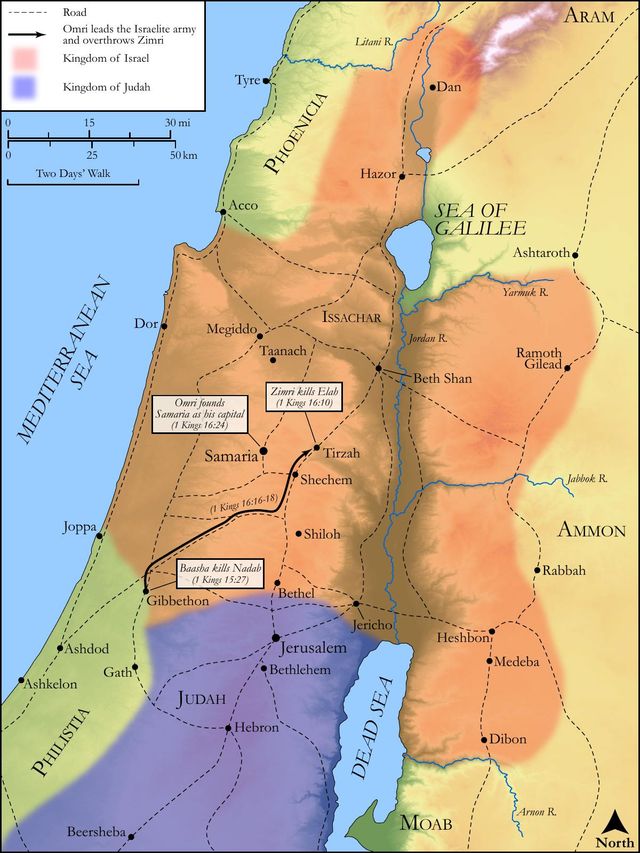
Baasha's son Elah, like Jeroboam's son Nadab, reigned two years, and then was slain by Zimri, one of his own soldiers, as Nadab was by Baasha; so like was his house made to that of Jeroboam, as was threatened, Kg1 16:3. Because his idolatry was like his, and one of the sins for which God contended with him being the destruction of Jeroboam's family, the more the destruction of his own resembled that, the nearer did the punishment resemble the sin, as face answers to face in a glass.
1.As then, so now, the king himself was first slain, but Elah fell more ingloriously than Nadab. Nadab was slain in the field of action and honour, he and his army then besieging Gibbethon (Kg1 15:27); but the siege being then raised upon that disaster, and the city remaining still in the Philistines' hands, the army of Israel was now renewing the attempt (Kg1 16:15) and Elah should have been with them to command in chief, but he loved his own ease and safety better than his honour or duty, or the public good, and therefore staid behind to take his pleasure; and, when he was drinking himself drunk in his servant's house, Zimri killed him, Kg1 16:9, Kg1 16:10. Let it be a warning to drunkards, especially to those who designedly drink themselves drunk, that they know not but death may surprise them in that condition.
(1.)Death comes easily upon men when they are drunk. Besides the chronic diseases which men frequently bring themselves into by hard drinking, and which cut them off in the midst of their days, men in that condition are more easily overcome by an enemy, as Amnon by Absalom, and are liable to more bad accidents, being unable to help themselves,
(2.)Death comes terribly upon men in that condition. Finding them in the act of sin, and incapacitated for any act of devotion, that day comes upon them unawares (Luk 21:34), like a thief.
2.As then, so now, the whole family was cut off, and rooted out. The traitor was the successor, to whom the unthinking people tamely submitted, as if it were all one to them what kind they had, so that they had one. The first thing Zimri did was to slay all the house of Baasha; thus he held by cruelty what he got by treason. His cruelty seems to have extended further than Baasha's did against the house of Jeroboam, for he left to Elah none of his kinsfolks or friends (Kg1 16:11), none of his avengers (so the word is), none that were likely to avenge his death; yet divine justice soon avenged it so remarkably that it was used as a proverb long after, Had Zimri peace who slew his master? Kg2 9:31. In this,
(1.)The word of God was fulfilled, Kg1 16:12.
(2.)The sins of Baasha and Elah were reckoned for, with which they provoked God by their vanities, Kg1 16:13. Their idols are called their vanities, for they cannot profit nor help. Miserable are those whose deities are vanities.
Continue studying 1 Kings 16:14 across the web’s major study libraries — every link below opens this exact verse, chapter, or book on the destination site.
Read & Compare
 BibleGatewayThis verse in more than 200 translations and 70 languages.
 Bible.comThe YouVersion reader — hundreds of translations, reading plans, and highlights.
 ESV.orgCrossway's official English Standard Version reader.
 NET BibleThe NET translation with 60,000+ translators' notes on every rendering decision.
 STEP BibleTyndale House's free study tool — original text, vocabulary, and scholarly resources.
 BibliaLogos Bible Software's free web reader.
 USCCBThe New American Bible (Revised Edition) with the U.S. bishops' study notes.
Commentaries
 BibleHub CommentariesDozens of classic commentaries on this verse, gathered on one page.
 StudyLightMore than 100 commentary sets — the largest collection on the web.
 BibleRefPlain-English commentary on what this verse means, verse by verse.
 Enduring WordDavid Guzik's free commentary on this chapter, widely used by Bible teachers.
 Bible Study ToolsVerse commentary alongside Greek and Hebrew study aids.
Original Language & Research
- BibleHub InterlinearThe verse word by word — original language, transliteration, and English.
- BibleHub LexiconEvery word's original-language definition and Strong's entry.
 Blue Letter BibleDeep-study tools — Strong's numbers, concordance, and word studies.
 SefariaThe Hebrew text with Rashi and centuries of Jewish commentary.
Sermons, Hymns & Audio


TrulyRandomVerse is not affiliated with these sites and doesn’t control their content. They’re linked because they’re genuinely useful.
Summary
1 Kings 16:14 serves as a formulaic conclusion to the brief and wicked reign of King Elah of Israel, marking a pivotal moment of political instability within the northern kingdom. This verse, characteristic of the Deuteronomistic History, points readers to external, presumably more detailed, state annals for a comprehensive account of Elah's actions, while the biblical narrative itself focuses on the theological implications of his unfaithfulness and the divine judgment manifested in his violent overthrow. It underscores the biblical author's selective presentation of history, prioritizing spiritual lessons over exhaustive historical documentation.
Context
ShowHideLiterary Context
This verse appears at the conclusion of the biblical narrative concerning King Elah, immediately following the account of his assassination by Zimri while he was drunk in Tirzah, as detailed in 1 Kings 16:9-10. It is a standard concluding formula found throughout the Books of Kings, signaling the end of a monarch's reign and typically preceding the introduction of the next king. This formulaic structure provides a consistent rhythm to the historical accounts, emphasizing the cyclical nature of kingship in Israel and Judah, often marked by unfaithfulness, judgment, and succession. The brevity of Elah's two-year reign and its violent end highlight the volatile political climate in the northern kingdom, setting the stage for further instability and the rise of the Omride dynasty.
Historical & Cultural Context
Elah's reign (c. 886-885 BC) occurred during a period of profound political turmoil and moral decay in the northern kingdom of Israel. He inherited the throne from his father, Baasha, who himself had seized power through violence. Elah's assassination by Zimri, one of his chariot commanders, was not an isolated incident but part of a recurring pattern of coups and regicides that plagued Israel, contrasting sharply with the more stable Davidic dynasty in Judah. This instability was often a consequence of the northern kingdom's persistent idolatry and rejection of the Mosaic covenant, leading to divine judgment. The "book of the chronicles of the kings of Israel" refers to official state records or annals, common in the courts of kings, where scribes meticulously documented royal decrees, military campaigns, and administrative details. These external records served as a historical backdrop, providing a broader context for the biblically selective narrative.
Key Themes
ShowHideThe formulaic conclusion in 1 Kings 16:14 contributes to several overarching themes in the Books of Kings. Firstly, it reinforces the divine oversight of history, demonstrating that even the briefest and most ignoble reigns, like Elah's, are meticulously recorded and fall within God's sovereign plan. The biblical author's selective focus on Elah's wickedness and violent end, rather than an exhaustive historical account, underscores the theme of consequences for covenant unfaithfulness and divine judgment. Elah's fate is presented as a direct result of the sins of his father, Baasha, and his own continued wickedness, as noted in 1 Kings 16:13. Furthermore, the reference to external chronicles highlights the historical verifiability of the biblical narrative, affirming that the biblical account is rooted in actual historical events, even as its primary purpose is theological rather than purely historical. This also subtly emphasizes the selective nature of biblical revelation, where God chooses to reveal what is necessary for understanding His character, covenant, and purposes, rather than providing an exhaustive historical record, a principle seen elsewhere, such as in John 21:25.
Exposition and Analysis
ShowHideKey Word Analysis
ShowHideDerived from a root meaning "to be hot," this word primarily denotes an "overhanging," and by implication, an "excess," "superiority," or "remainder." In 1 Kings 16:14, it signifies the "remainder" or "what is left" of Elah's actions not detailed in the biblical narrative. This indicates the biblical author's selective presentation of history, focusing on the theologically significant aspects rather than providing an exhaustive chronicle of every royal deed.
This versatile Hebrew word means "word," "matter," "thing," "affair," or "deed." In the phrase "rest of the acts," it refers to the various affairs, deeds, or events of King Elah's reign. It also appears in "chronicles" (literally "words of the days"), underscoring that these external records documented the spoken and performed "matters" of the king's time. Its broad semantic range highlights the comprehensive nature of the external records being referenced, encompassing all aspects of a monarch's rule.
This term refers to a "writing," "document," or "scroll." In this context, "the book of the chronicles" denotes an official state record or royal archive, a physical compilation of written accounts detailing the events of a king's reign. The existence of such meticulous records in monarchies like Israel provides a historical grounding for the biblical narrative, even as the Bible's primary purpose is theological rather than purely historical documentation.
Verse Breakdown
ShowHide"Now the rest of the acts of Elah, and all that he did,"
This opening clause serves as a summary statement, acknowledging that Elah's reign involved numerous activities beyond what is detailed in the biblical narrative. It acts as a transition, signaling the conclusion of the account of Elah's rule and preparing the reader for the subsequent formulaic reference to external records. The phrase "all that he did" further emphasizes the comprehensive nature of these unrecorded actions.
"[are] they not written in the book of the chronicles of the kings of Israel?"
This rhetorical question is a characteristic literary device in the Books of Kings. It functions not as a genuine inquiry but as an assertive statement, confirming the existence of official state records that contain further information about Elah's reign. By directing the reader to these external "chronicles," the biblical author implicitly states that the biblical narrative's purpose is not to be an exhaustive historical record, but rather a theologically focused account that highlights God's interaction with His people and their leaders.
Literary Devices
ShowHideThe verse primarily employs Formulaic Language, which is a hallmark of the Deuteronomistic History. The phrase "Now the rest of the acts of [King's Name], and all that he did, are they not written in the book of the chronicles of the kings of [Israel/Judah]?" is a recurring literary device that provides a consistent structural framework for each monarch's reign. This formula serves several purposes: it marks the end of a king's narrative, points to external historical sources for further details, and implicitly asserts the historical basis of the biblical account. Additionally, the verse uses a Rhetorical Question ("are they not written...?"), which is not intended to elicit an answer but to affirm a known fact, reinforcing the existence and accessibility of these external historical records. This device also subtly emphasizes the biblical author's authority and knowledge of these wider historical contexts.
Theological and Thematic Connections
ShowHide1 Kings 16:14, though a seemingly mundane concluding formula, carries profound theological weight. It reminds us that while the biblical narrative is divinely inspired and sufficient for salvation and spiritual instruction, it is not an exhaustive historical encyclopedia. God, through His inspired authors, chose to record what was essential for understanding His character, His covenant relationship with Israel, and the consequences of obedience and disobedience. The reference to external chronicles underscores God's sovereignty over all history, even the brief and ignoble reigns of wicked kings. Nothing escapes His notice, and all events, whether recorded in sacred scripture or secular annals, ultimately serve His overarching purposes. This verse implicitly teaches that accountability is universal; even if human records are incomplete, God's knowledge is perfect, and every life, no matter how short or seemingly insignificant, is part of His grand narrative.
Reflection and Application
ShowHideThe brevity of Elah's reign and its abrupt, violent end, combined with the biblical author's terse summary, offer a powerful lesson on the fleeting nature of earthly power and the ultimate accountability before God. While "the rest of the acts" of Elah may be recorded in human chronicles, the biblical narrative's focus on his wickedness and its consequences serves as a stark reminder that true significance is not found in the length or perceived success of a reign, but in faithfulness to God. Our lives, too, are being "written" in various "chronicles"—our memories, the impact we have on others, and ultimately, in God's eternal record. This verse prompts us to consider what story our lives are telling, whether it is one of fleeting earthly pursuits or of enduring faithfulness to the divine King. It encourages us to live with an awareness that while our earthly deeds may or may not be widely known, they are always known to God, who judges righteously and holds all history in His sovereign hand.
Questions for Reflection
ShowHideFAQ
ShowHideWhat is "the book of the chronicles of the kings of Israel" mentioned here?
ShowHideThe "book of the chronicles of the kings of Israel" (Hebrew: sepher divrei hayyamim lemalchei Yisrael) refers to official state annals or royal records maintained by scribes in the northern kingdom of Israel. These were not the biblical Books of Chronicles (which are part of the Old Testament canon and were written much later, offering a different theological perspective on Israel's history). Instead, they were secular historical documents, akin to a royal diary or archive, detailing the administrative, military, and political events of each king's reign. The biblical authors frequently refer to these external records, both for the kings of Israel and the kings of Judah, indicating their reliance on and awareness of wider historical sources. This practice lends historical credibility to the biblical narrative, grounding it in verifiable historical tradition, even as the Bible's primary purpose is theological rather than exhaustive historical reporting.
Why does the Bible refer to external books instead of providing all details about a king's reign?
ShowHideThe biblical narrative, particularly in the Books of Kings, is not intended to be an exhaustive historical account of every event or detail of a king's reign. Its primary purpose is theological: to demonstrate God's sovereignty over history, to illustrate the consequences of obedience and disobedience to His covenant, and to trace the lineage and spiritual trajectory of His people. By referring to external "chronicles," the biblical author implicitly communicates that while more historical information exists, the details included in the inspired text are precisely what God deemed necessary for His people's spiritual instruction and understanding of His redemptive plan. This selective approach highlights the Bible's focus on salvation history and God's moral governance of the world, rather than providing a comprehensive secular history. This principle is also evident in the New Testament, as John 21:25 notes that if everything Jesus did were written down, "the world itself could not contain the books that would be written."
Christ-Centered Fulfillment
ShowHideWhile 1 Kings 16:14 speaks of the earthly chronicles of a fleeting, unfaithful king, it subtly points to the ultimate and eternal "chronicles" of God's kingdom, centered on Christ. The reigns of earthly kings, like Elah, are marked by sin, instability, and eventual demise, their acts recorded in temporary human annals. In stark contrast, the "acts" of Jesus Christ, the King of Kings, are eternally recorded and bring about an everlasting kingdom that "shall never be destroyed," as prophesied in Daniel 2:44. Elah's story is one of judgment for unfaithfulness, but Christ's story is one of perfect obedience and redemptive sacrifice, through which His followers are written into the ultimate chronicle—the Lamb's Book of Life. The fleeting nature of Elah's earthly record stands in stark contrast to the eternal record of those whose names are inscribed in heaven, not by their own deeds, but by the perfect work of the Lamb of God, who takes away the sin of the world!. Ultimately, the "rest of the acts" that truly matter are not our own, but the finished work of Christ, which secures our eternal standing before God, as affirmed in Hebrews 10:10.