


1 Kings 16:15
Bible text: King James Version (1769 Blayney text) · Public domain
Bible text: King James Version with Strong's numbers · Public domain
Bible text: Berean Standard Bible · Public domain
Bible text: American Standard Version (1901) · Public domain
Bible text: World English Bible, Messianic edition · Public domain
Bible text: Geneva Bible (1599) · Public domain
Bible text: Young's Literal Translation · Public domain
- בִּשְׁנַתbish·Natin yearH8141Prep-b ¦ N-fscNoun Singular Feminine Constructבִּinשְׁנַתyear
- עֶשְׂרִים'es·RimtwentyH6242N-mpNoun Plural Masculine Absolute
- וָשֶׁבַעva·She·va'and sevenH7651Conj-w ¦ N-csNoun Singular common gender Absoluteוָandשֶׁבַעseven
- שָׁנָהsha·NahyearH8141N-fsNoun Singular Feminine Absolute
- לְאָסָאle·'a·Sa'of AsaH609Prep-l ¦ N-proper-mNoun Proper MasculineלְofאָסָאAsa
- מֶלֶךְMe·lekh[the] king ofH4428N-mscNoun Singular Masculine Construct
- יְהוּדָהye·hu·DahJudahH3063N-properNoun Proper Location
- מָלַךְma·Lakhhe became kingH4427V-Qal-Perf-3msVerb Qal Perfect 3rd Singular Masculine
- זִמְרִיzim·RiZimriH2174N-proper-mNoun Proper Masculine
- שִׁבְעַתshiv·'AtsevenH7651N-cscNoun Singular common gender Construct
- יָמִיםya·MimdaysH3117N-mpNoun Plural Masculine Absolute
- בְּתִרְצָהbe·tir·Tzahin TirzahH8656Prep-b ¦ N-properNoun Proper LocationבְּinתִרְצָהTirzah
- וְהָעָםve·ha·'Amand the peopleH5971Conj-w ¦ Art ¦ N-msNoun Singular Masculine Absoluteוְandהָtheעָםpeople
- חֹנִיםcho·Nim[were] encampedH2583V-Qal-Prtcpl-mpVerb Qal Participle Plural Masculine Absolute
- עַל'alonH5921PrepPreposition
- גִּבְּתוֹןgi·be·TonGibbethonH1405N-properNoun Proper Location
- אֲשֶׁר'a·SherwhichH834RelParticle Relative
- לַפְּלִשְׁתִּיםla·pe·lish·Tim[belonged] to the PhilistinesH6430Prep-l ¦ N-mpNoun Gentilic Plural Masculine Absoluteלַ[belonged] to theפְּלִשְׁתִּיםPhilistines
English is a literal word-by-word gloss of the Hebrew, not the KJV's wording. Why?
This is the original text the KJV's translators worked from — each Hebrew word with its own literal English meaning in this verse, prepared by scholars at Tyndale House, Cambridge. The KJV translates whole sentences, not word by word, so its wording differs: one Hebrew word can become several English words, and the KJV may choose “the LORD” where the gloss reads “Yahweh”. Both are faithful — they answer different questions. For the KJV's own rendering, switch to the KJV text.
Details
See on the biblical-era maps
Study this verse
Public-domain commentary
Matthew Henry
From his Commentary on the Whole Bible. Henry comments on passages, not single verses — this entry covers 1 Kings 16:15–28. His two-level outline is real structure in the source text, so it is rendered as structure.
Solomon observes (Pro 28:2) that for the transgression of a land many were the princes thereof (so it was here in Israel), but by a man of understanding the state thereof shall be prolonged - so it was with Judah at the same time under Asa. When men forsake God they are out of the way of rest and establishment. Zimri, and Tibni, and Omri, are here striving for the crown. Proud aspiring men ruin one another, and involve others in the ruin. These confusions end in the settlement of Omri; we must therefore take him along with us through this part of the story.
I.How he was chosen, as the Roman emperors often were, by the army in the field, now encamped before Gibbethon.
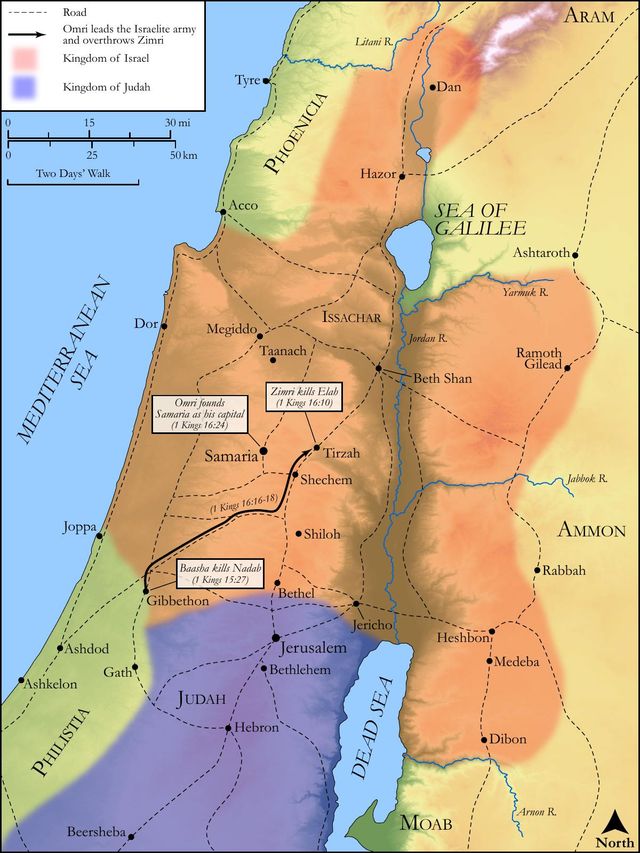
Notice was soon brought thither that Zimri had slain their king (Kg1 16:16) and set up himself in Tirzah, the royal city, whereupon they chose Omri king in the camp, that they might without delay avenge the death of Elah upon Zimri. Though he was idle and intemperate, yet he was their king, and they would not tamely submit to his murderer, nor let the treason go unpunished. They did not attempt to avenge the death of Nadab upon Baasha, perhaps because the house of Baasha had ruled with more gentleness than the house of Jeroboam; but Zimri shall feel the resentments of the provoked army. The siege of Gibbethon is quitted (Philistines are sure to gain when Israelites quarrel) and Zimri is prosecuted.
II.How he conquered Zimri, who is said to have reigned seven days (Kg1 16:15), so long before Omri was proclaimed king and himself proclaimed traitor; but we may suppose it was a longer time before he died, for he continued long enough to show his inclination to the way of Jeroboam, and to make himself obnoxious to the justice of God by supporting his idolatry, Kg1 16:19. Tirzah was a beautiful city, but not fortified, so that Omri soon made himself master of it (Kg1 16:17), forced Zimri into the palace, which being unable to defend, and yet unwilling to surrender, he burnt, and himself in it, Kg1 16:18. Unwilling that his rival should ever enjoy that sumptuous palace, he burnt it; and fearing that if he fell into the hands of the army, either alive or dead, he should be ignominiously treated, he burnt himself in it. See what desperate practices men's wickedness sometimes brings them to, and how it hurries them into their own ruin; see the disposition of incendiaries, who set palaces and kingdoms on fire, though they are themselves in danger of perishing in the flame.
III.How he struggled with Tibni, and at length got clear of him:
Half of the people followed this Tibni (Kg1 16:21), probably those who were in Zimri's interest, with whom others joined, who would not have a king chosen in the camp (lest he should rule by the sword and a standing army), but in a convention of the states. The contest between these two lasted some years, and, it is likely, cost a great deal of blood on both sides, for it was in the twenty-seventh year of Asa that Omri was first elected (Kg1 16:15) and thence the twelve years of his reign are to be dated; but it was not till the thirty-first year of Asa that he began to reign without a rival; then Tibni died, it is likely in battle, and Omri reigned, Kg1 16:22. Sir Walter Raleigh, in his History of the World (2.19.6), enquires here why it was that in all these confusions and revolutions of the kingdom of Israel they never thought of returning to the house of David, and uniting themselves again to Judah, for then it was better with them than now; and he thinks the reason was because the kings of Judah assumed a more absolute, arbitrary, and despotic power than the kings of Israel. It was the heaviness of the yoke that they complained of when they first revolted from the house of David, and the dread of that made them ever after averse to it, and attached to kings of their own, who ruled more by law and the rules of a limited monarchy.
IV.How he reigned when he was at length settled on the throne.
1.He made himself famous by building Samaria, which, ever after, was the royal city of the kings of Israel (the palace at Tirzah being burnt), and in process of time grew so considerable that it gave name to the middle part of Canaan (which lay between Galilee on the north and Judea on the south) and to the inhabitants of that country, who were called Samaritans. He bought the ground for two talents of silver, somewhat more than 700l. of our money, for a talent was 353l. 11s. 10 1/2d. Perhaps Shemer, who sold him the ground, let him have it considerably the cheaper upon condition that the city should be called after his name, for otherwise it would have borne the name of the purchaser; it was called Samaria, or Shemeren (as it is in the Hebrew), from Shemer, the former owner, Kg1 16:24. The kings of Israel changed their royal seats, Shechem first, then Tirzah, now Samaria; but the kings of Judah were constant to Jerusalem, the city of God. Those that cleave to the Lord fix, but those that leave him ever wander.
2.He made himself infamous by his wickedness; for he did worse than all that were before him, Kg1 16:25. Though he was brought to the throne with much difficulty, and Providence had remarkably favoured him in his advancement, yet he was more profane, or more superstitious, and a greater persecutor, than either of the houses of Jeroboam or Baasha. He went further than they had done in establishing iniquity by a law, and forcing his subjects to comply with him in it; for we read of the statutes of Omri, the keeping of which made Israel a desolation, Mic 6:16. Jeroboam caused Israel to sin by temptation, example, and allurement; but Omri did it by compulsion.
V.How he ended his reign, Kg1 16:27, Kg1 16:28.
He was in some repute for the might which he showed. Many a bad man has been a stout man. He died in his bed, as did Jeroboam and Baasha themselves; but, like them, left it to his posterity to fill up the measure, and then pay off the scores, of his iniquity.
Continue studying 1 Kings 16:15 across the web’s major study libraries — every link below opens this exact verse, chapter, or book on the destination site.
Read & Compare
 BibleGatewayThis verse in more than 200 translations and 70 languages.
 Bible.comThe YouVersion reader — hundreds of translations, reading plans, and highlights.
 ESV.orgCrossway's official English Standard Version reader.
 NET BibleThe NET translation with 60,000+ translators' notes on every rendering decision.
 STEP BibleTyndale House's free study tool — original text, vocabulary, and scholarly resources.
 BibliaLogos Bible Software's free web reader.
 USCCBThe New American Bible (Revised Edition) with the U.S. bishops' study notes.
Commentaries
 BibleHub CommentariesDozens of classic commentaries on this verse, gathered on one page.
 StudyLightMore than 100 commentary sets — the largest collection on the web.
 BibleRefPlain-English commentary on what this verse means, verse by verse.
 Enduring WordDavid Guzik's free commentary on this chapter, widely used by Bible teachers.
 Bible Study ToolsVerse commentary alongside Greek and Hebrew study aids.
Original Language & Research
- BibleHub InterlinearThe verse word by word — original language, transliteration, and English.
- BibleHub LexiconEvery word's original-language definition and Strong's entry.
 Blue Letter BibleDeep-study tools — Strong's numbers, concordance, and word studies.
 SefariaThe Hebrew text with Rashi and centuries of Jewish commentary.
Sermons, Hymns & Audio


TrulyRandomVerse is not affiliated with these sites and doesn’t control their content. They’re linked because they’re genuinely useful.
Summary
1 Kings 16:15 offers a stark and concise snapshot of extreme political volatility in the Northern Kingdom of Israel, documenting the exceptionally brief, seven-day reign of Zimri. This verse chronologically anchors Zimri's usurpation within the twenty-seventh year of King Asa of Judah, highlighting the concurrent military engagement of the Israelite army, which was encamped against the Philistine city of Gibbethon. This crucial detail reveals the immediate opportunity for Zimri's coup, as the army's absence from the capital, Tirzah, created a power vacuum, while simultaneously setting the stage for his swift downfall.
Context
ShowHideLiterary Context
This verse immediately follows the dramatic account of Zimri's assassination of King Elah while Elah was in Tirzah, drinking himself drunk, as detailed in 1 Kings 16:9. Zimri, a chariot commander, seized the throne through this violent act, fulfilling a prophecy of judgment against Baasha's house (Elah's father) delivered by the prophet Jehu son of Hanani, a prophecy found earlier in 1 Kings 16:1-4. The explicit statement of the brevity of Zimri's reign in this verse serves as a direct setup for the immediate counter-coup by Omri, the commander of the army, which is detailed in the very next verses, specifically 1 Kings 16:16-18. The rapid succession of kings and violent ends underscores the chaotic and unstable nature of Israel's monarchy during this period, often presented as a consequence of their spiritual apostasy.
Historical & Cultural Context
The mention of Tirzah as the capital of the Northern Kingdom is significant; it served as the primary seat of power for Israel from Jeroboam I until Omri established Samaria, a transition noted in 1 Kings 14:17 and later in 1 Kings 16:23-24. The precise chronological marker, "the twenty and seventh year of Asa king of Judah," aligns the tumultuous events in Israel with the more stable, albeit imperfect, reign in the Southern Kingdom, providing a valuable synchronism. The detail that "the people [were] encamped against Gibbethon, which [belonged] to the Philistines," reveals a critical strategic situation. Gibbethon was a Levitical city in Dan (see Joshua 21:23) that had fallen under Philistine control. Israel's ongoing efforts to reclaim it (previously seen in 1 Kings 15:27) indicate a persistent military struggle against the Philistines, a recurring feature of Israel's history since the days of the judges. The army's absence from the capital during this siege created the power vacuum Zimri exploited.
Key Themes
ShowHideThis verse powerfully illustrates several recurring themes in the book of 1 Kings and the broader Deuteronomistic History. Foremost is the political instability and rapid succession that plagued the Northern Kingdom, a stark contrast to the enduring Davidic dynasty in Judah. Zimri's incredibly brief reign epitomizes the fleeting nature of earthly power when it is seized through unrighteous means and lacks divine sanction. The narrative implicitly underscores divine sovereignty; even amidst human ambition, violence, and chaos, God's purposes are at work, often bringing swift judgment upon those who defy His will. Furthermore, the constant cycle of coups and assassinations in Israel is frequently presented as a consequence of the nation's persistent idolatry and departure from God's covenant, initiated by Jeroboam's sin, as seen in 1 Kings 14:16.
Exposition and Analysis
ShowHideKey Word Analysis
ShowHideThis name, derived from a root meaning "to sing" or "my music," stands in profound ironic contrast to the violent and discordant nature of his reign. His brief, bloody tenure was anything but harmonious, highlighting the deceptive nature of appearances and the ultimate futility of power gained through treachery. The name, meaning "musical," becomes a grim jest in light of his seven-day reign of chaos.
The capital city's name, meaning "delightsomeness" or "pleasantness," also presents a stark irony against the backdrop of the bloodshed and political turmoil that occurred within its walls during this period. It was a place of regicide and immediate counter-revolution, far from delightful for its inhabitants or rulers. The pleasant name belied the violent reality of its political landscape.
Meaning "a hilly spot," this city was strategically important. Its mention here signifies the ongoing military conflict with the Philistines and, more critically, the absence of Israel's main army from the capital. This absence was the crucial factor enabling Zimri's coup, and the army's immediate return from Gibbethon directly led to his demise, emphasizing the volatile military and political landscape.
Verse Breakdown
ShowHide"In the twenty and seventh year of Asa king of Judah"
This clause provides a precise chronological anchor for the events in Israel, linking them to the reign of the more stable Southern Kingdom. It underscores the contemporaneous nature of the two kingdoms' histories, often contrasting Judah's relative continuity with Israel's chronic instability and providing a fixed point for historical comparison.
"did Zimri reign seven days in Tirzah"
This is the central, most striking detail of the verse. "Seven days" marks the shortest reign of any king recorded in the Bible, a powerful testament to the extreme fragility and transience of power acquired through violence and lacking divine legitimacy. Tirzah is identified as the capital where this brief, ill-fated reign occurred, emphasizing the immediate location of the coup and its swift undoing.
"And the people [were] encamped against Gibbethon, which [belonged] to the Philistines"
This crucial detail explains the circumstances that allowed Zimri's coup. "The people" refers to the Israelite army. Their encampment at Gibbethon, a Philistine stronghold, meant the bulk of Israel's military force, led by Omri, was away from the capital. This created a power vacuum and an opportunity for Zimri's swift takeover, but it also sets the stage for the army's equally swift response upon hearing of the coup, leading directly to Zimri's downfall.
Literary Devices
ShowHideThe verse employs several potent literary devices to convey its message. Irony is prominently featured, particularly in the names "Zimri" ("my music") and "Tirzah" ("pleasantness"), which starkly contrast with the violent, discordant events they describe. This highlights the deceptive nature of appearances and the tragic reality of human sin and ambition. Foreshadowing is also present; the mention of the army at Gibbethon not only explains Zimri's opportunity but also subtly predicts his swift downfall, as it is this very army, led by Omri, that will immediately move against him. Furthermore, the verse uses Conciseness to deliver a powerful message; the extreme brevity of the description of Zimri's reign ("seven days") mirrors the brevity of his time on the throne, making the point about fleeting power even more impactful. There is also a clear Contrast drawn between the relative stability implied by dating the event to Asa's reign in Judah and the extreme instability demonstrated by Zimri's seven-day rule in Israel.
Theological and Thematic Connections
ShowHideZimri's seven-day reign serves as a profound biblical illustration of the transience of earthly power and the futility of human ambition when it operates outside of God's will. It underscores the principle that true authority and lasting dominion do not come from human machinations, violence, or usurpation, but are ultimately granted and withdrawn by the sovereign hand of God. The chaos and rapid succession of kings in the Northern Kingdom, epitomized by Zimri, are consistently presented in Scripture as a consequence of Israel's pervasive idolatry and covenant unfaithfulness, demonstrating that departure from God's ways inevitably leads to societal and political instability. Even in moments of intense human depravity and political upheaval, God remains in control, orchestrating events to fulfill His divine purposes and execute His righteous judgments.
Reflection and Application
ShowHideZimri's astonishingly brief reign offers a timeless cautionary tale for all who seek power or are entrusted with it. It compels us to reflect on the nature of authority and where true stability is found. In a world often characterized by political upheaval, ambition, and the pursuit of fleeting influence, this narrative reminds us that human power, especially when gained through unrighteous means, is ultimately fragile and ephemeral. It challenges us to examine our own ambitions: are we seeking to build our own kingdoms, or are we striving to serve the eternal Kingdom of God? The instability in Israel, rooted in their spiritual rebellion, also serves as a poignant reminder that societal chaos often stems from a departure from divine principles. For believers, this verse encourages trust in God's ultimate sovereignty, even when circumstances appear chaotic or unjust, knowing that His purposes will prevail and His justice will be meted out. It calls us to pursue justice and righteousness, understanding that true peace and lasting order are found only in alignment with God's will.
Questions for Reflection
ShowHideFAQ
ShowHideWhy was Zimri's reign so incredibly short?
ShowHideZimri's reign was exceptionally brief because he seized the throne through a violent coup while the main Israelite army, led by Omri, was away besieging Gibbethon. Upon hearing of Elah's assassination and Zimri's usurpation, the army immediately proclaimed Omri king and marched on Tirzah. Zimri, realizing his position was indefensible and facing imminent defeat, chose to commit suicide by setting the palace on fire around himself rather than be captured, thus ending his reign after only seven days, as detailed in 1 Kings 16:16-19. His lack of popular or military support outside of his initial treacherous act made his rule unsustainable and subject to swift divine judgment.
What was the significance of the army being "encamped against Gibbethon"?
ShowHideThe army's encampment against Gibbethon was strategically significant for two main reasons. First, it highlighted an ongoing conflict with the Philistines, indicating a persistent threat to Israel's borders and control over its territory, a struggle that had seen previous engagements (e.g., 1 Kings 15:27). Second, and more immediately relevant to Zimri's story, it meant that the bulk of Israel's military force and its commander, Omri, were absent from the capital city of Tirzah. This absence created the power vacuum that Zimri exploited to stage his coup against King Elah. However, it also meant that the army was a cohesive unit, capable of a swift and unified response once news of Zimri's treachery reached them, leading directly to his downfall.
How does Zimri's reign fit into the broader pattern of kingship in the Northern Kingdom of Israel?
ShowHideZimri's reign is a quintessential example of the chronic political instability that plagued the Northern Kingdom of Israel, particularly in contrast to the relatively more stable Davidic dynasty in Judah. From its inception under Jeroboam I, Israel experienced repeated coups, assassinations, and rapid changes in ruling families, often marked by violence and short reigns. This instability is frequently presented in 1 and 2 Kings as a direct consequence of Israel's persistent idolatry and departure from the covenant with God, initiated by Jeroboam's golden calves, as seen in 1 Kings 12:28-30. Zimri's seven-day rule is the most extreme manifestation of this pattern, demonstrating the ultimate futility and divine judgment upon a kingdom that had largely forsaken its God.
Christ-Centered Fulfillment
ShowHideThe chaotic and fleeting reign of Zimri, a mere seven days of violent usurpation and swift demise, stands in stark contrast to the eternal and unshakable reign of Jesus Christ. The instability, treachery, and bloodshed that characterized the Northern Kingdom's monarchy, exemplified by figures like Zimri, underscore the brokenness of human systems and the ultimate futility of power gained through unrighteous means. While earthly kings rise and fall, often through violence and ambition, Jesus' kingdom is "not of this world" (John 18:36), established not by force but by self-sacrificial love and divine authority. He is the true King, whose throne is established forever (Psalm 45:6), whose kingdom "shall never be destroyed" (Daniel 2:44), and of the increase of His government and peace there will be no end (Isaiah 9:7). Zimri's brief, fiery end serves as a powerful negative example, highlighting the desperate need for the perfect, eternal, and righteous King whose reign brings true peace and stability, not just for seven days, but for all eternity. We are called to seek first His kingdom, which cannot be shaken (Hebrews 12:28), finding true security and purpose in His enduring sovereignty and the promise of His return as the King of kings and Lord of lords (Revelation 19:16).