


2 Kings 9:31
Bible text: King James Version (1769 Blayney text) · Public domain
Bible text: Berean Standard Bible · Public domain
Bible text: American Standard Version (1901) · Public domain
Bible text: World English Bible, Messianic edition · Public domain
Bible text: Geneva Bible (1599) · Public domain
Bible text: Young's Literal Translation · Public domain
- וְיֵהוּאve·ye·Hu'and JehuH3058Conj-w ¦ N-proper-mNoun Proper MasculineוְandיֵהוּאJehu
- בָּאba'he cameH935V-Qal-Perf-3msVerb Qal Perfect 3rd Singular Masculine
- בַשָּׁעַרva·Sha·'arin the gateH8179Prep-b ¦ N-msNoun Singular Masculine Absoluteבַin theשָּׁעַרgate
- וַתֹּאמֶרva·To·merand she saidH559Conj-w ¦ V-Qal-ConsecImperf-3fsVerb Qal Consecutive Imperfect 3rd Singular Feminineוַandתֹּאמֶרshe said
- הֲשָׁלוֹםha·sha·Lom¿ peaceH7965Interrog ¦ N-msNoun Singular Masculine Absoluteהֲ¿שָׁלוֹםpeace
- זִמְרִיzim·RiO ZimriH2174N-proper-mNoun Proper Masculine
- הֹרֵגho·Reg[the] murderer ofH2026V-Qal-Prtcpl-msVerb Qal Participle Singular Masculine Construct
- אֲדֹנָיו'a·do·Navhis master<s>H113N-mpc ¦ 3msNoun Plural Masculine Constructאֲדֹנָיmaster<s>וhis
English is a literal word-by-word gloss of the Hebrew, not the KJV's wording. Why?
This is the original text the KJV's translators worked from — each Hebrew word with its own literal English meaning in this verse, prepared by scholars at Tyndale House, Cambridge. The KJV translates whole sentences, not word by word, so its wording differs: one Hebrew word can become several English words, and the KJV may choose “the LORD” where the gloss reads “Yahweh”. Both are faithful — they answer different questions. For the KJV's own rendering, switch to the KJV text.
Details
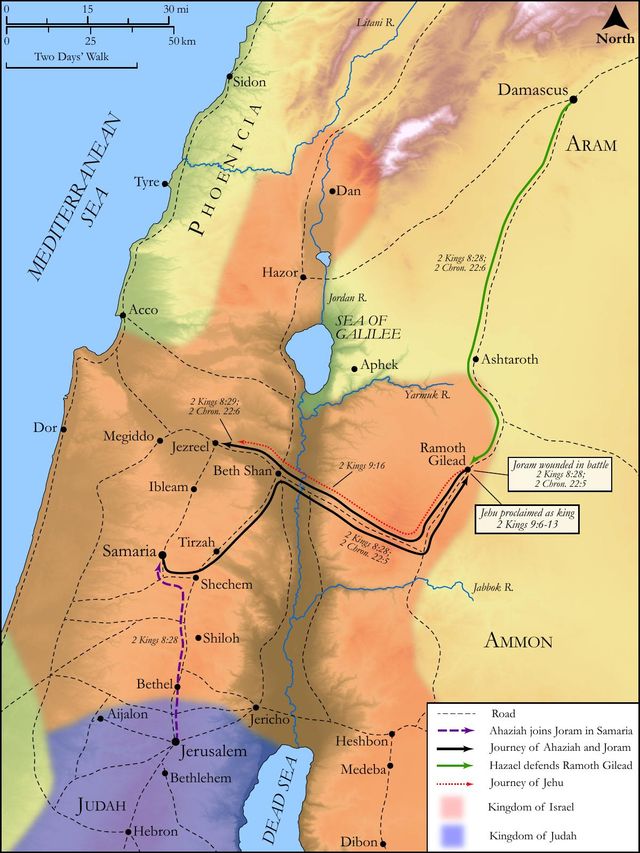
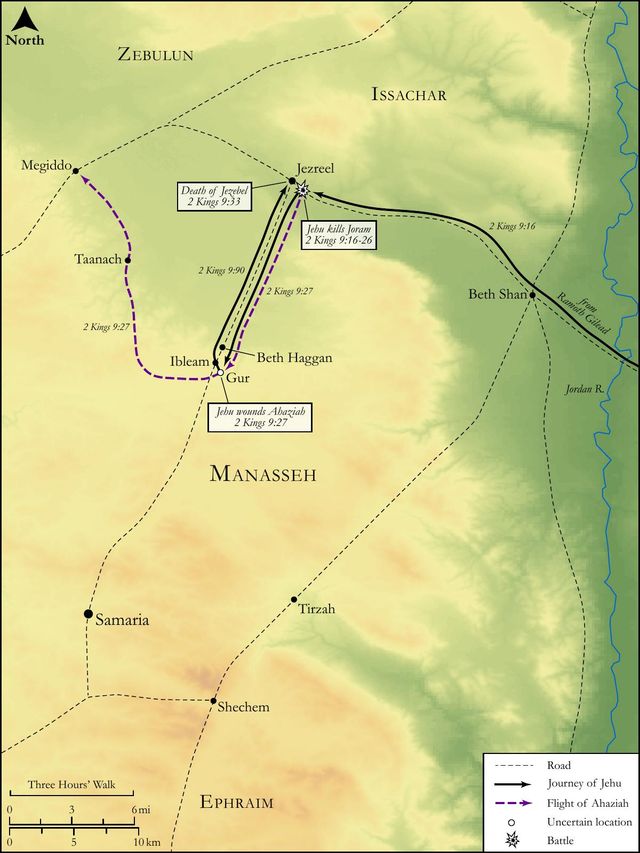
See on the biblical-era maps

Study this verse
Public-domain commentary
Matthew Henry
From his Commentary on the Whole Bible. Henry comments on passages, not single verses — this entry covers 2 Kings 9:30–37. His three-level outline is real structure in the source text, so it is rendered as structure.
The greatest delinquent in the house of Ahab was Jezebel: it was she that introduced Baal, slew the Lord's prophets, contrived the murder of Naboth, stirred up her husband first, and then her sons, to do wickedly; a cursed woman she is here called (Kg2 9:34), a curse to the country, and whom all that wished well to their country had a curse for. Three reigns her reign had lasted, but now, at length, her day had come to fall. We read of a false prophetess in the church of Thyatira that is compared to Jezebel, and called by her name (Rev 2:20), her wickedness the same, seducing God's servants to idolatry, a long space given her to repent (Kg2 9:21) as to Jezebel, and a fearful ruin brought upon her at last (Kg2 9:22, Kg2 9:23), as here upon Jezebel. So that Jezebel's destruction may be looked upon as typical of the destruction of idolaters and persecutors, especially that great whore, that mother of harlots, that hath made herself drunk with the blood of saints and the nations drunk with the wine of her fornications, when God shall put it into the heart of the kings of the earth to hate her, Rev 17:5, Rev 17:6. 16. Now here we have,
I.Jezebel daring the judgment.
She heard that Jehu had slain her son, and slain him for her whoredoms and witchcrafts, and thrown his dead body into the portion of Naboth, according to the word of the Lord, and that he was now coming to Jezreel, where she could not but expect herself to fall next a sacrifice to his revenging sword. Now see how she meets her fate; she posted herself in a window at the entering of the gate, to affront Jehu and set him at defiance.
1.Instead of hiding herself, as one afraid of divine vengeance, she exposed herself to it and scorned to flee, mocked at fear and was not affrighted. See how a heart hardened against God will brave it out to the last, run upon him, even upon his neck, Job 15:26. But never did any thus harden their hearts against him and prosper.
2.Instead of humbling herself, and putting herself into close mourning for her son, she painted her face, and tired her head, that she might appear like herself, that is (as she thought), great and majestic, hoping thereby to daunt Jehu, to put him out of countenance, and to stop his career. The Lord God called to baldness and girding with sackcloth, but behold painting and dressing, walking contrary to God, Isa 22:12, Isa 22:13. There is not a surer presage of ruin than an unhumbled heart under humbling providences. Let painted faces look in Jezebel's glass, and see how they like themselves.
3.Instead of trembling before Jehu, the instrument of God's vengeance, she thought to make him tremble with that threatening question, Had Zimri peace, who slew his master? Observe,
(1.)She took no notice of the hand of God gone out against her family, but flew in the face of him that was only the sword in his hand. We are very apt, when we are in trouble, to break out into a passion against the instruments of our trouble, when we ought to be submissive to God and angry at ourselves only.
(2.)She pleased herself with the thought that what Jehu was now doing would certainly end in his own ruin, and that he would not have peace in it. He had cut her off from all pretensions to peace (Kg2 9:22), and now she thought to cut him off likewise. Note, It is no new thing for those that are doing God's work to be looked upon as out of the way of peace. Active reformers, faithful reprovers, are threatened with trouble; but let them be in nothing terrified, Phi 1:28.
(3.)She quoted a precedent, to deter him from the prosecution of this enterprise: "Had Zimri peace? No, he had not; he came to the throne by blood and treachery, and within seven days was constrained to burn the palace over his head and himself in it: and canst thou expect to fare any better?" Had the case been parallel, it would have been proper enough to give him this memorandum; for the judgments of God upon those that have gone before us in any sinful way should be warnings to us to take heed of treading in their steps. But the instance of Zimri was misapplied to Jehu. Zimri had no warrant for what he did, but was incited to it merely by his own ambition and cruelty; whereas Jehu was anointed by one of the sons of the prophets, and did this by order from heaven, which would bear him out. In comparing persons and things we must carefully distinguish between the precious and the vile, and take heed lest from the fate of sinful men we read the doom of useful men.
II.Jehu demanding aid against her.
He looked up to the window, not daunted at the menaces of her impudent but impotent rage, and cried, Who is on my side? Who? Kg2 9:32. He was called out to do God's work, in reforming the land and punishing those that had debauched it; and here he calls out for assistance in the doing of it, looked as if there were any to help, any to uphold, Isa 63:5. He lifts up a standard, and makes proclamation, as Moses (Exo 32:26), Who is on the Lord's side? And the Psalmist (Psa 94:16), Who will rise up for me against the evil-doers? Note, When reformation-work is set on foot, it is time to ask, "Who sides with it?"
III.Her own attendants delivering her up to his just revenge.
Two or three chamberlains looked out to Jehu with such a countenance as encouraged him to believe they were on his side, and to them he called not to seize or secure her till further orders, but immediately to throw her down, which was one way of stoning malefactors, casting them headlong from some steep place. Thus was vengeance taken on her for the stoning of Naboth. They threw her down, Kg2 9:33. If God's command would justify Jehu, his command would justify them. Perhaps they had a secret dislike of Jezebel's wickedness, and hated her, though they served her; or, it may be, she was barbarous and injurious to those about her, and they were pleased with this opportunity of being avenged on her; or, observing Jehu's success, they hoped thus to ingratiate themselves with him, and keep their places in his court. However it was, thus she was most shamefully put to death, dashed against the wall and the pavement, and then trodden on by the horses, which were all besmeared with her blood and brains. See the end of pride and cruelty, and say, The Lord is righteous.
IV.The very dogs completing her shame and ruin, according to the prophecy.
When Jehu had taken some refreshment in the palace, he bethought himself of showing so much respect to Jezebel's sex and quality as to bury her. As bad as she was, she was a daughter, a king's daughter, a king's wife, a king's mother: Go and bury her, Kg2 9:34. But, though he had forgotten what the prophet said (Kg2 9:10, Dogs shall eat Jezebel), God had not forgotten it. While he was eating and drinking, the dogs had devoured her dead body, the dogs that went about the city (Psa 59:6) and fed upon the carrion, so that there was nothing left but her bare skull (the painted face gone) and her feet and hands. The hungry dogs had no respect to the dignity of her extraction; a king's daughter was no more to them than a common person. When we pamper our bodies, and use them deliciously, let us think how vile they are, and that shortly they will be either a feast for worms under ground or beasts above ground. When notice was brought of this to Jehu, he remembered the threatening (Kg1 21:23), The dogs shall eat Jezebel by the wall of Jezreel. Nothing should remain of her but the monuments of her infamy. She had been used to appear on public days in great state, and the cry was, "This is Jezebel. What a majestic port and figure! How great she looks!" But now it shall be said no more. We have often seen the wicked buried (Ecc 8:10), yet sometimes, as here, they have no burial, Ecc 6:3. Jezebel's name nowhere remained, but as stigmatized in sacred writ: they could not so much as say, "This is Jezebel's dust, This is Jezebel's grave," or "This is Jezebel's seed." Thus the name of the wicked shall rot - rot above ground.
Historical interpretation
Historical reception
1 surviving comment on this verse from the historical church.
They thought that she would have wept over her dead son, but in the very hour in which she heard that the king had come, she painted her eyes, a raving old woman, adorned her head with a miter and looked from her window so that she might be looked at. She thought that maybe [Jehu] would be seduced by her look and would take her among his wives. Maybe she had heard of the story of Adonijah, who at the time of Solomon was aided by Abishag the Shunammite and demanded that she became his wife, so that, through the queen, he might be elevated to the throne of the kingdom. So she believed that Jehu too, in order to confirm and pacify his troubled and agitated new reign, would walk the path of Adonijah. These were the thoughts of Jezebel until she was still able to control herself.But after seeing Jehu, who was entering the gate, she remembered the horrible murder of her son and could not stand the sight of his murderer any longer nor could she restrain her fury but insulted him angrily and abused him before the crowd by saying, “Is it peace, Zimri, murderer of your master?” Indeed, nothing could break the violence of that insolent woman, neither the hope of marriage, nor the fear of an imminent death, nor the fear of her adversary who brandished his sword while threatening her. She, who tortured the others, was not able to save herself, but she provoked the king like a madwoman, addressing him with insulting words, so that she kindled his rage even more and greater resentment rose against her.
Continue studying 2 Kings 9:31 across the web’s major study libraries — every link below opens this exact verse, chapter, or book on the destination site.
Read & Compare
 BibleGatewayThis verse in more than 200 translations and 70 languages.
 Bible.comThe YouVersion reader — hundreds of translations, reading plans, and highlights.
 ESV.orgCrossway's official English Standard Version reader.
 NET BibleThe NET translation with 60,000+ translators' notes on every rendering decision.
 STEP BibleTyndale House's free study tool — original text, vocabulary, and scholarly resources.
 BibliaLogos Bible Software's free web reader.
 USCCBThe New American Bible (Revised Edition) with the U.S. bishops' study notes.
Commentaries
 BibleHub CommentariesDozens of classic commentaries on this verse, gathered on one page.
 StudyLightMore than 100 commentary sets — the largest collection on the web.
 BibleRefPlain-English commentary on what this verse means, verse by verse.
 Enduring WordDavid Guzik's free commentary on this chapter, widely used by Bible teachers.
 Bible Study ToolsVerse commentary alongside Greek and Hebrew study aids.
Original Language & Research
- BibleHub InterlinearThe verse word by word — original language, transliteration, and English.
- BibleHub LexiconEvery word's original-language definition and Strong's entry.
 Blue Letter BibleDeep-study tools — Strong's numbers, concordance, and word studies.
 SefariaThe Hebrew text with Rashi and centuries of Jewish commentary.
Sermons, Hymns & Audio


TrulyRandomVerse is not affiliated with these sites and doesn’t control their content. They’re linked because they’re genuinely useful.
Summary
Second Kings 9:31 captures the intensely dramatic and defiant confrontation between the notorious Queen Jezebel and Jehu, the newly anointed king commissioned by God to execute divine judgment upon the idolatrous house of Ahab. As Jehu makes his triumphal entry into Jezreel, having already dispatched King Joram and King Ahaziah, Jezebel, adorned in royal regalia, confronts him from a window with a sharp rhetorical question invoking the ill-fated usurper Zimri. Her challenge, a final, desperate attempt to intimidate and delegitimize Jehu's authority by implying he would suffer a similar, short-lived fate, ironically serves as her last act of prideful defiance before the swift and gruesome fulfillment of God's long-standing prophetic judgment against her.
Context
ShowHideLiterary Context
This verse serves as the immediate and climactic culmination of the narrative detailing Jehu's anointing and his subsequent ruthless purge of the Omride dynasty. The prophet, sent by Elisha, explicitly commissions Jehu to "strike down the house of Ahab your master, that I may avenge on Jezebel the blood of my servants the prophets and the blood of all the servants of the Lord" 2 Kings 9:7. Following this divine mandate, Jehu acts with astonishing speed and brutality, first executing King Joram, Ahab's son, and then King Ahaziah of Judah, Joram's nephew 2 Kings 9:21-28. The narrative then shifts to Jezreel, the royal residence, where Jezebel awaits, setting the stage for the direct and shocking fulfillment of Elijah's earlier prophecy concerning her ignominious end 1 Kings 21:23. Verse 31 captures the final, defiant verbal exchange just moments before Jehu's command leads to Jezebel's horrific death in 2 Kings 9:32-37.
Historical & Cultural Context
The events described unfold in the Northern Kingdom of Israel during a tumultuous period marked by profound political instability and rampant religious apostasy. The Omride dynasty, particularly under the reign of Ahab and the pervasive influence of his Phoenician wife, Jezebel, had aggressively promoted the worship of Baal as the state religion, actively persecuting the prophets of Yahweh and perpetrating grave injustices, most notably the murder of Naboth to seize his vineyard 1 Kings 21. This widespread idolatry and unrighteousness provoked God's severe judgment, which is now being executed through Jehu. Jezebel, a princess from Sidon, was a formidable, ruthless, and deeply entrenched pagan queen. Her act of adorning herself (painting her eyes) and looking out a window was a culturally significant gesture for a royal woman, likely an attempt to maintain regal dignity, assert power, or even to intimidate through a show of defiance in the face of impending doom. City gates were central public spaces for legal proceedings, royal proclamations, and significant entrances, making Jezebel's public confrontation with Jehu a highly symbolic and confrontational act.
Key Themes
ShowHideThis passage powerfully illustrates the themes of Divine Judgment and Retribution, as God's long-prophesied wrath against the idolatrous and wicked house of Ahab and Jezebel is finally and dramatically unleashed. It highlights the Sovereignty of God over human affairs and political power, demonstrating unequivocally that even violent coups can be instruments of His righteous will. Jezebel's defiant question, despite her intent, underscores the Futility of Defiance Against God's Purposes; her human cunning, pride, and political acumen are utterly no match for divine decree. Furthermore, her invocation of Zimri serves as a Historical Parallel and Warning, albeit one that ironically backfires on Jezebel, emphasizing the consequences of usurping power without divine sanction and the ultimate triumph of God's justice over human wickedness, a recurring motif throughout the historical narrative of 2 Kings.
Exposition and Analysis
ShowHideKey Word Analysis
ShowHideJezebel's reference to Zimri (זִמְרִי, Zimrîy) is a calculated historical allusion. Zimri, whose name means "musical," was a chariot commander who assassinated King Elah of Israel and usurped the throne, reigning for only seven days before dying by his own hand when Omri besieged Tirzah 1 Kings 16:9-20. By invoking Zimri, Jezebel attempts to frame Jehu as another short-lived, illegitimate usurper who, having "slew his master" (Joram), would inevitably meet a similarly inglorious and violent end. This demonstrates her sharp political acumen, even in her final moments.
Jezebel's use of "peace" (שָׁלוֹם, shâlôwm) here is deeply ironic and sarcastic. While shâlôwm typically denotes wholeness, well-being, prosperity, security, and the absence of conflict, Jezebel employs it to imply the exact opposite. She is not asking if Zimri found true peace or lasting security, but rather asserting that he did not; his reign was brief and ended violently. Her question is a veiled curse or threat, suggesting Jehu will likewise find no peace or stability after his bloody coup. It signifies a lack of welfare, safety, or prosperity.
The verb "slew" (הָרַג, hârag) is a primitive root meaning to smite with deadly intent, to kill, murder, or put to death. Jezebel's choice of this word emphasizes the brutality of Jehu's actions, painting him as a regicide. While Jehu's actions were divinely commanded, from Jezebel's human perspective, he was a murderer and usurper. Her question highlights the violent nature of his ascent to power, seeking to associate him with the instability and short-lived reigns that often followed such bloody takeovers in Israelite history.
Verse Breakdown
ShowHide"And as Jehu entered in at the gate"
This phrase vividly sets the scene for a public, confrontational, and highly symbolic moment. The city gate was not merely an entrance; it was a prominent location, a place of public assembly, legal proceedings, and the reception of dignitaries or conquerors. Jehu's entry signifies the arrival of God's appointed agent of judgment into the very heart of Jezebel's domain, marking the culmination of his swift and decisive campaign.
"she said"
This simple yet powerful phrase underscores Jezebel's agency and unyielding defiance. Despite her perilous situation and the overwhelming force of Jehu's arrival, she is neither silent nor cowering. She actively confronts him, choosing her final words with calculated precision to challenge and provoke, demonstrating her characteristic boldness, pride, and unyielding spirit even in the face of certain doom.
"[Had] Zimri peace, who slew his master?"
This is a profound rhetorical question, laden with historical irony and a thinly veiled threat. Jezebel is not seeking information; she is making a damning statement. By recalling Zimri, who murdered his king but found no lasting peace or security, she implies that Jehu, having similarly "slew his master" (King Joram), will also face a violent and ignominious end. The profound irony lies in the fact that her own fate, immediately following this exchange, would be far more gruesome, definitive, and divinely ordained than Zimri's.
Literary Devices
ShowHideThe verse is rich in Rhetorical Question, as Jezebel's query is not posed to elicit information but to make a forceful statement and intimidate Jehu. This rhetorical device highlights her defiance and sharp intellect even in her final moments. There is profound Irony at play; Jezebel's attempt to curse or warn Jehu by invoking Zimri's short-lived, violent reign inadvertently highlights her own impending and even more ignominious doom. This also creates Dramatic Irony, as the audience is fully aware of the divine decree against Jezebel, making her defiant words tragically futile in the face of God's sovereign plan. The reference to Zimri functions as a powerful Historical Allusion, drawing a parallel to a significant and well-known event in Israelite history to frame Jehu's actions and predict his fate. Finally, Jezebel's act of adorning herself and confronting Jehu from a window can be seen as Symbolism, representing her unyielding pride, her desperate attempt to maintain regal authority and dignity, and her final, defiant act of self-assertion against the inevitable tide of divine judgment.
Theological and Thematic Connections
ShowHideThe dramatic confrontation in 2 Kings 9:31 serves as a stark and powerful reminder of God's unwavering justice and the absolute certainty of His prophetic word. Jezebel's final, defiant act, rooted in unbridled pride and a desperate attempt to assert human power and control, ultimately proves utterly futile against the divinely appointed instrument of judgment. This passage underscores the profound truth that no human authority, no matter how formidable, entrenched, or seemingly invincible, can thwart the sovereign purposes of God. It highlights the severe and inevitable consequences of unrepentant idolatry, spiritual apostasy, and grave injustice, demonstrating God's active involvement in human history to uphold His covenant and punish those who lead His people astray. The narrative emphatically emphasizes that God's judgment, though sometimes slow in coming, is ultimately decisive, comprehensive, and perfectly righteous, bringing an end to wickedness and fulfilling His righteous decrees with precision.
Reflection and Application
ShowHideThe scene at the gate of Jezreel, with Jezebel's defiant question echoing through history, offers profound and sobering lessons for contemporary believers. It illustrates with chilling clarity that unrepentant sin, particularly the promotion of spiritual apostasy, the persecution of God's people, and the embrace of idolatry, will inevitably face divine reckoning. While God's judgment may not always manifest in such dramatic, immediate, or physically violent ways in our present age, the underlying principle remains eternally true: God is perfectly just, and His moral order will ultimately prevail. Jezebel's prideful resistance, even in the face of overwhelming evidence of God's sovereign work through Jehu, serves as a powerful warning against the utter futility of human defiance against divine will. We are reminded that true peace, lasting security, and genuine prosperity are not found in manipulating circumstances, asserting our own power, or clinging to our pride, but rather in humble submission to God's ultimate sovereignty and His righteous ways. This narrative calls us to a deep self-examination: are we living in alignment with God's revealed will, or are there areas where we, perhaps subtly like Jezebel, are stubbornly resisting His truth and purposes, preferring our own way to His?
Questions for Reflection
ShowHideFAQ
ShowHideWhy did Jezebel invoke Zimri?
ShowHideJezebel invoked Zimri as a highly calculated rhetorical strategy designed to intimidate Jehu and undermine his legitimacy. Zimri was a historical figure who assassinated King Elah of Israel but reigned for only seven days before dying by his own hand when Omri besieged Tirzah 1 Kings 16:9-20. By asking, "Had Zimri peace, who slew his master?" Jezebel was implying that Jehu, having just "slew his master" (King Joram), was merely another short-lived usurper who would soon meet a similar, violent end. It was a veiled threat and a desperate attempt to assert her psychological dominance and maintain a semblance of control, even as her physical power crumbled. The profound irony, of course, is that her own demise, immediately following this exchange, would be far more immediate, gruesome, and definitive than Zimri's.
What was the significance of Jezebel 'painting her eyes'?
ShowHideThe text states Jezebel "painted her eyes" (KJV, "put her face in order" or "beautified her head" in other translations). This act, often associated with applying kohl or antimony to the eyelids and lashes, was a common practice among women, particularly among royalty and wealthy individuals, for cosmetic enhancement. Its significance in this specific context is debated but likely multifaceted. It could signify a final act of regal dignity and defiance, a refusal to appear defeated or disheveled before her executioner. Some scholars suggest it might have been an attempt to appear seductive or alluring, perhaps as a desperate, last-ditch effort to charm or manipulate Jehu, though this is less likely given Jehu's divinely appointed mission and ruthless demeanor. Most plausibly, it was a bold, defiant gesture, asserting her royal status and unyielding spirit even in the face of certain death, a final act of self-assertion and pride before God's judgment.
How does this verse relate to the broader theme of divine judgment in 2 Kings?
ShowHideThis verse is a pivotal and climactic moment in the unfolding theme of divine judgment that permeates the entire book of 2 Kings. The book meticulously chronicles the reigns of kings in both Israel and Judah, consistently evaluating them based on their faithfulness to the Lord and their adherence to His covenant. The Omride dynasty, particularly under Ahab and Jezebel, represented the pinnacle of idolatry, wickedness, and covenant infidelity in Israel, leading to widespread apostasy and injustice. God's judgment against them was prophesied long in advance by Elijah 1 Kings 21:23 and is now being executed through Jehu, God's chosen instrument of wrath. Jezebel's death, immediately following this verse, is a dramatic and undeniable fulfillment of these prophecies, demonstrating God's absolute sovereignty over human rulers and His unwavering commitment to bringing justice against unrepentant sin, especially idolatry, the persecution of His prophets, and the corruption of His people. It sets a powerful precedent for the subsequent judgments that would eventually lead to the exile and destruction of both the Northern Kingdom of Israel and later, the Southern Kingdom of Judah.
Christ-Centered Fulfillment
ShowHideThe dramatic judgment upon Jezebel and the house of Ahab, culminating in this defiant exchange, powerfully foreshadows God's ultimate and perfect justice, which finds its full and glorious expression in Jesus Christ. While Jehu was God's anointed instrument for temporal judgment against a wicked dynasty, Christ is the ultimate Anointed One, the Messiah, who comes to execute both righteous judgment and merciful salvation. Jezebel's futile attempt to invoke "peace" (shalom) ironically highlights the profound absence of true peace in a life of rebellion against God. In stark contrast, Jesus is the Prince of Peace, who offers a profound and lasting peace that the world cannot give, a peace rooted in reconciliation with God through His atoning sacrifice John 14:27. Jezebel's defiant resistance against Jehu, God's appointed agent, mirrors humanity's pervasive rebellion against God Himself, a rebellion for which Christ bore the full weight of divine wrath on the cross. He became the ultimate sacrifice, the Lamb of God who takes away the sin of the world, so that all who believe might escape eternal judgment and receive eternal life. Ultimately, the scene in 2 Kings 9:31 points forward to the day when Christ, the true and eternal King, will return not as a temporary usurper, but as the righteous Judge of all the earth Acts 17:31, before whom every knee will bow and every tongue confess that He is Lord, to the glory of God the Father Philippians 2:10-11, bringing about the perfect and eternal reign of God's justice, peace, and righteousness.