


Philippians 1:28
Bible text: King James Version (1769 Blayney text) · Public domain
Bible text: King James Version with Strong's numbers · Public domain
Bible text: Berean Standard Bible · Public domain
Bible text: American Standard Version (1901) · Public domain
Bible text: World English Bible, Messianic edition · Public domain
Bible text: Geneva Bible (1599) · Public domain
Bible text: Young's Literal Translation · Public domain
- καὶkaiandG2532CONJConjunction
- μὴmēnotG3361PRT-NNegative Particle Negative
- πτυρόμενοιpturomenoibeing frightenedG4426V-PPP-NPMVerb Present Passive Participle Nominative Plural Masculine
- ἐνeninG1722PREPPreposition
- μηδενὶmēdeninothingG3367A-DSNAdjective Dative Singular Neuter
- ὑπὸhupobyG5259PREPPreposition
- τῶνtōnthoseG3588T-GPMDefinite article Genitive Plural Masculine
- ἀντικειμένων·antikeimenōnopposing [you]G480V-PNP-GPMVerb Present Middle Or Passive Deponent Participle Genitive Plural Masculine
- ἥτιςhētiswhichG3748R-NSFRelative pronoun Nominative Singular Feminine
- ἐστὶνestinisG1510V-PAI-3SVerb Present Active Indicative 3rd Singular
- αὐτοῖςautoisto themG846P-DPMPersonal pronoun Dative Plural Masculine
- μένmenindeedG3303PRTParticle or Disjunctive
- ἔνδειξιςendeixisa demonstrationG1732N-NSFNoun Nominative Singular Feminine
- ἀπωλείαςapōleiasof destructionG684N-GSFNoun Genitive Singular Feminine
- ὑμῶνhumōnto youG4771P-2GPPersonal pronoun Genitive 2nd Plural
- δὲdehoweverG1161CONJConjunction
- σωτηρίαςsōtēriasof salvationG4991N-GSFNoun Genitive Singular Feminine
- καὶkaiandG2532CONJConjunction
- τοῦτοtoutothisG3778D-NSNDemonstrative pronoun Nominative Singular Neuter
- ἀπὸapofromG575PREPPreposition
- θεοῦ·theouGodG2316N-GSM-TNoun Genitive Singular Masculine Title
English is a literal word-by-word gloss of the Greek, not the KJV's wording. Why?
This is the original text the KJV's translators worked from — each Greek word with its own literal English meaning in this verse, prepared by scholars at Tyndale House, Cambridge. The KJV translates whole sentences, not word by word, so its wording differs: one Greek word can become several English words, and the KJV may choose “charity” where the gloss reads “love”. Both are faithful — they answer different questions. For the KJV's own rendering, switch to the KJV text.
Details
See on the biblical-era maps

Study this verse
Public-domain commentary
Matthew Henry
From his Commentary on the Whole Bible. Henry comments on passages, not single verses — this entry covers Philippians 1:27–30.
The apostle concludes the chapter with two exhortations: -
I.He exhorts them to strictness of conversation (Phi 1:27):
Only let your conversation be as becometh the gospel of Christ. Observe, Those who profess the gospel of Christ should have their conversation as becomes the gospel, or in a suitableness and agreeableness to it. Let it be as becomes those who believe gospel truths, submit to gospel laws, and depend upon gospel promises; and with an answerable faith, holiness, and comfort. Let it be in all respects as those who belong to the kingdom of God among men, and are members and subjects of it. It is an ornament to our profession when our conversation is of a piece with it. - That whether I come and see you, or else be absent, I may hear of your affairs. He had spoken in Phi 1:26 of his coming to them again, and had spoken it with some assurance, though he was now a prisoner; but he would not have them build upon that. Our religion must not be bound up in the hands of our ministers: "Whether I come or no, let me hear well of you, and do you stand fast." Whether ministers come or no, Christ is always at hand. He is nigh to us, never far from us; and hastens his second coming. The coming of the Lord draws nigh, Jam 5:8. Let me hear of you that you stand fast in one spirit, with one mind striving together for the faith of the gospel. Three things he desired to hear of them; and they are all such as become the gospel: - 1. It becomes those who profess the gospel to strive for it, to use a holy violence in taking the kingdom of heaven. The faith of the gospel is the doctrine of faith, or the religion of the gospel. There is that in the faith of the gospel which is worth striving for. If religion is worth any thing, it is worth every thing. There is much opposition, and there is need of striving. A man may sleep and go to hell; but he who will go to heaven must look about him and be diligent. 2. The unity and unanimity of Christians become the gospel: Strive together, not strive one with another; all of you must strive against the common adversary. One spirit and one mind become the gospel; for there is one Lord, one faith, one baptism. There may be a oneness of heart and affection among Christians, where there is diversity of judgment and apprehensions about many things. 3. Stedfastness becomes the gospel: Stand fast in one spirit, with one mind. Be stedfast and immovable by any opposition. It is a shame to religion when the professors of it are off and on, unfixed in their minds, and unstable as water; for they will never excel. Those who would strive for the faith of the gospel must stand firm to it.
II.He exhorts them to courage and constancy in suffering:
And in nothing terrified by your adversaries, Phi 1:28. The professors of the gospel have all along met with adversaries, especially at the first planting of Christianity. Our great care must be to keep close to our profession, and be constant to it: whatever oppositions we meet with, we must not be frightened at them, considering that the condition of the persecuted is much better and more desirable than the condition of the persecutors; for persecuting is an evident token of perdition. Those who oppose the gospel of Christ, and injure the professors of it, are marked out for ruin. But being persecuted is a token of salvation. Not that it is a certain mark; many hypocrites have suffered for their religion; but it is a good sign that we are in good earnest in religion, and designed for salvation, when we are enabled in a right manner to suffer for the cause of Christ. - For to you it is given on the behalf of Christ not only to believe, but also to suffer for his name, Phi 1:29. Here are two precious gifts given, and both on the behalf of Christ: - 1. To believe in him. Faith is God's gift on the behalf of Christ, who purchased for us not only the blessedness which is the object of faith, but the grace of faith itself: the ability or disposition to believe is from God. 2. To suffer for the sake of Christ is a valuable gift too: it is a great honour and a great advantage; for we may be very serviceable to the glory of God, which is the end of our creation, and encourage and confirm the faith of others. And there is a great reward attending it too: Blessed are you when men shall persecute you, for great is your reward in heaven, Mat 5:11, Mat 5:12. And, if we suffer with him, we shall also reign with him, Ti2 2:12. If we suffer reproach and loss for Christ, we are to reckon it a great gift, and prize it accordingly, always provided we behave under our sufferings with the genuine temper of martyrs and confessors (Phi 1:30): "Having the same conflict which you saw in me, and now hear to be in me; that is, suffering in the same manner as you saw and now hear of me that I suffer." It is not simply the suffering, but the cause, and not only the cause, but the spirit, which makes the martyr. A man may suffer in a bad cause, and then he suffers justly; or in a good cause, but with a wrong mind, and then his sufferings lose their value.
Historical interpretation
Historical reception
2 surviving comments on this verse. Each one is dated, so this reads as a timeline rather than a list.
Select a marker to jump to its quote. Markers stagger vertically where authors wrote within a few decades of each other.
This work of fearlessness is part of his explanation of what it means to conduct oneself worthily according to Christ’s gospel: Never be terrified, whether by adversaries or anything else.… For this very condition of being courageous tends toward our salvation. It deals a death blow to our adversaries. Yet this too is a work of God, lest we should think it part of our own work that our not being terrified should be a cause of our salvation. “For this too is of God,” he says, “just as I have often told you that all things come about through the will, the mercy and the grace of God.”
"And in nothing affrighted by the adversaries; which is for them an evident token of perdition, but to you of salvation."
Well said he, "affrighted," this is what befalls us from our enemies, they only frighten. "In nothing" therefore, he says, whatever happens, whether dangers-whether plots. For this is the part of those who stand upright; the enemy can do nought but frighten only. Since it was likely that they should be greatly troubled, when Paul suffered such numberless ills, he says, I exhort you not only not to be shaken, but not to be affrighted, yea rather to despise them heartily; for if ye are thus affected, ye will straightway, by this means, make evident at once their destruction, and your salvation. For when they see, that with their innumerable plots they are unable to frighten you, they will take it as a proof of their own destruction. For when the persecutors prevail not over the persecuted, the plotters over the objects of their plots, the powerful over those subject to their power, will it not be self-evident, that their perdition is at hand, that their power is nought, that their part is false, that their part is weak? "And this," he says, "comes from God."
Continue studying Philippians 1:28 across the web’s major study libraries — every link below opens this exact verse, chapter, or book on the destination site.
Read & Compare
 BibleGatewayThis verse in more than 200 translations and 70 languages.
 Bible.comThe YouVersion reader — hundreds of translations, reading plans, and highlights.
 ESV.orgCrossway's official English Standard Version reader.
 NET BibleThe NET translation with 60,000+ translators' notes on every rendering decision.
 STEP BibleTyndale House's free study tool — original text, vocabulary, and scholarly resources.
 BibliaLogos Bible Software's free web reader.
 USCCBThe New American Bible (Revised Edition) with the U.S. bishops' study notes.
Commentaries
 BibleHub CommentariesDozens of classic commentaries on this verse, gathered on one page.
 StudyLightMore than 100 commentary sets — the largest collection on the web.
 BibleRefPlain-English commentary on what this verse means, verse by verse.
 Enduring WordDavid Guzik's free commentary on this chapter, widely used by Bible teachers.
 Bible Study ToolsVerse commentary alongside Greek and Hebrew study aids.
Original Language & Research
- BibleHub InterlinearThe verse word by word — original language, transliteration, and English.
- BibleHub LexiconEvery word's original-language definition and Strong's entry.
 Blue Letter BibleDeep-study tools — Strong's numbers, concordance, and word studies.
 CNTR CollationThe earliest Greek manuscripts of this verse, collated letter by letter.
Sermons, Hymns & Audio


TrulyRandomVerse is not affiliated with these sites and doesn’t control their content. They’re linked because they’re genuinely useful.
Summary
Philippians 1:28 powerfully encourages believers to remain utterly undeterred by their adversaries, asserting that their steadfastness serves as a clear, divine indicator. For those who oppose the gospel, this unwavering faith is a manifest sign of their impending ruin, while for believers, it stands as an undeniable proof of their salvation, a salvation that originates from and is secured by God Himself.
Context
ShowHideLiterary Context
This verse is situated within Paul's deeply personal and encouraging letter to the Philippian church, written from his imprisonment (likely in Rome). Despite his confinement, Paul maintains a joyful and confident tone, expressing his longing for the Philippians and his conviction that his imprisonment has actually served to advance the gospel (Philippians 1:12-14). Immediately preceding this verse, Paul exhorts them to live lives worthy of the gospel of Christ, standing firm in one spirit, contending as one for the faith of the gospel, and in no way intimidated by their opponents. Verse 28 elaborates on the profound spiritual implications of such steadfastness, providing both a warning to adversaries and an assurance to believers.
Historical & Cultural Context
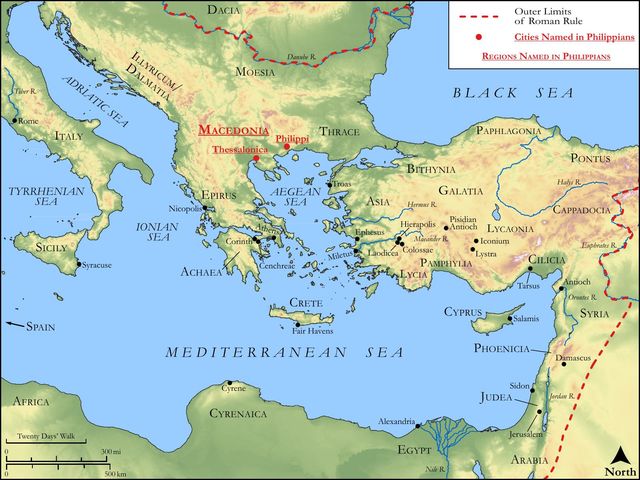
Philippi was a Roman colony, proud of its Roman citizenship and customs. This context meant that Christians in Philippi faced unique pressures. Their allegiance to Christ could be perceived as disloyalty to Caesar and Rome, potentially leading to social ostracism, economic hardship, or even legal persecution. Paul himself was a prisoner of Rome, and his situation underscored the reality of opposition. The "adversaries" mentioned could include Jewish opponents, pagan idolaters, or even Roman authorities who viewed Christianity as a disruptive or unlawful sect. The concept of an "evident token" would resonate in a society that valued public displays of loyalty and legal proofs.
Key Themes
ShowHidePhilippians 1:28 contributes significantly to several overarching themes in the letter. First, fearless steadfastness is paramount; Paul repeatedly calls for courage and unity in the face of external pressures (Philippians 1:27). Second, the theme of divine sovereignty and purpose is evident, as Paul views even his imprisonment and the Philippians' suffering as part of God's plan for gospel advancement (Philippians 1:12). Third, the verse highlights assurance of salvation, emphasizing that the believers' endurance is not merely human grit but a divinely enabled sign of their secure standing in Christ (Philippians 2:12-13). Finally, it underscores the contrasting destinies of those who oppose God and those who faithfully follow Him, a theme common throughout biblical eschatology.
Exposition and Analysis
ShowHideKey Word Analysis
ShowHideThis verb, from a presumed derivative of πτύω, means "to frighten," "to be startled," or "to be put to flight." Paul's command, "in nothing terrified," is a strong exhortation to maintain composure and courage, resisting any impulse to retreat or be intimidated by external threats or opposition. It speaks to an inner resolve that transcends fear.
Derived from ἐνδείκνυμι, this noun signifies an "indication," "declaration," or "proof." It denotes a clear, undeniable demonstration or sign. In this context, the steadfastness and fearlessness of the believers serve as a manifest, visible proof of profound spiritual realities to both their adversaries and themselves.
From a presumed derivative of ἀπόλλυμι, this term refers to "ruin," "loss," or "destruction," which can be physical, spiritual, or eternal. It signifies a state of being utterly undone, wasted, or eternally lost. The juxtaposition of this term with "salvation" highlights the ultimate, contrasting destinies revealed by the believers' conduct.
A feminine noun from a derivative of σωτήρ, meaning "rescue," "safety," or "deliverance." It encompasses comprehensive well-being, preservation, and the eternal life granted by God.
Verse Breakdown
ShowHide"And in nothing terrified by your adversaries:"
Paul begins with a powerful negative command, urging the Philippians not to be frightened or intimidated by those who oppose them. The phrase "in nothing" emphasizes the absolute nature of this fearlessness, implying that no form of opposition should cause them to waver or retreat. Their "adversaries" (Greek: antikeimenois) are those who set themselves against, oppose, or resist their faith and the gospel.
"which is to them an evident token of perdition,"
The unwavering, fearless stance of the believers serves as a clear, undeniable proof (an "evident token") to their adversaries. This token signifies the adversaries' ultimate ruin or destruction ("perdition"). Their inability to suppress or frighten God's people demonstrates that they are fighting against God Himself, thereby sealing their own doom.
"but to you of salvation,"
In stark contrast, this very same steadfastness acts as an equally clear and undeniable sign for the believers themselves. For them, it is a "token of salvation," confirming their secure standing in Christ and their ultimate deliverance. Their endurance is not merely human resilience but a divinely empowered confirmation of their eternal hope.
"and that of God."
This final phrase profoundly qualifies the nature of this salvation and the courage that evidences it. It is not a salvation earned by human effort or a courage born of mere willpower, but one that originates from, is sustained by, and ultimately belongs to God. This divine origin provides the ultimate assurance and foundation for both their steadfastness and their eternal destiny.
Literary Devices
ShowHidePhilippians 1:28 is rich in literary devices that amplify its message. The most prominent is Antithesis, the stark contrast between "perdition" for the adversaries and "salvation" for the believers. This dramatic opposition underscores the two ultimate and opposing spiritual destinies revealed by the believers' conduct. The phrase "evident token" functions as a form of Metonymy or Symbolism, where the believers' steadfastness itself becomes the tangible sign or proof of these unseen spiritual realities. Their courage is not just a characteristic but a divinely appointed indicator. Furthermore, there is an implied Divine Passive in "terrified" (ptýrō), suggesting that while adversaries may attempt to frighten, the believers' un-terrified state is a result of divine enablement. The concluding phrase, "and that of God," serves as a powerful Affirmation of divine agency, emphasizing that both the salvation and the strength to endure opposition are ultimately God's work, not human achievement.
Theological and Thematic Connections
ShowHideThis verse profoundly articulates the eschatological implications of present suffering and faithfulness. It reveals that the spiritual battle is not merely a human conflict but a collision of kingdoms with eternal consequences. The steadfastness of believers, empowered by God, becomes a visible signpost pointing to the ultimate triumph of God's kingdom and the certain judgment of those who oppose it. This provides immense comfort and assurance, reminding believers that their suffering is not in vain but is woven into God's sovereign plan, serving as a powerful witness and a confirmation of their secure, divinely-granted salvation.
Reflection and Application
ShowHideIn a world that often pressures believers to conform, compromise, or retreat, Philippians 1:28 serves as an enduring call to courageous faithfulness. It challenges us to examine our own responses to opposition, whether it be cultural ridicule, professional discrimination, or outright persecution. Our steadfastness, born not of human bravado but of divine strength, is a powerful testimony. It reminds us that our primary allegiance is to Christ, and our ultimate security rests in God's hands. When we stand firm, we not only affirm our own salvation but also provide a clear, undeniable witness to both the world's impending judgment and the glorious hope of the gospel. This verse encourages us to live with an eternal perspective, understanding that our present trials are momentary and light compared to the eternal weight of glory, and that our unwavering faith has profound, far-reaching spiritual implications for all who observe it.
Questions for Reflection
ShowHideFAQ
ShowHideWhat does "perdition" mean in the context of Philippians 1:28?
ShowHideIn Philippians 1:28, "perdition" (Greek: apōleia) refers to the ultimate ruin, destruction, or eternal loss that awaits those who oppose God and His people. It signifies a state of being utterly undone, wasted, or eternally separated from God's presence. It is the antithesis of "salvation" and highlights the dire spiritual consequence for those who actively resist the gospel and persecute believers. This is not merely physical death but a comprehensive, spiritual, and eternal demise.
How can believers be "in nothing terrified" when facing real threats?
ShowHideThe command to be "in nothing terrified" does not imply a lack of natural human fear, but rather a refusal to be controlled or intimidated by it to the point of compromising one's faith or retreating from gospel witness. This fearlessness is not born of human strength or recklessness, but is "of God." It stems from a deep trust in God's sovereignty, His protective power, and the assurance of eternal salvation. It is a supernatural peace and courage that allows believers to stand firm even when circumstances are frightening, knowing that their ultimate destiny is secure in Christ. As 2 Timothy 1:7 reminds us, "God has not given us a spirit of fear, but of power and of love and of a sound mind."
Christ-Centered Fulfillment
ShowHidePhilippians 1:28 finds its ultimate fulfillment and deepest meaning in Christ. He is the supreme example of one "in nothing terrified by adversaries." From facing the temptations of Satan in the wilderness to enduring the hostility of religious leaders and the agony of the cross, Jesus remained steadfast, utterly committed to His Father's will (Hebrews 12:2-3). His unwavering obedience, even unto death, served as the ultimate "evident token." For His adversaries, His resurrection and ascension became the undeniable proof of their "perdition" and the judgment awaiting those who rejected Him (Acts 2:23-24). Conversely, for all who believe, Christ's victory over sin, death, and the powers of darkness is the definitive "token of salvation," securing eternal life and deliverance (Romans 6:23). Our salvation and the courage to stand firm are entirely "of God" because they are rooted in the finished work of Christ, whose Spirit empowers us to live fearlessly, reflecting His own victorious life in the face of opposition (John 16:33). Thus, our steadfastness is a participation in Christ's own triumph, a living testament to His ultimate authority and the certainty of His return to judge the living and the dead.