


Philippians 1:29
Bible text: King James Version (1769 Blayney text) · Public domain
Bible text: Berean Standard Bible · Public domain
Bible text: American Standard Version (1901) · Public domain
Bible text: World English Bible, Messianic edition · Public domain
Bible text: Geneva Bible (1599) · Public domain
Bible text: Young's Literal Translation · Public domain
- ὅτιhotiForG3754CONJConjunction
- ὑμῖνhuminto youG4771P-2DPPersonal pronoun Dative 2nd Plural
- ἐχαρίσθηecharisthēit has been grantedG5483V-API-3SVerb Aorist Passive Indicative 3rd Singular
- τὸto<the>G3588T-NSNDefinite article Nominative Singular Neuter
- ὑπὲρhuperconcerningG5228PREPPreposition
- ΧριστοῦChristouChristG5547N-GSM-TNoun Genitive Singular Masculine Title
- οὐounotG3756PRT-NNegative Particle Negative
- μόνονmonononlyG3440ADVAdverb
- τὸto<the>G3588T-NSNDefinite article Nominative Singular Neuter
- εἰςeisinG1519PREPPreposition
- αὐτὸνautonHimG846P-ASMPersonal pronoun Accusative Singular Masculine
- πιστεύεινpisteueinto believeG4100V-PANVerb Present Active Infinitive
- ἀλλὰallabutG235CONJConjunction
- καὶkaialsoG2532CONJConjunction
- τὸto<the>G3588T-NSNDefinite article Nominative Singular Neuter
- ὑπὲρhuperconcerningG5228PREPPreposition
- αὐτοῦautouHimG846P-GSMPersonal pronoun Genitive Singular Masculine
- πάσχεινpascheinto sufferG3958V-PANVerb Present Active Infinitive
English is a literal word-by-word gloss of the Greek, not the KJV's wording. Why?
This is the original text the KJV's translators worked from — each Greek word with its own literal English meaning in this verse, prepared by scholars at Tyndale House, Cambridge. The KJV translates whole sentences, not word by word, so its wording differs: one Greek word can become several English words, and the KJV may choose “charity” where the gloss reads “love”. Both are faithful — they answer different questions. For the KJV's own rendering, switch to the KJV text.
Details
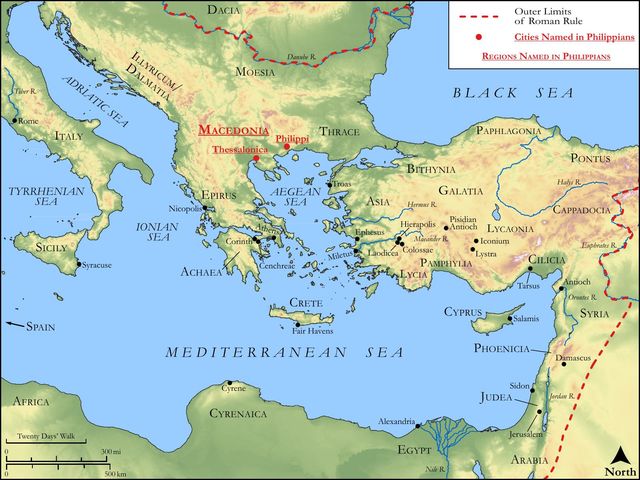
See on the biblical-era maps

Study this verse
Public-domain commentary
Matthew Henry
From his Commentary on the Whole Bible. Henry comments on passages, not single verses — this entry covers Philippians 1:27–30.
The apostle concludes the chapter with two exhortations: -
I.He exhorts them to strictness of conversation (Phi 1:27):
Only let your conversation be as becometh the gospel of Christ. Observe, Those who profess the gospel of Christ should have their conversation as becomes the gospel, or in a suitableness and agreeableness to it. Let it be as becomes those who believe gospel truths, submit to gospel laws, and depend upon gospel promises; and with an answerable faith, holiness, and comfort. Let it be in all respects as those who belong to the kingdom of God among men, and are members and subjects of it. It is an ornament to our profession when our conversation is of a piece with it. - That whether I come and see you, or else be absent, I may hear of your affairs. He had spoken in Phi 1:26 of his coming to them again, and had spoken it with some assurance, though he was now a prisoner; but he would not have them build upon that. Our religion must not be bound up in the hands of our ministers: "Whether I come or no, let me hear well of you, and do you stand fast." Whether ministers come or no, Christ is always at hand. He is nigh to us, never far from us; and hastens his second coming. The coming of the Lord draws nigh, Jam 5:8. Let me hear of you that you stand fast in one spirit, with one mind striving together for the faith of the gospel. Three things he desired to hear of them; and they are all such as become the gospel: - 1. It becomes those who profess the gospel to strive for it, to use a holy violence in taking the kingdom of heaven. The faith of the gospel is the doctrine of faith, or the religion of the gospel. There is that in the faith of the gospel which is worth striving for. If religion is worth any thing, it is worth every thing. There is much opposition, and there is need of striving. A man may sleep and go to hell; but he who will go to heaven must look about him and be diligent. 2. The unity and unanimity of Christians become the gospel: Strive together, not strive one with another; all of you must strive against the common adversary. One spirit and one mind become the gospel; for there is one Lord, one faith, one baptism. There may be a oneness of heart and affection among Christians, where there is diversity of judgment and apprehensions about many things. 3. Stedfastness becomes the gospel: Stand fast in one spirit, with one mind. Be stedfast and immovable by any opposition. It is a shame to religion when the professors of it are off and on, unfixed in their minds, and unstable as water; for they will never excel. Those who would strive for the faith of the gospel must stand firm to it.
II.He exhorts them to courage and constancy in suffering:
And in nothing terrified by your adversaries, Phi 1:28. The professors of the gospel have all along met with adversaries, especially at the first planting of Christianity. Our great care must be to keep close to our profession, and be constant to it: whatever oppositions we meet with, we must not be frightened at them, considering that the condition of the persecuted is much better and more desirable than the condition of the persecutors; for persecuting is an evident token of perdition. Those who oppose the gospel of Christ, and injure the professors of it, are marked out for ruin. But being persecuted is a token of salvation. Not that it is a certain mark; many hypocrites have suffered for their religion; but it is a good sign that we are in good earnest in religion, and designed for salvation, when we are enabled in a right manner to suffer for the cause of Christ. - For to you it is given on the behalf of Christ not only to believe, but also to suffer for his name, Phi 1:29. Here are two precious gifts given, and both on the behalf of Christ: - 1. To believe in him. Faith is God's gift on the behalf of Christ, who purchased for us not only the blessedness which is the object of faith, but the grace of faith itself: the ability or disposition to believe is from God. 2. To suffer for the sake of Christ is a valuable gift too: it is a great honour and a great advantage; for we may be very serviceable to the glory of God, which is the end of our creation, and encourage and confirm the faith of others. And there is a great reward attending it too: Blessed are you when men shall persecute you, for great is your reward in heaven, Mat 5:11, Mat 5:12. And, if we suffer with him, we shall also reign with him, Ti2 2:12. If we suffer reproach and loss for Christ, we are to reckon it a great gift, and prize it accordingly, always provided we behave under our sufferings with the genuine temper of martyrs and confessors (Phi 1:30): "Having the same conflict which you saw in me, and now hear to be in me; that is, suffering in the same manner as you saw and now hear of me that I suffer." It is not simply the suffering, but the cause, and not only the cause, but the spirit, which makes the martyr. A man may suffer in a bad cause, and then he suffers justly; or in a good cause, but with a wrong mind, and then his sufferings lose their value.
Historical interpretation
Seventeen Centuries of Reception
6 surviving comments on this verse. Each one is dated, so this reads as a timeline rather than a list.
Select a marker to jump to its quote. Markers stagger vertically where authors wrote within a few decades of each other.
For the things which are seen are temporal"-he is speaking of troubles; "but the things which are not seen are eternal"-he is promising rewards. But writing in bonds to the Thessalonians, he certainly affirmed that they were blessed, since to them it had been given not only to believe on Christ, but also to suffer for His sake.
It was therefore within his purpose that he gave to us the gift of trusting in him. This was an incomparable gift. It is only by faith in him that we are blessed with so great a reward. We are to believe in such a way as to be ready to suffer for him.
Although he extols the grace of Christ on many occasions, he offers a special kind of honor to the Philippians in this passage. He says: “God has allowed you to suffer for Christ.” He does not propose this distinction to any but true lovers of Christ. His paradoxical reasoning is that this gift “is given to you for Christ!” This means that God the Father gives this special gift to lovers of his Son. Why? That their blessings might increase correspondingly through their participation in suffering on Christ’s behalf. Paul speaks as one who himself has received this gift.
"For unto you it is given in the behalf of Christ, not only to believe on Him, but also to suffer in his behalf."
Again does he teach them moderation of spirit by referring all to God, and saying that sufferings in behalf of Christ are of grace, the gift of grace, a free gift. Be not then ashamed of the gift of grace, for it is more wonderful than the power of raising the dead, or working miracles; for there I am a debtor, but here I have Christ for my debtor. Wherefore ought we not only not to be ashamed, but even to rejoice, in that we have this gift. Virtues he calls gifts, yet not in like sort as other things, for those are entirely of God, but in these we have a share. But since even here the greatest part is of God, he ascribes it entirely to Him, not to overturn our free will, but to make us humble and rightly disposed.
Not only the beginning of our conversion but also the continuance of it through the endurance of suffering for it are gifts given to us by the Lord.
Which of the religions of the world gives to its followers the greatest happiness? While it lasts, the religion of worshiping oneself is the best. I have an elderly acquaintance of about eighty, who has lived a life of unbroken selfishness and self-admiration from the earliest years, and is, more or less, I regret to say, one of the happiest men I know. From the moral point of view it is very difficult! I am not approaching the question from that angle. As you perhaps know, I haven't always been a Christian. I didn't go to religion to make me happy. I always knew a bottle of port would do that. If you want a religion to make you feel really comfortable, I certainly don't recommend Christianity.
Continue studying Philippians 1:29 across the web’s major study libraries — every link below opens this exact verse, chapter, or book on the destination site.
Read & Compare
 BibleGatewayThis verse in more than 200 translations and 70 languages.
 Bible.comThe YouVersion reader — hundreds of translations, reading plans, and highlights.
 ESV.orgCrossway's official English Standard Version reader.
 NET BibleThe NET translation with 60,000+ translators' notes on every rendering decision.
 STEP BibleTyndale House's free study tool — original text, vocabulary, and scholarly resources.
 BibliaLogos Bible Software's free web reader.
 USCCBThe New American Bible (Revised Edition) with the U.S. bishops' study notes.
Commentaries
 BibleHub CommentariesDozens of classic commentaries on this verse, gathered on one page.
 StudyLightMore than 100 commentary sets — the largest collection on the web.
 BibleRefPlain-English commentary on what this verse means, verse by verse.
 Enduring WordDavid Guzik's free commentary on this chapter, widely used by Bible teachers.
 Bible Study ToolsVerse commentary alongside Greek and Hebrew study aids.
Original Language & Research
- BibleHub InterlinearThe verse word by word — original language, transliteration, and English.
- BibleHub LexiconEvery word's original-language definition and Strong's entry.
 Blue Letter BibleDeep-study tools — Strong's numbers, concordance, and word studies.
 CNTR CollationThe earliest Greek manuscripts of this verse, collated letter by letter.
Sermons, Hymns & Audio


TrulyRandomVerse is not affiliated with these sites and doesn’t control their content. They’re linked because they’re genuinely useful.
Summary
Philippians 1:29 unveils a profound theological truth, asserting that both the act of believing in Christ and the experience of suffering for His sake are divinely bestowed gifts. This verse challenges conventional human understanding by elevating hardship from a mere misfortune to a purposeful and gracious endowment from God, intended to deepen a believer's communion with Christ and advance the gospel.
Context
ShowHideLiterary Context
This verse is nestled within Paul's deeply personal and encouraging letter to the Philippian church, written while he was imprisoned, likely in Rome. Paul has just expressed his joy and confidence that his own imprisonment has, paradoxically, served to advance the gospel (Philippians 1:12-14). He then transitions to exhort the Philippians to live lives worthy of the gospel, standing firm and united against their adversaries (Philippians 1:27-28). Verse 29 directly follows this exhortation, providing the theological basis for their steadfastness: their suffering is not a sign of defeat but a divine privilege, aligning them with Christ and serving as evidence of their salvation.
Historical & Cultural Context
The Philippian church, situated in a Roman colony, would have understood the implications of Roman citizenship and the pressures of conforming to imperial cults. Early Christians often faced social ostracism, economic discrimination, and even legal persecution for their refusal to worship Roman gods or the emperor. Paul's own imprisonment serves as a vivid example of such suffering. The concept of suffering for one's faith was not abstract but a tangible reality for these believers, making Paul's assertion that this suffering is a "gift" particularly counter-cultural and impactful. It reframes their hardship within a divine, purposeful framework rather than as a random misfortune.
Key Themes
ShowHidePhilippians 1:29 contributes significantly to several overarching themes in the letter and broader New Testament. It reinforces the theme of Divine Sovereignty and Grace, asserting that even faith itself is not a human achievement but a gracious gift from God, echoing passages like Ephesians 2:8-9. It introduces the challenging but profound theme of Suffering as a Privilege, transforming hardship endured for Christ into an honor and a means of deeper fellowship with Him. This aligns with Paul's desire to know Christ and the fellowship of His sufferings (Philippians 3:10). The verse also underscores the Christ-Centeredness of the Christian life, as both belief and suffering are "in the behalf of Christ" and "for his sake," emphasizing that all aspects of the believer's existence are ultimately for His glory and the advancement of His kingdom.
Exposition and Analysis
ShowHideKey Word Analysis
ShowHideThis verb, derived from charis (grace), means "to grant as a favor," "to bestow freely," or "to show grace." Its use here emphatically conveys that both faith and suffering are not earned or merited by human effort but are gratuitous, unmerited endowments from God. This highlights the divine initiative and the gracious nature of the Christian experience.
To "have faith (in, upon, or with respect to, a person or thing)," or "to credit." By implication, it means "to entrust (especially one's spiritual well-being to Christ)." This word signifies a deep, active trust and commitment to Christ, not merely intellectual assent. Its inclusion as a "gift" underscores that saving faith itself is divinely enabled.
This primary verb means "to experience a sensation or impression," usually one that is painful. It encompasses enduring hardship, affliction, persecution, or distress. When linked with "for his sake," it specifically refers to the pain or difficulty experienced as a direct result of one's allegiance to Christ.
Verse Breakdown
ShowHide"For unto you it is given"
This opening phrase establishes the divine origin of what follows. The passive voice ("it is given") implies God as the active giver, emphasizing His sovereign grace and initiative in bestowing these spiritual realities upon the Philippians.
"in the behalf of Christ"
This crucial phrase clarifies the purpose and recipient of these gifts. Both the belief and the suffering are not for personal gain or random occurrence, but they serve the cause, person, and glory of Jesus Christ. They are experienced with Christ as their ultimate object and aim.
"not only to believe on him"
The first of the two gifts, foundational to salvation. This highlights that saving faith is not a human achievement but a gracious endowment from God, enabling one to place trust and reliance upon Christ. It underscores the supernatural nature of conversion.
"but also to suffer for his sake"
The second, and often more challenging, gift. This asserts that suffering endured because of one's identification with Christ is also a divine privilege. It is not a punishment or an accident, but a purposeful experience that allows believers to participate in Christ's own experiences and bear witness to His truth, ultimately for His honor.
Literary Devices
ShowHidePhilippians 1:29 masterfully employs Juxtaposition and Paradox by presenting belief and suffering as equally divine gifts. Typically, belief is seen as a blessing, while suffering is viewed as a curse or misfortune. Paul intentionally places these two seemingly opposite experiences side-by-side, revealing a profound spiritual truth: both are expressions of God's grace and integral to the Christian journey. The phrase "it is given" acts as a Divine Passive, subtly indicating God as the unseen agent behind these endowments. Furthermore, the repetition of the concept "in the behalf of Christ" and "for his sake" serves as a form of Emphasis, powerfully reinforcing the Christ-centered nature and ultimate purpose of the believer's life, including its trials.
Theological and Thematic Connections
ShowHideThis verse profoundly shapes our understanding of Christian discipleship, revealing that God's grace extends not only to our salvation but also to the very means by which we live out that salvation, even through hardship. It challenges the common notion that a blessed life is one devoid of suffering, instead proposing that suffering for Christ is a mark of divine favor and a means of deeper fellowship with Him. This perspective transforms suffering from a burden to be avoided into a privilege to be embraced, aligning believers with Christ's own path of suffering before glory. It underscores God's complete sovereignty over all aspects of a believer's life, including the trials they face, ensuring that even adversity serves His redemptive purposes.
Reflection and Application
ShowHidePhilippians 1:29 offers a radical reorientation of our perspective on faith and suffering. It calls us to recognize that our ability to believe in Christ is not a testament to our own intellect or will, but a gracious gift from God, humbling us and deepening our gratitude for salvation. More profoundly, it challenges us to view the hardships and persecutions we may face for our faith not as unfortunate accidents or divine punishments, but as purposeful, even privileged, experiences bestowed by God. This understanding can transform our response to adversity, enabling us to endure with joy and steadfastness, knowing that our struggles are not in vain but contribute to Christ's cause. It empowers us to find meaning in suffering, fostering a deeper intimacy with the Savior who Himself suffered.
Questions for Reflection
ShowHideFAQ
ShowHideDoes Philippians 1:29 mean Christians should seek out suffering?
ShowHideNo, Philippians 1:29 does not advocate for seeking out suffering for its own sake. Rather, it reframes the suffering that comes to believers because of their allegiance to Christ. The verse emphasizes that when hardship arises as a direct consequence of following Jesus—whether it's social ostracism, ridicule, or persecution—this particular kind of suffering is a divinely granted privilege. It's not about self-inflicted pain or martyrdom, but about understanding the spiritual significance and purpose of the opposition one naturally encounters when living faithfully for Christ in a fallen world. This perspective encourages endurance and joy in the face of such trials, knowing they are part of God's gracious plan for His children and serve the advancement of His kingdom (Matthew 5:10-12).
Christ-Centered Fulfillment
ShowHidePhilippians 1:29 finds its ultimate fulfillment and deepest meaning in the person and work of Jesus Christ. Our ability "to believe on him" is a gift because He is the very object and author of our faith, the one who perfectly demonstrated what it means to trust God implicitly, even unto death (Hebrews 12:2). Furthermore, the "suffering for his sake" is a profound participation in Christ's own redemptive journey. Jesus Himself, though sinless, suffered immensely "for our sake," bearing the penalty of sin and demonstrating perfect obedience through His passion and crucifixion (1 Peter 2:21-24). When believers suffer for Christ, they are not only identifying with His experience but also testifying to the power of His resurrection and the truth of His gospel. This suffering, therefore, is not a sign of weakness but a testament to the strength of Christ working within us, allowing us to complete what is lacking in Christ's afflictions for the sake of His body, the church (Colossians 1:24). Ultimately, both our faith and our suffering for Christ are designed to magnify His glory and demonstrate the transforming power of His finished work on the cross.