


2 Kings 9:10
Bible text: King James Version (1769 Blayney text) · Public domain
Bible text: Berean Standard Bible · Public domain
Bible text: American Standard Version (1901) · Public domain
Bible text: World English Bible, Messianic edition · Public domain
Bible text: Geneva Bible (1599) · Public domain
Bible text: Young's Literal Translation · Public domain
- וְאֶתve·'Etand <obj.>H853Conj-w ¦ DirObjMParticle Object Indicatorוְandאֶת<obj.>
- אִיזֶבֶל'i·Ze·velJezebelH348N-proper-fNoun Proper Feminine
- יֹאכְלוּyo·khe·Luthey will devourH398V-Qal-Imperf-3mpVerb Qal Imperfect 3rd Plural Masculine
- הַכְּלָבִיםha·ke·la·Vimthe dogsH3611Art ¦ N-mpNoun Plural Masculine Absoluteהַtheכְּלָבִיםdogs
- בְּחֵלֶקbe·Che·lekin [the] territory ofH2506Prep-b ¦ N-mscNoun Singular Masculine Constructבְּinחֵלֶק[the] territory of
- יִזְרְעֶאלyiz·re·'ElJezreelH3157N-properNoun Proper Location
- וְאֵיןve·'Einand there notH369Conj-w ¦ N-mscNoun Singular Masculine Constructוְandאֵיןthere not
- קֹבֵרko·Ver[will be one who] buries [her]H6912V-Qal-Prtcpl-msVerb Qal Participle Singular Masculine Absolute
- וַיִּפְתַּחvai·yif·Tachand he openedH6605Conj-w ¦ V-Qal-ConsecImperf-3msVerb Qal Consecutive Imperfect 3rd Singular Masculineוַandיִּפְתַּחhe opened
- הַדֶּלֶתha·De·letthe doorH1817Art ¦ N-fsNoun Singular Feminine Absoluteהַtheדֶּלֶתdoor
- וַיָּנֹסvai·ya·Nosand he fledH5127Conj-w ¦ V-Qal-ConsecImperf-3msVerb Qal Consecutive Imperfect 3rd Singular Masculineוַandיָּנֹסhe fled
English is a literal word-by-word gloss of the Hebrew, not the KJV's wording. Why?
This is the original text the KJV's translators worked from — each Hebrew word with its own literal English meaning in this verse, prepared by scholars at Tyndale House, Cambridge. The KJV translates whole sentences, not word by word, so its wording differs: one Hebrew word can become several English words, and the KJV may choose “the LORD” where the gloss reads “Yahweh”. Both are faithful — they answer different questions. For the KJV's own rendering, switch to the KJV text.
Details
See on the biblical-era maps
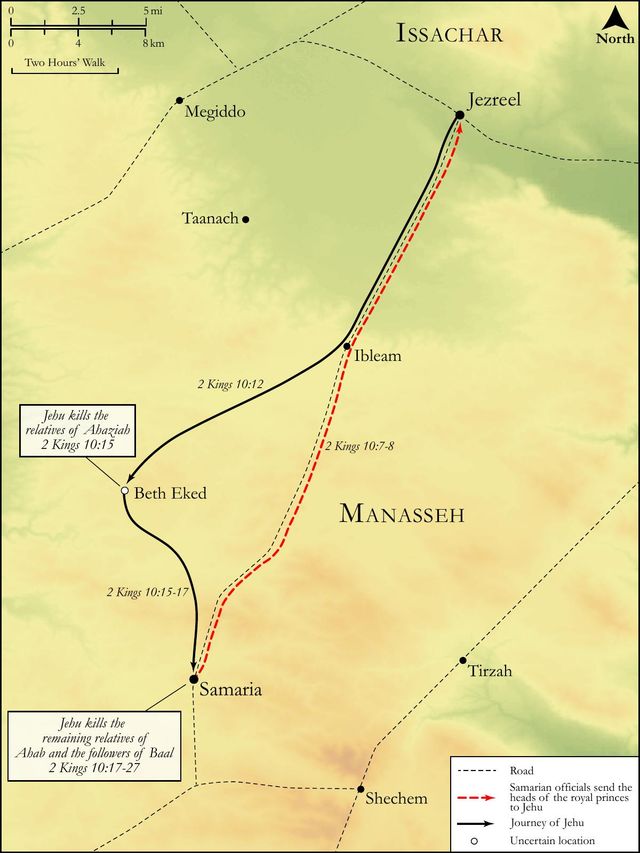
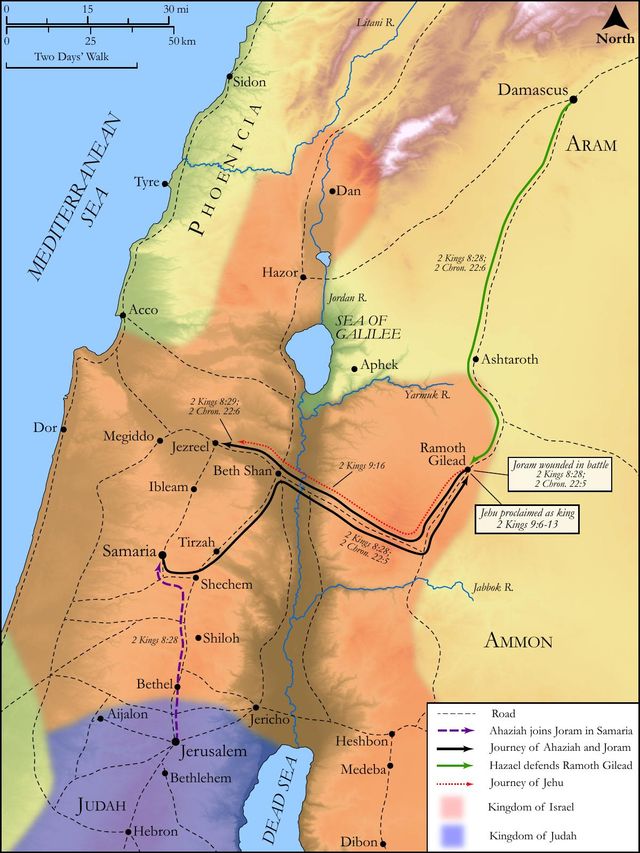
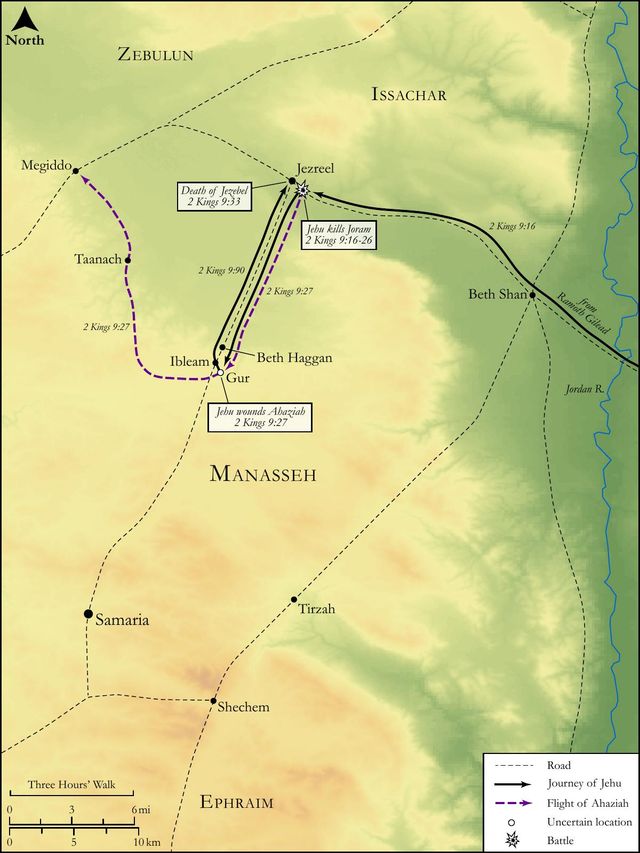
Study this verse
Public-domain commentary
Matthew Henry
From his Commentary on the Whole Bible. Henry comments on passages, not single verses — this entry covers 2 Kings 9:1–10. His four-level outline is real structure in the source text, so it is rendered as structure.
We have here the anointing of Jehu to be king, who was, at this time, a commander (probably commander-in-chief) of the forces employed at Ramoth-Gilead, Kg2 9:14. There he was fighting for the king his master, but received orders from a higher king to fight against him. It does not appear that Jehu aimed at the government, or that he ever thought of it, but the commission given him was a perfect surprise to him. Some think that he had been anointed before by Elijah, whom God ordered to do it, but privately, and with an intimation that he must not act till further orders, as Samuel anointed David long before he was to come to the throne: but that it not at all probable, for then we must suppose Elijah had anointed Hazael too. No, when God bade him do these things he bade him anoint Elisha to be prophet in his room, to do them when he was gone, as God should direct him. Here is,
I.The commission sent.
1.Elisha did not go himself to anoint Jehu, because he was old and unfit for such a journey and so well known that he could not do it privately, could not go and come without observation; therefore he sends one of the sons of the prophets to do it, Kg2 9:1. They not only reverences him as their father (Kg2 2:15), but observed and obeyed him as their father. This service of anointing Jehu,
(1.)Had danger in it (Sa1 16:2), and therefore it was not fit that Elisha should expose himself, but one of the sons of the prophets, whose life was of less value, and who could do it with less danger.
(2.)It required labour and was therefore fitter for a young man in his full strength. Let youth work and age direct.
(3.)Yet it was an honourable piece of service, to anoint a king, and he that did it might hope to be preferred for it afterwards, and therefore, for the encouragement of the young prophets, Elisha employed one of them: he would not engross all the honours to himself, nor grudge the young prophets a share in them.
2.When he sent him,
(1.)He put the oil into his hand with which he must anoint Jehu: Take this box of oil Solomon was anointed with oil out of the tabernacle, Kg1 1:39. That could not now be had, but oil from a prophet's hand was equivalent to oil out of God's house. Probably it was not the constant practice to anoint kings, but upon the disturbance of the succession, as in the case of Solomon, or the interruption of it, as in the case of Joash (Kg1 11:12), or the translation of the government to a new family, as here and in the case of David; yet it might be used generally, though the scripture does not mention it.
(2.)He put the words into his mouth which he must say (Kg2 9:3) - I have anointed thee king, and, no doubt, told him all the rest that he said, Kg2 9:7-10. Those whom God sends on his errands shall not go without full instructions.
(3.)He also ordered him,
[1.]To do it privately, to single out Jehu from the rest of the captains and anoint him in an inner chamber (Kg2 9:2), that Jehu's confidence in his commission might be tried, when he had no witness to attest it. His being suddenly animated for the service would be proof sufficient of his being anointed to it. There needed no other proof. The thing signified was the best evidence of the sign.
[2.]To do it expeditiously. When he went about it he must gird up his loins; when he had done it he must flee and not tarry for a fee, or a treat, or to see what Jehu would do. It becomes the sons of the prophets to be quick and lively at their work, to go about it and go through it as men that hate sauntering and trifling. They should be as angels that fly swiftly.
II.The commission delivered.
The young prophet did his business with despatch, was at Ramoth-Gilead presently, Kg2 9:4. There he found the general officers sitting together, either at dinner or in a council of war, Kg2 9:5. With the assurance that became a messenger from God, notwithstanding the meanness of his appearance, he called Jehu out from the rest, not waiting his leisure, or begging his pardon for disturbing him, but as one having authority: I have an errand to thee, O captain. Perhaps Jehu had some intimation of his business; and therefore, that he might not seem too forward to catch at the honour, he asked, To which of all us? that it might not be said afterwards he got it by speaking first, but they might all be satisfied he was indeed the person designed. When the prophet had him alone he anointed him, Kg2 9:6. The anointing of the Spirit is a hidden thing, that new name which none knows but those that have it. Herewith,
1.He invests him with the royal dignity: Thus saith the Lord God of Israel, whose messenger I am, in his name I have anointed thee king over the people of the Lord. He gives him an incontestable title, but reminds him that he was made king,
(1.)By the God of Israel; from him he must see his power derived (for by him kings reign), for he must use it, and to him he must be accountable. Magistrates are the ministers of God, and must therefore act in dependence upon him and with an entire devotedness to him and to his glory.
(2.)Over the Israel of God. Though the people of Israel were wretchedly corrupted, and had forfeited all the honour of relationship to God, yet they are here called the people of the Lord, for he had a right to them and had not yet given them a bill of divorce. Jehu must look upon the people he was made king of as the people of the Lord, not as his vassals, but God's freemen, his sons, his first-born, not to be abused or tyrannized over, God's people, and therefore to be ruled for him, and according to his laws.
2.He instructs him in his present service, which was to destroy all the house of Ahab (Kg2 9:7), not that he might clear his own way to the throne, and secure to himself the possession of it, but that he might execute the judgments of God upon that guilty and obnoxious family. He calls Ahab his master, that the relation might be no objection. "He was thy master, and to lift up thy hand against his son and successor would be not only base ingratitude, but treason, rebellion, and all that is bad, if thou hadst not an immediate command from God to do it. But thou art under higher obligations to thy Master in heaven than to thy master Ahab. He has determined that the whole house of Ahab shall perish, and by thy hand; fear not: has not he commanded thee? Fear not sin; his command will justify thee and bear thee out: fear not danger; his command will secure and prosper thee." That he might intelligently, and in a right manner, do this great execution on the house of Ahab, he tells him,
(1.)What was their crime, what the ground of the controversy, and wherefore God had quarrel with them, that he might have an eye to that which God had an eye to, and that was the blood of God's servants, the prophets and others, faithful worshippers, which they had shed, and which must now be required at the hand of Jezebel. That they were idolaters was bad enough, and merited all that was brought upon them; yet that is not mentioned here, but the controversy God has with them is for their being persecutors, not so much their throwing down God's altars as their slaying his prophets with the sword. Nothing fills the measure of the iniquity of any prince or people as this does nor brings a surer or a sorer ruin. This was the sin that brought on Jerusalem its first destruction (Ch2 36:16) and its final one, Mat 23:37, Mat 23:38. Jezebel's whoredoms and witchcrafts were not so provoking as her persecuting the prophets, killing some and driving the rest into corners and caves, Kg1 18:4.
(2.)What was their doom. They were sentenced to utter destruction; not to be corrected, but to be cut off and rooted out. This Jehu must know, that his eye might not spare for pity, favour, or affection. All that belonged to Ahab must be slain, Kg2 9:8. A pattern is given him of the destruction intended, in the destruction of the families of Jeroboam and Baasha (Kg2 9:9), and he is particularly directed to throw Jezebel to the dogs, Kg2 9:10. The whole stock of royal blood was little enough, and too little, to atone for the blood of the prophets, the saints and martyrs, which, in God's account, is of great price.
The prophet, having done this errand, made the best of his way home again, and left Jehu alone to consider what he had to do and beg direction from God.
Historical interpretation
Historical reception
1 surviving comment on this verse from the historical church.
“Then the prophet Elisha called a member of the company of prophets and said to him, ‘Gird up your loins; take this flask of oil in your hand, and go to Ramoth-gilead.’ ” Here the Scripture reports the just sentence that befalls the house of Ahab. Immediately it speaks about the choice of the judge and executor of the judgment. And this was Jehu, the son of Nimshi, who, on the word of the Lord, anointed one of the prophets for the royalty. And this was the disciple of Elisha who was sent by his master to the city of Ramoth-gilead, which was under the siege of the Israelites. He entered their camp and went to the tent where the commanders of the army gathered and standing before them, he naively said, “I have a message for you, commander.” Jehu said in reply, “For which one of us?” The servant realized that he was the one indicated by Elisha. In fact, he did not know his name, but even though the son of the prophet did not know him nor had ever seen him, he saw the importance of this situation, and his mind was troubled, so that he said, “For you, commander.” He showed that through the revelation of God he had realized that he was the one chosen by God. And immediately he took him into an inner chamber, according to the order of his master. And two things were also hidden: Jehu understood that that affair had to remain secret and that the news [of the anointing] should not be divulged at that time among the people. Therefore he anointed him and ordered him to take revenge against the house of Ahab. Then the prophet fled at once from the camp, and shortly later the entire assembly was in an admirable unanimity before king Jehu against Israel.So he went out with a group of select men. But he met Joram, king of Israel, in the course of his journey, and little later Ahaziah, king of Judah. He was able to defeat them after the first attack and killed them both. Jehu said to Bidkar, “ ‘Lift him out, and throw him on the plot of ground belonging to Naboth the Jezreelite,’ because last night I saw the blood of Naboth and the blood of his children.” He is thinking here about what had been said to him at night, or maybe he believes that this vengeance and the fact that he would kill Joram had been predicted to him at night through a vision. Jehu had also indicated to Bidkar another reason for killing Joram in his place and for ordering him to throw him on the plot of Naboth, saying, “When you and I rode side by side behind his father Ahab how the Lord uttered this oracle against him: ‘For the blood of Naboth and for the blood of his children that I saw yesterday, says the Lord, I swear I will repay you on this very plot of ground,’ ” that is, outside the walls of Jezreel where the goods of Naboth were. After this action accomplished outside the gates of Jezreel, he entered the city to complete what he had successfully begun.
Continue studying 2 Kings 9:10 across the web’s major study libraries — every link below opens this exact verse, chapter, or book on the destination site.
Read & Compare
 BibleGatewayThis verse in more than 200 translations and 70 languages.
 Bible.comThe YouVersion reader — hundreds of translations, reading plans, and highlights.
 ESV.orgCrossway's official English Standard Version reader.
 NET BibleThe NET translation with 60,000+ translators' notes on every rendering decision.
 STEP BibleTyndale House's free study tool — original text, vocabulary, and scholarly resources.
 BibliaLogos Bible Software's free web reader.
 USCCBThe New American Bible (Revised Edition) with the U.S. bishops' study notes.
Commentaries
 BibleHub CommentariesDozens of classic commentaries on this verse, gathered on one page.
 StudyLightMore than 100 commentary sets — the largest collection on the web.
 BibleRefPlain-English commentary on what this verse means, verse by verse.
 Enduring WordDavid Guzik's free commentary on this chapter, widely used by Bible teachers.
 Bible Study ToolsVerse commentary alongside Greek and Hebrew study aids.
Original Language & Research
- BibleHub InterlinearThe verse word by word — original language, transliteration, and English.
- BibleHub LexiconEvery word's original-language definition and Strong's entry.
 Blue Letter BibleDeep-study tools — Strong's numbers, concordance, and word studies.
 SefariaThe Hebrew text with Rashi and centuries of Jewish commentary.
Sermons, Hymns & Audio


TrulyRandomVerse is not affiliated with these sites and doesn’t control their content. They’re linked because they’re genuinely useful.
Summary
Second Kings 9:10 delivers a chilling and precise divine judgment against Jezebel, the notorious queen of Israel, declaring that dogs would devour her body within the confines of Jezreel and that she would be denied a proper burial. This pronouncement, delivered by a young prophet to Jehu during his anointing as king, serves as a direct fulfillment of Elijah's earlier prophecy and underscores God's unwavering justice against persistent wickedness, idolatry, and the persecution of His prophets. The verse immediately transitions to the prophet's swift departure, signaling the urgency and divine authority behind Jehu's commission to eradicate the house of Ahab.
Context
ShowHideLiterary Context
This verse is situated at a dramatic turning point in the narrative of 2 Kings, following the detailed account of Elisha's instruction to one of the sons of the prophets to anoint Jehu as king over Israel in 2 Kings 9:1-3. The prophet's charge to Jehu is explicit and urgent: to "strike down the house of Ahab your master, so that I may avenge the blood of my servants the prophets and the blood of all the servants of the Lord shed by the hand of Jezebel" (2 Kings 9:7). Verse 10, therefore, is not merely a prediction but a divinely ordained sentence, a specific and gruesome detail of the judgment to come, immediately preceding Jehu's decisive action to fulfill this commission. His mission begins with the assassination of Joram, the reigning king, and Ahaziah, the king of Judah, as detailed in 2 Kings 9:21-28. The prophet's hasty departure at the very end of the verse emphasizes the urgency, secrecy, and divine authority of the mandate, leaving Jehu to immediately act upon the weighty pronouncement.
Historical & Cultural Context
Jezebel, a Phoenician princess and wife of King Ahab, was a fervent worshipper of Baal and Asherah, notorious for introducing and aggressively promoting these idolatrous cults in Israel (1 Kings 16:31-33). Her influence led to widespread apostasy and the persecution and murder of the Lord's prophets (1 Kings 18:4). Furthermore, her manipulation and orchestration of Naboth's murder to seize his vineyard (1 Kings 21:7-16) cemented her reputation for ruthless wickedness and contempt for divine law. In Israel, a proper burial was paramount, as Abraham's purchase of the cave of Machpelah for Sarah and Jacob's charge to be buried with his fathers show, signifying dignity and honor. To be left unburied or to have one's body desecrated by scavengers was considered the ultimate disgrace, a profound curse, and a sign of divine rejection, often reserved for the most heinous criminals or enemies of the state. Jezreel, where this fate was to occur, was a significant royal city and a place where Jezebel had exercised her power and corruption, making it a fitting location for her ignominious end.
Key Themes
ShowHideThe primary themes interwoven in 2 Kings 9:10 are divine judgment and justice, demonstrating God's unwavering commitment to hold even the most powerful accountable for their rebellion and wickedness. Jezebel's gruesome end is a direct consequence of her persistent idolatry, persecution of prophets, and moral depravity, serving as a stark example of the ultimate outcome of unrepentant sin. Another crucial theme is prophetic fulfillment, as this verse explicitly brings to pass the detailed prophecy delivered by Elijah in 1 Kings 21:23, affirming the absolute certainty and reliability of God's word. The swift and precise execution of this judgment underscores God's sovereignty over human affairs and history, revealing that His declarations are not mere threats but certain realities. Finally, the ignominious nature of Jezebel's death highlights the theme of dishonor and disgrace as a divine consequence for those who defy the living God and oppress His people.
Exposition and Analysis
ShowHideKey Word Analysis
ShowHideThe name of Ahab's notorious queen (H348), originally a Phoenician princess, whose character is consistently portrayed as fiercely idolatrous, manipulative, and murderous. Her specific mention here underscores that this judgment is personal and precise, targeting the architect of much of Israel's spiritual decline and the persecution of God's prophets.
In ancient Israel, dogs (H3611) were generally not domesticated pets but rather scavenging animals, often associated with impurity, wildness, and contempt. To be eaten by dogs was a deeply humiliating and disgraceful fate, a public display of utter rejection and a denial of the dignity of burial. This detail emphasizes the severity of the divine curse and the ignominy of Jezebel's end, contrasting sharply with her former royal status and power.
The primitive root (H6912) meaning "to inter." The absence of burial was a profound curse in Israel, one named among the penalties of disobedience in Deuteronomy 28, signifying a complete lack of honor and respect. It meant the body was left exposed to the elements and scavengers, denying the deceased the peace and dignity afforded by traditional funerary rites. This detail in the prophecy signifies Jezebel's utter rejection by God and man, sealing her fate as one who died without honor or remembrance.
Verse Breakdown
ShowHide"And the dogs shall eat Jezebel in the portion of Jezreel,"
This clause delivers the core of the prophecy regarding Jezebel's gruesome demise. The active verb "shall eat" (יֹאכְלוּ, yo'khlu) highlights the certainty and immediacy of the judgment. The specific location, "in the portion of Jezreel," emphasizes the precision of the divine word, linking her judgment to the very place where she had exerted her wicked influence and where Naboth's murder had occurred. This detail ensures that the fulfillment would be undeniably recognizable as God's doing, a direct consequence of her actions in that very vicinity.
"and [there shall be] none to bury [her]."
This second part of the prophecy underscores the ultimate indignity and curse upon Jezebel. The phrase "none to bury her" signifies a complete denial of the customary funerary rites and the honor associated with a proper burial in Israel. Her body would be left exposed and desecrated, a public spectacle of divine wrath and human contempt, signifying her utter rejection and the finality of her disgrace. This aspect of the prophecy was particularly horrifying in a culture that placed immense value on proper burial.
"And he opened the door, and fled."
This concluding phrase shifts the focus from Jezebel's fate to the immediate action of the young prophet who delivered the message to Jehu. His swift departure emphasizes the urgency, secrecy, and divine authority of the commission given to Jehu. It marks the end of the prophetic encounter and the beginning of Jehu's bloody mission, highlighting the immediate transition from divine word to human action in the unfolding of God's sovereign plan. The prophet's quick exit also serves to protect him from any potential repercussions from the newly commissioned king or his allies.
Literary Devices
ShowHide2 Kings 9:10 employs several potent literary devices to convey its message with chilling clarity and theological depth. Foreshadowing is prominent, as the verse directly fulfills the prophecy spoken by Elijah in 1 Kings 21:23, demonstrating the long-term certainty and reliability of divine judgment. The gruesome imagery of dogs devouring Jezebel's body and the denial of burial functions as powerful symbolism, representing ultimate disgrace, divine curse, and the complete reversal of her former royal status and power. This vivid imagery also creates a stark contrast between Jezebel's life of luxury and power and her ignominious end. Furthermore, there is a strong element of irony in her fate; the woman who orchestrated the murder of Naboth to seize his land in Jezreel ultimately suffers her own undignified end in the very same vicinity, a testament to the principle of divine retribution. The abrupt ending of the prophet's interaction with Jehu, "And he opened the door, and fled," serves as a literary device to create a sense of urgency and the immediate transition from divine command to human action, propelling the narrative forward with dramatic swiftness.
Theological and Thematic Connections
ShowHide2 Kings 9:10 powerfully articulates the unwavering nature of God's justice and the certainty of His prophetic word. It serves as a profound theological statement that no one, regardless of their power or status, is beyond the reach of divine judgment when they persist in rebellion, idolatry, and the persecution of God's people. Jezebel's fate is a vivid illustration that God sees, remembers, and ultimately acts upon the wickedness committed in His sight, fulfilling His promises of both blessing and curse. This passage affirms God's sovereignty over history and human destiny, demonstrating that His declared will, even decades later, will come to pass with precise and undeniable execution, serving as a solemn warning to all who defy His righteous standards.
Reflection and Application
ShowHideThe grim prophecy concerning Jezebel in 2 Kings 9:10 offers profound lessons for contemporary believers. It serves as a stark reminder that God is not mocked; His justice, though sometimes delayed, is absolutely certain and meticulously executed. This passage compels us to consider the long-term consequences of our actions, particularly those rooted in persistent rebellion against God's commands, promotion of idolatry (whether literal or spiritual), and the oppression of the righteous. Jezebel's end cautions against the deceptive allure of power and influence when divorced from righteousness and accountability to God. Her story is a powerful testament to the truth that ultimately, all human authority is subject to divine authority, and those who wield power unjustly will face a reckoning. Furthermore, it reinforces the absolute trustworthiness of God's Word; if His prophecies concerning judgment are fulfilled with such precision, how much more certain are His promises of salvation, grace, and eternal life for those who turn to Him? We are called to live lives of humble obedience, recognizing that our ultimate destiny is shaped by our response to God's truth and His call to holiness, seeking to honor Him in all our ways rather than pursuing self-serving ambitions.
Questions for Reflection
ShowHideFAQ
ShowHideWhy was Jezebel's body eaten by dogs, and why was this considered such a severe punishment?
ShowHideJezebel's body being eaten by dogs was a deliberate and deeply symbolic act of divine judgment, considered one of the most severe forms of punishment and disgrace in Israel. Dogs in that context were often scavengers, associated with impurity and contempt. To be denied a proper burial and have one's body consumed by wild dogs was the ultimate indignity, signifying that the person was utterly rejected by both God and society. It meant their memory would be cursed and their legacy dishonored, denying them the common human dignity of a proper interment. This specific fate was prophesied by Elijah in 1 Kings 21:23 as a direct consequence of her heinous sins, including promoting Baal worship, persecuting God's prophets, and orchestrating Naboth's murder to seize his vineyard (1 Kings 21:7-16). It was a public display of God's righteous wrath against her persistent wickedness and a vivid demonstration that divine justice would prevail.
Christ-Centered Fulfillment
ShowHideWhile 2 Kings 9:10 vividly portrays God's righteous judgment against sin and the precise fulfillment of prophecy, its Christ-centered fulfillment is found not in the execution of judgment but in the ultimate triumph over the powers of sin and death that necessitated such judgment. Jezebel's ignominious end, a consequence of her rebellion and idolatry, foreshadows the finality of God's judgment against all unrighteousness, a judgment ultimately executed by Christ. The certainty of Elijah's prophecy being fulfilled points to the even greater certainty of God's promises concerning His Son. Jesus, the true King, came not to bring immediate, violent judgment upon the wicked, but to offer salvation through His atoning sacrifice, becoming the Lamb of God who takes away the sin of the world. He absorbed the curse of sin and death on the cross, ensuring that those who believe in Him will not face the ultimate disgrace of eternal separation from God, but will receive a glorious resurrection and eternal life (Romans 6:23). Furthermore, Christ's resurrection from the dead, unlike Jezebel's desecrated body, guarantees a future resurrection for all believers, securing their eternal dignity and honor in God's presence (1 Corinthians 15:20-22). Ultimately, the judgment against Jezebel, a type of the world's rebellion, finds its ultimate resolution in Christ's final victory over sin, death, and all evil, ensuring that every prophecy concerning God's justice and salvation will be fulfilled through Him, culminating in the Great White Throne Judgment where all unrighteousness is finally put away.