


2 Kings 9:11
Bible text: King James Version (1769 Blayney text) · Public domain
Bible text: King James Version with Strong's numbers · Public domain
Bible text: Berean Standard Bible · Public domain
Bible text: American Standard Version (1901) · Public domain
Bible text: World English Bible, Messianic edition · Public domain
Bible text: Geneva Bible (1599) · Public domain
Bible text: Young's Literal Translation · Public domain
- וְיֵהוּאve·ye·Hu'and JehuH3058Conj-w ¦ N-proper-mNoun Proper MasculineוְandיֵהוּאJehu
- יָצָאya·Tza'he went outH3318V-Qal-Perf-3msVerb Qal Perfect 3rd Singular Masculine
- אֶל'eltoH413PrepPreposition
- עַבְדֵי'av·Dei[the] servants ofH5650N-mpcNoun Plural Masculine Construct
- אֲדֹנָיו'a·do·Navhis master<s>H113N-mpc ¦ 3msNoun Plural Masculine Constructאֲדֹנָיmaster<s>וhis
- וַיֹּאמֶרvai·Yo·merand someone saidH559Conj-w ¦ V-Qal-ConsecImperf-3msVerb Qal Consecutive Imperfect 3rd Singular Masculineוַandיֹּאמֶרsomeone said
- לוֹloto himPrep-l ¦ 3msSuffix Personal 3rd Singular Masculineלtoוֹhim
- הֲשָׁלוֹםha·sha·Lom¿ peaceH7965Interrog ¦ N-msNoun Singular Masculine Absoluteהֲ¿שָׁלוֹםpeace
- מַדּוּעַma·Du·a'why?H4069InterrogParticle Interrogative
- בָּאba'did he comeH935V-Qal-Perf-3msVerb Qal Perfect 3rd Singular Masculine
- הַמְשֻׁגָּעham·shu·Ga'the mad [man]H7696Art ¦ V-Pual-PassPrtcpl-msVerb Pual Participle Passive Singular Masculine Absoluteהַtheמְשֻׁגָּעmad [man]
- הַזֶּהha·Zeh<the> thisH2088Art ¦ PrtParticle Demonstrativeהַ<the>זֶּהthis
- אֵלֶיךָ'e·Lei·khato youH413Prep ¦ 2msPrepositionאֵלֶיtoךָyou
- וַיֹּאמֶרvai·Yo·merand he saidH559Conj-w ¦ V-Qal-ConsecImperf-3msVerb Qal Consecutive Imperfect 3rd Singular Masculineוַandיֹּאמֶרhe said
- אֲלֵיהֶם'a·lei·Hemto themH413Prep ¦ 3mpPrepositionאֲלֵיtoהֶםthem
- אַתֶּם'a·TemyouH859Pro-2mpPronoun Personal 2nd Plural Masculine
- יְדַעְתֶּםye·da'·Temyou knowH3045V-Qal-Perf-2mpVerb Qal Perfect 2nd Plural Masculine
- אֶת'et<obj.>H853DirObjMParticle Object Indicator
- הָאִישׁha·'Ishthe manH376Art ¦ N-msNoun Singular Masculine Absoluteהָtheאִישׁman
- וְאֶתve·'Etand <obj.>H853Conj-w ¦ DirObjMParticle Object Indicatorוְandאֶת<obj.>
- שִׂיחוֹsi·Chohis talkH7879N-msc ¦ 3msNoun Singular Masculine Constructשִׂיחtalkוֹhis
English is a literal word-by-word gloss of the Hebrew, not the KJV's wording. Why?
This is the original text the KJV's translators worked from — each Hebrew word with its own literal English meaning in this verse, prepared by scholars at Tyndale House, Cambridge. The KJV translates whole sentences, not word by word, so its wording differs: one Hebrew word can become several English words, and the KJV may choose “the LORD” where the gloss reads “Yahweh”. Both are faithful — they answer different questions. For the KJV's own rendering, switch to the KJV text.
Details
See on the biblical-era maps

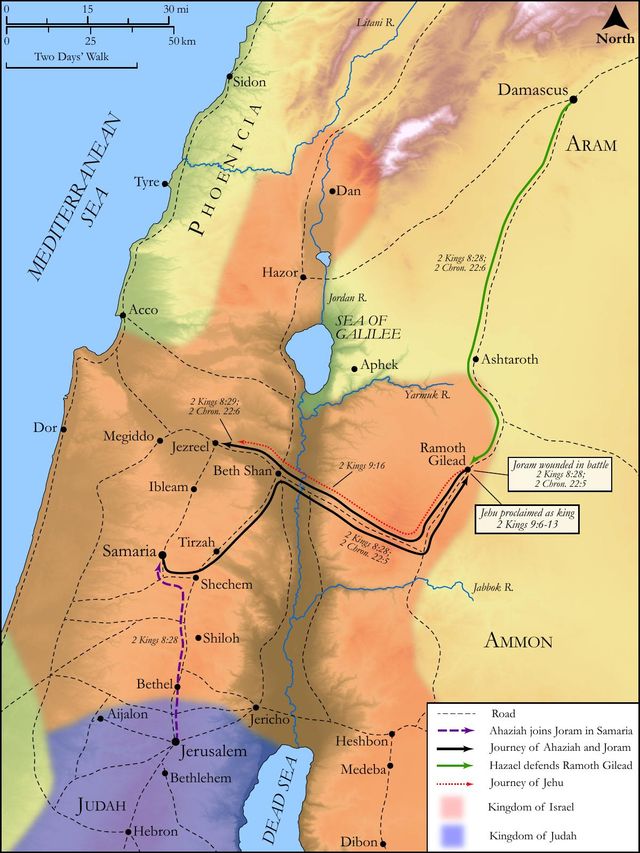
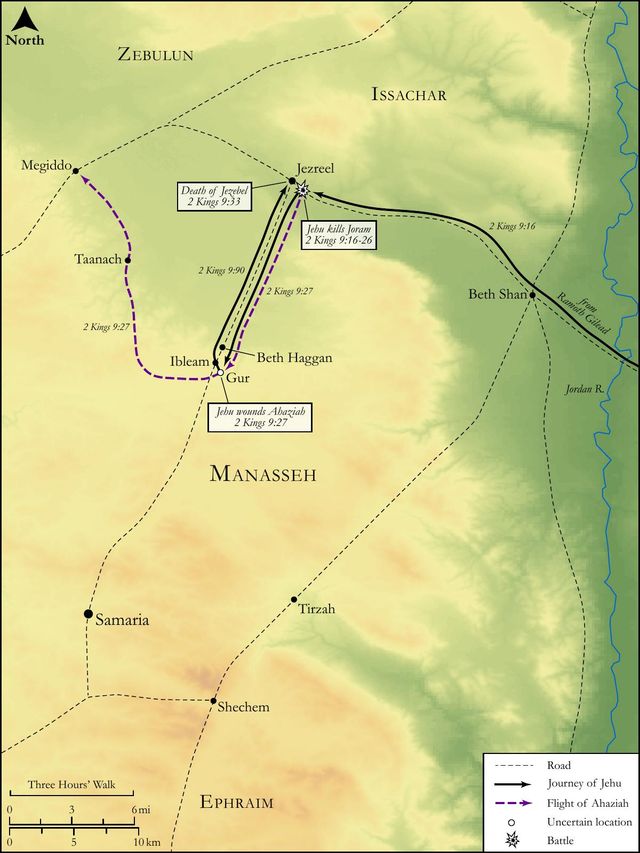
Study this verse
Public-domain commentary
Matthew Henry
From his Commentary on the Whole Bible. Henry comments on passages, not single verses — this entry covers 2 Kings 9:11–15.
Jehu, after some pause, returned to his place at the board, taking no notice of what had passed, but, as it should seem, designing, for the present, to keep it to himself, if they had not urged him to disclose it. Let us therefore see what passed between him and the captains.
I.With what contempt the captains speak of the young prophet (Kg2 9:11):
"Wherefore came this mad fellow to thee? What business had he with thee? And why wouldst thou humour him so far as to retire for conversation with him? Are prophets company for captains?" They are called him a mad fellow, because he was one of those that would not run with them to an excess of riot (Pe1 4:4), but lived a life of self-denial, mortification, and contempt of the world, and spent their time in devotion; for these things they thought the prophets were fools and the spiritual men were mad, Hos 9:7. Note, Those that have no religion commonly speak with disdain of those that are religious, and look upon them as mad. They said of our Saviour, He is beside himself, of John Baptist, He has a devil (is a poor melancholy man), of St. Paul, Much learning has made him mad. The highest wisdom is thus represented as folly, and those that best understand themselves are looked upon as beside themselves. Perhaps Jehu intended it for a rebuke to his friends when he said, "You know the man to be a prophet, why then do you call him a mad fellow? You know the way of his communication to be not from madness, but inspiration." Or, "Being a prophet, you may guess what his business is, to tell me of my faults, and to teach me my duty; I need not inform you concerning it." Thus he thought to put them off, but they urged him to tell them. "It is false," say they, "we cannot conjecture what was his errand, and therefore tell us." Being thus pressed to it, he told them that the prophet had anointed him king, and it is probable showed them the oil upon his head, Kg2 9:12. He knew not but some of them either out of loyalty to Joram or envy of him, might oppose him, and go near to crush his interest in its infancy; but he relied on the divine appointment, and was not afraid to own it, knowing whom he had trusted: he that raised him would stand by him.
II.With what respect they compliment the new king upon the first notice of his advancement, Kg2 9:13.
How meanly soever they thought of the prophet that anointed him, and of his office, they expressed a grat veneration for the royal dignity of him that was anointed, and were very forward to proclaim him and sound of trumpet. In token of their subjection and allegiance to him, their affection to his person and government, and their desire to see him high and easy in it, they put their garments under him, that he might stand or sit upon them on the top of the stairs, in sight of the soldiers, who, upon the first intimation, came together to grace the solemnity. God put it into their hearts thus readily to own him, for he turns the hearts of people as well as kings, like the rivers of water, into what channel he pleases. Perhaps they were disquieted at Joram's government or had a particular affection for Jehu; or, however this might be, things it seems were ripe for the revolution, and they all came into Jehu's interest and conspired against Joram, Kg2 9:14.
III.With what caution Jehu proceeded.
He had advantages against Joram, and he knew how to improve them. He had the army with him. Joram had left it, and had gone home badly wounded. Jehu's good conduct appears in two things: - 1. That he complimented the captains, and would do nothing without their advice and consent ("If it be your minds, we will do so and so, else not"), thereby intimating the deference he paid to their judgment and the confidence he had in their fidelity, both which tended to please and fix them. It is the wisdom of those that would rise fast, and stand firm, to take their friends along with them. 2. That he contrived to surprise Joram; and, in order thereto, to come upon him with speed, and to prevent his having notice of what was now done: "Let none go forth to tell it in Jezereel, that, as a snare, the ruin may come on him and his house." The suddenness of an attack sometimes turns to as good an account as the force of it.
Historical interpretation
Historical reception
1 surviving comment on this verse from the historical church.
“Then the prophet Elisha called a member of the company of prophets and said to him, ‘Gird up your loins; take this flask of oil in your hand, and go to Ramoth-gilead.’ ” Here the Scripture reports the just sentence that befalls the house of Ahab. Immediately it speaks about the choice of the judge and executor of the judgment. And this was Jehu, the son of Nimshi, who, on the word of the Lord, anointed one of the prophets for the royalty. And this was the disciple of Elisha who was sent by his master to the city of Ramoth-gilead, which was under the siege of the Israelites. He entered their camp and went to the tent where the commanders of the army gathered and standing before them, he naively said, “I have a message for you, commander.” Jehu said in reply, “For which one of us?” The servant realized that he was the one indicated by Elisha. In fact, he did not know his name, but even though the son of the prophet did not know him nor had ever seen him, he saw the importance of this situation, and his mind was troubled, so that he said, “For you, commander.” He showed that through the revelation of God he had realized that he was the one chosen by God. And immediately he took him into an inner chamber, according to the order of his master. And two things were also hidden: Jehu understood that that affair had to remain secret and that the news [of the anointing] should not be divulged at that time among the people. Therefore he anointed him and ordered him to take revenge against the house of Ahab. Then the prophet fled at once from the camp, and shortly later the entire assembly was in an admirable unanimity before king Jehu against Israel.So he went out with a group of select men. But he met Joram, king of Israel, in the course of his journey, and little later Ahaziah, king of Judah. He was able to defeat them after the first attack and killed them both. Jehu said to Bidkar, “ ‘Lift him out, and throw him on the plot of ground belonging to Naboth the Jezreelite,’ because last night I saw the blood of Naboth and the blood of his children.” He is thinking here about what had been said to him at night, or maybe he believes that this vengeance and the fact that he would kill Joram had been predicted to him at night through a vision. Jehu had also indicated to Bidkar another reason for killing Joram in his place and for ordering him to throw him on the plot of Naboth, saying, “When you and I rode side by side behind his father Ahab how the Lord uttered this oracle against him: ‘For the blood of Naboth and for the blood of his children that I saw yesterday, says the Lord, I swear I will repay you on this very plot of ground,’ ” that is, outside the walls of Jezreel where the goods of Naboth were. After this action accomplished outside the gates of Jezreel, he entered the city to complete what he had successfully begun.
Continue studying 2 Kings 9:11 across the web’s major study libraries — every link below opens this exact verse, chapter, or book on the destination site.
Read & Compare
 BibleGatewayThis verse in more than 200 translations and 70 languages.
 Bible.comThe YouVersion reader — hundreds of translations, reading plans, and highlights.
 ESV.orgCrossway's official English Standard Version reader.
 NET BibleThe NET translation with 60,000+ translators' notes on every rendering decision.
 STEP BibleTyndale House's free study tool — original text, vocabulary, and scholarly resources.
 BibliaLogos Bible Software's free web reader.
 USCCBThe New American Bible (Revised Edition) with the U.S. bishops' study notes.
Commentaries
 BibleHub CommentariesDozens of classic commentaries on this verse, gathered on one page.
 StudyLightMore than 100 commentary sets — the largest collection on the web.
 BibleRefPlain-English commentary on what this verse means, verse by verse.
 Enduring WordDavid Guzik's free commentary on this chapter, widely used by Bible teachers.
 Bible Study ToolsVerse commentary alongside Greek and Hebrew study aids.
Original Language & Research
- BibleHub InterlinearThe verse word by word — original language, transliteration, and English.
- BibleHub LexiconEvery word's original-language definition and Strong's entry.
 Blue Letter BibleDeep-study tools — Strong's numbers, concordance, and word studies.
 SefariaThe Hebrew text with Rashi and centuries of Jewish commentary.
Sermons, Hymns & Audio


TrulyRandomVerse is not affiliated with these sites and doesn’t control their content. They’re linked because they’re genuinely useful.
Summary
Upon returning to his fellow military commanders after a clandestine anointing, Jehu is immediately confronted with their dismissive skepticism regarding the prophet's unusual visit. They label the divine messenger a "mad fellow," prompting Jehu to offer an evasive, yet deeply significant, reply that sets the stage for the dramatic and divinely ordained events about to unfold, highlighting the profound tension between human perception and God's sovereign purpose.
Context
ShowHideLiterary Context
This pivotal verse immediately follows the dramatic, secret anointing of Jehu as king of Israel by a young prophet, dispatched by Elisha, with a specific divine mandate to utterly destroy the house of Ahab (2 Kings 9:1-10). Jehu, a prominent military commander, is abruptly thrust from his secular role into a divinely commissioned instrument of judgment. His return to his unsuspecting fellow officers creates a moment of intense narrative tension. Their casual, yet pointed, questioning about the prophet's strange and hurried visit, coupled with Jehu's guarded response, underscores the secrecy and immense gravity of the divine commission he has just received, foreshadowing the swift and violent purge that will follow. This scene effectively transitions from the private divine encounter to the public sphere where God's decree will be executed.
Historical & Cultural Context
The historical backdrop is the northern kingdom of Israel during the reign of King Joram (Jehoram), a descendant of the infamous King Ahab and Queen Jezebel. This era was characterized by pervasive spiritual apostasy, with the state-sponsored worship of Baal vigorously promoted by Jezebel. Prophets of Yahweh, such as Elijah and Elisha, frequently operated as counter-cultural figures, delivering messages of judgment and calling the nation back to covenant faithfulness. Such prophets, particularly when their actions were unconventional or their messages disruptive, were often perceived as eccentric, fanatical, or even "mad" by the secular and idolatrous establishment, who found their fervent devotion and divine pronouncements unsettling. Jehu himself was a military general, accustomed to a structured, hierarchical society where decorum and political stability were highly valued, making the prophet's abrupt, unceremonious anointing seem profoundly out of place and even suspicious to his peers.
Key Themes
ShowHideThe passage powerfully introduces several key themes that resonate throughout the narrative of Jehu's reign and the broader biblical account. Foremost is the theme of Divine Sovereignty vs. Human Perception, where God's ultimate plan unfolds irrespective of human skepticism or misunderstanding. The officers' immediate dismissal of the prophet as "mad" highlights how divine messengers or unconventional acts of God can be misjudged or scorned by those focused solely on earthly realities, a theme echoed in 1 Corinthians 1:18. Another crucial theme is the Nature of Prophetic Authority; despite the prophet's youth, haste, and the officers' derision, his anointing of Jehu carries the full weight of God's command, demonstrating that God often uses seemingly insignificant or unconventional instruments to achieve His mighty purposes (compare 1 Kings 21:21-24 for the earlier prophecy against Ahab's house). Finally, the theme of Secrecy and Impending Revelation is evident in Jehu's initial guardedness, which sets the stage for the swift and decisive actions he will soon take, dramatically revealing the full scope of God's judgment against the wicked dynasty of Ahab and Jezebel.
Exposition and Analysis
ShowHideKey Word Analysis
ShowHideThis Hebrew term (אֲדֹנִים, H113) refers to a "sovereign," "controller," "master," or "owner," and can be used for both human and divine authority. In this context, it refers to Jehu's earthly superior, King Joram, indicating Jehu's current position within the military hierarchy and the loyalty expected of him. The prophet's anointing, however, has just shifted Jehu's ultimate allegiance, making him the new "lord" and master of Israel, by divine decree, setting up a dramatic conflict of loyalties.
The Hebrew word (שָׁגַע, H7696) translated as "mad" means "to rave through insanity" or "to act wildly." While it can denote genuine mental instability, it was frequently applied in ancient Israel to describe the fervent, ecstatic, and often unconventional behavior of prophets who were deeply moved by the Spirit of God. To observers who lacked spiritual discernment or were hostile to their message, such behavior might appear irrational or "mad." The officers' use of this term reflects their dismissive and scornful attitude towards the prophet's unusual demeanor and message, highlighting their inability or unwillingness to discern the hand of God in the encounter (compare Jeremiah 29:26).
The Hebrew word (שִׂיחַ, H7879) translated as "communication" encompasses "talk," "meditation," "musing," or even "complaint." In this context, it refers to the prophet's message or the content of his discourse. Jehu's response, "Ye know the man, and his communication," is a masterful evasion. It can be interpreted as a subtle insinuation that they are familiar with the often eccentric or seemingly nonsensical "talk" of such prophets, thereby downplaying the significance of the encounter to avoid revealing the profound divine commission he has just received.
Verse Breakdown
ShowHide"Then Jehu came forth to the servants of his lord"
Jehu, having just been privately and profoundly transformed by a divine encounter that elevated him to kingship, re-enters the public sphere of his military colleagues. This transition from a secret, sacred moment to a mundane, social interaction immediately creates tension and anticipation, as Jehu now carries a world-altering secret.
"and [one] said unto him, [Is] all well? wherefore came this mad [fellow] to thee?"
This initiates the exchange. The initial "Is all well?" is a standard greeting, a polite inquiry about well-being, but it quickly shifts to an underlying tone of suspicion and curiosity. The officers have just witnessed the strange, hurried visit of the prophet and are eager to understand its purpose. Their immediate, dismissive label of "mad fellow" for the prophet betrays their worldly, cynical, and ultimately unspiritual perspective, demonstrating their inability to conceive of a divine message being delivered in such an unconventional manner or to recognize the authority behind the messenger.
"And he said unto them, Ye know the man, and his communication"
Jehu's reply is strategically ambiguous and deeply ironic. On the surface, it could be a dismissive brush-off, implying that prophetic pronouncements are often perceived as strange or irrelevant, thus deflecting further questions. However, on a deeper level, it carries a profound double meaning: Jehu might be subtly hinting that they should know the significance of such a visit, given the ongoing prophetic activity against the idolatrous house of Ahab. By this cryptic response, Jehu buys time, conceals the explosive truth of his anointing, and perhaps even tests the spiritual discernment of his peers.
Literary Devices
ShowHideThe verse employs several potent literary devices to heighten its impact. Irony is profoundly present, as the "mad fellow" scorned by the officers is, in fact, God's chosen instrument, delivering a message of immense divine significance that will soon overturn the kingdom. This highlights the stark contrast between human, worldly perception and divine reality. The terse, pointed dialogue serves as a powerful means of foreshadowing, as Jehu's evasiveness and the officers' skepticism subtly hint at the dramatic and violent events that Jehu is about to initiate, driven by the very message they dismiss. Furthermore, the use of epithet ("mad fellow") by the officers immediately characterizes their spiritual blindness and worldly cynicism, setting them in opposition to the divine will.
Theological and Thematic Connections
ShowHideThis verse serves as a powerful reminder that God's ways are often not our ways, and His wisdom frequently appears as foolishness to the world. The officers' immediate dismissal of the prophet as "mad" underscores humanity's pervasive tendency to judge divine messengers and messages based on conventional appearances or worldly standards, rather than discerning the spiritual authority at work. God frequently chooses the weak, the unconventional, or the seemingly "foolish" to confound the wise and mighty, demonstrating that His power is perfected in weakness and that His plans will always prevail, regardless of human skepticism or opposition. This passage challenges believers to cultivate spiritual discernment, looking beyond outward appearances to perceive God's hand at work, even when His methods are unexpected or appear irrational to the uninitiated. It affirms that God's instruments, though sometimes scorned by the world, carry the full weight of His divine authority.
Reflection and Application
ShowHideThis seemingly brief exchange offers profound insights for contemporary believers, challenging us to examine our own biases and preconceived notions about how God "should" act or whom He "should" use. Are we quick to dismiss messages or individuals who don't fit our conventional expectations of piety, professionalism, or rationality? God often works through unconventional means and unexpected messengers to accomplish His purposes, and what may appear "mad" or insignificant in the eyes of the world can be profoundly significant in God's eternal plan. This verse calls us to cultivate a spirit of discernment, to look beyond outward appearances, and to be open to God's voice, even when it comes through channels we might initially deem unworthy or strange. It also reminds us that obedience to God's call, even when it involves a radical shift in our lives or a challenging commission, is paramount. Jehu's guarded response, while strategic, also teaches us the wisdom of discerning the right time and manner to reveal God's work or our personal callings, ensuring that the message is received effectively rather than dismissed prematurely.
Questions for Reflection
ShowHideFAQ
ShowHideWhy did the officers call the prophet "mad"?
ShowHideThe officers called the prophet "mad" (Hebrew shaga') for several interconnected reasons. Firstly, prophetic behavior could often appear unconventional or ecstatic to those not accustomed to it; prophets sometimes exhibited intense emotional or physical manifestations when delivering divine messages, which could be misinterpreted as mental instability. Secondly, the circumstances of this particular visit were highly unusual: a young prophet arriving suddenly, secretly anointing Jehu, and then departing quickly and without ceremony. This furtive and abrupt nature would have seemed suspicious and irrational to the pragmatic military officers. Finally, the term "mad" was a common dismissive label used by those who rejected or scorned prophetic messages, especially when those messages challenged the status quo or brought unwelcome news, as seen with Jeremiah in Jeremiah 29:26. Their use of the term reveals their worldly perspective and their inability to discern the divine authority behind the prophet's actions.
What did Jehu mean by "Ye know the man, and his communication"?
ShowHideJehu's reply is a masterful piece of strategic ambiguity, designed to both deflect and subtly hint at the truth. On one level, he might be subtly implying that his fellow officers are already familiar with the often eccentric or seemingly nonsensical "talk" of such prophets, thereby downplaying the significance of the encounter and brushing off their inquiries. This would serve to maintain secrecy about his anointing and prevent premature action. However, on another, deeper level, Jehu's statement could be a veiled challenge, suggesting that they should know the significance of such a visit. Given the ongoing prophetic conflict against the idolatrous house of Ahab and the well-known prophecies of judgment against that dynasty, a prophet's visit to a military commander would naturally carry profound implications. Jehu's words allow him to acknowledge the prophet's presence without revealing the explosive truth of his divine commission, buying him crucial time to plan his next move and gauge the loyalty of his peers.
Christ-Centered Fulfillment
ShowHideThe narrative of the "mad fellow" prophet and Jehu's anointing finds profound Christ-centered fulfillment in the person and mission of Jesus Christ. Just as the prophet was dismissed as "mad" by worldly men, Jesus himself was often perceived as mad, demon-possessed, or a deceiver by those who rejected His divine authority and unconventional methods. His own family thought He was "out of His mind" (Mark 3:21), and many of His contemporaries declared, "He has a demon and is insane" (John 10:20). Yet, Jesus was the ultimate divine messenger, the Word made flesh (John 1:14), sent by God not merely to anoint a king for a specific judgment, but to establish an eternal kingdom and bring salvation to all who believe (John 3:16). The "madness" of the cross, which appears foolishness to the perishing, is in fact the power and wisdom of God (1 Corinthians 1:18). Jesus' mission, like Jehu's, involved judgment against spiritual wickedness, but His ultimate purpose was redemptive, offering reconciliation and new life through His atoning sacrifice (2 Corinthians 5:19). He was the true Prophet, Priest, and King, whose unconventional entry into the world and radical message challenged every human expectation, yet perfectly fulfilled God's eternal plan, inaugurating a new covenant of grace (Hebrews 8:6).