


Hosea 9:7
Bible text: King James Version (1769 Blayney text) · Public domain
Bible text: King James Version with Strong's numbers · Public domain
Bible text: Berean Standard Bible · Public domain
Bible text: American Standard Version (1901) · Public domain
Bible text: World English Bible, Messianic edition · Public domain
Bible text: Geneva Bible (1599) · Public domain
Bible text: Young's Literal Translation · Public domain
- בָּאוּBa·'uthey have comeH935V-Qal-Perf-3cpVerb Qal Perfect 3rd Plural common gender
- יְמֵיye·Mei[the] days ofH3117N-mpcNoun Plural Masculine Construct
- הַפְּקֻדָּהha·pe·ku·Dah<the> punishmentH6486Art ¦ N-fsNoun Singular Feminine Absoluteהַ<the>פְּקֻדָּהpunishment
- בָּאוּBa·'uthey have comeH935V-Qal-Perf-3cpVerb Qal Perfect 3rd Plural common gender
- יְמֵיye·Mei[the] days ofH3117N-mpcNoun Plural Masculine Construct
- הַשִׁלֻּםha·shi·Lum<the> retributionH7966Art ¦ N-msNoun Singular Masculine Absoluteהַ<the>שִׁלֻּםretribution
- יֵדְעוּye·de·'Ulet them knowH3045V-Qal-Imperf-3mpVerb Qal Imperfect 3rd Plural Masculine
- יִשְׂרָאֵלYis·ra·'ElIsraelH3478N-properNoun Proper Location
- אֱוִיל'e·Vil[is] a foolH191Adj-msAdjective Singular Masculine Absolute
- הַנָּבִיאha·na·Vi'the prophetH5030Art ¦ N-msNoun Singular Masculine Absoluteהַtheנָּבִיאprophet
- מְשֻׁגָּעme·shu·Ga'[is] madH7696V-Pual-PassPrtcpl-msVerb Pual Participle Passive Singular Masculine Absolute
- אִישׁ'ish[the] person ofH376N-mscNoun Singular Masculine Construct
- הָרוּחַha·Ru·achthe spiritH7307Art ¦ N-fsNoun Singular Feminine Absoluteהָtheרוּחַspirit
- עַל'alonH5921PrepPreposition
- רֹבro[the] greatness ofH7230N-mscNoun Singular Masculine Construct
- עֲוֹנְךָ'a·vo·ne·Khayour iniquityH5771N-msc ¦ 2msNoun Singular Masculine Constructעֲוֹנְiniquityךָyour
- וְרַבָּהve·ra·Bahand greatH7227Conj-w ¦ Adj-fsAdjective Singular Feminine Absoluteוְandרַבָּהgreat
- מַשְׂטֵמָהmas·te·MahanimosityH4895N-fsNoun Singular Feminine Absolute
English is a literal word-by-word gloss of the Hebrew, not the KJV's wording. Why?
This is the original text the KJV's translators worked from — each Hebrew word with its own literal English meaning in this verse, prepared by scholars at Tyndale House, Cambridge. The KJV translates whole sentences, not word by word, so its wording differs: one Hebrew word can become several English words, and the KJV may choose “the LORD” where the gloss reads “Yahweh”. Both are faithful — they answer different questions. For the KJV's own rendering, switch to the KJV text.
Details
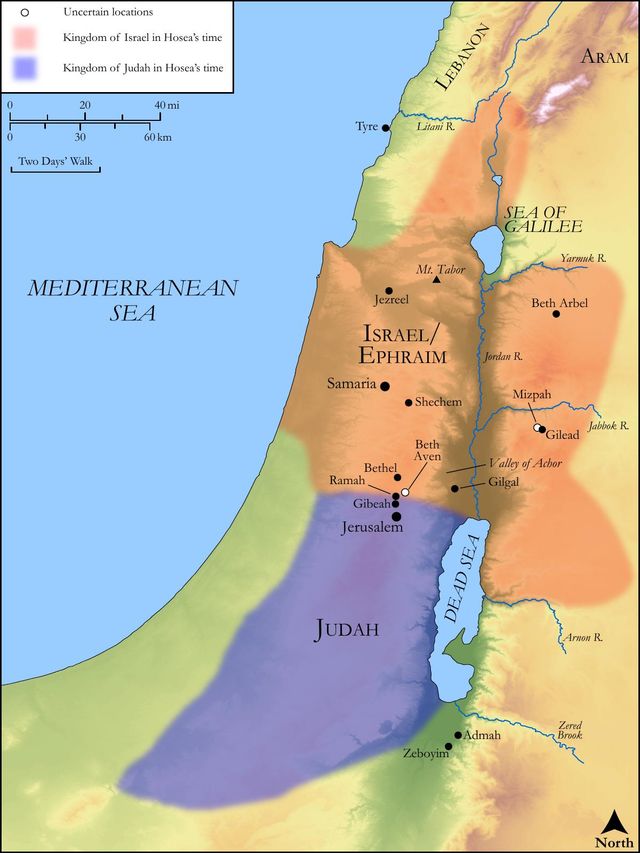
See on the biblical-era map
Study this verse
Public-domain commentary
Matthew Henry
From his Commentary on the Whole Bible. Henry comments on passages, not single verses — this entry covers Hosea 9:7–10. His three-level outline is real structure in the source text, so it is rendered as structure.
For their further awakening, it is here threatened,
I.That the destruction spoken of shall come speedily.
They shall have no reason to hope for a long reprieve, for the judgment slumbers not; it is at the door (Hos 9:7): The days of visitation have come, and there shall be no more delay; the days of recompence have come, which they have been so often warned to expect; their prophets have told them that destruction would come, and now it has come, and the time of the divine patience has expired. Note,
1.The day of God's judgments is both a day of visitation, in which men's sins are enquired into and brought to light, and a day of recompence, in which men's doom will be passed, and a reward given to every man according to his work; the strict visitation is in order to a just retribution.
2.This day of visitation and recompence is hastening on apace. It is sure; it is near; as if it had already come.
II.That hereby they shall be made ashamed of their sentiments concerning their prophets.
When the day of visitation comes Israel shall know it, shall be made to know that by sad experience which they would not know by instruction. Israel shall know then what an evil and bitter thing it is to depart from God, and what a fearful thing it is to fall into his hands. When thy hand is lifted up they will not see, but they shall see. Israel shall know the difference between true prophets and false.
1.They shall know then that the pretenders to prophecy, who flattered them in their sins, and rocked them asleep in their security, and told them that they should have peace though they went on, however they pretended to be spiritual men (as Ahab's prophets did, Kg1 22:24) were fools and madmen, and not true prophets; they deceived themselves and those to whom they prophesied. But why would God suffer his people Israel to be imposed upon by those false prophets? He answers, "It is for the multitude of thy iniquity which, in contempt of the divine law, thou hast persisted in, and, for the great hatred of the true prophets, that reproved thee, in God's name, for it." Note, Because men receive not the love of the truth, but conceive a hatred of it, and by the multitude of their iniquities bid defiance to it, therefore God shall send them strong delusions, to believe a lie, so strong that they shall not be undeceived till the day of visitation and recompence comes, which will convince them of the folly and madness of those that seduced them and of their own folly and madness in suffering themselves to be seduced by them.
2.They shall know then whether the true prophets, that were really spiritual men, guided by the Spirit of God, were such as they called and counted them, fools and madmen; and they shall be convinced that they were so far from being so that they were the wise men of their times, and God's faithful ambassadors to them. When Israel saw that none of Samuel's words fell to the ground they knew he was established to be a prophet (Sa1 3:20); and so here, when God fulfils the word of his messengers, by bringing the days of recompence they foretold, then those that despised and ridiculed them, and thought Bedlam the fittest place for them, will be ashamed of the multitude of their iniquities of that kind, and of their great hatred, for which God brings upon them this swift destruction. Mocking the messengers of the Lord was the sin they were punished for, and so made ashamed of.
III.That hereby the wickedness of the false prophets themselves shall be manifested to their shame (Hos 9:8):
"The watchman of Ephraim was with my God; he had been formerly. They had a set of worthy good ministers, that kept close to God and maintained communion with him; but now they have a race of corrupt, malignant, persecuting prophets, that are the ring-leaders of all mischief." Or, "The watchman of Ephraim now pretends to have been with my God, and prefaces his lies with, Thus saith the Lord; but he is a snare of a fowler in all his ways, and is cunning to draw the simple into sin and the upright into trouble; and he is so full of hatred and enmity to goodness and good men that he has become hatred itself in the house of his God, or against the house of his God." Note, Wicked prophets are the worst of men; their sins against God are most heinous, and their plots against religion most dangerous. They may boast that they are watchmen, speculators, and, as far as speculation goes, they may be right, and with my God, may have their heads full of good notions; but look into their lives, and they are the snare of a fowler in all their ways, catching for themselves and making a prey of others; look into their hearts, and they are hatred in the house of my God, very malicious and spiteful against good ministers and good people. Woe unto thee, O land! unto thee, O church! that hast such watchmen, such prophets, that are seers, but not doers! Corruptio optimi est pessima - The best things, when corrupted, become the worst.
IV.That God will now reckon with them for the sins of their fathers, which they have trod in the steps of, Hos 9:9, Hos 9:10.
1.They were as bad as their fathers: They have deeply corrupted themselves; they are rooted and riveted in sin; they are far gone in the depths of Satan (Isa 31:6), so that it is next to impossible that they should be recovered; the stain of their corruption is deep, not to be got out; it is as scarlet and crimson, or as the spots of the leopard: and it is their own fault; they have corrupted themselves, have polluted and hardened their own hearts, as in the days of Gibeah, when the Levite's concubine was abused to death by the men of Gibeah and the whole tribe of Benjamin patronised the villany; that was a time of deep corruption indeed, and such were the present days. Lewdness and wickedness were as impudent and daring now as in the days of Gibeah; and therefore what can be expected but such a vengeance as was then taken on Gibeah? Every tribe is now as bad as the tribe of Benjamin then was, and therefore may expect to be brought as low as that tribe then was.
2.They shall therefore be reckoned with for their fathers' sins: He will remember their iniquity and visit their sins, the iniquity they have by kind and by entail, the sin that runs in the blood; the sin of the father shall now be visited upon the children. Hence God takes occasion to upbraid them with the degeneracy and apostasy of their ancestors, their perfidiousness and base ingratitude, Hos 9:10. Here observe,
(1.)The great honour God put upon Israel when he first formed them into a people: I found Israel like grapes in the wilderness. He took as much delight and pleasure in them as a poor traveller would do if he found grapes in a wilderness, where he most needed them and least expected them. Or when they were in the wilderness he found them as grapes, not precious in themselves, but precious to him, and pleasant as the first-ripe grapes to the lord of the vineyard. They were precious in his sight, and honourable (Isa 43:4); he planted them a choice vine, a right seed (Jer 2:21), and found them no better than he himself made them, good grapes at first. I saw them with pleasure, as the first-ripe in the fig-tree at the first time. Good people are compared to the good things that are first ripe, Jer 24:2. One then is worth more than many afterwards. This intimates the delight God took in them and in doing them good, not for their sakes, but because he loved their fathers. He preserved them carefully, as a man does the first and choicest fruits of his vineyard. Now when he put all this honour upon them, and they stood so fair for preferment, one would think they should have maintained their excellency; but,
(2.)See the great disgrace they put upon themselves. God set them apart for himself as a peculiar people, but they went to Baal-peor, joined with the Moabites in sacrificing to that dirty dunghill deity (Num 25:2, Num 25:3), and they separated themselves unto that shame, that shameful idol, so Baal-peor was in a particular manner, if (as should seem) the whoredom which the people committed with the daughters of Moab was a part of the service done to Baal-peor. Note, Whatever those separate themselves to that forsake God it will certainly be a shame to them, first or last. Their abominations are here said to be as they loved; their practices which were an abomination to God were as the best-beloved of their souls. Or when they had once forsaken God they multiplied their abominations, their idols and abominable idolatries, at their pleasure. This was the way of their fathers; God had done well for them, but they had acted ungratefully towards him, and in the same manner had the present generation deeply corrupted themselves.
Historical interpretation
Historical reception
1 surviving comment on this verse from the historical church.
"The days of visitation have come, the days of retribution have come: know, O Israel, a foolish prophet, a spiritual madman because of the multitude of your iniquity, and the multitude of your madness." LXX: "The days of vengeance have come, the days of your retribution have come, and Israel shall be afflicted as a raving prophet, a man who had the Spirit, because" "the multitude of your iniquities, your madness has multiplied." And in this place there is a usual error: for where we have translated, "know, O Israel," that is, Israelites, and in Hebrew it is read Jadau, the Septuagint has translated "and will be afflicted:" thinking Jod is the vowel and Res the consonant instead of it, and reading it for Daleth: the former of which means knowledge, the latter affliction or malice. Therefore came the days of visitation, of which it was said above (Verse 5): "What will you do in the solemn day, and in the day of the feast of the Lord? The days of retribution have come." O Israel, now know your words, who called the prophet speaking true things to you, and prophesying by the Holy Spirit, a fool and insane, according to what the princes spoke to Jehu in Ramoth Galaad: "What is this madman coming to you?" (4 Kings 9:11). Therefore, because of the multitude of your injustices, in which you have revelled in wickedness for a long time, recognize that you are not my prophet, but rather insane, who labours to trample on my words. For "insanity," Aquila translates ἐγκότησιν, which we can also say in Latin as "anger" or "memory of pain". Some interpret the day of vengeance and retribution as the day of judgment, when Israel, who now boasts of seeing God, will be afflicted, not guided by the Holy Spirit but swept into various parts by demons, not knowing what they are saying: calling the Son of God a creature, denying the Holy Spirit God. And again another good God, asserting another creator of the world: their madness is manifold, because there were many iniquities. We said that he was a foolish prophet, and they interpreted him as a seventy pseudoprophet. And lest, by often repeating the same things, we seem to distrust the prudence of the reader, we briefly admonish that whatever is said about Israel and Ephraim in this prophet must be referred to heretics, who truly speak lies against God, being insane.
Continue studying Hosea 9:7 across the web’s major study libraries — every link below opens this exact verse, chapter, or book on the destination site.
Read & Compare
 BibleGatewayThis verse in more than 200 translations and 70 languages.
 Bible.comThe YouVersion reader — hundreds of translations, reading plans, and highlights.
 ESV.orgCrossway's official English Standard Version reader.
 NET BibleThe NET translation with 60,000+ translators' notes on every rendering decision.
 STEP BibleTyndale House's free study tool — original text, vocabulary, and scholarly resources.
 BibliaLogos Bible Software's free web reader.
 USCCBThe New American Bible (Revised Edition) with the U.S. bishops' study notes.
Commentaries
 BibleHub CommentariesDozens of classic commentaries on this verse, gathered on one page.
 StudyLightMore than 100 commentary sets — the largest collection on the web.
 BibleRefPlain-English commentary on what this verse means, verse by verse.
 Enduring WordDavid Guzik's free commentary on this chapter, widely used by Bible teachers.
 Bible Study ToolsVerse commentary alongside Greek and Hebrew study aids.
Original Language & Research
- BibleHub InterlinearThe verse word by word — original language, transliteration, and English.
- BibleHub LexiconEvery word's original-language definition and Strong's entry.
 Blue Letter BibleDeep-study tools — Strong's numbers, concordance, and word studies.
 SefariaThe Hebrew text with Rashi and centuries of Jewish commentary.
Sermons, Hymns & Audio


TrulyRandomVerse is not affiliated with these sites and doesn’t control their content. They’re linked because they’re genuinely useful.
Summary
Hosea 9:7 is a stark prophetic declaration of impending divine judgment upon the Northern Kingdom of Israel (Ephraim). It announces that the long-foretold "days of visitation" and "recompense" have arrived, signifying a divinely appointed time for reckoning where Israel will experience the direct consequences of their profound unfaithfulness. The verse highlights Israel's spiritual blindness and hostility, as they contemptuously dismiss God's true prophets as "fools" and "madmen," revealing their deep-seated rejection of divine truth. This severe judgment is explicitly attributed to their "multitude of iniquity" and "great hatred," underscoring the cumulative effect of their rebellion against God's covenant and His ways.
Context
ShowHideLiterary Context
This verse is situated within a broader section of Hosea (chapters 9-10) that intensifies the prophecies of judgment against Israel, particularly Ephraim, for their pervasive idolatry and covenant unfaithfulness. Immediately preceding this verse, Hosea 9:1-6 details Israel's spiritual harlotry, warning that their illicit worship practices will lead to the loss of their land, harvest, and the ability to offer sacrifices to YHWH. The people are depicted as celebrating their false gods, unaware that their revelry will soon turn to lament as they are driven into exile. Following Hosea 9:7, the prophet continues to elaborate on the severe consequences of their sin, including barrenness, destruction of their children, and their ultimate scattering among the nations, emphasizing the irreversible nature of the judgment due to their deep-seated corruption, reminiscent of the wickedness at Gibeah. The prophetic message here serves as a pivotal point, marking the definitive arrival of the promised retribution.
Historical & Cultural Context
Hosea prophesied to the Northern Kingdom of Israel during the turbulent 8th century BC, a period marked by significant political instability, moral decay, and spiritual apostasy. Following the relatively prosperous reign of Jeroboam II, Israel experienced a rapid succession of kings, many of whom came to power through assassination, indicating a breakdown of internal order. Culturally, the nation had deeply embraced syncretism, blending the worship of YHWH with the idolatrous practices of Baal and other Canaanite fertility cults, often involving ritual prostitution and child sacrifice. Politically, Israel sought alliances with powerful foreign nations like Egypt and Assyria, rather than trusting in God for their security, a direct violation of their covenant obligations. This era culminated in the Assyrian conquest and the fall of Samaria in 722 BC, which led to the exile of the Northern Kingdom, fulfilling the very judgments Hosea proclaimed. The "days of visitation" were not abstract but referred to the imminent, concrete actions of God through the Assyrian empire.
Key Themes
ShowHideHosea 9:7 powerfully contributes to several overarching themes in the book of Hosea. Firstly, it underscores the theme of Divine Judgment and Retribution, asserting that God's justice is not delayed indefinitely but will inevitably be enacted upon unrepentant sin. The "visitation" and "recompense" highlight God's active involvement in history to uphold His covenant, bringing consequences for Israel's rebellion. Secondly, the verse emphasizes the Rejection of God's Messengers, portraying Israel's profound spiritual blindness and hostility towards divine truth. Their contempt for the true prophet, labeling him a "fool" or "mad," reveals a hardened heart that prefers comforting lies to inconvenient truths, a pattern seen throughout biblical history where God's messengers often face scorn, as Jeremiah experienced. Finally, the verse explicitly links the impending judgment to the Consequences of Iniquity and Hatred. The "multitude of thine iniquity" refers to their pervasive idolatry and moral corruption, while "great hatred" signifies their deep-seated animosity towards God's law, His covenant, and His ways, demonstrating a fundamental rebellion that necessitates divine intervention. This echoes the universal biblical principle that the wages of sin is death.
Exposition and Analysis
ShowHideKey Word Analysis
ShowHideThis term, derived from a root meaning "to visit" or "to attend to," carries a dual sense in Scripture. While it can denote a gracious visit for blessing, as in Ruth 1:6, in the context of judgment, it signifies a divine inspection or reckoning that leads to punishment. Here, it is not a benevolent visit but an accounting for deeds, a time when God "calls to account" for Israel's transgressions, emphasizing the imminence and certainty of divine justice.
From a root meaning "to be complete" or "to repay," this word refers to a requital, payment, or retribution. It highlights the principle of divine justice where actions have consequences, and God repays or rewards according to deeds. In Hosea 9:7, it specifically points to the just retribution Israel will receive for their covenant breaking, emphasizing that their punishment is a direct and deserved outcome of their unfaithfulness.
This word primarily means "wind" or "breath," but extensively refers to "spirit," including the human spirit, the Spirit of God, or even a demonic spirit. When combined with "man" (ʼîysh), "spiritual man" (ʼîysh hārûaḥ) refers to an inspired person, specifically a true prophet who speaks under the influence or guidance of God's Spirit. The irony in Hosea 9:7 is that the very people who should recognize and revere such a man instead label him as "mad," demonstrating their profound spiritual blindness and perversion of truth.
Verse Breakdown
ShowHide"The days of visitation are come, the days of recompence are come"
This opening declaration serves as a solemn pronouncement of judgment. The repetition emphasizes the certainty and immediacy of God's appointed time for reckoning. It signifies that the period of divine patience has concluded, and the consequences for Israel's persistent sin are now at their threshold, not as a future threat but as a present reality.
"Israel shall know [it]"
This clause indicates that the impending judgment will serve as a stark, undeniable revelation for the nation. While they have refused to acknowledge God's warnings through His prophets, they will "know" the truth of His justice through the painful experience of its manifestation. This knowledge will not be intellectual assent but experiential understanding of their folly and God's unwavering righteousness.
"the prophet [is] a fool, the spiritual man [is] mad"
This phrase reveals Israel's contemptuous and dismissive attitude toward God's true messengers. They invert truth, labeling those who speak God's inconvenient word as irrational or insane. This reflects a profound spiritual distortion where genuine divine inspiration is perceived as folly, while their own idolatrous and rebellious ways are deemed rational. It highlights their hardened hearts and spiritual blindness.
"for the multitude of thine iniquity, and the great hatred"
This final clause provides the explicit reason for the impending judgment. The "multitude of iniquity" speaks to the pervasive and accumulated sin of the nation—their idolatry, moral corruption, and oppression. The "great hatred" refers not merely to their animosity towards the prophets, but fundamentally to their deep-seated aversion and rebellion against God's covenant, His commands, and His very being. This cumulative sin and active defiance have provoked God's righteous wrath.
Literary Devices
ShowHideHosea 9:7 employs several powerful literary devices to convey its urgent message of judgment. The most prominent is Repetition, seen in the phrase "The days of visitation are come, the days of recompence are come." This reiteration creates a sense of solemn finality and emphasizes the absolute certainty and imminence of God's judgment, serving as a drumbeat of doom. Parallelism is evident in "the prophet [is] a fool, the spiritual man [is] mad," where the second clause reinforces the first, highlighting Israel's consistent contempt for God's messengers. This is a form of Synonymous Parallelism, where similar ideas are expressed in different words. There is also profound Irony in the verse: Israel, in its spiritual depravity, labels God's true prophets—the very voices of wisdom and truth—as "fools" and "mad," while their own actions of idolatry, rebellion, and self-destruction are truly foolish and lead to madness. This inversion of truth underscores their profound spiritual blindness. The use of Metonymy or Synecdoche is present in "Israel," which stands for the entire Northern Kingdom and its people, representing their collective guilt and fate. Finally, the phrases "multitude of thine iniquity" and "great hatred" can be seen as a form of Hyperbole, emphasizing the overwhelming and pervasive nature of their sin and rebellion, leaving no doubt as to the justification for the severity of the impending divine retribution.
Theological and Thematic Connections
ShowHideHosea 9:7 resonates deeply with core biblical truths about God's character and humanity's accountability. It powerfully asserts God's unwavering justice and sovereignty, demonstrating that while His patience is vast, it is not infinite. The "days of visitation" and "recompense" underscore the principle that sin, particularly covenant unfaithfulness and rebellion against divine authority, inevitably incurs consequences. This is not arbitrary punishment but a righteous response to a "multitude of iniquity" and "great hatred" that has accumulated over generations. The verse also highlights the tragic human tendency to reject divine truth when it challenges comfortable sin. By labeling God's prophets as "fools" and "mad," Israel exemplifies a spiritual blindness that prefers self-deception and false security over the confronting reality of God's Word. This rejection of God's messengers is tantamount to rejecting God Himself, sealing their fate.
Reflection and Application
ShowHideHosea 9:7 serves as a profound and timeless warning for all generations. It compels us to confront the reality that sin has consequences, and God, in His perfect justice, will indeed bring a day of reckoning for unrepentant rebellion. This should instill a healthy fear of the Lord, not a terror that paralyzes, but a reverence that motivates us to live in alignment with His will. The verse also challenges us to examine our own hearts: do we welcome God's truth, even when it is uncomfortable or exposes our own shortcomings, or do we, like ancient Israel, dismiss it as foolishness or madness because it contradicts our desires or preferred narratives? In a world increasingly prone to rejecting objective truth, it is crucial to cultivate a humble and discerning spirit, one that is open to the corrective and transformative power of God's Word, even when it comes through unexpected or unpopular voices. We are called to discern between genuine spiritual guidance and deceptive influences, ensuring that our "hatred" is directed towards sin, not towards the holy God who exposes it. Ultimately, this verse calls us to repentance and a renewed commitment to walk in faithfulness, recognizing that true wisdom begins with revering the Lord and embracing His truth.
Questions for Reflection
ShowHideFAQ
ShowHideWhat does "the days of visitation" mean in this context?
ShowHideIn Hosea 9:7, "the days of visitation" refers to a divinely appointed time of reckoning or inspection. While "visitation" can sometimes imply a benevolent act of God, here it carries the ominous connotation of a judicial visit, where God comes to "call to account" or "punish" for the accumulated sins and unfaithfulness of Israel. It signifies that the period of divine patience has ended, and the consequences of their rebellion are now imminent and unavoidable, leading to their judgment and exile.
Why did Israel call the prophet a "fool" and the spiritual man "mad"?
ShowHideIsrael's labeling of the prophet as a "fool" and the spiritual man as "mad" reflects their profound spiritual blindness and hardened hearts. True prophets, like Hosea, spoke uncomfortable truths about Israel's idolatry, moral corruption, and impending judgment. These messages contradicted the people's self-perception and their desire for peace and prosperity without repentance. In their depravity, they inverted reality: they considered the divinely inspired message of the prophet to be irrational and insane, while their own rebellious and self-destructive path seemed rational to them. This dismissal was a way to justify their continued sin and reject God's inconvenient warnings, as seen when Jeremiah was mocked for his prophecies.
What is the "great hatred" mentioned as a reason for judgment?
ShowHideThe "great hatred" mentioned in Hosea 9:7 is not merely hatred towards the prophets, but a deeper, fundamental animosity towards God Himself, His covenant, His laws, and His ways. It signifies a profound rebellion and active defiance against divine authority. This "hatred" manifested in their persistent idolatry, their pursuit of foreign alliances, their oppression, and their rejection of God's loving discipline. It was a deep-seated aversion to the very principles of righteousness and faithfulness that God required of His covenant people.
Christ-Centered Fulfillment
ShowHideHosea 9:7, with its pronouncement of judgment for iniquity and the rejection of God's messengers, finds its ultimate fulfillment and profound reversal in the person and work of Jesus Christ. Just as Israel dismissed the true prophet as "fool" and "mad," so too was Jesus, the ultimate Prophet and the very Wisdom of God, perceived as a madman by some (John 10:20) and His message as foolishness by the world (1 Corinthians 1:18). He came in a "visitation" of grace and truth (Luke 19:41-44) to His own people, yet they, in their "great hatred" and "multitude of iniquity," rejected Him and crucified Him (John 1:11, Matthew 27:22-23). However, in a glorious paradox, Christ willingly absorbed the "recompense" for humanity's "multitude of iniquity" and "great hatred" on the cross. He became sin for us (2 Corinthians 5:21) and bore the judgment we deserved, thereby offering reconciliation and forgiveness. His death and resurrection demonstrate that while sin brings death and judgment, God's ultimate "visitation" in Christ was for salvation, not condemnation, for all who believe (John 3:17). The final "days of visitation" and "recompense" will occur at His second coming, when He returns not as a suffering servant but as a righteous Judge, bringing ultimate justice and eternal salvation to those who have embraced His truth (Matthew 25:31-46).