


Hosea 9:6
Bible text: King James Version (1769 Blayney text) · Public domain
Bible text: King James Version with Strong's numbers · Public domain
Bible text: Berean Standard Bible · Public domain
Bible text: American Standard Version (1901) · Public domain
Bible text: World English Bible, Messianic edition · Public domain
Bible text: Geneva Bible (1599) · Public domain
Bible text: Young's Literal Translation · Public domain
- כִּיkiforH3588PrtParticle Conditional
- הִנֵּהhi·Nehthere!H2009PrtParticle Interjection
- הָלְכוּha·le·Khuthey have goneH1980V-Qal-Perf-3cpVerb Qal Perfect 3rd Plural common gender
- מִשֹּׁדmi·Shodfrom [the] devastationH7701Prep-m ¦ N-msNoun Singular Masculine Absoluteמִfromשֹּׁד[the] devastation
- מִצְרַיִםmitz·Ra·yimEgyptH4714N-properNoun Proper Location
- תְּקַבְּצֵםte·ka·be·Tzemit will gather themH6908V-Piel-Imperf-3fs ¦ 3mpVerb Piel Imperfect 3rd Singular Feminineתְּקַבְּצֵit will gatherםthem
- מֹףmofMemphisH4644N-properNoun Proper Location
- תְּקַבְּרֵםte·ka·be·Remit will bury themH6912V-Piel-Imperf-3fs ¦ 3mpVerb Piel Imperfect 3rd Singular Feminineתְּקַבְּרֵit will buryםthem
- מַחְמַדmach·MadtreasureH4261N-msNoun Singular Masculine Absolute
- לְכַסְפָּםle·khas·Pamof their silverH3701Prep-l ¦ N-msc ¦ 3mpNoun Singular Masculine Constructלְofכַסְפָּsilverםtheir
- קִמּוֹשׂki·mOsnettle[s]H7057N-msNoun Singular Masculine Absolute
- יִירָשֵׁםyi·ra·Shemit will take possession of themH3423V-Qal-Imperf-3ms ¦ 3mpVerb Qal Imperfect 3rd Singular Masculineיִירָשֵׁit will take possession ofםthem
- חוֹחַCho·achthorn[s]H2336N-msNoun Singular Masculine Absolute
- בְּאָהֳלֵיהֶםbe·'o·ho·lei·Hem[will be] in their tentsH168Prep-b ¦ N-mpc ¦ 3mpNoun Plural Masculine Constructבְּ[will be] inאָהֳלֵיtentsהֶםtheir
English is a literal word-by-word gloss of the Hebrew, not the KJV's wording. Why?
This is the original text the KJV's translators worked from — each Hebrew word with its own literal English meaning in this verse, prepared by scholars at Tyndale House, Cambridge. The KJV translates whole sentences, not word by word, so its wording differs: one Hebrew word can become several English words, and the KJV may choose “the LORD” where the gloss reads “Yahweh”. Both are faithful — they answer different questions. For the KJV's own rendering, switch to the KJV text.
Details
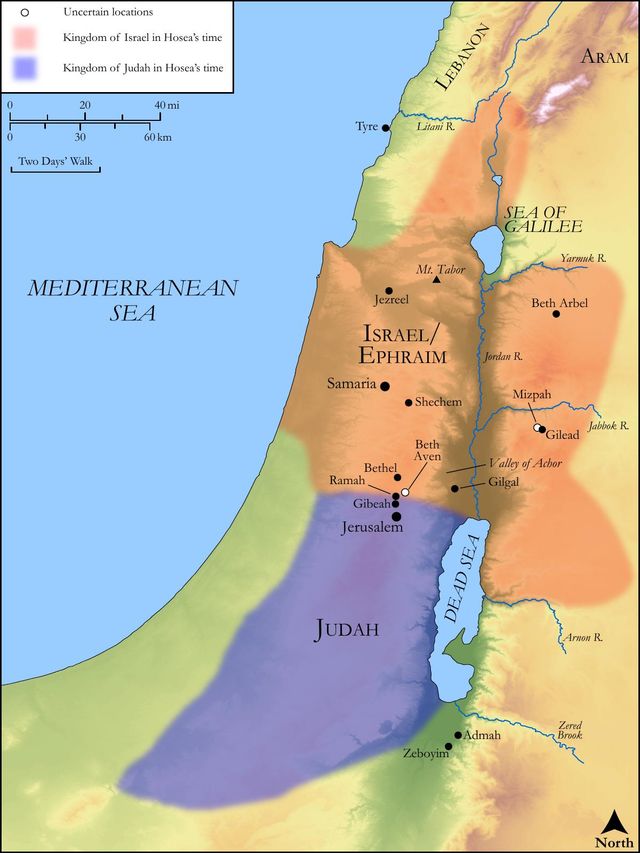
See on the biblical-era map
Study this verse
Public-domain commentary
Matthew Henry
From his Commentary on the Whole Bible. Henry comments on passages, not single verses — this entry covers Hosea 9:1–6. His two-level outline is real structure in the source text, so it is rendered as structure.
Here, I. The people of Israel are charged with spiritual adultery: O Israel! thou hast gone a whoring from thy God, Hos 9:1. Their covenant with God was a marriage-covenant, by which they were joined to him as their God, renouncing all others. But when they set up idols and worshipped them, when they fled to creatures for succour and put a confidence in them, they went a whoring from God as their God, and honoured the pretenders and rivals with the affection, adoration, and confidence, which were due to God only. Other people were idolaters, but that sin was not, in them, going a whoring from God, as it was in Israel that had been married to him. Note, The sins of those who have made a profession of religion and relation to God are more provoking to him than the sins of others. As a proof of their going a whoring from God, it is charged upon them that they loved a reward upon every corn-floor. 1. They loved to give rewards to their idols, in the offerings and first-fruits they presented to them out of every corn-floor. They took a strange pleasure in serving their idols with that which they would have grudged to consecrate to God and employ in his service. Note, It is common for those that are niggardly in the expenses of their religion to be very prodigal in spending upon their lusts. Or, 2. They loved to receive rewards from their idols; and such they reckoned the fruits of the earth to be: These are my rewards, which my lovers have given me, Hos 2:12. Note, Those are directly disposed to spiritual idolatry that love a reward in the corn-floor better than a reward in the favour of God and eternal life.
II.They are forbidden to rejoice as other people do:
"Rejoice not, O Israel! for joy. Do not expect to rejoice. What peace, what joy, what hast thou to do with either, while thy whoredoms and witchcrafts are so many?" Kg2 9:19-22. Be not disposed to rejoice, for it does not become thee, but rather to be afflicted, and mourn, and weep, Jam 4:9. Judah, that keeps close to the true God, nay, and other people that never knew him nor could ever be charged with revolting from him, may be allowed to rejoice, as not having so much cause to be ashamed as Israel has, that has gone a whoring from him. Some think that they had at this time particular occasions for joy, probably upon the account of some losses recovered, or some advantages gained, or some league made with a potent ally, for which they had public rejoicings, as other people used to have upon such occasions; but God sends to them not to rejoice. Note, Joy is forbidden fruit to wicked people. They must not rejoice, because they have gone a whoring from their God; and therefore,
1.Whatever it was that they rejoiced in, it would be no security nor advantage to them, so long as they were at a distance from God and at war with him. Note, We are likely to have small joy of any of our creature-comforts if we make not God our chief joy.
2.The sense of sin and dread of wrath ought to be a damp upon their joy and a strong alloy to all their comforts. Note, Those who by departing from God have made work for repentance have thereby marred their own mirth, till they return and make their peace with God.
III.They are threatened with destroying judgments for their spiritual whoredoms, according to what was said long before.
Psa 73:27, Thou hast destroyed all those that go a whoring from thee. It is here threatened,
1.That their land shall not yield its wonted increase. Canaan, that fruitful land, shall be turned into barrenness for the wickedness of those that dwell therein. They love the reward in the corn-floor, and are so full of the joy of harvest that they have no disposition at all to mourn for their sins; and therefore God will, for their effectual humiliation, take away from them, not only their delights and dainties, but even their necessary food (Hos 9:2): The floor and the wine-press shall not feed them, much less feast them; they shall either be blasted by the hand of God or plundered by the hand of man. The new wine with which they used to make merry shall fail in her. Note, When we make the world, and the things of it, our idol and portion, above what they were designed for, it is just with God to deny us even support and nourishment from them, according to that which they were designed for, to show us our folly and correct us for it. Let those miss of their food in the corn-floor that look for their reward in the corn-floor. We forfeit the good things of this world if we love them as the best things.
2.That their land shall not only cease to feed them, but cease to lodge them and to be a habitation for them; it shall spue them out, as it had done the Canaanites before them (Hos 9:3): They shall not dwell any longer in the Lord's land. The land of Canaan was in a peculiar manner the Lord's land, the land of the Shechinah (so the Chaldee), the land of the Lord of the world (so the Arabic); he whose all the earth is (Psa 24:1) took that for his demesne. The land is mine, says God, Lev 25:23. They had used it, or abused it rather, as if it had been their own, had not paid the rent, nor done the services, due to God as their landlord, and therefore God justly enters, and takes possession of it, they having forfeited their lease. "It is my land" (says God) "and I will make it appear, for they shall be turned off, as bad tenants, and be made to know that, though they thought themselves freeholders, they were but tenants at will." Note, It is for the honour of God's justice and holiness that those who go a whoring from God should not be suffered to dwell upon his land; and therefore, sooner or later, the wicked shall be chased out of the world. Or it is called the Lord's land because it was the holy land, Immanuel's land, the land that had peculiar tokens of God's favour to it, and presence in it, where God was known and his name was great, where God's prophets and oracles were; it was a kind of copy of the earthly paradise, and a type of the heavenly one. It was a great privilege to have a lot in such a land as this. It was a great sin and folly to rebel against God, and go a whoring from him, in such a land as this, to deal unjustly in a land of uprightness, Isa 26:10. And it was a sad and sore judgment to be driven out from such a land as this; it was like driving our first parents out of the garden of Eden, and almost amounted to an exclusion out of the heavenly Canaan. Note, Those cannot expect to dwell in the Lord's land that will not be subject to the Lord's laws, nor be influenced by his love. Those have forfeited the privileges of the church that conform not to the rules of it.
3.That, when they are turned out from the Lord's land, they shall have no rest nor satisfaction in any other land. When Cain was driven out from the presence of the Lord he was a fugitive and a vagabond ever after, and dwelt in the land of trembling. So Israel here. Some shall return into Egypt, the old house of bondage; thither they shall flee from the Assyrian (Hos 8:13) and they shall lose and ruin themselves where they thought to hide and help themselves. Others shall be carried captives to Assyria and there shall be forced to eat unclean things, either (1.) Such things as were not fit for men to eat, that which is rotten and putrefied, intimating that they shall be reduced to the utmost poverty, as the prodigal that would fain have filled his belly with the husks. Or, (2.) Such things as were not fit for Jews to eat, being prohibited by their law. It is probable that while they were in their own land, however disobedient in other things, they kept up the distinction of meats, and prided themselves in that; but, since they would not keep the law of God in other things, they should not be suffered to keep it in that, and it was a just punishment of their sin in eating things offered to idols. Note, When at any time we suffer in our food, and either through want or for our health are forced to eat or drink that which is unpleasing, we must acknowledge that God is righteous, because we have sinned about our food, and have indulged ourselves too much in that which is pleasing.
4.That in the land of their enemies, to which they shall be driven, they shall have no opportunity either of giving honour to God or obtaining favour with God, by offering any acceptable sacrifice to him; they should not be in a capacity of keeping up any face or show of religion among them; "and so" (as Dr. Pocock expresses it) "should be as it were quite cut off from any expression of relation to him, from all signs of grace, and means of reconciliation with him, which would be to them a token of their being rejected of God, estranged from him, and no more owned by him as his people." (1.) They shall have no sacrifices to offer, nor any altar to offer them on, nor priests to offer them; they shall not so much as offer drink-offerings to the Lord, much less any other sacrifices. (2.) If they should offer them, neither they nor their sacrifices shall be pleasing to him, for they cannot have any legal offerings, nor are their hearts humbled. (3.) Instead of their sacrifices of joy and praise, they shall eat the bread of mourners; they shall live desolate, and disconsolate, mourning for the death of their relations and their own miseries, so that if they had opportunity of sacrificing they should never be themselves in a frame fit for it; for they were forbidden to eat of the holy things in their mourning, Deu 26:14. All that eat of the bread of mourners are polluted, and incapacitated to partake of the altar. (4.) Their bread for their soul, the bread which they must either eat or starve, the bread which they shall have for the support of their lives, shall not come into the house of the Lord; they shall have no house of the Lord to bring it to, or, if they had, it is such as is not fit to be brought, nor are they rightly disposed to bring it. (5.) The return of the days of their sacred and solemn feasts would therefore be very melancholy and uncomfortable to them (Hos 9:5): What will you do in the solemn day, in the sabbath, the solemn day of every week, in the new moons, the solemn days of every month, at the return of the times for keeping the passover, pentecost, and feast of the tabernacles, the solemn days of every year, the days of the feasts of the Lord? Note, The feasts of the Lord are solemn days; and, when we are invited to those feasts, we ought to consider seriously what we shall do. But the question is here put to those who were to be deprived of the benefit and comfort of those solemn feasts, "What will you do then? You will then spend those days in sorrow and lamentation which, if it had not been your own fault, you might have been spending in joy and praise. You will then be made to know the worth of mercies by the want of them and to prize spiritual bread by being made to feel a famine of it." Note, When we enjoy the means of grace we ought to consider what we shall do if ever we should know the want of them, if either they should be taken from us or we be disabled to attend upon them.
5.That they should perish in the land of their dispersion (Hos 9:6): For, lo, they have gone out of the Lord's land, where they might have spent both their sabbath days and other days with comfort, gone because of destruction, gone to Egypt because of the destruction of their own country by the Assyrians, flattering themselves with hopes that they shall return when the storm is over; but those hopes also shall fail them; they shall find there are graves in Egypt, as their murmuring ancestors said (Exo 14:11), graves for them; for Egypt shall gather them up, as dead men are gathered up and carried forth to the grave, and Memphis (one of the chief cities of Egypt) shall bury them. Gathering and burying are put together, Jer 8:2; Job 27:19. Note, Those that think presumptuously to flee from the judgments of God are likely enough tp meet their death where they hoped to save their lives.
6.That their land, which they left behind and to which they hoped to return, should become a desolation: As for their tabernacles, where they formerly dwelt and where they kept their stores, the pleasant places for their silver, they shall be demolished and laid in ruins, to such a degree that they shall be overgrown with nettles; so that if they should survive the trouble, and return to their own land again, they would find it neither fruitful nor habitable; it would afford them neither food nor lodging. Note, Those that make their money their god reckon the places of their silver their pleasant places, as those that make the Lord their God reckon his tabernacles amiable and his ordinances their pleasant things, Isa 64:11. But, while the pleasures of communion with God are out of the reach of chance and change, the pleasant places of men's silver, which were purchased with silver, or in which they deposited their silver, or which were beautified and adorned with silver, are liable to be laid in ruins, in nettles, and therewith all the pleasure men took in them.
Historical interpretation
Historical reception
1 surviving comment on this verse from the historical church.
"What will you do on the solemn day, on the day of the Lord's festival? For behold, they have gone forth from desolation: Egypt shall gather them, Memphis shall bury them: the desirable silver of them, the nettle shall inherit, the burdock shall be in their tabernacles." LXX: "What will you do on the day of the assembly and on the day of the solemnity of the Lord? Therefore, behold they shall go from the misery of Egypt, and Memphis shall receive them, and Machmas shall bury them; their silver shall possess destruction, thorns shall be in their tabernacles." When the day of captivity will come, he says, and the most cruel enemy will attack, what is my solemnity? How pleasing a sacrifice do I have? For it avenges me against my enemies and puts a limit on their wrongdoing, and it flogs the impious sons. What then will you do on the day of the Lord's festival? Respond. With them being silent, he responds to himself, indeed he figures out with divine eyes what they will do: Behold, I say, in misery and ruin, they fled to Egypt, where those who want to capture the Assyrians and Chaldeans are bound. There Memphis will bury those, which at that time was the metropolis of Egypt, before Alexandria, which was formerly called No, received both the greatness of the city and its name. But what is said in the Septuagint, "Machmas will bury them," is not found in Hebrew; but Mamad, which means "beloved." From which it is clear that they are false, because of the similarity of the letters Daleth and Chaph; and instead of "Mamad," which everyone translated as "beloved," they thought "Machmas" to be an Egyptian city. We can consider that which is said: "For, behold, they are gone because of destruction, Egypt shall gather them up, Memphis shall bury them," and take from the tribe of Judah: when, after the murder of Gedaliah by Ishmael, whom Nebuchadnezzar had appointed over the land, the remnant of the people with the prophet Jeremiah fled to Egypt, and there later were either captured or buried by the Chaldeans who pursued them. However, their desirable silver that nettles possess, we will understand to be the villages and all the ornaments of the villages, which are bought with the price of silver. "And what follows, 'a burr in their tabernacles,' signifies a long desolation; so that where once their houses were, there burrs and nettles and thorns may grow. And is said also to heretics: When the solemn day shall come, what will ye do? Aquila interprets 'solemn day' as 'time.' From this it is manifest that it does not mean a festive day, but a time of retribution; for immediately it follows: 'The days of vengeance are come, the days of thy visitation.' Behold, ye are devastated by many enemies: the Assyrians and the Chaldeans have slaughtered you, ye have fled into the world, and ye are likened to other nations: there ye shall be buried in 'Memphis,' which means 'from the mouth,' and the sense is: According to your blasphemies ye shall receive, and what ye have spoken ye shall feel in punishments; your desirable things, that is, the doctrines which ye have artificially composed with language, which is interpreted silver, shall be possessed by the nettle, which shall consume you with eternal fire: and there shall be the burr or thorn in your tabernacles; for thorns shall grow on the hands of those who have been made drunk with the Babylonish cup." (Jer. 51) And in the Gospel we read that shameful thoughts and worries of this world, and clinging vices, are called thorns, which rising up in the herbs choke the grain. (Matthew 15).
Continue studying Hosea 9:6 across the web’s major study libraries — every link below opens this exact verse, chapter, or book on the destination site.
Read & Compare
 BibleGatewayThis verse in more than 200 translations and 70 languages.
 Bible.comThe YouVersion reader — hundreds of translations, reading plans, and highlights.
 ESV.orgCrossway's official English Standard Version reader.
 NET BibleThe NET translation with 60,000+ translators' notes on every rendering decision.
 STEP BibleTyndale House's free study tool — original text, vocabulary, and scholarly resources.
 BibliaLogos Bible Software's free web reader.
 USCCBThe New American Bible (Revised Edition) with the U.S. bishops' study notes.
Commentaries
 BibleHub CommentariesDozens of classic commentaries on this verse, gathered on one page.
 StudyLightMore than 100 commentary sets — the largest collection on the web.
 BibleRefPlain-English commentary on what this verse means, verse by verse.
 Enduring WordDavid Guzik's free commentary on this chapter, widely used by Bible teachers.
 Bible Study ToolsVerse commentary alongside Greek and Hebrew study aids.
Original Language & Research
- BibleHub InterlinearThe verse word by word — original language, transliteration, and English.
- BibleHub LexiconEvery word's original-language definition and Strong's entry.
 Blue Letter BibleDeep-study tools — Strong's numbers, concordance, and word studies.
 SefariaThe Hebrew text with Rashi and centuries of Jewish commentary.
Sermons, Hymns & Audio


TrulyRandomVerse is not affiliated with these sites and doesn’t control their content. They’re linked because they’re genuinely useful.
Summary
Hosea 9:6 delivers a poignant prophecy of judgment against the Northern Kingdom of Israel (Ephraim), foretelling their inevitable exile and the utter desolation of their land and cherished possessions. It vividly portrays the ironic fate awaiting a people who, having abandoned their covenant with Yahweh, would flee from Assyrian conquest only to find death and dishonorable burial in Egypt, their former ally, while their once-pleasant homes would be overrun by wild growth.
Context
ShowHideLiterary Context
This verse is situated within a larger section of Hosea (chapters 9-10) that pronounces severe judgment against Israel for their idolatry, unfaithfulness, and political alliances that defied God's covenant. Chapter 9 specifically details the consequences of their sin, including famine, exile, and the cessation of religious festivals. Verse 6 follows a declaration of their inability to offer sacrifices to the Lord in their land, setting the stage for their forced departure and the subsequent ruin of their dwelling places. The progression from spiritual defilement to physical desolation is a recurring motif in this prophetic book.
Historical & Cultural Context
Hosea prophesied during the tumultuous final decades of the Northern Kingdom, leading up to its fall to Assyria in 722 BCE. Israel, particularly Ephraim, had repeatedly sought alliances with foreign powers like Egypt and Assyria, rather than trusting in Yahweh for protection. This reliance on Egypt for military aid, often at the expense of their covenant obligations, is a significant backdrop to the prophecy in Hosea 7:11-12. Memphis (ancient Egyptian: Men-nefer) was a prominent capital of ancient Egypt, known for its vast necropolis, making its mention here particularly poignant as a place of death and burial for those who sought refuge there. The imagery of nettles and thorns reclaiming cultivated land speaks to a common understanding of desolation and abandonment.
Key Themes
ShowHideHosea 9:6 powerfully contributes to several overarching themes in the book of Hosea. It underscores the theme of Divine Judgment, demonstrating God's righteous wrath against persistent covenant unfaithfulness, as seen throughout Hosea 4. The verse also highlights the theme of Futility of False Security, illustrating how Israel's reliance on Egypt for protection, rather than on God, would ironically lead to their demise in that very land, a theme echoed in Isaiah 30:1-3. Furthermore, the imagery of nettles and thorns invading their homes speaks to the theme of Desolation and Ruin that would befall their once-prosperous nation, a consequence of their spiritual decay and a common prophetic motif for judgment, as also described in Micah 3:12.
Exposition and Analysis
ShowHideKey Word Analysis
ShowHideA primitive root meaning "to walk" or "to go" in a variety of applications. Here, it signifies a forced departure or movement, specifically their exile. It implies a definitive, irreversible departure, not a voluntary journey but a compelled removal from their land.
Meaning "violence," "ravage," "desolation," or "spoil." This word identifies the direct cause of their flight and subsequent demise. It speaks to the utter devastation and ruin that would befall them, not merely a minor setback but a comprehensive undoing.
Meaning "delightful," "object of affection or desire," or "goodly." This word describes the homes and possessions of Israel that were once cherished and valuable. Its use here emphasizes the stark contrast between their former state of comfort and the impending desolation, highlighting the magnitude of their loss.
A prickly plant. Along with "thorns" (H2336, chôwach'), these terms are common biblical symbols of desolation, neglect, and the wild reclaiming what was once cultivated. Their presence signifies the abandonment and ruin of the "pleasant places," indicating that these once-inhabited dwellings would become overgrown and uninhabitable.
Verse Breakdown
ShowHide"For, lo, they are gone because of destruction:"
This clause declares the immediate and inevitable consequence of Israel's actions: their forced departure or exile. The "destruction" refers to the Assyrian invasion and the ensuing devastation that would compel them to flee their homeland. It signals the beginning of their judgment.
"Egypt shall gather them up, Memphis shall bury them:"
This is a powerful statement of ironic judgment. Israel had often sought alliances with Egypt, relying on them for military support instead of God. Now, Egypt, rather than being a refuge, becomes the place of their demise. "Gather them up" suggests collecting the scattered remnants, perhaps as captives or refugees, while "Memphis shall bury them" signifies a dishonorable death and burial in a foreign land, a stark contrast to the ancestral burial grounds in their homeland.
"the pleasant [places] for their silver, nettles shall possess them:"
This clause focuses on the desolation of their material wealth and homes. "The pleasant places for their silver" refers to their cherished dwellings, likely adorned with valuable possessions, perhaps even acquired through unjust means. The prophecy states that these once-desirable places will be overrun by "nettles," symbolizing abandonment, decay, and the wild reclaiming what was once cultivated and cared for.
"thorns [shall be] in their tabernacles."
This final phrase reinforces the imagery of utter desolation. "Tabernacles" (H168, ʼôhel') refers to their tents or dwellings, signifying their homes. The presence of "thorns" further emphasizes the complete ruin and uninhabitable nature of their former residences. It paints a picture of a land stripped bare and homes left to decay, a direct consequence of their unfaithfulness.
Literary Devices
ShowHideHosea 9:6 employs several potent literary devices to convey its message of impending judgment. Irony is central, as Israel's reliance on Egypt for security ironically leads to their death and burial in that very land. Symbolism is heavily utilized with "nettles" and "thorns" representing desolation, abandonment, and the wild reclaiming cultivated spaces, vividly portraying the ruin of their homes and land. The phrase "pleasant [places] for their silver" uses Metonymy, where "silver" stands for the wealth and valuable possessions that were once cherished, emphasizing the material loss. The verse also employs Juxtaposition, contrasting the "pleasant places" with the invasive "nettles" and "thorns," highlighting the dramatic shift from prosperity to ruin. Finally, the vivid imagery creates a strong sense of Pathos, evoking pity for the tragic fate of a people who have brought such destruction upon themselves through their rebellion.
Theological and Thematic Connections
ShowHideHosea 9:6 profoundly illustrates the theological principle that persistent unfaithfulness to God inevitably leads to divine judgment and desolation. It underscores the covenantal consequences for Israel's idolatry and their reliance on foreign alliances rather than Yahweh. The prophecy reveals God's justice in allowing the very sources of their false security (like Egypt) to become instruments of their demise, demonstrating that true refuge and prosperity are found only in Him. This judgment, while severe, is part of God's righteous governance over His people, intended to expose the futility of their rebellion and, ultimately, to call them back to Himself.
Reflection and Application
ShowHideHosea 9:6 serves as a sobering reminder that choices have consequences, particularly in our relationship with God. For the ancient Israelites, their persistent turning away from God and seeking security in worldly alliances led to profound loss and desolation. For believers today, this passage challenges us to examine where we place our ultimate trust and security. Do we rely on our own resources, worldly systems, or human connections more than on God? The "pleasant places" of our lives—our careers, finances, relationships, or comforts—can become idols if we prioritize them over our devotion to Christ. When we stray from God's path, the "nettles" and "thorns" of spiritual decay, disillusionment, and emptiness can infest what was once desirable. This verse calls us to a radical re-evaluation of our priorities, urging us to root our hope and security firmly in God alone, recognizing that true flourishing comes from obedience and faithful dependence on Him, not from fleeting worldly comforts or unreliable human strategies.
Questions for Reflection
ShowHideFAQ
ShowHideWhy would Egypt "gather them up" and "bury them" if Israel was fleeing Assyria?
ShowHideThis verse highlights a profound irony and judgment. Israel often sought alliances with Egypt to counter Assyrian aggression, against God's explicit command (e.g., Isaiah 30:1-3). Hosea prophesies that those who flee from Assyria, perhaps hoping for refuge in Egypt, would instead find death there. "Gather them up" could refer to Egypt collecting the scattered remnants of Israel, either as refugees who would eventually die there, or even as captives. "Memphis shall bury them" signifies a dishonorable death and burial in a foreign land, far from their ancestral graves, underscoring the futility and tragic outcome of their misplaced trust. It's a divine judgment that their chosen refuge would become their tomb.
What is the significance of "nettles" and "thorns" possessing their homes?
ShowHideThe imagery of "nettles" and "thorns" (Hebrew qimmôwsh and chôwach) is highly symbolic in biblical prophecy. It signifies utter desolation, abandonment, and ruin. When cultivated land or dwellings are overrun by such wild, prickly plants, it indicates that they are no longer cared for, inhabited, or productive. For Israel, it meant that their once-cherished homes and "pleasant places" (perhaps acquired through ill-gotten gains, as suggested elsewhere in Hosea) would be left desolate and uninhabitable, a stark visual representation of the complete destruction of their society and the judgment on their unfaithfulness. It speaks to the reversal of blessing and prosperity.
Christ-Centered Fulfillment
ShowHideWhile Hosea 9:6 pronounces a severe judgment on Israel's unfaithfulness, its themes of judgment, exile, and the desolation of a people who rejected God ultimately point to the greater redemption found in Christ. Israel's failure to maintain their covenant foreshadows humanity's universal inability to perfectly obey God's law, necessitating a divine solution. The judgment described here, where a people are "gone because of destruction" and buried in a foreign land, highlights the ultimate consequence of sin: spiritual death and separation from God. However, in Christ, we see the perfect fulfillment of God's covenant. Jesus, the true Israel, perfectly obeyed God where Israel failed, enduring the ultimate "destruction" and "exile" on the cross, taking upon Himself the judgment due to humanity's sin (e.g., 2 Corinthians 5:21). Through His death and resurrection, He provides a new "tabernacle"—His own body, the Church—where God dwells among His people, not subject to thorns and nettles but to eternal flourishing (e.g., John 1:14 and Ephesians 2:19-22). Thus, while Israel's physical homes were desolated, Christ offers a spiritual dwelling and eternal security that can never be overrun by the consequences of sin, providing true refuge and an everlasting inheritance for all who trust in Him (e.g., 1 Peter 1:3-5).