


1 Samuel 3:20
Bible text: King James Version (1769 Blayney text) · Public domain
Bible text: Berean Standard Bible · Public domain
Bible text: American Standard Version (1901) · Public domain
Bible text: World English Bible, Messianic edition · Public domain
Bible text: Geneva Bible (1599) · Public domain
Bible text: Young's Literal Translation · Public domain
- וַיֵּדַעvai·Ye·da'and it knewH3045Conj-w ¦ V-Qal-ConsecImperf-3msVerb Qal Consecutive Imperfect 3rd Singular Masculineוַandיֵּדַעit knew
- כָּלkolallH3605N-mscNoun Singular Masculine Construct
- יִשְׂרָאֵלYis·ra·'ElIsraelH3478N-properNoun Proper Location
- מִדָּןmi·Danfrom DanH1835Prep-m ¦ N-properNoun Proper LocationמִfromדָּןDan
- וְעַדve·'adand toH5704Conj-w ¦ PrepPrepositionוְandעַדto
- בְּאֵרbe·'ErBeerH884N-properNoun Proper Location
- שָׁבַעSha·va'ShebaH884N-properNoun Proper Location
- כִּיkithatH3588PrtParticle Conditional
- נֶאֱמָןne·'e·Man[was being] establishedH539V-Niphal-Prtcpl-msVerb Niphal Participle Singular Masculine Absolute
- שְׁמוּאֵלshe·mu·'ElSamuelH8050N-proper-mNoun Proper Masculine
- לְנָבִיאle·na·Vi'to a prophetH5030Prep-l ¦ N-msNoun Singular Masculine Absoluteלְtoנָבִיאa prophet
- לַיהוָהla·Yah·wehof YahwehH3068Prep-l ¦ N-properNoun Proper TitleלַofיהוָהYahweh
English is a literal word-by-word gloss of the Hebrew, not the KJV's wording. Why?
This is the original text the KJV's translators worked from — each Hebrew word with its own literal English meaning in this verse, prepared by scholars at Tyndale House, Cambridge. The KJV translates whole sentences, not word by word, so its wording differs: one Hebrew word can become several English words, and the KJV may choose “the LORD” where the gloss reads “Yahweh”. Both are faithful — they answer different questions. For the KJV's own rendering, switch to the KJV text.
Details
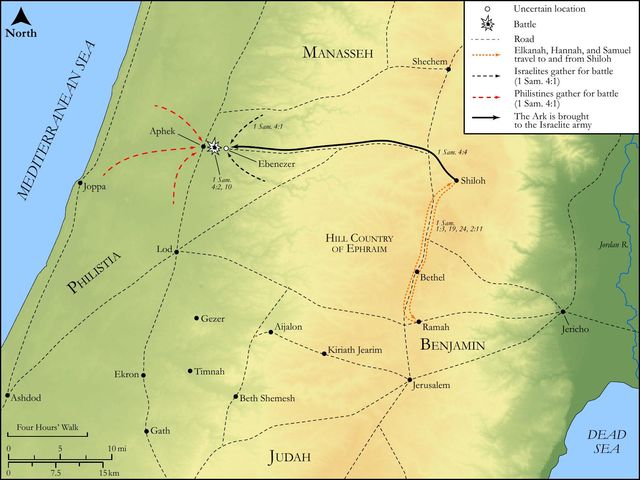
See on the biblical-era map
Study this verse
Public-domain commentary
Matthew Henry
From his Commentary on the Whole Bible. Henry comments on passages, not single verses — this entry covers 1 Samuel 3:19–21. His two-level outline is real structure in the source text, so it is rendered as structure.
Samuel being thus brought acquainted with the visions of God, we have here an account of the further honour done him as a prophet.
I.God did him honour.
Having begun to favour him, he carried on and crowned his own work in him: Samuel grew, for the Lord was with him, Sa1 3:19. All our increase in wisdom and grace is owing to the presence of God with us; this is all in all to our growth. God honoured Samuel,
1.By further manifestations of himself to him. Samuel had faithfully delivered the message he was entrusted with, and therefore God employed him again in his service: The Lord revealed himself again to Samuel in Shiloh, Sa1 3:21. Note, God will graciously repeat his visits to those that receive them aright.
2.By fulfilling what he spoke by him: God did let none of his words fall to the ground, Sa1 3:19. Whatever Samuel said, as a prophet, it proved true, and was accomplished in its season. Probably there were some remarkable instances of the truth of Samuel's predictions that happened soon after, which confirmed those that were afterwards to be fulfilled, and gave general satisfaction as to his mission. God will confirm the word of his servants, and perform the counsel of his messengers (Isa 44:26), and will do what he hath said.
II.Israel did him honour. They all knew and owned that Samuel was established to be a prophet, Sa1 3:20.
1.He grew famous; all that came up to Shiloh to worship took notice of him, and admired him, and talked of him when they returned home. Early piety will be the greatest honour of young people, and bring them, as much as any thing, and as soon, into reputation. Those that honour God he will honour.
2.He grew useful and very serviceable to his generation. He that began betimes to be good soon came to do good. His established commission from God, and established reputation with the people, gave him a great opportunity of shining as a light in Israel. When old Eli was rejected, young Samuel was established; for God will never leave himself without a witness nor his church without a guide.
Historical interpretation
Historical reception
1 surviving comment on this verse from the historical church.
And all Israel from Dan to Beersheba recognized, etc. And the Catholic, that is, the universal Church, the spiritual Israel, which has been gathered from the beginnings of renouncing the devil to the font of baptism, knows that Jesus Christ, who is called "God with Us," is the preacher of faith. For Dan is interpreted as "judgment." It signifies that time for the Church, of which it is said: "Now is the judgment of this world, now the prince of this world will be cast out" (John 12). Beersheba, however, which is interpreted as "well of the oath," or "seventh well," or "well of satisfaction," signifies the full reception of baptism, when, with the devil exorcised, renounced, and expelled from the heart, each one enters the font of regeneration to be consecrated by the sevenfold grace of the Spirit and to be filled by the abundance of heavenly gifts. Even the very location of these places alludes not insignificantly to the sacraments of the Church, because the terminus of the land of Judea was Dan to the north and Beersheba to the south, a mystical distance well known to those who can sing with the spouse: "Awake, O north wind, and come, south wind, blow upon my garden, that its spices may flow out" (Cant. 4). Dan, moreover, is a village about four miles from Paneas towards Tyre, from which place the river Jordan takes its name, as Jor means "river" or "stream" in Hebrew; this also not insignificantly points to the beginning of baptism. Furthermore, Beersheba is a city or village in the tribe of Judah, lying to the south, as we have said. Therefore, all Israel, that is, the people of Christians intent upon the vision of God, from Dan to Beersheba, from the north to the south, that is, from the catechumens to the faithful, from those who have just now expelled the harsh blasts of the ancient enemy, to those who have already been filled with the most radiant warmth of the Holy Spirit, recognizes that Jesus is the Christ, the Son of God, and that believers have eternal life in His name. In this reading, the person of blessed Samuel may well be referred to those very members of Christ, exalted by the merit of pure humility, about whom He Himself says: "Whoever humbles himself like this little child is the greatest in the kingdom of heaven" (Matt. 18). Those sleeping in the temple of the Lord, that is, who have turned away from the external cares of the world with the whole light of their heart directed solely towards contemplating the divine will above, are taught how the secrets of heavenly judgments are revealed in many ways which the old, blinded, and rejected Eli did not see, just as the Lord Himself, who speaks in the Gospel, says: "I thank you, Father, Lord of heaven and earth, that you have hidden these things from the wise and prudent and revealed them to babes" (Matt. 11). In this context, the crowned humility of the penitents and the condemned impiety of the proud are presented as an example, so that by these things it is manifestly shown that the hidden things of the wise of the world and the revealed mysteries to the humble are spoken.
Continue studying 1 Samuel 3:20 across the web’s major study libraries — every link below opens this exact verse, chapter, or book on the destination site.
Read & Compare
 BibleGatewayThis verse in more than 200 translations and 70 languages.
 Bible.comThe YouVersion reader — hundreds of translations, reading plans, and highlights.
 ESV.orgCrossway's official English Standard Version reader.
 NET BibleThe NET translation with 60,000+ translators' notes on every rendering decision.
 STEP BibleTyndale House's free study tool — original text, vocabulary, and scholarly resources.
 BibliaLogos Bible Software's free web reader.
 USCCBThe New American Bible (Revised Edition) with the U.S. bishops' study notes.
Commentaries
 BibleHub CommentariesDozens of classic commentaries on this verse, gathered on one page.
 StudyLightMore than 100 commentary sets — the largest collection on the web.
 BibleRefPlain-English commentary on what this verse means, verse by verse.
 Enduring WordDavid Guzik's free commentary on this chapter, widely used by Bible teachers.
 Bible Study ToolsVerse commentary alongside Greek and Hebrew study aids.
Original Language & Research
- BibleHub InterlinearThe verse word by word — original language, transliteration, and English.
- BibleHub LexiconEvery word's original-language definition and Strong's entry.
 Blue Letter BibleDeep-study tools — Strong's numbers, concordance, and word studies.
 SefariaThe Hebrew text with Rashi and centuries of Jewish commentary.
Sermons, Hymns & Audio


TrulyRandomVerse is not affiliated with these sites and doesn’t control their content. They’re linked because they’re genuinely useful.
Summary
1 Samuel 3:20 marks a pivotal moment in Israel's spiritual history, declaring the widespread and undeniable recognition of Samuel as God's divinely appointed prophet. In a period characterized by spiritual scarcity and a decline in prophetic communication, this verse proclaims that Samuel's establishment as a true spokesperson for the LORD was acknowledged across the entire nation, from its northernmost to its southernmost borders. It powerfully underscores God's sovereign initiative in raising up faithful leaders and restoring clear, authoritative communication with His people, thereby preparing the way for significant transformations in Israel's governance and spiritual trajectory.
Context
ShowHideLiterary Context
This verse serves as the climactic declaration following the dramatic and intimate narrative of Samuel's divine call in 1 Samuel 3. The preceding verses meticulously detail the LORD's repeated calls to young Samuel, his initial confusion, the discerning guidance from Eli, and Samuel's courageous, albeit difficult, delivery of God's severe judgment against Eli's corrupt household. The immediate context of 1 Samuel 3:19 explicitly states that "the LORD was with him and let none of his words fall to the ground," providing the essential foundation and divine authentication for the national recognition described in 1 Samuel 3:20. This narrative sequence firmly establishes Samuel's prophetic authority not through human appointment or lineage, but through undeniable divine authentication and the consistent fulfillment of his spoken words.
Historical & Cultural Context
The era depicted in 1 Samuel is one of profound spiritual and political decline for the nation of Israel. The preceding book of Judges concludes with the somber observation that "everyone did what was right in his own eyes" (Judges 21:25), and this moral decay is starkly evident in the priesthood under Eli's sons, Hophni and Phinehas, who flagrantly desecrated the tabernacle sacrifices (1 Samuel 2:12-17). Divine communication, once a vibrant hallmark of Israel's covenant relationship with God, had become "precious" and "there was no open vision" (1 Samuel 3:1). Within this backdrop of spiritual famine and moral corruption, Samuel's emergence as a legitimate prophet, recognized across the entire land from Dan in the north to Beersheba in the south, signaled a desperately needed restoration of God's active presence and authoritative guidance among His people.
Key Themes
ShowHideThis verse powerfully contributes to several foundational themes within 1 Samuel and the broader Old Testament narrative. It highlights the theme of Divine Establishment, emphasizing that Samuel's prophetic office was not self-proclaimed or humanly conferred, but divinely ordained and authenticated by God Himself, standing in stark contrast to the illegitimate and corrupt authority of Eli's sons. This leads directly to the theme of National Recognition, where the phrase "all Israel from Dan even to Beersheba" signifies a widespread, undeniable acknowledgment of God's renewed communication with His people through Samuel, indicating a genuine spiritual awakening and a collective turning back to divine revelation. Furthermore, it underscores the Restoration of the Prophetic Voice after a prolonged period of spiritual silence, positioning Samuel as the primary medium through whom God would guide Israel through significant transitions, including the establishment of the monarchy and the anointing of its first kings, Saul and David, as detailed in subsequent chapters of 1 Samuel.
Exposition and Analysis
ShowHideKey Word Analysis
ShowHideThis word, derived from the primitive root H539, conveys profound ideas of firmness, reliability, faithfulness, and trustworthiness. It is the same root from which the familiar word "Amen" is derived. In this context, it signifies that Samuel's prophetic authority and the truthfulness of his messages were not merely recognized by popular opinion, but were divinely confirmed and proven to be steadfast and certain. His words were dependable because they originated from and were authenticated by the LORD (H3068), consistently aligning with God's will and word. This divine authentication contrasts sharply with the unreliability and corruption of Eli's sons.
The term nâbîyʼ (H5030) refers to one who is called by God to speak on His behalf, acting as a divine spokesperson or messenger. A true prophet's words are not their own but are God's words, and their authority derives solely from this divine commission. Samuel's establishment as a nâbîyʼ meant he was the legitimate conduit for God's revelation to Israel, a crucial role that had been largely absent or corrupted prior to his ministry. This establishment was essential for Israel to distinguish true divine communication from false or humanly contrived messages.
Verse Breakdown
ShowHide"And all Israel from Dan even to Beersheba knew"
This phrase employs a common biblical idiom to denote the entire geographical and demographic breadth of the nation of Israel (H3478). "Dan" (H1835) represents the northernmost settlement, and "Beersheba" (H884) the southernmost. The verb "knew" (H3045, yâdaʻ) implies not just intellectual awareness but a deep, experiential recognition and acknowledgment. This was not a localized phenomenon but a widespread, undeniable consensus that Samuel (H8050) was indeed God's chosen messenger, indicating a significant spiritual shift and a renewed openness to divine revelation across the land.
"that Samuel [was] established [to be] a prophet of the LORD"
This clause is the core declaration of the verse. The term "established" (H539, as analyzed above) conveys divine authentication and reliability, indicating that Samuel's prophetic office was not self-proclaimed or humanly conferred, but divinely ordained and affirmed through the consistent fulfillment of his words. The phrase "of the LORD" (H3068) explicitly ties Samuel's authority directly to God, emphasizing that he was God's chosen and legitimate spokesperson. This divine endorsement was the foundation of his national recognition and the power of his ministry.
Literary Devices
ShowHide1 Samuel 3:20 employs several significant literary devices that amplify its meaning and impact. The phrase "all Israel from Dan even to Beersheba" is a classic example of Merism, a figure of speech in which two contrasting or extreme parts of a whole are used to represent the entirety of that whole. Here, the two extreme geographical points signify the entirety of the Israelite territory and its inhabitants, powerfully emphasizing the widespread and undeniable nature of Samuel's recognition. This also borders on Hyperbole, as it might not mean literally every single individual, but rather a universal consensus, underscoring the magnitude of Samuel's impact. Furthermore, the verse stands in stark Contrast to the spiritual darkness and lack of "open vision" described in 1 Samuel 3:1, highlighting the dramatic turnaround brought about by God's raising up of Samuel. The establishment of Samuel as a prophet also serves as Foreshadowing, pointing to his future pivotal role in guiding Israel, anointing kings, and mediating God's will during a critical period of transition from the era of the Judges to the Monarchy.
Theological and Thematic Connections
ShowHideThe universal recognition of Samuel as a prophet of the LORD in 1 Samuel 3:20 profoundly underscores God's unwavering commitment to His covenant people, even during times of spiritual decline and moral compromise. It reveals God's sovereignty in raising up faithful leaders and restoring His authoritative voice when it seems to have been silenced. Samuel's establishment signifies a divine intervention to re-establish proper, uncorrupted communication between God and Israel, moving beyond the corrupt and ineffective priesthood of Eli's sons. This momentous event sets the stage for a new era of divine guidance, demonstrating that God always provides a means for His truth to be heard and His will to be known, often through unexpected channels and individuals. It powerfully affirms that true spiritual authority comes from divine appointment and authentication, not from human lineage, status, or popularity.
Reflection and Application
ShowHideThe story of Samuel's establishment as a prophet of the LORD offers profound and enduring insights for believers today. It serves as a powerful reminder that God is eternally sovereign and actively engaged in the affairs of His people, even during periods of spiritual barrenness or moral decay within the church or society at large. Just as God raised up Samuel from obscurity to be His trusted voice, He continues to call, equip, and empower individuals, often those least expected, to speak truth, provide guidance, and lead His people. Our recognition and affirmation of God's chosen servants should be based fundamentally on the authenticity of their message—its unwavering alignment with God's revealed Word—and the fruit of their lives, rather than on human credentials, charisma, or fleeting popularity. This verse challenges us to cultivate a discerning spirit, enabling us to recognize God's voice in our own lives, primarily through the Scriptures, and to be faithful in proclaiming His truth, knowing that His word, like Samuel's, will not "fall to the ground." It calls us to trust implicitly in God's perfect timing and method for spiritual renewal, understanding that He will always provide a way for His eternal purposes to be fulfilled.
Questions for Reflection
ShowHideFAQ
ShowHideWhat is the significance of the phrase "from Dan even to Beersheba" in 1 Samuel 3:20?
ShowHideThe phrase "from Dan even to Beersheba" is a common and highly significant biblical idiom used to denote the entire geographical expanse of the land of Israel, from its northernmost city (Dan, H1835) to its southernmost city (Beersheba, H884). Its significance in 1 Samuel 3:20 is to emphasize the widespread, national, and undeniable recognition of Samuel's prophetic authority. It wasn't merely a localized phenomenon confined to Shiloh, but a profound consensus that permeated every corner of the Israelite territory and consciousness. This indicates a deep and pervasive spiritual shift, where God's renewed and authentic communication through Samuel was acknowledged by the entire nation (H3478), marking a powerful contrast to the spiritual silence and lack of "open vision" described in 1 Samuel 3:1. It signifies that God's authentication of Samuel was so clear, consistent, and powerful that it could not be ignored by anyone across the land.
Christ-Centered Fulfillment
ShowHide1 Samuel 3:20, with its declaration of Samuel's universal establishment as a prophet of the LORD, powerfully foreshadows the ultimate Prophet, Jesus Christ. Samuel emerged in a time of profound spiritual darkness and a scarcity of divine revelation, serving as God's authentic voice to a wayward nation. Similarly, Jesus came into a world steeped in spiritual blindness, moral decay, and a distorted understanding of God's law, bringing the fullness of truth and grace. Just as Samuel's words were established and none fell to the ground (1 Samuel 3:19), so too are Christ's words the very words of God, carrying ultimate authority and truth, for He is the Word made flesh who dwells among us. The recognition of Samuel "from Dan even to Beersheba" points to the universal scope of Christ's authority and the call for all nations and peoples to acknowledge Him as the Lamb of God who takes away the sin of the world. As the Prophet greater than Moses (Deuteronomy 18:15), Jesus not only spoke God's word but was God's final, complete, and perfect revelation (Hebrews 1:1-2). His establishment was not merely national but reached to heaven and earth, for all authority in heaven and on earth has been given to Him. Through Christ, the prophetic voice is not merely restored but perfectly embodied, offering eternal life to all who hear and obey Him (John 5:24).