


Old Testament · History · Book 7 of 66
Judges
After Joshua’s death Israel forsakes the LORD again and again, and he raises up judges to deliver them, until every man does what is right in his own eyes.
- 21 chapters
- 618 verses
- About 86 minutes to read
- The Judges & Ruth, c. 1380–1050 BC
Judges begins with the tribes going up to finish the conquest and ends with them nearly destroying one of their own. Before the first judge appears, the book sets out the pattern that governs it. Israel forsakes the LORD and serves Baalim; he sells them “into the hands of their enemies round about” (Judges 2:14); they cry to him, and he raises up a judge who saves them. When the judge dies they return and corrupt themselves “more than their fathers” (Judges 2:19).
The pattern turns six times, and each turn goes lower. Othniel’s account records no fault. Gideon’s ephod becomes “a snare unto Gideon, and to his house” (8:27). Jephthah’s vow costs him his daughter, and Samson, a Nazarite from the womb, gives Delilah his secret: he “told her all his heart” (16:17). Yet the LORD keeps answering. He hears their groaning, raises deliverers from the least likely places, and saves by few. The last five chapters have no judge at all, and show what Israel becomes without a king: “every man did that which was right in his own eyes” (21:25).
And when the LORD raised them up judges, then the LORD was with the judge, and delivered them out of the hand of their enemies all the days of the judge: for it repented the LORD because of their groanings by reason of them that oppressed them and vexed them.
Judges 2:18 KJV
Before you read
- Who wrote it
- Not named in the book; traditionally Samuel, the last of the judges (1 Samuel 7:15).
- When it was written
- In the days of the kings: the refrain “In those days there was no king in Israel” looks back from a time when there was one (Judges 17:6). The Jebusites still lived in Jerusalem “unto this day” (1:21), as they did until David took it (2 Samuel 5:6–7).
Those who read 18:30 of Shiloh’s fall “The captivity of the land” is the Philistines’ taking of the ark, when Shiloh was lost. The next verse ties Dan’s image to “all the time that the house of God was in Shiloh,” and the Psalm calls that loss a captivity.
Those who read 18:30 of the northern exile “The captivity of the land” is Assyria’s carrying away of the north, so this line was written after that time.
Grounds Judges 18:302 Kings 15:29
How Judges is laid out
8 movements · 97 passages · 618 verses
The conquest left unfinished
1:1–2:5 · 41 verses
After Joshua’s death Judah and Simeon go up first and take Bezek, Jerusalem, Hebron and Debir. Then the record lists what the other tribes did not do: Benjamin, Manasseh, Ephraim, Zebulun, Asher, Naphtali and Dan leave the Canaanites among them. The angel of the LORD comes up from Gilgal to Bochim, rebukes their disobedience, and the people weep.
The pattern set out
2:6–3:7 · 25 verses
The book steps back to Joshua’s death and the generation after him, “which knew not the LORD.” It then sets out what follows: Israel serves Baalim, the LORD delivers them to spoilers and raises up judges who save them, and each time the judge dies they turn back. The nations left in the land remain to prove Israel, and Israel marries among them.
Othniel, Ehud, Deborah
3:8–5:31 · 79 verses
Othniel delivers Israel from Chushanrishathaim. Ehud, a left-handed Benjamite, kills Eglon king of Moab in his summer parlour, and Shamgar slays six hundred Philistines with an ox goad. Under Jabin of Canaan, Deborah the prophetess sends Barak to mount Tabor; Sisera’s army is swept away at the Kishon, and Jael kills Sisera in her tent. Deborah and Barak sing the victory.
13 passages
- 3:8–11 Israel Delivered by Othniel
- 3:12–31 Ehud and Shamgar Deliver Israel
- 4:1–3 Israel Oppressed by Jabin and Sisera
- 4:4–11 Deborah the Judge Commissions Barak
- 4:12–16 God Delivers Israel at the Kishon
- 4:17–24 Jael Kills Sisera
- 5:1–3 The Song of Deborah and Barak
- 5:4–5 The Majestic Power of Yahweh
- 5:6–11 Israel's Decline and Deborah's Rise
- 5:12–18 Rallying the Tribes of Israel
- 5:19–23 The Battle at Megiddo and the Curse of Meroz
- 5:24–27 The Praise of Jael
- 5:28–31 The Lament of Sisera's Mother
Gideon and the three hundred
Chapters 6–8 · 100 verses
Midian strips the land for seven years. The angel of the LORD finds Gideon threshing wheat by the winepress and sends him. He throws down his father’s altar of Baal, asks signs with a fleece, and with three hundred men, trumpets and lamps in pitchers routs Midian. He refuses to rule, but makes an ephod from the spoil that becomes a snare.
16 passages
- 6:1–6 Israel Oppressed by Midian
- 6:7–10 The Lord Sends a Prophet
- 6:11–24 The Angel Appears to Gideon
- 6:25–32 Gideon Destroys Baal's Altar
- 6:33–40 Gideon Seeks Confirmation
- 7:1–8 The Army Is Reduced
- 7:9–15 Gideon Receives Divine Confirmation
- 7:16–22 Gideon's 300
- 7:23–25 Pursuit and Capture of Midianite Leaders
- 8:1–3 Gideon Pacifies Ephraim
- 8:4–12 The Pursuit and Refusal of Aid
- 8:13–17 Vengeance on Succoth and Penuel
- 8:18–21 Gideon Executes the Kings
- 8:22–28 The Offer of Kingship and the Ephod
- 8:29–32 Gideon's Final Years and Death
- 8:33–35 Israel's Immediate Apostasy
The bramble king
9:1–10:5 · 62 verses
Abimelech, Gideon’s son by a concubine of Shechem, kills his brothers on one stone and is made king there. Jotham, the youngest, escapes and tells the fable of the trees and the bramble. God sends an evil spirit between Abimelech and the men of Shechem; he destroys the city and dies at Thebez when a woman casts a millstone on his head. Tola and Jair judge Israel.
Jephthah of Gilead
10:6–12:15 · 68 verses
Israel serves the gods of the nations, and Ammon oppresses Gilead. When Israel puts away its gods, Gilead’s elders fetch Jephthah, a harlot’s son his brothers had thrust out. He argues Israel’s right to the land with Ammon’s king, vows to offer up whatever first meets him, wins, and is met by his daughter. Ephraim’s quarrel ends at the passages of Jordan. Ibzan, Elon and Abdon follow.
10 passages
- 10:6–9 Israel's Renewed Apostasy and Oppression
- 10:10–16 God Rebukes Israel's Hypocrisy
- 10:17–18 Preparation for Battle Against Ammon
- 11:1–3 Jephthah's Expulsion and Exile
- 11:4–11 Gilead Recruits Jephthah as Leader
- 11:12–28 Jephthah Negotiates with Ammon
- 11:29–33 The Vow and the Victory
- 11:34–40 The Fulfillment of the Tragic Vow
- 12:1–7 Jephthah and the Civil War with Ephraim
- 12:8–15 The Minor Judges: Ibzan, Elon, and Abdon
Samson the Nazarite
Chapters 13–16 · 96 verses
The angel of the LORD promises Manoah’s barren wife a son, a Nazarite from the womb who “shall begin to deliver Israel out of the hand of the Philistines.” Samson seeks a Philistine wife, tears a lion apart, and repays the Philistines with foxes and a jawbone. Delilah draws out the secret of his hair, and the Philistines blind him. His last prayer brings down Dagon’s house on its lords.
19 passages
- 13:1–2 Israel Oppressed by the Philistines
- 13:3–7 The Angel Announces Samson's Birth
- 13:8–14 Manoah Requests Further Instruction
- 13:15–23 Manoah Offers a Sacrifice
- 13:24–25 The Birth of Samson
- 14:1–4 Samson Seeks a Philistine Wife
- 14:5–9 The Lion and the Secret Honey
- 14:10–14 The Wedding Feast and the Riddle
- 14:15–18 Samson's Wife Reveals the Secret
- 14:19–20 Samson's Vengeance and Abandonment
- 15:1–3 Samson's Wife Given to Another
- 15:4–8 Samson Burns the Philistine Harvest
- 15:9–13 Judah Delivers Samson to the Philistines
- 15:14–17 Samson's Victory at Lehi
- 15:18–20 God Provides Water for Samson
- 16:1–3 Samson's Escape from Gaza
- 16:4–17 Samson and Delilah
- 16:18–21 Samson Betrayed and Captured
- 16:22–31 The Final Triumph and Death
No king in Israel
Chapters 17–21 · 147 verses
Micah’s mother has an image made from silver he had stolen, and he hires a Levite as priest. The Danites carry off both and settle Laish. At Gibeah of Benjamin a Levite’s concubine is abused through the night and dies; the tribes go to war, nearly destroy Benjamin, then find wives for its six hundred survivors. The book ends: “every man did that which was right in his own eyes.”
The words Judges turns on
The cycle in its own words: Israel forsakes the LORD and cries out; by his Spirit a judge saves. Then each does what is right in his own eyes.
What Judges teaches
shâphaṭ · judge
The LORD raised up judges
A judge in this book is first a deliverer: “Nevertheless the LORD raised up judges, which delivered them out of the hand of those that spoiled them” (2:16). The initiative is the LORD’s each time. He raises the judge, his Spirit comes upon him (3:10), and the LORD is with him “all the days of the judge.” What moves him is not Israel’s merit but its misery: “it repented the LORD because of their groanings” (2:18), and when Israel put away its gods, “his soul was grieved for the misery of Israel” (10:16). Jephthah names the true holder of the office when he sends to Ammon: “the LORD the Judge be judge this day” (11:27).
yâshaʻ · save
Not by many
The LORD sends Gideon out with thirty-two thousand men and keeps three hundred, “lest Israel vaunt themselves against me, saying, Mine own hand hath saved me” (7:2). The other deliverances run the same way. Ehud is “a man lefthanded” (3:15), Shamgar fights “with an ox goad” (3:31), the LORD sells Sisera “into the hand of a woman” (4:9), and Gideon is “the least in my father’s house” (6:15). The strength is the LORD’s. His Spirit comes upon Gideon (6:34), Jephthah (11:29) and Samson (14:6), and when the LORD leaves Samson, he “wist not that the LORD was departed from him” (16:20).
neder · vow
Jephthah’s vow
Jephthah vowed that “whatsoever cometh forth of the doors of my house to meet me … shall surely be the LORD’S, and I will offer it up for a burnt offering” (11:31), and his daughter came out first. The LORD had not asked for it, and the law called burning sons and daughters an abomination (Deuteronomy 12:31). Ambrose read the end as her death: It would have been better to make no promise at all than to fulfill it in the death of his daughter.
Others, since the law let a person vowed to the LORD be valued in silver (Leviticus 27:2–8), read it as a life given to the LORD unmarried: she went to “bewail my virginity,” and the account closes, “she knew no man” (11:37–39). The text says only that he “did with her according to his vow” (11:39).
yâshâr · right
Right in his own eyes
The last five chapters have no judge and no foreign oppressor. Their refrain is “In those days there was no king in Israel, but every man did that which was right in his own eyes” (17:6; 21:25). Moses had told Israel that in the land they would not do “every man whatsoever is right in his own eyes” (Deuteronomy 12:8), but would worship where the LORD chose. Instead a man keeps “an house of gods” (17:5), a Levite serves it for “ten shekels of silver by the year” (17:10), and a tribe carries both off to Dan. At Gibeah the men of an Israelite town make the demand of Sodom (19:22). The phrase had come earlier: Samson took his Philistine wife because, in the Hebrew, she was right in his eyes (14:3).
Christ in Judges
Paul, preaching at Antioch, tells Israel’s history as a line of gifts: God “gave unto them judges … until Samuel the prophet” (Acts 13:20), then a king, then David, and “Of this man’s seed hath God according to his promise raised unto Israel a Saviour, Jesus” (Acts 13:23). Nehemiah’s prayer calls the judges “saviours, who saved them out of the hand of their enemies” (Nehemiah 9:27). Each saved only “all the days of the judge” (Judges 2:18), and when he died Israel turned back. But “Christ being raised from the dead dieth no more” (Romans 6:9).
Hebrews names four men of this book among the faithful, “Gedeon, and of Barak, and of Samson, and of Jephthae” (Hebrews 11:32), men who “out of weakness were made strong” (11:34). They are commended for their faith, not their record. And the book’s last verse, “there was no king in Israel” (Judges 21:25), leaves Israel waiting for a king. The next book closes on David’s name (Ruth 4:22), and Matthew opens on “Jesus Christ, the son of David” (Matthew 1:1).
People
By how many verses name them
- GideonA son of Joash; father of Jether, Abimelech and Jotham47
- SamsonA son of Manoah; husband of Delilah37
- AbimelechSon of Gideon; a brother of Jether and Jotham35
- JephthahA son of Gilead24
- Micah17
- Sisera15
- ManoahFather of Samson14
- BarakA son of Abinoam12
72 more are named.
Places
137 named
- GibeahBenjamin’s town, where the Levite’s concubine is abused23
- Midian22
- ShechemAbimelech’s mother’s city, which makes him king and is razed19
- GileadJephthah’s country east of Jordan, oppressed by Ammon16
- Jordan11
- MoabEglon’s kingdom; Israel serves him eighteen years10
- Bethel8
- Egypt7
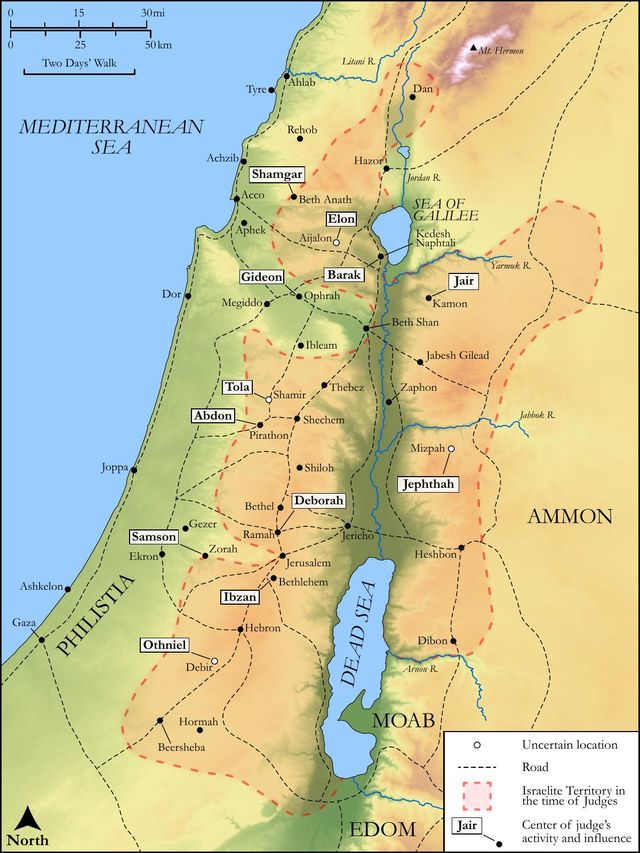
Where Judges reaches
The passages it leans on, and the ones that lean on it
Judges 2:3 Numbers 33:55 Joshua 23:13
Moses and Joshua warned that nations left in the land would be thorns and snares; at Bochim the LORD says it will be so.
Judges 7:2 Deuteronomy 8:17 1 Corinthians 1:27
Fewer men, so Israel cannot boast that its own hand saved it; Moses warned of that boast, and Paul names the rule.
Judges 5:12 Psalms 68:18 Ephesians 4:8
Deborah’s “lead thy captivity captive,” sung again in Psalm 68 and applied by Paul to Christ’s ascension.
The men of Gibeah make the demand the men of Sodom made of Lot, almost word for word.
Moses forbade each man doing what was right in his own eyes; Judges ends with all Israel doing it.
Books Judges links to most
The Church Fathers on Judges
164 quotations from 27 writers before AD 800 · the ten most quoted, in date order
- Origen253
- Ephrem373
- Athanasius373
- Ambrose397
- Jerome420
- Augustine430
- John Cassian435
- Caesarius542
- Gregory604
- Bede735
Salvian, on why the book’s great deliverances come through few hands and weak ones.
We read that when God wished it clearly understood that great deeds were done by him, they were done through a few or through the lowliest, lest the work of his heavenly hand be attributed to human strength. In this way the leader Sisera, before whom the Hebrew army trembled, was laid low by a woman.
Jerome read Gideon’s dry fleece as Israel, and the wet ground as the whole world receiving rain.
The truth of the Lord reaches even to the clouds. The clouds are the apostles and prophets; to them he gave the command not to rain upon Israel. This is in agreement with history as recorded in the book of Judges, where it speaks of the fleece that was dry while rain fell upon the rest of the world. It means that Israel is dry and the rain is pouring down over the whole world.
Caesarius read Samson’s riddle as a figure of Christ rising from the dead.
As to the question implied in the words “Out of the eater came forth food, and out of the strong came forth sweetness,” what else does it signify but Christ rising from the dead? Truly, out of the eater, that is, from death which devours and consumes all things, came forth that food which said, “I am the bread that has come down from heaven.”
Keep studying
Articles