


Judges 4:5
- וְהִיאVe·hi'and sheH1931Conj-w ¦ Pro-3fsPronoun Personal 3rd Singular Feminineוְandהִיאshe
- יוֹשֶׁבֶתyo·She·vet[was] dwellingH3427V-Qal-Prtcpl-fsVerb Qal Participle Singular Feminine Absolute
- תַּחַתta·chatunderH8478N-mscNoun Singular Masculine Construct
- תֹּמֶרTo·mer[the] palm tree ofH8560N-mscNoun Singular Masculine Construct
- דְּבוֹרָהde·vo·RahDeborahH1683N-proper-fNoun Proper Feminine
- בֵּיןbeinbetweenH996Adj-mscAdjective Numerical Singular Masculine Construct
- הָרָמָהha·ra·Mah<the> RamahH7414Art ¦ N-properNoun Proper Locationהָ<the>רָמָהRamah
- וּבֵיןu·Veinand betweenH996Conj-w ¦ Adj-mscAdjective Numerical Singular Masculine Constructוּandבֵיןbetween
- בֵּיתbeitBeth-H1008N-properNoun Proper Location
- אֵל'el-elH1008N-properNoun Proper Location
- בְּהַרbe·Harin [the] hill country ofH2022Prep-b ¦ N-mscNoun Singular Masculine Constructבְּinהַר[the] hill country of
- אֶפְרָיִם'ef·Ra·yimEphraimH669N-proper-mNoun Proper Masculine
- וַיַּעֲלוּvai·ya·'a·Luand they went upH5927Conj-w ¦ V-Qal-ConsecImperf-3mpVerb Qal Consecutive Imperfect 3rd Plural Masculineוַandיַּעֲלוּthey went up
- אֵלֶיהָ'e·Lei·hato herH413Prep ¦ 3fsPreposition Definiteאֵלֶיtoהָher
- בְּנֵיbe·Nei[the] people ofH1121N-mpcNoun Plural Masculine Construct
- יִשְׂרָאֵלYis·ra·'ElIsraelH3478N-properNoun Proper Location
- לַמִּשְׁפָּטla·mish·Patfor <the> judgmentH4941Prep-l ¦ N-msNoun Singular Masculine Absoluteלַfor <the>מִּשְׁפָּטjudgment
English is a literal word-by-word gloss of the Hebrew, not the KJV's wording. Why?
This is the original text the KJV's translators worked from — each Hebrew word with its own literal English meaning in this verse, prepared by scholars at Tyndale House, Cambridge. The KJV translates whole sentences, not word by word, so its wording differs: one Hebrew word can become several English words, and the KJV may choose “the LORD” where the gloss reads “Yahweh”. Both are faithful — they answer different questions. For the KJV's own rendering, switch to the KJV text.
Details
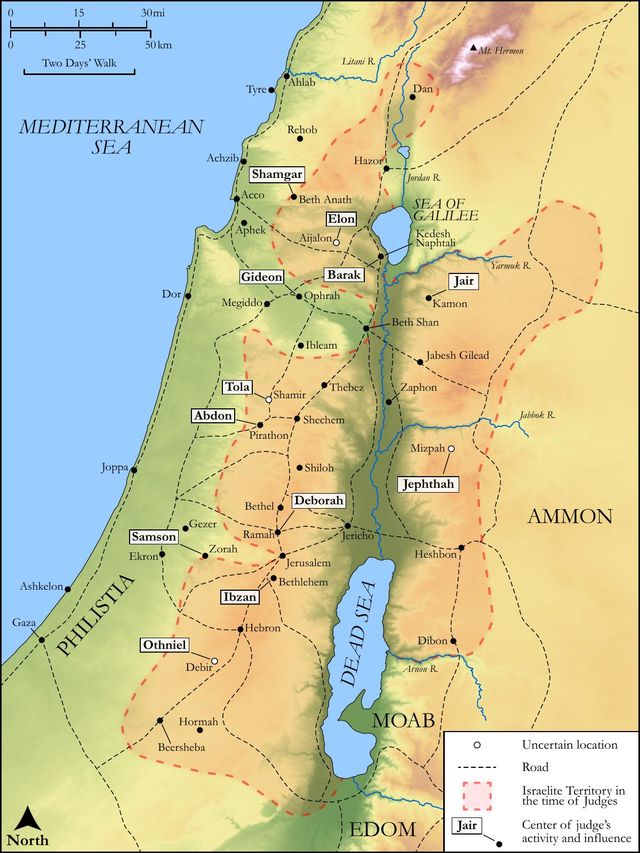
See on the biblical-era map
Study this verse
Public-domain commentary
Matthew Henry
From his Commentary on the Whole Bible. Henry comments on passages, not single verses — this entry covers Judges 4:4–9. His four-level outline is real structure in the source text, so it is rendered as structure.
The year of the redeemed at length came, when Israel was to be delivered out of the hands of Jabin, and restored again to their liberty, which we may suppose the northern tribes, that lay nearest to the oppressors and felt most the effects of his fury, did in a particular manner cry to God for. For the oppression of the poor, and the sighing of the needy, now will God arise. Now here we have,
I.The preparation of the people for their deliverance, by the prophetic conduct and government of Deborah, Jdg 4:4, Jdg 4:5.
Her name signifies a bee; and she answered her name by her industry, sagacity, and great usefulness to the public, her sweetness to her friends and sharpness to her enemies. She is said to be the wife of Lapidoth; but, the termination not being commonly found in the name of a man, some make this the name of a place: she was a woman of Lapidoth. Others take it appellatively, Lapidoth signifies lamps. The Rabbin say she had employed herself in making wicks for the lamps of the tabernacle; and, having stooped to that mean office for God, she was afterwards thus preferred. Or she was a woman of illuminations, or of splendours, one that was extraordinarily knowing and wise, and so came to be very eminent and illustrious. Concerning her we are here told,
1.That she was intimately acquainted with God; she was a prophetess, one that was instructed in divine knowledge by the immediate inspiration of the Spirit of God, and had gifts of wisdom, to which she attained not in an ordinary way: she heard the words of God, and probably saw the visions of the Almighty.
2.That she was entirely devoted to the service of Israel. She judged Israel at the time that Jabin oppressed them; and perhaps, being a woman, she was the more easily permitted by the oppressor to do it. She judged, not as a princess, by an civil authority conferred upon her, but as a prophetess, and as God's mouth to them, correcting abuses and redressing grievances, especially those which related to the worship of God. The children of Israel came up to her from all parts for judgment, not so much for the deciding of controversies between man and man as for advice in the reformation of what was amiss in things pertaining to God. Those among them who before had secretly lamented the impieties and idolatries of their neighbours, but knew not where to apply for the restraining of them, now made their complaints to Deborah, who, by the sword of the Spirit, showing them the judgment of God, reduced and reclaimed many, and excited and animated the magistrates in their respective districts to put the laws in execution. It is said she dwelt, or, as some read it, she sat under a palm-tree, called ever after from her the palm-tree of Deborah. Either she had her house under that tree, a mean habitation which would couch under a tree, or she had her judgment-seat in the open air, under the shadow of that tree, which was an emblem of the justice she sat there to administer, which will thrive and grow against opposition, as palms under pressures. Josephus says that the children of Israel came to Deborah, to desire her to pray to God for them, that they might be delivered out of the hand of Jabin; and Samuel is said at one particular time to judge Israel in Mizpeh, that is, to bring them back again to God, when they made the same address to him upon a like occasion, Sa1 7:6, Sa1 7:8.
II.The project laid for their deliverance.
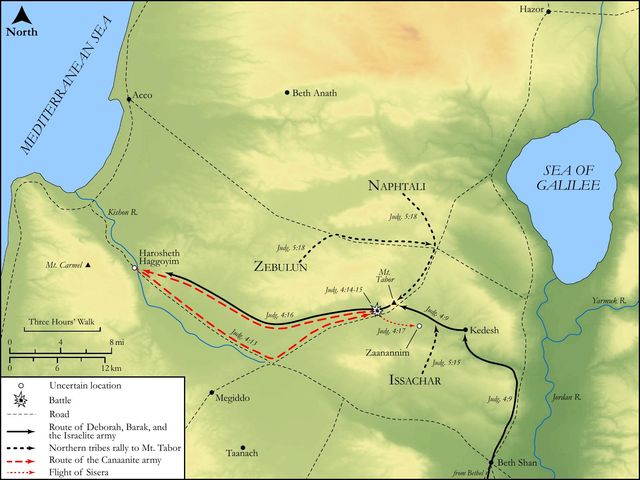
When the children of Israel came to her for judgment, with her they found salvation. So those that seek to God for grace shall have grace and peace, grace and comfort, grace and glory. She was not herself fit to command an army in person, being a woman; but she nominated one that was fit, Barak of Naphtali, who, it is probable, had already signalized himself in some rencounters with the forces of the oppressor, living near him (for Hazor and Harosheth lay within the lot of that tribe), and thereby had gained a reputation and interest among his people. Some struggles, we may suppose, that brave man had made towards the shaking off of the yoke, but could not effect it till he had his commission and instructions from Deborah. He could do nothing without her head, nor she without his hands; but both together made a complete deliverer, and effected a complete deliverance. The greatest and best are not self-sufficient, but need one another.
1.By God's direction, she orders Barak to raise an army, and engage Jabin's forces, that were under Sisera's command, Jdg 4:6, Jdg 4:7. Barak, it may be, had been meditating some great attempt against the common enemy; a spark of generous fire was glowing in his breast, and he would fain do something to the purpose for his people and for the cities of his God. But two things discouraged him:
(1.)He wanted a commission to levy forces; this therefore Deborah here gives him under the broad seal of heaven, which, as a prophetess, she had a warrant to affix to it: "Hath not the Lord God of Israel commanded it? Yet, certainly he has; take my word for it." Some think she intends this as an appeal to Barak's own heart. "Has not God, by a secret whisper to thyself, given thee some intimation of his purpose to make use of thee as an instrument in his hands to save Israel? Hast not thou felt some impulse of this kind upon thy own spirit?" If so, the spirit of prophesy in Deborah confirms the spirit of a soldier in Barak: Go and draw towards Mount Tabor.
[1.]She directs him what number of men to raise - 10,000; and let him not fear that these will be too few, when God hath said he will by them save Israel.
[2.]Whence he should raise them - only out of his own tribe, and that of Zebulun next adjoining. These two counties should furnish him with an army sufficient; he need not stay to go further. And,
[3.]She orders him where to make his rendezvous - at Mount Tabor, in his own neighbourhood.
(2.)When he had an army raised, he knew not how he should have an opportunity of engaging the enemy, who perhaps declined fighting, having heard that Israel, if they had but courage enough to make head against any enemy, seldom failed of success. "Well," says Deborah, in the name of "God, I will draw unto thee Sisera and his army." She assured him that the matter should be determined by one pitched battle, and should not be long in the doing.
[1.]In mentioning the power of the enemy, Sisera, a celebrated general, bold and experienced, his chariots, his iron chariots, and his multitude of soldiers, she obliged Barak to fortify himself with the utmost degree of resolution; for the enemy he was to engage was a very formidable one. It is good to know the worst, that we may provide accordingly. But,
[2.]In fixing the very place to which Sisera would draw his army, she gave him a sign, which might help to confirm his faith when he came to engage. it was a contingent things, and depended upon Sisera's own will; but, when afterwards Barak should see the event falling out just as Deborah had foretold, he might thence infer that certainly in the rest she said she spoke under a divine direction, which would be a great encouragement to him, especially because with this,
[3.]She gave him an express promise of success I will (that is, God will, in whose name I speak) deliver them into thy hand; so that when he saw them drawn up against him, according to Deborah's word, he might be confident that, according to her word, he should soon see them fallen before him. Observe, God drew them to him only that he might deliver them into his hand. When Sisera drew his forces together, he designed the destruction of Israel; but God gathered them as sheaves into the floor, for their own destruction, Mic 4:11, Mic 4:12. Assemble yourselves, and you shall be broken to pieces, Isa 8:9. See Rev 19:17, Rev 19:18.
2.At Barak's request, she promises to go along with him to the field of battle.
(1.)Barak insisted much upon the necessity of her presence, which would be to him better than a council of war (Jdg 4:8): "If thou wilt go with me to direct and advise me, and in every difficult case to let me know God's mind, then I will go with all my heart, and not fear the chariots of iron; otherwise not." Some make this to be the language of a weak faith; he could not take her word unless he had her with him in pawn, as it were, for performance. It seems rather to arise from a conviction of the necessity of God's presence and continual direction, a pledge and earnest of which he would reckon Deborah's presence to be, and therefore begged thus earnestly for it. "If thou go not up with me, in token of God's going with me, carry me not up hence." Nothing would be a greater satisfaction to him than to have the prophetess with him to animate the soldiers and to be consulted as an oracle upon all occasions.
(2.)Deborah promised to go with him, Jdg 4:9. No toil nor peril shall discourage her from doing the utmost that becomes her to do for the service of her country. She would not send him where she would not go herself. Those that in God's name call others to their duty should be very ready to assist them in it. Deborah was the weaker vessel, yet had the stronger faith. But though she agrees to go with Barak, if he insists upon it, she gives him a hint proper enough to move a soldier not to insist upon it: The journey thou undertakest (so confident was she of the success that she called his engaging in war but the undertaking of a journey) shall not be for thy honour; not so much for thy honour as if thou hadst gone by thyself; for the Lord shall sell Sisera (now his turn comes to be sold as Israel was, Jdg 4:2, by way of reprisal) "into the hands of a woman;" that is,
[1.]The world would ascribe the victory to the hand of Deborah: this he might himself foresee.
[2.]God (to correct his weakness) would complete the victory by the hand of Jael, which would be some eclipse to his glory. But Barak values the satisfaction of his mind, and the good success of his enterprise, more than his honour; and therefore will by no means drop his request. He dares not fight unless he have Deborah with him, to direct him and pray for him. She therefore stood to her word with a masculine courage; this noble heroine arose and went with Barak.
Historical interpretation
Historical reception
3 surviving comments on this verse. Each one is dated, so this reads as a timeline rather than a list.
Select a marker to jump to its quote. Markers stagger vertically where authors wrote within a few decades of each other.
And in order that it may not seem as if only one widow had fulfilled this inimitable work, it seems in no way doubtful that there were many others of equal or almost equal virtue, for good seed corn usually bears many ears filled with grains. Do not doubt, then, that that ancient seedtime was fruitful in the characters of many women. But as it would be tedious to include all, consider some, and especially Deborah, whose virtue Scripture records for us.For she showed not only that widows have no need of the help of a man, inasmuch as she, not at all restrained by the weakness of her sex, undertook to perform the duties of a man, and did even more than she had undertaken. And, at last, when the Jews were being ruled under the leadership of the judges, because they could not govern them with manly justice or defend them with manly strength, and so wars broke out on all sides, they chose Deborah, by whose judgment they might be ruled. And so one widow both ruled many thousands of men in peace and defended them from the enemy. There were many judges in Israel, but no woman before was a judge, as after Joshua there were many judges but none was a prophet. And I think that her judgeship has been narrated and her deeds described, that women should not be restrained from deeds of valor by the weakness of their sex. A widow, she governs the people; a widow, she leads armies; a widow, she chooses generals; a widow, she determines wars and orders triumphs. So, then, it is not nature which is answerable for the fault or which is liable to weakness. It is not sex but valor which makes strong.
And in time of peace there is no complaint, and no fault is found in this woman, whereas most of the judges were causes of no small sins to the people. But when the Canaanites, a people fierce in battle and rich in troops, successively joined them, showed a horrible disposition against the people of the Jews, this widow, before all others, made all the preparations for war. And to show that the needs of the household were not dependent on the public resources but rather that public duties were guided by the discipline of home life, she brings forth from her home her son as a leader of the army, that we may acknowledge that a widow can train a warrior; whom, as a mother, she taught, and, as judge, placed in command, as, being herself brave, she trained him, and, as a prophetess, sent to certain victory.
And lastly, her son Barak shows the chief part of the victory was in the hands of a woman when he said, “If you will not go with me I will not go, because I do not know on what day the Lord will send his angel with me.” How great, then, was the might of that woman to whom the leader of the army says, “If you will not go I will not go.” How great, I say, the fortitude of the widow who does not protect her son from dangers through motherly affection but rather with the zeal of a mother exhorts her son to go forth to victory, while saying that the decisive point of that victory is in the hand of a woman!
Indeed, nothing—nothing, I repeat—is more potent than a good and prudent woman in molding a man and shaping his soul in whatever way she desires. For he will not bear with friends, or teachers, or magistrates in the same way as with his wife, when she admonishes and advises him. Her admonition, in fact, carries with it a kind of pleasure, because of his very great love of the one who is admonishing him. Moreover, I could mention many men, formerly harsh and stubborn, who have become more tractable by this means. She shares with him his table and couch, the procreating of his children, his spoken words and secret thoughts, his comings and goings, and a great many other things as well. She is devoted to him in all things and as closely bound to him as the body is fastened to the head. If she chances to be prudent and diligent, she will surpass and excel all in her solicitude for her husband.Therefore, I beseech women to carry this out in practice and to give their husbands only the proper advice. For, just as a woman has great power for good, so also she has it for evil. A woman destroyed Absalom; a woman destroyed Amnon; a woman would have destroyed Job; a woman saved Nabal from being murdered; a woman saved an entire nation.
Furthermore, Deborah and Judith and innumerable other women directed the success of men who were generals. And that is why Paul said, “For how do you know, woman, whether you will save your husband?” In his day, too, we see Persis and Mary and Priscilla sharing in the apostle’s difficult trials. You also ought to imitate these women and mold the character of your husbands, not only by your words but also by your example.
Because these nations have come as enemies against your people, let us hear what judgment the psalmist calls down upon them. “Deal with them as with Midian; as with Sisera.” You have read the book of Judges; this is that Midian whom Gideon defeated. “As with Sisera and Jabin.” Jabin and Sisera are the foes whom Deborah and Barak conquered. “At the torrent Kishon, who perished at Endor.” Deborah and Barak destroyed Sisera, the general of the army. So much for what Scripture says; learn now what it means. Lord, because they are so arrogant, because they have come with a mighty army, because their prince is Nebuchadnezzar the king of the Assyrians, because they are the forces of the sons of Lot, because they follow the example of the fallen angels, because in their pride they have claimed equality with you; for all these reasons, I beg of you to overpower them, not by a man but to their shame by a woman.“They became dung on the ground.” Who? Midian, Sisera and Jabin, these three became putrid on the ground like dung. The name Midian means “one who is negligent of judgment.” The warriors against your people are heedless of the judgment that is to come. Sisera is understood as “the vision of a horse.” Your people’s enemies are not of your flock or of your herd but are stallions that rage with madness over the fillies. Stallions are always ready for battle. “And Jabin.” Jabin means “discernment.” They who trust in their own wisdom and not in the glory of God rot on the ground like dung. They who were glorying in their army, whose king was the Assyrian, and who used to boast “I will scale the heavens,” not only fell down to earth but on the ground became dung.
Continue studying Judges 4:5 across the web’s major study libraries — every link below opens this exact verse, chapter, or book on the destination site.
Read & Compare
 BibleGatewayThis verse in more than 200 translations and 70 languages.
 Bible.comThe YouVersion reader — hundreds of translations, reading plans, and highlights.
 ESV.orgCrossway's official English Standard Version reader.
 NET BibleThe NET translation with 60,000+ translators' notes on every rendering decision.
 STEP BibleTyndale House's free study tool — original text, vocabulary, and scholarly resources.
 BibliaLogos Bible Software's free web reader.
 USCCBThe New American Bible (Revised Edition) with the U.S. bishops' study notes.
Commentaries
 BibleHub CommentariesDozens of classic commentaries on this verse, gathered on one page.
 StudyLightMore than 100 commentary sets — the largest collection on the web.
 BibleRefPlain-English commentary on what this verse means, verse by verse.
 Enduring WordDavid Guzik's free commentary on this chapter, widely used by Bible teachers.
 Bible Study ToolsVerse commentary alongside Greek and Hebrew study aids.
Original Language & Research
- BibleHub InterlinearThe verse word by word — original language, transliteration, and English.
- BibleHub LexiconEvery word's original-language definition and Strong's entry.
 Blue Letter BibleDeep-study tools — Strong's numbers, concordance, and word studies.
 SefariaThe Hebrew text with Rashi and centuries of Jewish commentary.
Sermons, Hymns & Audio


TrulyRandomVerse is not affiliated with these sites and doesn’t control their content. They’re linked because they’re genuinely useful.
Summary
Judges 4:5 introduces Deborah, a pivotal figure in Israel's history, uniquely serving as both a prophetess and a civil judge during a period of severe Canaanite oppression. The verse precisely locates her ministry under a prominent palm tree between Ramah and Bethel in Mount Ephraim, a central and accessible point where the children of Israel would regularly gather to seek her divine counsel and the resolution of their legal and social disputes. This portrayal underscores her divinely appointed authority, the people's profound reliance on her wisdom, and her crucial role in mediating God's justice in a tumultuous and morally adrift era.
Context
ShowHideLiterary Context
Judges 4:5 is strategically positioned at the outset of the narrative concerning Deborah and Barak, immediately following the grim depiction of Israel's renewed apostasy and the subsequent twenty-year oppression under Jabin, the king of Hazor, and his formidable general, Sisera, who commanded 900 iron chariots. This oppressive context is vividly described in Judges 4:1-3. The verse serves as the formal introduction of Deborah, establishing her unparalleled dual role as a prophetess and a judge, before she issues her prophetic command to Barak to confront Sisera's army in Judges 4:6. It sets the crucial foundation for the dramatic military deliverance recounted in Judges 4 and is poetically celebrated in the triumphant song of Judges 5, thereby fitting perfectly within the cyclical pattern of sin, oppression, cry, and deliverance that defines the entire Book of Judges.
Historical & Cultural Context
The period of the Judges, roughly spanning from 1200 to 1000 BC, was characterized by profound political instability and spiritual decline in Israel. Without a centralized monarchy, the nation existed as a loose confederation of tribes, frequently succumbing to internal strife and foreign incursions, as encapsulated by the recurring refrain, "In those days there was no king in Israel; everyone did what was right in his own eyes" (Judges 21:25). Canaanite city-states, particularly Hazor, posed significant military threats due to their advanced iron technology, including formidable chariots. Within this predominantly patriarchal society, Deborah's emergence as a preeminent leader, wielding both prophetic and judicial authority, was exceptionally unusual and powerfully highlights God's sovereign choice of individuals. Her chosen location in Mount Ephraim, specifically between the significant towns of Ramah and Bethel, placed her in the geographical heartland of Israel, making her readily accessible to various tribes seeking her wisdom and arbitration.
Key Themes
ShowHideThis verse profoundly contributes to several overarching themes within the Book of Judges and the broader biblical narrative. Firstly, it powerfully illustrates Divine Sovereignty and Unconventional Leadership, demonstrating God's prerogative to raise up leaders according to His divine will, often transcending human expectations or established societal structures. Deborah's gender and her unique dual role as prophetess and judge exemplify God's ability to utilize anyone for His purposes, even within a patriarchal context. Secondly, the verse underscores the theme of Accessible Justice and Divine Wisdom. The vivid image of Israelites "coming up to her for judgment" under a public palm tree signifies a deep yearning for righteous governance and the ready availability of divine counsel in a period marked by moral and political decay. Deborah served as a vital conduit for God's law, providing the moral compass and discernment that Israel desperately needed. Lastly, it implicitly points to Israel's Spiritual Decline and Profound Need for Deliverance, as the very act of seeking judgment from a divinely appointed leader indicates the people's recognition of their spiritual and social disarray, thereby setting the stage for God's redemptive and powerful intervention through Deborah and Barak.
Exposition and Analysis
ShowHideKey Word Analysis
ShowHideThis primitive root means "to sit down," specifically in a judicial capacity, or to "abide" and "remain." In the context of Deborah, it signifies her established presence and authority as a judge. It implies that she was not merely passing through but had a fixed, recognized place where she "sat" to hear cases and dispense justice, much like a magistrate or elder. This term underscores the stability and permanence of her judicial function.
Meaning "bee." This name is highly evocative, possibly symbolizing her industrious nature, her role in gathering the scattered and disunited people of Israel, or even the "sting" (divine judgment) she would inflict upon Israel's enemies. The fact that a significant landmark was named after her ("the palm tree of Deborah") highlights her unique prominence and the enduring impact of her ministry and identity within Israelite society.
Meaning "a palm trunk" or "palm tree." In this context, "the palm tree of Deborah" transcends a mere botanical reference; it signifies a specific, well-known landmark that served as a customary public gathering place. Palm trees were often associated with shade, refreshment, and stability in the arid climate, making it an ideal, accessible location for public discourse, legal arbitration, and the dispensing of wisdom. Its naming after Deborah further underscores her central role and the enduring recognition of her ministry.
This word encompasses a broader meaning than simply a legal verdict. It refers to a "verdict" or "sentence" pronounced judicially, but also abstractly to "justice," "law," "ordinance," and "right." The Israelites came to Deborah not just for legal rulings on specific disputes, but for guidance, wisdom, and the application of divine law and principles to restore order and discern right from wrong in a society that had largely abandoned God's standards. It implies a seeking of divine discernment for societal and individual conduct.
Verse Breakdown
ShowHide"And she dwelt under the palm tree of Deborah"
This clause establishes Deborah's physical location and the public, accessible nature of her ministry. The specific naming of the palm tree after her ("palm tree of Deborah") indicates her established reputation and the widespread recognition of her as a significant, indeed iconic, figure. This open-air setting served as her "court," symbolizing her ready accessibility to the people and the transparency of her judicial proceedings.
"between Ramah and Bethel in mount Ephraim"
This specifies the precise geographical location of Deborah's ministry. Ramah (H7414) and Bethel (H1008, meaning "house of God") were significant towns situated in the tribal territory of Ephraim (H669), placing her in a central and strategically accessible region of Israel. This central location would have allowed people from various tribes to "come up" (H5927) to her, emphasizing her role as a leader whose authority and counsel extended across tribal lines, serving all Israel.
"and the children of Israel came up to her for judgment"
This final clause clarifies the primary purpose of the people's visits, underscoring Deborah's recognized authority as both a judge and a prophetess. It indicates that the Israelites sought her for legal arbitration, the resolution of disputes, and, crucially, for divine counsel and the application of God's righteous standards. This highlights their desperate need for godly leadership and their profound trust in her ability to discern and apply God's will in a time of widespread moral and social disarray.
Literary Devices
ShowHideThe verse employs several potent literary devices to convey its profound meaning and impact. Symbolism is powerfully evident in "the palm tree of Deborah," which is not merely a botanical reference but a potent symbol of stability, wisdom, and a public space where divine justice was readily accessible. It represents Deborah's deep rootedness in God's truth and her provision of shade, refreshment, and guidance to a weary and disoriented nation. The very act of "coming up" to her for judgment can be interpreted as a subtle form of climax within the narrative, highlighting the people's desperation and their recognition of Deborah as a divinely appointed last resort for intervention. Furthermore, the verse serves as a subtle foreshadowing, introducing Deborah in her established judicial capacity before revealing her more active prophetic and military leadership, hinting at the multifaceted and decisive role she is about to play in Israel's deliverance. The juxtaposition of Israel's widespread spiritual and moral decline (as vividly described in earlier chapters of Judges) with Deborah's singular, stable, and divinely-empowered leadership under the palm tree powerfully emphasizes her unique and indispensable role as a beacon of hope and order.
Theological and Thematic Connections
ShowHideJudges 4:5 powerfully illustrates God's unwavering commitment to His covenant people, even amidst their persistent cycles of apostasy and oppression, by raising up unexpected leaders to provide guidance, justice, and deliverance. Deborah's unparalleled dual role as prophetess and judge underscores that divine authority and wisdom are not confined by conventional human societal norms or expectations, but are freely bestowed by God upon those He sovereignly chooses and equips. Her accessible "court" under the palm tree signifies God's desire for justice to be readily available to all His people, and His willingness to use human instruments to mediate His truth and righteousness in a fallen world. This verse serves as a profound reminder that God's justice is not merely punitive but fundamentally restorative, aimed at bringing order, discernment, and spiritual clarity where there is chaos, confusion, and moral decay.
Reflection and Application
ShowHideDeborah's ministry under the palm tree offers a profound and enduring model for leadership and the pursuit of divine wisdom in every age. Her example powerfully reminds us that God often calls and equips individuals for His redemptive purposes in ways that confound human expectation (1 Corinthians 1:27). For believers today, this verse emphasizes the critical importance of seeking counsel and "judgment" from sources deeply rooted in God's truth, whether through diligent study of Scripture, wise mentors within the faith community, or the direct guidance of the Holy Spirit. Just as the Israelites found an accessible source of divine wisdom in Deborah, we are called to cultivate environments within our churches, families, and communities where godly counsel is readily available and where justice, mercy, and truth are consistently upheld. It challenges each of us to be leaders, in whatever sphere God places us, who are not only wise and discerning but also accessible, serving with unwavering integrity and a deep, abiding connection to the divine source of all wisdom and righteousness.
Questions for Reflection
ShowHideFAQ
ShowHideQuestion: Why was Deborah a judge and a prophetess, and how unique was this role for a woman in ancient Israel?
ShowHideDeborah's dual role as a prophetess and a judge was indeed highly unique, particularly for a woman in the patriarchal society of ancient Israel. As a prophetess, she received direct messages from God and communicated His divine will to the people, as evidenced by her prophetic instruction to Barak in Judges 4:6. As a judge, she functioned as a civil arbiter, resolving disputes, administering justice, and providing guidance rooted in divine law, much like Moses (Exodus 18:13-16) or Samuel (1 Samuel 7:15-17). While other women in the Old Testament served as prophetesses (e.g., Miriam in Exodus 15:20, Huldah in 2 Kings 22:14), Deborah is the only woman explicitly identified as a "judge" in the entire Book of Judges. This singular distinction powerfully highlights God's sovereignty in choosing His instruments, demonstrating that His Spirit empowers whomever He wills to fulfill His purposes, often challenging human expectations and conventions.
Question: What is the significance of the "palm tree of Deborah"?
ShowHideThe "palm tree of Deborah" (Hebrew: tômer Dᵉbôwrâh) was a well-known landmark that served as the central and public location for Deborah's judicial and prophetic ministry. Its significance is multifaceted. Firstly, it underscores her accessibility; it was an open, public place where "the children of Israel came up to her for judgment," symbolizing an open court where justice and divine counsel were readily available to all who sought them. Secondly, the act of naming the tree after her ("the palm tree of Deborah") profoundly underscores her prominence and the lasting impact she had on the people; it became synonymous with her wisdom, authority, and the divine presence she mediated. Thirdly, the choice of a palm tree, a symbol of life, stability, shade, and refreshment in the often arid climate of the ancient Near East, suggests that her ministry provided spiritual and social refreshment and counsel in a time of national distress and moral decay. It was not a formal, enclosed court, but an organic, natural setting that perhaps fostered a sense of approachability and trust, standing in stark contrast to the oppressive and unjust rule from which Israel suffered.
Christ-Centered Fulfillment
ShowHideDeborah's remarkable role as a judge and dispenser of divine wisdom under the palm tree finds its ultimate and perfect fulfillment in the person and work of Jesus Christ. While Deborah offered temporary justice and guidance to a nation in disarray, Christ is the eternal, perfectly righteous Judge, of whom the Father declares, "the Father judges no one, but has given all judgment to the Son" (John 5:22). The Israelites sought Deborah for mishpâṭ, divine justice and discernment; similarly, all humanity is invited to come to Christ, in whom "are hidden all the treasures of wisdom and knowledge" (Colossians 2:3). Her accessible "court" under the palm tree foreshadows Christ's open and gracious invitation to all who are weary and burdened to find rest, righteousness, and true justice in Him (Matthew 11:28). Deborah's unconventional leadership, chosen by God outside of typical societal expectations, powerfully points to Christ, who came not as an earthly king in splendor but as a humble servant, a "Wonderful Counselor, Mighty God, Everlasting Father, Prince of Peace" (Isaiah 9:6), profoundly defying human expectations of Messiahship. Ultimately, Deborah brought temporary deliverance from oppression, but Jesus Christ offers eternal salvation and perfect, redemptive justice, freeing humanity from the ultimate oppression of sin and death.