


Genesis 35:8
Bible text: King James Version (1769 Blayney text) · Public domain
Bible text: Berean Standard Bible · Public domain
Bible text: American Standard Version (1901) · Public domain
Bible text: World English Bible, Messianic edition · Public domain
Bible text: Geneva Bible (1599) · Public domain
Bible text: Young's Literal Translation · Public domain
- וַתָּמָתva·Ta·motand she diedH4191Conj-w ¦ V-Qal-ConsecImperf-3fsVerb Qal Consecutive Imperfect 3rd Singular Feminineוַandתָּמָתshe died
- דְּבֹרָהde·vo·RahDeborahH1683N-proper-fNoun Proper Feminine
- מֵינֶקֶתmei·Ne·ket[the] suckling-nurse ofH3243N-fscNoun Singular Feminine Construct
- רִבְקָהriv·KahRebekahH7259N-proper-fNoun Proper Feminine
- וַתִּקָּבֵרva·ti·ka·Verand she was buriedH6912Conj-w ¦ V-Niphal-ConsecImperf-3fsVerb Niphal Consecutive Imperfect 3rd Singular Feminineוַandתִּקָּבֵרshe was buried
- מִתַּחַתmi·Ta·chatfrom underH8478Prep-m ¦ N-mscNoun Singular Masculine Constructמִfromתַּחַתunder
- לְבֵיתle·veitto Beth-H1008Prep-l ¦ N-properNoun Proper LocationלְtoבֵיתBeth-
- אֵל'el-elH1008N-properNoun Proper Location
- תַּחַתTa·chatunderH8478N-mscNoun Singular Masculine Construct
- הָאַלּוֹןha·'a·Lonthe oakH437Art ¦ N-msNoun Singular Masculine Absoluteהָtheאַלּוֹןoak
- וַיִּקְרָאvai·yik·Ra'and someone calledH7121Conj-w ¦ V-Qal-ConsecImperf-3msVerb Qal Consecutive Imperfect 3rd Singular Masculineוַandיִּקְרָאsomeone called
- שְׁמוֹshe·Moits nameH8034N-msc ¦ 3msNoun Singular Masculine Constructשְׁמnameוֹits
- אַלּוֹן'a·LonAllonH439N-properNoun Proper Location
- בָּכוּתba·KhutBacuthH439N-properNoun Proper Location
English is a literal word-by-word gloss of the Hebrew, not the KJV's wording. Why?
This is the original text the KJV's translators worked from — each Hebrew word with its own literal English meaning in this verse, prepared by scholars at Tyndale House, Cambridge. The KJV translates whole sentences, not word by word, so its wording differs: one Hebrew word can become several English words, and the KJV may choose “the LORD” where the gloss reads “Yahweh”. Both are faithful — they answer different questions. For the KJV's own rendering, switch to the KJV text.
Details
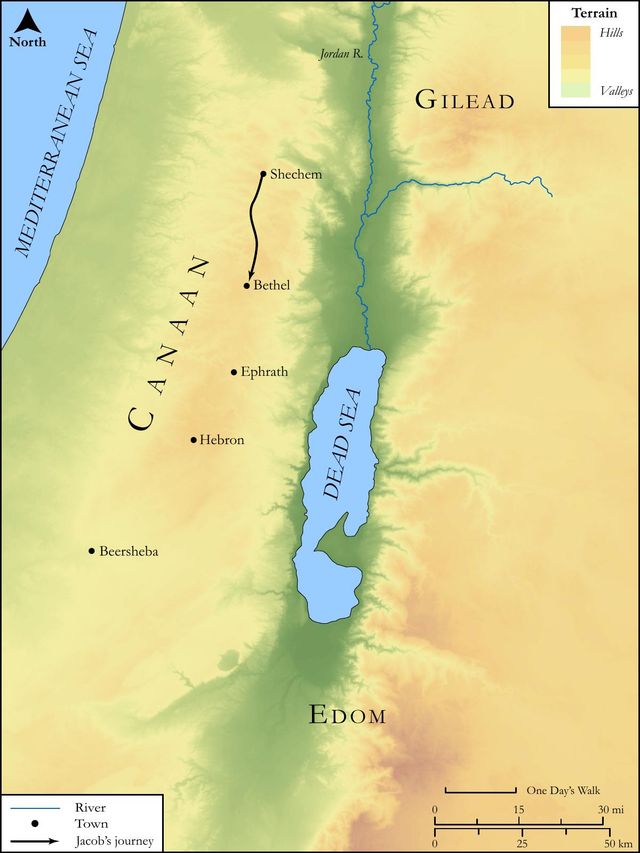
See on the biblical-era maps


Study this verse
Public-domain commentary
Matthew Henry
From his Commentary on the Whole Bible. Henry comments on passages, not single verses — this entry covers Genesis 35:6–15. His two-level outline is real structure in the source text, so it is rendered as structure.
Jacob and his retinue having safely arrived at Bethel, we are here told what passed there.
I.There he built an altar (Gen 35:7), and no doubt offered sacrifice upon it, perhaps the tenth of his cattle, according to his vow, I will give the tenth unto thee. With these sacrifices he joined praises for former mercies, particularly that which the sight of the place brought afresh to his remembrance; and he added prayers for the continuance of God's favour to him and his family. And he called the place (that is, the altar) El-beth-el, the God of Bethel. As, when he made a thankful acknowledgment of the honour God had lately done him in calling him Israel, he worshipped God by the name of El-elohe Israel; so, now that he was making a grateful recognition of God's former favour to him at Bethel, he worships God by the name of El-beth-el, the God of Bethel, because there God appeared to him. Note, The comfort which the saints have in holy ordinances is not so much from Bethel, the house of God, as from El-beth-el, the God of the house. The ordinances are but empty things if we do not meet with God in them.
II.There he buried Deborah, Rebekah's nurse, Gen 35:8.
We have reason to think that Jacob, after he came to Canaan, while his family dwelt near Shechem, went himself (it is likely, often) to visit his father Isaac at Hebron. Rebekah probably was dead, but her old nurse (of whom mention is made Gen 24:59) survived her, and Jacob took her to his family, to be a companion to his wives, her country-women, and an instructor to his children; while they were at Bethel, she died, and died lamented, so much lamented that the oak under which she was buried was called Allon-bachuth, the oak of weeping. Note,
1.Old servants in a family, that have in their time been faithful and useful, ought to be respected. Honour was done to this nurse, at her death, by Jacob's family, though she was not related to them, and though she was aged. Former services, in such a case, must be remembered.
2.We do not know where death may meet us; perhaps at Beth-el, the house of God. Therefore let us be always ready.
3.Family-afflictions may come even when family-reformation and religion are on foot. Therefore rejoice with trembling.
III.There God appeared to him (Gen 35:9), to own his altar, to answer to the name by which he had called him, The God of Bethel (Gen 35:7), and to comfort him under his affliction, Gen 35:8. Note, God will appear to those in a way of grace that attend on him in a way of duty. Here,
1.He confirmed the change of his name, Gen 35:10. It was done before by the angel that wrestled with him (Gen 32:28), and here it was ratified by the divine Majesty, or Shechinah, that appeared to him. There it was to encourage him against the fear of Esau, here against the fear of the Canaanites. Who can be too hard for Israel, a prince with God? It is below those who are thus dignified to droop and despond.
2.He renewed and ratified the covenant with him, by the name El-shaddai. I am God Almighty, God all-sufficient (Gen 35:11), able to make good the promise in due time, and to support thee and provide for thee in the mean time. Two things are promised him which we have met with often before: - (1.) That he should be the father of a great nation, great in honour and power - a company of nations shall be of thee (every tribe of Israel was a nation, and all the twelve a company of nations), great in honour and power - kings shall come out of thy loins. (2.) That he should be the master of a good land (Gen 35:12), described by the grantees, Abraham and Isaac, to whom it was promised, not by the occupants, the Canaanites in whose possession it now was. The land that was given to Abraham and Isaac is here entailed on Jacob and his seed. He shall not have children without an estate, which is often the case of the poor, nor an estate without children, which is often the grief of the rich; but both. These two promises had a spiritual signification, of which we may suppose Jacob himself had some notion, though not so clear and distinct as we now have; for, without doubt, Christ is the promised seed, and heaven is the promised land; the former is the foundation, and the latter the top-stone, of all God's favours.
3.He then went up from him, or from over him, in some visible display of glory, which had hovered over him while he talked with him, Gen 35:13. Note, The sweetest communions the saints have with God in this world are short and transient, and soon have an end. Our vision of God in heaven will be everlasting; there we shall be ever with the Lord; it is not so here.
IV.There Jacob erected a memorial of this, Gen 35:14.
1.He set up a pillar. When he was going to Padan-aram, he set up for a pillar that stone on which he had laid his head. This was agreeable enough to his low condition and his hasty flight; but now he took time to erect one more stately, more distinguishable and durable, probably placing that stone in it. In token of his intending it for a sacred memorial of his communion with God, he poured oil and the other ingredients of a drink-offering upon it. His vow was, This stone shall be God's house, that is, shall be set up for his honour, as houses to the praise of their builders; and here he performs it, transferring it to God by anointing it.
2.He confirmed the name he had formerly given to the place (Gen 35:15), Beth-el, the house of God. Yet this very place afterwards lost the honour of its name, and became Beth-aven, a house of iniquity; for here it was that Jeroboam set up one of his calves. It is impossible for the best man to entail upon a place so much as the profession and form of religion.
Historical interpretation
Historical reception
1 surviving comment on this verse from the historical church.
(Verse 8) And Deborah, the nurse of Rebekah, died and was buried near Bethel. If the nurse of Rebekah named Deborah is dead, as the Septuagint interpreters also translated here, and the Hebrew word is Meneketh: we cannot know why they put 'substantiam' there, 'nutricem' here.
Continue studying Genesis 35:8 across the web’s major study libraries — every link below opens this exact verse, chapter, or book on the destination site.
Read & Compare
 BibleGatewayThis verse in more than 200 translations and 70 languages.
 Bible.comThe YouVersion reader — hundreds of translations, reading plans, and highlights.
 ESV.orgCrossway's official English Standard Version reader.
 NET BibleThe NET translation with 60,000+ translators' notes on every rendering decision.
 STEP BibleTyndale House's free study tool — original text, vocabulary, and scholarly resources.
 BibliaLogos Bible Software's free web reader.
 USCCBThe New American Bible (Revised Edition) with the U.S. bishops' study notes.
Commentaries
 BibleHub CommentariesDozens of classic commentaries on this verse, gathered on one page.
 StudyLightMore than 100 commentary sets — the largest collection on the web.
 BibleRefPlain-English commentary on what this verse means, verse by verse.
 Enduring WordDavid Guzik's free commentary on this chapter, widely used by Bible teachers.
 Bible Study ToolsVerse commentary alongside Greek and Hebrew study aids.
Original Language & Research
- BibleHub InterlinearThe verse word by word — original language, transliteration, and English.
- BibleHub LexiconEvery word's original-language definition and Strong's entry.
 Blue Letter BibleDeep-study tools — Strong's numbers, concordance, and word studies.
 SefariaThe Hebrew text with Rashi and centuries of Jewish commentary.
Sermons, Hymns & Audio


TrulyRandomVerse is not affiliated with these sites and doesn’t control their content. They’re linked because they’re genuinely useful.
Summary
Genesis 35:8 records the poignant death and burial of Deborah, Rebekah's nurse, during Jacob's significant return journey to Bethel. This seemingly minor detail highlights the deep bonds within Jacob's household and the profound respect accorded to all its members, regardless of their social standing. Her burial beneath an oak, named "Allonbachuth" or "Oak of Weeping," serves as a lasting memorial to the genuine grief experienced by Jacob and his family, underscoring the human element within the unfolding divine narrative.
Context
ShowHideLiterary Context
This verse is strategically placed within a pivotal chapter that marks a significant turning point in Jacob's life and the patriarchal narrative. Following God's command to return to Bethel (Genesis 35:1), the site of his foundational vision of a ladder reaching heaven (Genesis 28:10-22), Jacob undertakes a spiritual cleansing of his household, ridding them of foreign gods and purifying themselves (Genesis 35:2-4). Amidst this preparation for renewed covenant communion and worship, the narrative pauses to note Deborah's death. Her presence with Jacob's family, long after Rebekah would have departed Haran, underscores her profound loyalty and enduring role, likely having accompanied Jacob's wives and children from Paddan-Aram, signifying her integration into the family unit.
Historical & Cultural Context
In the households of the patriarchs, nurses often held a position of significant trust and intimacy within a household, sometimes serving as surrogate mothers or lifelong companions. They were not merely employees but integral members of the extended family, often remaining with their charges throughout their lives. Deborah's continued presence with Jacob's household, decades after Rebekah's marriage to Isaac, exemplifies this deep-rooted cultural practice. Burial under prominent trees was also a common practice, serving as a natural landmark and a place of remembrance. The act of naming a place after a significant event, particularly one involving strong emotion like weeping, was a common ancient practice to memorialize events and emotions, making the location itself a historical marker.
Key Themes
ShowHideGenesis 35 contributes to several major theological and narrative themes. It emphasizes God's faithfulness in bringing Jacob back to the land and renewing His covenant promises, echoing the themes found throughout the Abrahamic covenant. The cleansing of Jacob's household highlights the theme of holiness and separation for God's chosen people, a recurring motif in the Pentateuch. The death of Deborah, a non-covenant figure, subtly introduces the theme of the value of every individual life within God's broader plan, even those not directly in the patriarchal lineage. Furthermore, the naming of "Allonbachuth" underscores the universal human experience of grief and mourning, demonstrating that even in moments of spiritual renewal, the realities of human loss are deeply felt and acknowledged by the patriarchs and their families. This chapter also serves as a transition, setting the stage for the birth of Benjamin and the death of Rachel, further emphasizing life's cycles within the unfolding narrative of God's people.
Exposition and Analysis
ShowHideGenesis 35:8 states, "But Deborah Rebekah's nurse died, and she was buried beneath Bethel under an oak: and the name of it was called Allonbachuth." This concise verse, though seemingly a minor interjection, carries significant emotional and thematic weight, revealing much about the values and experiences of the patriarchal family.
Key Word Analysis
ShowHideMeaning "bee." This is the name of Rebekah's nurse, indicating her identity and role. Her presence in Jacob's camp, likely accompanying Rebekah from Haran and remaining with the family for decades, signifies her deep integration and importance within the household, far beyond a mere servant.
A primitive root meaning "to suck; causatively, to give milk." This term highlights Deborah's intimate and nurturing role, providing care and sustenance from Rebekah's infancy. The enduring bond between a nurse and her charge was culturally significant, often extending throughout their lives, making her a trusted and beloved figure.
Meaning "house of God." This is the highly significant location where Jacob had his foundational dream and made a vow to God (Genesis 28:10-22). Burying Deborah "beneath Bethel" connects her passing to a sacred, covenantal site, imbuing her death with a sense of belonging within the divine narrative of the patriarchs.
Meaning "oak of weeping." This monumental name given to the burial site directly reflects the profound grief and mourning of Jacob's household. The "oak" (H437, ʼallôwn) signifies a prominent, enduring landmark, while "weeping" underscores the genuine sorrow experienced, making the place a permanent memorial to Deborah's cherished memory.
Verse Breakdown
ShowHide"But Deborah Rebekah's nurse died"
This clause introduces the unexpected death of Deborah, a figure whose presence is only mentioned here in the entire biblical narrative. Her identification as "Rebekah's nurse" immediately establishes her long-standing relationship and deep connection to the patriarchal family, having served Rebekah from her youth and evidently remaining with Jacob's household for many years. Her death, recorded with solemnity, indicates her significant, albeit unstated, influence and beloved status within the family unit.
"and she was buried beneath Bethel under an oak"
This specifies the location of her burial, emphasizing its proximity to Bethel, a place of immense spiritual significance for Jacob as the "House of God." The choice of an "oak" tree as her burial marker is consistent with the practice of burying under prominent trees, as the men of Jabesh buried Saul's bones under a tree, which served as natural, enduring landmarks, often associated with significant events or individuals. This act of burial signifies respect and the formal acknowledgment of her passing within the family's journey.
"and the name of it was called Allonbachuth"
This final clause reveals the profound emotional impact of Deborah's death. The naming of the burial site "Allonbachuth," meaning "Oak of Weeping," is a direct and powerful expression of the deep sorrow and mourning experienced by Jacob and his entire household. It transforms the physical location into a permanent memorial of their grief, underscoring the genuine affection and value placed upon Deborah, a faithful servant.
Literary Devices
ShowHideThe verse employs several Literary Devices to convey its meaning and emotional weight. The most prominent is Eponymous Naming, where the place of burial is named "Allonbachuth" ("Oak of Weeping") to commemorate the event and the emotional response it evoked. This act of naming transforms a geographical location into a memorial, permanently linking the place with the family's grief. The unexpected inclusion of Deborah's death, a seemingly minor character, serves as a form of Foreshadowing or Anticipation, subtly preparing the reader for subsequent, more significant deaths in the chapter, such as Rachel's (Genesis 35:19). The narrative's brevity regarding Deborah's life, contrasted with the detailed account of her burial and the naming of the site, creates a sense of Poignancy, highlighting the profound impact of her death despite her humble role. The mention of "Rebekah's nurse" also functions as a form of Analeptic Reference, reaching back into the past to remind the reader of Rebekah's journey from Haran and Deborah's long-standing dedication to the family.
Theological and Thematic Connections
ShowHideThe inclusion of Deborah's death, a non-covenant figure and a servant, highlights a profound biblical truth: the inherent dignity and value of every individual in the eyes of God and within the human community, regardless of their social standing or direct lineage to the covenant promises. Her lifelong dedication, first to Rebekah and then to Jacob's family, exemplifies a powerful theme of enduring loyalty and faithful service, which is consistently honored throughout Scripture as a virtue pleasing to God. The naming of "Allonbachuth" powerfully conveys the reality of human grief and mourning, demonstrating that sorrow is a natural and acknowledged response to loss, even for those not directly related by blood to the patriarch. This moment of shared grief also underscores the strong familial bonds and the communal nature of life within the patriarchal household, where even a servant's death deeply impacts the entire family.
Reflection and Application
ShowHideThe brief account of Deborah's death in Genesis 35:8 serves as a profound reminder that the biblical narrative is deeply human, valuing relationships and acknowledging the impact of individuals beyond the immediate lineage of covenant promise. Her story underscores that faithfulness and a life of dedicated service, even in a humble role, are cherished and remembered, not only by those she served but also by the divine author of Scripture. It challenges us to recognize and appreciate the often-unsung contributions of those who serve diligently in our own lives and communities, reminding us that every person, regardless of their station, holds intrinsic worth and can leave a lasting legacy of love and commitment. The genuine mourning for Deborah, expressed through the naming of "Allonbachuth," encourages us to cultivate deep, compassionate relationships with all those in our sphere of influence, to grieve authentically, and to honor the lives of those who have poured themselves out in service to others. It calls us to embody the same valuing of human dignity that is subtly but powerfully present in this ancient text.
Questions for Reflection
ShowHideFAQ
ShowHideWho was Deborah and why is her death recorded in Genesis 35?
ShowHideDeborah was Rebekah's nurse, a significant figure who had been with Rebekah since her youth and likely accompanied her from Haran to Canaan. Her death is recorded in Genesis 35 to highlight her beloved and integral status within Jacob's household, even though she was a servant. It underscores the deep familial bonds that extended beyond blood relatives and the value placed on all members of the community, demonstrating that her passing was a moment of genuine sorrow and significance for the entire family, worthy of inclusion in the patriarchal narrative.
What is the significance of the name "Allonbachuth"?
ShowHide"Allonbachuth" is a Hebrew name meaning "Oak of Weeping." It was the name given to the prominent oak tree under which Deborah was buried near Bethel. The name directly reflects the profound grief and mourning experienced by Jacob and his family at her death. It serves as a permanent memorial, signifying that her loss was deeply felt and remembered, emphasizing the emotional humanity of the biblical characters and the lasting impact of even those not directly in the covenant lineage. This naming practice was a common way among the patriarchs to commemorate significant events and emotions, making the place itself a testament to their sorrow.
Christ-Centered Fulfillment
ShowHideThe profound mourning for Deborah at "Allonbachuth" subtly foreshadows Christ's radical empathy and His divine valuing of every individual, regardless of their social standing or perceived importance. Just as Jacob's family wept for a faithful servant, recognizing her intrinsic worth, Christ consistently demonstrated boundless compassion for the lowly, the humble, and the "least of these" (Matthew 25:40). His earthly ministry was characterized by service, not being served (Mark 10:45), culminating in His sacrificial death, which transformed the deepest human sorrow into eternal hope. The "Oak of Weeping" can be seen as a poignant shadow of the cross, where the ultimate act of divine love met humanity's deepest grief and sin, turning mourning into joy for all who believe in the redemptive work of the Lamb of God. Through Christ, even the tears shed at "Allonbachuth" find their ultimate comfort and meaning, as He promises to one day wipe away every tear from our eyes.