


Genesis 35:7
- וַיִּבֶןvai·Yi·venand he builtH1129Conj-w ¦ V-Qal-ConsecImperf-3msVerb Qal Consecutive Imperfect 3rd Singular Masculineוַandיִּבֶןhe built
- שָׁםshamthereH8033AdvAdverb
- מִזְבֵּחַmiz·Be·achan altarH4196N-msNoun Singular Masculine Absolute
- וַיִּקְרָאvai·yik·Ra'and he calledH7121Conj-w ¦ V-Qal-ConsecImperf-3msVerb Qal Consecutive Imperfect 3rd Singular Masculineוַandיִּקְרָאhe called
- לַמָּקוֹםla·ma·Kom<to> the placeH4725Prep-l ¦ N-msNoun Singular Masculine Absoluteלַ<to> theמָּקוֹםplace
- אֵל'elElH416N-properNoun Proper Location
- בֵּיתbeitBeth-H416N-properNoun Proper Location
- אֵל'El-elH416N-properNoun Proper Location
- כִּיkiforH3588PrtParticle Conditional
- שָׁםShamthereH8033AdvAdverb
- נִגְלוּnig·Luthey had revealed themselvesH1540V-Niphal-Perf-3cpVerb Niphal Perfect 3rd Plural common gender
- אֵלָיו'e·Lavto himH413Prep ¦ 3msPreposition Definiteאֵלָיtoוhim
- הָאֱלֹהִיםha·'E·lo·Him<the> GodH430Art ¦ N-mpNoun Plural Masculine Absoluteהָ<the>אֱלֹהִיםGod
- בְּבָרְחוֹbe·va·re·Chowhen he fledH1272Prep-b ¦ V-Qal-Inf ¦ 3msVerb Qal Infinitive Constructבְּwhenבָרְחfledוֹhe
- מִפְּנֵיmi·pe·Neifrom beforeH6440Prep-m ¦ N-mpcNoun Plural Masculine Constructמִfromפְּנֵיbefore
- אָחִיו'a·Chivhis brotherH251N-msc ¦ 3msNoun Singular Masculine Constructאָחִיbrotherוhis
English is a literal word-by-word gloss of the Hebrew, not the KJV's wording. Why?
This is the original text the KJV's translators worked from — each Hebrew word with its own literal English meaning in this verse, prepared by scholars at Tyndale House, Cambridge. The KJV translates whole sentences, not word by word, so its wording differs: one Hebrew word can become several English words, and the KJV may choose “the LORD” where the gloss reads “Yahweh”. Both are faithful — they answer different questions. For the KJV's own rendering, switch to the KJV text.
Details
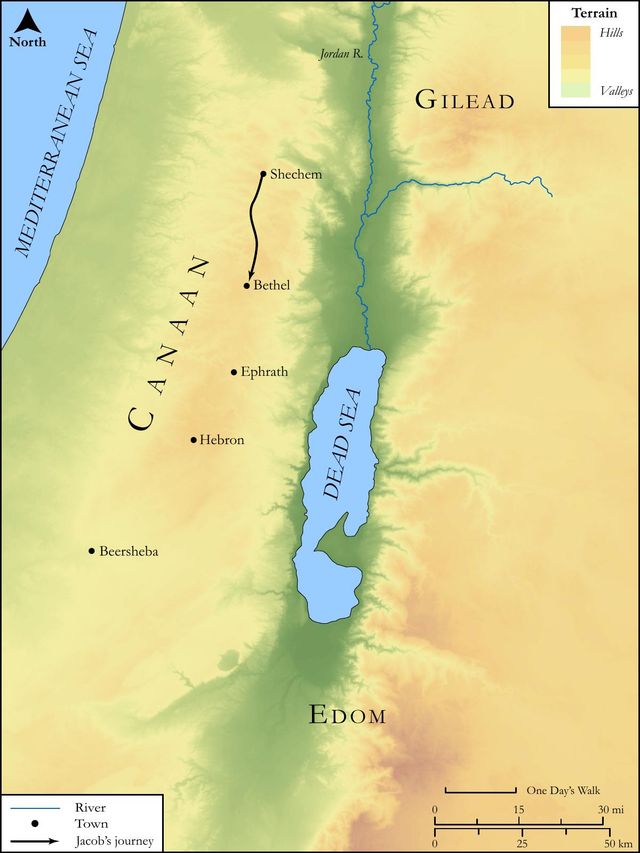
See on the biblical-era map


Study this verse
Public-domain commentary
Matthew Henry
From his Commentary on the Whole Bible. Henry comments on passages, not single verses — this entry covers Genesis 35:6–15. His two-level outline is real structure in the source text, so it is rendered as structure.
Jacob and his retinue having safely arrived at Bethel, we are here told what passed there.
I.There he built an altar (Gen 35:7), and no doubt offered sacrifice upon it, perhaps the tenth of his cattle, according to his vow, I will give the tenth unto thee. With these sacrifices he joined praises for former mercies, particularly that which the sight of the place brought afresh to his remembrance; and he added prayers for the continuance of God's favour to him and his family. And he called the place (that is, the altar) El-beth-el, the God of Bethel. As, when he made a thankful acknowledgment of the honour God had lately done him in calling him Israel, he worshipped God by the name of El-elohe Israel; so, now that he was making a grateful recognition of God's former favour to him at Bethel, he worships God by the name of El-beth-el, the God of Bethel, because there God appeared to him. Note, The comfort which the saints have in holy ordinances is not so much from Bethel, the house of God, as from El-beth-el, the God of the house. The ordinances are but empty things if we do not meet with God in them.
II.There he buried Deborah, Rebekah's nurse, Gen 35:8.
We have reason to think that Jacob, after he came to Canaan, while his family dwelt near Shechem, went himself (it is likely, often) to visit his father Isaac at Hebron. Rebekah probably was dead, but her old nurse (of whom mention is made Gen 24:59) survived her, and Jacob took her to his family, to be a companion to his wives, her country-women, and an instructor to his children; while they were at Bethel, she died, and died lamented, so much lamented that the oak under which she was buried was called Allon-bachuth, the oak of weeping. Note,
1.Old servants in a family, that have in their time been faithful and useful, ought to be respected. Honour was done to this nurse, at her death, by Jacob's family, though she was not related to them, and though she was aged. Former services, in such a case, must be remembered.
2.We do not know where death may meet us; perhaps at Beth-el, the house of God. Therefore let us be always ready.
3.Family-afflictions may come even when family-reformation and religion are on foot. Therefore rejoice with trembling.
III.There God appeared to him (Gen 35:9), to own his altar, to answer to the name by which he had called him, The God of Bethel (Gen 35:7), and to comfort him under his affliction, Gen 35:8. Note, God will appear to those in a way of grace that attend on him in a way of duty. Here,
1.He confirmed the change of his name, Gen 35:10. It was done before by the angel that wrestled with him (Gen 32:28), and here it was ratified by the divine Majesty, or Shechinah, that appeared to him. There it was to encourage him against the fear of Esau, here against the fear of the Canaanites. Who can be too hard for Israel, a prince with God? It is below those who are thus dignified to droop and despond.
2.He renewed and ratified the covenant with him, by the name El-shaddai. I am God Almighty, God all-sufficient (Gen 35:11), able to make good the promise in due time, and to support thee and provide for thee in the mean time. Two things are promised him which we have met with often before: - (1.) That he should be the father of a great nation, great in honour and power - a company of nations shall be of thee (every tribe of Israel was a nation, and all the twelve a company of nations), great in honour and power - kings shall come out of thy loins. (2.) That he should be the master of a good land (Gen 35:12), described by the grantees, Abraham and Isaac, to whom it was promised, not by the occupants, the Canaanites in whose possession it now was. The land that was given to Abraham and Isaac is here entailed on Jacob and his seed. He shall not have children without an estate, which is often the case of the poor, nor an estate without children, which is often the grief of the rich; but both. These two promises had a spiritual signification, of which we may suppose Jacob himself had some notion, though not so clear and distinct as we now have; for, without doubt, Christ is the promised seed, and heaven is the promised land; the former is the foundation, and the latter the top-stone, of all God's favours.
3.He then went up from him, or from over him, in some visible display of glory, which had hovered over him while he talked with him, Gen 35:13. Note, The sweetest communions the saints have with God in this world are short and transient, and soon have an end. Our vision of God in heaven will be everlasting; there we shall be ever with the Lord; it is not so here.
IV.There Jacob erected a memorial of this, Gen 35:14.
1.He set up a pillar. When he was going to Padan-aram, he set up for a pillar that stone on which he had laid his head. This was agreeable enough to his low condition and his hasty flight; but now he took time to erect one more stately, more distinguishable and durable, probably placing that stone in it. In token of his intending it for a sacred memorial of his communion with God, he poured oil and the other ingredients of a drink-offering upon it. His vow was, This stone shall be God's house, that is, shall be set up for his honour, as houses to the praise of their builders; and here he performs it, transferring it to God by anointing it.
2.He confirmed the name he had formerly given to the place (Gen 35:15), Beth-el, the house of God. Yet this very place afterwards lost the honour of its name, and became Beth-aven, a house of iniquity; for here it was that Jeroboam set up one of his calves. It is impossible for the best man to entail upon a place so much as the profession and form of religion.
Historical interpretation
Historical reception
1 surviving comment on this verse from the historical church.
(Verse 7.) And Jacob came to his father Isaac in Mamre, the city of Arba, which is Hebron. Arba was formerly a great city with fields surrounding it, while Hebron itself is situated on a mountain. This city is also called Mamre, as it has been called since ancient times by Abraham's friend.
Continue studying Genesis 35:7 across the web’s major study libraries — every link below opens this exact verse, chapter, or book on the destination site.
Read & Compare
 BibleGatewayThis verse in more than 200 translations and 70 languages.
 Bible.comThe YouVersion reader — hundreds of translations, reading plans, and highlights.
 ESV.orgCrossway's official English Standard Version reader.
 NET BibleThe NET translation with 60,000+ translators' notes on every rendering decision.
 STEP BibleTyndale House's free study tool — original text, vocabulary, and scholarly resources.
 BibliaLogos Bible Software's free web reader.
 USCCBThe New American Bible (Revised Edition) with the U.S. bishops' study notes.
Commentaries
 BibleHub CommentariesDozens of classic commentaries on this verse, gathered on one page.
 StudyLightMore than 100 commentary sets — the largest collection on the web.
 BibleRefPlain-English commentary on what this verse means, verse by verse.
 Enduring WordDavid Guzik's free commentary on this chapter, widely used by Bible teachers.
 Bible Study ToolsVerse commentary alongside Greek and Hebrew study aids.
Original Language & Research
- BibleHub InterlinearThe verse word by word — original language, transliteration, and English.
- BibleHub LexiconEvery word's original-language definition and Strong's entry.
 Blue Letter BibleDeep-study tools — Strong's numbers, concordance, and word studies.
 SefariaThe Hebrew text with Rashi and centuries of Jewish commentary.
Sermons, Hymns & Audio


TrulyRandomVerse is not affiliated with these sites and doesn’t control their content. They’re linked because they’re genuinely useful.
Summary
Genesis 35:7 encapsulates a pivotal moment in Jacob's spiritual pilgrimage, where, by divine command, he constructs an altar at Bethel and renames the site Elbethel. This act of worship serves as a profound memorial to God's prior manifestation and unwavering faithfulness to Jacob during his desperate flight from Esau, powerfully reaffirming God's enduring presence, protective care, and covenant promises to His chosen servant.
Context
ShowHideLiterary Context
Genesis 35:7 is nestled within a significant narrative arc detailing Jacob's return to Bethel, a place of profound personal and theological significance. Immediately preceding this verse, God commands Jacob to return to Bethel and build an altar there (Genesis 35:1). This divine instruction prompts Jacob to purify his household, removing foreign gods and defiling objects, signaling a renewed commitment to the God of his fathers (Genesis 35:2-4). The journey to Bethel is marked by divine protection, preventing any pursuit from surrounding peoples (Genesis 35:5). Upon arrival, Jacob fulfills God's command to build the altar, and this verse specifically records the naming of the place, explicitly linking it back to his initial, transformative encounter with God decades earlier when he was fleeing Esau (Genesis 28:10-22). The subsequent verses in Genesis 35 continue to detail God's reaffirmation of the Abrahamic covenant to Jacob at Bethel (Genesis 35:9-15).
Historical & Cultural Context
In the ancient Near East, the building of altars was a common practice among patriarchs and early communities to mark significant encounters with the divine, offer sacrifices, and establish places of worship. These altars served as tangible memorials of God's presence and intervention, often signifying a renewed covenant or a public declaration of allegiance. The act of naming a place, particularly after a significant event or divine revelation, was also a deeply meaningful cultural practice, imbuing the location with historical and theological significance that would be remembered by future generations. Jacob's renaming of the place to "Elbethel" is consistent with this practice, transforming a site of personal distress into a monument of divine faithfulness. Furthermore, the concept of a "house of God" (Bethel) was significant, representing a sacred space where the divine and human realms intersected, often marked by a pillar or an altar. Jacob's flight from Esau, a desperate act of self-preservation, underscores the vulnerability of individuals in a tribal society and highlights the profound nature of divine protection and guidance in such circumstances.
Key Themes
ShowHideGenesis 35:7 powerfully contributes to several overarching themes within the book of Genesis and the broader biblical narrative. Firstly, it highlights Divine Faithfulness, demonstrating God's unwavering commitment to His promises, even when Jacob's own actions have been flawed. God had promised to be with Jacob and bring him back to the land (Genesis 28:15), and this verse shows the fulfillment of that promise. Secondly, the verse underscores the theme of Worship and Covenant Renewal. Jacob's act of building an altar and naming the place is a direct response of worship and a public reaffirmation of his covenant relationship with God, marking a spiritual recommitment after years of wandering. Thirdly, it emphasizes the Significance of Sacred Space and Theophany. Bethel, a place where God "appeared" (a theophany), becomes a consecrated site, demonstrating that God reveals Himself in specific, transformative ways, thereby sanctifying the location and imbuing it with lasting spiritual meaning. Finally, the verse speaks to the Transformation of Experience, turning a place of Jacob's fear and flight into a monument of God's grace and enduring presence.
Exposition and Analysis
ShowHideKey Word Analysis
ShowHideThis primitive root signifies not merely construction, but also the act of establishing or setting up, often with implications of permanence or foundation. In the context of an altar, it denotes the deliberate creation of a sacred structure for worship and communion with God, signifying a foundational act of devotion.
While literally meaning "to denude" or "uncover," in this context, gâlâh is used figuratively to mean "to reveal" or "to disclose." It describes a divine manifestation, where God made Himself known to Jacob in a clear, undeniable way, pulling back the veil of the unseen to reveal His presence and purpose.
This compound proper name, derived from "God" (ʼÊl) and "House of God" (Bêyth-ʼÊl), literally means "The God of Bethel" or "God of the House of God." It signifies a profound theological declaration, emphasizing not just that the place is God's dwelling, but that the specific, personal God who met Jacob there is sovereign over that sacred space and actively present within it.
Verse Breakdown
ShowHide"And he built there an altar"
This clause describes Jacob's immediate and obedient response to God's command in Genesis 35:1. The construction of an altar was a customary and deeply significant act of worship among the patriarchs. It served as a physical marker of a divine encounter, a place for offering sacrifices, and a tangible expression of devotion, gratitude, and renewed covenant. This altar signifies Jacob's public declaration of allegiance to God and a memorial to God's past mercies and future promises.
"and called the place Elbethel"
Jacob's renaming of the site is a profound act of theological declaration. While the place was already known as Bethel ("House of God") from his earlier encounter (Genesis 28:19), the addition of "El" ("God" or "Mighty One") to form "Elbethel" ("God of Bethel") intensifies its meaning. It emphasizes that the God who met him there is not merely a resident of the house, but the sovereign, personal God who is actively present and has a specific relationship with that place and with Jacob himself. This renaming solidifies the identity of the God of Abraham and Isaac as the God who personally intervenes in Jacob's life.
"because there God appeared unto him, when he fled from the face of his brother"
This final clause provides the explicit theological rationale for Jacob's actions. It directly references the pivotal moment decades earlier when Jacob, in fear and desperation, fled from Esau's wrath (Genesis 27:41-45). At that time, God appeared to him in a dream, revealing a ladder to heaven and giving him foundational covenant promises (Genesis 28:12-15). The renaming of the place to Elbethel is thus an act of profound remembrance and gratitude, acknowledging God's consistent faithfulness from the time of his deepest need to his safe return. It transforms a place associated with past fear into a monument of present faith and enduring divine presence.
Literary Devices
ShowHideGenesis 35:7 employs several powerful literary devices. Recapitulation is central, as the verse explicitly recalls Jacob's initial encounter with God at Bethel when he "fled from the face of his brother," thereby linking the present act of worship to a foundational moment in Jacob's spiritual history. This serves to highlight God's enduring faithfulness across decades. The act of building an altar and naming the place "Elbethel" is rich in Symbolism. The altar symbolizes worship, sacrifice, and renewed covenant, a tangible marker of Jacob's devotion. The name "Elbethel" itself is a powerful Symbol of God's personal presence and sovereignty over a specific sacred space, transforming a geographical location into a theological statement. Furthermore, the "appearing" of God is a Theophany, a divine manifestation that underscores God's active involvement in human affairs and His personal relationship with His chosen people.
Theological and Thematic Connections
ShowHideGenesis 35:7 profoundly illustrates God's unwavering faithfulness to His covenant promises, demonstrating His consistent presence and protective care over Jacob throughout his life's journey. This act of worship at Elbethel serves as a powerful reminder that God remembers His people and fulfills His word, even when they wander or face hardship. It emphasizes that true worship is often a response of grateful remembrance, acknowledging God's past interventions and present reality. The renaming of the place highlights the theological significance of sacred spaces where God reveals Himself, transforming ordinary locations into monuments of divine encounter and covenant renewal.
Reflection and Application
ShowHideGenesis 35:7 offers profound lessons for believers today, inviting us to reflect on the places and moments in our own lives where God has uniquely met us, provided for us, or delivered us. Just as Jacob built a physical altar, we are called to establish spiritual "altars" of remembrance through intentional worship, prayer, and recounting God's faithfulness. This narrative encourages us to return to our spiritual "Bethels"—those foundational encounters with God's grace that shaped our faith—and to renew our commitment to Him, especially after periods of spiritual wandering or adversity. It reminds us that God's presence is not confined to specific locations but is profoundly revealed in our personal journeys, transforming places of fear into monuments of His enduring grace and faithfulness. Our worship, like Jacob's, should be a heartfelt response to the undeniable reality of God's active presence and transformative work in our lives.
Questions for Reflection
ShowHideFAQ
ShowHideWhy did Jacob rename the place "Elbethel" if it was already called "Bethel" ("House of God")?
ShowHideWhile the place was indeed previously named Bethel ("House of God") by Jacob himself after his initial dream (Genesis 28:19), his renaming of it to "Elbethel" in Genesis 35:7 carries a deeper, more personal theological significance. The addition of "El" (meaning "God" or "Mighty One") transforms the name from simply "House of God" to "God of the House of God" or "The God of Bethel." This emphasizes not just that the place is a sacred dwelling, but that the specific, personal God who appeared to Jacob—the God of Abraham and Isaac—is actively present, sovereign, and intimately connected to that location and to Jacob's life. It's a more intense and specific declaration of God's identity and His enduring relationship with Jacob, underscoring that the divine inhabitant, not merely the sacred space, is the focus of his renewed worship.
Christ-Centered Fulfillment
ShowHideThe significance of Bethel as a place of divine appearance and covenant renewal finds its ultimate and perfect fulfillment in the person of Jesus Christ. Just as Elbethel marked a specific location where God made Himself known, Christ is the very embodiment of God's presence dwelling among humanity, fulfilling the prophecy of Emmanuel, "God with us". Jacob's altar, built as a memorial and a place of worship, foreshadows the singular, perfect sacrifice of Christ on the cross, which provides the true and lasting means for humanity to encounter God, receive forgiveness, and enter into a new, eternal covenant relationship. The "ladder" Jacob saw connecting heaven and earth at Bethel (Genesis 28:12) is fully realized in Jesus, who declares Himself to be the ultimate connection between God and humanity (John 1:51). Through Christ, the promise of God's enduring presence with His people, first revealed at Elbethel, is not merely a localized event but an ever-present reality for all who believe, making every place a potential "house of God" through the indwelling Spirit (1-corinthians/3-16).