


Genesis 24:59
Bible text: King James Version (1769 Blayney text) · Public domain
Bible text: Berean Standard Bible · Public domain
Bible text: American Standard Version (1901) · Public domain
Bible text: World English Bible, Messianic edition · Public domain
Bible text: Geneva Bible (1599) · Public domain
Bible text: Young's Literal Translation · Public domain
- וַיְשַׁלְּחוּvay·sha·le·Chuand they sent awayH7971Conj-w ¦ V-Piel-ConsecImperf-3mpVerb Piel Consecutive Imperfect 3rd Plural Masculineוַandיְשַׁלְּחוּthey sent away
- אֶת'et<obj.>H853DirObjMParticle Object Indicator
- רִבְקָהriv·KahRebekahH7259N-proper-fNoun Proper Feminine
- אֲחֹתָם'a·cho·Tamtheir sisterH269N-fsc ¦ 3mpNoun Singular Feminine Constructאֲחֹתָsisterםtheir
- וְאֶתve·'Etand <obj.>H853Conj-w ¦ DirObjMParticle Object Indicatorוְandאֶת<obj.>
- מֵנִקְתָּהּme·nik·Tahher suckling-nurseH3243N-fsc ¦ 3fsNoun Singular Feminine Constructמֵנִקְתָּsuckling-nurseהּher
- וְאֶתve·'Etand <obj.>H853Conj-w ¦ DirObjMParticle Object Indicatorוְandאֶת<obj.>
- עֶבֶד'E·ved[the] servant ofH5650N-mscNoun Singular Masculine Construct
- אַבְרָהָם'av·ra·HamAbrahamH85N-proper-mNoun Proper Masculine
- וְאֶתve·'Etand <obj.>H853Conj-w ¦ DirObjMParticle Object Indicatorוְandאֶת<obj.>
- אֲנָשָׁיו'a·na·Shavhis menH582N-mpc ¦ 3msNoun Plural Masculine Constructאֲנָשָׁיmenוhis
English is a literal word-by-word gloss of the Hebrew, not the KJV's wording. Why?
This is the original text the KJV's translators worked from — each Hebrew word with its own literal English meaning in this verse, prepared by scholars at Tyndale House, Cambridge. The KJV translates whole sentences, not word by word, so its wording differs: one Hebrew word can become several English words, and the KJV may choose “the LORD” where the gloss reads “Yahweh”. Both are faithful — they answer different questions. For the KJV's own rendering, switch to the KJV text.
Details
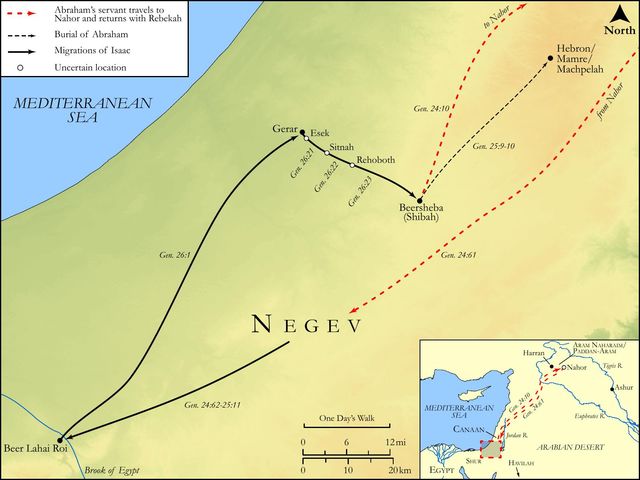
See on the biblical-era maps


Study this verse
Public-domain commentary
Matthew Henry
From his Commentary on the Whole Bible. Henry comments on passages, not single verses — this entry covers Genesis 24:54–61.
Rebekah is here taking leave of her father's house; and 1. Abraham's servant presses for a dismission. Though he and his company were very welcome, and very cheerful there, yet he said, Send me away (Gen 24:54), and again, Gen 24:56. He knew his master would expect him home with some impatience; he had business to do at home which wanted him, and therefore, as one that preferred his work before his pleasure, he was for hastening home. Note, Lingering and loitering no way become a wise and good man; when we have despatched our business abroad we must not delay our return to our business at home, nor be longer from it than needs must; for as a bird that wanders from her nest so is he that wanders from his place, Pro 27:8. 2. Rebekah's relations, from natural affection and according to the usual expression of kindness in that case, solicit for her stay some time among them, Gen 24:55. They could not think of parting with her on a sudden, especially as she was about the remove so far off and it was not likely that they would ever see one another again: Let her stay a few days, at least ten, which makes it as reasonable a request as the reading in the margin seems to make it unreasonable, a year, or at least ten months. They had consented to the marriage, and yet were loth to part with her. Note, It is an instance of the vanity of this world that there is nothing in it so agreeable but it has its alloy. Nulla est sincera voluptas - There is no unmingled pleasure. They were pleased that they had matched a daughter of their family so well, and yet, when it came to the last, it was with great reluctance that they sent her away. 3. Rebekah herself determined the matter. To her they appealed, as it was fit they should (Gen 24:57): Call the damsel (who had retired to her apartment with a modest silence) and enquire at her mouth. Note, As children ought not to marry without their parents' consent, so parents ought not to marry them without their own. Before the matter is resolved on, "Ask at the damsel's mouth;" she is a party principally concerned, and therefore ought to be principally consulted. Rebekah consented, not only to go, but to go immediately: I will go, Gen 24:58. We may hope that the notice she had taken of the servant's piety and devotion gave her such an idea of the prevalence of religion and godliness in the family she was to go to made her desirous to hasten thither, and willing to forget her own people and her father's house, where religion had not so much the ascendant. 4. Hereupon she is sent away with Abraham's servant; not, we may suppose, the very next day after, but very quickly: her friends see that she has a good heart on it, and so they dismiss her, (1.) With suitable attendants - her nurse (Gen 24:59), her damsels, Gen 24:61. It seems, then, that when she went to the well for water it was not because she had not servants at command, but because she took a pleasure in works of humble industry. Now that she was going among strangers, it was fit she should take those with her with whom she was acquainted. Here is nothing said of her portion. Her personal merits were a portion in her, she needed none with her, nor did that ever come into the treaty of marriage. (2.) With hearty good wishes: They blessed Rebekah, Gen 24:60. Note, When our relations are entering into a new condition, we ought by prayer to recommend them to the blessing and grace of God. Now that she was going to be a wife, they prayed that she might be a mother both of a numerous and of a victorious progeny. Perhaps Abraham's servant had told them of the promise God had lately made to his master, which it is likely, Abraham acquainted his household with, that God would multiply his seed as the stars of heaven, and that they should possess the gate of their enemies (Gen 22:17), to which promise they had an eye in this blessing, Be thou the mother of that seed.
Historical interpretation
Historical reception
1 surviving comment on this verse from the historical church.
(Verse 59.) And they sent away their sister Rebecca, and her belongings, and Abraham's servant, and the men who were with him. In Hebrew, it says: And they sent away their sister Rebecca, and her nurse, and Abraham's servant, and his men. For it was fitting that a virgin setting off for marriage without her parents should be comforted by the consolation of her nurse.
Continue studying Genesis 24:59 across the web’s major study libraries — every link below opens this exact verse, chapter, or book on the destination site.
Read & Compare
 BibleGatewayThis verse in more than 200 translations and 70 languages.
 Bible.comThe YouVersion reader — hundreds of translations, reading plans, and highlights.
 ESV.orgCrossway's official English Standard Version reader.
 NET BibleThe NET translation with 60,000+ translators' notes on every rendering decision.
 STEP BibleTyndale House's free study tool — original text, vocabulary, and scholarly resources.
 BibliaLogos Bible Software's free web reader.
 USCCBThe New American Bible (Revised Edition) with the U.S. bishops' study notes.
Commentaries
 BibleHub CommentariesDozens of classic commentaries on this verse, gathered on one page.
 StudyLightMore than 100 commentary sets — the largest collection on the web.
 BibleRefPlain-English commentary on what this verse means, verse by verse.
 Enduring WordDavid Guzik's free commentary on this chapter, widely used by Bible teachers.
 Bible Study ToolsVerse commentary alongside Greek and Hebrew study aids.
Original Language & Research
- BibleHub InterlinearThe verse word by word — original language, transliteration, and English.
- BibleHub LexiconEvery word's original-language definition and Strong's entry.
 Blue Letter BibleDeep-study tools — Strong's numbers, concordance, and word studies.
 SefariaThe Hebrew text with Rashi and centuries of Jewish commentary.
Sermons, Hymns & Audio


TrulyRandomVerse is not affiliated with these sites and doesn’t control their content. They’re linked because they’re genuinely useful.
Summary
Genesis 24:59 records the pivotal moment of Rebekah's official departure from her family in Paddan-Aram, signifying the immediate and decisive action taken to send her to Canaan to become Isaac's wife. This verse encapsulates the successful culmination of Abraham's servant's providential mission, highlighting Rebekah's willing obedience and the formal transfer of care, ensuring the continuation of the promised covenantal lineage.
Context
ShowHideLiterary Context
This verse serves as the direct narrative consequence of Rebekah's decisive consent to leave her family and go with Abraham's servant. The preceding verses detail the servant's successful mission, his providential encounter with Rebekah at the well, and the subsequent recognition by her family, Laban and Bethuel, that the entire affair was orchestrated by the Lord Genesis 24:50. Despite her family's request for her to remain for "some ten days" Genesis 24:55, Rebekah's resolute declaration, "I will go" Genesis 24:58, precipitates the immediate action described in verse 59. This verse, therefore, marks the literal commencement of her journey to Canaan, setting the stage for her encounter with Isaac.
Historical & Cultural Context
In Nahor's line, marriage arrangements were typically negotiated between families, often involving a bride-price and formal agreements. The sending off of a bride was a significant event, often accompanied by blessings and a retinue to ensure her safe passage and honor. The inclusion of Rebekah's nurse underscores her status and the provision made for her comfort and well-being during such a monumental transition, reflecting the deep personal bond that often existed between a child and their nurse in wealthy households. The long journey from Paddan-Aram (likely Haran or Nahor in Mesopotamia) to Canaan was arduous and dangerous, necessitating a well-equipped and protected entourage, which the mention of "Abraham's servant, and his men" confirms.
Key Themes
ShowHideGenesis 24, culminating in this verse, powerfully illustrates the theme of Divine Providence and Guidance, as God meticulously orchestrates every detail of the servant's mission to secure a wife for Isaac, ensuring the continuation of the Abrahamic covenant. It also highlights the theme of Faith and Obedience, particularly through Rebekah's willingness to leave the familiar for the unknown, mirroring Abraham's own journey of faith in Genesis 12:1-4. The narrative further emphasizes the Importance of Lineage and Covenant Succession, as the entire chapter is dedicated to securing the next generation through whom God's promises will be fulfilled, a theme foundational to the patriarchal narratives found throughout the book of Genesis.
Exposition and Analysis
ShowHideKey Word Analysis
ShowHideA primitive root meaning "to send away, for, or out (in a great variety of applications)." In this context, it signifies a formal, decisive, and final act of dismissal or dispatch. It conveys the idea of releasing Rebekah from her family's care and sending her forth on her new journey and destiny, underscoring the completion of the familial agreement.
A primitive root meaning "to suck; causatively, to give milk." This term specifically refers to a wet nurse or one who suckles a child, but by extension, it came to refer to a lifelong attendant or companion who had cared for the individual from infancy. Her presence signifies Rebekah's status and the provision made for her comfort, emotional support, and continued care during this significant life transition.
Meaning "a servant" or "bondman." This word denotes a person in a position of subservience or service. In this narrative, it refers to Abraham's trusted chief servant (traditionally identified as Eliezer), whose loyalty, diligence, and prayerful reliance on God were instrumental in the success of his mission to find a wife for Isaac. The term emphasizes his role as an agent fulfilling his master's will.
Verse Breakdown
ShowHide"And they sent away Rebekah their sister,"
This clause describes the formal and immediate action taken by Rebekah's family (Laban and Bethuel, representing the household) to dispatch her. The use of "their sister" emphasizes the familial bond and the significance of this separation, as she leaves her kin to join a new family and lineage. This act is a direct response to Rebekah's own willingness to depart, signifying the family's blessing and release.
"and her nurse,"
The inclusion of Rebekah's nurse highlights the provision for her comfort and continued care. This detail underscores Rebekah's importance and the family's desire to ensure her well-being during the long and transformative journey. The nurse would serve as a familiar face and trusted companion in an entirely new environment, providing emotional and practical support.
"and Abraham's servant, and his men."
This final clause identifies the escorts responsible for Rebekah's safe passage. "Abraham's servant" is the central figure who initiated and successfully completed the mission, while "his men" indicate the presence of additional attendants and security for the journey. This detail emphasizes the substantial nature of the traveling party, reflecting the distance and importance of the mission to secure Isaac's bride.
Literary Devices
ShowHideThe verse employs Conciseness to convey a momentous event with remarkable brevity, focusing on the immediate action of departure. The simple declarative sentence structure provides a sense of finality and purpose. The inclusion of specific individuals—Rebekah, her nurse, Abraham's servant, and his men—uses Synecdoche (or Metonymy) where the parts represent the whole, effectively communicating the full scope of the departing party and the significance of each participant's role in this pivotal journey. Furthermore, the act of "sending away" itself carries Symbolism, representing not merely a physical departure but a spiritual and covenantal transition, as Rebekah leaves her past behind to embrace a new identity and destiny within the promised lineage.
Theological and Thematic Connections
ShowHideGenesis 24:59 is a crucial juncture in the unfolding narrative of God's covenant with Abraham. Rebekah's departure signifies the successful continuation of the covenant line, ensuring that the promises of a great nation and a blessing to all peoples will be fulfilled through Isaac's offspring. This moment underscores God's meticulous faithfulness in providing for His chosen people, even in the intricate details of securing a spouse, demonstrating His sovereign hand guiding human affairs towards His ultimate redemptive purposes. The entire chapter, culminating in this verse, serves as a powerful testament to the interplay between divine sovereignty and human agency, as Rebekah's willing consent ("I will go") aligns perfectly with God's preordained plan.
Reflection and Application
ShowHideGenesis 24:59, though brief, offers profound insights into significant life transitions and the importance of trusting God's guidance. Like Rebekah, we are often called to step into the unknown, leaving familiar comforts, relationships, or past ways of life for a path God has prepared. This verse encourages us to seek and trust divine guidance when making life-altering choices, even when the future is uncertain, reminding us that every "sending away" or departure can be an opportunity for a new beginning, marked by faith and hope in God's providence. Furthermore, the presence of Rebekah's nurse signifies the importance of support systems during times of transition, highlighting how trusted companions, mentors, or spiritual guides can provide comfort, wisdom, and stability as we navigate new phases of life, echoing the biblical principle of community and mutual support in our spiritual journeys.
Questions for Reflection
ShowHideFAQ
ShowHideWhy was Rebekah's nurse sent with her?
ShowHideRebekah's nurse, later identified as Deborah in Genesis 35:8, was sent with her primarily to provide comfort, care, and companionship during her long and arduous journey from Paddan-Aram to Canaan, and during her significant transition into a new family and land. In patriarchal households, nurses often developed deep, lifelong bonds with the children they cared for, functioning almost as extended family members or confidantes. Her presence underscored Rebekah's status as a valued bride and ensured her well-being, providing a familiar and trusted presence in an entirely new and potentially overwhelming environment. This practice was a sign of honor and affection, ensuring the bride was well-attended and supported as she embarked on her new life.
Christ-Centered Fulfillment
ShowHideRebekah's journey from her homeland to a new life with Isaac, whom she had never met, serves as a profound prefigurement of the Church, the Bride of Christ. Just as Rebekah was chosen and called out by Abraham's servant—a faithful agent sent by the father—to be united with Isaac, so too is the Church called out by the Holy Spirit (the "servant" of the Father, sent by Christ) from the world to be united with Christ, her heavenly Bridegroom. Rebekah's decisive act of leaving the familiar for the unknown, trusting in the divine leading and the servant's testimony, mirrors the believer's call to forsake the old life and follow Christ in faith, anticipating the ultimate union and eternal inheritance promised in Him. This narrative underscores God's meticulous provision for His Son's bride, culminating in a covenantal union that ultimately points to Christ's sacrificial love for His Church, "that He might present her to Himself a glorious church, not having spot or wrinkle or any such thing, but that she should be holy and without blemish" Ephesians 5:25-27. The journey of faith initiated in this verse finds its ultimate fulfillment in the glorious reality of the "marriage supper of the Lamb" Revelation 19:7-9, where Christ and His redeemed people are eternally united.