


1 Samuel 5:11
- וַיִּשְׁלְחוּvai·yish·le·Chuand they sentH7971Conj-w ¦ V-Qal-ConsecImperf-3mpVerb Qal Consecutive Imperfect 3rd Plural Masculineוַandיִּשְׁלְחוּthey sent
- וַיַּאַסְפוּvai·ya·'as·Fuand they gatheredH622Conj-w ¦ V-Qal-ConsecImperf-3mpVerb Qal Consecutive Imperfect 3rd Plural Masculineוַandיַּאַסְפוּthey gathered
- אֶת'et<obj.>H853DirObjMParticle Object Indicator
- כָּלkolallH3605N-mscNoun Singular Masculine Construct
- סַרְנֵיsar·Nei[the] rulers ofH5633N-mpcNoun Plural Masculine Construct
- פְלִשְׁתִּיםfe·lish·Tim[the] PhilistinesH6430N-mpNoun Gentilic Plural Masculine Absolute
- וַיֹּאמְרוּvai·yo·me·Ruand they saidH559Conj-w ¦ V-Qal-ConsecImperf-3mpVerb Qal Consecutive Imperfect 3rd Plural Masculineוַandיֹּאמְרוּthey said
- שַׁלְּחוּsha·le·Chusend awayH7971V-Piel-Imp-2mpVerb Piel Imperative 2nd Plural Masculine
- אֶת'et<obj.>H853DirObjMParticle Object Indicator
- אֲרוֹן'a·Ron[the] ark ofH727N-mscNoun Singular Masculine Construct
- אֱלֹהֵי'e·lo·Hei[the] God ofH430N-mpcNoun Plural Masculine Construct
- יִשְׂרָאֵלYis·ra·'ElIsraelH3478N-properNoun Proper Location
- וְיָשֹׁבve·ya·Shoso may it returnH7725Conj-w ¦ V-Qal-Imperf-3msVerb Qal Imperfect 3rd Singular Masculineוְsoיָשֹׁבmay it return
- לִמְקֹמוֹlim·ko·Moto its own placeH4725Prep-l ¦ N-msc ¦ 3msNoun Singular Masculine Constructלִtoמְקֹמown placeוֹits
- וְלֹאve·lo'and notH3808Conj-w ¦ NegParticle Negativeוְandלֹאnot
- יָמִיתya·Mitit will killH4191V-Hiphil-Imperf-3msVerb Hiphil Imperfect 3rd Singular Masculine
- אֹתִי'o·Ti<obj.> meH853DirObjM ¦ 1csParticle Object Indicatorאֹתִ<obj.>יme
- וְאֶתve·'Etand <obj.>H853Conj-w ¦ DirObjMParticle Object Indicatorוְandאֶת<obj.>
- עַמִּי'a·Mimy peopleH5971N-msc ¦ 1csNoun Singular Masculine Constructעַמִּpeopleיmy
- כִּיkiforH3588PrtParticle Conditional
- הָיְתָהha·ye·Tahit wasH1961V-Qal-Perf-3fsVerb Qal Perfect 3rd Singular Feminine
- מְהוּמַתme·hu·matpanic ofH4103N-fscNoun Singular Feminine Construct
- מָוֶתma·vetdeathH4194N-msNoun Singular Masculine Absolute
- בְּכָלbe·kholin allH3605Prep-b ¦ N-mscNoun Singular Masculine Constructבְּinכָלall
- הָעִירha·'Irthe cityH5892Art ¦ N-fsNoun Singular Feminine Absoluteהָtheעִירcity
- כָּבְדָהka·ve·Dahit was heavyH3513V-Qal-Perf-3fsVerb Qal Perfect 3rd Singular Feminine
- מְאֹדme·'OdexceedinglyH3966Adj-msAdjective Numerical Singular Masculine Absolute
- יַדyad[the] hand ofH3027N-cscNoun Singular common gender Construct
- הָאֱלֹהִיםha·'E·lo·Him<the> GodH430Art ¦ N-mpNoun Plural Masculine Absoluteהָ<the>אֱלֹהִיםGod
- שָׁםShamthereH8033AdvAdverb
English is a literal word-by-word gloss of the Hebrew, not the KJV's wording. Why?
This is the original text the KJV's translators worked from — each Hebrew word with its own literal English meaning in this verse, prepared by scholars at Tyndale House, Cambridge. The KJV translates whole sentences, not word by word, so its wording differs: one Hebrew word can become several English words, and the KJV may choose “the LORD” where the gloss reads “Yahweh”. Both are faithful — they answer different questions. For the KJV's own rendering, switch to the KJV text.
Details
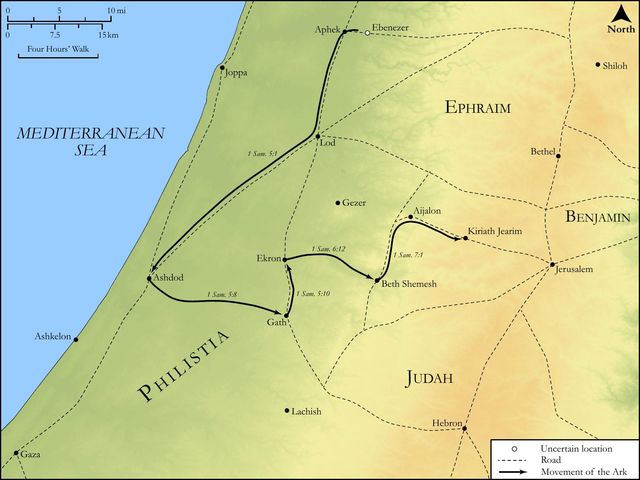
See on the biblical-era map
Study this verse
Public-domain commentary
Matthew Henry
From his Commentary on the Whole Bible. Henry comments on passages, not single verses — this entry covers 1 Samuel 5:6–12.
The downfall of Dagon (if the people had made a good use of it, and had been brought by it to repent of their idolatries and to humble themselves before the God of Israel and seek his face) might have prevented the vengeance which God here proceeds to take upon them for the indignities done to his ark, and their obstinate adherence to their idol, in defiance of the plainest conviction. Lord, when thy hand is lifted up they will not see, but they shall see, Isa 26:11. And, if they will not see the glory, they shall feel the weight, of God's hand, for so the Philistines did. The hand of the Lord was heavy upon them (Sa1 5:6), and he not only convinced them of their folly, but severely chastised their insolence. 1. He destroyed them, that is, cut many of them off by sudden death, those, we may suppose, that had most triumphed in the captivity of the ark. This is distinguished from the disease with which others were smitten. At Gath it is called a great destruction (Sa1 5:9), a deadly destruction, Sa1 5:11. And it is expressly said (Sa1 5:12) that those who were smitten with the emerods were the men that died not by the other destruction, which probably was the pestilence. They boasted of the great slaughter which their sword had made among the Israelites, Sa1 4:10. But God lets them know that though he does not see fit to draw Israel's sword against them (they were unworthy to be employed), yet God had a sword of his own, with which he could make a no less dreadful execution among them, which if he whet, and his hand take hold on judgment, he will render vengeance to his enemies, Deu 32:41, Deu 32:42. Note, Those that contend with God, his ark, and his Israel, will infallibly be ruined at last. If conviction conquer not, destruction shall. 2. Those that were not destroyed he smote with emerods (Sa1 5:6), in their secret parts (Sa1 5:9), so grievous that (Sa1 5:12) the cry went up to heaven, that is, it might be heard a great way off, and perhaps, in the extremity of their pain and misery, they cried, not to Dagon, but to the God of heaven. The Psalmist, speaking of this sore judgment upon the Philistines, describes it thus: God smote his enemies in the hinder parts, and put them to a perpetual reproach, Psa 78:66. The emerods (which we call the piles, and perhaps it was then a more grievous disease than it is now) is threatened among the judgments that would be the fruit of the curse, Deu 28:27. It was both a painful and shameful disease; a vile disease for vile deserts. By it God would humble their pride, and put contempt upon them, as they had done upon his ark. The disease was epidemical, and perhaps, among them, a new disease. Ashdod was smitten, and the coasts thereof, the country round. For contempt of God's ordinances, many are weak and sick, and many sleep, Co1 11:30. 3. The men of Ashdod were soon aware that it was the hand of God, the God of Israel, Sa1 5:7. Thus they were constrained to acknowledge his power and dominion, and confess themselves within his jurisdiction, and yet they would not renounce Dagon and submit to Jehovah; but rather, now that he touched their bone and their flesh, and in a tender part, they were ready to curse him to his face, and instead of making their peace with him, and courting the stay of his ark upon better terms, they desired to get clear of it, as the Gadarenes, who, when they had lost their swine, desired Christ to depart out of their coasts. Carnal hearts, when they smart under the judgments of God, would rather, if it were possible, put him far from them than enter into covenant and communion with him, and make him their friend. Thus the men of Ashdod resolve, The ark of the God of Israel shall not abide with us. 4. It is resolved to change the place of its imprisonment. A great council was called, and the question proposed to all the lords was, "What shall be we with the ark?" And at last it was agreed that it should be carried to Gath, Sa1 5:8. Some superstitious conceit they had that the fault was in the place, and that the ark would be better pleased with another lodging, further off from Dagon's temple; and therefore, instead of returning it, as they should have done, to its own place, they contrive to send it to another place. Gath is pitched upon, a place famed for a race of giants, but their strength and stature are no fence against the pestilence and the emerods: the men of that city were smitten, both great and small (Sa1 5:9), both dwarfs and giants, all alike to God's judgments; none so great as to over-top them, none so small as to be over-looked by them. 5. They were all at last weary of the ark, and very willing to get rid of it. It was sent from Gath to Ekron, and, coming by order of council, the Ekronites could not refuse it, but were much exasperated against their great men for sending them such a fatal present (Sa1 5:10): They have sent it to us to slay us and our people. The ark had the tables of the law in it; and nothing more welcome to faithful Israelites than the word of God (to them it is a savour of life unto life), but to uncircumcised Philistines, that persist in enmity to God, nothing more dreadful nor unwelcome: to them it is a savour of death unto death. A general assembly is instantly called, to advise about sending the ark again to its place, Sa1 5:11. While they are consulting about it, the hand of God is doing execution; and their contrivances to evade the judgment do but spread it. Many drop down dead among them. Many more are raging ill of the emerods, Sa1 5:12. What shall they do? Their triumphs in the captivity of the ark are soon turned into lamentations, and they are as eager to quit it as ever they had been to seize it. Note, God can easily make Jerusalem a burdensome stone to all that heave at it, Zac 12:3. Those that fight against God will soon have enough of it, and, first or last, will be made to know that none ever hardened their hearts against him and prospered. The wealth that is got by fraud and injustice, especially that which is got by sacrilege and robbing God, though swallowed greedily, and rolled under the tongue as a sweet morsel, must be vomited up again; for, till it be, the sinner shall not feel quietness in his belly, Job 20:15-20.
Historical interpretation
Historical reception
1 surviving comment on this verse from the historical church.
They sent therefore, and gathered all the satraps of the Philistines, etc. Many believers of the nations today, though not in words, say: Abandon the faith, and let it return to the children of Israel, so that at last, having cut us off, they may be grafted according to nature into their own olive tree. For it is better that the ignorant perish, than to be condemned for the transgression of faith, which we cannot keep, along with other sins.
Continue studying 1 Samuel 5:11 across the web’s major study libraries — every link below opens this exact verse, chapter, or book on the destination site.
Read & Compare
 BibleGatewayThis verse in more than 200 translations and 70 languages.
 Bible.comThe YouVersion reader — hundreds of translations, reading plans, and highlights.
 ESV.orgCrossway's official English Standard Version reader.
 NET BibleThe NET translation with 60,000+ translators' notes on every rendering decision.
 STEP BibleTyndale House's free study tool — original text, vocabulary, and scholarly resources.
 BibliaLogos Bible Software's free web reader.
 USCCBThe New American Bible (Revised Edition) with the U.S. bishops' study notes.
Commentaries
 BibleHub CommentariesDozens of classic commentaries on this verse, gathered on one page.
 StudyLightMore than 100 commentary sets — the largest collection on the web.
 BibleRefPlain-English commentary on what this verse means, verse by verse.
 Enduring WordDavid Guzik's free commentary on this chapter, widely used by Bible teachers.
 Bible Study ToolsVerse commentary alongside Greek and Hebrew study aids.
Original Language & Research
- BibleHub InterlinearThe verse word by word — original language, transliteration, and English.
- BibleHub LexiconEvery word's original-language definition and Strong's entry.
 Blue Letter BibleDeep-study tools — Strong's numbers, concordance, and word studies.
 SefariaThe Hebrew text with Rashi and centuries of Jewish commentary.
Sermons, Hymns & Audio


TrulyRandomVerse is not affiliated with these sites and doesn’t control their content. They’re linked because they’re genuinely useful.
Summary
1 Samuel 5:11 marks the desperate turning point in the Philistine ordeal with the Ark of the Covenant, as the leaders of Ekron, the third Philistine city to host the captured sacred object, convene to demand its immediate return to Israel. Overwhelmed by the "deadly destruction" and the "very heavy hand of God" that had afflicted their city, causing widespread death and panic, the Philistines recognized the divine wrath emanating from the Ark and prioritized their survival over their war trophy, acknowledging the irresistible power of the God of Israel.
Context
ShowHideLiterary Context
This verse is the climactic moment in the narrative of the Ark's capture and its subsequent devastating journey through Philistine territory, detailed in 1 Samuel 4-6. Chapter 4 describes the Ark's capture by the Philistines during a battle where Israel was defeated and Eli's sons killed. Chapter 5 then vividly illustrates the escalating consequences of this capture: first in Ashdod, where the idol Dagon repeatedly fell prostrate before the Ark and the people were afflicted with tumors and mice; then in Gath, where similar plagues ensued; and finally in Ekron, the city mentioned in this verse. The narrative builds tension through this progression, demonstrating the escalating severity and geographic spread of the divine judgment, culminating in a "deadly destruction" that forces the Philistine lords to a unanimous decision. This verse signifies the point of no return for the Philistines, as their fear of the God of Israel overrides any desire to retain their prize, powerfully showcasing God's sovereignty even among His enemies.
Historical & Cultural Context
The Philistines were a formidable "sea people" who had settled on the southwestern coast of Canaan by the 12th century BCE. Their polytheistic religion centered around deities like Dagon, often depicted as a fish-god or grain-god. In the ancient Near East, military victories were commonly interpreted as a triumph of one nation's god over another's, with the vanquished deity's cultic objects often taken as trophies. The Philistines' capture of the Ark, which represented the very presence of Israel's God, would have been seen as a monumental victory for Dagon over Yahweh. However, the subsequent events—Dagon's repeated humiliation (1 Samuel 5:4) and the widespread plagues—subverted this expectation, demonstrating Yahweh's unique power and sovereignty over all other gods and even over the natural world. The "tumors" (often translated as "emerods" or "hemorrhoids") and "mice" mentioned in preceding verses (1 Samuel 5:6) strongly suggest a form of bubonic plague, a devastating and highly contagious disease, which would have terrified ancient populations due to its rapid spread and high mortality rate. The assembly of the Philistine "lords" (seranim) reflects their political structure, where independent city-states were governed by a council of these rulers, who made collective decisions for their people's welfare.
Key Themes
ShowHideThe narrative of the Ark in Philistia powerfully underscores several core themes. Foremost is the absolute sovereignty and unparalleled power of the God of Israel. He requires no human army to defend His honor or His people; His mere presence, even in captivity, is sufficient to bring judgment upon His enemies and their false gods, as seen in Dagon's repeated collapse before the Ark. This highlights the futility of idolatry and the impotence of pagan deities in the face of the true God. Another crucial theme is God's holiness and the consequences of treating sacred things lightly. The Ark, representing God's holy presence, brought judgment not because it was inherently malicious, but because it was in an unholy place and handled by unholy hands. The Philistines' experience is a stark lesson in the fear of the Lord, demonstrating that even those outside the covenant can be compelled to acknowledge and respond to God's awesome power when confronted with His manifest judgment. The narrative also subtly prepares the way for the establishment of the monarchy, as Israel's earlier defeat and the Ark's capture revealed their spiritual weakness and need for righteous leadership.
Exposition and Analysis
ShowHideKey Word Analysis
ShowHideThis word signifies "confusion," "uproar," "discomfiture," or "trouble." It often implies a divinely sent disturbance or rout, a state of profound chaos and bewilderment. In this context, it describes not merely a physical affliction but a pervasive, disorienting calamity that overwhelmed the city of Ekron, leading to widespread panic and a breakdown of normal life.
This primitive word refers to a "hand," but is used with great latitude to denote power, means, direction, or agency. In the phrase "the hand of God," it is a powerful anthropomorphism, signifying God's direct, active, and tangible intervention. It conveys the idea that the plagues were not random occurrences but the direct, intentional work of God's irresistible power.
This root means "to be heavy," "to be weighty," "to be severe," or "to be grievous." When applied to God's hand, especially with the intensifier "very" (H3966, mᵉʼôd), it conveys an overwhelming and oppressive divine pressure. It indicates that the judgment was not light or easily borne, but intensely severe, burdensome, and unbearable, forcing the Philistines to their knees in submission.
Verse Breakdown
ShowHide"So they sent and gathered together all the lords of the Philistines, and said, Send away the ark of the God of Israel, and let it go again to his own place,"
This opening clause highlights the unified and urgent response of the Philistine leadership to the escalating crisis. The "lords" (seranim, H5633) represent the highest authority in their respective city-states, indicating that the decision to return the Ark was a collective, desperate measure, not a minor local issue. Their command to "send away" (H7971, shâlach) and "let it go again" (H7725, shûwb) to "his own place" (H4725, mâqôwm) signifies a complete reversal of their initial triumph and a recognition that the Ark does not belong among them; it is an alien, dangerous presence that must be expelled.
"that it slay us not, and our people:"
This reveals the primary motivation behind their decision: sheer terror and self-preservation. The Philistines explicitly attribute the widespread death to the Ark itself, or rather, to the God (H430, ʼĕlôhîym) whose holy presence it embodies. The phrase "slay us not" (H4191, mûwth) and "our people" (H5971, ʻam) underscores the devastating impact of the plagues, which affected both the leadership and the general populace, threatening their very existence as a society.
"for there was a deadly destruction throughout all the city;"
This provides the immediate justification for their fear and action. The "deadly destruction" (H4194, mâveth and H4103, mᵉhûwmâh) signifies a widespread, chaotic, and fatal epidemic or calamity that had engulfed Ekron. This was not isolated illness but a pervasive, city-wide catastrophe (H5892, ʻîyr), leaving no one unaffected and making the divine judgment undeniable.
"the hand of God was very heavy there."
This concluding statement offers the theological interpretation of the events from the narrator's perspective, confirming the divine origin and overwhelming power behind the "deadly destruction." It reiterates that the God of Israel (H3478, Yisrâʼêl) was actively and severely judging the Philistines, demonstrating His sovereignty and holiness even in enemy territory. The "heavy hand" (H3027, yâd and H3513, kâbad with intensifier H3966, mᵉʼôd) metaphor powerfully conveys the oppressive weight of God's wrath and irresistible power.
Literary Devices
ShowHideThe passage employs several potent literary devices to convey its message. Anthropomorphism is prominently featured in the phrase "the hand of God was very heavy there," attributing a human limb (hand) to God to describe His direct, physical, and overwhelming action. This makes God's involvement tangible and immediate, emphasizing His active role in the plagues. Hyperbole is evident in "deadly destruction throughout all the city," which, while likely reflecting a severe epidemic, uses strong language to convey the absolute and pervasive nature of the calamity, underscoring the Philistines' terror and the extent of God's judgment. The narrative also employs Irony: the Philistines, who had celebrated their victory over Israel and the capture of the Ark, are now reduced to begging for its removal, highlighting the ultimate futility of their triumph against the true God. Furthermore, the entire chapter functions as a Theophany, a manifestation of God's presence and power, not through fire or cloud, but through the devastating effects of His unseen presence, demonstrating that Yahweh's power is not confined to His people or His land.
Theological and Thematic Connections
ShowHide1 Samuel 5:11 powerfully illustrates the non-negotiable holiness and sovereign power of Yahweh, the God of Israel. His presence, even when contained within the Ark and captured by enemies, cannot be trifled with or domesticated by pagan deities. The Philistines' experience serves as a stark reminder that God's judgment is real, pervasive, and inescapable for those who defy His holiness or profane His sacred things. This episode confirms that the God of Israel is not merely a tribal deity, but the universal Lord whose authority extends beyond national borders and over all creation, including the gods of other nations. The fear that drove the Philistines to return the Ark is a testament to the awe-inspiring nature of God's manifest power, a fear that, while born of terror, implicitly acknowledges His supremacy. This narrative foreshadows the broader biblical theme of God's ultimate triumph over all forms of idolatry and rebellion, asserting His singular claim to worship and reverence.
Reflection and Application
ShowHideThe Philistines' desperate plea in 1 Samuel 5:11 offers a profound lesson for all who encounter the living God. Their experience demonstrates that God is not a passive deity to be manipulated or contained, but an active, holy, and powerful Being whose presence brings either blessing or judgment. For believers today, this passage underscores the importance of approaching God with reverence, awe, and obedience, understanding that His holiness demands our respect. While we no longer have a physical Ark, the principles of God's uncontainable power and the consequences of treating His commands or His presence lightly remain eternally true. We are called to live in a manner that honors His name and His word, recognizing that His "heavy hand" can manifest not only in judgment but also in the weighty glory of His transformative presence. Even for those who do not yet know God, this account serves as a powerful witness to His reality and power, prompting a recognition that there is a divine authority beyond human control, deserving of serious consideration and ultimately, humble submission.
Questions for Reflection
ShowHideFAQ
ShowHideWhat was the nature of the "deadly destruction" that afflicted the Philistines?
ShowHideWhile the text doesn't explicitly name the disease in 1 Samuel 5:11, the preceding verses (e.g., 1 Samuel 5:6) specify that the Philistines were afflicted with "tumors" (often translated as "emerods" or "hemorrhoids") and that "mice" were also present in the land. Many scholars interpret this combination of symptoms and the presence of rodents as a description of bubonic plague, a highly contagious and often fatal bacterial infection transmitted by fleas, typically carried by rodents like mice. The "deadly destruction" thus refers to the widespread mortality and severe suffering caused by this divinely sent epidemic, which was so devastating that it led the Philistines to believe the Ark itself was actively "slaying" them.
Why was the Ark of the Covenant so dangerous to the Philistines?
ShowHideThe Ark was dangerous to the Philistines not because it possessed inherent malevolent power, but because it represented the holy presence of Yahweh, the God of Israel. As a pagan nation, the Philistines were unholy and engaged in idolatry, particularly the worship of Dagon. The Ark's presence among them, in their temples and cities, was a direct confrontation between the living God and false gods, and between holiness and unholiness. God's judgment was a demonstration of His absolute sovereignty over all other deities and His intolerance for profanity. The plagues and destruction were the natural consequence of unholy people attempting to control or contain the manifestation of a holy God, showing that God's glory is both awesome and consuming to those who are not prepared to receive it.
Christ-Centered Fulfillment
ShowHideThe narrative of the Ark in Philistia, culminating in its forced return due to divine judgment, profoundly foreshadows the person and work of Jesus Christ. Just as the Ark embodied the very presence of God among His people, Jesus is the ultimate manifestation of God, the Word made flesh. The Ark's uncontainable holiness and the destructive power it unleashed upon those who profaned it point to Christ's absolute purity and the severe judgment that awaits those who reject Him. The Philistines' desperate plea to send away the Ark, fearing death, mirrors humanity's natural inclination to flee from God's holiness due to our sin, yet it also subtly points to the need for a mediator. Christ, unlike the Ark, did not bring judgment upon those who touched Him in faith; instead, He bore the full weight of God's "heavy hand" on the cross, becoming the ultimate sacrifice for sin, thereby removing the curse that would otherwise "slay us." Through His atoning work, the very presence of God, once terrifying to the unholy, is now accessible through faith, as believers are reconciled to God and indwelt by the Holy Spirit, the true Ark of the New Covenant (Hebrews 9:11-14). The episode in 1 Samuel 5:11 thus highlights the severity of God's holiness and the necessity of a divine intervention—Jesus Christ—who perfectly fulfilled the Ark's symbolic role by bridging the chasm between a holy God and sinful humanity, conquering sin and death not by inflicting plagues, but by enduring them for our sake (Romans 5:8).