


1 Samuel 5:4
Bible text: King James Version (1769 Blayney text) · Public domain
Bible text: King James Version with Strong's numbers · Public domain
Bible text: Berean Standard Bible · Public domain
Bible text: American Standard Version (1901) · Public domain
Bible text: World English Bible, Messianic edition · Public domain
Bible text: Geneva Bible (1599) · Public domain
Bible text: Young's Literal Translation · Public domain
- וַיַּשְׁכִּמוּvai·yash·Ki·muand they rose earlyH7925Conj-w ¦ V-Hiphil-ConsecImperf-3mpVerb Hiphil Consecutive Imperfect 3rd Plural Masculineוַandיַּשְׁכִּמוּthey rose early
- בַבֹּקֶרva·bo·Kerin the morningH1242Prep-b ¦ N-msNoun Singular Masculine Absoluteבַin theבֹּקֶרmorning
- מִמָּחֳרָתmi·mo·cho·Ratfrom [the] next dayH4283Prep-m ¦ N-fsNoun Singular Feminine Absoluteמִfromמָּחֳרָת[the] next day
- וְהִנֵּהve·hi·Nehand there!H2009Conj-w ¦ PrtParticle Interjectionוְandהִנֵּהthere!
- דָגוֹןda·GonDagonH1712N-properNoun Proper Title
- נֹפֵלno·Fel[was] fallenH5307V-Qal-Prtcpl-msVerb Qal Participle Singular Masculine Absolute
- לְפָנָיוle·fa·Navto its faceH6440Prep-l ¦ N-mpc ¦ 3msNoun Plural Masculine Constructלְtoפָנָיfaceוits
- אַרְצָה'Ar·tzah[the] ground towardsH776N-fs ¦ SfxNoun Singular Feminine Absoluteאַרְצָ[the] groundהtowards
- לִפְנֵיlif·Nei<to> beforeH6440Prep-l ¦ N-mpcNoun Plural Masculine Constructלִ<to>פְנֵיbefore
- אֲרוֹן'a·Ron[the] ark ofH727N-mscNoun Singular Masculine Construct
- יְהוָהYah·wehYahwehH3068N-properNoun Proper Title
- וְרֹאשׁve·Roshand [the] head ofH7218Conj-w ¦ N-mscNoun Singular Masculine Constructוְandרֹאשׁ[the] head of
- דָּגוֹןda·GonDagonH1712N-properNoun Proper Title
- וּשְׁתֵּיu·she·Teiand [the] twoH8147Conj-w ¦ N-fdcNoun Dual Feminine Constructוּandשְׁתֵּי[the] two
- כַּפּוֹתka·Pot[the] palms ofH3709N-fpcNoun Plural Feminine Construct
- יָדָיוya·Davits handsH3027N-cdc ¦ 3msNoun Dual common gender Constructיָדָיhandsוits
- כְּרֻתוֹתke·ru·tOtwere cut offH3772V-Qal-PassPrtcpl-fpVerb Qal Participle Passive Plural Feminine Absolute
- אֶל'eltoH413PrepPreposition
- הַמִּפְתָּןha·mif·Tanthe thresholdH4670Art ¦ N-msNoun Singular Masculine Absoluteהַtheמִּפְתָּןthreshold
- רַקrakonlyH7535AdvAdverb
- דָּגוֹןda·GonDagonH1712N-properNoun Proper Title
- נִשְׁאַרnish·'Arit remainedH7604V-Niphal-Perf-3msVerb Niphal Perfect 3rd Singular Masculine
- עָלָיו'a·Lavon itH5921Prep ¦ 3msPreposition Definiteעָלָיonוit
English is a literal word-by-word gloss of the Hebrew, not the KJV's wording. Why?
This is the original text the KJV's translators worked from — each Hebrew word with its own literal English meaning in this verse, prepared by scholars at Tyndale House, Cambridge. The KJV translates whole sentences, not word by word, so its wording differs: one Hebrew word can become several English words, and the KJV may choose “the LORD” where the gloss reads “Yahweh”. Both are faithful — they answer different questions. For the KJV's own rendering, switch to the KJV text.
Details
See on the biblical-era map
Study this verse
Public-domain commentary
Matthew Henry
From his Commentary on the Whole Bible. Henry comments on passages, not single verses — this entry covers 1 Samuel 5:1–5. His three-level outline is real structure in the source text, so it is rendered as structure.
Here is, I. The Philistines' triumph over the ark, which they were the more pleased, the more proud, to be now masters of, because before the battle they were possessed with a great fear of it, Sa1 4:7. When they had it in their hands God restrained them, that they did not offer any violence to it, did not break it to pieces, as the Israelites were ordered to do by the idols of the heathen, but showed some respect to it, and carefully carried it to a place of safety. Whether their curiosity led them to open it, and to read what was written with the finger of God on the two tables of stone that were in it, we are not told; perhaps they looked no further than the golden outside and the cherubim that covered it, like children that are more affected with the fine binding of their bibles than with the precious matter contained in them. They carried it to Ashdod, one of their five cities, and that in which Dagon's temple was; there they placed the ark of God, by Dagon (Sa1 5:2), either 1. As a sacred thing, which they designed to pay some religious respect to, in conjunction with Dagon; for the gods of the heathen were never looked upon as averse to partners. Though the nations would not change their gods, yet they would multiply them and add to them. But they were mistaken in the God of Israel when, in putting his ark by Dagon's image, they intended to do him honour; for he is not worshipped at all if he is not worshipped alone. The Lord our God is one Lord. Or rather, 2. They placed it there as a trophy of victory, in honour of Dagon their god, to whom no doubt they intended to offer a great sacrifice, as they had done when they had taken Samson (Jdg 16:23, Jdg 16:24), boasting that as then they had triumphed over Israel's champion so now over Israel's God. What a reproach was this to God's great name! what a disgrace to the throne of his glory! Shall the ark, the symbol of God's presence, be a prisoner to Dagon, a dunghill deity? (1.) So it is, because God will show of how little account the ark of the covenant is if the covenant itself be broken and neglected; even sacred signs are not things that either he is tied to or we can trust to. (2.) So it is for a time, that God may have so much the more glory, in reckoning with those that thus affront him, and get him honour upon them. Having punished Israel, that betrayed the ark, by giving it into the hands of the Philistines, he will next deal with those that abused it, and will fetch it out of their hands again. Thus even the wrath of man shall praise him; and he is bringing about his own glory even when he seems to neglect it, Psa 76:10. Out of the eater shall come forth meat.
II.The ark's triumph over Dagon.
Once and again Dagon was made to fall before it. If they designed to do honour to the ark, God thereby showed that he valued not their honour, nor would he accept it; for he will be worshipped, not with any god, but above all gods. He owes a shame (as bishop Hall expresses it) to those who will be making matches betwixt himself and Belial. But they really designed to affront it, and though for some hours Dagon stood by the ark, and it is likely stood above it (the ark, as its footstool), yet the next morning, when the worshippers of Dagon came to pay their devotions to his shrine, they found their triumphing short, Job 20:5.
1.Dagon, that is, the image (for that was all the god), had fallen upon his face to the earth before the ark, Sa1 5:3. God had seemed to forget the ark, but see how the Psalmist speaks of his appearing, at last, to vindicate his own honour. When he had delivered his strength into captivity, and all seemed going to ruin, then the Lord awaked as one out of sleep, and like a mighty man that shouteth by reason of wine, Psa 78:59-65. And therefore he prevented the utter desolations of the Jewish church, because he feared the wrath of the enemy, Deu 32:26, Deu 32:27. Great care was taken, in setting up the images of their gods, to fix them. The prophet takes notice of it, Isa 41:7, He fastened it with nails that it should not be moved; and again, Isa 46:7. And yet Dagon's fastenings stood him in no stead. The ark of God triumphs over him upon his own dunghill, in his own temple. Down he comes before the ark, directly towards it (though the ark was set on one side of him), as it were, pointing to the conqueror, to whom he is constrained to yield and do homage. Note, The kingdom of Satan will certainly fall before the kingdom of Christ, error before truth, profaneness before godliness, and corruption before grace in the hearts of the faithful. When the interests of religion seem to be run down and ready to sink, yet even then we may be confident that the day of their triumph will come. Great is the truth, and will prevail. Dagon by falling prostrate before the ark of God, which was a posture of adoration, did as it were direct his worshippers to pay their homage to the God of Israel, as greater than all gods. See Exo 18:11.
2.The priests, finding their idol on the floor, make all the haste they can, before it be known, to set him in his place again. A sorry silly thing it was to make a god of, which, when it was down, wanted help to get up again; and sottish wretches those were that could pray for help from that idol that needed, and in effect implored, their help. How could they attribute their victory to the power of Dagon when Dagon himself could not keep his own ground before the ark? But they are resolved Dagon shall be their god still, and therefore set him in his place. Bishop Hall observes hence, It is just with God that those who want grace shall want wit too; and it is the work of superstition to turn men into the stocks and stones they worship. Those that make them are like unto them. What is it that the great upholders of the antichristian kingdom are doing at this day but heaving Dagon up, and labouring to set him in his place again, and healing the deadly wound that has been given to the beast? but if the reformation be the cause of God, before which it has begun to fall, it shall not prevail, but shall surely fall before it.
3.The next night Dagon fell the second time, Sa1 5:4. They rose early, either, as usual, to make their addresses to their god, or earlier than usual, being impatient to know whether Dagon had kept his standing this night; and, to their great confusion, they find his case worse now than before. Whether the matter of which the image was made was apt to break or no, so it was that the head and hands were cut off upon the threshold, so that nothing remained but the stump, or, as the margin reads it, the fishy part of Dagon; for (as many learned men conjecture) the upper part of this image was in a human shape, the lower in the shape of a fish, as mermaids are painted. Such strong delusions were idolaters given up to, so vain were they in their imaginations, and so wretchedly darkened were their foolish hearts, as to worship the images, not only of creatures, but of nonentities, the mere figments of fancy. Well, the misshapen monster is by this fall made to appear,
(1.)Very ridiculous, and worthy to be despised. A pretty figure Dagon made now, when the fall had anatomized him, and shown how the human part and the fishy part were artificially put together, which perhaps the ignorant devotees had been made to believe was done by miracle!
(2.)Very impotent, and unworthy to be prayed to or trusted in; for his losing his head and hands proved him utterly destitute both of wisdom and power, and for ever disabled either to advise or act for his worshippers. This they got by setting Dagon in his place again; they had better have let him alone when he was down. But those can speed no better that contend with God, and will set up that which he is throwing down, Mal 1:4. God, by this, magnified his ark and made it honourable, when they vilified and made it contemptible. He also showed what will be the end of all that which is set up in opposition to him. Gird yourselves, but you shall be broken to pieces, Isa 8:9.
4.The threshold of Dagon's temple was ever looked upon as sacred, and not to be trodden on, Sa1 5:5. Some think that reference is had to this superstitious usage of Dagon's worshippers in Zep 1:9, where God threatens to punish those who, in imitation of them, leaped over the threshold. One would have thought that this incontestable proof of the ark's victory over Dagon would convince the Philistines of their folly in worshipping such a senseless thing, and that henceforward they would pay their homage to the conqueror; but, instead of being reformed, they were hardened in their idolatry, and, as evil men and seducers are wont to do, became worse and worse, Ti2 3:13. Instead of despising Dagon, for the threshold's sake that beheaded him, they were almost ready to worship the threshold because it was the block on which he was beheaded, and will never set their feet on that on which Dagon lost his head, shaming those who tread under foot the blood of the covenant and trample on things truly sacred. Yet this piece of superstition would help to perpetuate the remembrance of Dagon's disgrace; for, with the custom, the reason would be transmitted to posterity, and the children that should be born, enquiring why the threshold of Dagon's temple must not be trodden on, would be told that Dagon fell before the ark of the Lord. Thus God would have honour even out of their superstition. We are not told that they repaired the broken image; it is probable that they sent the art of God away first, and then they patched it up again, and set it in its place; for, it seems, they cannot deliver their souls, nor say, Is there not a lie in our right hand? Isa 44:20.
Historical interpretation
Three Centuries of Reception
6 surviving comments on this verse. Each one is dated, so this reads as a timeline rather than a list.
Select a marker to jump to its quote. Markers stagger vertically where authors wrote within a few decades of each other.
In short, if you believe the place is holy because the law and the books of prophets are there, then it is time for you to believe that idols and the temples of idols are holy. Once, when the Jews were at war, the people of Ashdod conquered them, took their ark and brought it into their own temple. Did the fact that it contained the ark make their temple a holy place? By no means! It continued to be profane and unclean, as the events immediately proved. For God wanted to teach the enemies of the Jews that the defeat was not due to God’s weakness but to the transgressions of those who worshiped him. And so the ark, which had been taken as booty in war, gave proof of its own power in an alien land by twice throwing the idol to the ground so that the idol was broken. The ark was so far from making that temple a holy place that it even openly attacked it.
And now is not the first time, but he has performed these amazing marvels from time immemorial. It is not pertinent to enumerate them all; I shall mention what seems to resemble these events most closely. Once when the Jews waged war in Palestine with certain foreigners and the enemy was victorious and took the ark of God, they dedicated it as the choice part of the spoils to one of their local idols named Dagon; and, as soon as the ark was brought in, the statue fell down and lay on its face. Since they did not comprehend God’s mighty power from this fall but set it up and again placed it on its pedestal, when they appeared the next day at dawn they observed that it was no longer simply fallen but also quite broken. The arms, detached from the shoulders, were flung onto the threshold of the temple, with the feet; and the rest of the statue was scattered in another place in pieces.… Therefore the place, which is able to exist for a long time, receives the blow and reminds each succeeding generation that those who do such things are ordained by law to suffer such things even if they do not pay the penalty at once; which is exactly what happened in the case of this temple.
So Dagon who was adored as God by them (although he was a dumb, senseless idol) was made to fall before the ark, and God prepared to stage a spectacle for the spectators, so that the Philistines might perceive the difference between false god and true God.In their folly, they raised him up again only to see him fallen a second time and brought to his knees, so to speak. Behaving thus with singular stupidity and reluctant to recognize the difference, they were taught by experience not to run to excess. Having learned their lesson, they returned to their senses, shook off their drunken ignorance and returned the ark, as was fitting, to its proper admirers, having honored it with votive offerings. They confessed their chastisements and instructed those who received it about the manner of its return.
Moreover, the trunk of Dagon alone, etc. Moreover, the people, having cast off and eliminated the profession of idolatry, and the operations of the demonic, among those who had advanced in faith, as if near the ark of God, preferred to remain humble and submissive, rather than to be cast out with the devil, that is, to be anathematized by the members of the Church. And the state of Dagon is not asserted to have been restored as before, because after many struggles of the Church, a cessation had occurred, from the defense of false gods, and victory was given to the one true God, Christ.
And again rising early in the morning the next day, etc. As the light of heavenly signs gradually increased, the face of idolatry was confused before the faithful of Christ, and they confessed as earthly and perishable all that they had hitherto done or believed.
But the head of Dagon and both the palms of his hands, etc. The head of all sin, the pride of the devil, and the work of idolatry; which, as if with two palms, was conducted by the profession of impiety, the ceremonies of praises and sacrifices, already separated from the related body, that is, the crowds of seducers adhering to it, was now, and about to be cast out, prepared by the growing triumph of Christ; who showed, as it were, the head and hands of the truncated Dagon lying on the threshold, when he said: "Now is the judgment of the world, now the prince of this world shall be cast out" (John 12).
Continue studying 1 Samuel 5:4 across the web’s major study libraries — every link below opens this exact verse, chapter, or book on the destination site.
Read & Compare
 BibleGatewayThis verse in more than 200 translations and 70 languages.
 Bible.comThe YouVersion reader — hundreds of translations, reading plans, and highlights.
 ESV.orgCrossway's official English Standard Version reader.
 NET BibleThe NET translation with 60,000+ translators' notes on every rendering decision.
 STEP BibleTyndale House's free study tool — original text, vocabulary, and scholarly resources.
 BibliaLogos Bible Software's free web reader.
 USCCBThe New American Bible (Revised Edition) with the U.S. bishops' study notes.
Commentaries
 BibleHub CommentariesDozens of classic commentaries on this verse, gathered on one page.
 StudyLightMore than 100 commentary sets — the largest collection on the web.
 BibleRefPlain-English commentary on what this verse means, verse by verse.
 Enduring WordDavid Guzik's free commentary on this chapter, widely used by Bible teachers.
 Bible Study ToolsVerse commentary alongside Greek and Hebrew study aids.
Original Language & Research
- BibleHub InterlinearThe verse word by word — original language, transliteration, and English.
- BibleHub LexiconEvery word's original-language definition and Strong's entry.
 Blue Letter BibleDeep-study tools — Strong's numbers, concordance, and word studies.
 SefariaThe Hebrew text with Rashi and centuries of Jewish commentary.
Sermons, Hymns & Audio


TrulyRandomVerse is not affiliated with these sites and doesn’t control their content. They’re linked because they’re genuinely useful.
Summary
1 Samuel 5:4 vividly narrates the second and more devastating collapse of the Philistine idol Dagon before the captured Ark of the LORD within his temple in Ashdod. After Dagon was found fallen the previous day and subsequently re-erected, this verse describes a divinely orchestrated event where Dagon's head and both palms of his hands were severed and lay upon the threshold, leaving only his "stump." This dramatic and undeniable scene powerfully asserts the absolute supremacy of the God of Israel over all false deities, demonstrating His sovereignty and the utter futility of idolatry in a direct and humiliating manner.
Context
ShowHideLiterary Context
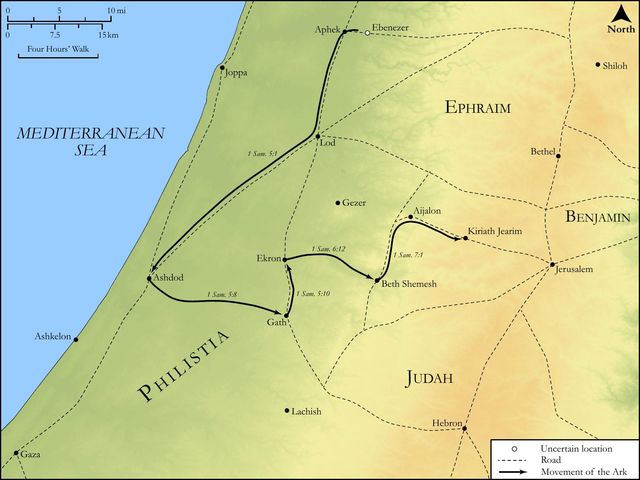
This verse is a pivotal moment within the larger narrative of the Ark of the Covenant's capture and its subsequent journey through Philistine territory, spanning 1 Samuel 4 through 1 Samuel 6. Following Israel's devastating defeat by the Philistines and the Ark's seizure in 1 Samuel 4:11, the Philistines brought it to Ashdod and placed it as a trophy in the temple of their chief deity, Dagon. The preceding verse, 1 Samuel 5:3, describes Dagon's initial fall, face down before the Ark, an event the Philistines seemingly dismissed as an accident and promptly rectified. Verse 4, however, escalates the divine judgment, making it unequivocally clear that this was no mere mishap but a deliberate act of the LORD, setting the stage for the plagues that would afflict Ashdod and other Philistine cities in the subsequent verses, beginning with 1 Samuel 5:6. This progression underscores the escalating nature of God's confrontation with idolatry.
Historical & Cultural Context
The Philistines were a formidable seafaring people who had settled on the southwestern coast of Canaan, frequently engaging in conflict with the Israelites. Dagon was their principal deity, often depicted as a half-man, half-fish figure, and was associated with grain (Hebrew dagan) and fish (dag), symbolizing fertility and prosperity for their agricultural and maritime society. Among the Philistines, idols were widely believed to embody the actual presence and power of the deity they represented. Placing a captured god's symbol, such as the Ark of the Covenant, in a victor's temple was a common practice intended to signify the subjugation of the defeated deity and the triumph of the conquering god. However, the events in Dagon's temple dramatically subverted this cultural norm, demonstrating that the God of Israel could not be contained or subjugated by any foreign power or deity. The "threshold" (Hebrew miphtân) held significant cultural importance, often seen as a sacred or liminal space, a boundary between realms, making Dagon's dismemberment upon it particularly humiliating and symbolically potent.
Key Themes
ShowHideThe events surrounding the Ark in Philistia, powerfully culminating in 1 Samuel 5:4, profoundly underscore the theme of God's Unquestionable Supremacy. The LORD, though His people Israel had been defeated due to their sin, asserts His absolute sovereignty even in enemy territory, proving He is not merely a tribal deity but the universal, living God over all creation. This narrative also highlights the Futility of Idolatry, as Dagon, a supposedly powerful god, is rendered utterly impotent and broken before the true God, serving as a stark reminder of the First Commandment. Furthermore, the account demonstrates Divine Judgment and Warning, as God's decisive actions against Dagon and the subsequent plagues on the Philistines (1 Samuel 5:6-12) serve as a clear consequence for their disrespect of His holiness and their idolatry. This entire section of 1 Samuel 5 reveals God's active presence and power, even when His people are in disarray, ensuring His glory is upheld among the nations.
Exposition and Analysis
ShowHideKey Word Analysis
ShowHideThe chief deity of the Philistines, associated with grain (dagan) and fish (dag), symbolizing fertility and maritime power. His repeated fall and, especially, his dismemberment before the Ark of the LORD utterly invalidated his claims to power and demonstrated his utter impotence as a god, serving as a direct challenge to Philistine religious beliefs.
This verb signifies a decisive and violent severance, implying destruction or consumption. In the context of Dagon, it emphasizes the complete and irreversible dismemberment of his head and hands. This was not a mere break but a targeted, forceful act of divine judgment that rendered the idol utterly useless and incapable of function, symbolizing the complete destruction of its perceived power.
This refers to the sill or doorstep of a building, specifically the entrance to Dagon's temple. In Scripture, thresholds were significant boundaries, often associated with entry, protection, or judgment, as in the blood struck on the lintel and the two side posts of the Israelites' houses at the Passover. Dagon's severed head and hands lying upon the threshold signifies not just his humiliation but also a permanent defilement of his sacred space, making the threshold a place of perpetual reminder of the LORD's victory, as evidenced by the Philistine custom mentioned in 1 Samuel 5:5.
Verse Breakdown
ShowHide"And when they arose early on the morrow morning, behold, Dagon [was] fallen upon his face to the ground before the ark of the LORD;"
This clause describes the repetition of the previous day's event (1 Samuel 5:3), but with heightened significance. The Philistines had reset Dagon, perhaps attributing the first fall to chance. The phrase "early on the morrow morning" emphasizes the immediate, undeniable nature of the divine intervention, occurring as soon as the priests returned. "Behold" draws attention to the astonishing sight, confirming that this was no accident but a deliberate, powerful act of God, asserting His presence and authority over the pagan deity.
"and the head of Dagon and both the palms of his hands [were] cut off upon the threshold;"
This is the crucial detail that distinguishes this fall from the first, elevating it from a mere collapse to a violent dismemberment. The severing of Dagon's head and hands is profoundly symbolic. In ancient thought, the head represented intellect, authority, and leadership, while the hands represented power, action, and capability. Their severance signifies Dagon's complete incapacitation, dishonor, and inability to act, think, or bless his worshippers. The location "upon the threshold" adds to the humiliation, as it is a place where one steps over, further desecrating the idol and its temple.
"only [the stump of] Dagon was left to him."
This final phrase underscores the utter emasculation and futility of the idol. What remains is a mere trunk or torso, a lifeless, useless object. It is a powerful visual metaphor for the impotence of all false gods when confronted by the living God. Dagon is reduced to nothing more than a broken piece of wood or stone, incapable of offering any help or protection to his devotees, a stark contrast to the living and active God of Israel.
Literary Devices
ShowHideThe narrative in 1 Samuel 5:4 masterfully employs several literary devices to convey its profound theological message. Irony is prominently displayed, as the Philistines intended to display the Ark as a trophy signifying their god's superiority, only for their god to be repeatedly and humiliatingly defeated by the Ark's very presence. The Symbolism is rich: Dagon's head and hands symbolize his supposed power, intellect, and authority, which are utterly stripped away, rendering him inert. The "threshold" symbolizes a point of entry and judgment, becoming a permanent marker of God's decisive victory and Dagon's desecration. The Ark itself is a powerful symbol of God's holy presence, covenant, and active power. The passage also utilizes Contrast effectively, juxtaposing the living, active, and sovereign God of Israel with the lifeless, impotent, and broken idol Dagon. The Repetition of Dagon's fall from 1 Samuel 5:3 to 1 Samuel 5:4 emphasizes the divine intervention and escalates the demonstration of God's power, moving from a mere fall to a complete dismemberment, leaving no room for doubt about the supernatural source of the event.
Theological and Thematic Connections
ShowHideThe events of 1 Samuel 5:4 serve as an emphatic divine declaration of God's absolute sovereignty over all creation, including the spiritual realm and all false deities. This narrative dismantles the very notion of polytheism, asserting that the God of Israel is not merely one god among many, but the unique, incomparable, and all-powerful Creator who tolerates no rivals. It underscores the inherent futility and emptiness of idolatry, demonstrating that man-made gods are powerless, lifeless objects incapable of defending themselves, let alone their worshippers. This scene is a powerful visual sermon against placing trust or worship in anything other than the living God, reinforcing the core tenet of monotheism central to Israel's covenant and God's unwavering demand for exclusive devotion.
Reflection and Application
ShowHideThe dramatic scene of Dagon's humiliation in 1 Samuel 5:4 offers profound lessons for contemporary believers. It serves as an enduring reminder that the God we worship is not a passive or weak deity, but one who actively asserts His supremacy over all rival powers, whether ancient idols or modern-day distractions. In a world that constantly vies for our allegiance, this narrative challenges us to examine what "gods" might subtly occupy the throne of our hearts—be it career, wealth, personal comfort, reputation, or even self-reliance. Anything that displaces God from His rightful place of preeminence becomes a modern "Dagon" that needs to be toppled. This passage encourages unwavering trust in God's power, assuring us that no earthly philosophy, societal trend, or spiritual opposition can ultimately stand against His sovereign will. It calls us to cultivate a deep sense of reverence and awe for God's holiness, recognizing that His presence, though no longer confined to a physical Ark, is manifest in His Word, His Spirit, and His Church. Our worship and daily lives should reflect this profound respect for His incomparable power and majesty.
Questions for Reflection
ShowHideFAQ
ShowHideWhy was Dagon dismembered, not just fallen?
ShowHideDagon's dismemberment, specifically the severing of his head and hands, was a deliberate and heightened act of divine judgment beyond his initial fall. The first fall (1 Samuel 5:3) could potentially be dismissed as an accident, but the second, more violent act left no room for doubt about its supernatural origin. The head symbolizes intellect, authority, and leadership, while the hands represent power, action, and capability. By severing these parts, God was symbolically and literally demonstrating Dagon's complete incapacitation, dishonor, and utter inability to act or think. This was a public, undeniable declaration of the LORD's absolute supremacy over the Philistine god, rendering Dagon utterly useless and humiliating him in his own temple. It was a clear sign that the God of Israel was not merely stronger, but the only true God, actively dismantling the illusion of pagan power.
What is the significance of the "threshold" in this verse?
ShowHideThe "threshold" (Hebrew miphtân) of Dagon's temple was a highly significant location. In Scripture, thresholds were often considered sacred spaces, as at the Passover, when the blood on the lintel and side posts marked the houses of Israel, marking the boundary between the sacred and profane, or between one's home and the outside world. They could be places of entry, judgment, or even protection. Dagon's head and hands being cut off and lying on the threshold signifies a profound desecration and humiliation. It means that the very entrance to his supposed sacred space was defiled by his own impotence, a public display of his defeat. This act made the threshold a permanent memorial of the LORD's victory, so much so that 1 Samuel 5:5 records that the Philistine priests and worshippers thereafter avoided stepping on the threshold, a lasting cultural and religious acknowledgment of the power of the God of Israel.
Christ-Centered Fulfillment
ShowHideThe dramatic scene of Dagon's humiliation in 1 Samuel 5:4 finds its ultimate fulfillment in the person and redemptive work of Jesus Christ, who is the supreme demonstration of God's power over all rival forces. Just as Dagon, a false god of fertility and power, was utterly broken and rendered powerless before the Ark of the Covenant, so too did Jesus, the true Ark of the New Covenant in whom the fullness of deity dwells, decisively triumph over all spiritual principalities and powers. His victory on the cross disarmed the spiritual "Dagons" of sin, death, and the devil, making a public spectacle of them (Colossians 2:15). The "stump" of Dagon, a lifeless remnant, stands in stark contrast to the living and resurrected Christ, who is the head of the church and whose hands, though pierced, are now raised in blessing and authority, having all power in heaven and on earth (Matthew 28:18). Through His resurrection, Jesus demonstrated that He is not merely a god among many, but the Lord of lords and King of kings, before whom every knee will bow and every false deity will ultimately fall. He is the true temple where God's presence dwells, and His victory ensures that no idol, whether ancient or modern, can stand against His glorious and eternal reign.