


Philippians 2:10
Bible text: King James Version (1769 Blayney text) · Public domain
Bible text: Berean Standard Bible · Public domain
Bible text: American Standard Version (1901) · Public domain
Bible text: World English Bible, Messianic edition · Public domain
Bible text: Geneva Bible (1599) · Public domain
Bible text: Young's Literal Translation · Public domain
- ἵναinathatG2443CONJConjunction
- ἐνenatG1722PREPPreposition
- τῷtōtheG3588T-DSNDefinite article Dative Singular Neuter
- ὀνόματιonomatinameG3686N-DSNNoun Dative Singular Neuter
- ἸησοῦIēsouof JesusG2424N-GSM-PNoun Genitive Singular Masculine Individual
- πᾶνpaneveryG3956A-NSNAdjective Nominative Singular Neuter
- γόνυgonukneeG1119N-NSNNoun Nominative Singular Neuter
- κάμψῃkampsēmay bowG2578V-AAS-3SVerb Aorist Active Subjunctive 3rd Singular
- ἐπουρανίωνepouraniōnin the heavensG2032A-GPMAdjective Genitive Plural Masculine
- καὶkaiandG2532CONJConjunction
- ἐπιγείωνepigeiōnon earthG1919A-GPMAdjective Genitive Plural Masculine
- καὶkaiandG2532CONJConjunction
- καταχθονίωνkatachthoniōnunder the earthG2709A-GPMAdjective Genitive Plural Masculine
English is a literal word-by-word gloss of the Greek, not the KJV's wording. Why?
This is the original text the KJV's translators worked from — each Greek word with its own literal English meaning in this verse, prepared by scholars at Tyndale House, Cambridge. The KJV translates whole sentences, not word by word, so its wording differs: one Greek word can become several English words, and the KJV may choose “charity” where the gloss reads “love”. Both are faithful — they answer different questions. For the KJV's own rendering, switch to the KJV text.
Details
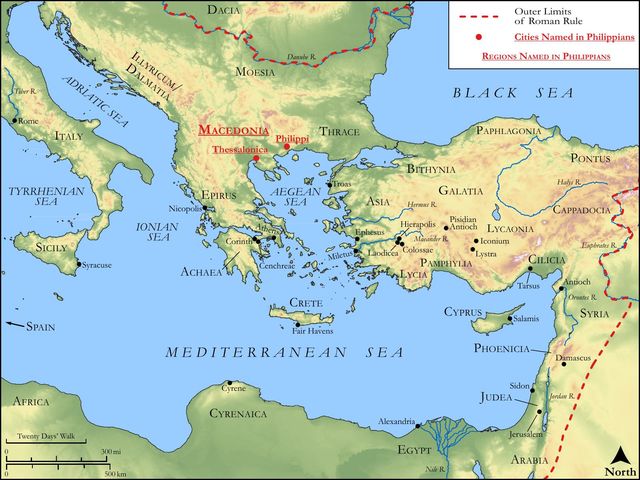
See on the biblical-era maps

Study this verse
Public-domain commentary
Matthew Henry
From his Commentary on the Whole Bible. Henry comments on passages, not single verses — this entry covers Philippians 2:1–11. His three-level outline is real structure in the source text, so it is rendered as structure.
The apostle proceeds in this chapter where he left off in the last, with further exhortations to Christian duties. He presses them largely to like-mindedness and lowly-mindedness, in conformity to the example of the Lord Jesus, the great pattern of humility and love. Here we may observe,
I.The great gospel precept passed upon us; that is, to love one another.
This is the law of Christ's kingdom, the lesson of his school, the livery of his family. This he represents (Phi 2:2) by being like-minded, having the same love, being of one accord, of one mind. We are of a like mind when we have the same love. Christians should be one in affection, whether they can be one in apprehension or no. This is always in their power, and always their duty, and is the likeliest way to bring them nearer in judgment. Having the same love. Observe, The same love that we are required to express to others, others are bound to express to us. Christian love ought to be mutual love. Love, and you shall be loved. Being of one accord, and of one mind; not crossing and thwarting, or driving on separate interests, but unanimously agreeing in the great things of God and keeping the unity of the Spirit in other differences. Here observe,
1.The pathetic pressing of the duty. He is very importunate with them, knowing what an evidence it is of our sincerity, and what a means of the preservation and edification of the body of Christ. The inducements to brotherly love are these: - (1.) "If there is any consolation in Christ. Have you experienced consolation in Christ? Evidence that experience by loving one another." The sweetness we have found in the doctrine of Christ should sweeten our spirits. Do we expect consolation in Christ? If we would not be disappointed, we must love one another. If we have not consolation in Christ, where else can we expect it? Those who have an interest in Christ have consolation in him, strong and everlasting consolation (Heb 6:18; Th2 2:16), and therefore ought to love one another. (2.) "Comfort of love. If there is any comfort in Christian love, in God's love to you, in your love to God, or in your brethren's love to us, in consideration of all this, be you like-minded. If you have ever found that comfort, if you would find it, if you indeed believe that the grace of love is a comfortable grace, abound in it." (3.) "Fellowship of the Spirit. If there is such a thing as communion with God and Christ by the Spirit, such a thing as the communion of saints, by virtue of their being animated and actuated by one and the same Spirit, be you like-minded; for Christian love and like-mindedness will preserve to us our communion with God and with one another." (4.) "Any bowels and mercies, in God and Christ, towards you. If you expect the benefit of God's compassions to yourselves, be you compassionate one to another. If there is such a thing as mercy to be found among the followers of Christ, if all who are sanctified have a disposition to holy pity, make it appear this way." How cogent are these arguments! One would think them enough to tame the most fierce, and mollify the hardest, heart. (5.) Another argument he insinuates is the comfort it would be to him: Fulfil you my joy. It is the joy of ministers to see people like-minded and living in love. He had been instrumental in bringing them to the grace of Christ and the love of God. "Now," says he, "if you have found any benefit by your participation of the gospel of Christ, if you have any comfort in it, or advantage by it, fulfil the joy of your poor minister, who preached the gospel to you."
2.He proposes some means to promote it.
(1.)Do nothing through strife and vain glory, Phi 2:3. There is no greater enemy to Christian love than pride and passion. If we do things in contradiction to our brethren, this is doing them through strife; if we do them through ostentation of ourselves, this is doing them through vain-glory: both are destructive of Christian love and kindle unchristian heats. Christ came to slay all enmities; therefore let there not be among Christians a spirit of opposition. Christ came to humble us, and therefore let there not be among us a spirit of pride.
(2.)We must esteem others in lowliness of mind better than ourselves, be severe upon our own faults and charitable in our judgments of others, be quick in observing our own defects and infirmities, but ready to overlook and make favourable allowances for the defects of others. We must esteem the good which is in others above that which is in ourselves; for we best know our own unworthiness and imperfections.
(3.)We must interest ourselves in the concerns of others, not in a way of curiosity and censoriousness, or as busy-bodies in other men's matters, but in Christian love and sympathy: Look not every man on his own things, but every man also on the things of others, Phi 2:4. A selfish spirit is destructive of Christian love. We must be concerned not only for our own credit, and ease, and safety, but for those of others also; and rejoice in the prosperity of others as truly as in our own. We must love our neighbour as ourselves, and make his case our own.
II.Here is a gospel pattern proposed to our imitation, and that is the example of our Lord Jesus Christ:
Let this mind be in you which was also in Christ Jesus, Phi 2:5. Observe, Christians must be of Christ's mind. We must bear a resemblance to his life, if we would have the benefit of his death. If we have not the Spirit of Christ, we are none of his, Rom 8:9. Now what was the mind of Christ? He was eminently humble, and this is what we are peculiarly to learn of him. Learn of me, for I am meek and lowly in heart, Mat 11:29. If we were lowly-minded, we should be like-minded; and, if we were like Christ, we should be lowly-minded. We must walk in the same spirit and in the same steps with the Lord Jesus, who humbled himself to sufferings and death for us; not only to satisfy God's justice, and pay the price of our redemption, but to set us an example, and that we might follow his steps. Now here we have the two natures and the two states of our Lord Jesus. It is observable that the apostle, having occasion to mention the Lord Jesus, and the mind which was in him, takes the hint to enlarge upon his person, and to give a particular description of him. It is a pleasing subject, and a gospel minister needs not think himself out of the way when he is upon it; any fit occasion should be readily taken.
1.Here are the two natures of Christ: his divine nature and his human nature.
(1.)Here is his divine nature: Who being in the form of God (Phi 2:6), partaking of the divine nature, as the eternal and only begotten Son of God. This agrees with Joh 1:1, In the beginning was the Word, and the Word was with God: it is of the same import with being the image of the invisible God (Col 1:15), and the brightness of his glory, and express image of his person, Heb 1:3. He thought it no robbery to be equal with God; did not think himself guilty of any invasion of what did not belong to him, or assuming another's right. He said, I and my Father are one, Joh 10:30. It is the highest degree of robbery for any mere man or mere creature to pretend to be equal with God, or profess himself one with the Father. This is for a man to rob God, not in tithes and offerings, but of the rights of his Godhead, Mal 3:8. Some understand being in the form of God - en morphē Theou huparchōn, of his appearance in a divine majestic glory to the patriarchs, and the Jews, under the Old Testament, which was often called the glory, and the Shechinah. The word is used in such a sense by the Septuagint and in the New Testament. He appeared to the two disciples, en hetera morphē - In another form, Mar 16:12. Metemorphōthē - he was transfigured before them, Mat 17:2. And he thought it no robbery to be equal with God; he did not greedily catch at, nor covet and affect to appear in that glory; he laid aside the majesty of his former appearance while he was here on earth, which is supposed to be the sense of the peculiar expression, ouk harpagmon hēgēsato. Vid. Bishop Bull's Def. cap. 2 sect. 4 et alibi, and Whitby in loc.
(2.)His human nature: He was made in the likeness of men, and found in fashion as a man. He was really and truly man, took part of our flesh and blood, appeared in the nature and habit of man. And he voluntarily assumed human nature; it was his own act, and by his own consent. We cannot say that our participation of the human nature is so. Herein he emptied himself, divested himself of the honours and glories of the upper world, and of his former appearance, to clothe himself with the rags of human nature. He was in all things like to us, Heb 2:17.
2.Here are his two estates, of humiliation and exaltation.
(1.)His estate of humiliation. He not only took upon him the likeness and fashion of a man, but the form of a servant, that is, a man of mean estate. He was not only God's servant whom he had chosen, but he came to minister to men, and was among them as one who serveth in a mean and servile state. One would think that the Lord Jesus, if he would be a man, should have been a prince, and appeared in splendour. But quite the contrary: He took upon him the form of a servant. He was brought up meanly, probably working with his supposed father at his trade. His whole life was a life of humiliation, meanness, poverty, and disgrace; he had nowhere to lay his head, lived upon alms, was a man of sorrows and acquainted with grief, did not appear with external pomp, or any marks of distinction from other men. This was the humiliation of his life. But the lowest step of his humiliation was his dying the death of the cross. He became obedient to death, even the death of the cross. He not only suffered, but was actually and voluntarily obedient; he obeyed the law which he brought himself under as Mediator, and by which he was obliged to die. I have power to lay down my life, and I have power to take it again: this commandment have I received of my Father, Joh 10:18. And he was made under the law, Gal 4:4. There is an emphasis laid upon the manner of his dying, which had in it all the circumstances possible which are humbling: Even the death of the cross, a cursed, painful, and shameful death, - a death accursed by the law (Cursed is he that hangeth on a tree) - full of pain, the body nailed through the nervous parts (the hands and feet) and hanging with all its weight upon the cross, - and the death of a malefactor and a slave, not of a free-man, - exposed as a public spectacle. Such was the condescension of the blessed Jesus.
(2.)His exaltation: Wherefore God also hath highly exalted him. His exaltation was the reward of his humiliation. Because he humbled himself, God exalted him; and he highly exalted him, huperupsōse, raised him to an exceeding height. He exalted his whole person, the human nature as well as the divine; for he is spoken of as being in the form of God as well as in the fashion of man. As it respects the divine nature, it could only be the recognizing of his rights, or the display and appearance of the glory he had with the Father before the world was (Joh 17:5), not any new acquisition of glory; and so the Father himself is said to be exalted. But the proper exaltation was of his human nature, which alone seems to be capable of it, though in conjunction with the divine. His exaltation here is made to consist in honour and power. In honour; so he had a name above every name, a title of dignity above all the creatures, men and angels. And in power: Every knee must bow to him. The whole creation must be in subjection to him: things in heaven, and things in earth, and things under the earth, the inhabitants of heaven and earth, the living and the dead. At the name of Jesus; not at the sound of the word, but the authority of Jesus; all should pay a solemn homage. And that every tongue should confess that Jesus Christ is Lord - every nation and language should publicly own the universal empire of the exalted Redeemer, and that all power in heaven and earth is given to him, Mat 28:18. Observe the vast extent of the kingdom of Christ; it reaches to heaven and earth, and to all the creatures in each, to angels as well as men, and to the dead as well as the living. - To the glory of God the Father. Observe, It is to the glory of God the Father to confess that Jesus Christ is Lord; for it is his will that all men should honour the Son as they honour the Father, Joh 5:23. Whatever respect is paid to Christ redounds to the honour of the Father. He who receiveth me receiveth him who sent me, Mat 10:40.
Historical interpretation
Two Centuries of Reception
15 surviving comments on this verse. Each one is dated, so this reads as a timeline rather than a list.
Select a marker to jump to its quote. Markers stagger vertically where authors wrote within a few decades of each other.
The Church, though dispersed throughout the whole world, even to the ends of the earth, has received from the apostles and their disciples this faith: She believes in one God, the Father Almighty, Maker of heaven, and earth, and the sea, and all things that are in them; and in one Christ Jesus, the Son of God, who became incarnate for our salvation; and in the Holy Spirit, who proclaimed through the prophets the dispensations of God, and the advents, and the birth from a virgin, and the passion, and the resurrection from the dead, and the ascension into heaven in the flesh of the beloved Christ Jesus, our Lord, and His future manifestation from heaven in the glory of the Father "to gather all things in one," and to raise up anew all flesh of the whole human race, in order that to Christ Jesus, our Lord, and God, and Saviour, and King, according to the will of the invisible Father, "every knee should bow, of things in heaven, and things in earth, and things under the earth, and that every tongue should confess" to Him.
"And not only for our sins,"— that is for those of the faithful, — is the Lord the propitiator, does he say, "but also for the whole world." He, indeed, saves all; but some [He saves], converting them by punishments; others, however, who follow voluntarily [He saves] with dignity of honour; so "that every knee should bow to Him, of things in heaven, and things on earth, and things under the earth;" [Philippians 2:10] that is, angels, men, and souls that before His advent have departed from this temporal life.
For the Father has delivered and subjected all to Christ our King "that at the name of Jesus every knee may bow, of things in heaven, and things in earth, and things under the earth, and every tongue confess that Jesus Christ is Lord, to the glory of God the Father.
After a little space the stone will come from heaven which smites the image and breaks it in pieces, and subverts all the kingdoms, and gives the kingdom to the saints of the Most High. This is the stone which becomes a great mountain, and fills the whole earth, of which Daniel says: "I saw in the night visions, and behold one like the Son of man came with the clouds of heaven, and came to the Ancient of days, and was brought near before Him. And there was given Him dominion, and glory, and a kingdom; and all peoples, tribes, and languages shall serve Him: and His dominion is an everlasting dominion, which shall not pass away, and His kingdom shall not be destroyed." He showed all power given by the Father to the Son, who is ordained Lord of things in heaven, and things on earth, and things under the earth, and Judge of all: of things in heaven, because He was born, the Word of God, before all (ages); and of things on earth, because He became man in the midst of men, to re-create our Adam through Himself; and of things under the earth, because He was also reckoned among the dead, preaching the Gospel to the souls of the saints, (and) by death overcoming death.
We should not understand this carnally, so as to suppose that even the heavenly bodies, which he says bend their knees, do this with fleshly limbs.… What spirit has knees? But the bending of the knees indicates that all is in subjection and observes the worship of God.
From a single beginning come many differences and varieties in creation. All these are now being recalled once again, synoptically in this text. They are now being viewed in relation to God’s goodness made known through the obedience of Christ. They are being drawn into a unity by the Holy Spirit. Everything is moving toward a common end, which corresponds to the goodness of the beginning. This means all those “in heaven and earth and the lower regions,” who, “bowing the knee at the name of Jesus,” have declared through this very act the tokens of their subjection. In these three appellations the whole universe is indicated. All things issue from one origin. They have been driven by their own motions in diverse ways. They are to be allotted different levels of blessedness in accord with their own willing.
The Deacon: Bow your heads to Jesus.
Might escape from the darts of the destroyer; and that Christ having thus suffered in the flesh, and having risen again the third day, might, with equal honour and glory with the Father and the Holy Spirit, be by all created things equally adored; for to Him every knee shall bow, of things in heaven, and things in earth, and things under the earth,
This means that after the mystery of the passion and the triumph of the ascension he who was wholly the Son of God with that which he had consented to be for our sakes, while remaining in the glory of God the Father (which means of course in the divinity of his own nature), should be adored by all the powers in heaven, on earth and below. Treatise , On the Priority of the Father
This name has become superior to every name. His divinity is such that it cannot be adequately manifested merely through verbal signs, no matter how exalted they are. As the exalted One comes to be in the lowly, so the lowly One may receive in return the properties of the exalted.
The One who once came into the world has now become the Firstborn from the dead, both of brothers in faith and of all creation. He will return to the world as judge of all the world in righteousness, as the prophet declares, when it will become clear. The name of Firstborn, which he assumed first on our behalf, will not be cast away in in those last days. Every knee will bow at the name of Jesus. He is above every name. The whole company of angels worships this One who has been called the Firstborn. They all rejoice in the restoration of humanity, whom he has restored to their original grace by becoming the Firstborn among us.
"Wherefore also God highly exalted Him, and gave Him the Name which is above every name: that in the Name of Jesus every knee should bow, of things in heaven, and things in earth, and things under the earth; and that every tongue should confess that Jesus Christ is Lord, to the glory of God the Father." Let us say against the heretics, If this is spoken of one who was not incarnate, if of God the Word, how did He highly exalt Him? Was it as if He gave Him something more than He had before? He would then have been imperfect in this point, and would have been made perfect for our sakes. For if He had not done good deeds to us, He would not have obtained that honor! "And gave Him the Name." See, He had not even a name, as you say! But how, if He received it as His due, is He found here to have received it by grace, and as a gift? And that "the Name which is above every name": and of what kind, let us see, is the Name? "That at the Name of Jesus," saith He, "every knee should bow." They (the heretics) explain name by glory. This glory then is above all glory, and this glory is in short that all worship Him! But ye hold yourselves far off from the greatness of God, who think that ye know God, as He knoweth Himself, and from this it is plain, how far off ye are from right thoughts of God. And this is plain from hence. Is this, tell me, glory? Therefore before men were created, before the angels or the archangels, He was not in glory. If this be the glory which is above every glory, for this is the name that is "above every name," though He were in glory before, yet was He in glory inferior to this. It was for this then that He made the things that are, that He might be raised to glory, not from His own goodness, but because He required glory from us! See ye not their folly? see ye not their impiety?
Now if they had said this of Him that was incarnate, there had been reason, for God the Word allows that this be said of His flesh. It touches not His divine nature, but has to do altogether with the dispensation. What means "of things in heaven, and things in the earth, and things under the earth"? It means the whole world, and angels, and men, and demons; or that both the just and the living and sinners.
"And every tongue," should "confess that Jesus Christ is Lord, to the glory of God the Father." That is, that all should say so; and this is glory to the Father. Seest thou how wherever the Son is glorified, the Father is also glorified? Thus too when the Son is dishonored, the Father is dishonored also. If this be so with us, where the difference is great between fathers and sons, much more in respect of God, where there is no difference, doth honor and insult pass on to Him. If the world be subjected to the Son, this is glory to the Father. And so when we say that He is perfect, wanting nothing, and not inferior to the Father, this is glory to the Father, that he begat such a one. This is a great proof of His power also, and goodness, and wisdom, that He begat one no whit inferior, neither in wisdom nor in goodness. When I say that He is wise as the Father, and no whit inferior, this is a proof of the great wisdom of the Father; when I say that He is powerful as the Father, this is a proof of the Father's power. When I say that He is good as the Father, this is the greatest evidence of His goodness, that He begat such (a Son), in no whit less or inferior to Himself. When I say that He begat Him not inferior in substance but equal, and not of another substance, in this I again wonder at God, His power, and goodness, and wisdom, that He hath manifested to us another, of Himself, such as Himself, except in His not being the Father. Thus whatsoever great things I say of the Son, pass on to the Father. Now if this small and light matter (for it is but a light thing to God's glory that the world should worship Him) is to the glory of God, how much more so are all those other things?
This means that after the mystery of the passion and the triumph of the ascension he who was wholly the Son of God with that which he had consented to be for our sakes, while remaining in the glory of God the Father (which means of course in the divinity of his own nature), should be adored by all the powers in heaven, on earth and below.
God the Word inhabited as his own temple the body taken from the woman. In this body lived a rational soul. God remade it into his own glory. On this account the holy Scripture declares that worship is proper only to the one who is God by nature. This is what Paul means when he writes that “at the name of Christ Jesus every knee shall bow.
He worships as one who has assumed the worshiping nature of humanity. It is this same One who is now worshiped as transcending the worshiping nature of humanity. He is now known to be God.
Continue studying Philippians 2:10 across the web’s major study libraries — every link below opens this exact verse, chapter, or book on the destination site.
Read & Compare
 BibleGatewayThis verse in more than 200 translations and 70 languages.
 Bible.comThe YouVersion reader — hundreds of translations, reading plans, and highlights.
 ESV.orgCrossway's official English Standard Version reader.
 NET BibleThe NET translation with 60,000+ translators' notes on every rendering decision.
 STEP BibleTyndale House's free study tool — original text, vocabulary, and scholarly resources.
 BibliaLogos Bible Software's free web reader.
 USCCBThe New American Bible (Revised Edition) with the U.S. bishops' study notes.
Commentaries
 BibleHub CommentariesDozens of classic commentaries on this verse, gathered on one page.
 StudyLightMore than 100 commentary sets — the largest collection on the web.
 BibleRefPlain-English commentary on what this verse means, verse by verse.
 Enduring WordDavid Guzik's free commentary on this chapter, widely used by Bible teachers.
 Bible Study ToolsVerse commentary alongside Greek and Hebrew study aids.
Original Language & Research
- BibleHub InterlinearThe verse word by word — original language, transliteration, and English.
- BibleHub LexiconEvery word's original-language definition and Strong's entry.
 Blue Letter BibleDeep-study tools — Strong's numbers, concordance, and word studies.
 CNTR CollationThe earliest Greek manuscripts of this verse, collated letter by letter.
Sermons, Hymns & Audio


TrulyRandomVerse is not affiliated with these sites and doesn’t control their content. They’re linked because they’re genuinely useful.
Summary
Philippians 2:10 stands as a profound declaration of the universal sovereignty and ultimate exaltation of Jesus Christ. Following His unparalleled humility, obedience, and sacrificial death, God the Father supremely honored Him, bestowing upon Him a name above all names. This verse proclaims that, as a direct consequence of this divine exaltation, every created being—whether in the celestial realms, upon the earth, or in the underworld—will ultimately acknowledge and submit to Jesus' supreme authority, bending the knee in homage and worship. It powerfully asserts Christ's absolute dominion over all existence, affirming His divine identity and rightful place as Lord of all.
Context
ShowHideLiterary Context
Philippians 2:10 is an integral part of the renowned "Christ Hymn" (often considered to span Philippians 2:5-11), which serves as the theological core of Paul's exhortation to unity and humility within the Philippian church. Paul presents Christ's example as the ultimate model for believers: though existing in the very nature of God, Jesus did not cling to His divine prerogatives but willingly "emptied himself" (Philippians 2:7) by taking on human form and humbling Himself to the point of death on a cross (Philippians 2:8). Because of this profound obedience and self-sacrifice, God the Father "highly exalted him and gave him the name that is above every name" (Philippians 2:9). Verse 10 directly elaborates on the universal consequence of this divine exaltation, leading to the climactic confession in Philippians 2:11. The entire hymn contrasts Christ's divine glory with His voluntary humiliation, culminating in His ultimate vindication and universal Lordship, thereby providing a powerful theological foundation for Paul's practical ethical instructions to the Philippians.
Historical & Cultural Context
The city of Philippi was a Roman colony, proud of its Roman citizenship and deeply influenced by Roman culture, including the imperial cult which demanded worship of the emperor as "Lord" (Kyrios). In this environment, Paul's declaration that "Jesus is Lord" (Philippians 2:11) was not merely a theological statement but a confession that set Christ above every earthly lord, Caesar included. The concept of "bowing the knee" was a common gesture of homage, respect, and submission, often performed before kings, emperors, or deities. Furthermore, Paul's language in Philippians 2:10-11 directly alludes to Isaiah 45:23, where Yahweh declares that "to me every knee shall bow, every tongue shall swear allegiance." By applying this Old Testament prophecy—originally referring to God Himself—to Jesus, Paul makes a profound statement about Jesus' divine identity and co-equality with God the Father, a radical claim in both Jewish and Roman contexts.
Key Themes
ShowHidePhilippians 2:10 contributes significantly to several major theological themes within the book of Philippians and broader Christian theology. Firstly, it underscores the Universal Lordship and Sovereignty of Jesus Christ, asserting His dominion over all creation, transcending all realms of existence. Secondly, it highlights the theme of Divine Exaltation and Vindication, demonstrating that God the Father's response to Christ's humility was to restore Him to a position of supreme authority and honor, publicly vindicating His perfect obedience. Thirdly, the verse speaks to the theme of Comprehensive Submission, emphasizing that whether willingly or unwillingly, all beings will ultimately acknowledge Jesus' supreme authority. This universal homage underscores His ultimate triumph over all powers and principalities, leading to the Ultimate Triumph of God's Plan through Christ. Finally, it reinforces the theme of Worship, as the bending of the knee signifies profound reverence and adoration, anticipating the eschatological reality where all creation will worship the exalted Christ, as seen in passages like Revelation 5:13.
Exposition and Analysis
ShowHideKey Word Analysis
ShowHideMore than a mere label, "name" in ancient thought, especially in a biblical context, represents the very essence, character, authority, and reputation of a person. To bow "at the name of Jesus" is therefore to bow to His person, His divine authority, His inherent character as God, and the power He embodies. It signifies complete recognition of who He is.
The "knee" is the physical part of the body that bends in an act of homage, submission, or worship. The act of bending the knee (proskynesis) is a universal sign of reverence and acknowledgment of superior authority or divinity. The emphasis on "every knee" underscores the absolute universality of this submission.
This verb means "to bend." When combined with "knee," it describes the physical act of prostration or kneeling in humility, reverence, or submission. In this context, it denotes the forced or willing acknowledgment of Jesus' supreme authority and Lordship.
This term refers to the subterranean regions, often understood as the underworld, the realm of the dead, or departed spirits. Its inclusion, alongside "in heaven" and "in earth," completes a merism, signifying that Christ's dominion extends to every conceivable sphere of existence, leaving no realm or being outside His ultimate authority.
Verse Breakdown
ShowHide"That at the name of Jesus"
The Greek conjunction hína (G2443, "in order that") introduces a purpose clause, indicating the divine intention behind God's exaltation of Jesus. The phrase "at the name of Jesus" signifies that the homage is rendered not merely to a title, but to the person and supreme authority of Jesus Himself, as embodied in His name. It is the direct result of God giving Him "the name that is above every name" (Philippians 2:9).
"every knee should bow"
This clause emphatically declares the universal and inevitable act of submission. "Every knee" leaves no exception, signifying that all beings, without distinction, will eventually perform this gesture of homage. "Should bow" indicates the necessary and appropriate response to Christ's exalted status, whether it be a willing act of worship from believers or a forced acknowledgment from those who oppose Him.
"of things in heaven, and things in earth, and things under the earth;"
This tripartite phrase is a comprehensive merism, a literary device that uses a list of parts to represent a whole. "Things in heaven" refers to celestial beings, including angels and heavenly hosts. "Things in earth" encompasses all humanity, living creatures, and earthly powers. "Things under the earth" refers to the departed spirits, those in the underworld, or even demonic entities. Together, these three realms signify the totality of creation, emphasizing that Jesus' dominion is absolute and extends over every single being in the cosmos, leaving no category outside His ultimate authority.
Literary Devices
ShowHideThe profound theological statement of Philippians 2:10 is amplified through several key literary devices. The most prominent is Allusion, specifically to Isaiah 45:23, where Yahweh (God) declares that "to me every knee shall bow." By applying this same divine declaration to Jesus, Paul powerfully asserts Christ's co-equality with God and His divine identity, a central tenet of Christian Christology. Another significant device is Merism, evident in the phrase "of things in heaven, and things in earth, and things under the earth." This figure of speech uses a comprehensive list of parts (the three realms of existence) to represent the totality of creation, thereby emphasizing the absolute and universal scope of Christ's dominion. This also functions as a form of Hyperbole to underscore the sweeping nature of Christ's authority, leaving no being or realm excluded from His ultimate sovereignty. The repetition of "things in" (implied) and the conjunction "and" also contribute to the rhythmic and emphatic quality of the declaration, reinforcing the idea of a complete and undeniable submission.
Theological and Thematic Connections
ShowHidePhilippians 2:10 stands as a cornerstone for understanding the ultimate triumph of God's redemptive plan through Jesus Christ. It underscores the eschatological reality that all creation will ultimately acknowledge Jesus' supreme Lordship, whether in willing worship or compelled submission. This universal homage is not merely a future event but a present truth that shapes the believer's life, calling for voluntary submission and worship now. The verse connects the humiliation of Christ (His kenosis and death) directly to His exaltation, demonstrating God's justice and faithfulness in honoring His obedient Son. It reassures believers of Christ's ultimate victory over all opposing forces, providing comfort and hope in a world that often seems to defy divine authority.
Reflection and Application
ShowHidePhilippians 2:10 offers profound comfort, challenge, and motivation for the believer. Knowing that "every knee will bow" to Jesus provides immense assurance in His ultimate sovereignty, even when circumstances seem chaotic or His Lordship appears challenged in the world. This truth calls us to live lives of voluntary submission and worship now, aligning our hearts and actions with the inevitable future reality. It reminds us that our present obedience is not in vain, but is a participation in the unfolding of God's cosmic plan. Furthermore, this verse inspires us to share the good news of Christ's reign, knowing that His kingdom will ultimately prevail and that all will one day acknowledge Him. It also fosters humility, as we recognize our own place within the vast creation that will bow before Him, prompting us to live in awe and reverence of His matchless glory.
Questions for Reflection
ShowHideFAQ
ShowHideWhat does "at the name of Jesus" truly mean in this context?
ShowHideIn biblical thought, a "name" represents the very essence, character, authority, and power of a person. Therefore, "at the name of Jesus" means bowing not merely to the sound of His name, but to the person of Jesus Himself, to His inherent divine authority, His character as God, and the supreme power He embodies. It signifies complete recognition and submission to who He is as the exalted Lord. It's about His identity and the authority God has vested in Him, as highlighted in Philippians 2:9, where God gives Him "the name that is above every name."
Does "every knee should bow" imply universal salvation for all beings?
ShowHideNo, this verse does not teach universal salvation. While it declares that every knee will ultimately bow and every tongue confess Jesus' Lordship, this can happen in two ways: willingly and joyfully by those who have placed their faith in Him, or unwillingly and under compulsion by those who have rejected Him. The bowing of the knee signifies an acknowledgment of His supreme authority and sovereignty, but it does not necessarily imply a salvific relationship. Romans 14:11 and Revelation 20:11-15 describe a future judgment where all will stand before Christ, acknowledging His Lordship, but not all will be found righteous unto salvation. The verse emphasizes Christ's undeniable dominion, not necessarily universal redemption.
Christ-Centered Fulfillment
ShowHidePhilippians 2:10 finds its profound Christ-centered fulfillment in the person and work of Jesus as the ultimate revelation of God's redemptive plan. The "name" above every name is His, not merely as a title, but as the embodiment of His unique divine-human identity and His completed work of salvation. His willingness to humble Himself, even to the point of death on a cross, was the necessary prelude to His exaltation, demonstrating that true glory is found in self-giving love and obedience. This verse underscores that the universal homage rendered to Jesus is a direct consequence of His triumph over sin and death through His resurrection and ascension. As the resurrected and ascended Lord, Jesus now reigns at the right hand of God, upholding all things by the word of His power (Hebrews 1:3). The bowing of every knee signifies that His reign is not merely spiritual but cosmic, extending over every realm and every creature, fulfilling God's eternal purpose to bring all things under the headship of Christ (Ephesians 1:20-23). This ultimate acknowledgment of His Lordship anticipates the day when He will put all enemies under His feet (1 Corinthians 15:25) and return in glory to fully establish His kingdom, a vision beautifully depicted in passages like Revelation 19:11-16. Thus, Philippians 2:10 is not just a statement about Christ's future glory, but a declaration of the present reality of His sovereign rule, established through His redemptive work on the cross.