


Romans 14:10
“Accountability to Christ, the Lord of All”Romans 14:5–12
Bible text: King James Version (1769 Blayney text) · Public domain
Bible text: King James Version with Strong's numbers · Public domain
Bible text: Berean Standard Bible · Public domain
Bible text: American Standard Version (1901) · Public domain
Bible text: World English Bible, Messianic edition · Public domain
Bible text: Geneva Bible (1599) · Public domain
Bible text: Young's Literal Translation · Public domain
- σὺsuYou yourselfG4771P-2NSPersonal pronoun Nominative 2nd Singular
- δὲdehoweverG1161CONJConjunction
- τίtiwhyG5101I-ASNInterrogative pronoun Accusative Singular Neuter
- κρίνειςkrineisjudge youG2919V-PAI-2SVerb Present Active Indicative 2nd Singular
- τὸνtontheG3588T-ASMDefinite article Accusative Singular Masculine
- ἀδελφόνadelphonbrotherG80N-ASMNoun Accusative Singular Masculine
- σου;souor you?G4771P-2GSPersonal pronoun Genitive 2nd Singular
- ἢēorG2228CONJConjunction
- καὶkaialsoG2532CONJConjunction
- σὺsuyou yourselfG4771P-2NSPersonal pronoun Nominative 2nd Singular
- τίtiwhyG5101I-ASNInterrogative pronoun Accusative Singular Neuter
- ἐξουθενεῖςexoutheneisdo despiseG1848V-PAI-2SVerb Present Active Indicative 2nd Singular
- τὸνtontheG3588T-ASMDefinite article Accusative Singular Masculine
- ἀδελφόνadelphonbrotherG80N-ASMNoun Accusative Singular Masculine
- σου;souof you?G4771P-2GSPersonal pronoun Genitive 2nd Singular
- πάντεςpantesAllG3956A-NPMAdjective Nominative Plural Masculine
- γὰρgarforG1063CONJConjunction
- παραστησόμεθαparastēsomethawe will stand beforeG3936V-FDI-1PVerb Future Middle Deponent Indicative 1st Plural
- τῷtōtheG3588T-DSNDefinite article Dative Singular Neuter
- βήματιbēmatijudgment seatG968N-DSNNoun Dative Singular Neuter
- τοῦtou[the]G3588T-GSMDefinite article Genitive Singular Masculine
- θεοῦtheouof GodG2316N-GSM-TNoun Genitive Singular Masculine Title
English is a literal word-by-word gloss of the Greek, not the KJV's wording. Why?
This is the original text the KJV's translators worked from — each Greek word with its own literal English meaning in this verse, prepared by scholars at Tyndale House, Cambridge. The KJV translates whole sentences, not word by word, so its wording differs: one Greek word can become several English words, and the KJV may choose “charity” where the gloss reads “love”. Both are faithful — they answer different questions. For the KJV's own rendering, switch to the KJV text.
Words in [ ] are added by the English.
Details
See on the biblical-era maps
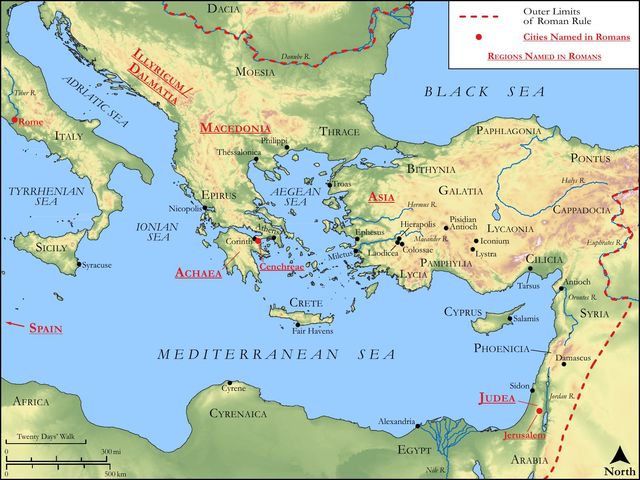
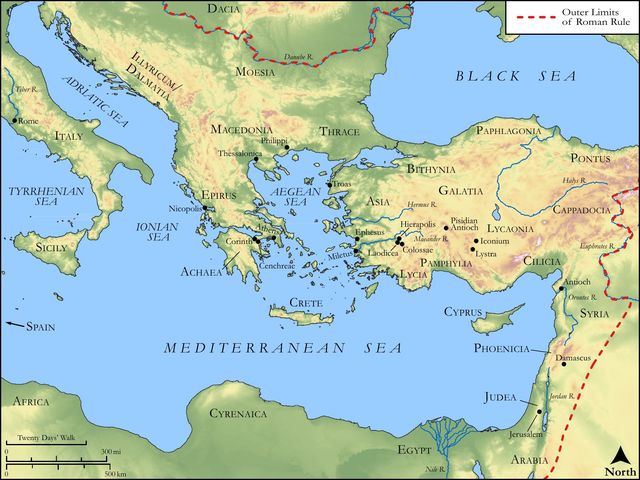
Study this verse
Public-domain commentary
Matthew Henry
From his Commentary on the Whole Bible. Henry wrote on whole passages, and this entry covers Romans 14:1–23. He set out his notes in a four-level outline, kept here as he numbered it.
We have in this chapter,
I.An account of the unhappy contention which had broken out in the Christian church.
Our Master had foretold that offences would come; and, it seems, so they did, for want of that wisdom and love which would have prevented discord, and kept up union among them.
1.There was a difference among them about the distinction of meats and days; these are the two things specified. There might be other similar occasions of difference, while these made the most noise, and were most taken notice of. The case was this: The members of the Christian church at Rome were some of them originally Gentiles, and others of them Jews. We find Jews at Rome believing, Acts xxviii. 24. Now those that had been Jews were trained up in the observance of the ceremonial appointments touching meats and days. This, which had been bred in the bone with them, could hardly be got out of the flesh, even after they turned Christians; especially with some of them, who were not easily weaned from what they had long been wedded to. They were not well instructed touching the cancelling of the ceremonial law by the death of Christ, and therefore retained the ceremonial institutions, and practised accordingly; while other Christians that understood themselves better, and knew their Christian liberty, made no such difference.
(1.)Concerning meats (v. 2): One believeth that he may eat all things—he is well satisfied that the ceremonial distinction of meats into clean and unclean is no longer in force, but that every creature of God is good, and nothing to be refused; nothing unclean of itself, v. 14. This he was assured of, not only from the general tenour and scope of the gospel, but particularly from the revelation which Peter, the apostle of the circumcision (and therefore more immediately concerned in it), had to this purport, Acts x. 15, 28. This the strong Christian is clear in, and practises accordingly, eating what is set before him, and asking no question for conscience' sake, 1 Cor. x. 27. On the other hand, another, who is weak, is dissatisfied in this point, is not clear in his Christian liberty, but rather inclines to think that the meats forbidden by the law remain still unclean; and therefore, to keep at a distance from them, he will eat no flesh at all, but eateth herbs, contenting himself with only the fruits of the earth. See to what degrees of mortification and self-denial a tender conscience will submit. None know but those that experience it how great both the restraining and the constraining power of conscience is.
(2.)Concerning days, v. 5. Those who thought themselves still under some kind of obligation to the ceremonial law esteemed one day above another—kept up a respect to the times of the passover, pentecost, new moons, and feasts of tabernacles; thought those days better than other days, and solemnized them accordingly with particular observances, binding themselves to some religious rest and exercise on those days. Those who knew that all these things were abolished and done away by Christ's coming esteemed every day alike. We must understand it with an exception of the Lord's day, which all Christians unanimously observed; but they made no account, took no notice, of those antiquated festivals of the Jews. Here the apostle speaks of the distinction of meats and days as a thing indifferent, when it went no further than the opinion and practice of some particular persons, who had been trained up all their days to such observances, and therefore were the more excusable if they with difficulty parted with them. But in the epistle to the Galatians, where he deals with those that were originally Gentiles, but were influenced by some judaizing teachers, not only to believe such a distinction and to practise accordingly, but to lay a stress upon it as necessary to salvation, and to make the observance of the Jewish festivals public and congregational, here the case was altered, and it is charged upon them as the frustrating of the design of the gospel, falling from grace, Gal. iv. 9-11. The Romans did it out of weakness, the Galatians did it out of wilfulness and wickedness; and therefore the apostle handles them thus differently. This epistle is supposed to have been written some time before that to the Galatians. The apostle seems willing to let the ceremonial law wither by degrees, and to let it have an honourable burial; now these weak Romans seem to be only following it weeping to its grave, but those Galatians were raking it out of its ashes.
2.It was not so much the difference itself that did the mischief as the mismanagement of the difference, making it a bone of contention.
(1.)Those who were strong, and knew their Christian liberty, and made use of it, despised the weak, who did not. Whereas they should have pitied them, and helped them, and afforded them meek and friendly instruction, they trampled upon them as silly, and humoursome, and superstitious, for scrupling those things which they knew to be lawful: so apt are those who have knowledge to be puffed up with it, and to look disdainfully and scornfully upon their brethren.
(2.)Those who were weak, and durst not use their Christian liberty, judged and censured the strong, who did, as if they were loose Christians, carnal professors, that cared not what they did, but walked at all adventures, and stuck at nothing. They judged them as breakers of the law, contemners of God's ordinance, and the like. Such censures as these discovered a great deal of rashness and uncharitableness, and would doubtless tend much to the alienating of affection. Well, this was the disease, and we see it remaining in the church to this day; the like differences, in like manner mismanaged, are still the disturbers of the church's peace. But,
II.We have proper directions and suggestions laid down for allaying this contention, and preventing the ill consequences of it.
The apostle, as a wise physician, prescribes proper remedies for the disease, which are made up of rules and reasons. Such gentle methods does he take, with such cords of a man does he draw them together; not by excommunicating, suspending, and silencing either side, but by persuading them both to a mutual forbearance: and as a faithful daysman he lays his hand upon them both, reasoning the case with the strong that they should not be so scornful, and with the weak that they should not be so censorious. If the contending parties will but submit to this fair arbitration, each abate of his rigour, and sacrifice their differences to their graces, all will be well quickly. Let us observe the rules he gives, some to the strong and some to the weak, and some to both, for they are interwoven; and reduce the reasons to their proper rules.
1.Those who are weak must be received, but not to doubtful disputations, v. 1. Take this for a general rule; spend your zeal in those things wherein you and all the people of God are agreed, and do not dispute about matters that are doubtful. Receive him, proslambavesthe—take him to you, bid him welcome, receive him with the greatest affection and tenderness; porrigite manum (so the Syriac): lend him your hand, to help him, to fetch him to you, to encourage him. Receive him into your company, and converse, and communion, entertain him with readiness and condescension, and treat him with all possible endearments. Receive him: not to quarrel with him, and to argue about uncertain points that are in controversy, which will but confound him, and fill his head with empty notions, perplex him, and shake his faith. Let not your Christian friendship and fellowship be disturbed with such vain janglings and strifes of words.—Not to judge his doubtful thoughts (so the margin), "not to pump out his weak sentiments concerning those things which he is in doubt about, that you may censure and condemn him." Receive him, not to expose him, but to instruct and strengthen him. See 1 Cor. i. 10; Phil. iii. 15, 16.
2.Those who are strong must by no means despise the weak; nor those who are weak judge the strong, v.
3.This is levelled directly against the fault of each party. It is seldom that any such contention exists but there is a fault on both sides, and both must mend. He argues against both these jointly: we must not despise nor judge our brethren. Why so?
(1.)Because God hath received them; and we reflect upon him if we reject those whom he hath received. God never cast off any one that had true grace, though he was but weak in it; never broke the bruised reed. Strong believers and weak believers, those that eat and those that eat not, if they be true believers, are accepted of God. It will be good for us to put this question to ourselves, when we are tempted to behave scornfully towards our brethren, to disdain and censure them: "Hast not God owned them; and, if he has, dare I disown them?" "Nay, God doth not only receive him, but hold him up, v. 4. You think that he who eateth will fall by his presumption, or that he who eateth not will sink under the weight of his own fears and scruples; but if they have true faith, and an eye to God, the one in the intelligent use of his Christian liberty and the other in the conscientious forbearance of it, they shall be held up—the one in his integrity, and the other in his comfort. This hope is built upon the power of God, for God is able to make him stand; and, being able, no doubt he is willing to exert that power for the preservation of those that are his own." In reference to spiritual difficulties and dangers (our own and others), much of our hope and comfort are grounded upon the divine power, 1 Pet. i. 5; Jude 24.
(2.)Because they are servants to their own master (v. 4): Who art thou that judgest another man's servant? We reckon it a piece of ill manners to meddle with other people's servants, and to find fault with them and censure them. Weak and strong Christians are indeed our brethren, but they are not our servants. This rash judging is reproved, Jam. iii. 1, under the notion of being many masters. We make ourselves our brethren's masters, and do in effect usurp the throne of God, when we take upon us thus to judge them, especially to judge their thoughts and intentions, which are out of our view, to judge their persons and state, concerning which it is hard to conclude by those few indications which fall within our cognizance. God sees not as man sees; and he is their master, and not we. In judging and censuring our brethren, we meddle with that which does not belong to us: we have work enough to do at home; and, if we must needs be judging, let us exercise our faculty upon our own hearts and ways.—To his own master he stands or falls; that is, his doom will be according to his master's sentence, and not according to ours. How well for us is it that we are not to stand nor fall by the judgment one of another, but by the righteous and unerring judgment of God, which is according to truth! "While thy brother's cause is before thy judgment, it is coram non judice—before one who is not the judge; the court of heaven is the proper court for trial, where, and where only, the sentence is definitive and conclusive; and to this, if his heart be upright, he may comfortably appeal from thy rash censure."
(3.)Because both the one and the other, if they be true believers, and are right in the main, have an eye to God, and do approve themselves to God in what they do, v. 6. He that regards the day—that makes conscience of the observance of the Jewish fasts and festivals, not imposing it upon others, nor laying a stress upon it, but willing to be as he thinks on the surer side, as thinking there is no harm in resting from worldly labours, and worshipping God on those days—it is well. We have reason to think, because in other things he conducts himself like a good Christian, that in this also his eye is single, and that he regardeth it unto the Lord; and God will accept of his honest intention, though he be under a mistake about the observance of days; for the sincerity and uprightness of the heart were never rejected for the weakness and infirmity of the head: so good a master do we serve. On the other hand, he that regards not the day—that does not make a difference between one day and another, does not call one day holy and another profane, one day lucky and another unlucky, but esteems every day alike—he does not do it out of a spirit of opposition, contradiction, or contempt of his brother. If he be a good Christian, he does not, he dares not, do it from such a principle; and therefore we charitably conclude that to the Lord he does not regard it. he makes no such difference of days only because he knows God hath made none; and therefore intends his honour in endeavouring to dedicate ever day to him. So for the other instance: He that eateth whatever is set before him, though it be blood, though it be swine's flesh, if it be food convenient for him, he eateth to the Lord. He understands the liberty that God has granted him, and uses it to the glory of God, with an eye to his wisdom and goodness in enlarging our allowance now under the gospel, and taking off the yoke of legal restraints; and he giveth God thanks for the variety of food he has, and the liberty he has to eat it, and that in those things his conscience is not fettered. On the other hand, he that eatest not those meats which were forbidden by the ceremonial law, to the Lord he eateth not. It is for God's sake, because he is afraid of offending God by eating that which he is sure was once prohibited; and he giveth God thanks too that there is enough besides. If he conscientiously deny himself that which he takes to be forbidden fruit, yet he blesses God that of other trees in the garden he may freely eat. Thus, while both have an eye to God in what they do, and approve themselves to him in their integrity, why should either of them be judged or despised? Observe, Whether we eat flesh, or eat herbs, it is a thankful regard to God, the author and giver of all our mercies, that sanctifies and sweetens it. Bishop Sanderson, in his 34th sermon, upon 1 Tim. iv. 4, justly makes this observation: It appears by this that saying grace (as we commonly call it, perhaps from 1 Cor. x. 30) before and after meat was the common known practice of the church, among Christians of all sorts, weak and strong: an ancient, commendable, apostolical, Christian practice, derived down from Christ's example through all the ages of the church, Matt. xiv. 19; xv. 36; Luke ix. 16; John vi. 11; Matt. xxvi. 26, 27; Acts xxvii. 35. Blessing the creatures in the name of God before we use them, and blessing the name of God for them after, are both included; for eulogein and eucharistein are used promiscuously. To clear this argument against rash judging and despising, he shows how essential it is to true Christianity to have a regard to God and not to ourselves, which therefore, unless the contrary do manifestly appear, we must presume concerning those that in minor things differ from us. Observe his description of true Christians, taken from their end and aim (v. 7, 8), and the ground of it, v. 9.
[1.]Our end and aim: not self, but the Lord. As the particular end specifies the action, so the general scope and tendency specify the state. If we would know what way we walk in, we must enquire what end we walk towards. First, Not to self. We have learned to deny ourselves; this was our first lesson: None of us liveth to himself. This is a thing in which all the people of God are one, however they differ in other things; though some are weak and others are strong, yet both agree in this, not to live to themselves. Not one that hath given up his name to Christ is allowedly a self-seeker; it is contrary to the foundation of true Christianity. We neither live to ourselves nor die to ourselves. We are not our own masters, nor our own proprietors—we are not at our own disposal. The business of our lives is not to please ourselves, but to please God. The business of our deaths, to which we are every day exposed and delivered, is not to make ourselves talked of; we run not such hazards out of vain-glory, while we are dying daily. When we come to die actually, neither is that to ourselves; it is not barely that we would be unclothed, and eased of the burden of the flesh, but it is to the Lord, that we may depart and be with Christ, may be present with the Lord. Secondly, But to the Lord (v. 8), to the Lord Christ, to whom all power and judgment are committed, and in whose name we are taught, as Christians, to do every thing we do (Col. iii. 17), with an eye to the will of Christ as our rule, to the glory of Christ as our end, Phil. i. 21. Christ is the gain we aim at, living and dying. We live to glorify him in all the actions and affairs of life; we die, whether a natural or a violent death, to glorify him, and to go to be glorified with him. Christ is the centre, in which all the lines of life and death do meet. This is true Christianity, which makes Christ all in all. So that, whether we live or die, we are the Lord's, devoted to him, depending on him, designed and designing for him. Though some Christians are weak and others strong,—though of different sizes, capacities, apprehensions, and practices, in minor things, yet they are all the Lord's—all eying, and serving, and approving themselves to Christ, and are accordingly owned and accepted of him. Is it for us then to judge or despise them, as if we were their masters, and they were to make it their business to please us, and to stand or fall by our dooms?
[2.]The ground of this, v. 9. It is grounded upon Christ's absolute sovereignty and dominion, which were the fruit and end of his death and resurrection. To this end he both died, and rose, and revived (he, having risen, entered upon a heavenly life, the glory which he had before) that he might be Lord both of dead and living—that he might be universal monarch, Lord of all (Acts x. 36), all the animate and inanimate creatures; for he is head over all things to the church. He is Lord of those that are living to rule them, of those that are dead to receive them and raise them up. This was that name above every name which God gave him as the reward of his humiliation, Phil. ii. 8, 9. It was after he had died and risen that he said, All power is given unto me (Matt. xxviii. 18), and presently he exerts that power in issuing out commissions, v. 19, 20. Now if Christ paid so dearly for his dominion over souls and consciences, and has such a just and undisputed right to exercise that dominion, we must not so much as seem to invade it, nor intrench upon it, by judging the consciences of our brethren, and arraigning them at our bar. When we are ready to reproach and reflect upon the name and memory of those that are dead and gone, and to pass a censure upon them (which some the rather do, because such judgments of the dead are more likely to pass uncontrolled and uncontradicted), we must consider that Christ is Lord of the dead, as well as of the living. If they are dead, they have already given up their account, and let that suffice. And this leads to another reason against judging and despising,
(4.)Because both the one and the other must shortly give an account, v. 10-12. A believing regard to the judgment of the great day would silence all these rash judgings: Why dost thou that art weak judge thy brother that is strong? And why dost thou that art strong set at nought thy brother that is weak? Why is all this clashing, and contradicting, and censuring, among Christians? We shall all stand before the judgment-seat of Christ, 2 Cor. v. 10. Christ will be the judge, and he has both authority and ability to determine men's eternal state according to their works, and before him we shall stand as persons to be tried, and to give up an account, expecting our final doom from him, which will be eternally conclusive. To illustrate this (v. 11), he quotes a passage out of the Old Testament, which speaks of Christ's universal sovereignty and dominion, and that established with an oath: As I live (saith the Lord), every knee shall bow to me. It is quoted from Isa. xlv. 23. There it is, I have sworn by myself; here it is, As I live. So that whenever God saith As I live, it is to be interpreted as swearing by himself; for it is God's prerogative to have life in himself: there is a further ratification of it there, The word is gone out of my mouth. It is a prophecy, in general, of Christ's dominion; and here very fully applied to the judgment of the great day, which will be the highest and most illustrious exercise of that dominion. Here is a proof of Christ's Godhead: he is the Lord and he is God, equal with the Father. Divine honour is due to him, and must be paid. It is paid to God through him as Mediator. God will judge the world by him, Acts xvii. 31. The bowing of the knee to him, and the confession made with the tongue, are but outward expressions of inward adoration and praise. Every knee and every tongue, either freely or by force.
[1.]All his friends do it freely, are made willing in the day of his power. Grace is the soul's cheerful, entire, and avowed subjection to Jesus Christ. First, Bowing to him—the understanding bowed to his truths, the will to his laws, the whole man to his authority; and this expressed by the bowing of the knee, the posture of adoration and prayer. It is proclaimed before our Joseph, Bow the knee, Gen. xli. 43. Though bodily exercise alone profits little, yet, as it is guided by inward fear and reverence, it is accepted. Secondly, Confessing to him—acknowledging his glory, grace, and greatness—acknowledging our own meanness and vileness, confessing our sins to him; so some understand it.
[2.]All his foes shall be constrained to do it, whether they will or no. When he shall come in the clouds, and every eye shall see him, then, and not till then, will all those promises which speak of his victories over his enemies and their subjection to him have their full and complete accomplishment; then his foes shall be his footstool, and all his enemies shall lick the dust. Hence he concludes (v. 12), Every one of us shall give account of himself to God. We must not give account for others, nor they for us; but every one for himself. We must give account how we have spent our time, how we have improved our opportunities, what we have done and how we have done it. And therefore, First, We have little to do to judge others, for they are not accountable to us, nor are we accountable for them (Gal. ii. 6): Whatsoever they were, it maketh no matter to me, God accepteth no man's person. Whatever they are, and whatever they do, they must give account to their own master, and not to us; if we can in any thing be helpers of their joy, it is well; but we have not dominion over their faith. And, Secondly, We have the more to do to judge ourselves. We have an account of our own to make up, and that is enough for us; let every man prove his own work (Gal. vi. 4), state his own accounts, search his own heart and life; let this take up his thoughts, and he that is strict in judging himself and abasing himself will not be apt to judge and despise his brother. Let all these differences be referred to the arbitration of Christ at the great day.
(5.)Because the stress of Christianity is not to be laid upon these things, nor are they at all essential to religion, either on the one side or on the other. This is his reason (v. 17, 18), which is reducible to this branch of exhortation. Why should you spend your zeal either for or against those things which are so minute and inconsiderable in religion? Some make it a reason why, in case of offence likely to be taken, we should refrain the use of our Christian liberty; but it seems directed in general against that heat about those things which he observed on both sides. The kingdom of God is not meat, &c. Observe here,
[1.]The nature of true Christianity, what it is: it is here called, The kingdom of God; it is a religion intended to rule us, a kingdom: it stands in a true and hearty subjection to God's power and dominion. The gospel dispensation is in a special manner called the kingdom of God, in distinction from the legal dispensation, Matt. iii. 2; iv. 17. First, It is not meat and drink: it does not consist either in using or in abstaining from such and such meats and drinks. Christianity gives no rule in that case, either in one way or another. The Jewish religion consisted much in meats and drinks (Heb. ix. 10), abstaining from some meats religiously (Lev. xi. 2), eating other meats religiously, as in several of the sacrifices, part of which were to be eaten before the Lord: but all those appointments are now abolished and are no more, Col. ii. 21, 22. The matter is left at large. Every creature of God is good, 1 Tim. iv. 4. So, as to other things, it is neither circumcision nor uncircumcision (Gal. v. 6; vi. 15; 1 Cor. vii. 19), it is not being of this party and persuasion, of this or the other opinion in minor things, that will recommend us to God. It will not be asked at the great day, "Who ate flesh, and who ate herbs?" "Who kept holy days, and who did not?" Nor will it be asked, "Who was conformist and who was non-conformist?" But it will be asked, "Who feared God and worked righteousness, and who did not?" Nothing more destructive to true Christianity than placing it in modes, and forms, and circumstantials, which eat out the essentials. Secondly, It is righteousness, and peace, and joy in the Holy Ghost. These are some of the essentials of Christianity, things in which all the people of God are agreed, in the pursuit of which we must spend our zeal, and which we must mind with an excelling care. Righteousness, peace, and joy, are very comprehensive words; and each of them includes much, both of the foundation and the superstructure of religion. Might I limit the sense of them, it should be thus:—As to God, our great concern is righteousness—to appear before him justified by the merit of Christ's death, sanctified by the Spirit of his grace; for the righteous Lord loveth righteousness. As to our brethren, it is peace—to live in peace and love, and charity with them, following peace with all men: Christ came into the world to be the great peace-maker. As to ourselves, it is joy in the Holy Ghost—that spiritual joy which is wrought by the blessed Spirit in the hearts of believers, which respects God as their reconciled Father and heaven as their expected home. Next to our compliance with God, the life of religion consists in our complacency in him; to delight ourselves always in the Lord. Surely we serve a good Master, who makes peace and joy so essential to our religion. Then and then only we may expect peace and joy in the Holy Ghost when the foundation is laid in righteousness, Isa. xxxii. 17. Thirdly, It is in these things to serve Christ (v. 18), to do all this out of respect to Christ himself as our Master, to his will as our rule and to his glory as our end. That which puts an acceptableness upon all our good duties is a regard to Christ in the doing of them. We are to serve his interests and designs in the world, which are in the first place to reconcile us one to another. What is Christianity but the serving of Christ? And we may well afford to serve him who for us and for our salvation took upon him the form of a servant.
[2.]The advantages of it. He that duly observeth these things, First, Is acceptable to God. God is well pleased with such a one, though he be not in every thing just of our length. He has the love and favour of God; his person, his performances, are accepted of God, and we need no more to make us happy. If God now accepts thy works, thou mayest eat thy bread with joy. Those are most pleasing to God that are best pleased with him; and they are those that abound most in peace and joy in the Holy Ghost. Secondly, He is approved of men—of all wise and good men, and the opinion of others is not to be regarded. The persons and things which are acceptable to God should be approved of us. Should not we be pleased with that which God is pleased with? What is it to be sanctified, but to be of God's mind? Observe, The approbation of men is not to be slighted; for we must provide things honest in the sight of all men, and study those things that are lovely and of good report: but the acceptance of God is to be desired and aimed at in the first place, because, sooner or later, God will bring all the world to be of his mind.
3.Another rule here given is this, that in these doubtful things every one not only may, but must, walk according to the light that God hath given him. This is laid down v. 5, Let every man be fully persuaded in his own mind; that is, "Practise according to your own judgment in these things, and leave others to do so too. Do not censure the practice of others; let them enjoy their own opinion; if they be persuaded in their own mind that they ought to do so and so, do not condemn them, but, if your sober sentiments be otherwise, do not make their practice a rule to you, any more than you must prescribe yours as a rule to them. Take heed of acting contrary to the dictates of a doubting conscience. First be persuaded that what you do is lawful, before you venture to do it." In doubtful things, it is good keeping on the sure side of the hedge. If a weak Christian doubts whether it be lawful to eat flesh, while he remains under that doubt he had best forbear, till he be fully persuaded in his own mind. We must not pin our faith upon any one's sleeve, nor make the practice of others our rule; but follow the dictates of our own understanding. To this purport he argues, v. 14 and 23, which two verses explain this, and give us a rule not to act against the dictates,
(1.)Of a mistaken conscience, v. 14. If a thing be indifferent, so that it is not in itself a sin not to do it, if we really think it a sin to do it it is to us a sin, though not to others, because we act against our consciences, though mistaken and misinformed. He specifies the case in hand, concerning the difference of meats. Observe,
[1.]His own clearness in this matter. "I know and am persuaded—I am fully persuaded, I am acquainted with my Christian liberty, and am satisfied in it, without any doubt or scruple, that there is nothing unclean of itself, that is, no kind of meat that lies under any ceremonial uncleanness, nor is forbidden to be eaten, if it be food proper for human bodies." Several kinds of meat were forbidden to the Jews, that in that, as in other things, they might be a peculiar and separate people, Lev. xi. 44; Deut. xiv. 2, 3. Sin had brought a curse upon the whole creation: Cursed is the ground for thy sake; the use of the creatures and dominion over them were forfeited, so that to man they were all unclean (Tit. i. 15), in token of which God in the ceremonial law prohibited the use of some, to show what he might have done concerning all; but now that Christ has removed the curse the matter is set at large again, and that prohibition is taken away. Therefore Paul says that he was persuaded by the Lord Jesus, not only as the author of that persuasion, but as the ground of it; it was built upon the efficacy of Christ's death, which removed the curse, took off the forfeiture, and restored our right to the creature in general, and consequently put a period to that particular distinguishing prohibition. So that now there is nothing unclean of itself, every creature of God is good; nothing common: so the margin, ouden koinon; nothing which is common to others to eat, from the use of which the professors of religion are restrained: nothing profane; in this sense the Jews used the word common. It is explained by the word akatharton, Acts x. 14, nothing common or unclean. It was not only from the revelation made to Peter in this matter, but from the tenour and tendency of the whole gospel, and from the manifest design of Christ's death in general, that Paul learned to count nothing common or unclean. This was Paul's own clearness, and he practised accordingly.
[2.]But here is a caution he gives to those who had not that clearness in this matter which he had: To him that esteemeth any thing to be unclean, though it be his error, yet to him it is unclean. This particular case, thus determined, gives a general rule, That he who does a thing which he verily believes to be unlawful, however the thing be in itself, to him it is a sin. This arises from that unchangeable law of our creation, which is, that our wills, in all their choices, motions, and directions, should follow the dictates of our understandings. This is the order of nature, which order is broken if the understanding (though misguided) tell us that such a thing is a sin, and yet we will do it. This is a will to do evil; for, if it appears to us to be sin, there is the same pravity and corruption of the will in the doing of it as if really it were a sin; and therefore we ought not to do it. Not that it is in the power of any man's conscience to alter the nature of the action in itself, but only as to himself. It must be understood likewise with this proviso, though men's judgments and opinions may make that which is good in itself to become evil to them, yet they cannot make that which is evil in itself to become good, either in itself or to them. If a man were verily persuaded (it is Dr. Sanderson's instance, sermon on ch. xiv. 23) that it were evil to ask his father's blessing, that mispersuasion would make it become evil to him: but, if he should be as verily persuaded that it were good to curse his father, this would not make it become good. The Pharisees taught people to plead conscience, when they made corban an excuse for denying relief to their parents, Matt. xv. 5, 6. But this would not serve any more than Paul's erroneous conscience would justify his rage against Christianity (Acts xxvi. 9), or theirs, John xvi. 2.
(2.)Nor must we act against the dictates of a doubting conscience. In those indifferent things which we are sure it is no sin not to do, and yet are not clear that it is lawful to do them, we must not do them while we continue under those doubts; for he that doubteth is damned if he eat (v. 23), that is, it turns into sin to him; he is damned, katakekritai—he is condemned of his own conscience, because he eateth not of faith, because he does that which he is not fully persuaded he may lawfully do. He is not clear that it is lawful for him to eat swine's flesh (suppose), and yet is drawn, notwithstanding his doubts, to eat it, because he sees others do it, because he would gratify his appetite with it, or because he would not be reproached for his singularity. Here his own heart cannot but condemn him as a transgressor. Our rule is, to walk as far as we have attained, not further, Phil. iii. 15, 16.—For whatsoever is not of faith is sin. Taking it in general, it is the same with that of the apostle (Heb. xi. 6), Without faith it is impossible to please God. Whatever we do in religion, it will not turn to any good account, except we do it from a principle of faith, with a believing regard to the will of Christ as our rule, to the glory of Christ as our end, and to the righteousness of Christ as our plea. Here it seems to be taken more strictly; whatever is not of faith (that is, whatever is done while we are not clearly persuaded of the lawfulness of it), is a sin against conscience. He that will venture to do that which his own conscience suggests to him to be unlawful, when it is not so in itself, will by a like temptation be brought to do that which his conscience tells him is unlawful when it is really so. The spirit of a man is the candle of the Lord, and it is a dangerous thing to debauch and put a force upon conscience, though it be under a mistake. This seems to be the meaning of that aphorism, which sounds somewhat darkly (v. 22), Happy is he that condemns not himself in that thing which he allows. Many a one allows himself in practice to do that which yet in his judgment and conscience he condemns himself for—allows it for the sake of the pleasure, profit, or credit of it—allows it in conformity to the custom; and yet whilst he does it, and pleas for it, his own heart gives him the lie, and his conscience condemns him for it. Now, happy is the man who so orders his conversation as not in any action to expose himself to the challenges and reproaches of his own conscience—that does not make his own heart his adversary, as he must needs do who does that which he is not clear he may lawfully do. He is happy that has peace and quietness within, for the testimony of conscience will be a special cordial in troublesome times. Though men condemn us, it is well enough if our own hearts condemn us not, 1 John iii. 21.
4.Another rule here prescribed is to those who are clear in these matters, and know their Christian liberty, yet to take heed of using it so as to give offence to a weak brother. This is laid down v. 13, Let us not judge one another any more. "Let it suffice that you have hitherto continued in this uncharitable practice, and do so no more." The better to insinuate the exhortation, he puts himself in; Let us not; as if he had said, "It is what I have resolved against, therefore do you leave it: but judge this rather, instead of censuring the practice of others, let us look to our own, that no man put a stumbling-block, or an occasion to fall, in his brother's way,"—proskomma, e skandalon. We must take heed of saying or doing any thing which may occasion our brother to stumble or fall; the one signifies a less, the other a greater degree of mischief and offence—that which may be an occasion,
(1.)Of grief to our brother, "One that is weak, and thinks it unlawful to eat such and such meats, will be greatly troubled to see thee eat them, out of a concern for the honour of the law which he thinks forbids them, and for the good of thy soul which he thinks is wronged by them, especially when thou dost it wilfully and with a seeming presumption, and not with that tenderness and that care to give satisfaction to thy weak brother which would become thee." Christians should take heed of grieving one another, and of saddening the hearts of Christ's little ones. See Matt. xviii. 6, 10.
(2.)Of guilt to our brother. The former is a stumbling-block, that gives our brother a great shake, and is a hindrance and discouragement to him; but this is an occasion to fall. "If thy weak brother, purely by thy example and influence, without any satisfaction received concerning his Christian liberty, be drawn to act against his conscience and to walk contrary to the light he has, and so to contract guilt upon his soul, though the thing were lawful to thee, yet not being so to him (he having not yet thereto attained), thou art to be blamed for giving the occasion." See this case explained, 1 Cor. viii. 9-11. To the same purport (v. 21) he recommends it to our care not to give offence to any one by the use of lawful things: It is good neither to eat flesh nor to drink wine; these are things lawful indeed and comfortable, but not necessary to the support of human life, and therefore we may, and must, deny ourselves in them, rather than give offence. It is good—pleasing to God, profitable to our brother, and no harm to ourselves. Daniel and his fellows were in better liking with pulse and water than those were who ate the portion of the king's meat. It is a generous piece of self-denial, for which we have Paul's example (1 Cor. viii. 13), If meat make my brother to offend; he does not say, I will eat no meat, that is to destroy himself; but I will eat no flesh, that is to deny himself, while the world stands. This is to be extended to all such indifferent things whereby thy brother stumbleth, or is offended, is involved either in sin or in trouble: or is made weak—his graces weakened, his comforts weakened, his resolutions weakened. Is made weak, that is, takes occasion to show his weakness by his censures and scruples. We must not weaken those that are weak; that is to quench the smoking flax and to break the bruised reed. Observe the motives to enforce this caution.
[1.]Consider the royal law of Christian love and charity, which is hereby broken (v. 15): If thy brother be grieved with thy meat—be troubled to see thee eat those things which the law of Moses did forbid, which yet thou mayest lawfully do; possibly thou art ready to say, "Now he talks foolishly and weakly, and it is no great matter what he says." We are apt, in such a case, to lay all the blame on that side. But the reproof is here given to the stronger and more knowing Christian: Now walkest thou not charitably. Thus the apostle takes part with the weakest, and condemns the defect in love on the one side more than the defect in knowledge on the other side; agreeably to his principles elsewhere, that the way of love is the more excellent way, 1 Cor. xii. 31. Knowledge puffeth up, but charity edifieth, 1 Cor. viii. 1-3. Now walkest thou not charitably. Charity to the souls of our brethren is the best charity. True love would make us tender of their peace and purity, and beget a regard to their consciences as well as to our own. Christ deals gently with those that have true grace, though they are weak in it.
[2.]Consider the design of Christ's death: Destroy not him with thy meat for whom Christ died, v. 15. First, Drawing a soul to sin threatens the destruction of that soul. By shaking his faith, provoking his passion, and tempting him to act against the light of his own conscience, thou dost, as much as in thee lies, destroy him, giving him an occasion to return to Judaism. Me apollye. It denotes an utter destruction. The beginning of sin is as the letting forth of water; we are not sure that it will stop any where on this side of eternal destruction. Secondly, The consideration of the love of Christ in dying for souls should make us very tender of the happiness and salvation of souls, and careful not to do any thing which may obstruct and hinder them. Did Christ quit a life for souls, such a life, and shall not we quit a morsel of meat for them? Shall we despise those whom Christ valued at so high a rate? Did he think it worth while to deny himself so much for them as to die for them, and shall not we think it worth while to deny ourselves so little for them as abstaining from flesh comes to?—with thy meat. Thou pleadest that it is thy own meat, and thou mayest do what thou wilt with it; but remember that, though the meat is thine, the brother offended by it is Christ's, and a part of his purchase. While thou destroyest thy brother thou art helping forward the devil's design, for he is the great destroyer; and, as much as in thee lies, thou art crossing the design of Christ, for he is the great Saviour, and dost not only offend thy brother, but offend Christ; for the work of salvation is that which his heart is upon. But are any destroyed for whom Christ died? If we understand it of the sufficiency and general intendment of Christ's death, which was to save all upon gospel terms, no doubt but multitudes are. If of the particular determination of the efficacy of his death to the elect, then, though none that were given to Christ shall perish (John vi. 39), yet thou mayest, as much as is in thy power, destroy such. No thanks to thee if they be not destroyed; by doing that which has a tendency to it, thou dost manifest a great opposition to Christ. Nay, and thou mayest utterly destroy some whose profession may be so justifiable that thou art bound to believe, in a judgment of charity, that Christ died for them. Compare this with 1 Cor. viii. 10, 11.
[3.]Consider the work of God (v. 20): "For meat destroy not the work of God—the work of grace, particularly the work of faith in thy brother's soul." The works of peace and comfort are destroyed by such an offence given; take heed of it therefore; do not undo that which God hath done. You should work together with God, do not countermine his work. First, The work of grace and peace is the work of God; it is wrought by him, it is wrought for him; it is a good work of his beginning, Phil. i. 6. Observe, The same for whom Christ died (v. 15) are here called the work of God; besides the work that is wrought for us there is a work to be wrought in us, in order to our salvation. Every saint is God's workmanship, his husbandry, his building, Eph. ii. 10; 1 Cor. iii. 9. Secondly, We must be very careful to do nothing which tends to the destruction of this work, either in ourselves or others. We must deny ourselves in our appetites, inclinations, and in the use of Christian liberty, rather than obstruct and prejudice our own or others' grace and peace. Many do for meat and drink destroy the work of God in themselves (nothing more destructive to eh soul than pampering and pleasing the flesh, and fulfilling the lusts of it), so likewise in others, by wilful offence given. Think what thou destroyest—the work of God, whose work is honourable and glorious; think for what thou destroyest it—for meat, which was but for the belly, and the belly for it.
[4.]Consider the evil of giving offence, and what an abuse it is of our Christian liberty. He grants that all things indeed are pure. We may lawfully eat flesh, even those meats which were prohibited by the ceremonial law; but, if we abuse this liberty, it turns into sin to us: It is evil to him that eats with offence. Lawful things may be done unlawfully.—Eats with offence, either carelessly or designedly giving offence to his brethren. It is observable that the apostle directs his reproof most against those who gave the offence; not as if those were not to be blamed who causelessly and weakly took the offence from their ignorance of Christian liberty, and the want of that charity which is not easily provoked and which thinketh no evil (he several times tacitly reflects upon them), but he directs his speech to the strong, because they were better able to bear the reproof, and to begin the reformation. For the further pressing of this rule, we may here observe two directions which have relation to it:—First, Let not then your good be evil spoken of (v. 16)—take heed of doing any thing which may give occasion to others to speak evil, either of the Christian religion in general, or of your Christian liberty in particular. The gospel is your good; the liberties and franchises, the privileges and immunities, granted by it, are your good; your knowledge and strength of grace to discern and use your liberty in things disputed are your good, a good which the weak brother hath not. Now let not this be evil spoken of. It is true we cannot hinder loose and ungoverned tongues from speaking evil of us, and of the best things we have; but we must not (if we can help it) give them any occasion to do it. Let not the reproach arise from any default of ours; as 1 Tim. iv. 12, Let no man despise thee, that is, do not make thyself despicable. So here, Do not use your knowledge and strength in such a manner as to give occasion to people to call it presumption and loose walking, and disobedience to God's law. We must deny ourselves in many cases for the preservation of our credit and reputation, forbearing to do that which we rightly know we may lawfully do, when our doing it may be a prejudice to our good name; as, when it is suspicious and has the appearance of evil, or when it becomes scandalous among good people, or has any way a brand upon it. In such a case we must rather cross ourselves than shame ourselves. Though it be but a little folly, it may be like a dead fly, very prejudicial to one that is in reputation for wisdom and honour, Eccl. x. 1. We may apply it more generally. We should manage all our good duties in such a manner that they may not be evil spoken of. That which for the matter of it is good and unexceptionable may sometimes, by mismanagement, be rendered liable to a great deal of censure and reproach. Good praying, preaching, and discourse, may often, for want of prudence in ordering the time, the expression, and other circumstances to edification, be evil spoken of. It is indeed their sin who do speak evil of that which is good for the sake of any such circumstantial errors, but it is our folly if we give any occasion to do so. As we tender the reputation of the good we profess and practise, let us so order it that it may not be evil spoken of. Secondly, Hast thou faith? Have it to thyself before God, v. 22. It is not meant of justifying faith (that must not be hid, but manifested by our works), but of a knowledge and persuasion of our Christian liberty in things disputed. "Hast thou clearness in such a particular? Art thou satisfied that thou mayest eat all meats, and observe all days (except the Lord's day) alike? Have it to thyself, that is, enjoy the comfort of it in thy own bosom, and do not trouble others by the imprudent use of it, when it might give offence, and cause thy weak brother to stumble and fall." In these indifferent things, though we must never contradict our persuasion, yet we may sometimes conceal it, when the avowing of it will do more hurt than good. Have it to thyself—a rule to thyself (not to be imposed upon others, or made a rule to them), or a rejoicing to thyself. Clearness in doubtful matters contributes very much to our comfortable walking, as it frees us from those scruples, jealousies, and suspicions, which those who have not such clearness are entangled in endlessly. Compare Gal. vi. 4, Let every man prove his own work, that is, bring it to the touchstone of the word and try it by that so exactly as to be well satisfied in what he does; and then he shall have rejoicing in himself alone, and not in another. Paul had faith in these things: I am persuaded that there is nothing unclean of itself; but he had it to himself, so as not to use his liberty to the offence of others. How happy were it for the church if those that have a clearness in disputable things would be satisfied to have it to themselves before God, and not impose those things upon others, and make them terms of communions, than which nothing is more opposite to Christian liberty, nor more destructive both to the peace of churches and the peace of consciences. That healing method is not the less excellent for being common: in things necessary let there be unity, things unnecessary let there be liberty, and in both let there be charity, then all will be well quickly.—Have it to thyself before God. The end of such knowledge is that, being satisfied in our liberty, we may have a conscience void of offence towards God, and let that content us. That is the true comfort which we have before God. Those are right indeed that are so in God's sight.
Historical interpretation
Two Centuries of Reception
6 surviving comments on this verse. Each one is dated, so this reads as a timeline rather than a list.
Select a marker to jump to its quote. Markers stagger vertically where authors wrote within a few decades of each other.
This reflects the behavior of those who have advanced a little way in knowledge but reject and refuse to instruct those who are less able to attain this higher understanding. Others show how unskilled and rebellious they are by judging (by accusing and condemning) those who are trying to obtain a knowledge which is higher and deeper than what they are capable of understanding. The apostle wants to reprove the blame which attaches to both of these by ordering the first group not to reject or despise the less advanced and the others not to think of themselves as superior when in fact they have no ability to judge them.… The judgment seat of God is the same thing as the judgment seat of Christ, to which Paul refers when writing to the Corinthians.
"But why dost thou judge thy brother? or why dost thou set at nought thy brother?"
And so he seems to be setting them upon a level, but from that he has said, he shows that the difference between them is great. First then by the appellation of "brother" he does away with disputatiousness, and then also by calling that awful day to their mind. For after saying, "Why dost thou set at nought thy brother?" he proceeds, "For we shall all stand before the judgment-seat of Christ."
And he seems indeed to be again rebuking the more advanced in saying this, but he is putting the mind of the Judaizer to confusion by not only calling for his reverence to the benefit that had been done him, but also making him afraid of the punishment to come. "For we shall all," he says, "stand before the judgment-seat of Christ."
By what authority do you condemn your brother as a voracious glutton? For what reason do you despise him, as if he were weak or his fast were pointless? The Lord will judge our consciences to see with what sort of desire and intention we did what we did.
“Why do you pass judgment on your brother?” was said to the Jews. “Why do you despise your brother?” was said to the Gentiles. Neither of you should do either, says Paul, because you are under obligation to maintain Christ’s standards of behavior in your life.
Paul addresses these words to the Jews.
Once again Paul takes up his earlier theme and by adding the word brother shows how inappropriate this kind of judging is.
Continue studying Romans 14:10 across the web’s major study libraries — every link below opens this exact verse, chapter, or book on the destination site.
Read & Compare
 BibleGatewayThis verse in more than 200 translations and 70 languages.
 Bible.comThe YouVersion reader — hundreds of translations, reading plans, and highlights.
 ESV.orgCrossway's official English Standard Version reader.
 NET BibleThe NET translation with 60,000+ translators' notes on every rendering decision.
 STEP BibleTyndale House's free study tool — original text, vocabulary, and scholarly resources.
 BibliaLogos Bible Software's free web reader.
 USCCBThe New American Bible (Revised Edition) with the U.S. bishops' study notes.
Commentaries
 BibleHub CommentariesDozens of classic commentaries on this verse, gathered on one page.
 StudyLightMore than 100 commentary sets — the largest collection on the web.
 BibleRefPlain-English commentary on what this verse means, verse by verse.
 Enduring WordDavid Guzik's free commentary on this chapter, widely used by Bible teachers.
 Bible Study ToolsVerse commentary alongside Greek and Hebrew study aids.
Original Language & Research
- BibleHub InterlinearThe verse word by word — original language, transliteration, and English.
- BibleHub LexiconEvery word's original-language definition and Strong's entry.
 Blue Letter BibleDeep-study tools — Strong's numbers, concordance, and word studies.
 CNTR CollationThe earliest Greek manuscripts of this verse, collated letter by letter.
Sermons, Hymns & Audio


TrulyRandomVerse is not affiliated with these sites and doesn’t control their content. They’re linked because they’re genuinely useful.
Written with AI assistance. Always check it against Scripture.
This verse
Paul asks why a believer would judge or despise his brother, since we shall all stand before the judgment seat of Christ.
“But why dost thou judge thy brother?”
Aimed at the one who condemns another believer’s practice, which takes a place that belongs to Christ.
“or why dost thou set at nought thy brother?”
Aimed at the one who looks down on another believer as worthless. Both questions call him “thy brother”.
“for we shall all stand before the judgment seat of Christ.”
The reason. Every believer will stand before Christ’s tribunal, judge and judged alike.
Passage studyRomans 14:5–12
Accountability to Christ, the Lord of All
Summary
Paul is writing to a church divided over days and food. Some believers in Rome kept certain days as holy while others treated every day alike, and some ate freely while others abstained. Paul asks each of them to be fully persuaded in his own mind, and he shows that both sides act “unto the Lord” and give God thanks. Then he gives the reason beneath it all. Every believer, living or dying, belongs to the Lord, and Christ died and rose again so that he might be Lord of the dead and the living. So Paul asks why anyone would judge or despise a brother, since we shall all stand before the judgment seat of Christ. Isaiah’s word that every knee shall bow to God settles the matter, and every one of us shall give account of himself to God.
The quarrel Paul is answering
These verses belong to a section of the letter that runs from Romans 14:1 to 15:13. It comes after Paul has set out justification by faith, life in the Spirit and God’s purpose for Israel, and here he applies those truths to a church where believers disagreed. Romans 14 opens with the command to receive the one who is weak in the faith, and to receive him in a way that does not lead to quarrels over opinions. One believer eats all things and another eats only herbs, and Paul tells the eater to stop despising the abstainer and the abstainer to stop judging the eater (Romans 14:2–3). Each is the Lord’s servant, and to his own master he stands or falls (Romans 14:4).
The church in Rome was made up of Jewish and Gentile converts, and that is the most likely background to the dispute. Jewish believers had grown up under the law of Moses and could feel bound to keep its food laws and its days: the weekly Sabbath, the yearly feasts such as Passover and Pentecost, and the fast days. These were a deep part of their heritage. Gentile converts came from a world where much of the meat in the market had been offered to idols, the question Paul takes up in 1 Corinthians 8, and some may have wanted to keep away from days tied to pagan festivals. Paul calls the believer with the stricter conscience “weak in the faith”, a plain description used without scorn, and the one who understands his freedom in Christ is often called the strong. Each side had its own temptation. The weak judged the strong as careless, and the strong despised the weak as bound by rules. Paul treats both as sincerely seeking to honour God.
Each one fully persuaded in his own mind
“One man esteemeth one day above another” uses the verb krínō, which properly means to distinguish or to decide, whether in the mind or in a court, and by implication to try or to condemn. Here it is the mind’s decision that one day is worth more than another. The same verb comes back in verse 10 as “judge”, so the believer who is free to make a judgment about a day is warned against passing judgment on his brother. The word for day, hēméra, is the ordinary word for a day, and here it means a day kept for a religious purpose, such as the Sabbath, a feast day or a fast.
“Another esteemeth every day alike” describes a believer, likely a Gentile or one with a firm grasp of his liberty, who holds every day equally holy to God. On this view what makes a day holy is the believer’s devotion to the Lord on it. The word “alike” is supplied by the KJV to complete the sense.
Then comes the command: “Let every man be fully persuaded in his own mind.” “Every man” is hékastos, each one, so the command reaches every believer on both sides. “Fully persuaded” is plērophoréō, formed from words for “full” and “to carry”, meaning to carry something out fully or to assure and convince someone completely. Paul asks for a settled conviction, reached by weighing the matter in prayer and in Scripture, held in the noûs, the mind, before God. He leaves room for both practices and asks only that each one be held with a clear conscience before the Lord.
Conviction and opinion
An opinion can be a passing preference, easily swayed and easily pressed on others. A conviction in Paul’s sense is a settled belief, reached with care and a sincere desire to honour God from what one understands of Scripture, and it guides what a person does. It is also held humbly, because the same verse that tells me to be fully persuaded gives my brother the same freedom to be fully persuaded of something else.
Does this verse do away with special days?
Paul leaves the keeping of a day to each believer’s conviction before the Lord, so one may keep a day and another may treat every day alike, and both can please him. For some believers, keeping Sunday as the Lord’s Day, or Christmas and Easter, is a meaningful way to honour God and remember his works. Others worship him the same on every day. Paul’s concern is the heart and conscience behind the practice and its effect on the unity of the church, which is why he goes on to say that no one should put a stumbling block in a brother’s way (Romans 14:13).
He says the same to the Colossians, telling them to let no man judge them in meat or drink or in respect of a holy day, because these things “are a shadow of things to come; but the body is of Christ” (Colossians 2:16–17). Jesus himself said that “the sabbath was made for man, and not man for the sabbath” (Mark 2:27), and he taught that the Father seeks those who worship him “in spirit and in truth” (John 4:23–24). Christ came to fulfil the law (Matthew 5:17), and he is the end of the law for righteousness to everyone who believes (Romans 10:4). So Paul can say, “Stand fast therefore in the liberty wherewith Christ hath made us free, and be not entangled again with the yoke of bondage” (Galatians 5:1).
Which matters does Paul leave to conscience?
Paul is speaking about matters where God has left believers free and their consciences differ, such as food and days, which the New Covenant does not require for salvation or holiness. These are sometimes called matters indifferent, or adiaphora. The essential doctrines of the faith stand outside this freedom, and so do acts that God’s word plainly forbids, which stay sinful whoever claims to do them to the Lord.
Within that freedom the same principle reaches many questions that divide sincere believers today: styles of worship, forms of entertainment, political loyalties, choices of diet beyond what Scripture forbids, and whether to school children at home. In all of them each believer acts on his own conviction, refrains from judging others, and follows “the things which make for peace, and things wherewith one may edify another” (Romans 14:19).
Unto the Lord, with thanks
“He that regardeth the day” uses phronéō, to set the mind on something, to hold a view or to be inclined in a certain direction. The believer who keeps the day has thought about it and keeps it out of conviction, and the believer who does not keep it has thought about it just as carefully. Paul says of each that he does it “unto the Lord”. The phrase comes four times in the verse, twice for days and twice for food, and it carries the whole argument. Both believers are looking to the same Lord.
The second half of the verse turns from days to food. “He that eateth” eats meat, perhaps including meat that had been offered to idols, and “he that eateth not” keeps to herbs (Romans 14:2–3). Each “giveth God thanks”. The verb is eucharistéō, to be grateful or to give thanks, used especially of giving thanks at a meal. The eater thanks God for his food, and the one who abstains thanks God as well, so the same thanksgiving rises from both tables. A thankful heart is what makes both eating and abstaining acts of worship. Paul tells the Corinthians that meat does not commend us to God and warns them to take heed that their liberty does not become a stumbling block (1 Corinthians 8:8–9), and later in this chapter he says, “For the kingdom of God is not meat and drink; but righteousness, and peace, and joy in the Holy Ghost” (Romans 14:17).
Verse 6 applies to food and days a rule that covers the whole of life: “whatsoever ye do, do all to the glory of God” (1 Corinthians 10:31), and do all “in the name of the Lord Jesus, giving thanks to God and the Father by him” (Colossians 3:17). Paul has already urged believers to present their bodies a living sacrifice (Romans 12:1). The same rule guards against two dangers. It frees the believer from rigid rules on matters God has left open, and it keeps freedom from becoming licence, because every choice is made under Christ’s lordship. Above all stands the command to love God and to love one’s neighbour (Matthew 22:37–39).
None of us lives to himself
Verse 7 opens with gár, “for”, which gives the reason for what has just been said. Believers on both sides can act unto the Lord because “none of us liveth to himself, and no man dieth to himself”. “None” is oudeís, not even one, and it allows for no exception among believers. “Liveth” is záō, to live or be alive, and it can also mean how a person conducts himself. “Himself” is heautoû, the ordinary reflexive pronoun.
To live to himself would be to live for his own ends, as though he answered to nobody, and to die to himself would be to meet death as a purely private event. Paul says that no believer lives or dies that way, and verse 8 says what he means: “For whether we live, we live unto the Lord; and whether we die, we die unto the Lord: whether we live therefore, or die, we are the Lord’s.” Live and die are set side by side, and both end in the same place, “unto the Lord”. So every part of a believer’s life, from daily choices to the hour of death, is lived toward Christ, for his purpose and under his authority.
The word for Lord, kýrios, means one supreme in authority, a master or controller. The New Testament uses it for God and also for Jesus Christ, which marks his divine authority and his ownership of those who belong to him. “Die” is apothnḗskō, the ordinary word for to die, and here it means bodily death.
We are the Lord’s
The verse ends with belonging: “we are the Lord’s”. The “therefore” gathers up what came before. A believer is owned, in the way Paul tells the Corinthians, “ye are not your own? For ye are bought with a price” (1 Corinthians 6:19–20). The price was paid at the cross, where we were redeemed with the precious blood of Christ (1 Peter 1:18–19), and we were raised with him to walk in newness of life (Romans 6:4). Paul could say, “I am crucified with Christ: nevertheless I live; yet not I, but Christ liveth in me” (Galatians 2:20).
Belonging to Christ holds firm at death. To die unto the Lord means that death stays within his purpose and his care, and for the believer it is a passage into his presence. Paul longed for Christ to be magnified in his body “whether it be by life, or by death. For to me to live is Christ, and to die is gain” (Philippians 1:20–21). Jesus is “the resurrection, and the life” (John 11:25), so even in death we remain his. This truth also frees the believer from living to please others, because his account is owed to the Lord.
What this means for our brothers and sisters
Because every believer belongs to Christ, what one believer does touches the others. Paul makes the same point in another letter: “All things are lawful for me, but all things are not expedient… Let no man seek his own, but every man another’s wealth” (1 Corinthians 10:23–24). He describes the church as one body with many members (1 Corinthians 12), and in the next chapter of Romans he asks the strong to bear the infirmities of the weak, as Christ pleased not himself, and to receive one another as Christ received us (Romans 15:1–7). The liberty of verse 5 is real, and verse 7 shows that it is always exercised in a family whose members all share one Master.
Christ lived and died for others
Christ himself is the clearest picture of a life lived to the Father and for others. He emptied himself, took the form of a servant, and became obedient unto death, even the death of the cross (Philippians 2:5–8). His death was the death of “the Lamb of God, which taketh away the sin of the world” (John 1:29), and he showed the greatest love by laying down his life for his friends (John 15:13). Those joined to him share that life, for he “died for all, that they which live should not henceforth live unto themselves, but unto him which died for them, and rose again” (2 Corinthians 5:15).
Why Christ died and rose again
Verse 9 tells us the purpose of Christ’s death and resurrection in this setting: “For to this end Christ both died, and rose, and revived, that he might be Lord both of the dead and living.” “Died” is again apothnḗskō, and here it is the real death of Christ on the cross, which atoned for sin. “Rose” is anístēmi, to stand up, to rise or to live again. “Revived” is usually understood as his living again in his glorified life, which takes in his ascension and his life now at the Father’s right hand. The three verbs move from death to risen life to reigning life, and the sentence leads to its goal: “that he might be Lord”.
“Be Lord” is a verb, kyrieúō, formed from kyrios, and it means to rule, to have dominion, to exercise lordship. It describes a real and present reign, and its reach is “both of the dead and living”. Christ has authority over those who have died and over their destiny, for all who are in the graves shall hear his voice and come forth (John 5:28–29). He also has authority over everyone now alive, and he claims their trust, obedience and worship. In Revelation he speaks as the one who conquered death and hell (Revelation 1:18). This lordship rests on events that happened, Christ’s death for our sins, his burial and his rising on the third day (1 Corinthians 15:3–4).
In Rome the word kyrios was also a title for the emperors, for pagan gods and for masters of households. To call Christ Lord of the dead and the living was to set his claim above every other, Caesar’s included.
The King God promised
Christ’s lordship fulfils what God promised long before. In Psalm 110:1 the LORD invites the king to sit at his right hand. On the day of Pentecost Peter declared that God had made the same Jesus who was crucified “both Lord and Christ” (Acts 2:36). Paul tells the Ephesians that God set him at his own right hand in the heavenly places, “far above all principality, and power, and might, and dominion, and every name that is named, not only in this world, but also in that which is to come” (Ephesians 1:20–23). He tells the Philippians that God “hath highly exalted him, and given him a name which is above every name” (Philippians 2:9–11).
Paul brings all this into a chapter about food and days because it settles the dispute. If Christ is Lord of every believer, then each believer answers to him, and his brothers and sisters are relieved of the task of judging him. The rest of the chapter shows how that freedom is used in love, so that no brother is made to stumble (Romans 14:13–23).
Why judge or despise your brother?
Verse 10 opens with dé, “but”, turning from Christ’s lordship back to the quarrel in Rome. Paul asks two questions, and each fits one side. “Why dost thou judge thy brother?” uses krínō again, here in the sense of passing judgment and condemning, which takes up an authority that belongs to God. This was the temptation of the weak, who judged the freedom of the strong. “Or why dost thou set at nought thy brother?” uses exouthenéō, related to exoudenóō, which means to treat with contempt, to look down on someone as worthless. This was the temptation of the strong, who despised the scruples of the weak. The word “or” (ḗ) joins the two as distinct but related faults, and both questions call the other believer “thy brother”. Condemning and despising alike wound the fellowship and show a lack of love and humility.
The reason follows with gár, “for”: “we shall all stand before the judgment seat of Christ.” “All” is pâs, and “stand” is parístēmi, to stand beside or to present oneself. The judgment seat is the bēma, from the root of básis, a step. It came to mean a raised platform, the tribunal where a judge or official sat to give his decisions. Paul writes the same to the Corinthians: “For we must all appear before the judgment seat of Christ” (2 Corinthians 5:10). Since every believer will stand there, judging one another now is out of place, and Paul tells the Corinthians to “judge nothing before the time” (1 Corinthians 4:5). The Father has “committed all judgment unto the Son” (John 5:22), and Jesus warned, “Judge not according to the appearance, but judge righteous judgment” (John 7:24).
What happens at the judgment seat of Christ?
At the judgment seat Christ will review the lives and works of those who belong to him, their faithfulness, their service and their use of what he entrusted to them. Their salvation rests on his atoning work, received by faith, for “there is therefore now no condemnation to them which are in Christ Jesus” (Romans 8:1). Paul describes each man’s work being tried by fire, so that some receive a reward and others suffer loss while they themselves are saved (1 Corinthians 3:12–15). The one who sits on that seat is our merciful High Priest, who is touched with the feeling of our infirmities (Hebrews 4:15).
Some believers distinguish this judgment from the great white throne of Revelation 20:11–15, where the dead are judged according to their works, and whoever is not found written in the book of life is cast into the lake of fire. On that reading the judgment seat of Christ is for believers and concerns reward, and the great white throne is for those who rejected God and ends in condemnation.
Every knee shall bow
Paul grounds what he has said in Scripture: “For it is written”. The verb is gráphō, to write, and “it is written” is his usual way of bringing in the Old Testament, here Isaiah 45:23. The truth that all must answer to God was revealed long before Paul wrote.
“As I live, saith the Lord” is an oath. God swears by his own life, so the promise that follows is as sure as his very being. “Every knee shall bow to me” uses kámptō, to bend. Bowing the knee is a posture of homage and submission that owns another’s supreme authority. “Every tongue shall confess to God” uses exomologéō, to acknowledge fully and openly. It can be used of confessing sins, and here, beside the bowed knee, it means openly owning God’s truth and his right to rule. The knee and the tongue stand for the whole person, the body bowing and the mouth speaking, and “every” takes in all mankind.
In Isaiah the one speaking is the LORD. Paul applies the same words to Jesus in Philippians 2:9–11: “That at the name of Jesus every knee should bow… And that every tongue should confess that Jesus Christ is Lord, to the glory of God the Father.” So the Lord before whom every knee will bow is Jesus Christ, sharing fully in the Father’s sovereignty, and the judgment seat of verse 10 is his.
Is the bowing willing or forced?
Every knee will bow and every tongue confess, and for believers it is willing worship and joyful submission to their Lord. For those who have rejected God, it will be an acknowledgment of his authority and justice forced on them by what they can then no longer deny. Both bow, and in that day God’s lordship is owned by all.
Every one of us shall give account
“So then” draws the conclusion of the whole argument: “every one of us shall give account of himself to God.” “Every one” is hékastos again, each one, the same word that opened the command in verse 5. “Give” is dídōmi, the ordinary verb to give, here to render or present something. “Account” is lógos, which means something said, and by extension a reasoning, a motive or a reckoning. Here it is the report a person gives of his life, his choices and his motives. “Of himself” is perí with heautoû, so each one gives account of his own life, and “to God” (tō Theō) names the one who receives it.
Paul has just spoken of standing before Christ, and now of giving account to God, because the Father has committed all judgment to the Son (John 5:22). The God who comes “to judge the earth” (Psalm 96:13) will do it through the risen Christ. The account reaches every part of life, for Jesus said men will give account of “every idle word” in the day of judgment (Matthew 12:36), and all things are naked and opened to the eyes of him with whom we have to do (Hebrews 4:13). That is why the believer can leave his brother’s account to God and give his attention to his own.
Does giving account mean salvation depends on works?
Salvation is God’s free gift, received by grace through faith in Christ (Ephesians 2:8–9), and the account in this verse is given by people Christ has already saved. It concerns the quality of their service, the motives behind what they did, and how they used the gifts and opportunities God gave them. Christ already bore the condemnation for their sin, and he stands for them as “an advocate with the Father, Jesus Christ the righteous” (1 John 2:1).
So the believer can live with this accountability free from fear. The account is given to a loving Father who wants his children to grow, and the desire to give a good account springs from gratitude for Christ’s sacrifice. It is the freedom of Galatians 5:1, lived out in joyful obedience.
One Lord over every believer
These verses give us a Lord who owns his people completely, in life and in death, because he died and rose again to make them his. The believer who differs from us over a day or a meal looks to the same Lord, thanks the same God, and will stand before the same judgment seat. That takes judgment out of our hands and puts it in the hands of the one who bought us. It also lifts the weight of other people’s verdicts, since the account each of us gives is given to God. And it shows us who God is: the LORD who swears by his own life that every knee will bow, revealed in Jesus Christ, the Judge of all who is also the merciful High Priest and Advocate of his people.
Romans 14:5
“One man esteemeth one day above another:”
The first group gives special honour to certain days, such as the Sabbath, a feast or a day of fasting. “Esteemeth” is krínō, the verb Paul uses for “judge” in verse 10.
“another esteemeth every day alike.”
The second group holds all days equally holy to God. “Alike” is supplied by the KJV to complete the sense.
“Let every man be fully persuaded in his own mind.”
The command of the verse. Each believer is to hold a settled conviction before God, and Paul makes room for both practices.
Romans 14:6
“He that regardeth the day, regardeth it unto the Lord;”
Keeping the day is an act of devotion, offered to Christ.
“and he that regardeth not the day, to the Lord he doth not regard it.”
Leaving the day unkept is just as much an act of devotion when it springs from the believer’s understanding of Christ’s fulfilment of the law.
“He that eateth, eateth to the Lord, for he giveth God thanks;”
The thanks he gives makes his meal an act of worship.
“and he that eateth not, to the Lord he eateth not, and giveth God thanks.”
The one who abstains also thanks God, so both tables are places of worship.
Romans 14:7
“For none of us liveth to himself,”
Every believer’s life is lived in relation to the Lord, and so it also touches the rest of his people.
“and no man dieth to himself.”
Death, which looks like the most private thing of all, also belongs to the Lord, as verse 8 explains.
Romans 14:8
“For whether we live, we live unto the Lord;”
“Unto the Lord” speaks of direction and allegiance, a life turned toward pleasing Christ.
“and whether we die, we die unto the Lord:”
Death keeps the believer within Christ’s purpose and brings him into his presence.
“whether we live therefore, or die, we are the Lord’s.”
The conclusion. Belonging to Christ is the believer’s state in both life and death, and it is shared by every believer on both sides of the dispute.
Romans 14:9
“For to this end Christ both died, and rose, and revived,”
“To this end” names a purpose. The death, the resurrection and the risen life of Christ were aimed at a goal.
“that he might be Lord”
His lordship is a reign he exercises, won through his death and resurrection.
“both of the dead and living.”
No one, living or dead, is outside his rule.
Romans 14:10 This verse
“But why dost thou judge thy brother?”
Aimed at the one who condemns another believer’s practice, which takes a place that belongs to Christ.
“or why dost thou set at nought thy brother?”
Aimed at the one who looks down on another believer as worthless. Both questions call him “thy brother”.
“for we shall all stand before the judgment seat of Christ.”
The reason. Every believer will stand before Christ’s tribunal, judge and judged alike.
Romans 14:11
“For it is written,”
Paul grounds his argument in Isaiah 45:23.
“As I live, saith the Lord,”
God’s oath by his own life, which makes what follows certain.
“every knee shall bow to me,”
Bowing the knee owns his supreme authority, and every person will do it.
“and every tongue shall confess to God.”
Open, spoken acknowledgment of God’s rightful rule, which Philippians 2:9–11 applies to Jesus.
Romans 14:12
“So then”
The conclusion Paul draws from verses 10 and 11.
“every one of us”
Each believer, without exception.
“shall give account”
A reckoning of one’s life, choices and motives, rendered before God.
“of himself”
Each answers for his own life and leaves his brother’s account to God.
“to God.”
God receives the account, and he has given all judgment to the Son.
Last revised