


Jeremiah 50:2
- הַגִּידוּha·Gi·dudeclareH5046V-Hiphil-Imp-2mpVerb Hiphil Imperative 2nd Plural Masculine
- בַגּוֹיִםva·go·Yimamong the nationsH1471Prep-b ¦ N-mpNoun Plural Masculine Absoluteבַamong theגּוֹיִםnations
- וְהַשְׁמִיעוּve·hash·Mi·'uand make a proclamationH8085Conj-w ¦ V-Hiphil-Imp-2mpVerb Hiphil Imperative 2nd Plural Masculineוְandהַשְׁמִיעוּmake a proclamation
- וּשְׂאוּu·se·'uand lift upH5375Conj-w ¦ V-Qal-Imp-2mpVerb Qal Imperative 2nd Plural Masculineוּandשְׂאוּlift up
- נֵסNesa standardH5251N-msNoun Singular Masculine Absolute
- הַשְׁמִיעוּhash·Mi·'umake a proclamationH8085V-Hiphil-Imp-2mpVerb Hiphil Imperative 2nd Plural Masculine
- אַל'almay notH408NegParticle Negative
- תְּכַחֵדוּte·kha·Che·duyou hide [it]H3582V-Piel-Imperf-2mpVerb Piel Imperfect 2nd Plural Masculine
- אִמְרוּ'im·RusayH559V-Qal-Imp-2mpVerb Qal Imperative 2nd Plural Masculine
- נִלְכְּדָהnil·ke·Dahit will be capturedH3920V-Niphal-Perf-3fsVerb Niphal Perfect 3rd Singular Feminine
- בָבֶלva·VelBabylonH894N-properNoun Proper Location
- הֹבִישׁho·Vishit will be put to shameH954V-Hiphil-Perf-3msVerb Hiphil Perfect 3rd Singular Masculine
- בֵּלbelBelH1078N-properNoun Proper Title
- חַתchatit will be shatteredH2865V-Qal-Perf-3msVerb Qal Perfect 3rd Singular Masculine
- מְרֹדָךְme·ro·DakhMardukH4781N-properNoun Proper Title
- הֹבִישׁוּho·Vi·shuthey will be put to shameH954V-Hiphil-Perf-3cpVerb Hiphil Perfect 3rd Plural common gender
- עֲצַבֶּיהָ'a·tza·Bei·haits imagesH6091N-mpc ¦ 3fsNoun Plural Masculine Constructעֲצַבֶּיimagesהָits
- חַתּוּCha·tuthey will be shatteredH2865V-Qal-Perf-3cpVerb Qal Perfect 3rd Plural common gender
- גִּלּוּלֶיהָgi·lu·Lei·haits idolsH1544N-mpc ¦ 3fsNoun Plural Masculine Constructגִּלּוּלֶיidolsהָits
English is a literal word-by-word gloss of the Hebrew, not the KJV's wording. Why?
This is the original text the KJV's translators worked from — each Hebrew word with its own literal English meaning in this verse, prepared by scholars at Tyndale House, Cambridge. The KJV translates whole sentences, not word by word, so its wording differs: one Hebrew word can become several English words, and the KJV may choose “the LORD” where the gloss reads “Yahweh”. Both are faithful — they answer different questions. For the KJV's own rendering, switch to the KJV text.
Details
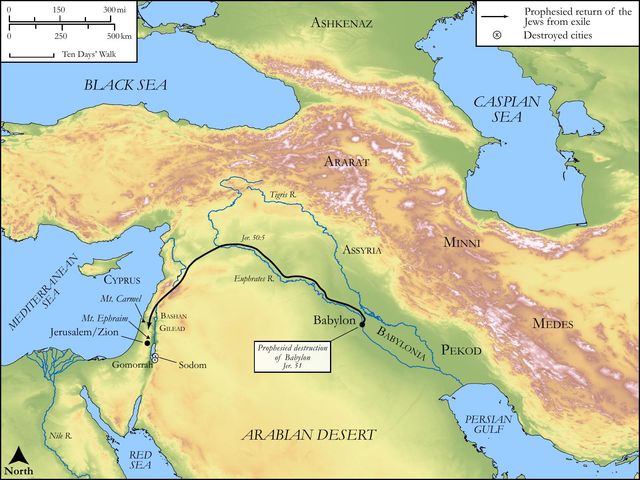
See on the biblical-era map
Study this verse
Public-domain commentary
Matthew Henry
From his Commentary on the Whole Bible. Henry comments on passages, not single verses — this entry covers Jeremiah 50:1–8. His three-level outline is real structure in the source text, so it is rendered as structure.
I.Here is a word spoken against Babylon by him whose works all agree with his word and none of whose words fall to the ground.
The king of Babylon had been very kind of Jeremiah, and yet he must foretel the ruin of that kingdom; for God's prophets must not be governed by favour or affection. Whoever are our friends, if, notwithstanding, they are God's enemies, we dare not speak peace to them.
1.The destruction of Babylon is here spoken of as a thing done, Jer 50:2. let it be published to the nations as a piece of news, true news, and great news, and news they are all concerned in; let them hang out the flag, as is usual on days of triumph, to give notice of it; let all the world take notice of it: Babylon is taken. Let God have the honour of it, let his people have the comfort of it, and therefore do not conceal it. Take care that it be known, that the Lord may be known by those judgments which he executes, Psa 9:16.
2.It is spoken of as a thing done thoroughly. For,
(1.)The very idols of Babylon, which the people would protect with all possible care, and from which they expected protection, shall be destroyed. Bel and Merodach were their two principal deities; they shall be confounded, and the images of them broken to pieces.
(2.)The country shall be laid waste (Jer 50:3) out of the north, from Media, which lay north of Babylon, and from Assyria, through which Cyrus made his descent upon Babylon; thence the nation shall come that shall make her land desolate. Their land was north of the countries that they destroyed, who were therefore threatened with evil from the north (Omne malum ab aquilone - Every evil comes from the north); but God will find out nations yet further north to come upon them. The pomp and power of old Rome were brought down by northern nations, the Goths and Vandals.
II.Here is a word spoken for the people of God, and for their comfort, both the children of Israel and of Judah; for many there were of the ten tribes that associated with those of the two tribes in their return out of Babylon. Now here,
1.It is promised that they shall return to their God first and then to their own land; and the promise of their conversion and reformation is that which makes way for all the other promises, Jer 50:4, Jer 50:5.
(1.)They shall lament after the Lord (as the whole house of Israel did in Samuel's time, Sa1 7:2); they shall go weeping. These tears flow not from the sorrow of the world as those when they went into captivity, but from godly sorrow; they are tears of repentance for sin, tears of joy for the goodness of God, in the dawning of the day of their deliverance, which, for aught that appears, does more towards the bringing of them to mourn for sin than all the calamities of their captivity; that prevails to lead them to repentance when the other did not prevail to drive them to it. Note, It is a good sign that God is coming towards a people in ways of mercy when they begin to be tenderly affected under his hand.
(2.)They shall enquire after the Lord; they shall not sink under their sorrows, but bestir themselves to find out comfort where it is to be had: They shall go weeping to seek the Lord their God. Those that seek the Lord must seek him sorrowing, as Christ's parents sought him, Luk 2:48. And those that sorrow must seek the Lord, and then their sorrow shall soon be turned into joy, for he will be found of those that so seek him. They shall seek the Lord as their God, and shall now have no more to do with idols. When they shall hear that the idols of Babylon are confounded and broken it will be seasonable for them to enquire after their own God and to return to him who lives for ever. Therefore men are deceived in false gods, that they may depend on the true God only.
(3.)They shall think of returning to their own country again; they shall think of it not only as a mercy, but as a duty, because there only is the holy hill of Zion, on which once stood the house of the Lord their God (Jer 50:5): They shall ask the way to Zion with their faces thitherward. Zion was the city of their solemnities; they often thought of it in the depth of their captivity (Psa 137:1); but, now that the ruin of Babylon gave them some hopes of a release, they talk of nothing else but of going back to Zion. Their hearts were upon it before, and now they set their faces thitherward. They long to be there; they set out for Zion, and resolve not to take up short of it. The journey is long and they know not the road, but they will ask the way, for they will press forward till they come to Zion; and, as they are determined not to turn back, so they are in care not to miss the way. This represents the return of poor souls to God. Heaven is the Zion they aim at as their end; on this they have set their hearts; towards this they have set their faces, and therefore they ask the way thither. They do not ask the way to heaven and set their faces towards the world; nor set their faces towards heaven and go on at a venture without asking the way. But in all true converts there are both a sincere desire to attain the end and a constant care to keep in the way; and a blessed sight it is to see people thus asking the way to heaven with their faces thitherward.
(4.)They shall renew their covenant to walk with God more closely for the future: Come, and let us join ourselves to the Lord in a perpetual covenant. They had broken covenant with God, had in effect separated themselves from him, but now they resolve to join themselves to him again, by engaging themselves afresh to be his. Thus, when backsliders return, they must do their first works, must renew the covenant they first made; and it must be a perpetual covenant, that must never be broken; and, in order to that, must never be forgotten; for a due remembrance of it will be the means of a due observance of it.
2.Their present case is lamented as very sad, and as having been long so: "My people" (for he owns them as his now that they are returning to him) "have been lost sheep (Jer 50:6); they have gone from mountain to hill, have been hurried from place to place, and could find no pasture; they have forgotten their resting-place in their own country and cannot find their way to it." And that which aggravated their misery was,
(1.)That they were led astray by their own shepherds, their own princes and priests; they turned them from their duty, and so provoked God to turn them out of their own land. It is bad with a people when their leaders cause them to err, when those that should direct them, and when those that should secure and advance their interests are the betrayers of them.
(2.)That in their wanderings they lay exposed to the beasts of prey, who thought they were entitled to them, as waifs and strays that had no owner (Jer 50:7); it is with them as with wandering sheep, all that found them have devoured them and made a prey of them; and when they did them the greatest injuries they laughed at them, telling them it was what their own prophets had many a time told them they deserved; that was far from justifying those who did them wrong, yet they bantered them with this excuse, We offend not, because they have sinned against the Lord; but they could not pretend that they had sinned against them. And see what notion they had of the Lord they had sinned against, not as the only true and living God, but only as the habitation of justice and the hope of their fathers; they had put a contempt upon the temple and upon the tradition of their ancestors, and therefore deserved to suffer these hard things. And yet it was indeed an aggravation of their sin, and justified God, though it did not justify their adversaries in what was done to them, that they had forsaken the habitation of justice and him that was the hope of their fathers.
3.They are called upon to hasten away, as soon as ever the door of liberty was opened to them (Jer 50:8): "Remove, not only out of the borders, but out of the midst of Babylon; though you be ever so well seated there, think not to settle there, but hasten to Zion, and be as the he-goats before the flocks; strive which shall be foremost, which shall lead in so good a work:" a he-goat is comely in going (Pro 30:31) because he goes first. It is a graceful thing to be forward in a good work and to set others a good example.
Continue studying Jeremiah 50:2 across the web’s major study libraries — every link below opens this exact verse, chapter, or book on the destination site.
Read & Compare
 BibleGatewayThis verse in more than 200 translations and 70 languages.
 Bible.comThe YouVersion reader — hundreds of translations, reading plans, and highlights.
 ESV.orgCrossway's official English Standard Version reader.
 NET BibleThe NET translation with 60,000+ translators' notes on every rendering decision.
 STEP BibleTyndale House's free study tool — original text, vocabulary, and scholarly resources.
 BibliaLogos Bible Software's free web reader.
 USCCBThe New American Bible (Revised Edition) with the U.S. bishops' study notes.
Commentaries
 BibleHub CommentariesDozens of classic commentaries on this verse, gathered on one page.
 StudyLightMore than 100 commentary sets — the largest collection on the web.
 BibleRefPlain-English commentary on what this verse means, verse by verse.
 Enduring WordDavid Guzik's free commentary on this chapter, widely used by Bible teachers.
 Bible Study ToolsVerse commentary alongside Greek and Hebrew study aids.
Original Language & Research
- BibleHub InterlinearThe verse word by word — original language, transliteration, and English.
- BibleHub LexiconEvery word's original-language definition and Strong's entry.
 Blue Letter BibleDeep-study tools — Strong's numbers, concordance, and word studies.
 SefariaThe Hebrew text with Rashi and centuries of Jewish commentary.
Sermons, Hymns & Audio


TrulyRandomVerse is not affiliated with these sites and doesn’t control their content. They’re linked because they’re genuinely useful.
Summary
Jeremiah 50:2 delivers a powerful prophetic mandate for a universal and unreserved proclamation of Babylon's impending and absolute downfall. This declaration not only foretells the capture of the mighty empire but also the utter humiliation and destruction of its chief deities, Bel and Merodach, along with all its associated idols and images. The verse serves as a profound testament to Yahweh's supreme sovereignty over all nations and the ultimate futility of idolatry in the face of divine judgment.
Context
ShowHideLiterary Context
Jeremiah 50:2 initiates a significant prophetic oracle spanning chapters 50 and 51, exclusively dedicated to the judgment of Babylon. This extended prophecy provides a stark contrast to the preceding chapters, which predominantly detail God's judgment against Judah and surrounding nations. Its strategic placement after pronouncements of exile and suffering for Israel serves as a profound message of hope and vindication for the exiled Israelites. It assures them that their oppressor, Babylon—though seemingly invincible—is not beyond God's reach and will assuredly face divine retribution. This section powerfully demonstrates God's unwavering commitment to His covenant people and His ultimate control over world history, even when His people are in distress and under foreign domination.
Historical & Cultural Context
During the period of Jeremiah's prophecy, Babylon stood as the undisputed dominant world power. Under Nebuchadnezzar II, the Neo-Babylonian Empire had conquered Judah, leading to the exile of its people in several waves, culminating in the destruction of Jerusalem and its temple in 586 BC. Babylon was at its zenith, celebrated for its military prowess, architectural marvels, and a sophisticated religious system. Central to Babylonian religion was an elaborate pantheon of gods, with Marduk (often referred to as Merodach, and identified with Bel, meaning "lord") holding the position of chief deity and patron god of the city of Babylon. The city itself was widely perceived as impregnable, fortified by massive walls and the presumed protection of its powerful gods. The prophecy of Babylon's fall, which historically occurred in 539 BC when Cyrus the Great of Persia conquered the city, would have appeared utterly improbable to many contemporaries, thereby underscoring the supernatural origin and nature of Jeremiah's message.
Key Themes
ShowHideJeremiah 50:2 contributes significantly to several overarching themes within the book of Jeremiah and the broader prophetic literature. Firstly, it powerfully underscores Divine Sovereignty and Justice, asserting that Yahweh, the God of Israel, is the supreme ruler over all nations, capable of raising up and bringing down empires according to His will. Babylon's fall is presented as a direct act of God's justice, a retribution for its pride and its role in oppressing God's people, a theme profoundly echoed in other prophetic books like Isaiah 13 and Habakkuk 2. Secondly, the explicit mention of Bel and Merodach being "confounded" and "broken in pieces" highlights the Futility and Impotence of Idolatry. This serves as a stark contrast to the omnipotence of Yahweh, demonstrating that humanly devised gods are powerless and will ultimately be shamed and destroyed, a truth consistently proclaimed throughout the Old Testament, as seen in Isaiah 44:9-20 and Psalm 115:4-8. Finally, the repeated commands to "declare," "publish," and "conceal not" emphasize the Public Proclamation of God's Acts, signifying that Babylon's judgment is not a hidden event but a monumental, undeniable demonstration of God's power and justice to be witnessed by all nations.
Exposition and Analysis
ShowHideKey Word Analysis
ShowHideBy contraction for בַּעַל; Bel, the Baal of the Babylonians; Bel. This term, a contraction of בַּעַל (Baal), signifies "lord" or "master." In the context of Babylon, Bel refers to the chief god of the Babylonian pantheon, Marduk (also known as Merodach), who was elevated to supreme status as the patron deity of Babylon. His mention here signifies the direct assault on the very heart of Babylonian religious and political power, as his perceived strength was intertwined with the empire's might and its claim to divine favor.
Of foreign derivation; Merodak, a Babylonian idol; Merodach. Compare מְרֹאדַךְ בַּלְאָדָן. This is the specific name for Marduk, the most prominent god in the Babylonian pantheon, particularly during the Neo-Babylonian Empire. He was considered the creator god, the god of magic, and the one who established order in the cosmos. His humiliation and breaking in pieces symbolize the complete collapse of the Babylonian worldview, its religious system, and its perceived divine protection, demonstrating the emptiness of its spiritual foundations.
A primitive root; to be ashamed, confused or disappointed; also (as failing) to dry up (as water) or wither (as herbage); be ashamed, clean, be confounded, (make) dry (up), (do) shame(-fully), [idiom] utterly, wither (away). This primitive root means "to be ashamed, confused, or disappointed." When applied to Bel and the idols, it vividly portrays their utter humiliation, discrediting, and public shaming. They are not merely defeated; they are exposed as powerless and worthless, bringing profound shame upon their worshippers and revealing their absolute inability to protect their city or themselves.
Verse Breakdown
ShowHide"Declare ye among the nations, and publish, and set up a standard; publish, [and] conceal not:"
This opening clause comprises a series of urgent, emphatic commands for a widespread, public, and undeniable proclamation. "Declare among the nations" emphasizes the universal scope of the message, ensuring that all peoples are aware of God's impending judgment. The repetition of "publish" and the command to "set up a standard" (a banner or signal raised high for all to see) underscore the certainty, visibility, and authoritative nature of the impending event. The concluding command "conceal not" removes any possibility of secrecy or doubt, demanding a bold and open announcement of what God is about to do, leaving no room for misunderstanding or denial.
"say, Babylon is taken,"
This is the precise, declarative message to be proclaimed. "Babylon is taken" is stated as an accomplished fact, even though it is prophetic, signifying the military defeat and capture of the mighty city. This concise, direct phrase conveys the absolute, irreversible, and comprehensive nature of its fall, stripped of its power, independence, and perceived invincibility. It is a divine decree that will inevitably come to pass.
"Bel is confounded, Merodach is broken in pieces;"
This clause directly targets the very heart of Babylon's spiritual and national identity. Bel and Merodach, the chief deities of the Babylonian pantheon, are explicitly named and declared "confounded" (shamed, disgraced, put to utter confusion) and "broken in pieces" (shattered, utterly destroyed, rendered impotent). This signifies not merely a military defeat but a profound spiritual triumph of Yahweh, the God of Israel, over the false gods of Babylon, demonstrating their utter impotence and exposing them as mere idols incapable of defending their city or their worshippers.
"her idols are confounded, her images are broken in pieces."
This final clause broadens the scope of the divine judgment from the chief deities to the entire pantheon of Babylonian idolatry. "Idols" (ʻâtsâb) and "images" (gillûwl) refer to the various cultic objects and representations of their numerous gods. The repetition of "confounded" and "broken in pieces" emphasizes the comprehensive and total nature of the destruction. It is a complete dismantling of Babylon's religious foundation, signifying that its entire system of worship is utterly discredited, shamed, and rendered powerless before the one true, living God.
Literary Devices
ShowHideJeremiah 50:2 employs several potent literary devices to convey its message with maximum force and clarity. Repetition is prominently featured, with "publish" appearing twice, and the parallel phrases "confounded" and "broken in pieces" applied to both the chief deities and the general idols. This repetition serves to emphasize the certainty, universality, and completeness of Babylon's downfall and the profound humiliation of its gods. The phrase "set up a standard" functions as powerful Symbolism, representing a visible signal or banner raised high for all nations to witness, underscoring the public and undeniable nature of God's impending act. The description of Bel and Merodach as being "confounded" and "broken in pieces" utilizes a form of Anthropomorphism or Personification, attributing human experiences of shame and physical destruction to inanimate idols, thereby vividly portraying their utter defeat and powerlessness. Furthermore, the verse employs striking Parallelism, especially in the latter half ("Bel is confounded, Merodach is broken in pieces; her idols are confounded, her images are broken in pieces"), where similar ideas are expressed in successive clauses, reinforcing the message of comprehensive judgment against both the specific deities and the broader idolatrous system. The entire declaration also carries a tone of profound Divine Irony, as the mighty gods believed to protect Babylon are themselves subjected to shame and destruction by the God of Israel.
Theological and Thematic Connections
ShowHideJeremiah 50:2 is a profound theological statement on the nature of God, the reality of idolatry, and the certainty of divine justice. It unequivocally declares Yahweh's absolute sovereignty over all earthly powers, demonstrating that no empire, however mighty, can stand against His purposes or thwart His will. The public humiliation of Bel and Merodach underscores the biblical truth that all humanly contrived gods are ultimately powerless and vain, mere creations of human hands that cannot save themselves or their worshippers. This prophecy serves as a powerful reminder that God sees the oppression of His people and will act decisively to bring justice, vindicating His name and demonstrating His unwavering faithfulness to His covenant. For believers, this offers immense comfort in times of national or personal distress, knowing that God remains on His throne, orchestrating history for His glory and the good of His people, and that all false powers will ultimately fall.
Reflection and Application
ShowHideJeremiah 50:2 calls us to profound reflection on where we place our ultimate trust and allegiance. In a world still dominated by powerful nations, pervasive ideologies, and intricate systems that often subtly or overtly oppose God's kingdom, this verse serves as a stark reminder that ultimate authority and final victory belong solely to the Lord. It challenges us to critically discern and courageously dismantle the "idols" in our own lives—anything that competes for God's rightful place in our hearts, be it wealth, power, reputation, comfort, self-reliance, or even the approval of others. Just as Bel and Merodach were exposed as utterly impotent, so too will all false gods and human constructs ultimately prove to be "confounded" and "broken in pieces" before the majesty of God. For those who feel oppressed, overwhelmed, or disheartened by the "Babylons" of our age—be they pervasive injustices, cultural pressures, or personal struggles—this prophecy offers immense hope and assurance that God sees, God acts, and God will bring justice in His perfect timing. It compels us to boldly "declare" and "publish" God's truth, refusing to "conceal" His absolute sovereignty and His coming judgment, living as faithful witnesses to His ultimate triumph over all that opposes Him.
Questions for Reflection
ShowHideFAQ
ShowHideWhy is Babylon's fall so significant in Jeremiah's prophecy?
ShowHideBabylon's fall is profoundly significant because it represents God's divine justice and absolute sovereignty over the most powerful empire of Jeremiah's time. Babylon had been God's instrument for judging Judah's sin, but it had also acted with excessive cruelty, pride, and a disregard for God's people, exceeding its divine mandate. The prophecy of its downfall, therefore, serves multiple crucial purposes: it offers hope and assurance to the exiled Israelites that their suffering is not eternal and that God remembers His covenant; it demonstrates that God holds all nations accountable, even those He uses for His purposes; and it powerfully vindicates Yahweh's name as the one true God, superior to all pagan deities and human empires. This event, though future for Jeremiah's audience, was a concrete sign of God's control over history and His unwavering faithfulness to His people, a theme woven throughout the book of Jeremiah.
Who were Bel and Merodach, and why are they specifically mentioned?
ShowHideBel and Merodach (also known as Marduk) were the most prominent deities in the Babylonian pantheon. Bel, meaning "lord," was a common title for various gods, but in this context, it specifically refers to Marduk, who was the chief god and patron deity of the city of Babylon. Marduk was revered as the creator god, the god of magic, and the one who established order in the cosmos, widely believed to be the protector of the city and its destiny. Their specific mention in Jeremiah 50:2 is crucial because it highlights the direct confrontation between Yahweh and the gods of Babylon. Their "confusion" and "breaking in pieces" symbolize the utter defeat and humiliation of the entire Babylonian religious system, demonstrating that their supposed power was nothing before the true God of Israel. This is a common and powerful theme in prophetic literature, where God's victory over nations is often depicted as a decisive victory over their gods, as seen in Isaiah 46:1-2.
How does this prophecy relate to God's people, Israel?
ShowHideThis prophecy is intrinsically linked to God's people, Israel, primarily as a message of profound hope and future restoration. While Jeremiah had faithfully delivered messages of severe judgment and exile to Judah for their disobedience, the prophecies against Babylon (Jeremiah 50-51) decisively shift the focus to the oppressor. For the exiles, who were suffering under Babylonian rule, this word from God was a profound assurance that their captivity would not last forever. It affirmed that God had not forgotten them and that He would bring justice upon their enemies. By foretelling Babylon's fall, God was implicitly promising Israel's eventual release and return to their land, demonstrating His faithfulness to His covenant promises even in the midst of severe discipline. This theme of God's restoration of His people after judgment is central to Jeremiah's broader message, powerfully articulated in passages like Jeremiah 29:10-14.
Christ-Centered Fulfillment
ShowHideJeremiah 50:2, with its powerful declaration of Babylon's fall and the humiliation of its false gods, finds its ultimate and comprehensive fulfillment in the person and redemptive work of Jesus Christ. Babylon, throughout Scripture, often serves as a potent symbol of the world system in rebellion against God, characterized by idolatry, pride, and oppression. Just as ancient Babylon's seemingly invincible might and its revered deities were ultimately "confounded" and "broken in pieces" by God's sovereign hand, so too has Christ decisively triumphed over all spiritual powers and systems that oppose God's kingdom. His death on the cross and glorious resurrection represent the ultimate victory over sin, death, and the principalities and powers, as Colossians 2:15 powerfully declares, "He disarmed the rulers and authorities and put them to open shame, by triumphing over them in him." The "standard" raised among the nations is now the cross of Christ, proclaiming His universal reign and the utter futility of all human attempts to establish a kingdom apart from Him. The ultimate "fall of Babylon" is vividly depicted in the New Testament, particularly in Revelation 18:2, symbolizing the final and complete judgment on all unrighteousness and every system that exalts itself against God. Christ, the true King of kings and Lord of lords, is the one who will ultimately "break in pieces" every idol and establish His eternal kingdom, a kingdom that will never be destroyed, as majestically prophesied in Daniel 7:13-14. He is the Lamb of God who takes away the sin of the world and will ultimately bring all things under His feet, fulfilling the prophetic declaration of God's absolute sovereignty and the complete triumph over all forms of spiritual and worldly opposition.