


Jeremiah 50:3
Bible text: King James Version (1769 Blayney text) · Public domain
Bible text: King James Version with Strong's numbers · Public domain
Bible text: Berean Standard Bible · Public domain
Bible text: American Standard Version (1901) · Public domain
Bible text: World English Bible, Messianic edition · Public domain
Bible text: Geneva Bible (1599) · Public domain
Bible text: Young's Literal Translation · Public domain
- כִּיkiforH3588PrtParticle Conditional
- עָלָה'a·Lahit will go upH5927V-Qal-Perf-3msVerb Qal Perfect 3rd Singular Masculine
- עָלֶיהָ'a·Lei·haon itH5921Prep ¦ 3fsPreposition Definiteעָלֶיonהָit
- גּוֹיGoya nationH1471N-msNoun Singular Masculine Absolute
- מִצָּפוֹןmi·tza·Fonfrom [the] northH6828Prep-m ¦ N-fsNoun Singular Feminine Absoluteמִfromצָּפוֹן[the] north
- הוּאhu'itH1931Pro-3msPronoun Personal 3rd Singular Masculine
- יָשִׁיתya·Shitit will makeH7896V-Qal-Imperf-3msVerb Qal Imperfect 3rd Singular Masculine
- אֶת'et<obj.>H853DirObjMParticle Object Indicator
- אַרְצָהּ'ar·Tzahits landH776N-fsc ¦ 3fsNoun Singular Feminine Constructאַרְצָlandהּits
- לְשַׁמָּהle·sha·Mahinto a wasteH8047Prep-l ¦ N-fsNoun Singular Feminine Absoluteלְintoשַׁמָּהa waste
- וְלֹאve·lo'and notH3808Conj-w ¦ NegParticle Negativeוְandלֹאnot
- יִהְיֶהyih·Yehhe will beH1961V-Qal-Imperf-3msVerb Qal Imperfect 3rd Singular Masculine
- יוֹשֵׁבyo·Shevan inhabitantH3427V-Qal-Prtcpl-msVerb Qal Participle Singular Masculine Absolute
- בָּהּBahin <the> itPrep-b ¦ 3fsSuffix Personal 3rd Singular Feminineבָּin <the>הּit
- מֵאָדָםme·'a·Damfrom humankindH120Prep-m ¦ N-msNoun Singular Masculine Absoluteמֵfromאָדָםhumankind
- וְעַדve·'adand untoH5704Conj-w ¦ PrepPrepositionוְandעַדunto
- בְּהֵמָהbe·he·Mahanimal[s]H929N-fsNoun Singular Feminine Absolute
- נָדוּNa·duthey will take flightH5110V-Qal-Perf-3cpVerb Qal Perfect 3rd Plural common gender
- הָלָכוּha·La·khuthey will goH1980V-Qal-Perf-3cpVerb Qal Perfect 3rd Plural common gender
English is a literal word-by-word gloss of the Hebrew, not the KJV's wording. Why?
This is the original text the KJV's translators worked from — each Hebrew word with its own literal English meaning in this verse, prepared by scholars at Tyndale House, Cambridge. The KJV translates whole sentences, not word by word, so its wording differs: one Hebrew word can become several English words, and the KJV may choose “the LORD” where the gloss reads “Yahweh”. Both are faithful — they answer different questions. For the KJV's own rendering, switch to the KJV text.
Details
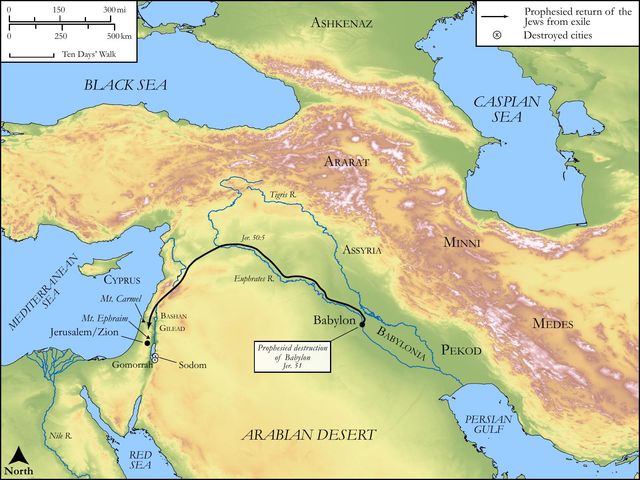
See on the biblical-era map
Study this verse
Public-domain commentary
Matthew Henry
From his Commentary on the Whole Bible. Henry comments on passages, not single verses — this entry covers Jeremiah 50:1–8. His three-level outline is real structure in the source text, so it is rendered as structure.
I.Here is a word spoken against Babylon by him whose works all agree with his word and none of whose words fall to the ground.
The king of Babylon had been very kind of Jeremiah, and yet he must foretel the ruin of that kingdom; for God's prophets must not be governed by favour or affection. Whoever are our friends, if, notwithstanding, they are God's enemies, we dare not speak peace to them.
1.The destruction of Babylon is here spoken of as a thing done, Jer 50:2. let it be published to the nations as a piece of news, true news, and great news, and news they are all concerned in; let them hang out the flag, as is usual on days of triumph, to give notice of it; let all the world take notice of it: Babylon is taken. Let God have the honour of it, let his people have the comfort of it, and therefore do not conceal it. Take care that it be known, that the Lord may be known by those judgments which he executes, Psa 9:16.
2.It is spoken of as a thing done thoroughly. For,
(1.)The very idols of Babylon, which the people would protect with all possible care, and from which they expected protection, shall be destroyed. Bel and Merodach were their two principal deities; they shall be confounded, and the images of them broken to pieces.
(2.)The country shall be laid waste (Jer 50:3) out of the north, from Media, which lay north of Babylon, and from Assyria, through which Cyrus made his descent upon Babylon; thence the nation shall come that shall make her land desolate. Their land was north of the countries that they destroyed, who were therefore threatened with evil from the north (Omne malum ab aquilone - Every evil comes from the north); but God will find out nations yet further north to come upon them. The pomp and power of old Rome were brought down by northern nations, the Goths and Vandals.
II.Here is a word spoken for the people of God, and for their comfort, both the children of Israel and of Judah; for many there were of the ten tribes that associated with those of the two tribes in their return out of Babylon. Now here,
1.It is promised that they shall return to their God first and then to their own land; and the promise of their conversion and reformation is that which makes way for all the other promises, Jer 50:4, Jer 50:5.
(1.)They shall lament after the Lord (as the whole house of Israel did in Samuel's time, Sa1 7:2); they shall go weeping. These tears flow not from the sorrow of the world as those when they went into captivity, but from godly sorrow; they are tears of repentance for sin, tears of joy for the goodness of God, in the dawning of the day of their deliverance, which, for aught that appears, does more towards the bringing of them to mourn for sin than all the calamities of their captivity; that prevails to lead them to repentance when the other did not prevail to drive them to it. Note, It is a good sign that God is coming towards a people in ways of mercy when they begin to be tenderly affected under his hand.
(2.)They shall enquire after the Lord; they shall not sink under their sorrows, but bestir themselves to find out comfort where it is to be had: They shall go weeping to seek the Lord their God. Those that seek the Lord must seek him sorrowing, as Christ's parents sought him, Luk 2:48. And those that sorrow must seek the Lord, and then their sorrow shall soon be turned into joy, for he will be found of those that so seek him. They shall seek the Lord as their God, and shall now have no more to do with idols. When they shall hear that the idols of Babylon are confounded and broken it will be seasonable for them to enquire after their own God and to return to him who lives for ever. Therefore men are deceived in false gods, that they may depend on the true God only.
(3.)They shall think of returning to their own country again; they shall think of it not only as a mercy, but as a duty, because there only is the holy hill of Zion, on which once stood the house of the Lord their God (Jer 50:5): They shall ask the way to Zion with their faces thitherward. Zion was the city of their solemnities; they often thought of it in the depth of their captivity (Psa 137:1); but, now that the ruin of Babylon gave them some hopes of a release, they talk of nothing else but of going back to Zion. Their hearts were upon it before, and now they set their faces thitherward. They long to be there; they set out for Zion, and resolve not to take up short of it. The journey is long and they know not the road, but they will ask the way, for they will press forward till they come to Zion; and, as they are determined not to turn back, so they are in care not to miss the way. This represents the return of poor souls to God. Heaven is the Zion they aim at as their end; on this they have set their hearts; towards this they have set their faces, and therefore they ask the way thither. They do not ask the way to heaven and set their faces towards the world; nor set their faces towards heaven and go on at a venture without asking the way. But in all true converts there are both a sincere desire to attain the end and a constant care to keep in the way; and a blessed sight it is to see people thus asking the way to heaven with their faces thitherward.
(4.)They shall renew their covenant to walk with God more closely for the future: Come, and let us join ourselves to the Lord in a perpetual covenant. They had broken covenant with God, had in effect separated themselves from him, but now they resolve to join themselves to him again, by engaging themselves afresh to be his. Thus, when backsliders return, they must do their first works, must renew the covenant they first made; and it must be a perpetual covenant, that must never be broken; and, in order to that, must never be forgotten; for a due remembrance of it will be the means of a due observance of it.
2.Their present case is lamented as very sad, and as having been long so: "My people" (for he owns them as his now that they are returning to him) "have been lost sheep (Jer 50:6); they have gone from mountain to hill, have been hurried from place to place, and could find no pasture; they have forgotten their resting-place in their own country and cannot find their way to it." And that which aggravated their misery was,
(1.)That they were led astray by their own shepherds, their own princes and priests; they turned them from their duty, and so provoked God to turn them out of their own land. It is bad with a people when their leaders cause them to err, when those that should direct them, and when those that should secure and advance their interests are the betrayers of them.
(2.)That in their wanderings they lay exposed to the beasts of prey, who thought they were entitled to them, as waifs and strays that had no owner (Jer 50:7); it is with them as with wandering sheep, all that found them have devoured them and made a prey of them; and when they did them the greatest injuries they laughed at them, telling them it was what their own prophets had many a time told them they deserved; that was far from justifying those who did them wrong, yet they bantered them with this excuse, We offend not, because they have sinned against the Lord; but they could not pretend that they had sinned against them. And see what notion they had of the Lord they had sinned against, not as the only true and living God, but only as the habitation of justice and the hope of their fathers; they had put a contempt upon the temple and upon the tradition of their ancestors, and therefore deserved to suffer these hard things. And yet it was indeed an aggravation of their sin, and justified God, though it did not justify their adversaries in what was done to them, that they had forsaken the habitation of justice and him that was the hope of their fathers.
3.They are called upon to hasten away, as soon as ever the door of liberty was opened to them (Jer 50:8): "Remove, not only out of the borders, but out of the midst of Babylon; though you be ever so well seated there, think not to settle there, but hasten to Zion, and be as the he-goats before the flocks; strive which shall be foremost, which shall lead in so good a work:" a he-goat is comely in going (Pro 30:31) because he goes first. It is a graceful thing to be forward in a good work and to set others a good example.
Continue studying Jeremiah 50:3 across the web’s major study libraries — every link below opens this exact verse, chapter, or book on the destination site.
Read & Compare
 BibleGatewayThis verse in more than 200 translations and 70 languages.
 Bible.comThe YouVersion reader — hundreds of translations, reading plans, and highlights.
 ESV.orgCrossway's official English Standard Version reader.
 NET BibleThe NET translation with 60,000+ translators' notes on every rendering decision.
 STEP BibleTyndale House's free study tool — original text, vocabulary, and scholarly resources.
 BibliaLogos Bible Software's free web reader.
 USCCBThe New American Bible (Revised Edition) with the U.S. bishops' study notes.
Commentaries
 BibleHub CommentariesDozens of classic commentaries on this verse, gathered on one page.
 StudyLightMore than 100 commentary sets — the largest collection on the web.
 BibleRefPlain-English commentary on what this verse means, verse by verse.
 Enduring WordDavid Guzik's free commentary on this chapter, widely used by Bible teachers.
 Bible Study ToolsVerse commentary alongside Greek and Hebrew study aids.
Original Language & Research
- BibleHub InterlinearThe verse word by word — original language, transliteration, and English.
- BibleHub LexiconEvery word's original-language definition and Strong's entry.
 Blue Letter BibleDeep-study tools — Strong's numbers, concordance, and word studies.
 SefariaThe Hebrew text with Rashi and centuries of Jewish commentary.
Sermons, Hymns & Audio


TrulyRandomVerse is not affiliated with these sites and doesn’t control their content. They’re linked because they’re genuinely useful.
Summary
Jeremiah 50:3 delivers a profound prophetic declaration within a larger oracle against Babylon, foretelling its complete and irreversible destruction. It vividly describes a formidable, unnamed nation emerging from the north, destined to lay waste to Babylon's land, rendering it utterly uninhabitable. The verse emphasizes the totality of this desolation, indicating that both human inhabitants and animals will be forced to flee, leaving the once-mighty empire a desolate wasteland. This prophecy powerfully underscores God's sovereign judgment over even the most powerful earthly kingdoms and His unwavering commitment to justice.
Context
ShowHideLiterary Context
Jeremiah 50:3 is strategically placed within a significant prophetic section (chapters 50-51) dedicated entirely to the impending judgment of Babylon. This extensive oracle serves as a climactic counterpoint to the preceding prophecies against Judah and other surrounding nations (chapters 46-49). While God used Babylon as His instrument of judgment against Judah and Jerusalem, these chapters unequivocally reveal that Babylon itself is not exempt from divine accountability for its pride, widespread idolatry, and excessive cruelty. The detailed nature of this prophecy, including specific descriptions of Babylon's fall, highlights God's ultimate sovereignty over history and His commitment to righteous justice, even for the oppressors of His covenant people. It stands as a powerful testament to the principle that those who execute God's judgment are themselves subject to His righteous standards, as seen in passages like Jeremiah 25:9. This section of Jeremiah assures the exiled Israelites that their oppressors will not escape divine retribution, offering a future hope amidst their present suffering.
Historical & Cultural Context
The "nation out of the north" historically refers to the Medo-Persian Empire, which, under the leadership of Cyrus the Great, famously conquered Babylon in 539 BC. This event marked a pivotal shift among the nations, ending the Neo-Babylonian Empire's dominance. The "north" was a recurring directional motif in Israelite prophecy, often associated with invasion and divine judgment, particularly from the powers of Mesopotamia or regions beyond (e.g., Jeremiah 1:14). Babylon, at the height of its power, was renowned for its immense wealth, formidable defenses (including its massive walls and the Euphrates River), and its widespread idolatry, particularly the worship of its chief god, Marduk. The prophecy of its complete desolation would have seemed improbable to contemporaries, given Babylon's perceived invincibility. Yet, it accurately foretold the empire's eventual decline into ruin, a stark contrast to its former glory, demonstrating the precision of divine foresight.
Key Themes
ShowHideThis verse contributes significantly to several overarching themes within the book of Jeremiah and the broader prophetic literature. Firstly, it powerfully illustrates the theme of Divine Judgment and Retribution, demonstrating that God's justice extends to all nations, holding them accountable for their actions, particularly their oppression and defiance of Him. Babylon, though used as an instrument, is judged for its own hubris and cruelty. Secondly, it highlights God's Sovereignty over Nations, asserting His absolute control over the rise and fall of empires. The very power God used to punish Judah is now itself brought low by His decree, reinforcing that no earthly kingdom can defy His will indefinitely (Daniel 2:21). Thirdly, the theme of Utter Desolation is prominent, emphasizing the complete and irreversible ruin that will befall Babylon, a fate more severe and lasting than the temporary exile of Judah. This serves as a potent warning against pride and idolatry, and a promise of vindication for the oppressed, assuring them that God's justice will ultimately prevail.
Exposition and Analysis
ShowHideKey Word Analysis
ShowHideThis word refers to a foreign nation, often with connotations of being non-Israelite or Gentile. In this context, it specifically denotes the invading Medo-Persian forces, highlighting their distinct identity from Babylon and their role as an instrument of divine judgment. The use of "nation" rather than a specific name (like "Chaldeans" for Babylon) emphasizes the broad, divinely appointed nature of the force, underscoring that God raises up and brings down nations according to His sovereign plan.
This term signifies ruin, desolation, or consternation. It conveys a sense of utter emptiness, abandonment, and the shocking state of a place reduced to waste. The prophecy is not merely about defeat but about a profound and lasting destruction that renders the land uninhabitable, evoking a feeling of dread and astonishment at its downfall. This word emphasizes the complete and enduring nature of Babylon's ruin, a state of perpetual abandonment.
This primitive root means to nod, waver, wander, flee, or disappear. Here, in conjunction with "depart," it vividly describes the forced exodus and complete evacuation of the inhabitants. It paints a picture of a desperate, disoriented flight, underscoring the comprehensive nature of the depopulation and the utter collapse of societal order. The term implies a restless, aimless wandering, a stark contrast to the settled life of a thriving city.
Verse Breakdown
ShowHide"For out of the north there cometh up a nation against her,"
This opening clause precisely identifies both the origin and the nature of the impending judgment. "The north" is a common prophetic motif for an invading force, often signifying a threat from Mesopotamia or regions beyond, and in this case, specifically pointing to the Medo-Persian Empire. "A nation" (Hebrew gôwy) is God's chosen instrument, rising with hostile intent "against her" (Babylon), indicating an aggressive, divinely orchestrated assault that will bring about its downfall.
"which shall make her land desolate, and none shall dwell therein:"
This segment describes the devastating and lasting consequence of the invasion. The invading nation will actively "make her land desolate," implying a deliberate act of destruction and depopulation, reducing it to ruin (Hebrew shammâh). The subsequent phrase "and none shall dwell therein" (Hebrew yâshab) emphatically underscores the absolute and enduring nature of this desolation, signifying that the land will be rendered completely uninhabitable, devoid of any permanent human presence.
"they shall remove, they shall depart, both man and beast."
This final clause reinforces the totality of the abandonment and the comprehensive nature of the judgment. The double verbs "remove" (Hebrew nûwd, to wander/flee) and "depart" (Hebrew hâlak, to go/walk away) create an emphatic sense of flight and evacuation, stressing that all living things – "both man and beast" – will be driven out. This comprehensive expulsion underscores the severity of the judgment, leaving no life behind to sustain the land or its former glory, signaling the complete collapse of the Babylonian civilization.
Literary Devices
ShowHideJeremiah 50:3 employs several powerful literary devices to convey its message of impending doom and the totality of Babylon's fall. The phrase "out of the north there cometh up a nation against her" utilizes vivid Imagery to evoke a sense of an unstoppable, rising threat, a common directional motif in prophetic literature for divine judgment. The repetition of verbs like "remove" (Hebrew nûwd) and "depart" (Hebrew hâlak) in the final clause creates a strong sense of Parallelism and Emphasis, underscoring the complete and frantic evacuation of the land. Furthermore, the declaration that "none shall dwell therein" and the inclusion of "both man and beast" utilize Hyperbole to stress the absolute and total desolation, painting a vivid picture of a land utterly emptied of life. The entire verse functions as a form of Prophetic Foreshadowing, vividly describing an event that would occur decades after Jeremiah's ministry, lending immense weight to the divine authority behind the message and demonstrating God's meticulous control over history.
Theological and Thematic Connections
ShowHideJeremiah 50:3 profoundly illustrates God's unwavering commitment to justice and His absolute sovereignty over human history. It reveals that even the most formidable empires, though used by God for His purposes, are not immune to His righteous judgment when they succumb to pride, idolatry, and oppression. The desolation prophesied for Babylon serves as a stark reminder that all earthly power is temporary and ultimately subject to the divine will. This passage offers both a solemn warning to those who wield power unjustly and a profound comfort to the oppressed, assuring them that God sees their suffering and will ultimately bring retribution upon their oppressors. It strengthens faith in God's faithfulness to His word, demonstrating His ability to meticulously fulfill prophecies across centuries, thereby affirming His character as the just and sovereign ruler of all creation.
Reflection and Application
ShowHideJeremiah 50:3 offers enduring lessons for contemporary believers, reminding us of the unchanging character of God and the transient nature of human power. In a world often marked by injustice, oppression, and the seemingly unchecked arrogance of powerful entities, this verse provides profound assurance that God remains actively engaged in the affairs of nations. It calls us to trust in His ultimate justice, even when His timing differs from our expectations, fostering patience and perseverance in faith. For those who feel overlooked or oppressed, this prophecy serves as a beacon of hope, affirming that God will indeed bring down systems of evil and vindicate His people, ultimately establishing His perfect reign. Conversely, it stands as a solemn warning to individuals and nations against the dangers of pride, idolatry, and the abuse of power, urging humility, righteousness, and a recognition of God's supreme authority. Our response should be one of reverent awe at God's sovereignty and a renewed commitment to living justly and compassionately, knowing that all earthly kingdoms will one day give way to His eternal reign.
Questions for Reflection
ShowHideFAQ
ShowHideWas Babylon's desolation truly as complete as prophesied in Jeremiah 50:3?
ShowHideYes, historical and archaeological evidence largely supports the fulfillment of this prophecy, though its complete desolation was a gradual process rather than an immediate, single event. While Babylon was initially conquered by Cyrus the Great in 539 BC without a complete immediate destruction, its decline was irreversible. Over subsequent centuries, the city progressively lost its prominence, suffered further attacks (e.g., by Xerxes I), and eventually fell into ruin. By the time of the Christian era, it was largely abandoned, becoming a desolate wasteland, fulfilling the prophecy that "none shall dwell therein." Today, the extensive ruins of ancient Babylon are largely uninhabited, serving as a stark testament to the accuracy and enduring power of Jeremiah's prophetic words.
Christ-Centered Fulfillment
ShowHideWhile Jeremiah 50:3 directly prophesies the historical fall of ancient Babylon, its profound theological implications find ultimate fulfillment and resonance in Christ. The judgment against Babylon, a powerful symbol of worldly power, idolatry, and opposition to God's people throughout biblical history, foreshadows the triumph of Christ over all spiritual and earthly forces that stand against God's kingdom. Just as a nation from the north brought desolation to Babylon, Christ, the true King and ultimate Judge, will one day return to establish His righteous reign and bring ultimate judgment upon all systems of evil and rebellion. The "desolation" of Babylon points to the final eradication of sin and death through Christ's atoning work and His victorious return, as vividly described in passages like Revelation 19:11-16. Furthermore, the promise that "none shall dwell therein" and the complete departure of "man and beast" from Babylon's land prefigures the new heavens and new earth, where righteousness dwells and evil has no place, a reality secured by Christ's sacrifice and resurrection (2 Peter 3:13 and Revelation 21:1-4). Ultimately, Jeremiah 50:3, in its depiction of divine justice against a mighty oppressor, points to the Lamb of God who conquers all evil and establishes an eternal kingdom where true peace and justice will finally prevail, a kingdom that will never be destroyed (see Revelation 11:15).