


Jeremiah 51:62
Bible text: King James Version (1769 Blayney text) · Public domain
Bible text: King James Version with Strong's numbers · Public domain
Bible text: Berean Standard Bible · Public domain
Bible text: American Standard Version (1901) · Public domain
Bible text: World English Bible, Messianic edition · Public domain
Bible text: Geneva Bible (1599) · Public domain
Bible text: Young's Literal Translation · Public domain
- וְאָמַרְתָּve·'a·mar·Taand you will sayH559Conj-w ¦ V-Qal-ConsecPerf-2msVerb Qal Consecutive Perfect 2nd Singular Masculineוְandאָמַרְתָּyou will say
- יְהוָהYah·wehO YahwehH3068N-properNoun Proper Title
- אַתָּה'a·TahyouH859Pro-2msPronoun Personal 2nd Singular Masculine
- דִבַּרְתָּdi·Bar·tayou have spokenH1696V-Piel-Perf-2msVerb Piel Perfect 2nd Singular Masculine
- אֶל'elconcerningH413PrepPreposition
- הַמָּקוֹםha·ma·Komthe placeH4725Art ¦ N-msNoun Singular Masculine Absoluteהַtheמָּקוֹםplace
- הַזֶּהha·Zeh<the> thisH2088Art ¦ PrtParticle Demonstrativeהַ<the>זֶּהthis
- לְהַכְרִיתוֹle·hakh·ri·Toto cut off itH3772Prep-l ¦ V-Hiphil-Inf ¦ 3msVerb Hiphil Infinitive Constructלְtoהַכְרִיתcut offוֹit
- לְבִלְתִּיle·vil·Tito notH1115Prep-l ¦ N-csNoun Singular common gender Absoluteלְtoבִלְתִּיnot
- הֱיוֹתhe·yotto beH1961V-Qal-InfVerb Qal Infinitive Construct
- בּוֹboin <the> itPrep-b ¦ 3msSuffix Personal 3rd Singular Masculineבּin <the>וֹit
- יוֹשֵׁבyo·Shevan inhabitantH3427V-Qal-Prtcpl-msVerb Qal Participle Singular Masculine Absolute
- לְמֵאָדָםle·me·'a·Dam<to> from humankindH120Prep-l ¦ Prep-m ¦ N-msNoun Singular Masculine Absoluteלְ<to>מֵfromאָדָםhumankind
- וְעַדve·'adand untoH5704Conj-w ¦ PrepPrepositionוְandעַדunto
- בְּהֵמָהbe·he·MahanimalH929N-fsNoun Singular Feminine Absolute
- כִּיkiforH3588PrtParticle Conditional
- שִׁמְמוֹתshi·Motdesolations ofH8077N-fpcNoun Plural Feminine Construct
- עוֹלָםo·LamperpetuityH5769N-msNoun Singular Masculine Absolute
- תִּהְיֶהTih·Yehit will beH1961V-Qal-Imperf-3fsVerb Qal Imperfect 3rd Singular Feminine
English is a literal word-by-word gloss of the Hebrew, not the KJV's wording. Why?
This is the original text the KJV's translators worked from — each Hebrew word with its own literal English meaning in this verse, prepared by scholars at Tyndale House, Cambridge. The KJV translates whole sentences, not word by word, so its wording differs: one Hebrew word can become several English words, and the KJV may choose “the LORD” where the gloss reads “Yahweh”. Both are faithful — they answer different questions. For the KJV's own rendering, switch to the KJV text.
Details
See on the biblical-era map
Study this verse
Public-domain commentary
Matthew Henry
From his Commentary on the Whole Bible. Henry comments on passages, not single verses — this entry covers Jeremiah 51:59–64.
We have been long attending the judgment of Babylon in this and the foregoing chapter; now here we have the conclusion of that whole matter. 1. A copy is taken of this prophecy, it should seem by Jeremiah himself, for Baruch his scribe is not mentioned here (Jer 51:60): Jeremiah wrote in a book all these words that are here written against Babylon. He received this notice that he might give it to all whom it might concern. It is of great advantage both to the propagating and to the perpetuating of the word of God to have it written, and to have copies taken of the law, prophets, and epistles. 2. It is sent to Babylon, to the captives there, by the hand of Seraiah, who went there attendant on or ambassador for king Zedekiah, in the fourth year of his reign, Jer 51:59. He went with Zedekiah, or (as the margin reads it) on the behalf of Zedekiah, into Babylon. The character given of him is observable, that this Seraiah was a quiet prince, a prince of rest. He was in honour and power, but not, as most f the princes then were, hot and heady, making parties, and heading factions, and driving things furiously. He was of a calm temper, studied the things that made for peace, endeavoured to preserve a good understanding between the king his master and the king of Babylon, and to keep his master from rebelling. He was no persecutor of God's prophets, but a moderate man. Zedekiah was happy in the choice of such a man to be his envoy to the king of Babylon, and Jeremiah might safely entrust such a man with his errand too. Note, it is the real honour of great men to be quiet men, and it is the wisdom of princes to put such into places of trust. 3. Seraiah is desired to read it to his countrymen that had already gone into captivity: "When thou shalt come to Babylon, and shalt see what a magnificent place it is, how large a city, how strong, how rich, and how well fortified, and shalt therefore be tempted to think, Surely, it will stand forever" (as the disciples, when they observed the buildings of the temple, concluded that nothing would throw them down but the end of the world, Mat 24:3), "then thou shalt read all these words to thyself and thy particular friends, for their encouragement in their captivity: let them with an eye of faith see to the end of these threatening powers, and comfort themselves and one another herewith." 4. He is directed to make a solemn protestation of the divine authority and unquestionable certainty of that which he had read (Jer 51:62): Then thou shalt look up to God, and say, O Lord! it is thou that hast spoken against this place, to cut it off. This is like the angel's protestation concerning the destruction of the New Testament Babylon. These are the true sayings of God, Rev 19:9. These words are true and faithful, Rev 21:5. Though Seraiah sees Babylon flourishing, having read this prophecy he must foresee Babylon falling, and by virtue of it must curse its habitation, though it be taking root (Job 5:3): "O Lord! thou hast spoken against this place, and I believe what thou hast spoken, that, as thou knowest every thing, so thou canst do every thing. Thou hast passed sentence upon Babylon, and it shall be executed. Thou hast spoken against this place, to cut it off, and therefore we will neither envy its pomp nor fear its power." When we see what this world is, how glittering its shows are and how flattering its proposals, let us read in the book of the Lord that its fashion passes away, and it shall shortly be cut off and be desolate for ever, and we shall learn to look upon it with a holy contempt. Observe here, When we have been reading the word of God it becomes us to direct to him whose word it is a humble believing acknowledgment of the truth, equity, and goodness, of what we have read. 5. He must then tie a stone to the book and throw it into the midst of the river Euphrates, as a confirming sign of the things contained in it, saying, "Thus shall Babylon sink, and not rise; for they shall be weary, they shall perfectly succumb, as men tired with a burden, under the load of the evil that I will bring upon them, which they shall never shake off, nor get from under," Jer 51:53, Jer 51:64. In the sign it was the stone that sunk the book, which otherwise would have swum. But in the thing signified it was rather the book that sunk the stone; it was the divine sentence passed upon Babylon in this prophecy that sunk that city, which seemed as firm as a stone. The fall of the New Testament Babylon was represented by something like this, but much more magnificent, Rev 18:21. A mighty angel cast a great millstone into the sea, saying, Thus shall Babylon fall. Those that sink under the weight of God's wrath and curse sink irrecoverably. The last words of the chapter seal up the vision and prophecy of this book: Thus far are the words of Jeremiah. Not that this prophecy against Babylon was the last of his prophecies; for it was dated in the fourth year of Zedekiah (Jer 51:59), long before he finished his testimony; but this is recorded last of his prophecies because it was to be last accomplished of all his prophecies against the Gentiles, Jer 46:1. And the chapter which remains is purely historical, and, as some think, was added by some other hand.
Continue studying Jeremiah 51:62 across the web’s major study libraries — every link below opens this exact verse, chapter, or book on the destination site.
Read & Compare
 BibleGatewayThis verse in more than 200 translations and 70 languages.
 Bible.comThe YouVersion reader — hundreds of translations, reading plans, and highlights.
 ESV.orgCrossway's official English Standard Version reader.
 NET BibleThe NET translation with 60,000+ translators' notes on every rendering decision.
 STEP BibleTyndale House's free study tool — original text, vocabulary, and scholarly resources.
 BibliaLogos Bible Software's free web reader.
 USCCBThe New American Bible (Revised Edition) with the U.S. bishops' study notes.
Commentaries
 BibleHub CommentariesDozens of classic commentaries on this verse, gathered on one page.
 StudyLightMore than 100 commentary sets — the largest collection on the web.
 BibleRefPlain-English commentary on what this verse means, verse by verse.
 Enduring WordDavid Guzik's free commentary on this chapter, widely used by Bible teachers.
 Bible Study ToolsVerse commentary alongside Greek and Hebrew study aids.
Original Language & Research
- BibleHub InterlinearThe verse word by word — original language, transliteration, and English.
- BibleHub LexiconEvery word's original-language definition and Strong's entry.
 Blue Letter BibleDeep-study tools — Strong's numbers, concordance, and word studies.
 SefariaThe Hebrew text with Rashi and centuries of Jewish commentary.
Sermons, Hymns & Audio


TrulyRandomVerse is not affiliated with these sites and doesn’t control their content. They’re linked because they’re genuinely useful.
Summary
Jeremiah 51:62 encapsulates a solemn divine declaration concerning the utter and permanent destruction of Babylon. This verse, part of a larger prophetic oracle delivered through Jeremiah, serves as a direct instruction to Seraiah, affirming that the Lord Himself has decreed a complete cutting off of the city, ensuring that neither man nor beast will remain, leaving it in perpetual desolation. It underscores the certainty and severity of God's judgment against a powerful empire that had oppressed His people.
Context
ShowHideLiterary Context
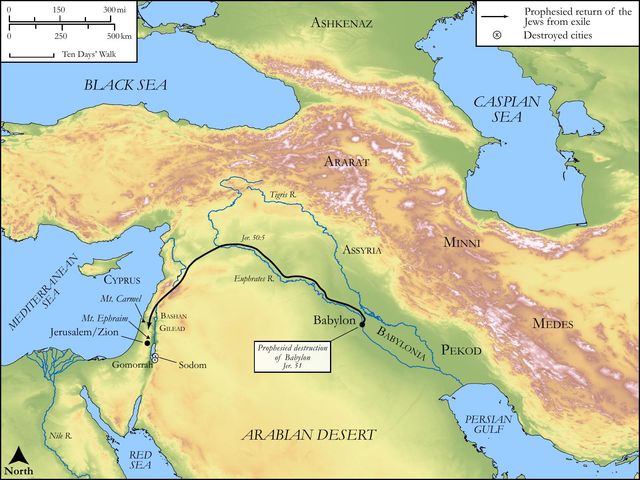
Jeremiah 51:62 is situated within a lengthy prophetic oracle against Babylon, spanning chapters 50 and 51 of the book of Jeremiah. Specifically, it forms part of the instructions given by Jeremiah to Seraiah, the quartermaster, who was accompanying King Zedekiah to Babylon. Jeremiah had entrusted Seraiah with a scroll containing all the prophecies of judgment against Babylon. The preceding verses detail the extent of Babylon's impending fall, describing it as a judgment from the Lord for its pride and cruelty. Verse 62 is the specific declaration Seraiah was to make aloud in Babylon, affirming the divine origin and irreversible nature of the coming desolation, immediately before the symbolic act of sinking the scroll in the Euphrates River as described in Jeremiah 51:63-64. This literary placement emphasizes the divine authority behind the prophecy and the tangible, public nature of its pronouncement.
Historical & Cultural Context
The prophecy against Babylon was delivered during a tumultuous period in Judah's history, likely after the first Babylonian deportation in 597 BC and before the final destruction of Jerusalem in 586 BC. Babylon, under Nebuchadnezzar, was the dominant superpower, having conquered Judah, destroyed the temple, and exiled its inhabitants. The city of Babylon itself was a marvel of its day, renowned for its immense walls, hanging gardens, and vast wealth. For a prophet to declare such a complete and permanent desolation against such a formidable empire, and for this declaration to be made within Babylon's own borders, was an act of profound faith and defiance against human power, rooted solely in the authority of Yahweh. The desolation Jeremiah foretells is a return to the state before creation, as in his earlier vision, "I beheld the earth, and, lo, it was without form, and void; and the heavens, and they had no light," signifying a judgment of the highest order.
Key Themes
ShowHideThis verse powerfully contributes to several overarching themes within Jeremiah and the broader prophetic literature. First, it highlights Divine Sovereignty and Justice, asserting that the Lord, not any earthly power, is the ultimate arbiter of nations' destinies. Babylon's fall is presented not as a mere political shift but as a direct act of God's righteous judgment against its idolatry, pride, and oppression of His covenant people, as seen in Jeremiah 50:29. Second, it underscores the Certainty and Efficacy of God's Word. The command for Seraiah to declare this prophecy publicly in Babylon before its fulfillment serves as a powerful testament to God's faithfulness to His promises and threats. Just as God's word brought creation into being, His word also brings about judgment and desolation, as affirmed in Isaiah 55:11. Finally, the phrase "desolate for ever" emphasizes the theme of Irreversible Judgment and Ultimate Desolation. Unlike other nations that might experience cycles of rise and fall, Babylon's decreed end is presented as final, a perpetual wasteland, signifying the severity of its sins and serving as a lasting warning, echoing similar prophecies in Isaiah 13:20-22.
Exposition and Analysis
ShowHideKey Word Analysis
ShowHideThis primitive root is used with great latitude, meaning "to say," "to speak," "to declare," or "to command." In this context, it signifies a direct, authoritative pronouncement from the prophet, echoing the very words of the Lord. It emphasizes the divine origin and certainty of the message, not merely a human opinion or prediction.
This root means "to cut (off, down or asunder)," and by implication, "to destroy or consume." While often used for making covenants (by cutting flesh), here it is used in its destructive sense, indicating a complete and decisive separation or termination. It implies a thorough and irreversible act of judgment that severs Babylon from its existence and power.
This feminine noun signifies "devastation" or "astonishment." It describes a state of utter ruin, waste, or desolation, often implying a shocking and awe-inspiring destruction. The use of this word underscores the visual and emotional impact of Babylon's future state – a place rendered uninhabitable and a monument to divine wrath.
Verse Breakdown
ShowHide"Then shalt thou say, O LORD, thou hast spoken against this place,"
This opening clause establishes the divine authority and prophetic mandate. Seraiah is not speaking his own words but is commanded to declare what the Lord Himself has already "spoken." The phrase "this place" directly refers to Babylon, the object of God's pronouncement. It highlights God's active involvement in history and His direct confrontation with the prideful empire.
"to cut it off, that none shall remain in it, neither man nor beast,"
This segment details the nature and extent of the judgment. "To cut it off" signifies a complete eradication, a severing of Babylon's existence. The phrase "that none shall remain in it, neither man nor beast" is a powerful hyperbole emphasizing absolute and total depopulation. It paints a picture of a land so utterly devastated that no life, human or animal, can subsist there, signifying a return to an uninhabited wilderness.
"but that it shall be desolate for ever."
This concluding clause specifies the duration and permanence of the judgment. "Desolate" (as analyzed above) conveys utter ruin, and "for ever" (Hebrew, ʻôwlâm') denotes an indefinite, perpetual duration, often signifying eternity or a very long, enduring time. In this context, combined with the extreme desolation, it strongly conveys an irreversible, permanent state of ruin, ensuring Babylon's inability to rise again to its former glory.
Literary Devices
ShowHideJeremiah 51:62 employs several potent literary devices to convey the gravity and certainty of Babylon's judgment. Personification is subtly present as the Lord is depicted as "speaking against this place," giving Babylon a quasi-personal status as an entity directly addressed by divine wrath. The phrase "that none shall remain in it, neither man nor beast" is a clear example of Hyperbole, an exaggeration used for emphasis. While literal, absolute eradication of all life might be difficult to achieve, the hyperbole effectively communicates the totality and severity of the impending destruction, leaving no hope for recovery or re-habitation. The entire verse functions as a Prophetic Oracle, a divinely inspired utterance that declares future events, emphasizing the Divine Fiat – God's authoritative command that brings about what He declares. The ultimate state of Babylon, "desolate for ever," serves as a powerful Symbolism of the consequences of national pride, idolatry, and oppression, a lasting monument to divine justice.
Theological and Thematic Connections
ShowHideThis verse profoundly articulates the theological truth of God's absolute sovereignty over all nations and His unwavering commitment to justice. It demonstrates that no earthly power, however mighty or seemingly invincible, can ultimately withstand the divine decree. The Lord's "speaking against" Babylon signifies not merely a verbal pronouncement but an active, effectual word that brings about its intended purpose. This judgment serves as a stark reminder that God holds all of humanity accountable for their actions, particularly those who oppress the innocent and defy His righteous standards. The complete and lasting desolation of Babylon, a city once the epitome of human glory and power, underscores the transient nature of worldly empires and the eternal nature of God's kingdom and His judgments.
Reflection and Application
ShowHideJeremiah 51:62 offers profound lessons for contemporary believers. It reminds us that God remains sovereign over all human affairs, even when circumstances seem chaotic or oppressive. The ultimate downfall of Babylon, a symbol of worldly power and rebellion against God, assures us that divine justice will prevail, and no evil will escape accountability. This truth provides comfort to those who feel oppressed and a sober warning to those who might be tempted to abuse power or disregard divine commands. It calls us to align our lives, our communities, and our nations with God's righteous standards, trusting that His word is reliable and His purposes will ultimately be fulfilled. Furthermore, it encourages us to cultivate a posture of humility, recognizing that all earthly achievements and powers are fleeting in comparison to the eternal kingdom of God.
Questions for Reflection
ShowHideFAQ
ShowHideWhy is Babylon's destruction described as "for ever" and so absolute ("neither man nor beast")?
ShowHideThe description of Babylon's destruction as "for ever" (Hebrew, ʻôwlâm') and utterly absolute ("neither man nor beast") emphasizes the finality and severity of God's judgment. It signifies that Babylon's fall would not be a temporary setback or a mere change of rulers, but a complete and irreversible end to its existence as a dominant, inhabited power. This hyperbole underscores the depth of its sin—its pride, idolatry, and brutal oppression of God's people (see Jeremiah 50:29). The "for ever" aspect suggests that it would serve as a perpetual warning and a testament to God's justice, a desolate monument to human rebellion, as echoed in Isaiah 13:20.
How does this specific prophecy relate to the broader biblical theme of God's judgment on nations?
ShowHideThis prophecy is a prime example of the biblical theme that God is sovereign over all nations and holds them accountable for their actions. Throughout the Old Testament, God raises up and casts down empires according to His divine plan and righteous judgment (e.g., Daniel 2:21). Babylon, though used by God as an instrument of judgment against Judah, ultimately faced its own reckoning for its arrogance and cruelty. This demonstrates that God's justice is impartial and universal, applying to His own people and to the surrounding nations alike, reinforcing the principle that "righteousness exalts a nation, but sin is a reproach to any people" (Proverbs 14:34).
Christ-Centered Fulfillment
ShowHideWhile Jeremiah 51:62 directly prophesies the historical destruction of ancient Babylon, its profound message of divine judgment against a powerful, oppressive world system finds its ultimate Christ-centered fulfillment in the New Testament's portrayal of the final judgment of all evil and the establishment of God's eternal kingdom. Just as God "spoke against" Babylon and brought about its desolation, so too will Christ, the Word made flesh, execute ultimate judgment against all forms of sin, rebellion, and anti-God systems, often symbolized as "Babylon the Great" in Revelation (e.g., Revelation 18:2). The "cutting off" and "desolation for ever" of Babylon foreshadow the complete eradication of evil and suffering that Christ accomplishes through His atoning sacrifice and His triumphant return. His death on the cross "cut off" the power of sin and death, and His resurrection guarantees the "desolation" of the grave for believers. Ultimately, the new heavens and new earth, where "neither man nor beast" (in the sense of fallen creation) will suffer under the curse, represent the final, eternal state of peace and righteousness, where former things have passed away (Revelation 21:4). Christ, the righteous Judge and benevolent King, ensures that the desolation of sin's reign is permanent, paving the way for His everlasting kingdom of light and life (2 Peter 3:13).