


1 Samuel 4:11
Bible text: King James Version (1769 Blayney text) · Public domain
Bible text: Berean Standard Bible · Public domain
Bible text: American Standard Version (1901) · Public domain
Bible text: World English Bible, Messianic edition · Public domain
Bible text: Geneva Bible (1599) · Public domain
Bible text: Young's Literal Translation · Public domain
- וַאֲרוֹןva·'a·Ronand [the] ark ofH727Conj-w ¦ N-mscNoun Singular Masculine Constructוַandאֲרוֹן[the] ark of
- אֱלֹהִים'E·lo·HimGodH430N-mpNoun Plural Masculine Absolute
- נִלְקָחnil·Kachit was takenH3947V-Niphal-Perf-3msVerb Niphal Perfect 3rd Singular Masculine
- וּשְׁנֵיu·she·Neiand [the] twoH8147Conj-w ¦ N-cdcNoun Dual common gender Constructוּandשְׁנֵי[the] two
- בְנֵיve·nei[the] sons ofH1121N-mpcNoun Plural Masculine Construct
- עֵלִי'e·LiEliH5941N-proper-mNoun Proper Masculine
- מֵתוּMe·tuthey diedH4191V-Qal-Perf-3cpVerb Qal Perfect 3rd Plural common gender
- חָפְנִיcha·fe·NiHophniH2652N-proper-mNoun Proper Masculine
- וּפִינְחָסu·Fi·ne·Chasand PhinehasH6372Conj-w ¦ N-proper-mNoun Proper MasculineוּandפִינְחָסPhinehas
English is a literal word-by-word gloss of the Hebrew, not the KJV's wording. Why?
This is the original text the KJV's translators worked from — each Hebrew word with its own literal English meaning in this verse, prepared by scholars at Tyndale House, Cambridge. The KJV translates whole sentences, not word by word, so its wording differs: one Hebrew word can become several English words, and the KJV may choose “the LORD” where the gloss reads “Yahweh”. Both are faithful — they answer different questions. For the KJV's own rendering, switch to the KJV text.
Details
See on the biblical-era map
Study this verse
Public-domain commentary
Matthew Henry
From his Commentary on the Whole Bible. Henry comments on passages, not single verses — this entry covers 1 Samuel 4:10–11. His two-level outline is real structure in the source text, so it is rendered as structure.
Here is a short account of the issue of this battle.
I.Israel was smitten, the army dispersed and totally routed, not retiring into the camp, as before (Sa1 4:2) when they hoped to rally again, but returning to their tents, every man shifting for his own safety and making the best of his way home, despairing to make head any more; and 30,000 were slain in the field of battle, Sa1 4:10. Israel was put to the worse,
1.Though they had the better cause, were the people of God and the Philistines were uncircumcised; they stood up in necessary defence of their just rights and liberties against invaders, and yet they failed of success, for their rock had sold them. A good cause often suffers for the sake of the bad men that undertake it.
2.Though they had the greater confidence, and were the more courageous. They shouted, while the Philistines trembled, and yet, when God pleased so to order it, the Philistines' terrors were turned into triumphs, and Israel's shouts into lamentations.
3.Though they had the ark of God with them. External privileges will secure none that abuse them and do not live up to them. The ark in the camp will add nothing to its strength when there is an Achan in it.
II.The ark itself was taken by the Philistines; and Hophni and Phinehas, who it is likely kept close to it, and when it was in danger ventured far in the defense of it, because by it they got their living, were both slain, Sa1 4:11. To this sad even the Psalmist refers, Psa 78:61. 64, He delivered his strength into captivity, and his glory into the enemy's hands. Their priests fell by the sword. 1. The slaughter of the priests, considering their bad character, was no great loss to Israel, but it was a dreadful judgment upon the house of Eli. The word which God had spoken was fulfilled in it (Sa1 2:34): This shall be a sign unto thee, an earnest of the judgments threatened, thy two sons shall die both in one day, and so shall all the increase of thy house die in the flower of their age, v. 33. If Eli had done his duty, and put them, as polluted, from the priesthood (Neh 7:64), they might have lived, though in disgrace; but now God takes the work into his own hands, and chases them out of the world by the sword of the uncircumcised. The Lord is known by those judgments which he executeth. It is true the sword devours one as well as another, but these were waited for of the sword, marked for vengeance. They were out of the place; what had they to do in the camp? When men leave the way of their duty they shut themselves out of God's protection. But this was not all; they had betrayed the ark, by bringing it into danger, without a warrant from God, and this filled the measure of their iniquities. But, 2. The taking of the ark was a very great judgment upon Israel, and a certain token of God's hot displeasure against them. Now they are made to see their folly in trusting to their external privileges which they had by their wickedness forfeited them, and fancying that the ark would save them when God had departed from them. Now they are made to reflect, with the utmost regret, upon their own rashness and presumption in bringing the ark into the camp and so exposing it, and wish a thousand times they had left it where God had fixed it. Now they are convinced that God will not be prescribed to by vain and foolish men, and that though he has bound us to his ark he has not bound himself to it, but will rather deliver it into the hands of his sworn enemies than suffer it to be profaned by his false friends, and countenance their superstition. Let none think to shelter themselves from the wrath of God under the cloak of a visible profession, for there will be those cast into outer darkness that have eaten and drunk in Christ's presence.
Historical interpretation
Five Centuries of Reception
3 surviving comments on this verse. Each one is dated, so this reads as a timeline rather than a list.
Select a marker to jump to its quote. Markers stagger vertically where authors wrote within a few decades of each other.
How will it be true to say about that [earthly] tabernacle that only “the innocent in hands and pure in heart, who did not receive his soul in vain,” will inhabit it, when the history of the kings transmits that the worst priests, “sons of pestilence,” have dwelt in the tabernacle of God and the ark of the covenant itself also was captured by foreigners and detained with the impious and profane? From all of this it is evident that the prophet felt in a far different sense about this tabernacle in which he says that only “the innocent in hands and pure in heart, who did not receive his soul in vain nor do evil to his neighbor and did not accept reproach against his neighbor” will dwell. It is necessary, therefore, that the inhabitant of this tabernacle which the Lord erected, not man, be such a person.
And the ark of God was captured, etc. And the kingdom was taken away from the Jews and given to a nation producing its fruits. The order of the priesthood, which had not behaved rightly, was transferred by the judgment of the Lord.
And the ark of God was captured, etc. And with the proclamation of the apostles and the faith of the repenting people spreading far and wide, the grace of God was taken away from the Jews, and that priesthood of legal judgments, once glorious on the throne, fell backward, that is, it turned back on itself and did not fear to take up the sins it once abandoned; it perished with the breaking of its singular pride, and this near that door, namely which he says: "If anyone enters through me, he will be saved" (John 10), near which he sat by the mystery of figures, but by the merit of perfidy did not enter in.
Continue studying 1 Samuel 4:11 across the web’s major study libraries — every link below opens this exact verse, chapter, or book on the destination site.
Read & Compare
 BibleGatewayThis verse in more than 200 translations and 70 languages.
 Bible.comThe YouVersion reader — hundreds of translations, reading plans, and highlights.
 ESV.orgCrossway's official English Standard Version reader.
 NET BibleThe NET translation with 60,000+ translators' notes on every rendering decision.
 STEP BibleTyndale House's free study tool — original text, vocabulary, and scholarly resources.
 BibliaLogos Bible Software's free web reader.
 USCCBThe New American Bible (Revised Edition) with the U.S. bishops' study notes.
Commentaries
 BibleHub CommentariesDozens of classic commentaries on this verse, gathered on one page.
 StudyLightMore than 100 commentary sets — the largest collection on the web.
 BibleRefPlain-English commentary on what this verse means, verse by verse.
 Enduring WordDavid Guzik's free commentary on this chapter, widely used by Bible teachers.
 Bible Study ToolsVerse commentary alongside Greek and Hebrew study aids.
Original Language & Research
- BibleHub InterlinearThe verse word by word — original language, transliteration, and English.
- BibleHub LexiconEvery word's original-language definition and Strong's entry.
 Blue Letter BibleDeep-study tools — Strong's numbers, concordance, and word studies.
 SefariaThe Hebrew text with Rashi and centuries of Jewish commentary.
Sermons, Hymns & Audio


TrulyRandomVerse is not affiliated with these sites and doesn’t control their content. They’re linked because they’re genuinely useful.
Summary
First Samuel 4:11 records a pivotal and devastating moment in Israel's history: the capture of the Ark of God by the Philistines and the simultaneous death of Eli's two corrupt sons, Hophni and Phinehas. This verse encapsulates the grim climax of divine judgment against a disobedient nation and a defiled priestly line, marking a profound spiritual and national crisis that underscored God's unwavering sovereignty and the severe consequences of treating His holy presence with presumption, irreverence, and unfaithfulness.
Context
ShowHideLiterary Context
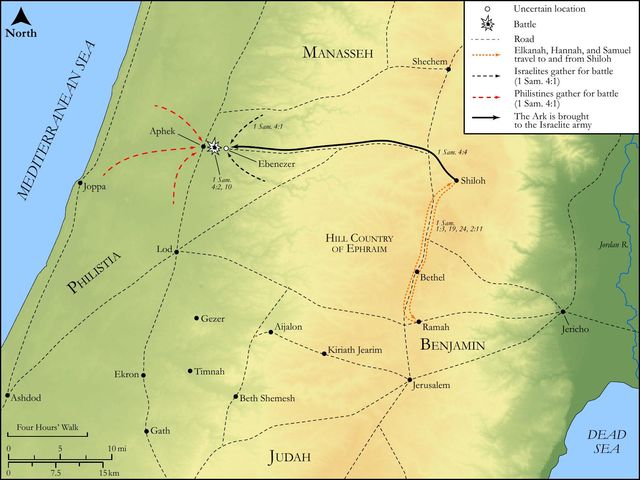
This verse serves as the tragic culmination of the second battle between Israel and the Philistines, detailed in 1 Samuel 4. Following an initial defeat, the elders of Israel presumptuously brought the Ark of the Covenant from Shiloh to the battlefield, believing its mere presence would guarantee victory, rather than seeking God's will or repenting of their widespread sins. This act, devoid of genuine faith and obedience, effectively reduced the sacred Ark to a superstitious charm. The narrative prior to this verse describes the initial Israelite defeat, their misguided decision to retrieve the Ark, the Philistines' fear and subsequent resolve, and the final, catastrophic defeat where 30,000 Israelite foot soldiers were slain (1 Samuel 4:1-10). Verse 11 delivers the two most shocking and consequential outcomes of this battle, dramatically setting the stage for the subsequent narrative of the Ark's journey in Philistine territory (1 Samuel 5) and the immediate, tragic demise of Eli and his family upon hearing the news (1 Samuel 4:12-22).
Historical & Cultural Context
The period of the Judges, which immediately preceded the events of 1 Samuel and led into the early monarchy, was characterized by profound spiritual decline in Israel, famously summarized by the recurring phrase, "everyone did what was right in his own eyes" (Judges 21:25). The Philistines, a formidable and technologically superior Sea People, were a constant and growing threat to Israel's western borders, frequently engaging in conflict. The Ark of the Covenant was the most sacred object in Israel, representing God's throne, His covenant presence, and His active involvement among His people, dwelling above the mercy seat (Exodus 25:22). Culturally, its presence was indeed understood to signify God's active involvement and favor. However, the Israelites' critical error was treating it as a magical talisman or an automatic guarantee of victory, rather than a symbol requiring a holy and obedient relationship with the transcendent God it represented. Furthermore, the priesthood under Eli, particularly his sons Hophni and Phinehas, had become notoriously corrupt, abusing their office, taking offerings by force, and committing immorality at the tabernacle entrance (1 Samuel 2:12-17). This profound moral and spiritual decay within the nation's spiritual leadership contributed significantly to the national apostasy and created the conditions for divine judgment.
Key Themes
ShowHideThis verse powerfully illustrates several crucial theological and narrative themes. Firstly, it underscores Divine Judgment and the Consequences of Disobedience, demonstrating God's unwavering holiness and His refusal to be manipulated or contained by human presumption. The capture of the Ark and the death of Eli's sons were direct fulfillments of prophecies against Eli's house (1 Samuel 2:34) and a stark judgment on Israel's misguided reliance on an object rather than on God Himself. Secondly, it highlights God's Sovereignty Over Sacred Objects, showing that even the most sacred symbols of His presence cannot be used to coerce His will or guarantee success apart from genuine faith and obedience. God is not bound by human rituals or physical objects; He remains sovereign even when His Ark is in enemy hands, as further demonstrated by the plagues and destruction it brings upon the Philistines in 1 Samuel 5. Thirdly, the demise of Hophni and Phinehas emphasizes the Accountability of Leadership, particularly spiritual leaders. Their corruption, irreverence, and disregard for God's commands led to their downfall, serving as a severe warning against spiritual negligence, unrighteous conduct, and the abuse of positions of influence within God's people.
Exposition and Analysis
ShowHideKey Word Analysis
ShowHideThis primitive root means "to take" in a wide variety of applications, including to seize or capture. In this context, it emphasizes the active, forceful seizure of the Ark by the Philistines, rather than a passive loss or abandonment. The Ark was not merely misplaced; it was decisively captured, signifying the completeness of Israel's defeat and the profound humiliation of God's people, orchestrated by divine allowance.
Derived from the root meaning "to build," this word refers to a son, in the widest sense, as one who builds or continues the family name. Here, it specifically refers to Hophni and Phinehas, the direct offspring of Eli, highlighting their lineage and the profound responsibility they inherited as priests. Their identity as "sons of Eli" underscores the generational nature of the priestly office and the tragic failure of this particular line.
This primitive root means "to die" (literally or figuratively) and, causatively, "to kill" or "to put to death." It is a stark and direct term for their demise, emphasizing that their deaths were not merely casualties of war but a violent, decisive, and divinely orchestrated judgment. This word conveys the finality and severity of the retribution for their wickedness and the direct fulfillment of prophecy.
Verse Breakdown
ShowHide"And the ark of God was taken"
This clause signifies the most catastrophic event for Israel, far outweighing the loss of human life in the battle. The capture of the Ark, the very symbol of Yahweh's presence, covenant, and power, was an unprecedented theological and national disaster. It communicated a profound message: God was not obligated to defend His people when they acted presumptuously, dishonored His name, and relied on a mere object rather than on Him. It shattered Israel's false sense of security, which was based on a physical emblem rather than a living, obedient relationship with their God.
"and the two sons of Eli, Hophni and Phinehas, were slain"
This second clause describes the immediate and direct fulfillment of the prophecy given to Eli by a man of God in 1 Samuel 2:34, which stated that "both your sons, Hophni and Phinehas, will die on the same day." Their deaths on the battlefield, while in the presence of the Ark they had so grievously defiled, served as a clear and undeniable sign of God's righteous judgment on the corrupt priestly line of Eli. Their demise was not random but a precise act of divine justice, underscoring the severity of their sin, their abuse of sacred office, and the dire consequences of their unrighteous leadership.
Literary Devices
ShowHideThe verse employs several potent literary devices that amplify its dramatic and theological impact. Juxtaposition is central, placing the capture of the sacred Ark directly alongside the death of Eli's corrupt sons. This highlights the interconnectedness of Israel's spiritual state, the profound corruption of its leadership, and the resulting, inevitable divine judgment. The narrative also employs powerful Foreshadowing, as the events of this verse directly fulfill the prophecy delivered earlier against Eli's house (1 Samuel 2:34), emphasizing God's sovereign control over history and the infallible nature of His spoken word. There is a strong sense of Irony in Israel's desperate and superstitious attempt to secure victory by bringing the Ark to battle, only for its capture to signify their ultimate defeat and God's judgment upon them. The Ark itself functions as a powerful Symbolism; its capture represents not just a military loss but the apparent withdrawal of God's favor and presence from a disobedient people, serving as a visceral lesson that God cannot be confined, manipulated, or coerced by human rituals or objects.
Theological and Thematic Connections
ShowHide1 Samuel 4:11 serves as a stark and enduring reminder of God's absolute holiness and His refusal to be treated as a tribal deity or a magical charm. The capture of the Ark and the death of Eli's sons underscore that divine presence and blessing are contingent upon obedience, reverence, and genuine faith, not mere possession of sacred objects or mechanical adherence to rituals. God's judgment is precise, just, and inevitable, especially against those who profane His name, abuse His office, or lead His people astray. This traumatic event marks a critical turning point in Israelite history, signaling the definitive end of the priestly line of Eli and paving the way for a new era of leadership, ultimately leading to the establishment of the monarchy and the rise of Samuel as a faithful prophet and judge. It powerfully illustrates that God's covenant faithfulness to His people does not preclude His righteous judgment upon their sin, even among His chosen nation.
Reflection and Application
ShowHideThe tragic events of 1 Samuel 4:11 offer profound and timeless lessons for believers today, cautioning us against treating our faith as a superficial set of rituals or symbols that can guarantee God's favor without genuine heart transformation and obedient living. Like ancient Israel, we can be tempted to rely on outward expressions of religiosity—such as church attendance, prayer routines, or even Bible reading—as a means to manipulate God, earn His blessings, or ensure our comfort, rather than cultivating a living, dynamic, and obedient relationship with Him. This verse calls us to a deep examination of our motivations: do we truly revere God for who He is, in His holiness and sovereignty, or do we subtly seek to use Him for our own purposes, reducing Him to a means to an end? Furthermore, for those in positions of spiritual leadership, the fate of Hophni and Phinehas is a sobering and severe warning. It underscores the immense responsibility to lead with integrity, holiness, and a deep reverence for God, recognizing that spiritual negligence, corruption, and irreverence have devastating consequences, not only for the leaders themselves but also for those they influence and for the spiritual health of the community. Ultimately, God's power and presence are not dependent on human strategies, physical objects, or corrupt leadership, but on His divine will and our humble, faithful submission to it.
Questions for Reflection
ShowHideFAQ
ShowHideWhy was the Ark of God taken by the Philistines?
ShowHideThe Ark of God was taken not because the Philistines were stronger than God, but as a direct and sovereign act of divine judgment against Israel's widespread sin, presumption, and profound spiritual corruption. The Israelites treated the Ark as a magical talisman, believing its mere presence would guarantee victory, rather than seeking God's will, repenting of their disobedience, or addressing the deep moral decay within Eli's priestly house. God allowed the Ark to be captured to demonstrate His absolute sovereignty, to humble His disobedient people, and to unequivocally show that He cannot be manipulated or contained by human rituals or objects. The subsequent events detailed in 1 Samuel 5 clearly show that even in Philistine hands, the Ark continued to manifest God's power and judgment, proving that its capture was part of His righteous plan, not a sign of His defeat or weakness.
What was the significance of Hophni and Phinehas dying on the same day?
ShowHideThe death of Hophni and Phinehas on the same day was the precise and dramatic fulfillment of the prophecy given to Eli, their father, by a man of God in 1 Samuel 2:34. This prophecy explicitly foretold that "both your sons, Hophni and Phinehas, will die on the same day." Their simultaneous demise underscored the absolute certainty and infallibility of God's word and the severe nature of His judgment against their profound corruption, irreverence, and abuse of their priestly office. It marked the definitive end of Eli's defiled priestly line and served as a clear and undeniable sign of God's faithfulness to His pronouncements of judgment, even when those judgments were against His own chosen people and their leaders.
Christ-Centered Fulfillment
ShowHideThe tragic events of 1 Samuel 4:11, particularly the capture of the Ark and the death of the corrupt priests, powerfully foreshadow the ultimate and perfect fulfillment found in Jesus Christ. The Ark symbolized God's presence among His people, yet it was a physical object that could be captured, its presence could be profaned by human sin, and it could be taken away. In Christ, however, we behold the perfect and unassailable dwelling of God among humanity, for He is truly Immanuel, God with us. He is the true Ark of God, the very Word made flesh, in whom the fullness of the Deity dwells bodily (Colossians 2:9). Unlike the Ark, which could be taken by enemies, Christ's divine presence cannot be captured, manipulated, or diminished; His power is inherent, eternal, and unassailable. Furthermore, Hophni and Phinehas represent a flawed, corrupt, and ultimately failing priesthood that failed to mediate God's presence effectively and instead brought judgment upon themselves and Israel. Jesus, by contrast, is our perfect and eternal High Priest, who offered Himself as the spotless, once-for-all sacrifice for sin (Hebrews 7:27). He did not die for His own sin, for He was sinless, but for the sins of the world, taking upon Himself the divine judgment that justly fell upon disobedient Israel and corrupt priests. Through His perfect life, atoning death, and glorious resurrection, Christ provides true, unhindered access to God's presence, not through a physical object or a flawed human mediator, but through the new and living way opened by His precious blood. Thus, the devastating judgment and spiritual crisis of 1 Samuel 4:11 ultimately point to the glorious salvation, perfect mediation, and enduring presence of God found exclusively in Christ.