


1 Samuel 4:12
Bible text: King James Version (1769 Blayney text) · Public domain
Bible text: Berean Standard Bible · Public domain
Bible text: American Standard Version (1901) · Public domain
Bible text: World English Bible, Messianic edition · Public domain
Bible text: Geneva Bible (1599) · Public domain
Bible text: Young's Literal Translation · Public domain
- וַיָּרָץvai·Ya·rotzand he ranH7323Conj-w ¦ V-Qal-ConsecImperf-3msVerb Qal Consecutive Imperfect 3rd Singular Masculineוַandיָּרָץhe ran
- אִישׁ'ish[the] man ofH376N-mscNoun Singular Masculine Construct
- בִּנְיָמִןbin·ya·MinBenjaminH1144N-proper-mNoun Proper Masculine
- מֵהַמַּעֲרָכָהme·ha·Ma·'a·ra·Khahfrom the battle lineH4634Prep-m ¦ Art ¦ N-fsNoun Singular Feminine Absoluteמֵfromהַtheמַּעֲרָכָהbattle line
- וַיָּבֹאvai·ya·Vo'and he cameH935Conj-w ¦ V-Qal-ConsecImperf-3msVerb Qal Consecutive Imperfect 3rd Singular Masculineוַandיָּבֹאhe came
- שִׁלֹהshi·LohShilohH7887N-properNoun Proper Location
- בַּיּוֹםbai·Yomon the dayH3117Prep-b ¦ N-msNoun Singular Masculine Absoluteבַּon theיּוֹםday
- הַהוּאha·Hu'<the> thatH1931Art ¦ Pro-3msPronoun Personal 3rd Singular Masculineהַ<the>הוּאthat
- וּמַדָּיוu·ma·Davand his garmentsH4055Conj-w ¦ N-mpc ¦ 3msNoun Plural Masculine Constructוּandמַדָּיgarmentsוhis
- קְרֻעִיםke·ru·'Im[were] tornH7167V-Qal-PassPrtcpl-mpVerb Qal Participle Passive Plural Masculine Absolute
- וַאֲדָמָהva·'a·da·Mahand earthH127Conj-w ¦ N-fsNoun Singular Feminine Absoluteוַandאֲדָמָהearth
- עַל'al[was] onH5921PrepPreposition
- רֹאשׁוֹro·Shohis headH7218N-msc ¦ 3msNoun Singular Masculine Constructרֹאשׁheadוֹhis
English is a literal word-by-word gloss of the Hebrew, not the KJV's wording. Why?
This is the original text the KJV's translators worked from — each Hebrew word with its own literal English meaning in this verse, prepared by scholars at Tyndale House, Cambridge. The KJV translates whole sentences, not word by word, so its wording differs: one Hebrew word can become several English words, and the KJV may choose “the LORD” where the gloss reads “Yahweh”. Both are faithful — they answer different questions. For the KJV's own rendering, switch to the KJV text.
Details
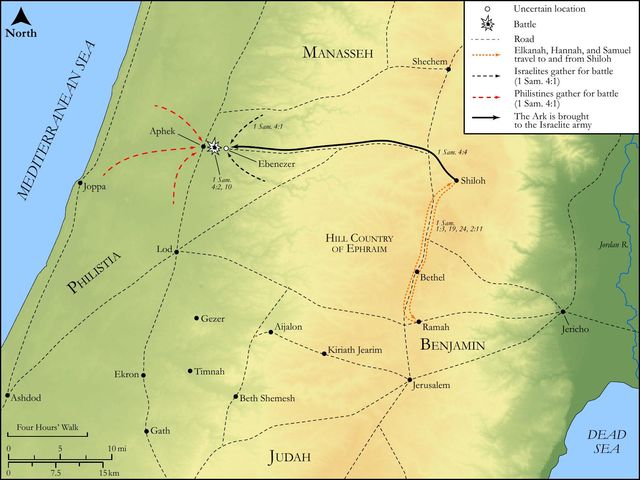
See on the biblical-era map
Study this verse
Public-domain commentary
Matthew Henry
From his Commentary on the Whole Bible. Henry comments on passages, not single verses — this entry covers 1 Samuel 4:12–18. His two-level outline is real structure in the source text, so it is rendered as structure.
Tidings are here brought to Shiloh of the fatal issue of their battle with the Philistines. Bad news flies fast. This soon spread through all Israel; every man that fled to his tent brought it, with too plain a proof of it, to his neighbours. But no place was so nearly concerned as Shiloh. Thither therefore an express posted away immediately; it was a man of Benjamin; the Jews fancy it was Saul. He rent his clothes, and put earth upon his head, by these signs to proclaim the sorrowful news to all that saw him as he ran, and to show how much he himself was affected with it, Sa1 4:12. He went straight to Shiloh with it; and here we are told,
I.How the city received it.
Eli sat in the gate (Sa1 4:13, Sa1 4:18), but the messenger was loth to tell him first, and therefore passed him by, and told it in the city, with all the aggravating circumstances; and now both the ears of every one that heard it tingled, as was foretold, Sa1 3:11. Their hearts trembled, and every face gathered blackness. All the city cried out (Sa1 3:13), and well they might, for, besides that this was a calamity to all Israel, it was a particular loss to Shiloh, and the ruin of that place; for, though the ark was soon rescued out of the hands of the Philistines, yet it never returned to Shiloh again; their candlestick was removed out of its place, because they had left their first love, and their city dwindled, and sunk, and came to nothing. Now God forsook the tabernacle of Shiloh, they having driven him from them; and the tribe of Ephraim, which had for 340 years been blessed with the presence of the ark in it, lost the honour (Psa 78:60, Psa 78:67), and, some time after, it was transferred to the tribe of Judah, the Mount Sion which he loved, as it follows there (Psa 78:68), because the men of Shiloh knew not the day of their visitation. This abandoning of Shiloh Jerusalem is long afterwards reminded of, and told to take warning by. Jer 7:12, "Go see what I did to Shiloh. From this day, this fatal day, let the desolations of Shiloh be dated." They had therefore reason enough to cry out when they heard that the ark was taken.
II.What a fatal blow it was to old Eli. Let us see,
1.With what fear he expected the tidings. Though old, and blind, and heavy, yet he could not keep his chamber when he was sensible the glory of Israel lay at stake, but placed himself by the way-side, to receive the first intelligence; for his heart trembled for the ark of God, Sa1 4:13. His careful thoughts represented to him what a dishonour it would be to God, and what an irreparable loss to Israel, if the ark should fall into the Philistines' hands, with what profane triumphs the tidings would be told in Gath and published in the streets of Ashkelon. He also apprehended what imminent danger there was of it. Israel had forfeited the ark (his own sons especially) and the Philistines would aim at it; and now the threatening comes to his mind, that he should see an enemy in God's habitation (Sa1 2:32); and perhaps his own heart reproached him for not using his authority to prevent the carrying of the ark into the camp. All these things made him tremble. Note, All good men lay the interests of God's church nearer their hearts than any secular interest or concern of their own, and cannot but be in pain and fear for them if at any time they are in peril. How can we be easy if the ark be not safe?
2.With what grief he received the tidings. Though he could not see, he could hear the tumult and crying of the city, and perceived it to be the voice of lamentation, and mourning, and woe; like a careful magistrate, he asks, What means the noise of this tumult? Sa1 4:14. He is told there is an express come from the army, who relates the story to him very distinctly, and with great confidence, having himself been an eye-witness of it, Sa1 4:16, Sa1 4:17. The account of the defeat of the army, and the slaughter of a great number of the soldiers, was very grievous to him as a judge; the tidings of the death of his two sons, of whom he had been so indulgent, and who, he had reason to fear, died impenitent, touched him in a tender part as a father; yet it was not for these that his heart trembled: there is a greater concern upon his spirit, which swallows up the less; he does not interrupt the narrative with any passionate lamentations for his sons, like David for Absalom, but waits for the end of the story, not doubting but that the messenger, being an Israelite, would, without being asked, say something of the ark; and if he could but have said, "Yet the ark of God is safe, and we are bringing that home," his joy for that would have overcome his grief for all the other disasters, and have made him easy; but, when the messenger concludes his story with, The ark of God is taken, he is struck to the heart, his spirits fail, and, it should seem, he swooned away, fell off his seat, and partly with the fainting, and partly with the fall, he died immediately, and never spoke a word more. His heart was broken first, and then his neck. So fell the high priest and judge of Israel, so fell his heavy head when he had lived within two of 100 years, so fell the crown from his head when he had judged Israel about forty years: thus did his sun set under a cloud, thus were the folly and wickedness of those sons of his, whom he had indulged, his ruin at last. Thus does God sometimes set marks of his displeasure in this life upon good men who have misconducted themselves, that others may hear, and fear, and take warning. A man may die miserably and yet not die eternally, may come to an untimely end and yet the end be peace. Dr. Lightfoot observes that Eli died the death of an unredeemed ass, whose neck was to be broken, Exo 13:13. Yet we must observe, to Eli's praise, that it was the loss of the ark that was his death, not the slaughter of his sons. He does, in effect, say, "Let me fall with the ark, for what pious Israelite can live with any comfort when God's ordinances are removed?" Farewell all in this world, even life itself, if the ark be gone.
Historical interpretation
Historical reception
1 surviving comment on this verse from the historical church.
But a man of Benjamin ran from the battle line, etc. The people who remained from the Jews perishing because of their perfidy, hearing from the apostles: "Save yourselves from this crooked generation" (Acts 2), came to instruct those who, having been emptied of Christ, still boasted in the law and kept the tabernacle of the Lord in Shiloh without the ark of the covenant; in order to provoke the listeners more easily to repentance, tearing off every old habit, and despising all former reliance on their strength as nothing, appeared in mourning. This man is said to have well descended from Benjamin, that is, the son of the right hand, because indeed the Church, in comparison to the Synagogue, because the heavenly Jerusalem, namely our mother, compared to the present one, stands out as the right hand to the left. This man of Benjamin therefore suggests either the people of the primitive Church or some teacher of that age, the son of the right hand of faith, or certainly the apostle Paul, who also descended from the tribe of Benjamin, who, though he was the last of the apostles, labored more than all in preaching (1 Cor. 15).
Continue studying 1 Samuel 4:12 across the web’s major study libraries — every link below opens this exact verse, chapter, or book on the destination site.
Read & Compare
 BibleGatewayThis verse in more than 200 translations and 70 languages.
 Bible.comThe YouVersion reader — hundreds of translations, reading plans, and highlights.
 ESV.orgCrossway's official English Standard Version reader.
 NET BibleThe NET translation with 60,000+ translators' notes on every rendering decision.
 STEP BibleTyndale House's free study tool — original text, vocabulary, and scholarly resources.
 BibliaLogos Bible Software's free web reader.
 USCCBThe New American Bible (Revised Edition) with the U.S. bishops' study notes.
Commentaries
 BibleHub CommentariesDozens of classic commentaries on this verse, gathered on one page.
 StudyLightMore than 100 commentary sets — the largest collection on the web.
 BibleRefPlain-English commentary on what this verse means, verse by verse.
 Enduring WordDavid Guzik's free commentary on this chapter, widely used by Bible teachers.
 Bible Study ToolsVerse commentary alongside Greek and Hebrew study aids.
Original Language & Research
- BibleHub InterlinearThe verse word by word — original language, transliteration, and English.
- BibleHub LexiconEvery word's original-language definition and Strong's entry.
 Blue Letter BibleDeep-study tools — Strong's numbers, concordance, and word studies.
 SefariaThe Hebrew text with Rashi and centuries of Jewish commentary.
Sermons, Hymns & Audio


TrulyRandomVerse is not affiliated with these sites and doesn’t control their content. They’re linked because they’re genuinely useful.
Summary
1 Samuel 4:12 vividly portrays the immediate aftermath of a national catastrophe through the arrival of a lone messenger at Shiloh. His disheveled appearance, marked by torn clothes and earth upon his head, serves as a non-verbal, yet profoundly eloquent, declaration of Israel's devastating defeat by the Philistines and the calamitous loss of the Ark of the Covenant. This verse dramatically sets the stage for the tragic news that will soon be delivered, impacting the aged High Priest Eli and the entire nation.
Context
ShowHideLiterary Context
This verse marks a pivotal, dramatic turning point, serving as the immediate climax of a series of escalating disasters for Israel. It directly follows the account of Israel's second, more catastrophic defeat by the Philistines, detailed in 1 Samuel 4:1-11. The initial battle resulted in 4,000 Israelite casualties. In a misguided attempt to secure victory, the elders brought the Ark of the Covenant from Shiloh into battle, treating it as a magical charm rather than a sacred symbol of God's holy presence. This act of presumption led to an even greater rout, with 30,000 Israelite foot soldiers falling, and, most critically, the capture of the Ark of God and the death of Eli's wicked sons, Hophni and Phinehas, as described in 1 Samuel 4:11. The man of Benjamin in 1 Samuel 4:12 is the first eyewitness to return to Shiloh, the spiritual center where the Ark had resided and where Eli anxiously awaited news. His arrival directly precedes the devastating news that will lead to Eli's own death, as recounted in 1 Samuel 4:13-18.
Historical & Cultural Context
The events of 1 Samuel 4 unfold during a tumultuous period in Israel's history, characterized by Philistine dominance and Israel's spiritual decline under the corrupt priesthood of Eli's sons. Shiloh was the central sanctuary where the Tabernacle and the Ark of the Covenant had been housed for centuries, making it the spiritual and administrative heart of the nation. The Philistines, a powerful seafaring people who settled along the southwestern coast of Canaan, were a constant military threat to Israel, possessing superior iron weaponry that gave them a significant advantage. The customs of "clothes rent" and "earth upon his head" were deeply ingrained expressions in Israel of profound grief, national calamity, and personal despair, as when Joshua rent his clothes and put dust upon his head before the ark after the defeat at Ai. These were not merely ceremonial but visceral, public displays of overwhelming sorrow and humiliation, immediately signaling disaster to anyone who witnessed them. Such acts communicated a loss so immense that it brought one to the lowest state, often associated with the dust of death and the grave.
Key Themes
ShowHideThis verse powerfully contributes to several key themes within the book of 1 Samuel and the broader Old Testament narrative. It highlights the theme of divine judgment against Israel's sin and the corruption of Eli's house, demonstrating that God's presence (symbolized by the Ark) is not a guarantee of victory when His people are disobedient. The capture of the Ark, a central element of Israel's covenant relationship with God, underscores the theme of loss of divine presence and national humiliation, a direct consequence of misplaced trust in ritual over genuine faith and obedience. The swift and dramatic arrival of the messenger also emphasizes the urgency and gravity of bad news, particularly when it concerns the spiritual state and security of the nation. This event marks a pivotal moment, signaling the end of an era for the priesthood in Shiloh and foreshadowing the rise of new leadership, themes that continue to develop throughout the book of 1 Samuel.
Exposition and Analysis
ShowHideKey Word Analysis
ShowHideVerse Breakdown
ShowHide"¶ And there ran a man of Benjamin out of the army,"
This clause immediately establishes the messenger's identity, his tribal affiliation (Benjamin), and his origin (the battlefield). The verb "ran" (רוּץ, ruts) conveys urgency and the speed with which the news is being carried, emphasizing the desperate nature of the situation. He is not merely walking, but fleeing with haste, indicating the severity of the defeat and the dire need to deliver the tidings.
"and came to Shiloh the same day"
This part highlights the swiftness of his journey and his direct destination. Shiloh, as the religious and administrative center housing the Ark, was the natural place for such news to be delivered, especially to the anxious High Priest Eli. The phrase "the same day" underscores the immediacy and intensity of the crisis, allowing no delay in the delivery of the catastrophic tidings, indicating the profound impact this news will have on the nation's spiritual heart.
"with his clothes rent, and with earth upon his head."
This final clause provides the crucial visual details of the messenger's appearance. These are not incidental details but powerful symbols, well understood in Israel, of profound mourning, national disaster, and personal despair. His outward state is a pre-verbal announcement of the calamity, signaling to any observer the immense tragedy that has occurred before a single word is spoken, preparing them for the devastating news.
Literary Devices
ShowHideThe verse makes powerful use of Imagery to convey the magnitude of the disaster. The visual description of the messenger—his clothes torn and earth upon his head—creates an immediate and visceral picture of profound distress and desolation. This imagery is highly Symbolic; the messenger's physical state is not just his personal grief but symbolizes the shattered state of the entire nation of Israel, their humiliation, and the perceived withdrawal of God's favor. His appearance serves as potent Foreshadowing, building intense suspense and signaling that the news he carries will be devastating, preparing the reader and the characters within the narrative (especially Eli) for the catastrophic revelations that follow. The rapid pace implied by "ran" and "the same day" also contributes to the dramatic tension, creating a sense of Urgency.
Theological and Thematic Connections
ShowHideThe arrival of the Benjamite messenger, visually embodying utter despair, serves as a stark theological commentary on the consequences of Israel's spiritual complacency and disobedience. The loss of the Ark, which this messenger's appearance foreshadows, was not merely a military defeat but a profound spiritual crisis, symbolizing the temporary withdrawal of God's visible presence due to the nation's sin and the corruption of the priesthood. This event underscores God's sovereignty and His willingness to judge His own people when they turn from Him, demonstrating that His presence cannot be manipulated or taken for granted through mere ritual. It highlights the principle that true security and blessing come from genuine obedience and faithfulness, not from superstitious reliance on sacred objects.
Reflection and Application
ShowHideThe scene in 1 Samuel 4:12 offers a poignant glimpse into the raw human experience of profound loss and the ancient ways of communicating such devastation. While our modern expressions of grief and shock may differ, the underlying emotions of sorrow, despair, and the impact of catastrophic news remain universal. For ancient Israel, the capture of the Ark was not just a military defeat but a spiritual catastrophe, symbolizing the perceived withdrawal of God's favor due to their disobedience and the corruption within the priesthood. For us today, this narrative serves as a powerful reminder of the consequences of spiritual complacency and the importance of genuine faith and obedience over mere ritualistic practices. It challenges us to examine where our true trust lies—in external forms or in a living relationship with God. It also highlights the often painful but necessary role of those who must deliver difficult truths, requiring courage and compassion in times of crisis, and the need for us to be prepared to receive such truths, even when they are unwelcome, and to process them with humility and a desire for repentance.
Questions for Reflection
ShowHideFAQ
ShowHideWhy is the messenger identified specifically as a "man of Benjamin"?
ShowHideThe identification of the messenger as a "man of Benjamin" is not incidental. Benjamin was a smaller tribe, but historically known for its fierce warriors and skilled slingers (e.g., Judges 20:16). This detail underscores the sheer scale of the Israelite defeat; even a warrior from such a tenacious tribe was forced to flee. Furthermore, it subtly foreshadows future events in 1 Samuel, as Israel's first king, Saul, will also be from the tribe of Benjamin, and his reign will likewise be marked by significant conflict with the Philistines and eventual tragedy. The Benjamite's arrival in Shiloh, a place of spiritual significance, also sets the stage for the dramatic shift in leadership that will eventually lead to the monarchy.
What is the significance of Shiloh in this narrative?
ShowHideShiloh was the preeminent religious center of Israel during the period of the Judges, serving as the location of the Tabernacle and the Ark of the Covenant for centuries (e.g., Joshua 18:1). It was where the people came to worship, offer sacrifices, and consult the Lord. For the Ark to be captured and for the messenger to return to Shiloh with news of this catastrophe signifies not just a military defeat but a profound spiritual crisis and the end of an era for this sacred site. The capture of the Ark from Shiloh marked a temporary departure of God's visible presence from His people and led to the eventual desolation of Shiloh, as later alluded to in Jeremiah 7:12.
Christ-Centered Fulfillment
ShowHideThe devastating news brought by the Benjamite messenger, culminating in the temporary loss of God's visible presence through the Ark, profoundly foreshadows the ultimate separation from God that humanity experiences due to sin. The Ark, representing God's dwelling among His people, was taken captive because of Israel's unfaithfulness and the corruption of the priesthood. This temporary loss of divine presence finds its ultimate reversal in Jesus Christ. He is the true and permanent dwelling of God among humanity, the very embodiment of God's presence (Immanuel, Matthew 1:23). Unlike the Ark, which could be captured and whose presence was contingent on Israel's obedience, Christ's presence is eternal and unshakeable. He is the ultimate messenger, not of bad news and judgment, but of the glorious good news of salvation, bringing reconciliation between God and humanity through His perfect sacrifice on the cross (Romans 5:8). Where the messenger in 1 Samuel 4:12 brought tidings of death and despair, Christ's arrival brings life and hope, declaring, "I have come that they may have life, and have it to the full!". He is the true High Priest, whose perfect and eternal sacrifice ensures that God's presence is not withdrawn but permanently accessible to all who believe, fulfilling and surpassing all that the Ark and the Old Covenant priesthood represented (Hebrews 9:11-14).