


1 Samuel 4:14
Bible text: King James Version (1769 Blayney text) · Public domain
Bible text: Berean Standard Bible · Public domain
Bible text: American Standard Version (1901) · Public domain
Bible text: World English Bible, Messianic edition · Public domain
Bible text: Geneva Bible (1599) · Public domain
Bible text: Young's Literal Translation · Public domain
- וַיִּשְׁמַעvai·yish·Ma'and he heardH8085Conj-w ¦ V-Qal-ConsecImperf-3msVerb Qal Consecutive Imperfect 3rd Singular Masculineוַandיִּשְׁמַעhe heard
- עֵלִי'e·LiEliH5941N-proper-mNoun Proper Masculine
- אֶת'et<obj.>H853DirObjMParticle Object Indicator
- קוֹלKol[the] sound ofH6963N-mscNoun Singular Masculine Construct
- הַצְּעָקָהha·tze·'a·Kahthe outcryH6818Art ¦ N-fsNoun Singular Feminine Absoluteהַtheצְּעָקָהoutcry
- וַיֹּאמֶרvai·Yo·merand he saidH559Conj-w ¦ V-Qal-ConsecImperf-3msVerb Qal Consecutive Imperfect 3rd Singular Masculineוַandיֹּאמֶרhe said
- מֶהmehwhat?H4100InterrogPronoun Interrogative
- קוֹלKol[is] [the] sound ofH6963N-mscNoun Singular Masculine Construct
- הֶהָמוֹןhe·ha·Monthe uproarH1995Art ¦ N-msNoun Singular Masculine Absoluteהֶtheהָמוֹןuproar
- הַזֶּהha·Zeh<the> thisH2088Art ¦ PrtParticle Demonstrativeהַ<the>זֶּהthis
- וְהָאִישׁve·ha·'Ishand the manH376Conj-w ¦ Art ¦ N-msNoun Singular Masculine Absoluteוְandהָtheאִישׁman
- מִהַרmi·Harhe hurriedH4116V-Piel-Perf-3msVerb Piel Perfect 3rd Singular Masculine
- וַיָּבֹאvai·ya·Vo'and he cameH935Conj-w ¦ V-Qal-ConsecImperf-3msVerb Qal Consecutive Imperfect 3rd Singular Masculineוַandיָּבֹאhe came
- וַיַּגֵּדvai·ya·Gedand he toldH5046Conj-w ¦ V-Hiphil-ConsecImperf-3msVerb Hiphil Consecutive Imperfect 3rd Singular Masculineוַandיַּגֵּדhe told
- לְעֵלִיle·'e·Lito EliH5941Prep-l ¦ N-proper-mNoun Proper MasculineלְtoעֵלִיEli
English is a literal word-by-word gloss of the Hebrew, not the KJV's wording. Why?
This is the original text the KJV's translators worked from — each Hebrew word with its own literal English meaning in this verse, prepared by scholars at Tyndale House, Cambridge. The KJV translates whole sentences, not word by word, so its wording differs: one Hebrew word can become several English words, and the KJV may choose “the LORD” where the gloss reads “Yahweh”. Both are faithful — they answer different questions. For the KJV's own rendering, switch to the KJV text.
Details
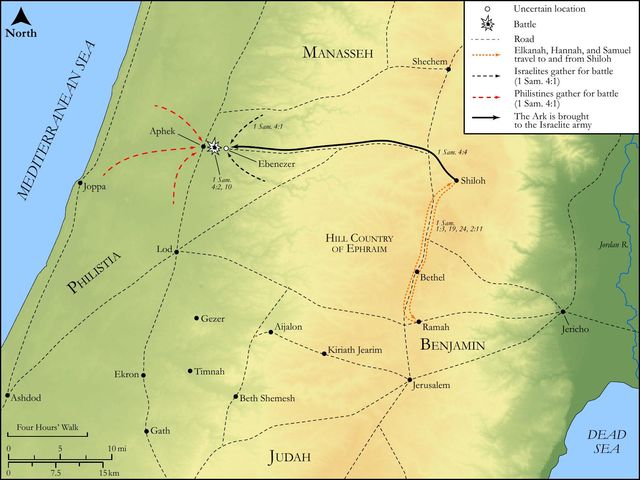
See on the biblical-era map
Study this verse
Public-domain commentary
Matthew Henry
From his Commentary on the Whole Bible. Henry comments on passages, not single verses — this entry covers 1 Samuel 4:12–18. His two-level outline is real structure in the source text, so it is rendered as structure.
Tidings are here brought to Shiloh of the fatal issue of their battle with the Philistines. Bad news flies fast. This soon spread through all Israel; every man that fled to his tent brought it, with too plain a proof of it, to his neighbours. But no place was so nearly concerned as Shiloh. Thither therefore an express posted away immediately; it was a man of Benjamin; the Jews fancy it was Saul. He rent his clothes, and put earth upon his head, by these signs to proclaim the sorrowful news to all that saw him as he ran, and to show how much he himself was affected with it, Sa1 4:12. He went straight to Shiloh with it; and here we are told,
I.How the city received it.
Eli sat in the gate (Sa1 4:13, Sa1 4:18), but the messenger was loth to tell him first, and therefore passed him by, and told it in the city, with all the aggravating circumstances; and now both the ears of every one that heard it tingled, as was foretold, Sa1 3:11. Their hearts trembled, and every face gathered blackness. All the city cried out (Sa1 3:13), and well they might, for, besides that this was a calamity to all Israel, it was a particular loss to Shiloh, and the ruin of that place; for, though the ark was soon rescued out of the hands of the Philistines, yet it never returned to Shiloh again; their candlestick was removed out of its place, because they had left their first love, and their city dwindled, and sunk, and came to nothing. Now God forsook the tabernacle of Shiloh, they having driven him from them; and the tribe of Ephraim, which had for 340 years been blessed with the presence of the ark in it, lost the honour (Psa 78:60, Psa 78:67), and, some time after, it was transferred to the tribe of Judah, the Mount Sion which he loved, as it follows there (Psa 78:68), because the men of Shiloh knew not the day of their visitation. This abandoning of Shiloh Jerusalem is long afterwards reminded of, and told to take warning by. Jer 7:12, "Go see what I did to Shiloh. From this day, this fatal day, let the desolations of Shiloh be dated." They had therefore reason enough to cry out when they heard that the ark was taken.
II.What a fatal blow it was to old Eli. Let us see,
1.With what fear he expected the tidings. Though old, and blind, and heavy, yet he could not keep his chamber when he was sensible the glory of Israel lay at stake, but placed himself by the way-side, to receive the first intelligence; for his heart trembled for the ark of God, Sa1 4:13. His careful thoughts represented to him what a dishonour it would be to God, and what an irreparable loss to Israel, if the ark should fall into the Philistines' hands, with what profane triumphs the tidings would be told in Gath and published in the streets of Ashkelon. He also apprehended what imminent danger there was of it. Israel had forfeited the ark (his own sons especially) and the Philistines would aim at it; and now the threatening comes to his mind, that he should see an enemy in God's habitation (Sa1 2:32); and perhaps his own heart reproached him for not using his authority to prevent the carrying of the ark into the camp. All these things made him tremble. Note, All good men lay the interests of God's church nearer their hearts than any secular interest or concern of their own, and cannot but be in pain and fear for them if at any time they are in peril. How can we be easy if the ark be not safe?
2.With what grief he received the tidings. Though he could not see, he could hear the tumult and crying of the city, and perceived it to be the voice of lamentation, and mourning, and woe; like a careful magistrate, he asks, What means the noise of this tumult? Sa1 4:14. He is told there is an express come from the army, who relates the story to him very distinctly, and with great confidence, having himself been an eye-witness of it, Sa1 4:16, Sa1 4:17. The account of the defeat of the army, and the slaughter of a great number of the soldiers, was very grievous to him as a judge; the tidings of the death of his two sons, of whom he had been so indulgent, and who, he had reason to fear, died impenitent, touched him in a tender part as a father; yet it was not for these that his heart trembled: there is a greater concern upon his spirit, which swallows up the less; he does not interrupt the narrative with any passionate lamentations for his sons, like David for Absalom, but waits for the end of the story, not doubting but that the messenger, being an Israelite, would, without being asked, say something of the ark; and if he could but have said, "Yet the ark of God is safe, and we are bringing that home," his joy for that would have overcome his grief for all the other disasters, and have made him easy; but, when the messenger concludes his story with, The ark of God is taken, he is struck to the heart, his spirits fail, and, it should seem, he swooned away, fell off his seat, and partly with the fainting, and partly with the fall, he died immediately, and never spoke a word more. His heart was broken first, and then his neck. So fell the high priest and judge of Israel, so fell his heavy head when he had lived within two of 100 years, so fell the crown from his head when he had judged Israel about forty years: thus did his sun set under a cloud, thus were the folly and wickedness of those sons of his, whom he had indulged, his ruin at last. Thus does God sometimes set marks of his displeasure in this life upon good men who have misconducted themselves, that others may hear, and fear, and take warning. A man may die miserably and yet not die eternally, may come to an untimely end and yet the end be peace. Dr. Lightfoot observes that Eli died the death of an unredeemed ass, whose neck was to be broken, Exo 13:13. Yet we must observe, to Eli's praise, that it was the loss of the ark that was his death, not the slaughter of his sons. He does, in effect, say, "Let me fall with the ark, for what pious Israelite can live with any comfort when God's ordinances are removed?" Farewell all in this world, even life itself, if the ark be gone.
Historical interpretation
Historical reception
1 surviving comment on this verse from the historical church.
And Eli heard the sound of the crying, etc. And the reputation of the repenting people reached even to the ears of the chief priests through the exhortation of the apostles, and it was not gladly received. Finally, while they were speaking to the people, the priests, and the magistrates of the temple, and the Sadducees came upon them, grieving that they were teaching the people and proclaiming in Jesus the resurrection from the dead. And the apostles did not delay to evangelize even them.
Continue studying 1 Samuel 4:14 across the web’s major study libraries — every link below opens this exact verse, chapter, or book on the destination site.
Read & Compare
 BibleGatewayThis verse in more than 200 translations and 70 languages.
 Bible.comThe YouVersion reader — hundreds of translations, reading plans, and highlights.
 ESV.orgCrossway's official English Standard Version reader.
 NET BibleThe NET translation with 60,000+ translators' notes on every rendering decision.
 STEP BibleTyndale House's free study tool — original text, vocabulary, and scholarly resources.
 BibliaLogos Bible Software's free web reader.
 USCCBThe New American Bible (Revised Edition) with the U.S. bishops' study notes.
Commentaries
 BibleHub CommentariesDozens of classic commentaries on this verse, gathered on one page.
 StudyLightMore than 100 commentary sets — the largest collection on the web.
 BibleRefPlain-English commentary on what this verse means, verse by verse.
 Enduring WordDavid Guzik's free commentary on this chapter, widely used by Bible teachers.
 Bible Study ToolsVerse commentary alongside Greek and Hebrew study aids.
Original Language & Research
- BibleHub InterlinearThe verse word by word — original language, transliteration, and English.
- BibleHub LexiconEvery word's original-language definition and Strong's entry.
 Blue Letter BibleDeep-study tools — Strong's numbers, concordance, and word studies.
 SefariaThe Hebrew text with Rashi and centuries of Jewish commentary.
Sermons, Hymns & Audio


TrulyRandomVerse is not affiliated with these sites and doesn’t control their content. They’re linked because they’re genuinely useful.
Summary
1 Samuel 4:14 vividly portrays the climactic moment when the aged High Priest Eli, anxiously awaiting news from the battlefield, is confronted by the chaotic sounds emanating from Shiloh. His immediate, discerning inquiry about the "noise of this tumult" reveals his profound apprehension, knowing that the Ark of the Covenant and his two corrupt sons were engaged in battle. This verse acts as a powerful dramatic prelude, setting the stage for the catastrophic news that will confirm his deepest fears and signify the devastating fulfillment of divine judgment upon his priestly house and the nation of Israel.
Context
ShowHideLiterary Context
This verse is strategically positioned as the narrative's tension reaches its peak, leading directly into the devastating climax of Israel's defeat and the judgment on Eli's family. The preceding verses (1 Samuel 4:1-11) recount Israel's initial defeat by the Philistines, their misguided decision to bring the Ark of the Covenant from Shiloh to the battlefield as a presumed talisman of victory, and the subsequent, even more catastrophic, second defeat where the Ark is captured and Eli's sons, Hophni and Phinehas, are killed. Eli, old, heavy, and nearly blind (as noted in 1 Samuel 4:15), has been sitting by the roadside, his heart "trembling for the ark of God" (1 Samuel 4:13), anxiously anticipating news. The "noise of the crying" he hears in verse 14 is the unmistakable sound of the defeated Israelite army returning in disarray, coupled with the wailing of the populace, signaling a national disaster even before the messenger arrives with the explicit details. This moment directly precedes the messenger's tragic report in 1 Samuel 4:17 and Eli's subsequent death upon hearing the news of the Ark's capture in 1 Samuel 4:18.
Historical & Cultural Context
The setting for 1 Samuel 4:14 is the turbulent period of the Judges, transitioning into the early monarchy. This era was marked by widespread spiritual apostasy, moral decay, and recurrent cycles of foreign oppression, particularly from the Philistines. Shiloh served as the central sanctuary for Israel, housing the Ark of the Covenant and thus functioning as the spiritual and religious heart of the nation. Eli, as the High Priest, held immense spiritual and national authority, but his failure to restrain his corrupt sons, Hophni and Phinehas, led to the desecration of the priesthood and the sanctuary, as detailed in the account of the wickedness of Eli's sons. The Philistines, a formidable seafaring people who had settled on the coastal plain, represented a constant military threat to Israel's sovereignty. The Israelites' decision to bring the Ark to battle reflected a superstitious and presumptuous belief that its mere physical presence, rather than God's active command and their obedient faith, would guarantee victory. This act profoundly misunderstood the nature of God's covenant and His holy presence, underscoring a deep spiritual malaise and a reliance on ritual over relationship.
Key Themes
ShowHideThis verse powerfully contributes to several overarching themes developed throughout 1 Samuel. Firstly, it underscores the consequences of unfaithfulness and spiritual corruption, particularly within leadership. The "tumult" Eli hears is a direct manifestation of Israel's pervasive sin and Eli's own failure to discipline his sons, fulfilling the prophecies of divine judgment against his house (e.g., God's judgment on Eli's house and Samuel's prophecy to Eli). Secondly, the passage highlights the weight and responsibility of spiritual leadership and the profound impact of a leader's actions and inactions on the entire community. Eli's palpable anxiety reflects the immense burden he carries, even as he faces the devastating fallout of his own moral compromises. Thirdly, the impending news signals the fall of Shiloh as the central place of worship, as the Ark is captured and never fully returns there, symbolizing a significant shift in God's presence and the end of an era for the Israelite priesthood and its worship practices. Finally, the verse powerfully embodies divine sovereignty; even amidst apparent defeat and chaos, God is meticulously working out His purposes of judgment and preparing the way for a new era of leadership under Samuel.
Exposition and Analysis
ShowHideKey Word Analysis
ShowHideThe Hebrew word ק֣וֹל (qôwl, H6963) generally translates to "voice" or "sound." However, in this context, coupled with "crying" and "tumult," it denotes a loud, distinct, and alarming sound that is far from ordinary. It is not merely ambient noise but a specific, recognizable sound of distress and commotion, indicating a significant and troubling event has occurred. Eli immediately discerns the unusual and foreboding nature of this sound, prompting his urgent inquiry.
The word צְעָקָה (tsaʻăqâh, H6818) signifies an "outcry," "wailing," or "shout," frequently associated with deep distress, lamentation, or a desperate cry for help. It implies a collective expression of anguish, panic, and sorrow from a large group of people. This specific type of "noise" instantly signals to Eli that the news is catastrophic, far surpassing a simple military setback, and pointing to a profound national sorrow and fear.
The Hebrew term הָמ֣וֹן (hâmôwn, H1995) refers to an "uproar," "clamor," or "commotion," often linked to a noisy crowd, the chaos of battle, or a scene of destruction. It conveys a strong sense of disorder, disarray, and a loud, confused disturbance. Eli's use of this word in his question, "What [meaneth] the noise of this tumult?", reveals his intuitive understanding that the sounds signify not just bad news, but a widespread, chaotic disaster that has engulfed the community.
Verse Breakdown
ShowHide"And when Eli heard the noise of the crying"
This clause immediately draws attention to Eli's acute auditory perception, despite his advanced age and failing eyesight (as noted in 1 Samuel 4:15). The specific nature of the sound—"the noise of the crying"—is paramount. It is not the sound of celebration, normal activity, or even a typical battle cry, but a distinct, collective wail of distress, indicating a profound tragedy has befallen the people. Eli's position "by the wayside upon a seat watching" (1 Samuel 4:13) emphasizes his anxious anticipation of news from the battle, making him particularly attuned to such a significant auditory signal.
"he said, What [meaneth] the noise of this tumult?"
Eli's immediate verbal response underscores his deep apprehension and spiritual discernment. He doesn't require explicit details; the very nature of the sound confirms his worst fears. His question is not born of ignorance but rather a desperate plea for confirmation of the specific disaster he instinctively perceives. The word "tumult" (הָמ֣וֹן, hâmôwn) implies a chaotic, disorienting uproar, suggesting a national catastrophe rather than a minor setback, highlighting the widespread nature of the impending tragedy.
"And the man came in hastily, and told Eli."
This final clause marks the dramatic transition from Eli's anxious premonition to the direct confrontation with reality. The messenger's hasty arrival (from mâhar, H4116, "to hurry") emphasizes the urgency and gravity of the news he carries. This moment serves as the critical pivot point where Eli's long-held fears, and the divine prophecies against his house, are about to be fulfilled, leading directly to the devastating report of the Ark's capture and his sons' deaths. The narrative efficiently moves from sound to inquiry to the arrival of the bearer of doom.
Literary Devices
ShowHideThe verse employs several powerful literary devices to heighten its dramatic impact and underscore its theological significance. Foreshadowing is prominently featured, as the "noise of the crying" and "tumult" directly precede and unmistakably anticipate the catastrophic news that will be delivered. The reader, already privy to the battle's outcome from earlier verses, experiences dramatic irony as Eli, though sensing profound disaster, remains unaware of its full, devastating scope. The scene also skillfully evokes pathos, as Eli, despite his earlier failings and the judgment pronounced upon him, is presented as an old, vulnerable figure awaiting news that will shatter his world and end his life, eliciting a degree of pity from the audience. The contrast between Eli's physical weakness (blindness, advanced age) and his acute spiritual intuition regarding the nature of the sound creates a subtle irony, emphasizing that true discernment is not always dependent on physical sight. Furthermore, the rapid progression from the unsettling sound to Eli's urgent question, and then to the messenger's swift arrival, masterfully builds suspense, drawing the reader deeply into Eli's anxious and fateful wait.
Theological and Thematic Connections
ShowHide1 Samuel 4:14 stands as a stark and sobering reminder that the consequences of spiritual compromise and disobedience are often far-reaching and devastating, impacting not just individuals but entire communities and nations. Eli's anxious inquiry underscores the profound principle that sin, particularly when tolerated or perpetuated within leadership, creates a deep spiritual "tumult" that eventually manifests in tangible, often tragic, ways. God, though patient and long-suffering, ultimately brings His righteous judgment upon unfaithfulness, even when it involves the capture of His own sacred Ark. This demonstrates His absolute sovereignty over all circumstances and His unwavering refusal to be manipulated or contained by human presumption or superstition. The noise of the crying is thus the sound of a people reaping what they have sown, a nation experiencing the painful and unavoidable consequences of neglecting God's commands and dishonoring His name through corrupt practices and a superficial approach to worship.
Reflection and Application
ShowHideEli's experience in 1 Samuel 4:14 offers profound and timeless lessons for contemporary believers and communities. It compels us to cultivate spiritual discernment, urging us not merely to hear but to truly understand the "noise of the crying" and the "tumult" that may be present in our own lives, families, churches, and societies. These "noises" might manifest as moral decay, relational brokenness, spiritual apathy, widespread injustice, or a pervasive sense of anxiety—all indicators that something is profoundly amiss and that divine warnings might have been ignored. Like Eli, we may sense impending trouble, and this verse challenges us to move beyond mere apprehension to active introspection, humble confession, and genuine repentance. It serves as a powerful reminder that our actions and inactions, especially those of leaders, have ripple effects that can lead to widespread spiritual and even physical devastation. We are called to heed God's warnings with urgency, to confront difficult truths with courage, and to seek His grace for genuine repentance and restoration, rather than passively awaiting the inevitable and often painful consequences of unfaithfulness.
Questions for Reflection
ShowHideFAQ
ShowHideWhy was Eli so anxious about the noise, even before the messenger arrived?
ShowHideEli's profound anxiety stemmed from a confluence of critical factors. Firstly, he was acutely aware of the immense stakes of the battle, particularly because the Ark of God, symbolizing God's presence and covenant with Israel, had been presumptuously taken to the front lines, as described in the account of the Ark being brought to battle. His heart was already "trembling for the ark of God" (1 Samuel 4:13), recognizing the immense spiritual significance and potential danger of its use as a mere war charm. Secondly, he knew his two wicked sons, Hophni and Phinehas, were with the Ark, and he had already received dire prophecies of judgment against his house due to their ungodliness and his failure to restrain them (see God's judgment on Eli's house and Samuel's prophecy to Eli). The specific nature of the sound—a "noise of the crying" and "tumult"—was not just general commotion, but a distinct, collective wail of distress and chaos, which would immediately suggest a catastrophic defeat and the worst possible news regarding the Ark and his sons. His spiritual discernment, though flawed in other areas, was acute enough to interpret these sounds as an undeniable harbinger of disaster.
Christ-Centered Fulfillment
ShowHideThe "noise of the crying" and "tumult" that Eli heard in 1 Samuel 4:14 serves as a poignant echo of the spiritual chaos, judgment, and brokenness that pervades a world estranged from God. Eli, as the High Priest, was divinely appointed to mediate God's presence and blessing to His people, yet his own failures, and the subsequent judgment on his house and the Ark's capture, powerfully underscored the ultimate inadequacy of the Old Covenant priesthood to truly address the deep-seated sin and spiritual brokenness of humanity. This historical moment points forward to the ultimate and perfect High Priest, Jesus Christ. Unlike Eli, who could only hear the sound of impending judgment and passively await its devastating confirmation, Jesus actively stepped into the "tumult" of human sin and bore its full weight. He is the one who silences the "noise of the crying" caused by sin and death, not by averting judgment, but by receiving it upon Himself on the cross. Through His perfect sacrifice, Jesus became the true Lamb of God who takes away the sin of the world, offering a definitive and eternal solution to the spiritual chaos that plagued Israel and continues to afflict humanity. His priesthood, unlike Eli's, is eternal, incorruptible, and perfectly effective (Hebrews 7:23-28), ensuring perfect intercession and complete reconciliation between God and humanity. In Christ, the "tumult" of divine wrath is appeased, and true peace with God is established, fulfilling what the Old Covenant priesthood could only foreshadow and ultimately failed to achieve.