


1 Samuel 4:18
Bible text: King James Version (1769 Blayney text) · Public domain
Bible text: King James Version with Strong's numbers · Public domain
Bible text: Berean Standard Bible · Public domain
Bible text: American Standard Version (1901) · Public domain
Bible text: World English Bible, Messianic edition · Public domain
Bible text: Geneva Bible (1599) · Public domain
Bible text: Young's Literal Translation · Public domain
- וַיְהִיvay·Hiand it wasH1961Conj-w ¦ V-Qal-ConsecImperf-3msVerb Qal Consecutive Imperfect 3rd Singular Masculineוַandיְהִיit was
- כְּהַזְכִּירוֹke·haz·ki·Rowhen he brought to remembranceH2142Prep-k ¦ V-Hiphil-Inf ¦ 3msVerb Hiphil Infinitive Constructכְּwhenהַזְכִּירbrought to remembranceוֹhe
- אֶת'et<obj.>H853DirObjMParticle Object Indicator
- אֲרוֹן'a·Ron[the] ark ofH727N-mscNoun Singular Masculine Construct
- הָאֱלֹהִיםha·'E·lo·Him<the> GodH430Art ¦ N-mpNoun Plural Masculine Absoluteהָ<the>אֱלֹהִיםGod
- וַיִּפֹּלvai·yi·Poland he fellH5307Conj-w ¦ V-Qal-ConsecImperf-3msVerb Qal Consecutive Imperfect 3rd Singular Masculineוַandיִּפֹּלhe fell
- מֵעַלme·'alfrom onH5921Prep-m ¦ PrepPrepositionמֵfromעַלon
- הַכִּסֵּאHa·ki·se'the seatH3678Art ¦ N-msNoun Singular Masculine Absoluteהַtheכִּסֵּאseat
- אֲחֹרַנִּית'a·Cho·ra·NitbackwardsH322AdvAdverb
- בְּעַדbe·'AdbehindH1157Adj-cscAdjective Numerical Singular common gender Construct
- יַדyad[the] side ofH3027N-cscNoun Singular common gender Construct
- הַשַּׁעַרha·Sha·'arthe gateH8179Art ¦ N-msNoun Singular Masculine Absoluteהַtheשַּׁעַרgate
- וַתִּשָּׁבֵרva·ti·sha·Verand it was brokenH7665Conj-w ¦ V-Niphal-ConsecImperf-3fsVerb Niphal Consecutive Imperfect 3rd Singular Feminineוַandתִּשָּׁבֵרit was broken
- מַפְרַקְתּוֹmaf·rak·Tohis neckH4665N-fsc ¦ 3msNoun Singular Feminine Constructמַפְרַקְתּneckוֹhis
- וַיָּמֹתvai·ya·Motand he diedH4191Conj-w ¦ V-Qal-ConsecImperf-3msVerb Qal Consecutive Imperfect 3rd Singular Masculineוַandיָּמֹתhe died
- כִּיkiforH3588PrtParticle Conditional
- זָקֵןza·Kenhe was oldH2204V-Qal-Perf-3msVerb Qal Perfect 3rd Singular Masculine
- הָאִישׁha·'Ishthe manH376Art ¦ N-msNoun Singular Masculine Absoluteהָtheאִישׁman
- וְכָבֵדve·kha·Vedand heavyH3515Conj-w ¦ Adj-msAdjective Singular Masculine Absoluteוְandכָבֵדheavy
- וְהוּאve·Hu'and heH1931Conj-w ¦ Pro-3msPronoun Personal 3rd Singular Masculineוְandהוּאhe
- שָׁפַטsha·Fathe had judgedH8199V-Qal-Perf-3msVerb Qal Perfect 3rd Singular Masculine
- אֶת'et<obj.>H853DirObjMParticle Object Indicator
- יִשְׂרָאֵלYis·ra·'ElIsraelH3478N-properNoun Proper Location
- אַרְבָּעִים'ar·ba·'ImfortyH705N-mpNoun Plural Masculine Absolute
- שָׁנָהsha·Nahyear[s]H8141N-fsNoun Singular Feminine Absolute
English is a literal word-by-word gloss of the Hebrew, not the KJV's wording. Why?
This is the original text the KJV's translators worked from — each Hebrew word with its own literal English meaning in this verse, prepared by scholars at Tyndale House, Cambridge. The KJV translates whole sentences, not word by word, so its wording differs: one Hebrew word can become several English words, and the KJV may choose “the LORD” where the gloss reads “Yahweh”. Both are faithful — they answer different questions. For the KJV's own rendering, switch to the KJV text.
Details
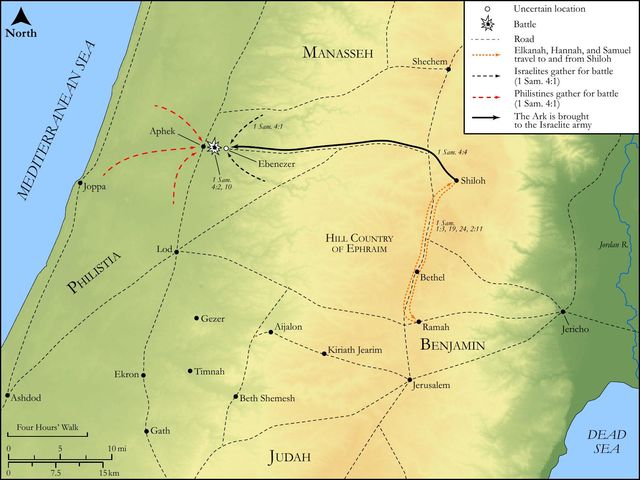
See on the biblical-era map
Study this verse
Public-domain commentary
Matthew Henry
From his Commentary on the Whole Bible. Henry comments on passages, not single verses — this entry covers 1 Samuel 4:12–18. His two-level outline is real structure in the source text, so it is rendered as structure.
Tidings are here brought to Shiloh of the fatal issue of their battle with the Philistines. Bad news flies fast. This soon spread through all Israel; every man that fled to his tent brought it, with too plain a proof of it, to his neighbours. But no place was so nearly concerned as Shiloh. Thither therefore an express posted away immediately; it was a man of Benjamin; the Jews fancy it was Saul. He rent his clothes, and put earth upon his head, by these signs to proclaim the sorrowful news to all that saw him as he ran, and to show how much he himself was affected with it, Sa1 4:12. He went straight to Shiloh with it; and here we are told,
I.How the city received it.
Eli sat in the gate (Sa1 4:13, Sa1 4:18), but the messenger was loth to tell him first, and therefore passed him by, and told it in the city, with all the aggravating circumstances; and now both the ears of every one that heard it tingled, as was foretold, Sa1 3:11. Their hearts trembled, and every face gathered blackness. All the city cried out (Sa1 3:13), and well they might, for, besides that this was a calamity to all Israel, it was a particular loss to Shiloh, and the ruin of that place; for, though the ark was soon rescued out of the hands of the Philistines, yet it never returned to Shiloh again; their candlestick was removed out of its place, because they had left their first love, and their city dwindled, and sunk, and came to nothing. Now God forsook the tabernacle of Shiloh, they having driven him from them; and the tribe of Ephraim, which had for 340 years been blessed with the presence of the ark in it, lost the honour (Psa 78:60, Psa 78:67), and, some time after, it was transferred to the tribe of Judah, the Mount Sion which he loved, as it follows there (Psa 78:68), because the men of Shiloh knew not the day of their visitation. This abandoning of Shiloh Jerusalem is long afterwards reminded of, and told to take warning by. Jer 7:12, "Go see what I did to Shiloh. From this day, this fatal day, let the desolations of Shiloh be dated." They had therefore reason enough to cry out when they heard that the ark was taken.
II.What a fatal blow it was to old Eli. Let us see,
1.With what fear he expected the tidings. Though old, and blind, and heavy, yet he could not keep his chamber when he was sensible the glory of Israel lay at stake, but placed himself by the way-side, to receive the first intelligence; for his heart trembled for the ark of God, Sa1 4:13. His careful thoughts represented to him what a dishonour it would be to God, and what an irreparable loss to Israel, if the ark should fall into the Philistines' hands, with what profane triumphs the tidings would be told in Gath and published in the streets of Ashkelon. He also apprehended what imminent danger there was of it. Israel had forfeited the ark (his own sons especially) and the Philistines would aim at it; and now the threatening comes to his mind, that he should see an enemy in God's habitation (Sa1 2:32); and perhaps his own heart reproached him for not using his authority to prevent the carrying of the ark into the camp. All these things made him tremble. Note, All good men lay the interests of God's church nearer their hearts than any secular interest or concern of their own, and cannot but be in pain and fear for them if at any time they are in peril. How can we be easy if the ark be not safe?
2.With what grief he received the tidings. Though he could not see, he could hear the tumult and crying of the city, and perceived it to be the voice of lamentation, and mourning, and woe; like a careful magistrate, he asks, What means the noise of this tumult? Sa1 4:14. He is told there is an express come from the army, who relates the story to him very distinctly, and with great confidence, having himself been an eye-witness of it, Sa1 4:16, Sa1 4:17. The account of the defeat of the army, and the slaughter of a great number of the soldiers, was very grievous to him as a judge; the tidings of the death of his two sons, of whom he had been so indulgent, and who, he had reason to fear, died impenitent, touched him in a tender part as a father; yet it was not for these that his heart trembled: there is a greater concern upon his spirit, which swallows up the less; he does not interrupt the narrative with any passionate lamentations for his sons, like David for Absalom, but waits for the end of the story, not doubting but that the messenger, being an Israelite, would, without being asked, say something of the ark; and if he could but have said, "Yet the ark of God is safe, and we are bringing that home," his joy for that would have overcome his grief for all the other disasters, and have made him easy; but, when the messenger concludes his story with, The ark of God is taken, he is struck to the heart, his spirits fail, and, it should seem, he swooned away, fell off his seat, and partly with the fainting, and partly with the fall, he died immediately, and never spoke a word more. His heart was broken first, and then his neck. So fell the high priest and judge of Israel, so fell his heavy head when he had lived within two of 100 years, so fell the crown from his head when he had judged Israel about forty years: thus did his sun set under a cloud, thus were the folly and wickedness of those sons of his, whom he had indulged, his ruin at last. Thus does God sometimes set marks of his displeasure in this life upon good men who have misconducted themselves, that others may hear, and fear, and take warning. A man may die miserably and yet not die eternally, may come to an untimely end and yet the end be peace. Dr. Lightfoot observes that Eli died the death of an unredeemed ass, whose neck was to be broken, Exo 13:13. Yet we must observe, to Eli's praise, that it was the loss of the ark that was his death, not the slaughter of his sons. He does, in effect, say, "Let me fall with the ark, for what pious Israelite can live with any comfort when God's ordinances are removed?" Farewell all in this world, even life itself, if the ark be gone.
Historical interpretation
Fourteen Centuries of Reception
4 surviving comments on this verse. Each one is dated, so this reads as a timeline rather than a list.
Select a marker to jump to its quote. Markers stagger vertically where authors wrote within a few decades of each other.
See what chastity is required in a bishop! If his child is unchaste, he himself cannot be a bishop, and he offends God in the same way as did Eli the priest, who had indeed rebuked his sons, but because he had not put away the offenders, fell backwards and died before the lamp of God went out.
Harsh preaching provides remedies for souls that are sick and arranges adornments for the healthy. What the Holy Spirit threatens the Lord’s priests through the prophet is not a slight matter. “If you do not declare to the wicked his iniquity,” he says, “I will require his blood at your hand,” and again: “cry, do not cease; lift up your voice like a trumpet, and show my people their sins.” … For this reason, dearly beloved, I absolve my conscience in the sight of God as often as I mention with humility a few words for the salvation of your soul. Indeed, I fear and shudder at the example of Eli, the priest, for, when he heard that his sons were committing adultery, he pretended to kill them or to suspend them from communion, but only gently admonished them, saying, “My sons, it is no good report that I hear about you. If one man shall sin against another, the priest will pray for him; but if the priest himself sins, who shall pray for him?” Now, in spite of this admonition, he fell backwards from his stool and died of a broken neck, and his name was blotted out of the book of life, because he did not punish his sons with great severity.
The man was an old man, and advanced in years, etc. That priesthood had become aged at that time, once glorious with rich virtue, and it showed, at the appropriate time, judgments of the divine law, which is encompassed in the Decalogue, to the people of Israel through chief priests, elders of the people, scribes, and Pharisees who are also called doctors of the law. Moreover, according to the figurative interpretation of the law, each of us ought to keep the ark of the covenant within the tabernacle interiorly, and, when the time comes, while preparing to fight against the Philistines, he must offer this with himself; that is, he must always maintain firm faith and a chaste conscience; and when the situation demands, he must bring it forth as his aid in spiritual warfare against the impure, be they humans or demons, carrying with him two priests as guards, namely, the vigilant senses of twin love. For the Apostle does not deem just any faith worthy of praise, but rather that which works through love (Gal. V). And if, perhaps, while we are fighting, the impure spirits or heretics snatch away the ark of faith and kill the priestly and devout senses, it is necessary for a Benjamite man, distinguished by mourning dress, that is, a mind uplifted by the hope of heavenly piety, to come humbly and penitently, bringing back to our minds our errors and inducing the whole city of our ruler into mourning and tears, until, through God's mercy, the captured ark is returned, and a better priest is given to us in place of the lost ones, that is, a more chastened sense, after the labors of penance, and more vigilant and careful. Neither does the time of the seven months during which the Philistines held the ark diverge from the figurative form of penance. For it is well established that the grace of the Holy Spirit, which is said to be sevenfold, must be obtained by undertaking penance for the committed sins and seeking forgiveness; and the Fathers declare that this forgiveness must be sought in seven ways. Indeed, the expositors of the Psalter suggest seven penitential psalms, by which heavenly piety should be implored to obtain the remission of sins. However, there are those who convert the remembrance, recognition, and sorrow of sins not to seek remedy, but as Judas to augment their previous crimes. Since they have become aged among all their enemies, with their eye of the mind disturbed by the wrath of God, they have also lost the light of faith, and suddenly returning to the seat of judicial discretion, immediately perishing, they leave; and although they seemed to have lived discreetly for a while and managed themselves well according to the precepts of the law and the Gospel (for this is to judge Israel for forty years), nevertheless, upon the onset of the trial, they succumb to a miserable death.
Named the ark: There is great reason, by all these circumstances, to hope that Heli died in a state of grace; and by his temporal punishments escaped the eternal.
Continue studying 1 Samuel 4:18 across the web’s major study libraries — every link below opens this exact verse, chapter, or book on the destination site.
Read & Compare
 BibleGatewayThis verse in more than 200 translations and 70 languages.
 Bible.comThe YouVersion reader — hundreds of translations, reading plans, and highlights.
 ESV.orgCrossway's official English Standard Version reader.
 NET BibleThe NET translation with 60,000+ translators' notes on every rendering decision.
 STEP BibleTyndale House's free study tool — original text, vocabulary, and scholarly resources.
 BibliaLogos Bible Software's free web reader.
 USCCBThe New American Bible (Revised Edition) with the U.S. bishops' study notes.
Commentaries
 BibleHub CommentariesDozens of classic commentaries on this verse, gathered on one page.
 StudyLightMore than 100 commentary sets — the largest collection on the web.
 BibleRefPlain-English commentary on what this verse means, verse by verse.
 Enduring WordDavid Guzik's free commentary on this chapter, widely used by Bible teachers.
 Bible Study ToolsVerse commentary alongside Greek and Hebrew study aids.
Original Language & Research
- BibleHub InterlinearThe verse word by word — original language, transliteration, and English.
- BibleHub LexiconEvery word's original-language definition and Strong's entry.
 Blue Letter BibleDeep-study tools — Strong's numbers, concordance, and word studies.
 SefariaThe Hebrew text with Rashi and centuries of Jewish commentary.
Sermons, Hymns & Audio


TrulyRandomVerse is not affiliated with these sites and doesn’t control their content. They’re linked because they’re genuinely useful.
Summary
1 Samuel 4:18 vividly recounts the sudden and tragic death of Eli, Israel's high priest and judge, immediately upon hearing the devastating news of the Ark of God's capture by the Philistines. This pivotal moment not only marks the definitive end of Eli's forty-year leadership but also serves as the climactic fulfillment of divine judgment against his house, powerfully illustrating the severe consequences of spiritual negligence and the profound, irreplaceable significance of God's holy presence among His people.
Context
ShowHideLiterary Context
This verse stands as the somber culmination of a narrative thread meticulously woven through the preceding chapters, detailing the spiritual decay within Israel under Eli's leadership and the impending divine reckoning. The narrative previously established Eli's profound failure to restrain his two sons, Hophni and Phinehas, who brazenly profaned the tabernacle and scorned the Lord's offerings, as detailed in 1 Samuel 2:12-17. A divine messenger, identified as a "man of God," first delivered a chilling prophecy foretelling the downfall of Eli's priestly house, including the precise detail of his two sons dying on the same day, a prophecy recorded in 1 Samuel 2:27-36. This dire pronouncement was later reaffirmed and expanded upon to the young prophet Samuel, solidifying the certainty of God's judgment in 1 Samuel 3:11-14. The immediate backdrop to 1 Samuel 4:18 is the disastrous military engagement with the Philistines, where Israel, presumptuously treating the Ark of the Covenant as a mere magical charm rather than revering it as the sacred symbol of God's holy presence, brought it into battle, as recounted in 1 Samuel 4:3-5. The messenger's arrival at Shiloh, where Eli sat by the city gate, delivered a cascade of increasingly devastating news: Israel's crushing defeat, the death of his two sons, and finally, the unthinkable capture of the Ark. It was this ultimate piece of news that proved fatal for the aged Eli.
Historical & Cultural Context
During this tumultuous period of Israel's history, Eli held the dual and immensely significant roles of High Priest and Judge, thereby combining both spiritual and civil authority over the nation. Shiloh served as the central place of worship, housing the tabernacle and the Ark of the Covenant, effectively making it the spiritual capital of Israel. The Ark itself was far more than a mere religious artifact; it was the holiest object in Israelite worship, representing God's very throne, His covenant presence, and the place from which He communed with His people, as detailed in Exodus 25:22. Its capture by the Philistines, a formidable and frequently hostile neighboring power, constituted an unprecedented national catastrophe and a profound spiritual humiliation. This event was widely understood as a visible sign of God's temporary withdrawal of His manifest presence, a direct consequence of Israel's pervasive sin and the deep corruption within the priesthood. Eli's customary position "by the side of the gate" was culturally significant, indicating his public role as a civic leader, overseeing the city's affairs, dispensing justice, and awaiting vital news—a common practice for judges and elders in the cities of Israel, as when Boaz sat down in the gate with ten men of the elders of the city.
Key Themes
ShowHideThe narrative surrounding Eli's death is replete with profound and enduring theological themes. Divine Judgment and Consequences stand paramount, as Eli's demise is a direct and dramatic fulfillment of the prophecies pronounced against his house, particularly the one in 1 Samuel 3:13. His death vividly illustrates that spiritual negligence, especially within leadership, carries severe and inescapable consequences, demonstrating God's unwavering commitment to His holiness and justice. Another crucial theme is Reverence for God's Presence, powerfully underscored by Eli's ultimate reaction to the Ark's capture. While the news of his sons' deaths was undoubtedly tragic, it was the report of the Ark's loss that triggered his fatal collapse, emphasizing the Ark's immense spiritual significance as the tangible symbol of God's covenant relationship with Israel. Its capture was perceived as the ultimate affront to God's honor and a national spiritual disaster, signifying a breach in the divine-human relationship. Finally, the Weight of Leadership is profoundly evident in Eli's story. His physical description as an "old man, and heavy" not only provides a practical explanation for his fatal fall but also metaphorically conveys the immense burden and sacred responsibility of his dual roles as high priest and judge. His failure to uphold righteousness and to discipline his sons effectively led not only to his personal downfall but also to a significant national crisis, emphasizing the profound and far-reaching impact of spiritual leadership on a community's well-being and its relationship with God.
Exposition and Analysis
ShowHideKey Word Analysis
ShowHideThis primitive root signifies "to mark (so as to be recognized), i.e., to remember; by implication, to mention." In this context, the messenger's act of "making mention" of the Ark of God is not a casual reference but a deliberate, impactful pronouncement. It implies bringing to Eli's remembrance the ultimate symbol of God's presence, the very thing Eli, as High Priest, was charged to protect and honor. The word highlights the specific trigger for Eli's collapse, indicating that the loss of God's manifest presence was the most grievous news he could receive, surpassing even the death of his own sons.
This word, from a primitive root meaning "to be heavy," carries a rich semantic range that extends beyond mere physical corpulence. While it certainly describes Eli's physical weight, which contributed to his fatal fall, it also encompasses senses of being burdensome, dull, or even honored. In Eli's case, it suggests not only his literal physical "heaviness" but also metaphorically the spiritual and emotional "heaviness" of his age, the cumulative burden of his unfulfilled responsibilities, his failures as a father and priest, and the crushing weight of the divine judgment that had now fully descended upon his family and the nation. His physical state thus mirrors his spiritual and emotional condition.
This primitive root means "to burst (literally or figuratively); break (down, off, in pieces, up)." Here, it is used to describe the violent and sudden breaking of Eli's neck, indicating an immediate and definitive end to his life. The choice of this powerful verb emphasizes the abruptness and finality of his death, directly linking it to the profound shock and spiritual devastation caused by the news of the Ark's capture. It signifies a complete and irreversible collapse, both physically and, symbolically, of his era of leadership.
Verse Breakdown
ShowHide"And it came to pass, when he made mention of the ark of God,"
This clause pinpoints the precise catalyst for Eli's demise. The messenger had already delivered the grim tidings of Israel's military defeat and the death of Eli's two sons, Hophni and Phinehas. However, it was the specific, climactic announcement of the Ark of God's capture that proved to be the ultimate breaking point for Eli, underscoring his profound, albeit tragically belated, prioritization of God's honor and presence above even his own family.
"that he fell from off the seat backward by the side of the gate,"
This describes the physical action of Eli's collapse. His sitting "by the side of the gate" signifies his public role as judge and elder, a place where he would typically receive news and administer justice. His falling "backward" suggests a sudden, uncontrolled, and perhaps undignified collapse, indicative of overwhelming shock, despair, and physical frailty. The fall from his seat symbolizes the abrupt end of his authority and the era of his leadership.
"and his neck brake, and he died:"
This directly states the immediate cause and consequence of his fall. The breaking of his neck signifies an instant and fatal injury, leading to an immediate death. This swift and decisive end underscores the severity of the shock and the finality of the divine judgment that had been pronounced against his house and his priestly line. His death is presented not as a mere accident but as a divinely ordained consequence.
"for he was an old man, and heavy."
This provides a practical, physical explanation for the fatal nature of his fall. His advanced age and physical corpulence ("heavy") made him particularly vulnerable to such a severe injury. However, as explored in the Key Word Analysis, "heavy" also carries profound metaphorical weight, hinting at the accumulated burden of his responsibilities, his spiritual failures, and the crushing weight of the judgment that culminated in this moment.
"And he had judged Israel forty years."
This concluding statement serves as a concise summary of Eli's long tenure as judge, emphasizing the significant period of his leadership that now abruptly concludes. The duration of "forty years" often symbolizes a generation or a significant period of testing, transition, and divine dealings in biblical narratives. His death marks the definitive close of an era characterized by spiritual decline and sets the stage for the emergence of Samuel as a prophet and judge, ushering in a new chapter in Israel's history.
Literary Devices
ShowHideThe passage masterfully employs several potent literary devices to convey its profound message and emotional impact. Irony is strikingly evident in Eli's death: he, the High Priest, whose sacred duty it was to guard the Ark and uphold God's holiness, dies as a direct consequence of its capture, an event precipitated by the very spiritual negligence he failed to curb in his sons. His physical "heaviness" serves as powerful Symbolism, representing not only his literal corpulence but also the immense spiritual burden of his unfaithfulness, the weight of his unaddressed failures, and the crushing judgment upon his house. The abruptness of his fall and immediate death, triggered by the news of the Ark, creates a profound sense of Pathos, evoking pity for the old man whose ultimate concern, despite his personal failings, was the glory of God and the preservation of His presence. Furthermore, the entire narrative of Eli's decline and ultimate demise functions as Foreshadowing for the broader spiritual state of Israel, signaling the necessity of a radical shift and the impending arrival of a new era of leadership, soon to be ushered in by Samuel and eventually the monarchy.
Theological and Thematic Connections
ShowHideEli's tragic death in 1 Samuel 4:18 stands as a stark and sobering illustration of God's unwavering justice and the severe consequences of spiritual compromise, particularly for those entrusted with positions of leadership. It powerfully underscores that God values His own honor and the integrity of His covenant above all else, even above human life, familial loyalties, or personal comfort. Eli's failure to prioritize God's explicit commands and to effectively discipline his sons, who brought God's name into disrepute, directly led to the fulfillment of a divine judgment that brought an end to his priestly line and his era of leadership. This pivotal event serves as a potent reminder that while God is infinitely merciful, He is also absolutely holy and will not tolerate persistent disobedience, especially when it profanes His sacred institutions and diminishes His glory. The narrative emphasizes that true reverence for God demands active obedience, upholding His standards, and diligently guarding His presence, not merely performing empty rituals.
Reflection and Application
ShowHideThe poignant and tragic account of Eli's death offers profound and enduring lessons for believers today, particularly for those who bear the weighty mantle of spiritual authority within their families, churches, or communities. It compels us to undertake a rigorous self-examination of our own priorities: do we genuinely honor God above all else, including our personal comfort, the desire for familial harmony, or our worldly reputation? Eli's ultimate despair was over the Ark of God, yet his prior negligence allowed the very conditions that led to its capture. This highlights the critical importance of consistent faithfulness, proactive spiritual leadership, and unwavering moral courage. For all believers, the story serves as a sober reminder that God's holiness demands profound reverence, and His warnings are not to be taken lightly. We are called to live lives that authentically reflect His glory, to diligently guard the integrity of His truth, and to discipline ourselves and those under our care in accordance with His immutable Word. Our greatest treasure should unequivocally be the manifest presence of God, and our greatest sorrow, anything that dishonors Him or diminishes His presence in our individual lives and collective communities.
Questions for Reflection
ShowHideFAQ
ShowHideWhy was the Ark's capture more impactful to Eli than the death of his sons?
ShowHideEli's visceral reaction, prioritizing the news of the Ark's capture over the tragic deaths of his own sons, profoundly reveals his understanding of its immense spiritual significance. While the loss of his sons was a deeply personal tragedy and a direct fulfillment of prophecy, the Ark of God represented the very presence of God among His people, the tangible symbol of His covenant with Israel, and His throne (the mercy seat). Its capture was not merely a military defeat but an unprecedented spiritual catastrophe, signifying God's apparent withdrawal or judgment upon His people and the desecration of His holy name. For Eli, as High Priest, the loss of the Ark was the ultimate blasphemy and national humiliation, a direct affront to God's glory, which he, despite his personal failings in leadership, still held in supreme regard. This emphasis on the Ark's loss over his sons' lives underscores that Eli's deepest identity and concern were intrinsically tied to the spiritual well-being and divine presence within Israel, even if he had demonstrably failed in his duties leading up to this moment, as highlighted in 1 Samuel 2:27-36.
What does the description of Eli as "heavy" truly imply beyond his physical weight?
ShowHideThe Hebrew word for "heavy" (כָּבֵד, kâbad' H3513) carries a rich and significant double meaning. While it literally refers to Eli's physical corpulence, which undoubtedly contributed to the fatal outcome of his fall, it also metaphorically implies a "heaviness" of spirit. This can encompass a burden of responsibility, profound sorrow, or even the crushing weight of his guilt and the impending divine judgment. Eli was "heavy" with the burden of his advanced age, heavy with the immense responsibility of his high office, heavy with the sorrow of his sons' wickedness and the nation's crushing defeat, and ultimately, heavy with the spiritual consequences of his own negligence. This linguistic nuance adds profound depth to the tragedy, suggesting that his physical collapse was a visible manifestation of the cumulative spiritual, emotional, and moral weight he had carried, and ultimately succumbed to. This metaphorical sense of "heaviness" is also seen elsewhere in Scripture, such as Pharaoh's heart being "heavy" or hardened in Exodus 7:14.
Was Eli's death a direct judgment from God, or merely an accident?
ShowHideEli's death was unequivocally a direct judgment from God, not merely a tragic accident. While his physical condition—being an "old man, and heavy"—certainly contributed to the fatal outcome of his fall, the precise timing and the specific trigger of his death were divinely orchestrated. The prophecies delivered by the unnamed "man of God" in 1 Samuel 2:27-36 and subsequently reaffirmed by the young prophet Samuel in 1 Samuel 3:11-14 explicitly foretold the downfall of Eli's house due to his failure to honor God above his own sons. His sons died on the very same day, exactly as prophesied, and Eli's death immediately followed the news of the Ark's capture, which was the ultimate sign of God's profound displeasure and judgment upon Israel and its corrupt priesthood. This precise sequence of events powerfully demonstrates God's sovereignty and His unwavering commitment to fulfilling His Word, both in warning and in decisive judgment. Eli's death thus served as the final, dramatic, and divinely ordained fulfillment of the judgment pronounced against his negligent leadership.
Christ-Centered Fulfillment
ShowHideEli's tragic end, marked by the devastating loss of the Ark of God and the divine judgment upon his priestly line, powerfully foreshadows the ultimate and indispensable need for a new, perfect, and eternal High Priest. The capture of the Ark, which symbolized God's holy presence among His people, starkly highlighted the inherent fragility and temporary nature of the Old Covenant system and the Levitical priesthood. This system, with its repeated sacrifices and fallible human priests, could not ultimately atone for sin or guarantee God's abiding presence. Eli's personal failure to honor God and the profound corruption of his sons underscore the inherent limitations and deficiencies of all human leadership, pointing to the absolute necessity of a perfect mediator. In Christ, we find the glorious fulfillment of all that the Ark symbolized and all that Eli's flawed priesthood lacked. Jesus is not merely the bearer of God's presence but God incarnate, the very Word made flesh who "tabernacled" among us, establishing a new and living way. He is our Great High Priest, who offered Himself as the perfect, once-for-all sacrifice, a stark contrast to the repeated, insufficient sacrifices of the Old Covenant (e.g., Hebrews 7:27). Through His atoning work on the cross, Jesus did not merely recover a lost Ark but opened a new and living way for us to enter God's very presence, not in a physical temple but through His indwelling Spirit (e.g., Ephesians 2:18). Eli's physical "heaviness" and fatal fall contrast sharply with Christ, who bore the ultimate "heaviness" of the world's sin on the cross, yet rose in triumphant resurrection power, establishing an eternal priesthood and securing an everlasting covenant where God's presence is not lost but eternally secured for all who believe (e.g., Matthew 28:20).