


1 Peter 4:18
Bible text: King James Version (1769 Blayney text) · Public domain
Bible text: Berean Standard Bible · Public domain
Bible text: American Standard Version (1901) · Public domain
Bible text: World English Bible, Messianic edition · Public domain
Bible text: Geneva Bible (1599) · Public domain
Bible text: Young's Literal Translation · Public domain
- καὶkaiAndG2532CONJConjunction
- εἰeiIfG1487CONDConjunction
- ὁhotheG3588T-NSMDefinite article Nominative Singular Masculine
- δίκαιοςdikaiosrighteous [one]G1342A-NSMAdjective Nominative Singular Masculine
- μόλιςmoliswith difficultyG3433ADVAdverb
- σῴζεταιsōzetaiis savedG4982V-PPI-3SVerb Present Passive Indicative 3rd Singular
- ὁhotheG3588T-NSMDefinite article Nominative Singular Masculine
- ἀσεβὴςasebēsungodlyG765A-NSMAdjective Nominative Singular Masculine
- καὶkaiandG2532CONJConjunction
- ἁμαρτωλὸςhamartōlossinnerG268A-NSMAdjective Nominative Singular Masculine
- ποῦpouwhereG4226ADV-IAdverb Interrogative
- φανεῖται;phaneitaiwill appear?G5316V-FDI-3SVerb Future Middle Deponent Indicative 3rd Singular
English is a literal word-by-word gloss of the Greek, not the KJV's wording. Why?
This is the original text the KJV's translators worked from — each Greek word with its own literal English meaning in this verse, prepared by scholars at Tyndale House, Cambridge. The KJV translates whole sentences, not word by word, so its wording differs: one Greek word can become several English words, and the KJV may choose “charity” where the gloss reads “love”. Both are faithful — they answer different questions. For the KJV's own rendering, switch to the KJV text.
Details
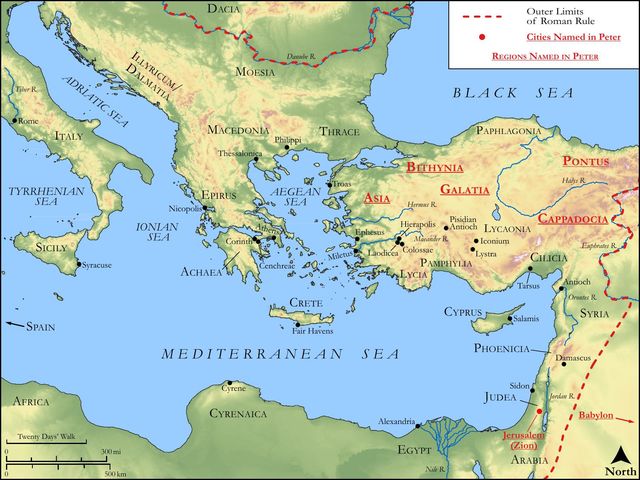
See on the biblical-era maps

Study this verse
Public-domain commentary
Matthew Henry
From his Commentary on the Whole Bible. Henry comments on passages, not single verses — this entry covers 1 Peter 4:12–19. His four-level outline is real structure in the source text, so it is rendered as structure.
The frequent repetition of counsel and comfort to Christians, considered as sufferers, in every chapter of this epistle, shows that the greatest danger these new converts were in arose from the persecutions to which their embracing Christianity exposed them. The good behaviour of Christians under sufferings is the most difficult part of their duty, but yet necessary both for the honour of Christ and their own comfort; and therefore the apostle, having extorted them in the former part of this chapter to the great duty of mortification, comes here to direct them in the necessary duty of patience under sufferings. An unmortified spirit is very unfit to bear trials. Observe,
I.The apostle's kind manner of address to these poor despised Christians: they were his beloved, Pe1 4:9.
II.His advice to them, relating to their sufferings, which is,
1.That they should not think them strange, nor be surprised at them, as if some unexpected event befell them; for,
(1.)Though they be sharp and fiery, yet they are designed only to try, not to ruin them, to try their sincerity, strength, patience, and trust in God. On the contrary, they ought rather to rejoice under their sufferings, because theirs may properly be called Christ's sufferings. They are of the same kind, and for the same cause, that Christ suffered; they make us conformable to him; he suffers in them, and feels in our infirmities; and, if we be partakers of his sufferings, we shall also be make partakers of his glory, and shall meet him with exceeding joy at his great appearing to judge his enemies, and crown his faithful servants, Th2 1:7, etc. Learn,
[1.]True Christians love and own the children of God in their lowest and most distressing circumstances. The apostle owns these poor afflicted Christians, and calls them his beloved. True Christians never look more amiable one to another than in their adversities.
[2.]There is no reason for Christians to think strange, or to wonder, at the unkindnesses and persecutions of the world, because they are forewarned of them. Christ himself endured them; and forsaking all, denying ourselves, are the terms upon which Christ accepts of us to be his disciples.
[3.]Christians ought not only to be patient, but to rejoice, in their sharpest sorest sufferings for Christ, because they are tokens of divine favour; they promote the gospel and prepare for glory. Those who rejoice in their sufferings for Christ shall eternally triumph and rejoice with him in glory.
(2.)From the fiery trial the apostle descends to a lower degree of persecution - that of the tongue by slander and reproach, Pe1 4:14. He supposes that this sort of suffering would fall to their lot: they would be reviled, evil-spoken of, and slandered for the name or sake of Christ. In such case he asserts, Happy are you, the reason of which is, "Because you have the spirit of God with you, to fortify and comfort you; and the Spirit of God is also the Spirit of glory, that will carry you through all, bring you off gloriously, and prepare and seal you up for eternal glory. This glorious Spirit resteth upon you, resideth with you, dwelleth in you, supporteth you, and is pleased with you; and is not this an unspeakable privilege? By your patience and fortitude in suffering, by your dependence upon the promises of God, and adhering to the word which the Holy Spirit hath revealed, he is on your part glorified; but by the contempt and reproaches cast upon you the Spirit itself is evil-spoken of and blasphemed." Learn,
[1.]The best men and the best things usually meet with reproaches in the world. Jesus Christ and his followers, the Spirit of God and the gospel, are all evil-spoken of.
[2.]The happiness of good people not only consists with, but even flows from their afflictions: Happy are you.
[3.]That man who hath the Spirit of God resting upon him cannot be miserable, let his afflictions be ever so great: Happy are you; for the Spirit of God, etc.
[4.]The blasphemies and reproaches which evil men cast upon good people are taken by the Spirit of God as cast upon himself: On their part he is evil-spoken of.
[5.]When good people are vilified for the name of Christ his Holy Spirit is glorified in them.
2.That they should take care they did not suffer justly, as evil-doers, Pe1 4:15. One would think such a caution as this needless to such an excellent set of Christians as these were. But their enemies charged them with these and other foul crimes: therefore the apostle, when he was settling the rules of the Christian religion, thought these cautions necessary, forbidding every one of them to hurt the life or the estate and property of any one, or to do any sort of evil, or, without call and necessity, to play the bishop in another man's charge, or busy himself in other men's matters. To this caution he adds a direction, that if any man suffer for the cause of Christianity, and with a patient Christian spirit, he ought not to account it a shame, but an honour to him; and ought to glorify God who hath thus dignified him, Pe1 4:16. Learn,
(1.)The best of men need to be warned against the worst of sins.
(2.)There is very little comfort in sufferings when we bring them upon ourselves by our own sin and folly. It is not the suffering, but the cause, that makes the martyr.
(3.)We have reason to thank God for the honour if he calls us out to suffer for his truth and gospel, for our adherence to any of the doctrines or duties of Christianity.
3.That their trials were now at hand, and they should stand prepared accordingly, Pe1 4:17, Pe1 4:18.
(1.)He tells them that the time had come when judgment must begin at the house of God. The usual method of Providence has been this: When God brings great calamities and sore judgments upon whole nations, he generally begins with his own people, Isa 10:12; Jer 25:29; Eze 9:6. "Such a time of universal calamity is now at hand, which was foretold by our Saviour, Mat 24:9, Mat 24:10. This renders all the foregoing exhortations to patience necessary for you. And you have two considerations to support you." [1.] "That these judgments will but begin with you that are God's house and family, and will soon be over: your trials and corrections will not last long." [2.] "Your troubles will be but light and short, in comparison of what shall befall the wicked world, your own countrymen the Jews, and the infidels and idolatrous people among whom you live: What shall the end be of those who obey not the gospel of God?" Learn, First, The best of God's servants, his own household, have so much amiss in them as renders it fit and necessary that God should sometimes correct and punish them with his judgments: Judgment begins at the house of God. Secondly, Those who are the family of God have their worst things in this life. Their worst condition is tolerable, and will soon be over. Thirdly, Such persons or societies of men as disobey the gospel of God are not of his church and household, though possibly they may make the loudest pretensions. The apostle distinguishes the disobedient from the house of God. Fourthly, The sufferings of good people in this life are demonstrations of the unspeakable torments that are coming upon the disobedient and unbelieving: What shall the end be of those that obey not the gospel? Who can express or say how dreadful their end will be?
(2.)He intimates the irremediable doom of the wicked: If the righteous scarcely be saved, where shall the ungodly and sinner appear, Pe1 4:18. This whole verse is taken from Pro 11:31, Behold the righteous shall be recompensed in the earth; how much more the wicked and the sinner? This the Septuagint translates exactly as the apostle here quotes it. Hence we may learn,
[1.]The grievous sufferings of good people in this world are sad presages of much heavier judgments coming upon impenitent sinners. But, if we take the salvation here in the highest sense, then we may learn,
[2.]It is as much as the best can do to secure the salvation of their souls; there are so many sufferings, temptations, and difficulties to be overcome, so many sins to be mortified, the gate is so strait and the way so narrow, that it is as much as the righteous can do to be saved. Let the absolute necessity of salvation balance the difficulty of it. Consider, Your difficulties are greatest at first; God offers his grace and help; the contest will not last long; be but faithful to the death, and God will give you the crown of life, Rev 2:10.
[3.]The ungodly and the sinner are unquestionably in a state of damnation. Where shall they appear? How will they stand before their Judge? Where can they show their heads? If the righteous scarcely be saved, the wicked must certainly perish.
4.That when called to suffer, according to the will of God, they should look chiefly to the safety of their souls, which are put into hazard by affliction, and cannot be kept secure otherwise than by committing them to God, who will undertake the charge, if we commit them to him in well-doing; for he is their Creator, and has out of mere grace made many kind promises to them of eternal salvation, in which he will show himself faithful and true, Pe1 4:19. Learn,
(1.)All the sufferings that befall good people come upon them according to the will of God.
(2.)It is the duty of Christians, in all their distresses, to look more to the keeping of their souls than to the preserving of their bodies. The soul is of greatest value, and yet in most danger. If suffering from without raise uneasiness, vexation, and other sinful and tormenting passions within, the soul is then the greatest sufferer. If the soul be not well kept, persecution will drive people to apostasy, Psa 125:3.
(3.)The only way to keep the soul well is to commit it to God, in well-doing. Commit your souls to God by solemn dedication, prayer, and patient perseverance in well-doing, Rom 2:7.
(4.)Good people, when they are in affliction, have great encouragement to commit their souls to God, because he is their Creator, and faithful in all his promises.
Historical interpretation
Fourteen Centuries of Reception
5 surviving comments on this verse. Each one is dated, so this reads as a timeline rather than a list.
Select a marker to jump to its quote. Markers stagger vertically where authors wrote within a few decades of each other.
When I see Moses asking for forgiveness and not obtaining it, when I see him considered unworthy of pardon because of his few words, spoken against the rock in anger, in spite of his many good deeds, I truly realize what the severity of God is like and am persuaded that these words of the apostle are true.
It is the righteous man who is scarcely saved on the day of judgment. If he had no fault, he would easily be saved. As it is, he is righteous because he flourishes with many virtues, but he is scarcely saved because he stands in need of the mercy of God in some things.
And if the righteous man is scarcely saved, etc. The Pelagians do not want to believe that in one man the entire mass of the human race is corrupted and utterly damned. From this vice and condemnation of one man alone, the grace of Christ heals and liberates. For why should the righteous man be scarcely saved? Is it a labor for God to free the righteous man? By no means. But in order to show that it was deservedly condemned by nature, the Almighty Himself does not wish to easily liberate from such a great evil. Because of this, both sins are easily fallen into and justice is laborious, except for those who love. But the charity that makes those who love comes from God. It is to be noted, however, that Blessed Peter took this sentence from the Proverbs of Solomon according to the ancient Editio, for which in our version that descends from the Hebrew truth, it is written: If the righteous man receives on earth, how much more the impious and the sinner (Proverbs XI)? Which is to say openly: If the fragility of mortal life is so great that not even the righteous who are to be crowned in Heaven pass through it without tribulation because of the innumerable errors of corrupted nature, how much more those who are deprived of heavenly grace expect the certain outcome of their perpetual damnation?
For it is time for judgment to begin with God's household; and if it begins with us, what will the outcome be for those who do not obey the gospel of God? And, If it is hard for the righteous to be saved, what will become of the ungodly and the sinner? Therefore, let those who are afflicted according to the will of God entrust their souls to a faithful Creator by doing good.
"For it is time for judgment to begin with God's household." It makes them anxious and terrifies them, driving them away from sloth and a relaxed life; therefore, it also adds: "If the investigation of matters already done begins first with us who are the house of God, what should we think will be the end of those who did not believe? Judgment now does not mean condemnation, but investigation, scrutiny, discussion to choose what is better." However, let it begin first from the house of God, since, according to our Basil the Great, we are more annoyed towards those who are most familiar to us when they sin against us: but to God, there are no others more familiar than the faithful, who complete the house of God, or the Church. Therefore, the Savior also said: "He will say first to those who will be on his right hand." (Matt. 25:34) However, this judgment here refers to the examination, namely the afflictions that the wicked bring upon the faithful: of which the Lord also foretold the instigation when He said: "They will hand you over to councils." etc. (Matt. 5:17)
Then, as if to console them, He adds: And, If it is hard for the righteous to be saved, what will become of the ungodly. And this is confirmed by the Scripture which says: "If the righteous scarcely be saved, where shall the ungodly and the sinner appear?" (Prov. 11:31) However, this is what Scripture intends to signify: If the righteous attain salvation through labor and affliction (for the kingdom of heaven is taken by violence (Matt. 9:12), and through many afflictions one attains it Acts 14:21), what will those who lead a depraved and indulgent life attain? It must be understood in the future age regarding what concerns the wicked. Therefore, if this is so, he says,
who are afflicted according to will of God, so that we do not become sluggish, but rather entrust their souls to a faithful Creator by doing good. He said, according to the will of God, either signifying that our afflictions are not without divine providence but are distributed to us as a test from Him; or that, being afflicted by the will of God, we attribute the outcome to Him. For He is indeed faithful, that is, secure and who does not lie in His promises: nor will He allow us to be afflicted beyond what we can bear. But how should one commit oneself to God? (1 Cor. 10:13)
By doing good, Peter says. And what is that? By the modesty of the soul, committing oneself to Him without exalting oneself because of what one suffers: but the greater the suffering seems, the more firmly one should cling to Him, so that one considers oneself useless and says, "for you are righteous in all the things that you have done to us." (Dan. 3:27) Moreover, the wicked and the sinner differ in this respect: for the wicked is completely alien to God, while the sinner clings to God somewhat, but as one who despises Him and transgresses His laws. However, one can be both wicked and a sinner: for whoever works iniquity acts wickedly, in that he sins, thinking that God does not exist.
Scarcely: That is, not without much labour and difficulty; and because of the dangers which constantly surround, the temptations of the world, of the devil, and of our own corrupt nature.
Continue studying 1 Peter 4:18 across the web’s major study libraries — every link below opens this exact verse, chapter, or book on the destination site.
Read & Compare
 BibleGatewayThis verse in more than 200 translations and 70 languages.
 Bible.comThe YouVersion reader — hundreds of translations, reading plans, and highlights.
 ESV.orgCrossway's official English Standard Version reader.
 NET BibleThe NET translation with 60,000+ translators' notes on every rendering decision.
 STEP BibleTyndale House's free study tool — original text, vocabulary, and scholarly resources.
 BibliaLogos Bible Software's free web reader.
 USCCBThe New American Bible (Revised Edition) with the U.S. bishops' study notes.
Commentaries
 BibleHub CommentariesDozens of classic commentaries on this verse, gathered on one page.
 StudyLightMore than 100 commentary sets — the largest collection on the web.
 BibleRefPlain-English commentary on what this verse means, verse by verse.
 Enduring WordDavid Guzik's free commentary on this chapter, widely used by Bible teachers.
 Bible Study ToolsVerse commentary alongside Greek and Hebrew study aids.
Original Language & Research
- BibleHub InterlinearThe verse word by word — original language, transliteration, and English.
- BibleHub LexiconEvery word's original-language definition and Strong's entry.
 Blue Letter BibleDeep-study tools — Strong's numbers, concordance, and word studies.
 CNTR CollationThe earliest Greek manuscripts of this verse, collated letter by letter.
Sermons, Hymns & Audio


TrulyRandomVerse is not affiliated with these sites and doesn’t control their content. They’re linked because they’re genuinely useful.
Summary
First Peter 4:18 presents a profound rhetorical question that climaxes Peter's discussion on suffering and divine judgment, starkly contrasting the arduous path of salvation for the righteous with the terrifying and inescapable judgment awaiting the ungodly and the sinner. It serves as a sobering reminder of the seriousness of God's justice and the absolute necessity of living a life aligned with His will, underscoring that if even those who strive for righteousness face such a rigorous journey, the fate of those who reject God is far more perilous.
Context
ShowHideLiterary Context
This verse stands near the close of a significant section in Peter's epistle (beginning around 1 Peter 4:12) where he addresses the theme of suffering for Christ's sake. Peter encourages believers not to be surprised by "fiery trials" but to rejoice in their participation in Christ's sufferings, anticipating future glory. He then transitions to the concept of divine judgment, asserting that "judgment must begin at the house of God" (verse 17). This phrase refers to the purifying trials and disciplinary actions God allows His people to endure, which serve as a prelude to the final, universal judgment. Verse 18 functions as a powerful rhetorical climax, extending the logic: if God's own people, who are being refined through suffering, find salvation to be a challenging journey, what hope can there be for those who are utterly estranged from Him? It underscores the severity and impartiality of God's justice, leaving no room for complacency.
Historical & Cultural Context
Peter is writing to scattered believers in Asia Minor (modern-day Turkey) who are experiencing various forms of persecution and social ostracism for their faith. This context of suffering is crucial for understanding the "fiery trial" mentioned earlier in 1 Peter 4:12. The early Christians faced not only official Roman persecution but also social alienation, slander, and economic hardship from their pagan neighbors. The concept of divine judgment was deeply rooted in both Jewish and Roman thought, though with different nuances. For Jews, judgment often involved God's covenant faithfulness and justice within history, leading to restoration or exile. For Romans, justice was tied to law and order, with consequences for transgression. Peter draws on this shared understanding of accountability, emphasizing that God's judgment is universal and inescapable, affecting both those within and outside the covenant community. The idea of "scarcely being saved" would resonate with those enduring intense pressure, highlighting the perseverance required in a hostile world.
Key Themes
ShowHideThe overarching themes in this passage are Divine Judgment and Perseverance in Suffering. The verse underscores the certainty and impartiality of God's ultimate judgment for all humanity, a truth that no one can escape. It highlights that judgment is not merely a future event but also a present reality, as God refines His people through trials. Furthermore, the phrase "if the righteous scarcely be saved" points to the Rigor of the Righteous Path. This does not imply a lack of God's saving power or grace, but rather emphasizes the challenging, often arduous journey of faith, perseverance through trials, and the continuous need for God's mercy and strength on the path to salvation. It speaks to the narrowness and difficulty of the way that leads to life, as taught by Jesus in Matthew 7:13-14. Conversely, the rhetorical question powerfully warns about the Dire Fate of the Ungodly, emphasizing the inescapable and severe consequences for those who reject God and live in rebellion against His commands. If even the righteous face such a demanding path, how much more precarious is the position of the ungodly and the sinner when they stand before God's judgment seat?
Exposition and Analysis
ShowHideKey Word Analysis
ShowHideThis word signifies "with difficulty," "hardly," or "barely." In this context, it does not suggest a deficiency in God's ability to save or an uncertainty in the believer's salvation, but rather highlights the rigorous nature of the Christian walk. It speaks to the perseverance required through tribulation, temptation, and the ongoing battle against sin, emphasizing the demanding process of sanctification and enduring to the end. It underscores the narrowness of the path to life and the effort required to walk it faithfully.
This term describes someone who is "irreverent," "impious," or "wicked." It denotes a fundamental lack of proper respect, reverence, or awe for God. It characterizes an attitude of godlessness, a life lived without regard for divine authority or moral standards, often manifesting in active rebellion against God's will.
This word refers to one who "misses the mark" or "transgresses God's law." It describes a person living in a state of sin, characterized by habitual or pervasive disobedience to God's commands. While "ungodly" speaks to an attitude of irreverence, "sinner" focuses on the actions and state of being that result from that irreverence. The pairing of "ungodly and sinner" creates a comprehensive picture of those who are alienated from God both in disposition and deed.
Verse Breakdown
ShowHide"And if the righteous scarcely be saved"
This clause sets up the premise of Peter's rhetorical question. The "righteous" (Greek: díkaios) refers to those who have been justified by faith in Christ and are striving to live in accordance with God's will. The term "scarcely" (mólis) does not imply that their salvation is uncertain or that God's grace is insufficient. Instead, it underscores the arduous nature of the Christian journey—the "fiery trials" (1 Peter 4:12), the need for perseverance, self-control, and enduring faith in the face of immense spiritual and physical opposition. Salvation, while a gift of grace, involves a lifelong process of sanctification and endurance, a narrow path that requires diligent effort and reliance on God's sustaining power. It highlights the difficulty of navigating a fallen world while remaining faithful, not the inadequacy of God's saving power.
"where shall the ungodly and the sinner appear?"
This is the forceful rhetorical question that follows from the first clause. If even those who are righteous and striving for holiness find the path to salvation challenging, what hope can there be for those who are "ungodly" (irreverent, impious) and "sinner" (those who habitually miss God's mark)? The word "appear" (Greek: phaínō) suggests being made manifest or standing exposed before God's judgment seat. The question implies a terrifying answer: there is no place of refuge or escape for them. Their ultimate destiny is one of certain and severe judgment, without the hope of salvation that the righteous, despite their struggles, possess through Christ. It serves as a stark warning and a call to repentance.
Literary Devices
ShowHideThe verse powerfully employs several literary devices to convey its urgent message. The primary device is a Rhetorical Question, "where shall the ungodly and the sinner appear?" This question is not posed to elicit an answer but to make a forceful assertion: there is no place for the ungodly and sinner to stand before God's judgment. It compels the reader to consider the dire implications. Closely related is Contrast or Antithesis, as Peter juxtaposes "the righteous" with "the ungodly and the sinner," highlighting the vast chasm between their spiritual states and ultimate destinies. This stark comparison amplifies the severity of the ungodly's fate. Furthermore, the phrase "scarcely be saved" can be seen as a form of Understatement or Litotes (an ironic understatement in which an affirmative is expressed by the negative of its contrary). It doesn't diminish the certainty of salvation for the righteous, but rather emphasizes the immense difficulty and perseverance involved in the journey, thereby making the contrast with the ungodly even more impactful.
Theological and Thematic Connections
ShowHideThis verse deeply underscores the biblical truth of God's absolute holiness and unwavering justice. It reveals that salvation, while entirely a gift of God's grace, is not a passive experience but a journey of active participation and perseverance that demands everything from the believer. The "scarcely" points to the rigorous process of sanctification, the daily battle against sin, and the endurance through trials that characterize the Christian life, all of which are empowered by the Holy Spirit. It reminds us that God's judgment is real, universal, and impartial, beginning even with His own household for purification, and culminating in a final reckoning for all humanity. The stark contrast between the righteous and the ungodly highlights the two ultimate destinies for humanity, emphasizing the urgency of repentance and faith in Christ as the only escape from divine wrath.
Reflection and Application
ShowHideFirst Peter 4:18 serves as a profound call to both introspection and urgent action for all. For believers, it is a sobering reminder that while our salvation is secured by grace through faith, the journey of living out that salvation is a demanding one, requiring diligence, perseverance, and a steadfast pursuit of holiness amidst trials and temptations. It encourages us to take our walk with God seriously, to continually rely on His strength and mercy, and to understand that the "narrow gate" (as Jesus described it in Matthew 7:14) requires intentional effort and endurance. This verse should not lead to doubt about one's salvation but to a deeper commitment to the process of sanctification and a greater appreciation for the sustaining grace of God. For those who do not yet know Christ, or who live in willful rebellion against God, this verse stands as a stark and terrifying warning. It emphasizes the absolute certainty of divine judgment and the utter lack of refuge for those who remain unrepentant. It underscores the urgency of turning to Jesus Christ, the only one who can justify the ungodly and reconcile sinners to a holy God, thereby escaping the wrath to come.
Questions for Reflection
ShowHideFAQ
ShowHideDoes "if the righteous scarcely be saved" mean that my salvation is uncertain or that I have to earn it?
ShowHideNo, this phrase does not imply that salvation is uncertain or that it must be earned through human effort. The "scarcely" (Greek: mólis) refers to the difficulty and strenuousness of the process of living out one's salvation in a fallen world, not to the certainty of God's saving act. Salvation is a free gift of God's grace, received through faith in Jesus Christ (Ephesians 2:8-9). However, living as a disciple of Christ involves a lifelong journey of sanctification, perseverance through trials, and battling against sin and the world's temptations. This journey is often arduous and requires divine strength and endurance. Peter is highlighting the rigorous nature of this pilgrimage, not casting doubt on God's ability or willingness to save those who trust in Him. The emphasis is on the narrowness of the path (Matthew 7:14) and the need for believers to remain steadfast and diligent.
What is the difference between "ungodly" and "sinner" in this verse?
ShowHideWhile often used together and describing similar states, "ungodly" (Greek: asebḗs) and "sinner" (Greek: hamartōlós) emphasize slightly different aspects of alienation from God. "Ungodly" primarily describes an attitude or disposition: a lack of reverence, piety, or respect for God. It speaks to a fundamental godlessness, a life lived without acknowledging or honoring God's authority. "Sinner," on the other hand, focuses more on actions and the state of being resulting from those actions: one who misses the mark, transgresses God's law, or lives in a state of habitual disobedience. The pairing of these terms in 1 Peter 4:18 creates a comprehensive picture of those who are estranged from God both in their inner disposition and their outward conduct, emphasizing their complete lack of standing before a holy God.
Christ-Centered Fulfillment
ShowHideFirst Peter 4:18, with its stark contrast between the "scarcely saved" righteous and the doomed ungodly, finds its ultimate resolution and fulfillment in Jesus Christ. He is the perfectly righteous one who, though sinless, experienced the ultimate "scarcely" in His suffering, humiliation, and death on the cross (Isaiah 53:3-5). His agony in Gethsemane (Luke 22:42-44) and His cry of abandonment on the cross (Matthew 27:46) reveal the immense difficulty and cost of securing salvation. Yet, through His resurrection, He was "saved" from death, vindicated by God, and exalted as Lord. For the "ungodly and the sinner," who have no hope of appearing justified before God on their own merit, Christ offers the only way. He became sin for us, so that in Him we might become the righteousness of God (2 Corinthians 5:21). Through faith in His atoning sacrifice, the ungodly are declared righteous (Romans 3:23-24) and can "appear" before God not in judgment, but in grace, having their sins forgiven and their standing secured by the Lamb of God (John 1:29). Thus, Christ is both the embodiment of the righteous one who endured the "scarcely" and the merciful Savior who provides the only path for the ungodly to stand justified before a holy God.