


1 Samuel 4:21
Bible text: King James Version (1769 Blayney text) · Public domain
Bible text: King James Version with Strong's numbers · Public domain
Bible text: Berean Standard Bible · Public domain
Bible text: American Standard Version (1901) · Public domain
Bible text: World English Bible, Messianic edition · Public domain
Bible text: Geneva Bible (1599) · Public domain
Bible text: Young's Literal Translation · Public domain
- וַתִּקְרָאva·tik·Ra'and she calledH7121Conj-w ¦ V-Qal-ConsecImperf-3fsVerb Qal Consecutive Imperfect 3rd Singular Feminineוַandתִּקְרָאshe called
- לַנַּעַרla·Na·'ar<to> the ladH5288Prep-l ¦ N-msNoun Singular Masculine Absoluteלַ<to> theנַּעַרlad
- אִי'iI-H350N-proper-mNoun Proper Masculine
- כָבוֹדkha·Vod-chabodH350N-proper-mNoun Proper Masculine
- לֵאמֹרle·Mor<to> sayingH559Prep-l ¦ V-Qal-InfVerb Qal Infinitive Constructלֵ<to>אמֹרsaying
- גָּלָהga·Lahit has gone into exileH1540V-Qal-Perf-3msVerb Qal Perfect 3rd Singular Masculine
- כָבוֹדkha·VodgloryH3519N-msNoun Singular Masculine Absolute
- מִיִּשְׂרָאֵלmi·Yis·ra·'Elfrom IsraelH3478Prep-m ¦ N-properNoun Proper LocationמִfromיִּשְׂרָאֵלIsrael
- אֶל'elbecause ofH413PrepPreposition
- הִלָּקַחhi·la·Kach[the] being taken ofH3947V-Niphal-InfVerb Niphal Infinitive Construct
- אֲרוֹן'a·Ron[the] ark ofH727N-mscNoun Singular Masculine Construct
- הָאֱלֹהִיםha·'E·lo·Him<the> GodH430Art ¦ N-mpNoun Plural Masculine Absoluteהָ<the>אֱלֹהִיםGod
- וְאֶלve·'eland because ofH413Conj-w ¦ PrepPrepositionוְandאֶלbecause of
- חָמִיהָcha·Mi·haher father-in-lawH2524N-msc ¦ 3fsNoun Singular Masculine Constructחָמִיfather-in-lawהָher
- וְאִישָׁהּve·'i·Shahand her husbandH376Conj-w ¦ N-msc ¦ 3fsNoun Singular Masculine Constructוְandאִישָׁhusbandהּher
English is a literal word-by-word gloss of the Hebrew, not the KJV's wording. Why?
This is the original text the KJV's translators worked from — each Hebrew word with its own literal English meaning in this verse, prepared by scholars at Tyndale House, Cambridge. The KJV translates whole sentences, not word by word, so its wording differs: one Hebrew word can become several English words, and the KJV may choose “the LORD” where the gloss reads “Yahweh”. Both are faithful — they answer different questions. For the KJV's own rendering, switch to the KJV text.
Details
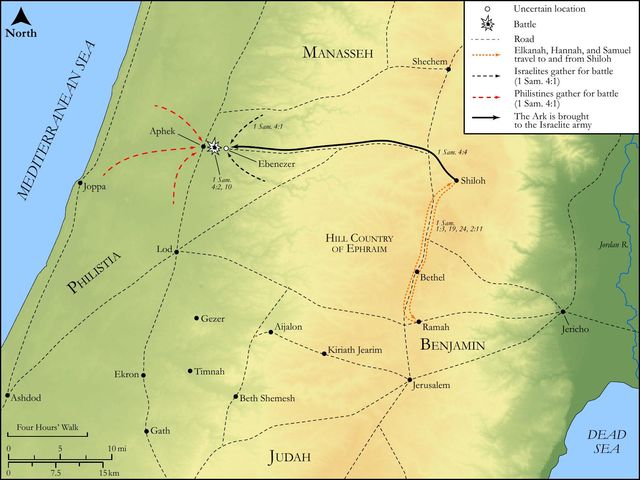
See on the biblical-era map
Study this verse
Public-domain commentary
Matthew Henry
From his Commentary on the Whole Bible. Henry comments on passages, not single verses — this entry covers 1 Samuel 4:19–22. His three-level outline is real structure in the source text, so it is rendered as structure.
We have here another melancholy story, that carries on the desolations of Eli's house, and the sorrowful feeling which the tidings of the ark's captivity excited. It is concerning the wife of Phinehas, one of those ungracious sons of Eli that had brought all this mischief on Israel. It cost her her life, though young, as well as that of her father-in-law, that was old; for many a green head, as well as many a hoary head, has been brought by sorrow to the grave: it worketh death. By what is here related of her it appears,
I.That she was a woman of a very tender spirit.
Providence so ordered it that, just at this time, she was near her time; and our Saviour hath said, Woe to those that are with child, or give suck, in such days as these, Mat 24:19. So little joy will there then be in the birth, even of a man-child, that it will be said, Blessed are the wombs that bear not, Luk 23:29. The amazing news coming at this unhappy juncture, it put her into labour, as great frights or other strong passions sometimes do. When she heard of the death of her father-in-law whom she reverenced, and her husband whom, bad as he was, she loved, but especially of the loss of the ark, she travailed, for her pains came thickly upon her (Sa1 4:19), and the tidings so seized her spirits, at a time when they needed all possible supports, that, though she had strength to bear the child, she, soon after, fainted and died away, being very willing to let life go when she had lost the greatest comforts of her life. Those who are drawing near to that trying hour have need to treasure up for themselves comforts from the covenant of grace, to balance, not only the usual sorrows, but any thing extraordinary that may add to the grief which they do not foresee. Faith, at such a time, will keep from fainting, Psa 27:13.
II.That she was a woman of a very gracious spirit though matched to a wicked husband.
Her concern for the death of her husband and father-in-law was an evidence of her natural affection; but her much greater concern for the loss of the ark was an evidence of her pious and devout affection to God and sacred things. The former helped to hasten her travail, but it appears by her dying words that the latter lay nearer her heart (Sa1 4:22): She said, The glory has departed from Israel, not lamenting so much the sinking of that particular family to which she was related as the general calamity of Israel in the captivity of the ark. This, this was it that was her grief, that was her death.
1.This made her regardless of her child. The women that attended her, who it is likely were some of the first rank in the city, encouraged her, and, thinking that he concern was mostly about the issue of her pains, when the child was born, said unto her, Fear not, now the worst is past, for thou has borne a son (and perhaps it was her first-born), but she answered not, neither did she regard it. The sorrows of her travail, if she had no other, would have been forgotten, for joy that a man-child was born into the world. Joh 16:21. But what is that joy,
(1.)To one that feels herself dying? No joy but that which is spiritual and divine will stand us in any stead then. Death is too serious a thing to admit the relish of any earthly joy; it is all flat and sapless then.
(2.)What is it to one that is lamenting the loss of the ark? Small comfort could she have of a child born in Israel, in Shiloh, when the ark is lost, and is a prisoner in the land of the Philistines. What pleasure can we take in our creature-comforts and enjoyments if we want God's word and ordinances, especially if we want the comfort of his gracious presence and the light of his countenance? As vinegar upon nitre, so is he that sings songs so such heavy hearts.
2.This made her give her child a name which should perpetuate the remembrance of the calamity and her sense of it. She has nothing to say to the child, only it being her province, now that her husband was dead, to name the child, she orders them to call it I-chabod, that is, Where is the glory? Or, Alas for the glory! or, There is no glory (Sa1 4:21), which she thus explains with her dying lips (Sa1 4:22): "The glory has departed from Israel; for the ark of God is taken. Call the child inglorious, for so he is; the beauty of Israel is lost, and there appears no hope of ever retrieving it; never let the name of an Israelite, must less a priest, carry glory in it any more, now that the ark is taken." Note, (1.) The purity and plenty of God's ordinances, and the tokens of his presence in them, are the glory of any people, much more so than their wealth, and trade, and interest, among the nations. 2. Nothing is more cutting, more killing, to a faithful Israelite, than the want and loss of these. If God go, the glory goes, and all good goes. Woe unto us if he depart!
Historical interpretation
Ten Centuries of Reception
2 surviving comments on this verse. Each one is dated, so this reads as a timeline rather than a list.
Select a marker to jump to its quote. Markers stagger vertically where authors wrote within a few decades of each other.
And she named the child Ichabod, etc. Ichabod is interpreted as "woe to glory," or "glory has departed," which no one will nearly dispute as being an apt name for the Jews of that time. But the glory of faith was transferred from Israel to the Gentiles, from the Synagogue to the Church; but at the end of the world, it will return to Israel. Let us rejoice in the glory transferred to us; let us fear for it to be transferred from us to its homeland, which is to be brought back on the wagon of new conversation.
Ichabod: That is, Where is the glory? or, there is no glory. We see how much the Israelites lamented the loss of the ark, which was but the symbol of God's presence among them. How much more ought Christians to lament the loss of God himself, when by sin they have driven him out of their souls.
Continue studying 1 Samuel 4:21 across the web’s major study libraries — every link below opens this exact verse, chapter, or book on the destination site.
Read & Compare
 BibleGatewayThis verse in more than 200 translations and 70 languages.
 Bible.comThe YouVersion reader — hundreds of translations, reading plans, and highlights.
 ESV.orgCrossway's official English Standard Version reader.
 NET BibleThe NET translation with 60,000+ translators' notes on every rendering decision.
 STEP BibleTyndale House's free study tool — original text, vocabulary, and scholarly resources.
 BibliaLogos Bible Software's free web reader.
 USCCBThe New American Bible (Revised Edition) with the U.S. bishops' study notes.
Commentaries
 BibleHub CommentariesDozens of classic commentaries on this verse, gathered on one page.
 StudyLightMore than 100 commentary sets — the largest collection on the web.
 BibleRefPlain-English commentary on what this verse means, verse by verse.
 Enduring WordDavid Guzik's free commentary on this chapter, widely used by Bible teachers.
 Bible Study ToolsVerse commentary alongside Greek and Hebrew study aids.
Original Language & Research
- BibleHub InterlinearThe verse word by word — original language, transliteration, and English.
- BibleHub LexiconEvery word's original-language definition and Strong's entry.
 Blue Letter BibleDeep-study tools — Strong's numbers, concordance, and word studies.
 SefariaThe Hebrew text with Rashi and centuries of Jewish commentary.
Sermons, Hymns & Audio


TrulyRandomVerse is not affiliated with these sites and doesn’t control their content. They’re linked because they’re genuinely useful.
Summary
1 Samuel 4:21 records one of the most poignant and tragic naming events in biblical history, as Phinehas's wife, on her deathbed, names her newborn son Ichabod, declaring that "the glory is departed from Israel." This profound act of naming encapsulates the devastating impact of Israel's crushing defeat by the Philistines, the loss of her husband and father-in-law, and most significantly, the capture of the Ark of God, which symbolized God's manifest presence among His people. It serves as a powerful lament over the spiritual emptiness and divine withdrawal experienced by the nation due to their sin and disobedience, marking a dark turning point in Israel's history and highlighting the conditional nature of God's manifest favor.
Context
ShowHideLiterary Context
This verse serves as the climactic and deeply personal conclusion to a series of national catastrophes detailed in 1 Samuel 4. It follows Israel's misguided decision to bring the Ark of the Covenant into battle against the Philistines, foolishly believing its mere presence would guarantee victory, rather than relying on God Himself. The preceding verses vividly describe the crushing defeat, the death of 30,000 Israelite soldiers, and the capture of the Ark, the most sacred object representing God's presence. The narrative then escalates with the news of the deaths of Eli's wicked sons, Hophni and Phinehas, and finally, the death of the aged high priest Eli himself upon hearing of the Ark's capture. This entire sequence unfolds as a direct fulfillment of God's judgment pronounced against Eli's house due to the unrighteous behavior of his sons and Eli's failure to restrain them, as foretold in 1 Samuel 2:27-36 and 1 Samuel 3:11-14. Phinehas's wife's premature labor and dying declaration thus seal the narrative of divine judgment and the apparent withdrawal of God's favor from Israel.
Historical & Cultural Context
In ancient Israel, the Ark of the Covenant was not merely a religious artifact but the tangible symbol of God's dwelling among His people, representing His throne and His manifest presence, particularly at the mercy seat within the Tabernacle. Its capture by a pagan nation was therefore a theological disaster of unparalleled magnitude, signifying a profound breach in the covenant relationship and the apparent withdrawal of divine protection. The naming of a child was a significant cultural act, often reflecting the circumstances of birth, expressing parental hopes or fears, or even serving as a prophetic declaration. For a dying mother to name her son "Ichabod" ("no glory") underscored the depth of despair and the widespread belief that the very essence of Israel's identity and blessing had been stripped away. This period was characterized by spiritual decline, with a corrupt priesthood and a general turning away from God, setting the stage for the transition from the era of judges to the monarchy.
Key Themes
ShowHideThis verse powerfully articulates several core themes central to the book of 1 Samuel and the broader Old Testament narrative. The most prominent is The Departure of God's Glory, highlighting the loss of God's manifest presence and favor, profoundly symbolized by the Ark's capture. This was a spiritual catastrophe, far outweighing any military defeat, as it implied God's protective and guiding presence had withdrawn due to Israel's sin and misplaced trust in ritual over relationship. Another crucial theme is The Consequences of Sin and Disobedience, particularly among spiritual leaders. The unrighteous behavior of Eli's sons and Eli's failure to restrain them (as detailed in 1 Samuel 2:12-17) directly led to widespread national tragedy and the apparent removal of God's blessing. Finally, the verse expresses Profound National and Personal Grief and Despair. The mother's dying cry encapsulates the deep hopelessness felt by the faithful in Israel, viewing the loss of the Ark as the ultimate calamity, threatening the very essence of their covenant relationship with God. This period of spiritual darkness sets the stage for God's eventual raising up of Samuel to bring about national repentance and restoration.
Exposition and Analysis
ShowHideKey Word Analysis
ShowHideThis unique and poignant name literally means "no glory" or "where is the glory?" It is a compound of the negative particle אִי ('î), meaning "no" or "where," and כָּבוֹד (kāvōd), meaning "glory." The mother's choice of name is a profound lament and a prophetic declaration, encapsulating the spiritual desolation of Israel. It signifies not merely a temporary setback but a perceived permanent loss of God's manifest presence and favor, which was the very essence of Israel's identity and strength. The name itself becomes a memorial to a national tragedy.
The Hebrew word כָּבוֹד (kāvōd) carries a rich theological meaning, referring to God's weight, honor, splendor, and manifest presence. It denotes the tangible, visible manifestation of God's majesty and power, such as when the glory of the Lord filled the Tabernacle or Solomon's Temple (1 Kings 8:11). Its "departure" signifies the withdrawal of divine favor, protection, and the very essence of God's dwelling among His people, leaving a profound spiritual emptiness. The loss of kâbôwd was the ultimate spiritual catastrophe for Israel.
From a primitive root meaning "to denude" or "to exile," this word implies a stripping away or removal, often in a disgraceful sense. In this context, it powerfully conveys the idea that God's glory has been taken away or removed from Israel, not merely that it has vanished. It emphasizes the active withdrawal of God's manifest presence as a consequence of Israel's sin and the capture of the Ark, leaving the nation spiritually bare and exposed.
Verse Breakdown
ShowHide"And she named the child Ichabod,"
This clause highlights the mother's final, desperate act of naming her newborn son. The name "Ichabod" is not merely a label but a theological statement, a lament, and a prophecy. It is a direct reflection of the catastrophic circumstances surrounding his birth, signifying that the child's identity is inextricably linked to the nation's spiritual state. The act of naming itself is a powerful literary device, immediately conveying the depth of despair and the perceived loss of divine favor.
"saying, The glory is departed from Israel:"
This is the core declaration of the verse, articulating the spiritual meaning of "Ichabod." The "glory" refers to the kâbôwd of God – His manifest presence, honor, and protective power. Its "departure" indicates a perceived withdrawal of divine favor and the loss of God's intimate dwelling among His people. This was the ultimate tragedy for Israel, far surpassing any military defeat, as it struck at the very heart of their covenant relationship and national identity.
"because the ark of God was taken,"
This phrase provides the primary, overarching reason for the declaration of departed glory. The Ark of God was the most sacred object in Israel, symbolizing God's throne and His presence among them. Its capture by the Philistines was not just a physical loss but a profound spiritual crisis, interpreted as God abandoning His people due to their sin and their misplaced trust in the object itself rather than the God it represented. This event underscored the conditional nature of God's manifest presence, dependent on Israel's faithfulness.
"and because of her father in law and her husband."
This final clause adds a layer of personal tragedy and reinforces the reasons for the "glory departed." The deaths of Eli (her father-in-law, the high priest) and Phinehas (her husband, a corrupt priest) were immediate and devastating personal losses. More significantly, their deaths were a direct consequence of God's judgment on Eli's house due to their wickedness and Eli's failure to restrain his sons. Thus, the personal sorrow is inextricably intertwined with the national spiritual catastrophe, showing how individual sin and priestly corruption led to widespread divine judgment and the perceived loss of God's presence.
Literary Devices
ShowHideThe verse is rich in Symbolism, with the Ark of God serving as the central symbol of God's manifest presence and covenant relationship with Israel. Its capture symbolizes the perceived departure of God's glory. The name Ichabod itself is a powerful Lament and a form of Prophetic Naming, where the child's name encapsulates the spiritual state and future outlook of the nation. There is profound Irony in the fact that the very object meant to signify God's presence is taken, highlighting Israel's misplaced trust in ritualistic adherence rather than genuine obedience. The narrative also employs Foreshadowing, as the "departed glory" sets the stage for a period of national decline and spiritual barrenness, which will eventually be reversed through the rise of Samuel and the establishment of the monarchy under David, who would bring the Ark back to Jerusalem and establish a more faithful worship.
Theological and Thematic Connections
ShowHideThe declaration of "Ichabod" in 1 Samuel 4:21 profoundly underscores the Old Testament understanding of God's presence as both glorious and conditional. While God's ultimate sovereignty is never truly diminished, His manifest presence and favor can indeed be withdrawn from a disobedient people, as seen in the capture of the Ark. This event serves as a stark reminder that ritualistic practices or the mere possession of sacred objects do not guarantee divine blessing; rather, genuine obedience and a covenant relationship with God are paramount. The "departed glory" is a severe consequence of corporate and individual sin, particularly the corruption within the priesthood, highlighting the immense responsibility of spiritual leadership. Yet, even in this moment of despair, the narrative subtly points to God's enduring faithfulness, as He would eventually raise up a righteous leader in Samuel and later establish a kingdom through David, ultimately restoring His presence among His people, albeit in new forms.
Reflection and Application
ShowHideThe tragic account of Ichabod serves as a timeless cautionary tale for believers and the church today. It compels us to examine where we place our trust and what we truly consider to be "glory." Do we, like ancient Israel, rely on religious traditions, outward forms, or institutional structures, rather than on the living God Himself? The narrative challenges us to consider the profound implications of spiritual complacency and disobedience, especially among those in leadership. Just as the Ark's capture signaled a deeper spiritual problem in Israel, so too can apparent "losses" or difficulties in our lives or in the church point to areas where we have drifted from God's will or taken His presence for granted. True glory is not found in relics or rituals, but in the authentic, obedient, and worshipful relationship with God, whose presence is our ultimate strength and joy. We are called to guard this relationship jealously, ensuring that our lives and communities reflect His character and honor His name, lest we too experience a sense of "departed glory" in our spiritual walk.
Questions for Reflection
ShowHideFAQ
ShowHideWhat happened to the Ark of God after its capture?
ShowHideAfter its capture by the Philistines, the Ark of God brought divine judgment upon them, causing plagues and tumors in their cities, notably in Ashdod, Gath, and Ekron (detailed in 1 Samuel 5:1-12). Recognizing it as the source of their affliction, the Philistines eventually returned the Ark to Israel, sending it on a new cart drawn by cows to Beth-shemesh (1 Samuel 6:1-12). However, due to the irreverence of the people of Beth-shemesh, many died, and the Ark was then moved to Kiriath-jearim, where it remained for twenty years in the house of Abinadab (1 Samuel 7:1-2) until King David eventually brought it to Jerusalem (2 Samuel 6:1-19).
Was the glory truly gone from Israel forever?
ShowHideWhile the declaration "the glory is departed from Israel" reflected the profound despair and spiritual reality of that specific moment, it was not a permanent state for the nation. God's ultimate faithfulness to His covenant promises meant that His glory would eventually return and be manifest among His people, though perhaps in different ways. The period of "Ichabod" was a time of divine discipline and preparation. God raised up Samuel, a righteous prophet and judge, who led Israel to repentance and spiritual renewal (1 Samuel 7:3-17). Later, King David, a man after God's own heart, brought the Ark back to Jerusalem, symbolizing the restoration of God's presence and favor (2 Samuel 6). Ultimately, the truest and most complete return of God's glory would be found not in an object or a physical location, but in the person of Jesus Christ, as further explained in the Christ-Centered Fulfillment section.
Christ-Centered Fulfillment
ShowHideThe lament of "Ichabod," meaning "the glory is departed," finds its ultimate and profound reversal in the person and work of Jesus Christ. While ancient Israel experienced a temporary withdrawal of God's manifest presence due to their sin, the New Testament reveals that true glory is not found in a physical ark or temple, but in the incarnate Son of God. John proclaims that "the Word became flesh and dwelt among us, and we have seen his glory, glory as of the only Son from the Father, full of grace and truth" (John 1:14). Jesus is the ultimate embodiment of God's kâbôwd, the very radiance of God's glory and the exact imprint of His nature (Hebrews 1:3). Through His sacrificial death and resurrection, Christ not only restores humanity's access to God's presence but also enables believers to become temples of the Holy Spirit (1 Corinthians 6:19), ensuring that God's glory, in the person of the Spirit, dwells within His people. The "Ichabod" state of separation and despair is definitively overcome by Christ, who brings eternal glory and reconciliation, making it possible for us to "behold the glory of the Lord" and be "transformed into the same image from one degree of glory to another" (2 Corinthians 3:18). He is the true Ark, the living presence of God, who takes away the sin of the world and ensures that God's glory will never truly depart from His redeemed people.