


1 Samuel 4:20
Bible text: King James Version (1769 Blayney text) · Public domain
Bible text: King James Version with Strong's numbers · Public domain
Bible text: Berean Standard Bible · Public domain
Bible text: American Standard Version (1901) · Public domain
Bible text: World English Bible, Messianic edition · Public domain
Bible text: Geneva Bible (1599) · Public domain
Bible text: Young's Literal Translation · Public domain
- וּכְעֵתu·khe·'Etand about [the] time ofH6256Conj-w ¦ Prep-k ¦ N-cscNoun Singular common gender Constructוּandכְaboutעֵת[the] time of
- מוּתָהּmu·Tahshe dyingH4191V-Qal-Inf ¦ 3fsVerb Qal Infinitive Constructמוּתָdyingהּshe
- וַתְּדַבֵּרְנָהva·te·da·Be·re·nahand they spokeH1696Conj-w ¦ V-Piel-ConsecImperf-3fpVerb Piel Consecutive Imperfect 3rd Plural Feminineוַandתְּדַבֵּרְנָהthey spoke
- הַנִּצָּבוֹתha·ni·tza·Votthose [who] were standingH5324Art ¦ V-Niphal-Prtcpl-fpVerb Niphal Participle Plural Feminine Absoluteהַthoseנִּצָּבוֹת[who] were standing
- עָלֶיהָ'a·Lei·haover herH5921Prep ¦ 3fsPreposition Definiteעָלֶיoverהָher
- אַל'almay notH408NegParticle Negative
- תִּירְאִיtir·'Iyou be afraidH3372V-Qal-Imperf-2fsVerb Qal Imperfect 2nd Singular Feminine
- כִּיkiforH3588PrtParticle Conditional
- בֵןvena sonH1121N-msNoun Singular Masculine Absolute
- יָלָדְתְּya·La·detyou have borneH3205V-Qal-Perf-2fsVerb Qal Perfect 2nd Singular Feminine
- וְלֹאve·Lo'and notH3808Conj-w ¦ NegParticle Negativeוְandלֹאnot
- עָנְתָה'a·ne·Tahshe answeredH6030V-Qal-Perf-3fsVerb Qal Perfect 3rd Singular Feminine
- וְלֹאve·lo'and notH3808Conj-w ¦ NegParticle Negativeוְandלֹאnot
- שָׁתָהSha·tahshe setH7896V-Qal-Perf-3fsVerb Qal Perfect 3rd Singular Feminine
- לִבָּהּli·Bahher heartH3820N-msc ¦ 3fsNoun Singular Masculine Constructלִבָּheartהּher
English is a literal word-by-word gloss of the Hebrew, not the KJV's wording. Why?
This is the original text the KJV's translators worked from — each Hebrew word with its own literal English meaning in this verse, prepared by scholars at Tyndale House, Cambridge. The KJV translates whole sentences, not word by word, so its wording differs: one Hebrew word can become several English words, and the KJV may choose “the LORD” where the gloss reads “Yahweh”. Both are faithful — they answer different questions. For the KJV's own rendering, switch to the KJV text.
Details
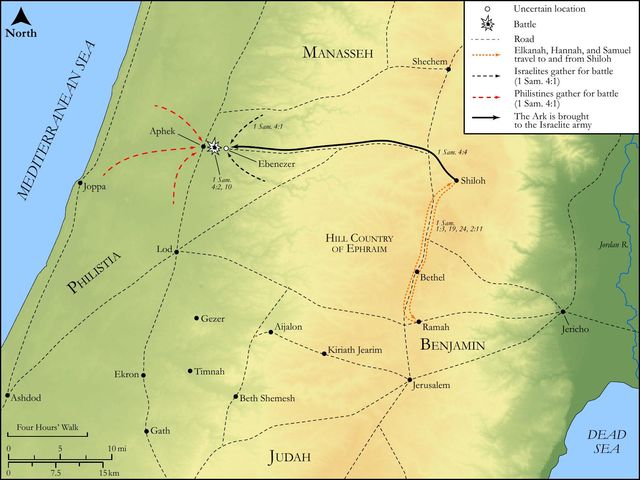
See on the biblical-era map
Study this verse
Public-domain commentary
Matthew Henry
From his Commentary on the Whole Bible. Henry comments on passages, not single verses — this entry covers 1 Samuel 4:19–22. His three-level outline is real structure in the source text, so it is rendered as structure.
We have here another melancholy story, that carries on the desolations of Eli's house, and the sorrowful feeling which the tidings of the ark's captivity excited. It is concerning the wife of Phinehas, one of those ungracious sons of Eli that had brought all this mischief on Israel. It cost her her life, though young, as well as that of her father-in-law, that was old; for many a green head, as well as many a hoary head, has been brought by sorrow to the grave: it worketh death. By what is here related of her it appears,
I.That she was a woman of a very tender spirit.
Providence so ordered it that, just at this time, she was near her time; and our Saviour hath said, Woe to those that are with child, or give suck, in such days as these, Mat 24:19. So little joy will there then be in the birth, even of a man-child, that it will be said, Blessed are the wombs that bear not, Luk 23:29. The amazing news coming at this unhappy juncture, it put her into labour, as great frights or other strong passions sometimes do. When she heard of the death of her father-in-law whom she reverenced, and her husband whom, bad as he was, she loved, but especially of the loss of the ark, she travailed, for her pains came thickly upon her (Sa1 4:19), and the tidings so seized her spirits, at a time when they needed all possible supports, that, though she had strength to bear the child, she, soon after, fainted and died away, being very willing to let life go when she had lost the greatest comforts of her life. Those who are drawing near to that trying hour have need to treasure up for themselves comforts from the covenant of grace, to balance, not only the usual sorrows, but any thing extraordinary that may add to the grief which they do not foresee. Faith, at such a time, will keep from fainting, Psa 27:13.
II.That she was a woman of a very gracious spirit though matched to a wicked husband.
Her concern for the death of her husband and father-in-law was an evidence of her natural affection; but her much greater concern for the loss of the ark was an evidence of her pious and devout affection to God and sacred things. The former helped to hasten her travail, but it appears by her dying words that the latter lay nearer her heart (Sa1 4:22): She said, The glory has departed from Israel, not lamenting so much the sinking of that particular family to which she was related as the general calamity of Israel in the captivity of the ark. This, this was it that was her grief, that was her death.
1.This made her regardless of her child. The women that attended her, who it is likely were some of the first rank in the city, encouraged her, and, thinking that he concern was mostly about the issue of her pains, when the child was born, said unto her, Fear not, now the worst is past, for thou has borne a son (and perhaps it was her first-born), but she answered not, neither did she regard it. The sorrows of her travail, if she had no other, would have been forgotten, for joy that a man-child was born into the world. Joh 16:21. But what is that joy,
(1.)To one that feels herself dying? No joy but that which is spiritual and divine will stand us in any stead then. Death is too serious a thing to admit the relish of any earthly joy; it is all flat and sapless then.
(2.)What is it to one that is lamenting the loss of the ark? Small comfort could she have of a child born in Israel, in Shiloh, when the ark is lost, and is a prisoner in the land of the Philistines. What pleasure can we take in our creature-comforts and enjoyments if we want God's word and ordinances, especially if we want the comfort of his gracious presence and the light of his countenance? As vinegar upon nitre, so is he that sings songs so such heavy hearts.
2.This made her give her child a name which should perpetuate the remembrance of the calamity and her sense of it. She has nothing to say to the child, only it being her province, now that her husband was dead, to name the child, she orders them to call it I-chabod, that is, Where is the glory? Or, Alas for the glory! or, There is no glory (Sa1 4:21), which she thus explains with her dying lips (Sa1 4:22): "The glory has departed from Israel; for the ark of God is taken. Call the child inglorious, for so he is; the beauty of Israel is lost, and there appears no hope of ever retrieving it; never let the name of an Israelite, must less a priest, carry glory in it any more, now that the ark is taken." Note, (1.) The purity and plenty of God's ordinances, and the tokens of his presence in them, are the glory of any people, much more so than their wealth, and trade, and interest, among the nations. 2. Nothing is more cutting, more killing, to a faithful Israelite, than the want and loss of these. If God go, the glory goes, and all good goes. Woe unto us if he depart!
Historical interpretation
Two Centuries of Reception
2 surviving comments on this verse. Each one is dated, so this reads as a timeline rather than a list.
Select a marker to jump to its quote. Markers stagger vertically where authors wrote within a few decades of each other.
Read the Scriptures and you will never find holy women bearing children in pain, with the exception of Rachel, who, when she was on a journey and in the hippodrome, that is, in the course for horses which had been sold to Egypt, suffered while delivering her son, whom his father later called “son of the right hand.” Eve, when she was expelled from paradise and was told “You will bear children in pain,” is described as experiencing pain in childbirth. The wife of Phinehas, who was bent over and could not stand erect, like the woman whom the devil bound in the gospel, gave birth after she had heard that the ark of God was captured and her people were destroyed. But Sarah, because she was holy and postmenopausal, said to Isaac when he was born: “God has made laughter for me, for whoever hears about this will congratulate me.” The pains, therefore, which overcame the tower of the flock, are the pains of hell and the pains of death, which surrounded and attacked even the Savior but were never able to overtake him, as he himself says in PSALM 17:5: “The pains of death surrounded me and the torrents of evil shook me and the pains of hell attacked me.”
“Their priests fell by the sword and their widows were not mourned.” We read that during the captivity the sons of the priest Eli were put to the sword by the foreigners. The wife of one of them thus widowed suddenly gave birth and prematurely died. So it happened that his widow went wholly unmourned, since they were all preoccupied by the widespread deaths. We must believe that this fate befell many widows among the people, since divine authority has cited a plurality of widows, and we know that no detail recorded is useless.
Continue studying 1 Samuel 4:20 across the web’s major study libraries — every link below opens this exact verse, chapter, or book on the destination site.
Read & Compare
 BibleGatewayThis verse in more than 200 translations and 70 languages.
 Bible.comThe YouVersion reader — hundreds of translations, reading plans, and highlights.
 ESV.orgCrossway's official English Standard Version reader.
 NET BibleThe NET translation with 60,000+ translators' notes on every rendering decision.
 STEP BibleTyndale House's free study tool — original text, vocabulary, and scholarly resources.
 BibliaLogos Bible Software's free web reader.
 USCCBThe New American Bible (Revised Edition) with the U.S. bishops' study notes.
Commentaries
 BibleHub CommentariesDozens of classic commentaries on this verse, gathered on one page.
 StudyLightMore than 100 commentary sets — the largest collection on the web.
 BibleRefPlain-English commentary on what this verse means, verse by verse.
 Enduring WordDavid Guzik's free commentary on this chapter, widely used by Bible teachers.
 Bible Study ToolsVerse commentary alongside Greek and Hebrew study aids.
Original Language & Research
- BibleHub InterlinearThe verse word by word — original language, transliteration, and English.
- BibleHub LexiconEvery word's original-language definition and Strong's entry.
 Blue Letter BibleDeep-study tools — Strong's numbers, concordance, and word studies.
 SefariaThe Hebrew text with Rashi and centuries of Jewish commentary.
Sermons, Hymns & Audio


TrulyRandomVerse is not affiliated with these sites and doesn’t control their content. They’re linked because they’re genuinely useful.
Summary
1 Samuel 4:20 encapsulates a moment of profound national and personal tragedy, depicting the final, agonizing moments of Phinehas's wife. Despite the attending women's culturally significant and joyful announcement of the birth of her son, her overwhelming despair over the loss of God's presence and glory to Israel renders her completely unresponsive, highlighting a spiritual anguish so deep it transcends all personal blessings and physical pain.
Context
ShowHideLiterary Context
This verse serves as the climactic and deeply poignant culmination of a catastrophic sequence of events for Israel and the priestly house of Eli. The preceding narrative details Israel's humiliating defeat by the Philistines and, most significantly, the capture of the Ark of the Covenant, the sacred symbol of God's dwelling among His people (1 Samuel 4:11). News of this profound theological disaster, compounded by the deaths of Eli's two wicked sons, Hophni and Phinehas, leads directly to the death of Eli himself, who falls backward and breaks his neck upon hearing that the Ark of God has been taken (1 Samuel 4:18). It is into this maelstrom of national humiliation and personal devastation that Phinehas's pregnant wife, overwhelmed by the cumulative shock, goes into premature and difficult labor. The women attending her attempt to offer comfort by announcing the birth of a male child, a source of immense joy and blessing in ancient Israelite society, yet their words fall on deaf ears, underscoring the depth of her spiritual anguish.
Historical & Cultural Context
The Ark of the Covenant was not merely a religious artifact in ancient Israel; it was the tangible, most sacred representation of God's dwelling among His people, housed in the Most Holy Place of the tabernacle. Its capture by the Philistines was therefore perceived as the ultimate sign of divine judgment and the perceived departure of God's presence from Israel—a theological catastrophe far outweighing any military defeat. In ancient Israelite culture, bearing a son was a profound blessing, ensuring the continuation of the family line, inheritance, and social standing. Childbirth, though often dangerous, was a moment of great celebration, especially for a male heir. The women's attempt to comfort Phinehas's wife with the news of her son's birth reflects this deep-seated cultural value, expecting it to alleviate her distress. However, her reaction subverts this expectation entirely, demonstrating that for her, the national spiritual calamity eclipsed all personal joy and even the instinct for survival.
Key Themes
ShowHideThe passage powerfully underscores several critical themes that resonate throughout the book of Samuel. First, it highlights the profound consequences of priestly corruption and national sin, which led to divine judgment and the perceived withdrawal of God's presence. The capture of the Ark, central to the narrative in 1 Samuel 4, is the starkest manifestation of this judgment. Second, it emphasizes the priority of spiritual realities over temporal blessings. Despite the immense cultural value of a male birth, the mother's focus remains solely on the loss of God's glory, foreshadowing the naming of her son Ichabod, meaning "the glory has departed" (1 Samuel 4:21). This demonstrates a deep spiritual discernment, recognizing that true well-being and life are tied to God's active presence among His people. Finally, the verse introduces the theme of divine sovereignty and the transition of leadership, as the era of Eli's corrupt priesthood ends and the stage is set for the rise of Samuel, who will eventually lead Israel back to God and establish a new era of prophetic leadership (1 Samuel 7).
Exposition and Analysis
ShowHideKey Word Analysis
ShowHideA primitive root meaning "to eye or (generally) to heed, i.e. pay attention; by implication, to respond; by extension to begin to speak; specifically to sing, shout, testify, announce." The phrase "she answered not" (וְלֹא עָנָתָה, wəlo' ʿānāṯāh) signifies her complete silence and unresponsiveness. This is far more than a mere lack of verbal reply; it indicates a state of profound shock, despair, and perhaps even a catatonic withdrawal from her surroundings. It underscores the depth of her anguish, rendering her utterly incapable of the expected joyful reaction to the news of her son's birth. Her silence speaks volumes about her shattered spirit.
The KJV "regard [it]" translates the Hebrew idiom וְלֹא שָׂמָה לִבָּהּ (wəlo' śāmâ libbāh), literally "she did not set her heart upon it." This idiom combines H7896 (shîyth), "to place (in a very wide application); apply, appoint, array, bring, consider, lay (up), let alone, look, make, mark, put (on), regard, set, shew, be stayed, take," with H3820 (lêb), "the heart; also used (figuratively) very widely for the feelings, the will and even the intellect; likewise for the centre of anything." This conveys not merely a lack of attention but a profound and absolute indifference or inability to process the information. Her mental and emotional faculties were entirely consumed by the national tragedy, rendering the personal joy of a newborn son utterly meaningless and irrelevant to her.
Verse Breakdown
ShowHide"And about the time of her death"
This phrase (כְּמוֹתָהּ, kəmoṯāh) indicates that she was at the point of collapse or near-death due to the extreme shock of the news and the trauma of premature labor. It powerfully conveys the imminence of her demise and the severity of her physical and emotional state, setting a somber, urgent, and tragic tone for the scene. Her life force was draining away, not just from the physical strain of childbirth, but from the spiritual wound inflicted upon her soul.
"the women that stood by her said unto her, Fear not; for thou hast born a son."
The attending women, recognizing her distress and the danger of her condition, attempted to comfort her. Their words "Fear not" are a common biblical reassurance, and the news "thou hast born a son" was intended to be the ultimate source of joy and hope. In ancient Israelite society, a male heir was a profound blessing, ensuring family continuity and social standing, typically overshadowing any pain or fear associated with childbirth. This highlights the cultural significance of male offspring and the women's expectation of a positive, life-affirming response.
"But she answered not, neither did she regard [it]."
This is the poignant climax of the verse. Despite the life-affirming news and the attempted comfort, she remains utterly silent and unresponsive. Her inability to "answer" or "regard" (i.e., pay attention to or care about) the birth of her son powerfully conveys her complete emotional and spiritual devastation. Her mind and heart were so consumed by the catastrophic loss of the Ark and the glory of God that personal joy, even the joy of new life, held absolutely no meaning for her. This demonstrates a profound spiritual priority, where the national spiritual well-being eclipses all personal blessings.
Literary Devices
ShowHideThe verse is rich in Irony, presenting the paradox of a life-affirming birth occurring amidst overwhelming death, despair, and national catastrophe. The women's joyful pronouncement of a son is met with absolute silence and indifference, creating a stark Contrast that highlights the depth of the mother's spiritual anguish. This scene powerfully employs Pathos, evoking deep sympathy for the suffering woman, whose personal pain is inextricably linked to the national spiritual crisis. Furthermore, the verse serves as powerful Foreshadowing, setting the stage for the naming of her son Ichabod in the very next verse (1 Samuel 4:21), which explicitly articulates the "departure of glory" that her silence already profoundly communicates. The narrative structure uses Juxtaposition to place the intensely personal event (the birth) against the devastating national calamity (the Ark's capture), demonstrating how deeply individual lives were intertwined with the spiritual state of the community and God's manifest presence.
Theological and Thematic Connections
ShowHideThis verse serves as a stark theological commentary on the profound significance of God's presence among His people and the devastating consequences of its perceived withdrawal. For Phinehas's wife, the loss of the Ark, symbolizing God's glory, was a catastrophe so immense that it rendered even the most cherished personal blessing—the birth of a son—meaningless. Her reaction prioritizes spiritual reality over temporal joy, illustrating that true life, hope, and well-being are rooted in God's active presence and favor, not merely in material or familial blessings. This underscores a critical biblical principle: the spiritual health and glory of God's people are paramount, and their absence can overshadow all other forms of prosperity. The scene is a powerful indictment of the spiritual decay in Israel under Eli's corrupt priesthood, demonstrating how corporate sin can lead to divine judgment and a palpable sense of God's departure from His sanctuary.
Reflection and Application
ShowHideThe profound despair of Phinehas's wife in 1 Samuel 4:20 challenges us to examine our own priorities and sources of joy and sorrow. In a world that often measures success and happiness by personal achievements, material possessions, or familial blessings, this verse powerfully reminds us that true, lasting joy, security, and meaning are fundamentally tied to God's active presence and glory in our lives and communities. Her indifference to the birth of her son, a blessing of immense cultural value, highlights a spiritual discernment that recognized the ultimate catastrophe was not personal loss but the perceived departure of God's glory from Israel. This prompts us to consider what truly devastates us: personal setbacks or the spiritual decline of our churches and nations? It calls us to cultivate a heart that grieves over the absence of God's manifest presence and rejoices in His glory above all else, recognizing that when God's glory departs, all other blessings can feel hollow and insufficient. It also serves as a sobering reminder that the corporate spiritual health of God's people has tangible consequences, impacting individual lives in profound ways and calling us to repentance and renewal.
Questions for Reflection
ShowHideFAQ
ShowHideWhy is her "death" mentioned if she doesn't die in this verse?
ShowHideThe phrase "about the time of her death" (כְּמוֹתָהּ, kəmoṯāh) is often understood idiomatically to mean "as she was dying" or "at the point of death." It describes her extreme physical and emotional collapse, indicating that she was in a critical, life-threatening condition due to the overwhelming shock and premature labor. While she doesn't literally die at that exact moment within this verse, the phrase powerfully conveys the imminence of her demise and the severity of her state, setting the stage for her actual death in the following verse after naming her son Ichabod (1 Samuel 4:21).
What was the significance of bearing a son in ancient Israelite culture?
ShowHideIn ancient Israel, bearing a son was of immense cultural, social, and religious significance. Sons ensured the continuation of the family line, preserved the family name, inherited property, and provided security for parents in their old age. A male heir was considered a divine blessing and a sign of God's favor, often seen as a fulfillment of God's covenant promises to multiply His people. Conversely, barrenness or the absence of a son was often a source of great sorrow, shame, and even social stigma. The women's announcement of a son's birth was therefore intended as the most comforting and joyous news possible, meant to elicit a positive, celebratory response from Phinehas's wife, which makes her indifference even more striking.
Why was the Ark's capture so devastating to Phinehas's wife and to Israel?
ShowHideThe Ark of the Covenant was the most sacred object in Israel, representing the very presence and glory of Yahweh among His people. It was housed in the Most Holy Place of the tabernacle and later the temple, symbolizing God's throne, His covenant relationship with Israel, and His divine protection (Exodus 25:22). Its capture by the Philistines was not merely a military defeat but a profound theological catastrophe. It was perceived as God's judgment on Israel's sin and the corrupt priesthood of Eli's sons, signifying that God had "departed" from His people, leaving them vulnerable and without His divine protection. For Phinehas's wife, this loss of God's glory (which she explicitly articulates in 1 Samuel 4:21) was a spiritual blow so immense that it overshadowed all personal joy, including the birth of her son.
Christ-Centered Fulfillment
ShowHideThe tragic cry of "the glory has departed" (Ichabod) in 1 Samuel 4:20-21, stemming from the loss of the Ark, foreshadows a far greater "departure" and a more glorious "return" in the person of Jesus Christ. The Ark symbolized God's presence, but it was a localized and limited presence, vulnerable to capture and ultimately a shadow of the true divine indwelling. When Jesus, the very "radiance of God's glory and the exact representation of his being" (Hebrews 1:3), came into the world, He was the ultimate embodiment of God's glory dwelling among humanity, the Word made flesh (John 1:14). Yet, Israel, in its spiritual blindness, rejected Him, leading to a profound "departure" of God's glory from the temple and Jerusalem, culminating in the crucifixion and the subsequent destruction of the temple (Matthew 23:37-38). However, unlike the temporary loss of the Ark, Christ's departure through death was not a defeat but a decisive victory, paving the way for the ultimate return of God's glory through the resurrection and the outpouring of the Holy Spirit. Through Christ, God's glory did not merely return to a physical temple but now indwells believers, making them "temples of the Holy Spirit" (1 Corinthians 6:19). Thus, the despair over "Ichabod" finds its ultimate answer in Christ, who ensures that God's glory, once perceived as departed, is now eternally present with His people through His Spirit, a presence that can never be taken away (John 14:16-17).