


Genesis 35:18
Bible text: King James Version (1769 Blayney text) · Public domain
Bible text: Berean Standard Bible · Public domain
Bible text: American Standard Version (1901) · Public domain
Bible text: World English Bible, Messianic edition · Public domain
Bible text: Geneva Bible (1599) · Public domain
Bible text: Young's Literal Translation · Public domain
- וַיְהִיvay·Hiand it wasH1961Conj-w ¦ V-Qal-ConsecImperf-3msVerb Qal Consecutive Imperfect 3rd Singular Masculineוַandיְהִיit was
- בְּצֵאתbe·Tzetwhen went outH3318Prep-b ¦ V-Qal-InfVerb Qal Infinitive Constructבְּwhenצֵאתwent out
- נַפְשָׁהּnaf·Shahher lifeH5315N-fsc ¦ 3fsNoun Singular Feminine Constructנַפְשָׁlifeהּher
- כִּיkiforH3588PrtParticle Conditional
- מֵתָהMe·tahshe diedH4191V-Qal-Perf-3fsVerb Qal Perfect 3rd Singular Feminine
- וַתִּקְרָאva·tik·Ra'and she calledH7121Conj-w ¦ V-Qal-ConsecImperf-3fsVerb Qal Consecutive Imperfect 3rd Singular Feminineוַandתִּקְרָאshe called
- שְׁמוֹshe·Mohis nameH8034N-msc ¦ 3msNoun Singular Masculine Constructשְׁמnameוֹhis
- בֶּןbenBen-H1126N-proper-mNoun Proper Masculine
- אוֹנִי'o·NiOniH1126N-proper-mNoun Proper Masculine
- וְאָבִיוve·'a·Vivand his fatherH1Conj-w ¦ N-msc ¦ 3msNoun Singular Masculine Constructוְandאָבִיfatherוhis
- קָרָאka·ra'he calledH7121V-Qal-Perf-3msVerb Qal Perfect 3rd Singular Masculine
- לוֹlo<to> <the> himPrep-l ¦ 3msSuffix Personal 3rd Singular Masculineל<to> <the>וֹhim
- בִנְיָמִיןvin·ya·MinBenjaminH1144N-proper-mNoun Proper Masculine
English is a literal word-by-word gloss of the Hebrew, not the KJV's wording. Why?
This is the original text the KJV's translators worked from — each Hebrew word with its own literal English meaning in this verse, prepared by scholars at Tyndale House, Cambridge. The KJV translates whole sentences, not word by word, so its wording differs: one Hebrew word can become several English words, and the KJV may choose “the LORD” where the gloss reads “Yahweh”. Both are faithful — they answer different questions. For the KJV's own rendering, switch to the KJV text.
Details
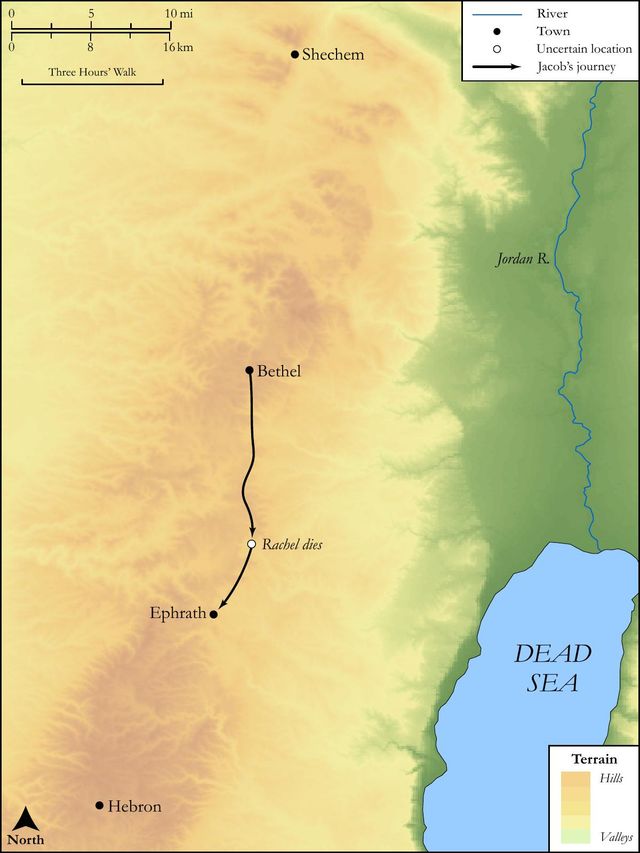
See on the biblical-era maps


Study this verse
Public-domain commentary
Matthew Henry
From his Commentary on the Whole Bible. Henry comments on passages, not single verses — this entry covers Genesis 35:16–20.
We have here the story of the death of Rachel, the beloved wife of Jacob. 1. She fell in travail by the way, not able to reach to Bethlehem, the next town, though they were near it; so suddenly does pain sometimes come upon a woman in travail, which she cannot escape, or put off. We may suppose Jacob had soon a tent up, convenient enough for her reception. 2. Her pains were violent. She had hard labour, harder than usual: this was the effect of sin, Gen 3:16. Note, Human life begins with sorrow, and the roses of its joy are surrounded with thorns. 3. The midwife encouraged her, Gen 35:17. No doubt she had her midwife with her, ready at hand, yet that would not secure her. Rachel had said, when she bore Joseph, God shall add another son, which now the midwife remembers, and tells her her words were made good. Yet this did not avail to keep up her spirits; unless God command away fear, no one else can. He only says as one having authority, Fear not. We are apt, in extreme perils, to comfort ourselves and our friends with the hopes of a temporal deliverance, in which we may be disappointed; we had better found our comforts on that which cannot fail us, the hope of eternal life. 4. Her travail was to the life of the child, but to her own death. Note, Though the pains and perils of childbearing were introduced by sin, yet they have sometimes been fatal to very holy women, who, though not saved in childbearing, are saved through it with an everlasting salvation. Rachel had passionately said, Give me children, or else I die; and now that she had children (for this was her second) she died. Her dying is here called the departing of her soul. Note, The death of the body is but the departure of the soul to the world of spirits. 5. Her dying lips called her new-born son Ben-oni, The son of my sorrow. And many a son, not born in such hard labour, yet proves the son of his parent's sorrow, and the heaviness of her that bore him. Children are enough the sorrow of their poor mothers in the breeding, bearing, and nursing of them; they should therefore, when they grow up, study to be their joy, and so, if possible, to make them some amends. But Jacob, because he would not renew the sorrowful remembrance of the mother's death every time he called his son by his name, changed his name, and called him Benjamin, The son of my right hand; that is, "very dear to me, set on my right hand for a blessing, the support of my age, like the staff in my right hand." 6. Jacob buried her near the place where she died. As she died in child-bed, it was convenient to bury her quickly; and therefore he did not bring her to the burying-place of his family. If the soul be at rest after death, it matters little where the body lies. In the place where the tree falls, there let it be. No mention is made of the mourning that was at her death, because that might easily be taken for granted. Jacob, no doubt, was a true mourner. Note, Great afflictions sometimes befal us immediately after great comforts. Lest Jacob should be lifted up with the visions of the Almighty with which he was honoured, this was sent as a thorn in the flesh to humble him. Those that enjoy the favours peculiar to the children of God must yet expect the troubles that are common to the children of men. Deborah, who, had she lived, would have been a comfort to Rachel in her extremity, died but a little before. Note, When death comes into a family, it often strikes double. God by it speaks once, yea, twice. The Jewish writers say, "The death of Deborah and Rachel was to expiate the murder of the Shechemites, occasioned by Dinah, a daughter of the family." 7. Jacob set up a pillar upon her grave, so that it was known, long after, to be Rachel's sepulchre (Sa1 10:2), and Providence so ordered it that this place afterwards fell in the lot of Benjamin. Jacob set up a pillar in remembrance of his joys (Gen 35:14), and here he sets up one in remembrance of his sorrows; for, as it may be of use to ourselves to keep both in mind, so it may be of use to others to transmit the memorials of both: the church, long afterwards, owned that what God said to Jacob at Bethel, both by his word and by his rod, he intended for their instruction (Hos 12:4), There he spoke with us.
Historical interpretation
Historical reception
1 surviving comment on this verse from the historical church.
(Verse 18.) And it came to pass, when her soul departed, for she died, that he called her name, 'The Son of my Sorrow'; but his father called his name Benjamin. In Hebrew, the similarity of the name is echoed; for the son of my sorrow, which the dying mother gave him as a name, is called Benoni (). However, the son of the right hand, that is, of strength, which Jacob changed, is called Benjamin. Hence, those who think Benjamin () is interpreted as 'Son of Days' are mistaken. For when the right hand is called Jamin (), and it ends in the letter n: the days are indeed called Jamim (), but they end in the letter m.
Continue studying Genesis 35:18 across the web’s major study libraries — every link below opens this exact verse, chapter, or book on the destination site.
Read & Compare
 BibleGatewayThis verse in more than 200 translations and 70 languages.
 Bible.comThe YouVersion reader — hundreds of translations, reading plans, and highlights.
 ESV.orgCrossway's official English Standard Version reader.
 NET BibleThe NET translation with 60,000+ translators' notes on every rendering decision.
 STEP BibleTyndale House's free study tool — original text, vocabulary, and scholarly resources.
 BibliaLogos Bible Software's free web reader.
 USCCBThe New American Bible (Revised Edition) with the U.S. bishops' study notes.
Commentaries
 BibleHub CommentariesDozens of classic commentaries on this verse, gathered on one page.
 StudyLightMore than 100 commentary sets — the largest collection on the web.
 BibleRefPlain-English commentary on what this verse means, verse by verse.
 Enduring WordDavid Guzik's free commentary on this chapter, widely used by Bible teachers.
 Bible Study ToolsVerse commentary alongside Greek and Hebrew study aids.
Original Language & Research
- BibleHub InterlinearThe verse word by word — original language, transliteration, and English.
- BibleHub LexiconEvery word's original-language definition and Strong's entry.
 Blue Letter BibleDeep-study tools — Strong's numbers, concordance, and word studies.
 SefariaThe Hebrew text with Rashi and centuries of Jewish commentary.
Sermons, Hymns & Audio


TrulyRandomVerse is not affiliated with these sites and doesn’t control their content. They’re linked because they’re genuinely useful.
Summary
Genesis 35:18 poignantly narrates the death of Rachel during the arduous birth of her second son near Ephrath. In her final moments, overwhelmed by pain, she names him "Benoni," meaning "son of my sorrow." However, Jacob, her devoted husband, immediately renames the child "Benjamin," signifying "son of my right hand," thereby transforming a legacy of grief into one of strength, honor, and future blessing, and completing the foundational lineage of the twelve tribes of Israel.
Context
ShowHideLiterary Context
This verse is situated within a significant transitional period in Jacob's life, following his return to the Promised Land after wrestling with God at Peniel and his reconciliation with Esau. The preceding verses in Genesis 35 recount God's reaffirmation of the Abrahamic covenant to Jacob at Bethel, commanding him to be fruitful and multiply, and promising that nations and kings would come from him. The narrative then shifts to Jacob's journey towards Ephrath, marked by the tragic loss of Deborah, Rebekah's nurse, and culminating in Rachel's death. This sorrowful event is immediately followed by Reuben's transgression and the listing of Jacob's twelve sons, emphasizing the completion of the patriarchal family unit despite the pain.
Historical & Cultural Context
Childbirth in the age of the patriarchs was often perilous, with high mortality rates for both mother and child. Rachel's difficult labor and subsequent death were not uncommon tragedies of the time, highlighting the harsh realities of life. The act of naming a child was profoundly significant, often reflecting the circumstances of birth, the parents' emotions, or a prophetic hope for the child's future. The "right hand" (Hebrew: yamin) held immense cultural symbolism, representing strength, authority, honor, favor, and a position of blessing or power. Kings and honored guests sat at the right hand, and blessings were often bestowed with the right hand, as seen in Jacob's blessing of Ephraim over Manasseh.
Key Themes
ShowHideGenesis 35 is rich with themes central to the patriarchal narratives. Divine Sovereignty and Covenant Fulfillment are paramount, as God continues to guide Jacob and fulfill His promise of a numerous offspring, even through sorrowful events like Rachel's death, which paradoxically completes the twelve-son lineage. The Significance of Naming is powerfully demonstrated, showing how names can convey immediate emotional states or enduring prophetic declarations of identity and destiny. The contrast between Rachel's "Benoni" and Jacob's "Benjamin" underscores the theme of Sorrow and Hope, illustrating how human grief can coexist with divine purpose and the transformation of tragedy into blessing, a recurring motif in the biblical narrative (e.g., Joseph's story).
Exposition and Analysis
ShowHideKey Word Analysis
ShowHideThis word, translated as "soul" in the phrase "as her soul was in departing," refers to a breathing creature, vitality, or life. In this context, it vividly describes Rachel's life force ebbing away, her very being departing from her body as she succumbs to the pain of childbirth. It emphasizes the profound and final nature of her death, as her animating principle leaves her.
This is the name "Benoni," meaning "son of my sorrow." It is a compound word derived from ben (son) and ʼâven (trouble, sorrow, mischief, or even vanity/futility). Rachel's choice of this name is a raw, immediate, and deeply personal expression of her agonizing pain, the tragic circumstances of her death, and perhaps even a lament over the brevity and hardship of her life. It encapsulates the profound grief and suffering of a dying mother.
This is the name "Benjamin," meaning "son of (the) right hand." This name, given by Jacob, carries immense symbolic weight. The "right hand" (Hebrew: yamin) signifies strength, honor, favor, authority, and blessing. Jacob's renaming transforms the child's identity from one defined by sorrow to one imbued with strength, a favored position, and a hopeful future. It reflects Jacob's faith and his desire to bestow a legacy of blessing rather than pain upon his youngest son.
Verse Breakdown
ShowHide"And it came to pass, as her soul was in departing, (for she died)"
This clause describes the climactic moment of Rachel's death during childbirth. The phrase "her soul was in departing" vividly portrays the final struggle of life leaving the body, emphasizing the agony and the irreversible nature of her demise. The parenthetical "for she died" confirms the tragic outcome, underscoring the profound loss for Jacob and his family.
"that she called his name Benoni"
In her final, agonizing moments, Rachel exercises her dying wish by naming her newborn son. Her choice, "Benoni" ("son of my sorrow"), is a poignant and immediate reflection of her overwhelming pain and the sorrowful circumstances of his birth. This act reveals the depth of her suffering and her perception of the event as a tragic culmination.
"but his father called him Benjamin."
In stark contrast to Rachel's dying lament, Jacob immediately intervenes to rename the child. His choice, "Benjamin" ("son of the right hand"), is a deliberate act of transforming the child's identity from one of sorrow to one of strength, blessing, and honor. This renaming asserts Jacob's paternal authority and his hopeful outlook, redirecting the narrative from grief to a future imbued with favor and purpose within the covenant lineage.
Literary Devices
ShowHideThe verse powerfully employs Contrast to highlight the opposing perspectives of Rachel and Jacob in the face of tragedy. Rachel's name "Benoni" (son of sorrow) stands in stark opposition to Jacob's "Benjamin" (son of the right hand), creating a tension between immediate grief and enduring hope. This contrast is further amplified by Symbolism, particularly in the meaning of "right hand," which universally represents strength, honor, and favor, transforming a birth marked by death into one imbued with future significance. The narrative also uses Foreshadowing by establishing Benjamin's name as one of strength and favor, hinting at the future prominence of his tribe, known for its warriors and for producing Israel's first king. Finally, the act of Naming itself serves as a crucial literary device, as the names chosen reflect character, circumstance, and destiny, emphasizing their profound significance in biblical narratives.
Theological and Thematic Connections
ShowHideGenesis 35:18 offers a profound theological reflection on the interplay of human suffering and divine sovereignty. Rachel's dying act of naming her son "Benoni" ("son of my sorrow") is a raw, honest expression of human grief and the reality of pain in a fallen world. Yet, Jacob's immediate renaming of the child to "Benjamin" ("son of the right hand") serves as a powerful testament to faith and hope, transforming a moment of profound loss into one of future blessing and strength. This narrative underscores that even in the midst of tragedy, God's overarching redemptive plan continues to unfold, bringing forth new life and purpose. The completion of Jacob's twelve sons, despite the sorrow of Rachel's death, signifies the faithful progression of God's covenant promises, ensuring the lineage through which the nation of Israel would be established.
Reflection and Application
ShowHideThe poignant narrative of Benjamin's birth in Genesis 35:18 offers a powerful lens through which to view our own experiences of sorrow and hope. Rachel's naming of "Benoni" reminds us that it is natural and human to acknowledge and express our pain, grief, and the profound impact of life's tragedies. Her raw honesty validates our own struggles. However, Jacob's subsequent renaming of the child to "Benjamin" provides a profound spiritual counterpoint. It challenges us to look beyond immediate pain, to exercise faith, and to trust in God's ability to transform our deepest sorrows into sources of strength, blessing, and renewed purpose. This passage encourages us to embrace a perspective that, while acknowledging the reality of suffering, also actively seeks and proclaims God's redemptive work, believing that He can bring good out of even the most difficult circumstances. It invites us to consider how we might rename our own "Benoni" moments with the "Benjamin" of God's grace and future hope, trusting that our identity and destiny are ultimately defined by His sovereign plan, not by our pain.
Questions for Reflection
ShowHideFAQ
ShowHideWhy did Rachel name her son "Benoni" and what does it mean?
ShowHideRachel named her son "Benoni" (Hebrew: Ben-ʼÔwnîy) in her dying moments. This name literally means "son of my sorrow" or "son of my pain." It was a direct and poignant expression of her overwhelming agony during childbirth and her realization that she was dying. It reflects the immediate, profound grief and suffering she experienced in those final moments.
Why did Jacob rename his son "Benjamin" and what is its significance?
ShowHideJacob renamed his son "Benjamin" (Hebrew: Binyâmîyn) immediately after Rachel's death. This name means "son of the right hand." Jacob's renaming was a deliberate act to transform the legacy of sorrow into one of hope, strength, honor, and blessing. Throughout Scripture, the "right hand" symbolized power, favor, and a position of authority and privilege. By renaming him Benjamin, Jacob bestowed a name that looked forward to a positive future and a favored place within the family and the unfolding covenant, ensuring the child's identity was not solely defined by the tragedy of his birth.
Does this passage suggest that God causes sorrow or death?
ShowHideThis passage highlights the reality of suffering and death in a fallen world, even within the lives of those chosen by God. While God is sovereign over all events, including life and death, the text does not attribute Rachel's death to a specific punitive act of God. Instead, it demonstrates how God's overarching plan of redemption and covenant fulfillment continues to unfold even amidst human tragedy. The birth of Benjamin, despite the sorrow, completes the lineage of the twelve tribes, showing how God can work through difficult circumstances to achieve His purposes and transform sorrow into a path for future blessing, as seen in Joseph's later declaration in Genesis 50:20.
Christ-Centered Fulfillment
ShowHideThe poignant narrative of Benjamin's birth and renaming powerfully prefigures the person and work of Jesus Christ. Just as Benjamin was born of profound sorrow yet renamed "Son of the Right Hand," Jesus, the true Son, entered a world steeped in pain and ultimately experienced the deepest sorrow and suffering, even death on the cross, to bring forth new life and eternal hope for humanity. He is the ultimate "man of sorrows, and acquainted with grief" as prophesied in Isaiah 53:3. Yet, through His resurrection and ascension, Christ is now exalted to the right hand of God, a position of ultimate power, honor, and blessing, as affirmed in Hebrews 1:3 and Romans 8:34. Through His sacrifice, Christ transforms our "Benoni" moments of pain, sin, and death into "Benjamin" moments of spiritual strength, new identity, and eternal life, fulfilling God's ultimate covenant promise to bring blessing to all nations through His lineage and reign.